
Australia Mining Equipment Market Size, Share, Trends and Forecast by Type, Equipment, Application, and Region, 2026-2034
Australia Mining Equipment Market Overview:
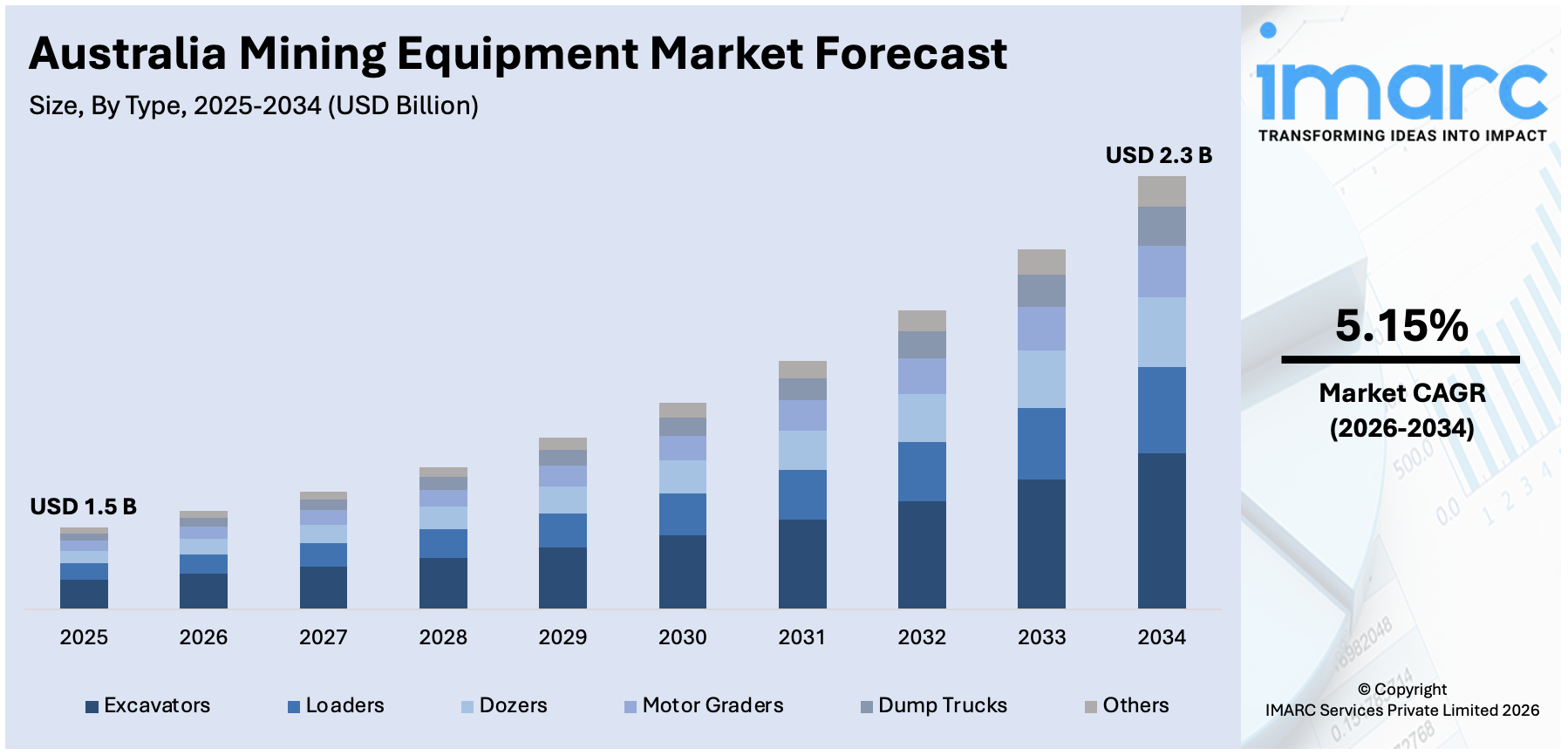
The Australia mining equipment market size reached USD 1.5 Billion in 2025. Looking forward, the market is projected to reach USD 2.3 Billion by 2034, exhibiting a growth rate (CAGR) of 5.15% during 2026-2034. Some of the factors driving the market's growth include the growing need for sustainable mining methods, the growing emphasis on worker health and safety, and the growing usage of automated and remotely managed machinery to improve operations' efficiency, safety, and cost-effectiveness.
|
Report Attribute
|
Key Statistics
|
|---|---|
|
Base Year
|
2025 |
|
Forecast Years
|
2026-2034
|
|
Historical Years
|
2020-2025
|
| Market Size in 2025 | USD 1.5 Billion |
| Market Forecast in 2034 | USD 2.3 Billion |
| Market Growth Rate 2026-2034 | 5.15% |
Key Trends of Australia Mining Equipment Market:
Technological Advancements and Automation
Automated and remote-controlled equipment is being used by mining firms in Australia to increase operational efficiency, safety, and cost effectiveness. Technological innovations, such as drones for surveys, autonomous haul trucks, and advanced drilling equipment, allow for continuous operations with little human intervention, reducing labor costs and improving safety by reducing the amount of time that employees are exposed to hazardous situations. Additionally, predictive maintenance, which increases equipment efficiency and decreases downtime, is made possible by the integration of artificial intelligence (AI) and the Internet of Things (IoT) in mining machinery. By using more precise and regulated mining techniques, this technological breakthrough helps the mining industry maintain high levels of output while simultaneously addressing environmental concerns. In 2024, Scania launched its autonomous mining trucks, beginning with a 40-ton edition and later introducing a 50-ton model for sale. Sales will start in Australia first, with deliveries and operations starting in 2026, then moving on to Latin America. Scania's self-driving technology, developed through thorough testing in Australian mines, offers improved safety, productivity, and environmental responsibility in mining activities.
To get more information on this market Request Sample
Growing Focus on Sustainable Mining Practices
Mining firms are implementing sustainable practices and technology as a result of their realization of the environmental impact of their activities. In response to this shift, equipment manufacturers are developing energy-efficient devices that produce fewer emissions and lessen environmental damage. The creation of hybrid and electric mining vehicles is one way to lessen carbon emissions. Stricter environmental regulations are being enforced by regulatory agencies, which is motivating mining firms to spend money on cutting-edge machinery that promotes sustainable operations. This change increases the need for environmentally friendly mining equipment by assisting businesses in adhering to regulations and improving their social license to operate. In 2023, AngloGold Ashanti Australia started testing Sandvik's TH665B, the biggest battery-powered mining truck, at its Sunrise Dam gold mine in Western Australia. This vehicle, which featured a 630kW electric driveline and a 354kWh battery, provided zero emissions and substantial heat reduction, marking a notable advancement in underground mining sustainability. The trial reflected a broader trend in the mining sector, emphasizing the urgent need for sustainable technology adoption.
Rising Focus on Safety and Workforce Health
Mining operations are inherently hazardous, and there is pressure from both regulators and the public to ensure safer working conditions. This is encouraging mining industries to invest in equipment that minimizes human exposure to dangerous environments, such as remote-controlled and automated machinery, personal protective equipment (PPE), and advanced ventilation systems. Additionally, wearable technologies that monitor the health and safety of miners in real-time are becoming more prevalent, requiring integration with other mining equipment to enhance overall safety. The commitment to safety includes lowering accident rates, avoiding injuries related to equipment, and ensuring compliance with stringent health and safety regulations. In 2024, EACON Mining and MACA displayed their joint projects at the Electric Mining 2024 expo in Perth, Australia, focusing on innovations in electrification and autonomous driving technologies. Their collaboration is focused on bringing battery electric and hybrid mining trucks with EACON's energy and autonomous technology to the Australian market. This effort highlights their dedication to improving safety, efficiency, and sustainability in mining activities.
Growth Drivers of Australia Mining Equipment Market:
Expansion of Mining Activities
Development of mining activities in Australia strongly influences the demand and development of sophisticated mining machines. The country's rich stores of coal, iron ore, gold, lithium, and other minerals have prompted rising exploration and production activities in many areas. Mining companies are spending heavily on advanced machines, including drills, loaders, haul trucks, and processing machinery, to enhance operating efficiency and productivity. Technologies such as remote-controlled and automated equipment facilitate more precise and safe operations, as well as lower downtime and labor costs. The increasing size of mining activities, in addition to growing world mineral demand, drives further investment in advanced equipment. These elements together support sustained Australia mining equipment market growth, setting the stage for long-term development.
Government Support and Policies
Government programs and supportive policies are essential in advancing the Australia mining equipment market. Incentives, tax advantages, and regulatory measures designed to foster investment in the mining sector motivate companies to expand their operations and update their equipment. Policies that support exploration, promote safe mining practices, and ensure environmental compliance help create a favorable environment for acquiring advanced machinery. Public-private collaborations and funding initiatives for research and development boost the integration of innovative mining solutions. This governmental backing mitigates operational risks, offers financial support, and encourages sustainable practices, leading companies to invest in modern equipment for extraction and processing. These actions collectively enhance industry capabilities and promote steady investment, increasing Australia mining equipment market demand across both domestic and export-oriented businesses.
Rising Infrastructure and Construction Projects
The expansion of infrastructure and construction projects in Australia is driving up the demand for raw materials like coal, iron ore, and aggregates, which in turn propels mining activities. As urbanization, industrial growth, and large-scale construction projects increase, mining firms need advanced machinery to efficiently meet production goals. Equipment such as excavators, loaders, and crushing machines is crucial for ensuring timely resource extraction and processing. The growing emphasis on sustainable construction methods and superior material quality also heightens the requirement for dependable and precise mining equipment. With these trends, mining operations are increasing both in scope and the adoption of advanced technology. This shift directly contributes to improved production efficiency and market growth, reinforcing the overall Australia mining equipment market share.
Government Initiatives for Australia Mining Equipment Market:
Financial Incentives and Tax Benefits
Financial incentives and tax benefits are vital in bolstering the Australia mining equipment market. The government offers grants, subsidies, and tax relief to stimulate investment in mining operations, especially for modernizing machinery and adopting cutting-edge technologies. These initiatives lessen the financial strain on companies, enabling them to upgrade aging equipment, enhance operational efficiency, and boost productivity. Additionally, such incentives encourage small and medium-sized mining enterprises to invest in high-performance machinery, leading to safer and more sustainable operations. By reducing initial costs and providing fiscal advantages, these initiatives enhance the overall competitiveness of the mining sector, fostering long-term investment and ongoing technological advancements, which align with national economic and industrial goals.
Support for Research and Innovation
Government-supported research and innovation are essential in pushing the boundaries of mining equipment technology in Australia. Funding programs and collaborative efforts allow companies to create and implement automated, intelligent, and sustainable mining solutions. Technologies such as AI-driven machinery, remote-operated equipment, and energy-efficient systems are being integrated to maximize productivity, safety, and environmental compliance. These efforts also encourage the testing and adoption of new materials and processes that lower operational costs and reduce carbon emissions. According to Australia mining equipment market analysis, this government support accelerates technological adoption across both large and mid-sized mining companies, promoting modernization within the industry. By facilitating innovation, these programs help ensure Australia maintains its competitiveness in the global mining arena while addressing the changing demands of resource extraction and sustainable practices.
Regulatory Frameworks for Safety and Environmental Compliance
Regulatory frameworks play a crucial role in fostering responsible practices within the Australian mining equipment market. Policies centered on worker safety, operational efficiency, and environmental sustainability mandate that mining companies utilize equipment that adheres to strict standards. Compliance promotes safe machinery operation, decreasing workplace accidents and enhancing overall productivity. Environmental regulations advocate for the adoption of energy-efficient and low-emission equipment, enabling the industry to minimize its ecological footprint. Regular audits, reporting obligations, and adherence to established guidelines ensure accountability and drive ongoing improvements in equipment quality and performance. By enforcing these regulations, the government safeguards both the workforce and the environment while supporting the sustainable growth of the mining sector, ensuring that machinery modernization meets legal and ecological standards.
Australia Mining Equipment Market Segmentation:
IMARC Group provides an analysis of the key trends in each segment of the market, along with forecasts at the region/country level for 2026-2034. Our report has categorized the market based on type, equipment, and application.
Type Insights:
- Excavators
- Loaders
- Dozers
- Motor Graders
- Dump Trucks
- Others
The report has provided a detailed breakup and analysis of the market based on the type. This includes excavators, loaders, dozers, motor graders, dump trucks, and others.
Equipment Insights:
- Underground Mining
- Surface Mining
- Crushing, Pulverizing and Screening
- Drills and Breakers
- Others
A detailed breakup and analysis of the market based on the equipment have also been provided in the report. This includes underground mining, surface mining, crushing, pulverizing and screening, drills and breakers, and others.
Application Insights:
Access the comprehensive market breakdown Request Sample
- Metal Mining
- Mineral Mining
- Coal Mining
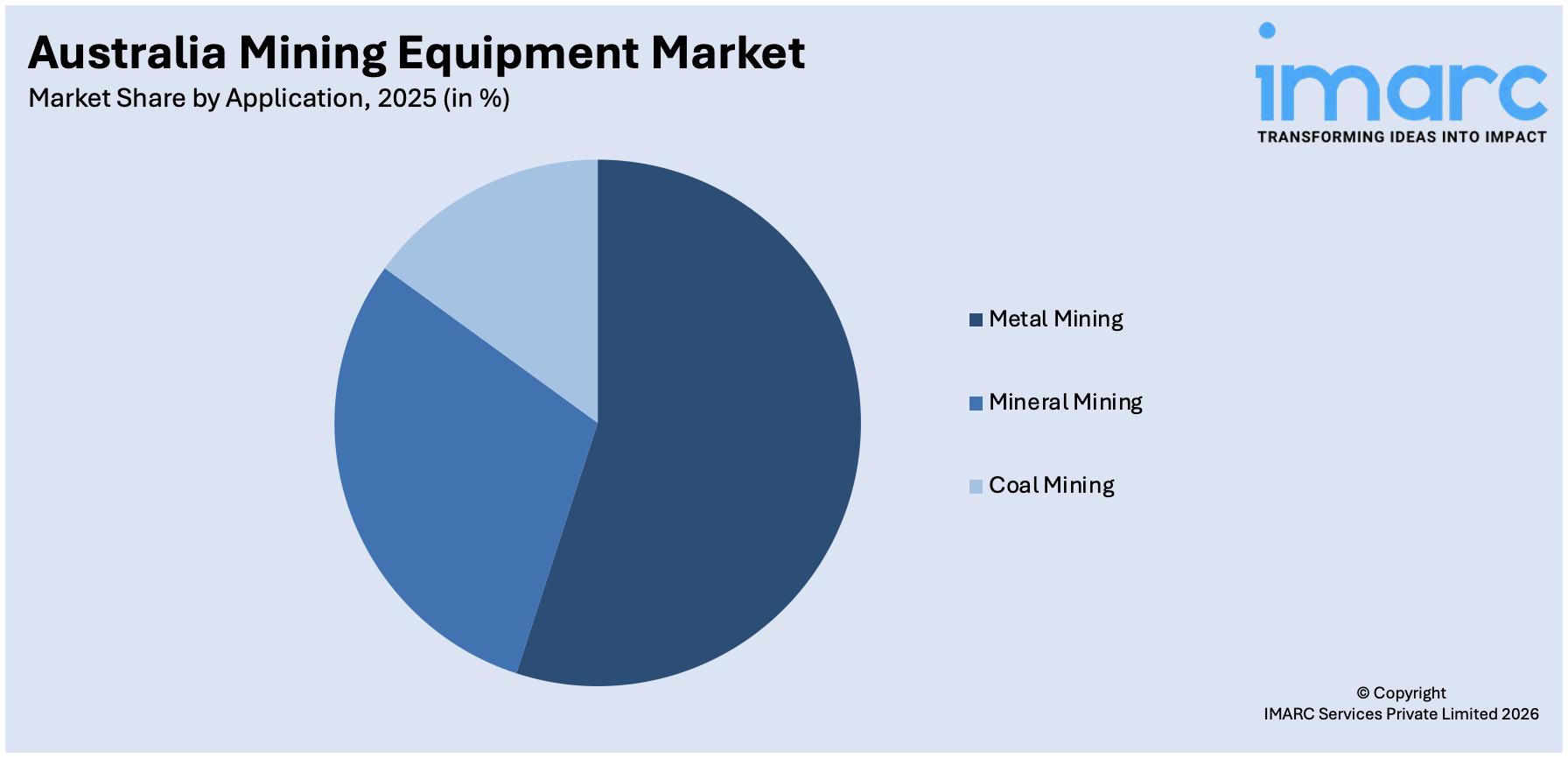
A detailed breakup and analysis of the market based on the application have also been provided in the report. This includes metal mining, mineral mining, and coal mining.
Region Insights:
- Australia Capital Territory & New South Wales
- Victoria & Tasmania
- Queensland
- Northern Territory & Southern Australia
- Western Australia
The report has also provided a comprehensive analysis of all the major regional markets, which include Australia Capital Territory & New South Wales, Victoria & Tasmania, Queensland, Northern Territory & Southern Australia, and Western Australia.
Competitive Landscape:
The market research report has also provided a comprehensive analysis of the competitive landscape. Competitive analysis such as market structure, key player positioning, top winning strategies, competitive dashboard, and company evaluation quadrant has been covered in the report. Also, detailed profiles of all major companies have been provided.

Australia Mining Equipment Market News:
- June 2024: Gears Mining, located in Toowoomba, Australia, introduced the world's largest mill liner handler machine, weighing 8,100 kg. This new development shows the dedication of the company to improve mining equipment technology and maintain operator safety.
- July 2024: Manheim Australia revealed plans for two upcoming online auctions of mining machinery, including a multi-vendor event happening from July 25 to 31 with a variety of heavy equipment and a BidNow auction in Tasmania from July 19 to 24 featuring almost new mining utility vehicles. These auctions offer chances for participants to obtain different mining and utility vehicles, including brands like Caterpillar and Toyota that are up for sale.
Australia Mining Equipment Market Report Coverage:
| Report Features | Details |
|---|---|
| Base Year of the Analysis | 2025 |
| Historical Period | 2020-2025 |
| Forecast Period | 2026-2034 |
| Units | Billion USD |
| Scope of the Report |
Exploration of Historical Trends and Market Outlook, Industry Catalysts and Challenges, Segment-Wise Historical and Future Market Assessment:
|
| Types Covered | Excavators, Loaders, Dozers, Motor Graders, Dump Trucks, Others |
| Equipments Covered | Underground Mining, Surface Mining, Crushing, Pulverizing and Screening, Drills and Breakers, Others |
| Applications Covered | Metal Mining, Mineral Mining, Coal Mining |
| Regions Covered | Australia Capital Territory & New South Wales, Victoria & Tasmania, Queensland, Northern Territory & Southern Australia, Western Australia |
| Customization Scope | 10% Free Customization |
| Post-Sale Analyst Support | 10-12 Weeks |
| Delivery Format | PDF and Excel through Email (We can also provide the editable version of the report in PPT/Word format on special request) |
Key Benefits for Stakeholders:
- IMARC’s industry report offers a comprehensive quantitative analysis of various market segments, historical and current market trends, market forecasts, and dynamics of the Australia mining equipment market from 2020-2034.
- The research report provides the latest information on the market drivers, challenges, and opportunities in the Australia mining equipment market.
- Porter's Five Forces analysis assists stakeholders in assessing the impact of new entrants, competitive rivalry, supplier power, buyer power, and the threat of substitution. It helps stakeholders to analyze the level of competition within the Australia mining equipment industry and its attractiveness.
- Competitive landscape allows stakeholders to understand their competitive environment and provides an insight into the current positions of key players in the market.
Frequently Asked Questions About the Australia Mining Equipment Market Report
The mining equipment market in Australia was valued at USD 1.5 Billion in 2025.
The Australia mining equipment market is projected to exhibit a compound annual growth rate (CAGR) of 5.15% during 2026-2034.
The Australia mining equipment market is expected to reach a value of USD 2.3 Billion by 2034.
The Australia mining equipment market is witnessing trends such as increased adoption of automated and AI-enabled machinery, focus on energy-efficient and sustainable equipment, integration of IoT and digital monitoring, preference for modular and multi-functional machinery, and growing emphasis on safety-enhancing technologies and predictive maintenance solutions.
Key growth drivers include expansion of mineral exploration and extraction activities, rising global demand for metals and minerals, government incentives for modernization, technological advancements in mining machinery, increasing investment in large-scale infrastructure projects, and the replacement of outdated equipment to improve efficiency, productivity, and operational safety across mining operations.
Need more help?
- Speak to our experienced analysts for insights on the current market scenarios.
- Include additional segments and countries to customize the report as per your requirement.
- Gain an unparalleled competitive advantage in your domain by understanding how to utilize the report and positively impacting your operations and revenue.
- For further assistance, please connect with our analysts.
 Request Customization
 Speak to an Analyst
 Request Brochure
 Inquire Before Buying
Benefits of Customization
- Personalize this research
- Triangulate with your data
- Get data as per your format and definition
- Gain a deeper dive into a specific application, geography, customer, or competitor
- Any level of personalization
Get in Touch With Us
UNITED STATES
Phone: +1-201-971-6302
INDIA
Phone: +91-120-433-0800
UNITED KINGDOM
Phone: +44-753-714-6104
Email: [email protected]
Client Testimonials




.webp)




.webp)













Related Reports

Choose your plan
*Please note that the prices mentioned below are starting prices for each bundle type. Kindly contact our team for further details.*
Single User License
- 1 User License, Access on 2 Devices
- PDF Report + Excel Dataset (Password Protected)
- Lifetime Access
- No Printing Rights
- 10% Free Report Customization
- 10–12 Weeks of Analyst Support
Five User License
- Access for 5 Users, 2 Devices per User
- PDF Report + Excel Dataset (Password Protected)
- Lifetime Access
- Dedicated Account Manager
- 12–14 Weeks of Analyst Support
- No Printing Rights
- 15% Free Report Customization
- 25% Discount on Your Next Purchase
Corporate User License
- Unlimited User Access (Within Your Organization)
- PDF Report + Excel Dataset
- Lifetime Access
- Dedicated Account Manager
- 14–20 Weeks of Analyst Support
- No Printing Rights
- 20% Free Report Customization
- 30% Discount on Your Next Purchase
Essential Insights
What's included:
3 reports
- Lifetime Access
- PDF Reports
- Excel Datasets
- 2 Weeks of Free Analyst Support
- 2 User Licenses
- Access on 2 Devices
- Printing Rights
- Complimentary PowerPoint (PPT) Version
- Complimentary License Upgrade
Professional Access
What's included:
5 reports
- Lifetime Access
- PDF Reports
- Excel Datasets
- 8 Weeks of Free Analyst Support
- 2 User Licenses
- Access on 2 Devices
- Printing Rights
- Complimentary PowerPoint (PPT) Version
- Complimentary License Upgrade
Business Advantage
What's included:
8 reports
- Lifetime Access
- PDF Reports
- Excel Datasets
- 14 Weeks of Free Analyst Support
- 2 User Licenses
- Access on 2 Devices
- Printing Rights
- Complimentary PowerPoint (PPT) Version
- Complimentary License Upgrade
Enterprise Intelligence
What's included:
10 reports
- Lifetime Access
- PDF Reports
- Excel Datasets
- 20 Weeks of Free Analyst Support
- 2 User Licenses
- Access on 2 Devices
- Printing Rights
- Complimentary PowerPoint (PPT) Version
- Complimentary License Upgrade