
Australia Perfume Market Size, Share, Trends and Forecast by Perfume Type, Category, and Region, 2026-2034
Australia Perfume Market Size, Share, Trends & Forecast (2026-2034)
The Australia perfume market reached USD 831.8 Million in 2025 and is projected to reach USD 1,266.2 Million by 2034, growing at a CAGR of 4.78% during 2026-2034. Growth is driven by rising premiumisation, expanding niche and indie fragrance houses, and a growing gifting culture across major Australian cities. Premium perfume products dominate at 58.7% of the market, reflecting consumers' shift toward prestige fragrance houses over mass-market alternatives. Female fragrances lead the category split at 49.6%, followed by male fragrances at 34.8% and unisex fragrances at 15.6%. Australia Capital Territory and New South Wales command the largest regional share at 39.6%, anchored by Sydney's concentrated luxury retail and duty-free infrastructure.
Market Snapshot
|
Metric |
Value |
|
Market Size (2025) |
USD 831.8 Million |
|
Forecast Market Size (2034) |
USD 1,266.2 Million |
|
CAGR (2026-2034) |
4.78% |
|
Base Year |
2025 |
|
Historical Period |
2020-2025 |
|
Forecast Period |
2026-2034 |
|
Dominant Perfume Type |
Premium Perfume Products (58.7%, 2025) |
|
Dominant Category |
Female Fragrances (49.6%, 2025) |
|
Leading Region |
Australia Capital Territory & New South Wales (39.6%, 2025) |
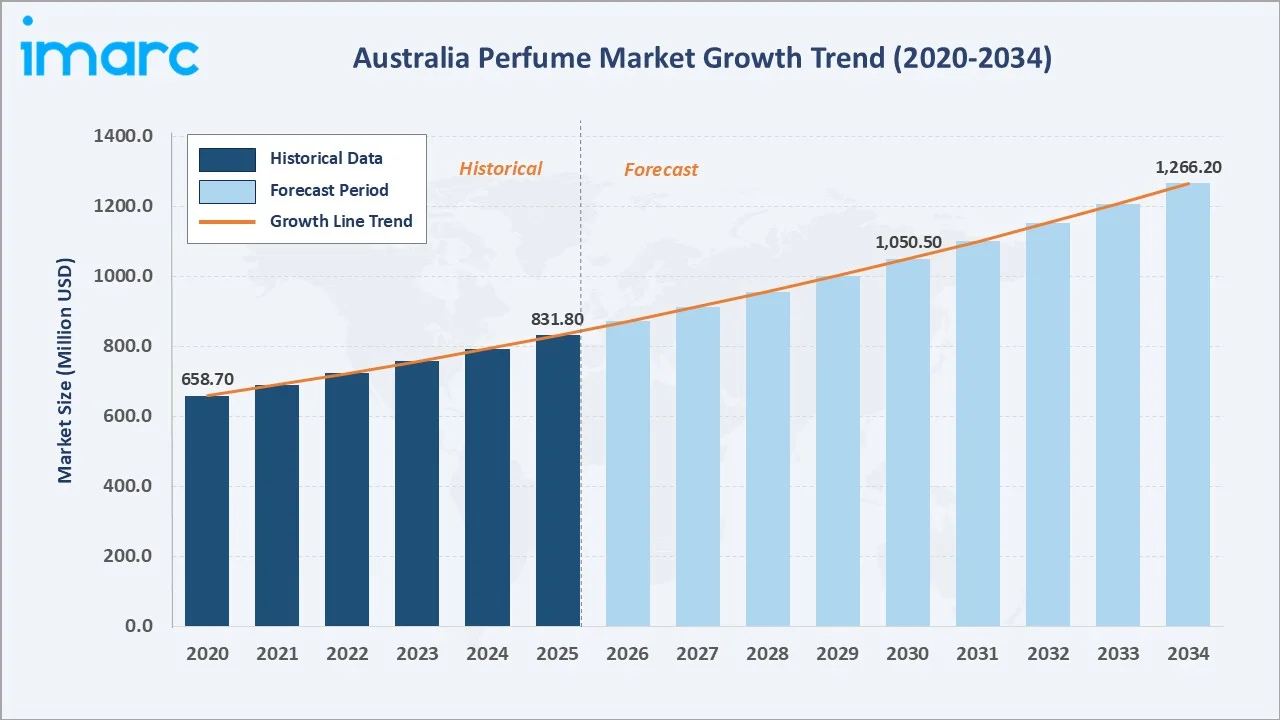
Australia's perfume market expanded from USD 658.7 Million in 2020 to USD 831.8 Million in 2025, anchored at USD 1,050.5 Million in 2030, and forecast to reach USD 1,266.2 Million by 2034. Post-pandemic recovery between 2022 and 2025 coincided with the return of international travel, duty-free spending, and social occasions, reviving fragrance-gifting demand across Australian households. Rising disposable incomes and growing exposure to global fragrance trends through social media are sustaining premiumisation, encouraging consumers to trade up from mass-market colognes toward prestige and niche perfume houses throughout the forecast period.
To get more information on this market, Request Sample
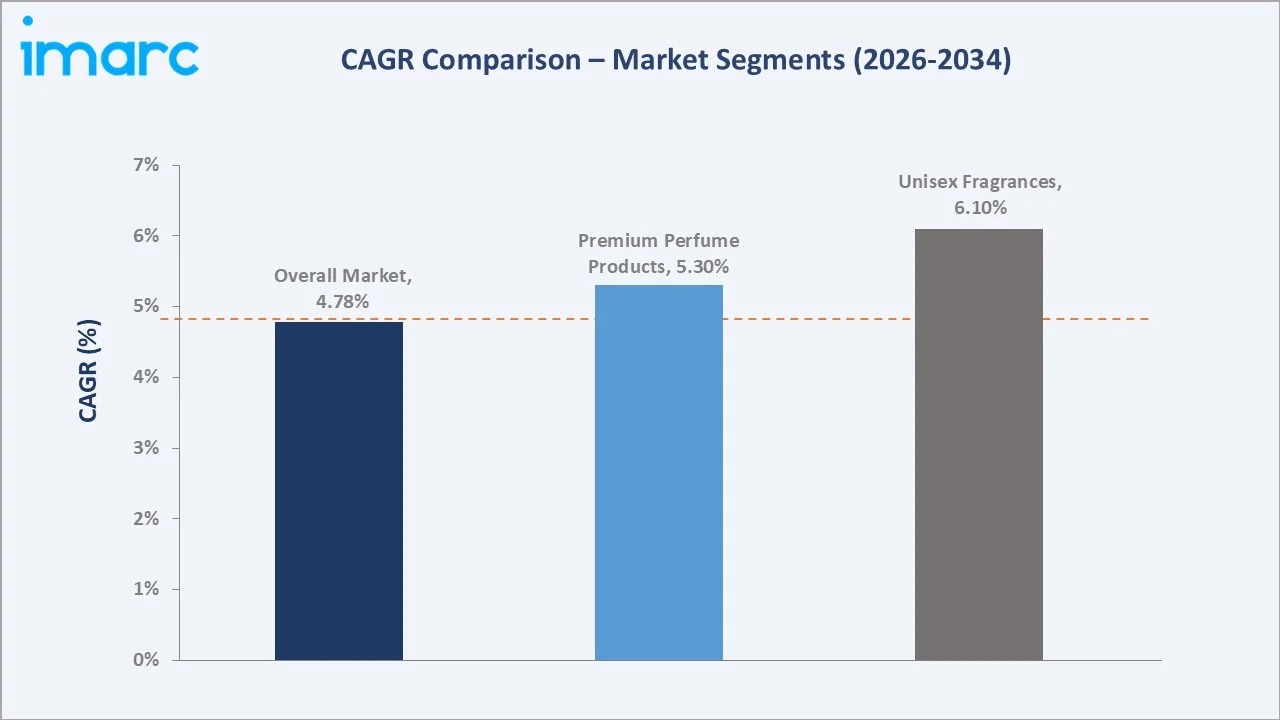
Premium perfume products grow faster, at an estimated ~5.3% CAGR, as Australian consumers increasingly favour designer and niche fragrance houses over drugstore colognes. Unisex fragrances post the fastest categorical growth, at an estimated ~6.1% CAGR, reflecting a cultural shift toward gender-neutral scent profiles among younger Australians. Female fragrances retain the largest revenue base at 49.6%, while male fragrances grow steadily at an estimated ~4.9% CAGR through grooming category expansion.
Executive Summary
Australia's perfume market reached USD 831.8 Million in 2025, representing one of the Asia-Pacific region's most mature and brand-conscious fragrance markets. Perfumes sold across Australia range from prestige eau de parfum collections to indie botanical fragrances, mass-market colognes, and duty-free exclusives, serving department stores, specialty beauty retailers, pharmacies, and a fast-growing e-commerce channel. The market is projected to reach USD 1,266.2 Million by 2034.
Premium perfume products lead at 58.7% through Australians' growing preference for prestige fragrance houses and niche perfumers over mass-market alternatives. Female fragrances dominate the category split at 49.6%, supported by strong department-store and specialty beauty retail penetration. Australia Capital Territory and New South Wales lead regionally at 39.6%, reflecting Sydney's concentration of flagship boutiques, duty-free retail, and affluent consumer spending.
Looking ahead, the market outlook remains positive as niche fragrance houses, gender-fluid scent formats, and sustainable refillable packaging reshape consumer preference, while e-commerce and social media-led discovery continue expanding fragrance access beyond metropolitan boundaries.
Key Market Insights
|
Insight |
Data |
|
Dominant Perfume Type |
Premium Perfume Products - 58.7% share (2025) |
|
Dominant Category |
Female Fragrances - 49.6% market share (2025) |
|
Leading Region |
Australia Capital Territory & New South Wales - 39.6% market share (2025) |
|
Market Opportunity |
Niche and indie fragrance houses; gender-neutral scent formats; refillable and sustainable packaging; duty-free and travel retail expansion; fragrance personalisation services |
Key Analytical Observations Supporting The Above Data:
- Premium Perfume Products at 58.7%: The segment dominates due to Australians' rising preference for prestige fragrance houses, department-store counters, and niche perfumeries such as MECCA Perfumeria over drugstore colognes, supported by rising disposable incomes and beauty-category premiumisation.
- Female Fragrances at 49.6%: The category leads through the widest product assortment across eau de parfum, eau de toilette, and layered fragrance sets, alongside strong department-store and gifting-occasion demand throughout the year.
- Male Fragrances at 34.8%: Growth benefits from expanding male grooming culture, premium aftershave adoption, and rising self-purchase behaviour among Australian men, moving beyond traditional gift-only occasions.
- Unisex Fragrances at 15.6%: This is the fastest-growing category as younger Australians embrace gender-neutral scent profiles, molecular and niche perfumery, and personalised fragrance wardrobing.
- Australia Capital Territory & New South Wales at 39.6%: The region leads through Sydney's concentration of flagship fragrance boutiques, department stores, and international duty-free retail infrastructure at major airports.
- Import Dependence: Australia imports the majority of finished perfume products sold domestically, with France, the United States, and China among the leading supply sources for fragrance products.
Australia Perfume Market Overview
Australia's perfume market encompasses the manufacturing, formulation, importation, distribution, and retail sale of eau de parfum, eau de toilette, cologne, and specialty fragrance products across premium and mass price tiers. The market serves department stores, specialty beauty retailers, pharmacies, duty-free outlets, and a rapidly growing direct-to-consumer e-commerce channel.
The fragrance ecosystem integrates global fragrance oil and essence suppliers, prestige and mass-market brand houses, packaging and bottling partners, and a distribution network spanning physical retail and digital commerce. Regulatory oversight from the Australian Industrial Chemicals Introduction Scheme (AICIS) governs the safety and registration of cosmetic ingredients, including fragrance blends, entering the Australian market.
Market Dynamics
To evaluate market opportunities, Request Sample
Market Drivers
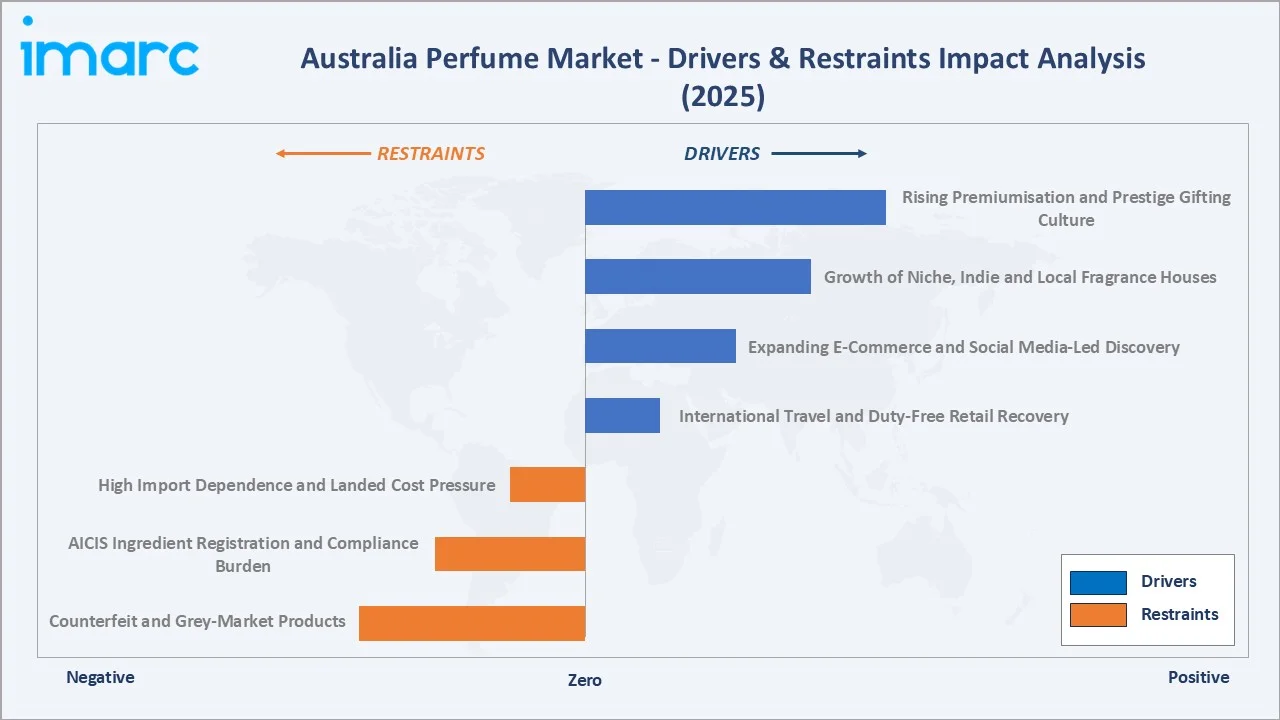
- Rising Premiumisation and Prestige Gifting Culture: Rising premiumisation is driving Australian consumers toward prestige and niche perfume houses over mass-market colognes. Fragrance is increasingly positioned as a self-expression and gifting category, with birthdays, Christmas, and Valentine's Day driving concentrated seasonal demand.
- Growth of Niche, Indie and Local Fragrance Houses: Growth of niche, indie, and Australian-founded fragrance houses is expanding category depth beyond global designer names. In July 2024, MECCA welcomed its first Australian-founded fragrance brand, Tsu Lange Yor, co-founded by musician Troye Sivan, whose signature scent uses Tasmanian Mountain Pepper, a world-first botanical inclusion in fine fragrance.
- Expanding E-Commerce and Social Media-Led Discovery: Expanding e-commerce and social media-led fragrance discovery is broadening market access beyond metropolitan flagship boutiques. Beauty retailers report fragrance mists, layering sets, and viral 'cult' scents accelerating category velocity, with online consultations and virtual scent-matching tools helping regional Australian consumers access prestige fragrance ranges.
- International Travel and Duty-Free Retail Recovery: International travel recovery is reviving duty-free perfume spending at major Australian airports. Arriving international travellers may bring in general goods, including perfume, valued up to AU$900 per adult duty-free, supporting strong impulse and gifting purchases through airport fragrance boutiques.
Market Restraints
- High Import Dependence and Landed Cost Pressure: High import dependence increases exposure to freight costs, currency fluctuation, and international supply disruption, since the large majority of finished perfume products sold in Australia are imported rather than locally manufactured.
- AICIS Ingredient Registration and Compliance Burden: Businesses that import or manufacture cosmetic products, including fragrance blends, must register with the Australian Industrial Chemicals Introduction Scheme and confirm every ingredient is listed on the Australian Inventory of Industrial Chemicals before introduction, adding compliance cost and lead time for new fragrance launches.
Market Opportunities
- Sustainable and Refillable Packaging: Sustainable and refillable perfume packaging creates an opportunity for brand houses to reduce glass and plastic use while strengthening loyalty among environmentally conscious Australian consumers, particularly within the premium and niche segments.
- Personalisation and Fragrance Wardrobing Services: Personalisation and fragrance wardrobing services, including in-store scent consultations and custom blending, create an opportunity for retailers to deepen engagement and support higher average transaction values among prestige fragrance shoppers.
Market Challenges
- Counterfeit and Grey-Market Products: Counterfeit and parallel-imported grey-market perfume products challenge legitimate brand houses and retailers by undercutting authorised pricing and creating consumer safety concerns around unregistered ingredient content.
- Market Saturation in the Mass Perfume Segment: Market saturation in the mass perfume segment challenges revenue growth as private-label and budget retail alternatives compress pricing, pushing brand houses to differentiate through prestige positioning rather than volume competition.
Emerging Market Trends
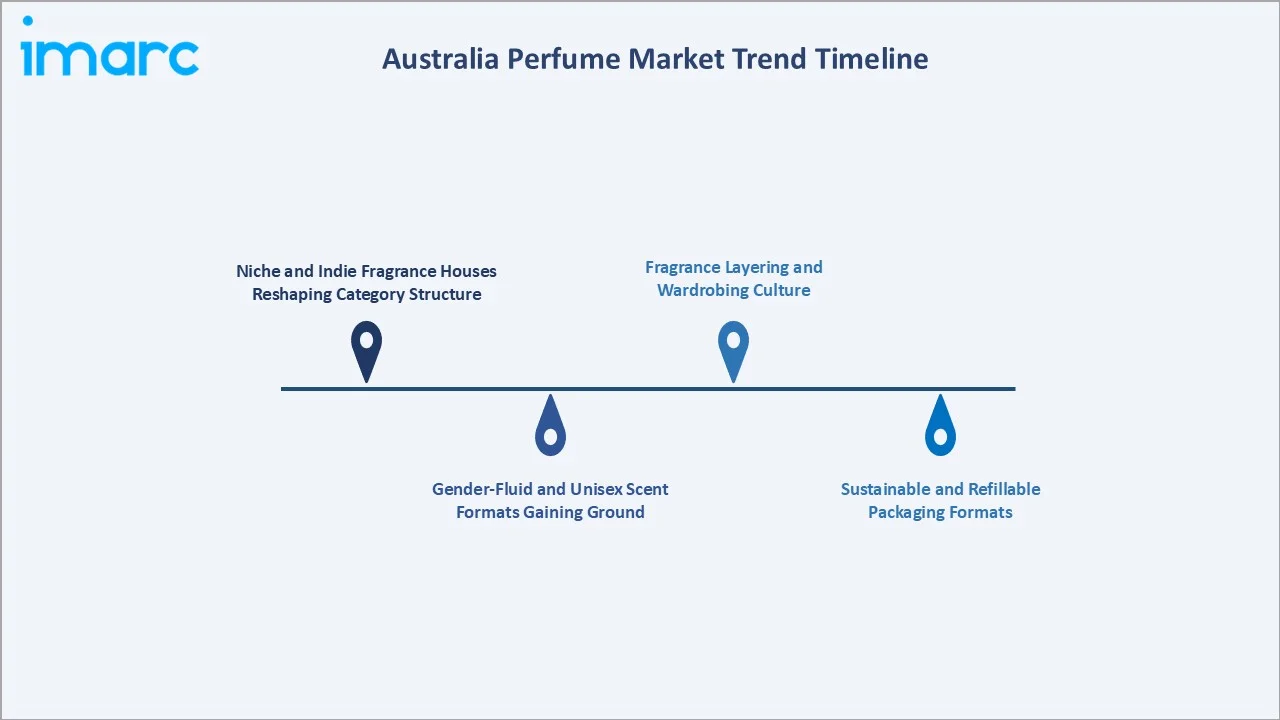
1. Niche and Indie Fragrance Houses Reshaping Category Structure
Niche and indie fragrance houses are reshaping Australia's perfume category structure as consumers move beyond global designer names toward botanically inspired and provenance-led scents. MECCA's Perfumeria has curated niche houses since 2000s, and the July 2024 addition of Australian-founded Tsu Lange Yor signalled growing local demand for homegrown fragrance storytelling.
2. Gender-Fluid and Unisex Scent Formats Gaining Ground
Gender-fluid and unisex scent formats are gaining ground among younger Australian consumers who favour molecular, androgynous, and skin-scent fragrance profiles over traditionally gendered marketing. This shift is expanding the unisex fragrance category's share of new product launches across both prestige and mass price tiers.
3. Fragrance Layering and Wardrobing Culture
Fragrance layering and wardrobing culture is emerging as Australian consumers build multi-bottle fragrance collections for different occasions, moods, and seasons, rather than relying on a single signature scent, encouraging repeat purchase and cross-category sales of complementary body mists.
4. Sustainable and Refillable Packaging Formats
Sustainable and refillable packaging formats are emerging as fragrance houses respond to consumer demand for reduced glass and plastic waste, introducing refill pouches, concentrate cartridges, and take-back programmes across premium retail counters.
Industry Value Chain Analysis
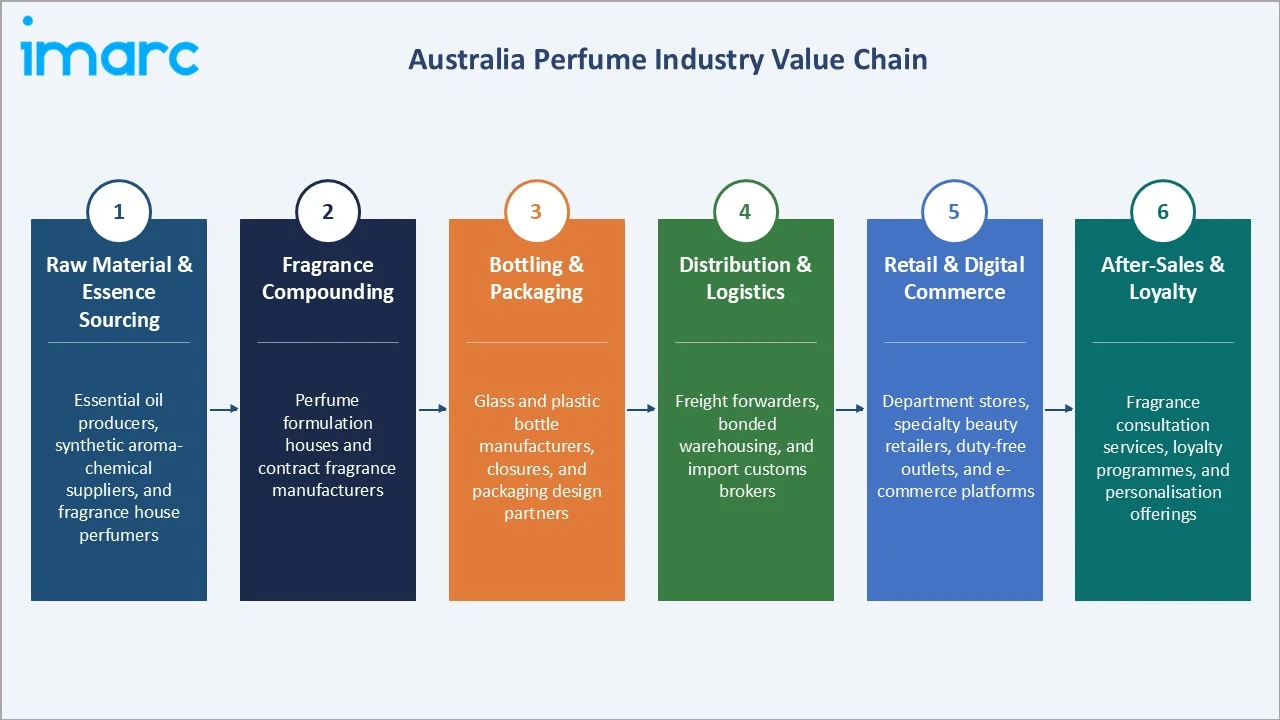
Australia's perfume value chain integrates fragrance oil and essence sourcing, compounding and formulation, bottling and packaging, distribution and logistics, and retail and digital commerce.
|
Stage |
Key Participants |
|
Raw Material & Essence Sourcing |
Essential oil producers, synthetic aroma-chemical suppliers, and fragrance house perfumers |
|
Fragrance Compounding |
Perfume formulation houses and contract fragrance manufacturers |
|
Bottling & Packaging |
Glass and plastic bottle manufacturers, closures, and packaging design partners |
|
Distribution & Logistics |
Freight forwarders, bonded warehousing, and import customs brokers |
|
Retail & Digital Commerce |
Department stores, specialty beauty retailers, duty-free outlets, and e-commerce platforms |
|
After-Sales & Loyalty |
Fragrance consultation services, loyalty programmes, and personalisation offerings |
The retail and digital commerce stage is the Australian perfume value chain's most differentiated phase, where curated brand assortment and personalised scent discovery increasingly determine competitive advantage. The after-sales and loyalty stage is the value chain's fastest-growing engagement layer as retailers invest in fragrance consultation and wardrobing services.
Technology Landscape in the Australia Perfume Industry
Fragrance Formulation and Molecular Technology
Fragrance formulation technology is advancing through molecular and biotechnology-derived aroma-chemicals that replicate rare natural extracts sustainably. Perfume houses are increasingly using headspace technology to capture botanical scent profiles, including Australian native ingredients, without depleting wild plant sources.
Sustainable and Refillable Packaging Innovation
Sustainable and refillable packaging innovation is reshaping fragrance presentation as brand houses introduce lightweight glass, recycled materials, and refill cartridge systems. These formats reduce packaging waste while supporting premium positioning among environmentally conscious consumers.
Digital Scent Discovery and Personalisation
Digital scent discovery tools, including online fragrance quizzes, AI-assisted matching, and virtual consultation, are helping retailers replicate in-store expertise for online shoppers. MECCA's in-store fragrance consultation model illustrates growing retailer investment in personalised scent discovery.
Automation in Manufacturing and Filling
Automation in perfume filling and packaging lines is improving batch consistency, reducing production lead time, and supporting smaller-batch niche fragrance runs that would be commercially unviable under manual filling processes.
Market Segmentation Analysis
The report covers the following segments:
|
Segment Category |
Leading Segment |
Market Share |
Year |
|
Perfume Type |
Premium Perfume Products |
58.7% |
2025 |
|
Category |
Female Fragrances |
49.6% |
2025 |
|
Region |
Australia Capital Territory & New South Wales |
39.6% |
2025 |

By Perfume Type
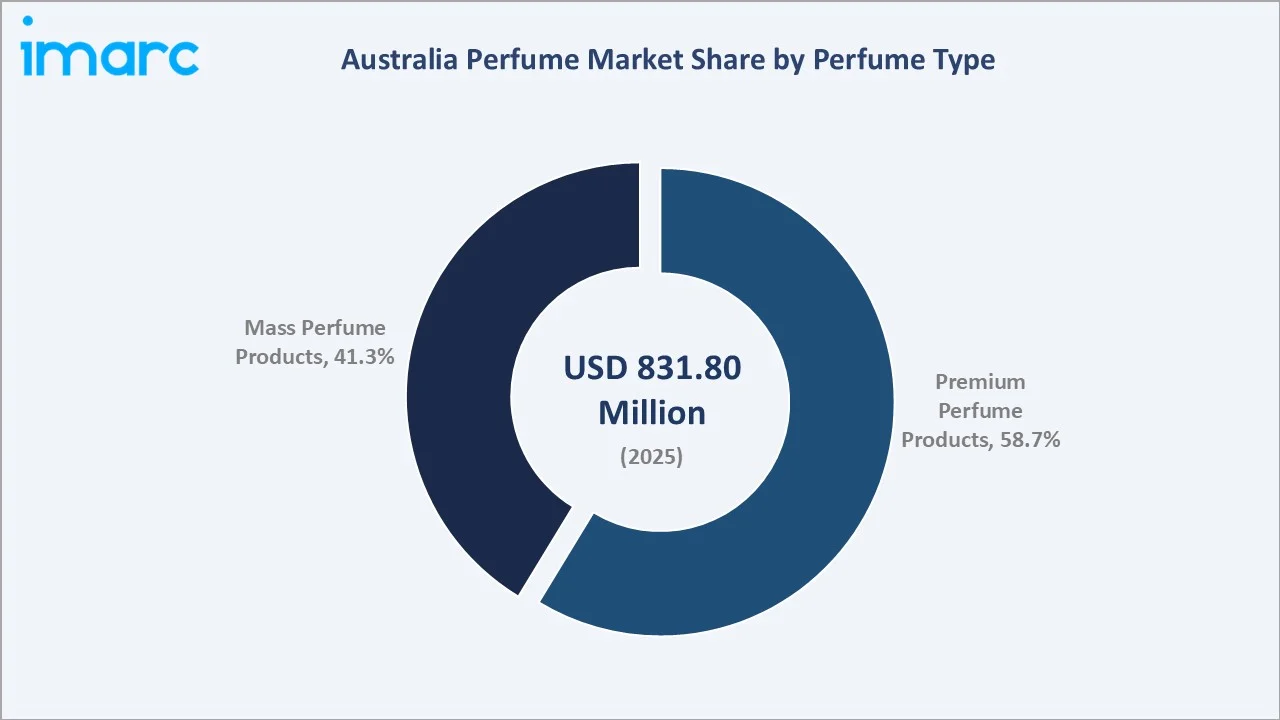
Premium perfume products lead at 58.7% (2025). The premium segment spans eau de parfum and eau de toilette collections from prestige and niche fragrance houses, sold predominantly through department stores, specialty beauty retailers, and duty-free boutiques. Premiumisation and gifting culture are driving Australians to trade up from mass-market colognes, supporting an estimated ~5.3% CAGR for the segment through 2034.
To access detailed market analysis, Request Sample
Mass perfume products hold 41.3% and remain relevant through pharmacy and supermarket-led everyday fragrance, budget-conscious younger shoppers, and private-label ranges growing at an estimated ~3.9% CAGR.
By Category
Female fragrances lead at 49.6% (2025), reflecting the broadest product assortment across floral, gourmand, and fresh fragrance families sold through department-store counters and specialty beauty retail. The segment grows at an estimated ~4.5% CAGR through sustained gifting and self-purchase demand.
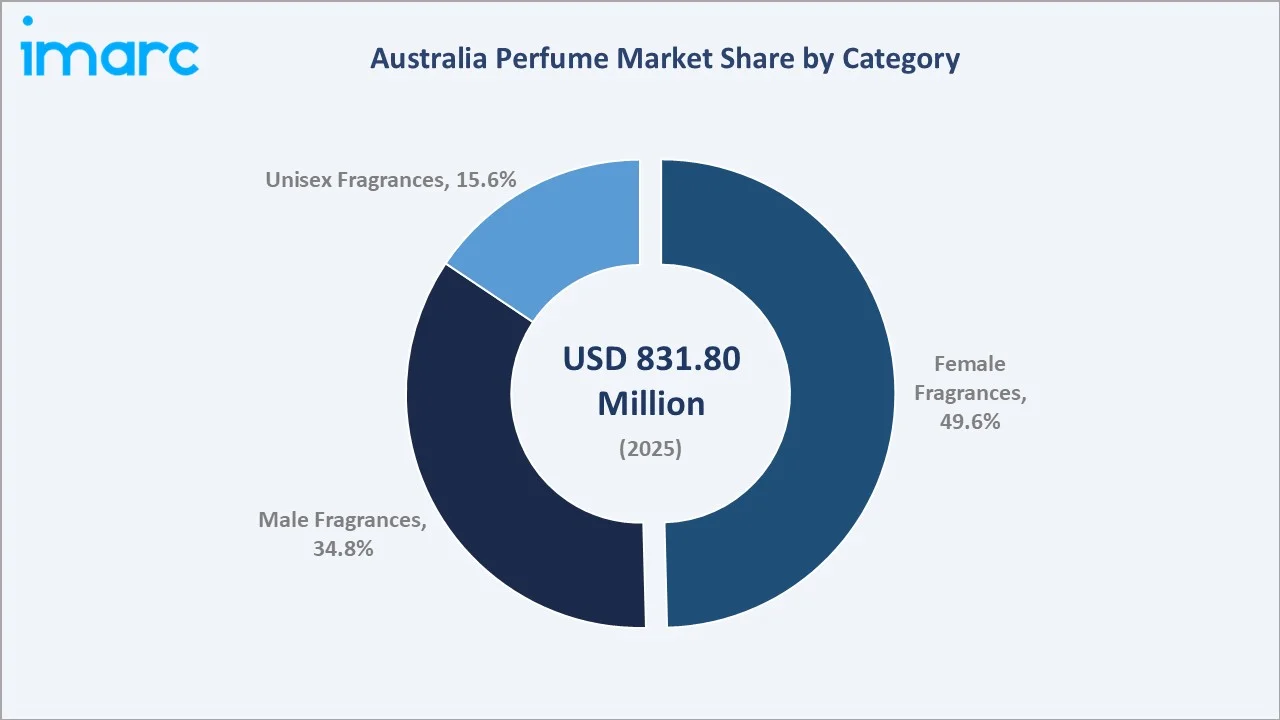
Male fragrances hold 34.8%, supported by expanding grooming culture and premium aftershave adoption at an estimated ~4.9% CAGR. Unisex fragrances, at 15.6%, are the fastest-growing category, at an estimated ~6.1% CAGR, as gender-neutral scent profiles gain traction among younger Australian consumers.
Regional Market Insights
|
Region |
Share (2025) |
Key Australia Perfume Market Drivers & Characteristics |
|
Australia Capital Territory & New South Wales |
39.6% |
Anchored by Sydney's concentration of flagship fragrance boutiques, department stores, luxury duty-free retail, and affluent household spending. |
|
Victoria & Tasmania |
24.1% |
Supported by Melbourne's specialty beauty retail density, niche perfumery culture, and strong prestige fragrance gifting occasions. |
|
Queensland |
18.3% |
Driven by tourism-linked duty-free spending, growing metropolitan retail expansion, and rising disposable incomes across Brisbane and the Gold Coast. |
|
Western Australia |
10.4% |
Benefits from resource-sector income levels supporting premium fragrance spending and expanding specialty beauty retail presence in Perth. |
|
Northern Territory & Southern Australia |
7.6% |
Supported by growing e-commerce access, regional retail expansion, and rising participation in national fragrance gifting occasions. |
ACT and New South Wales' 39.6% regional leadership reflects Sydney's position as Australia's fragrance retail capital, hosting flagship boutiques for global luxury houses alongside MECCA's largest stores and major international airport duty-free infrastructure. Victoria and Tasmania's 24.1% share is reinforced by Melbourne's specialty beauty retail density and niche perfumery culture.
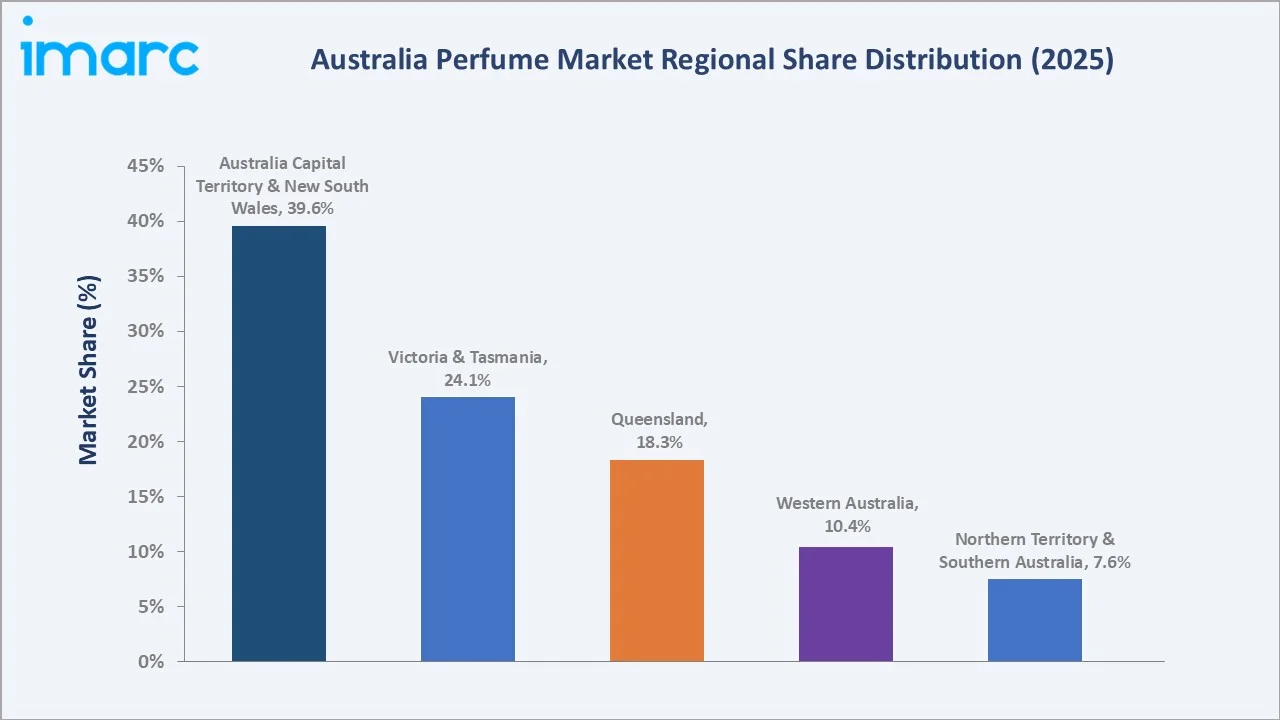
Queensland's 18.3% reflects tourism-linked duty-free spending and expanding metropolitan retail. Western Australia, at 10.4%, benefits from resource-sector income supporting premium fragrance spending. The combined 7.6% share of the Northern Territory and Southern Australia is strategically important beyond its current size, supported by growing e-commerce access.
Competitive Landscape
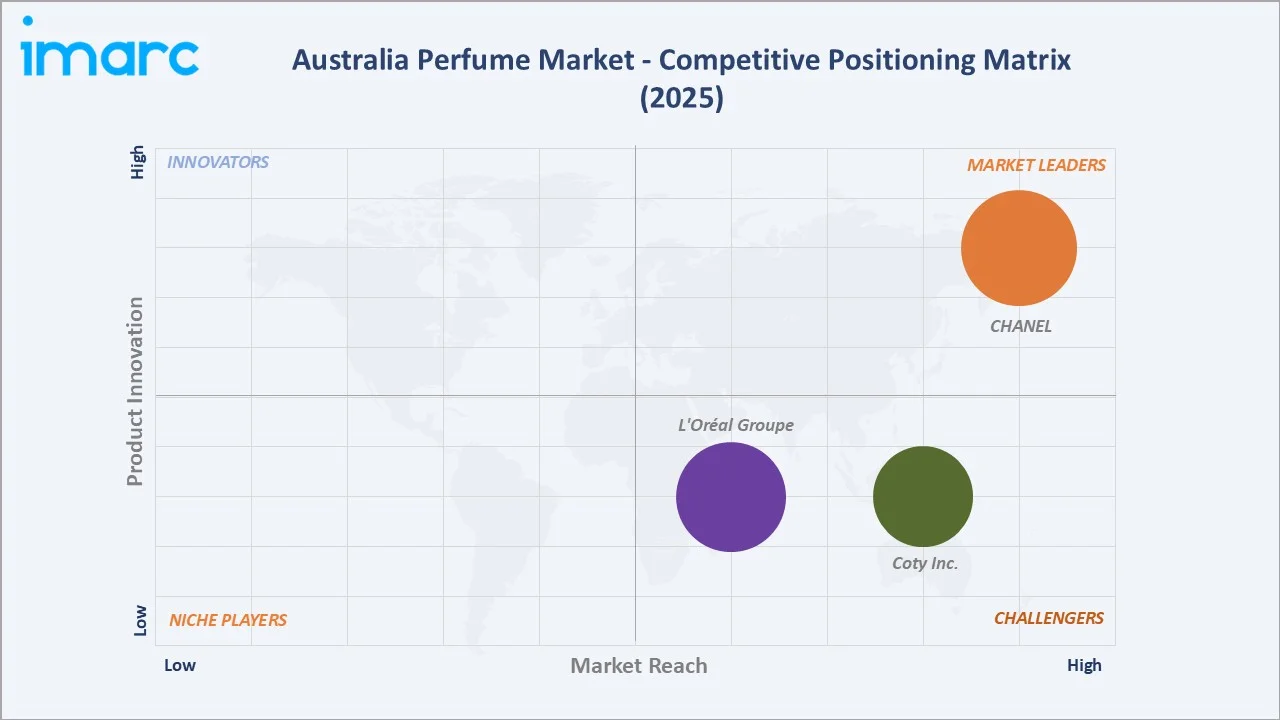
Australia's perfume market's competitive landscape spans global luxury houses, specialty beauty retailers, and a growing base of Australian-founded niche fragrance brands. Independent and niche perfumers compete on provenance storytelling and curated retail placement rather than volume, carving distinct positioning against global designer names.
|
Company Name |
Key Brands / Products |
Market Position |
Core Strength |
|
CHANEL |
CHANEL N°5, Coco Mademoiselle, Chance, Coco & Coco Noir |
Market Leader |
CHANEL operates a dedicated Fragrance & Beauty boutique network across major Australian cities, including Sydney, Melbourne, Brisbane, and Parramatta, alongside duty-free presence |
|
L'Oréal Groupe |
Yves Saint Laurent, Armani Beauty, Lancôme |
Strong Challenger |
Operates L'Oréal Luxe, high-profile couture designer portfolios, and strong regional performance |
|
Coty Inc. |
Hugo Boss, Calvin Klein, Burberry |
Strong Challenger |
Global fragrance houses supply a broad portfolio of licensed designer and mass-prestige fragrance brands distributed through department stores and pharmacies |
Australian-founded niche houses such as Grandiflora and Tsu Lange Yor are creating new competitive dynamics by positioning provenance-led, botanically inspired fragrance against established global designer names, supported by exclusive retail partnerships with MECCA.
Key Company Profiles
CHANEL
CHANEL, which holds CHANEL Fragrance & Beauty, is one of Australia's leading prestige fragrance houses, operating a dedicated Fragrance & Beauty boutique network across Sydney, Melbourne, Brisbane, and Parramatta, alongside standalone fashion boutiques and duty-free counters at major airports.
- Key Products: CHANEL N°5, Coco Mademoiselle, Chance, Coco & Coco Noir, and others.
- Strategic Focus: Strengthening prestige fragrance discovery through immersive in-boutique scent experiences, personalised fragrance consultations, and exclusive limited-edition releases across the Australian retail network.
L'Oréal Groupe
L'Oréal Groupe is one of the dominant players in Australia fragrance market, with its L'Oréal Luxe division distributing brands like Yves Saint Laurent, Giorgio Armani, and Lancôme through department stores, perfumeries, and travel retail.
- Key Products: Yves Saint Laurent, Armani Beauty, Lancôme, and others.
- Strategic Focus: Premiumization through its L'Oréal Luxe division (YSL, Giorgio Armani, Lancôme, Prada), distributed across department stores, perfumeries, and travel retail.
Market Concentration Analysis
Australia's perfume market is moderately concentrated, with global luxury houses and MECCA Brands' curated retail platform commanding the largest combined share of prestige fragrance sales. The mass perfume segment is more fragmented, with private-label and pharmacy-channel brands competing primarily on price. Consolidation trends are emerging as global fragrance houses expand dedicated boutique formats, while niche and indie brands increasingly rely on exclusive retail partnerships with MECCA to reach national distribution without building independent retail infrastructure.
Investment & Growth Opportunities
Highest Growth Segments
Unisex fragrances (~6.1% CAGR), premium perfume products (~5.3% CAGR), male fragrances (~4.9% CAGR through grooming category expansion), and Queensland's tourism-linked duty-free channel represent the highest-growth investment vectors in Australia's perfume market through 2034.
Emerging Investment Opportunities
Australia's niche and indie fragrance segment represents the most commercially dynamic long-term investment opportunity, with MECCA's curated retail platform providing a proven distribution pathway for new entrants. Brand houses establishing exclusive retail partnerships and provenance-led product storytelling before category saturation will capture first-mover shelf positioning that compounds as consumer discovery accelerates.
Investment Themes
- Niche fragrance house retail partnership positioning: Establishing exclusive distribution partnerships with MECCA and specialty beauty retailers ahead of category saturation positions new entrants for national distribution without independent retail infrastructure investment.
- Refillable and sustainable packaging investment: Developing refillable perfume packaging formats that command a premium price above standard glass bottles while reducing packaging waste creates a differentiated value proposition that retains environmentally conscious prestige fragrance shoppers.
Future Market Outlook (2026-2034)
Australia's perfume market is projected to grow from USD 831.8 Million in 2025 to USD 1,266.2 Million by 2034, delivering a 4.78% CAGR over the forecast period. The market's anchor value of USD 1,050.5 Million in 2030 represents the midpoint of a structural shift toward premiumisation, gender-neutral fragrance formats, and sustainable packaging across the Australian fragrance category.
Three structural forces define Australia's perfume market growth through 2034 with strong confidence. Premiumisation is a durable consumer trend as Australians continue trading up from mass-market colognes toward prestige and niche fragrance houses. Gender-fluid fragrance formats are reshaping new product development across both prestige and mass price tiers. E-commerce and social media-led discovery are extending prestige fragrance access beyond Australia's major metropolitan boundaries, sustaining above-trend growth in regional and outer-metropolitan markets.
Research Methodology
Primary Research
Primary research comprised structured interviews with industry stakeholders including beauty retail category managers, fragrance brand representatives, distributors, and regulatory compliance specialists across Australia's perfume market.
Secondary Research
Secondary research encompassed Australian Industrial Chemicals Introduction Scheme (AICIS) regulatory guidance, Australian Border Force tariff classification records, industry association publications, company disclosures, and Australia perfume market trade and retail data.
Forecasting Models
Market revenue forecasts were developed using a segment bottom-up model: perfume type and category revenue growth adjusted for premiumisation rate, regional retail infrastructure density, and duty-free and e-commerce channel expansion across the 2026-2034 forecast period.
Australia Perfume Market Report Coverage:
| Report Features | Details |
|---|---|
| Base Year of the Analysis | 2025 |
| Historical Period | 2020-2025 |
| Forecast Period | 2026-2034 |
| Units | Million USD |
| Scope of the Report |
Exploration of Historical Trends and Market Outlook, Industry Catalysts and Challenges, Segment-Wise Historical and Future Market Assessment:
|
| Perfume Types Covered | Premium Perfume Products and Mass Perfume Products |
| Categories Covered | Female Fragrances, Male Fragrances, and Unisex Fragrances |
| Regions Covered | Australia Capital Territory & New South Wales, Victoria & Tasmania, Queensland, Northern Territory & Southern Australia, and Western Australia |
| Companies Covered | CHANEL, L'Oréal Groupe, Coty Inc., etc. |
| Customization Scope | 10% Free Customization |
| Post-Sale Analyst Support | 10-12 Weeks |
| Delivery Format | PDF and Excel through Email (We can also provide the editable version of the report in PPT/Word format on special request) |
Key Benefits for Stakeholders:
- IMARC’s industry report offers a comprehensive quantitative analysis of various market segments, historical and current market trends, market forecasts, and dynamics of the Australia perfume market from 2020-2034.
- The research report provides the latest information on the market drivers, challenges, and opportunities in the Australia perfume market.
- Porter's five forces analysis assist stakeholders in assessing the impact of new entrants, competitive rivalry, supplier power, buyer power, and the threat of substitution. It helps stakeholders to analyze the level of competition within the Australia perfume industry and its attractiveness.
- Competitive landscape allows stakeholders to understand their competitive environment and provides an insight into the current positions of key players in the market.
Frequently Asked Questions About the Australia Perfume Market Report
Australia's perfume market reached USD 831.8 Million in 2025. Growth is driven by rising premiumisation, expanding niche fragrance houses, and growing gifting culture across department stores, specialty beauty retailers, and duty-free channels.
Australia's perfume market grows at a 4.78% CAGR during 2026-2034, reaching USD 1,266.2 Million by 2034. Premium perfume products and unisex fragrances are estimated to grow fastest, supported by premiumisation and gender-neutral scent trends.
Premium perfume products lead at 58.7% through Australians' growing preference for prestige and niche fragrance houses over mass-market colognes, supported by department-store counters and duty-free boutiques.
Female fragrances lead at 49.6% through the broadest product assortment across floral, gourmand, and fresh fragrance families, supported by strong department-store and gifting-occasion demand throughout the year.
Australia Capital Territory and New South Wales lead at 39.6%, anchored by Sydney's concentration of flagship fragrance boutiques, department stores, and international duty-free retail infrastructure.
Leading companies include CHANEL, L'Oréal Groupe, and Coty Inc., among others.
Australia's perfume market is projected to reach approximately USD 1,050.5 Million by 2030, as premiumisation, gender-fluid fragrance formats, and expanding e-commerce discovery continue reshaping consumer purchasing behaviour.
Two priority investment opportunities include niche fragrance house retail partnership positioning ahead of category saturation, and refillable and sustainable packaging investment to capture environmentally conscious prestige fragrance shoppers.
Businesses that import or manufacture cosmetic products, including fragrance blends, must register with the Australian Industrial Chemicals Introduction Scheme (AICIS) and confirm ingredient compliance before introducing products into the market.
E-commerce and social media-led fragrance discovery are broadening market access beyond metropolitan flagship boutiques, with online scent-matching tools helping regional Australian consumers access prestige fragrance ranges.
Need more help?
- Speak to our experienced analysts for insights on the current market scenarios.
- Include additional segments and countries to customize the report as per your requirement.
- Gain an unparalleled competitive advantage in your domain by understanding how to utilize the report and positively impacting your operations and revenue.
- For further assistance, please connect with our analysts.
 Request Customization
 Speak to an Analyst
 Request Brochure
 Inquire Before Buying
Benefits of Customization
- Personalize this research
- Triangulate with your data
- Get data as per your format and definition
- Gain a deeper dive into a specific application, geography, customer, or competitor
- Any level of personalization
Get in Touch With Us
UNITED STATES
Phone: +1-201-971-6302
INDIA
Phone: +91-120-433-0800
UNITED KINGDOM
Phone: +44-753-714-6104
Email: [email protected]
Client Testimonials




.webp)




.webp)













Related Reports

Choose your plan
*Please note that the prices mentioned below are starting prices for each bundle type. Kindly contact our team for further details.*
Single User License
- 1 User License, Access on 2 Devices
- PDF Report + Excel Dataset (Password Protected)
- Lifetime Access
- No Printing Rights
- 10% Free Report Customization
- 10–12 Weeks of Analyst Support
Five User License
- Access for 5 Users, 2 Devices per User
- PDF Report + Excel Dataset (Password Protected)
- Lifetime Access
- Dedicated Account Manager
- 12–14 Weeks of Analyst Support
- No Printing Rights
- 15% Free Report Customization
- 25% Discount on Your Next Purchase
Corporate User License
- Unlimited User Access (Within Your Organization)
- PDF Report + Excel Dataset
- Lifetime Access
- Dedicated Account Manager
- 14–20 Weeks of Analyst Support
- No Printing Rights
- 20% Free Report Customization
- 30% Discount on Your Next Purchase
Essential Insights
What's included:
3 reports
- Lifetime Access
- PDF Reports
- Excel Datasets
- 2 Weeks of Free Analyst Support
- 2 User Licenses
- Access on 2 Devices
- Printing Rights
- Complimentary PowerPoint (PPT) Version
- Complimentary License Upgrade
Professional Access
What's included:
5 reports
- Lifetime Access
- PDF Reports
- Excel Datasets
- 8 Weeks of Free Analyst Support
- 2 User Licenses
- Access on 2 Devices
- Printing Rights
- Complimentary PowerPoint (PPT) Version
- Complimentary License Upgrade
Business Advantage
What's included:
8 reports
- Lifetime Access
- PDF Reports
- Excel Datasets
- 14 Weeks of Free Analyst Support
- 2 User Licenses
- Access on 2 Devices
- Printing Rights
- Complimentary PowerPoint (PPT) Version
- Complimentary License Upgrade
Enterprise Intelligence
What's included:
10 reports
- Lifetime Access
- PDF Reports
- Excel Datasets
- 20 Weeks of Free Analyst Support
- 2 User Licenses
- Access on 2 Devices
- Printing Rights
- Complimentary PowerPoint (PPT) Version
- Complimentary License Upgrade