
Australia Plastic Caps and Closure Market Size, Share, Trends and Forecast by Product Type, Raw Material, Container Type, Technology, End Use, and Region, 2026-2034
Australia Plastic Caps and Closure Market Size, Share, Trends & Forecast (2026-2034)
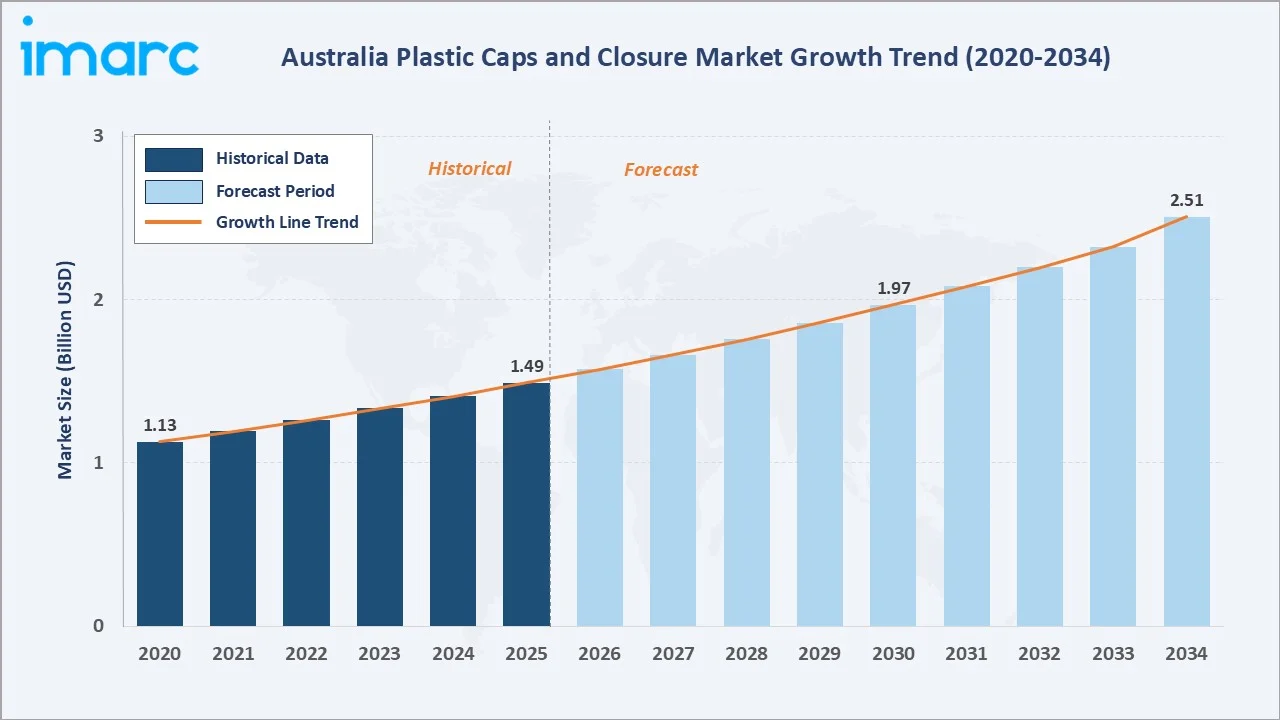
The Australia plastic caps and closure market reached USD 1.49 Billion in 2025 and is projected to reach USD 2.51 Billion by 2034, exhibiting a CAGR of 5.68% during 2026-2034. The sustained expansion of Australia's food and beverage manufacturing sector and the pharmaceutical sector's growth requiring tamper-evident and child-resistant closures are the primary growth catalysts. In 2024, Australia imported USD 13.6 billion worth of food processing ingredients, with the United States contributing approximately USD 1.4 billion of these imports. The growth of food ingredient imports and food processing activities is increasing demand for plastic caps and closures used in packaging applications such as beverages, sauces, dairy products, and processed foods. Screw-on caps lead the product type at 68.5%, plastic container type leads at 73.5%, and Australia Capital Territory & New South Wales account for the largest regional share at 39.4%.
Market Snapshot
|
Metric |
Value |
|
Market Size (2025) |
USD 1.49 Billion |
|
Forecast Market Size (2034) |
USD 2.51 Billion |
|
CAGR (2026-2034) |
5.68% |
|
Base Year |
2025 |
|
Historical Period |
2020-2025 |
|
Forecast Period |
2026-2034 |
|
Dominant Product Type |
Screw-On Caps – 68.5% (2025) |
|
Dominant Container Type |
Plastic – 73.5% (2025) |
|
Leading Region |
Australia Capital Territory & New South Wales – 39.4% (2025) |
The Australia plastic caps and closure market grew from USD 1.13 Billion in 2020 to USD 1.49 Billion in 2025, driven by Australia's FMCG industry expansion, the accelerated shift to packaged beverages during COVID-19 lockdowns, and the growing pharmaceutical sector's demand for compliant closure solutions. The market is projected to reach USD 1.97 Billion by 2030 and USD 2.51 Billion by 2034.
To get more information on this market, Request Sample
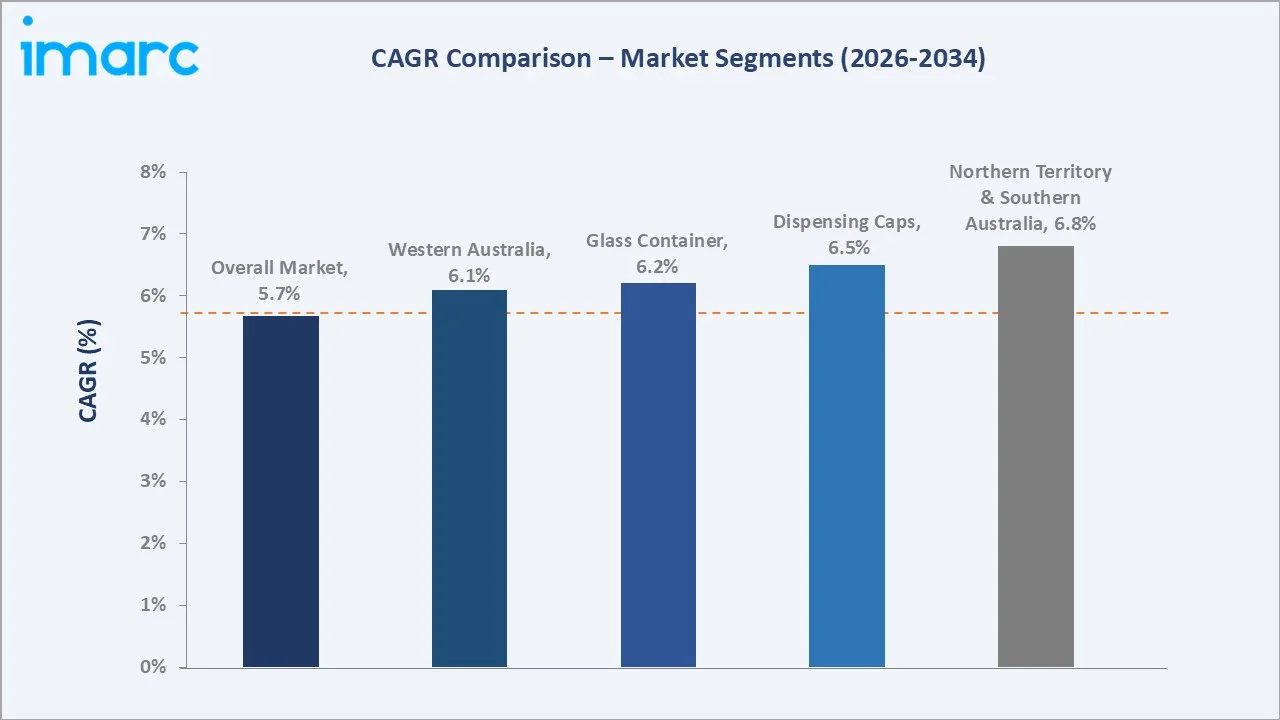
Northern Territory & Southern Australia grow at ~6.80% CAGR through resources sector industrial chemicals packaging demand from Olympic Dam and South Australia's agribusiness growth. Dispensing caps grow at ~6.50% CAGR through cosmetics, household chemicals, and personal care product category expansion. Glass container closures grow at ~6.20% CAGR through premiumization of wine, spirits, and specialty food products in glass. Western Australia grows at ~6.10% CAGR through resources sector and food and beverage expansion in the Perth metropolitan market.
Executive Summary
The Australia plastic caps and closure market is a foundational component of the national packaging industry, providing the critical sealing function that enables product safety, shelf-life extension, tamper evidence, and consumer convenience across virtually every liquid, semi-liquid, and powder product category sold through Australian retail, foodservice, and industrial channels. The market spans the complete closure spectrum: screw-on caps, dispensing closures, pharmaceutical closures, and specialty closures.
Screw-on caps lead at 68.5% (2025) through their universal application across Australia's highest-volume consumer packaged goods categories: water and CSD closures, dairy and food closure applications, household chemical containers, and agricultural chemical packaging. Plastic container type leads at 73.5% (2025) through PET beverage bottles and HDPE household chemical and dairy containers that represent the overwhelming majority of Australian consumer packaging volume. Australia Capital Territory & New South Wales lead at 39.4% through Sydney's concentration of FMCG manufacturing and distribution, NSW's food and beverage processing cluster, and Canberra's pharmaceutical sector activity.
Key Market Insights
|
Insight |
Data |
|
Dominant Product Type |
Screw-On Caps – 68.5% share (2025) |
|
Dominant Container Type |
Plastic – 73.5% share (2025) |
|
Leading Region |
Australia Capital Territory & New South Wales – 39.4% share (2025) |
|
Market Opportunity |
Tethered closure development for single-stream recycling; PCR content closure manufacturing; pharmaceutical child-resistant closure; premium spirit and wine glass closure; Queensland and WA food and beverage sector expansion |
Key Analytical Observations:
- Screw-On Caps at 68.5% (2025): Screw-on caps command market leadership through their application on Australia's highest-volume consumer product format, where billions of individual closure units are consumed annually across water, carbonated soft drinks, juice, dairy beverages, cordials, sauces, condiments, and household cleaning products.
- Plastic Container Type at 73.5% (2025): Plastic container closures, serving PET beverage bottles, HDPE household chemical containers, HDPE dairy containers, and PP/PE food containers, command the majority market share through the plastic container's cost, weight, and functional advantages that sustain its dominance in Australian consumer packaging despite sustainability pressures.
- Australia Capital Territory & New South Wales at 39.4% (2025): Australia Capital Territory & New South Wales dominate due to the presence of major food and beverage manufacturers, packaging companies, and consumer goods industries.
Australia Plastic Caps and Closure Market Overview
Australia plastic caps and closure market encompasses the manufacturing, distribution, and sale of plastic closure systems used across the food and beverage, pharmaceutical, personal care, household chemicals, and industrial packaging sectors. Closures are manufactured through injection molding and compression molding. Macroeconomic factors include population growth, rising consumer spending, and expansion of the food, beverage, pharmaceutical, and personal care industries. Increasing manufacturing activity, urbanization, and demand for packaged goods are supporting higher consumption of plastic packaging solutions. Additionally, sustainability initiatives and investments in recycling infrastructure are shaping the development of innovative and recyclable closure products.
Market Dynamics
To evaluate market opportunities, Request Sample
Market Drivers
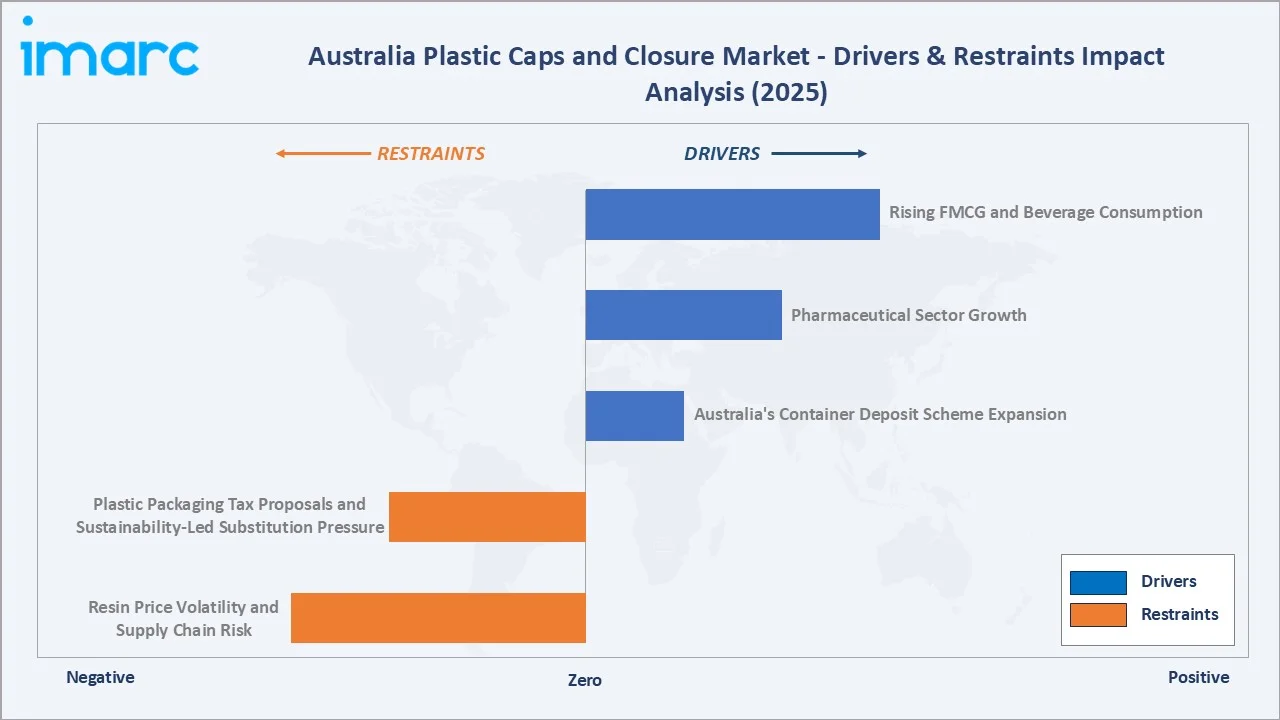
- Rising FMCG and Beverage Consumption: Australia's food and beverage sector is the primary driver of plastic closure demand through the structural link between packaged product consumption and closure unit volume. In 2023–24, total water consumption across Australian industries and households increased by 12.9% to 17,223 GL, compared with 15,258 GL in 2022–23. The Agriculture, forestry, and fishing sector recorded a 14.6% rise in water usage, reaching 11,760 GL, while household water consumption increased by 6.2% to 1,868 GL from 1,759 GL in the previous year. The increase in household and industrial water consumption reflects the expansion of food processing, beverage manufacturing, and consumer goods production activities in Australia. Growing demand for packaged food and beverages is increasing the need for plastic caps and closures for bottles, containers, and other packaging formats.
- Pharmaceutical Sector Growth: Australia's pharmaceutical sector requires closures meeting regulatory-mandated child-resistant performance standards, tamper-evident features, desiccant integration, and material compatibility with pharmaceutical formulations. The insurance expansion and Australia's aging population demographics are driving increased prescription and OTC pharmaceutical consumption, creating structural demand growth for pharmaceutical-grade closures.
- Australia's Container Deposit Scheme Expansion: The completion of Australia's national Container Deposit Scheme rollout is creating incentives for beverage packaging design that facilitates effective collection and recycling, including closure design that does not impede single-stream recyclability. In 2024–25, approximately 69% of eligible beverage containers supplied in the Australian Capital Territory (ACT) were returned through the container deposit scheme. The program collected around 109 million drink containers for recycling, highlighting growing participation in recycling initiatives and increasing demand for sustainable packaging solutions. This regulatory-driven redesign cycle creates ongoing product development and tooling investment for Australian closure manufacturers.
Market Restraints
- Plastic Packaging Tax Proposals and Sustainability-Led Substitution Pressure: State and federal government policy discussions around plastic packaging levies and extended producer responsibility (EPR) schemes create commercial uncertainty for Australian closure manufacturers whose products face potential cost increases from EPR levies. The plastic packaging debate in Australia creates sensitivity around plastic closure market growth projections that brand owners and retailers are navigating through sustainability investment and communication strategies.
- Resin Price Volatility and Supply Chain Risk: Polypropylene (PP) and high-density polyethylene (HDPE) are petrochemical derivatives whose prices fluctuate with crude oil pricing, global ethylene and propylene supply-demand dynamics, and currency movements that affect import costs for Australian manufacturers. The resin shortage period demonstrated the supply chain vulnerability of Australian closure manufacturers who are dependent on imported resin from Middle Eastern, Asian, and US producers, as domestic Australian polymer production does not cover the full closure manufacturing resin requirement.
Market Opportunities
- Tethered Closure Development and Tooling Investment: The growing adoption of tethered closures, driven by sustainability regulations and recycling initiatives, is creating opportunities for investment in advanced closure designs and manufacturing capabilities. Packaging manufacturers can invest in specialized tooling, injection molding technologies, and production upgrades to meet rising demand for compliant and recyclable closure solutions. This opportunity enables companies to develop innovative caps that improve recyclability, reduce material usage, and align with evolving environmental standards.
- Recycled Content Closure Manufacturing: The increasing focus on circular economy initiatives and sustainable packaging regulations is creating opportunities for manufacturers to develop plastic closures with higher recycled content. Investment in recycled resin processing, advanced injection molding technologies, and recycling partnerships can help companies meet sustainability targets. This opportunity enables closure producers to reduce reliance on virgin plastics, support brand sustainability goals, and address growing demand for environmentally friendly packaging solutions.
Market Challenges
- Import Competition from Asian Closure Manufacturers: Australian domestic closure manufacturers face increasing price competition from Chinese, South Korean, and Indian closure manufacturers who supply standard commodity closures at landed costs competitive with Australian-manufactured equivalents. While food-contact compliance requirements, quality consistency, and logistics reliability provide domestic manufacturers with competitive advantages for premium and regulatory-sensitive applications, the lower technical barrier commodity closure segment is progressively exposed to import competition as Asian manufacturers improve their quality management systems and invest in Australian market development.
- Design Complexity and Tooling Investment Requirements: As closure specifications become increasingly complex, the injection molding tooling investment required for each new closure specification increases substantially. Multi-cavity tools for high-volume beverage closures can cost high per tool, with amortization requiring sustained volume commitments that create commercial risk when packaging formats change or brand owners switch closure suppliers.
Emerging Market Trends
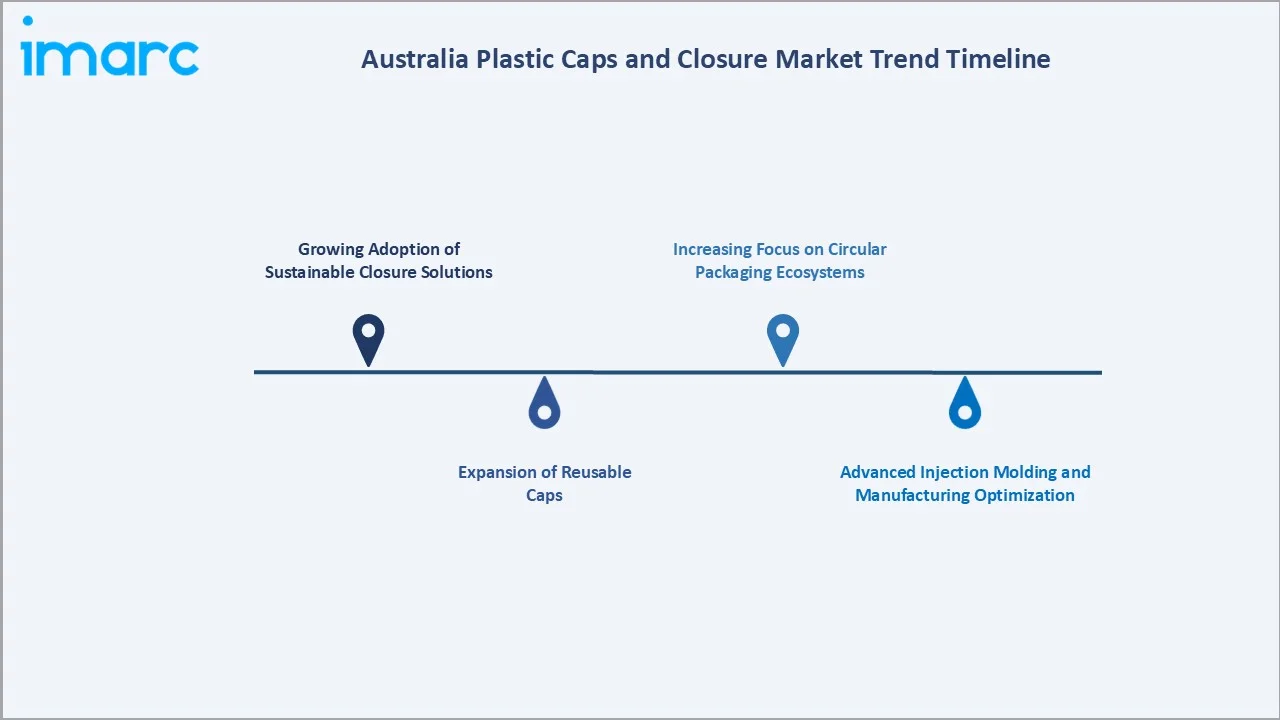
1. Growing Adoption of Sustainable Closure Solutions
The increasing participation in container recycling programs is accelerating demand for environmentally friendly plastic caps and closures. Manufacturers are focusing on recyclable materials, lightweight designs, and reduced plastic usage to support circular economy goals. This trend is encouraging innovation in closure manufacturing and sustainable packaging development.
2. Expansion of Reusable Caps
The growing emphasis on waste reduction and circular packaging models is driving interest in reusable caps across beverage, food, and consumer goods applications. In April 2026, PakTech introduced a reusable keg cap in Australia made from 100% recycled HDPE, designed as a closed-loop packaging solution for protecting beer kegs. Developed in partnership with Bodriggy Brewing Co, the Keg Kap replaces single-use plastic keg covers with a reusable alternative that can be cleaned, reused, and eventually recycled. This trend supports the transition toward lower-waste packaging solutions in the Australian market.
3. Advanced Injection Molding and Manufacturing Optimization
The demand for high-volume recyclable closures is encouraging investments in advanced injection molding technologies and precision tooling. Manufacturers are adopting automation, improved production processes, and material-efficient designs to enhance productivity and reduce manufacturing costs. This trend is supporting the development of lightweight and high-performance closure solutions.
4. Increasing Focus on Circular Packaging Ecosystems
The success of container deposit schemes is strengthening collaboration among beverage producers, recyclers, and packaging manufacturers. Companies are developing closed-loop packaging systems that improve collection, recycling, and reuse of plastic materials. This trend is driving innovation in sustainable cap and closure solutions across the Australian market.
Industry Value Chain Analysis
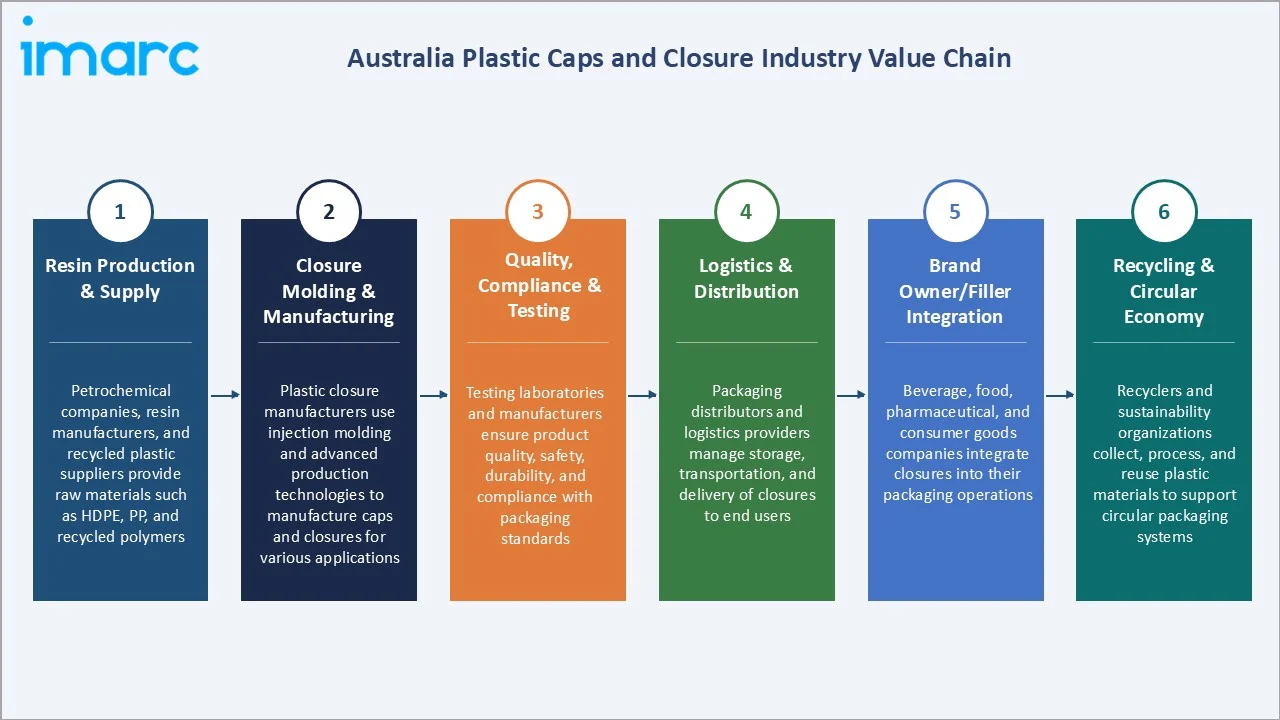
The Australia plastic caps and closure value chain integrates resin production & supply, closure molding & manufacturing, quality, compliance & testing, logistics & distribution, brand owner/filler integration, and recycling & circular economy.
|
Stage |
Key Participants |
|
Resin Production & Supply |
Petrochemical companies, resin manufacturers, and recycled plastic suppliers provide raw materials such as HDPE, PP, and recycled polymers. |
|
Closure Molding & Manufacturing |
Plastic closure manufacturers use injection molding and advanced production technologies to manufacture caps and closures for various applications. |
|
Quality, Compliance & Testing |
Testing laboratories and manufacturers ensure product quality, safety, durability, and compliance with packaging standards. |
|
Logistics & Distribution |
Packaging distributors and logistics providers manage storage, transportation, and delivery of closures to end users. |
|
Brand Owner/Filler Integration |
Beverage, food, pharmaceutical, and consumer goods companies integrate closures into their packaging operations. |
|
Recycling & Circular Economy |
Recyclers and sustainability organizations collect, process, and reuse plastic materials to support circular packaging systems. |
The closure molding & manufacturing stage is the most value-added segment in the plastic caps and closures value chain, as it involves advanced injection molding technologies, precision tooling, and design optimization. This stage directly influences product quality, performance, sustainability, and cost efficiency while enabling manufacturers to develop innovative closure solutions for different end-use industries.
Technology Landscape in the Australia Plastic Caps and Closure Industry
Advanced Injection Molding Technology
Advanced injection molding is widely used for high-volume production of plastic caps and closures due to its precision, speed, and cost efficiency. Modern systems enable lightweight designs, improved dimensional accuracy, and reduced material consumption. Automation and smart molding technologies are enhancing production efficiency and quality control. These technologies support manufacturers in meeting growing demand from beverage, food, pharmaceutical, and personal care industries.
Tethered Closure Technology
Tethered closure technology is gaining adoption due to sustainability regulations and increasing focus on improving plastic recycling rates. These closures remain attached to bottles after opening, reducing litter and improving collection efficiency. Manufacturers are investing in specialized molds and production upgrades to meet evolving packaging requirements. Technology supports compliance with circular economy initiatives and sustainable packaging goals.
Lightweighting and Material Optimization Technology
Lightweighting technologies focus on reducing the amount of plastic required for manufacturing closures while maintaining strength and functionality. Advanced design software, material engineering, and precision molding techniques enable thinner and more efficient closure structures. This helps reduce production costs, lower environmental impact, and improve transportation efficiency. The technology is increasingly adopted by packaging manufacturers seeking sustainable solutions.
Market Segmentation Analysis
The report covers the following segments:
|
Segment Category |
Leading Segment |
Market Share |
Year |
|
Product Type |
Screw-On Caps |
68.5% |
2025 |
|
Raw Material |
🔒 |
🔒 |
2025 |
|
Container Type |
Plastic |
73.5% |
2025 |
|
Technology |
🔒 |
🔒 |
2025 |
|
End Use |
🔒 |
🔒 |
2025 |
|
Region |
Australia Capital Territory & New South Wales |
39.4% |
2025 |

By Product Type
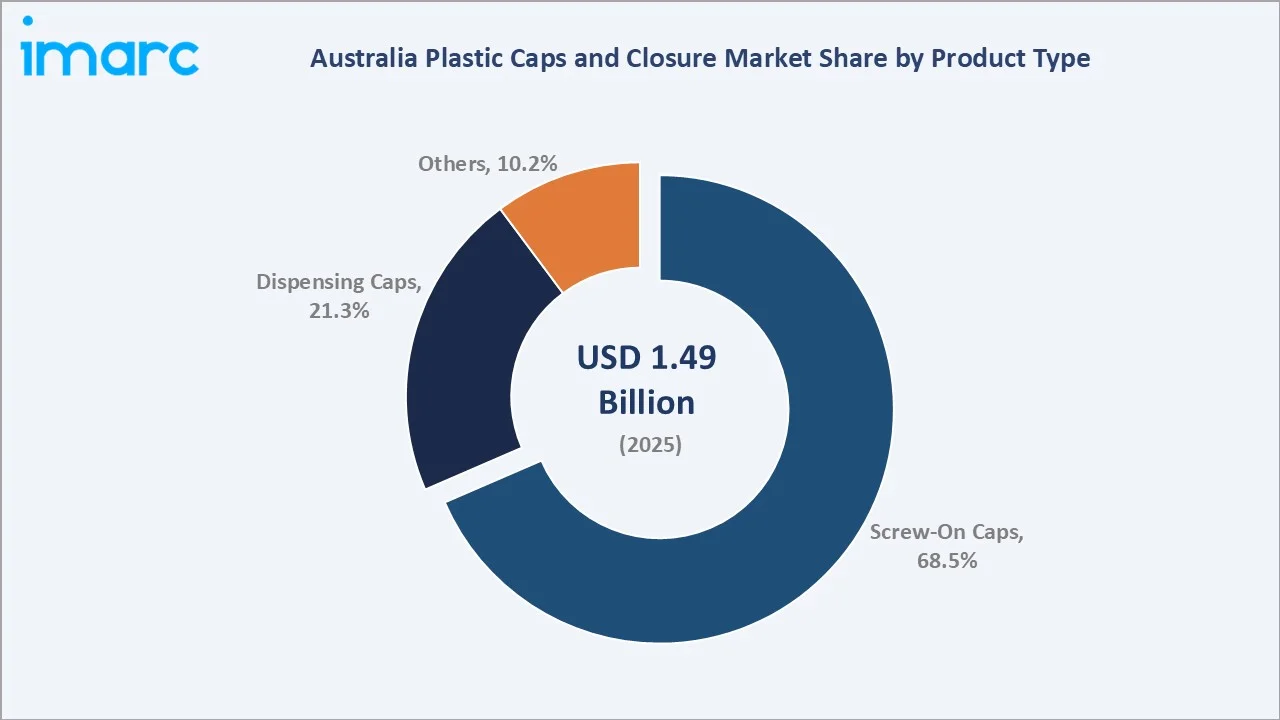
Screw-on caps lead at 68.5% (2025) through universal application in Australia's highest-volume consumer packaging. Australia's beverage closure manufacturing and food and household product closure supply serve the bulk of this segment.
To access detailed market analysis, Request Sample
Dispensing caps at 21.3%, growing at ~6.50% CAGR, serve personal care, cosmetics, household chemicals, and condiment categories through flip-top, disc-top, pump, and spray formats supplied by specialized dispensing closure importers. Others at 10.2% encompasses pharmaceutical child-resistant closures, carbonated beverage specialty closures, hot-fill closures for high-acid food products, and sports closures.
By Container Type
Plastic dominates at 73.5% (2025) through PET beverage bottles, HDPE household chemical containers, HDPE dairy containers, and PP/PE food containers. The plastic container closure segment is supplied primarily by domestic manufacturers for beverage and food applications, with imported closures serving commodity household and industrial packaging segments.
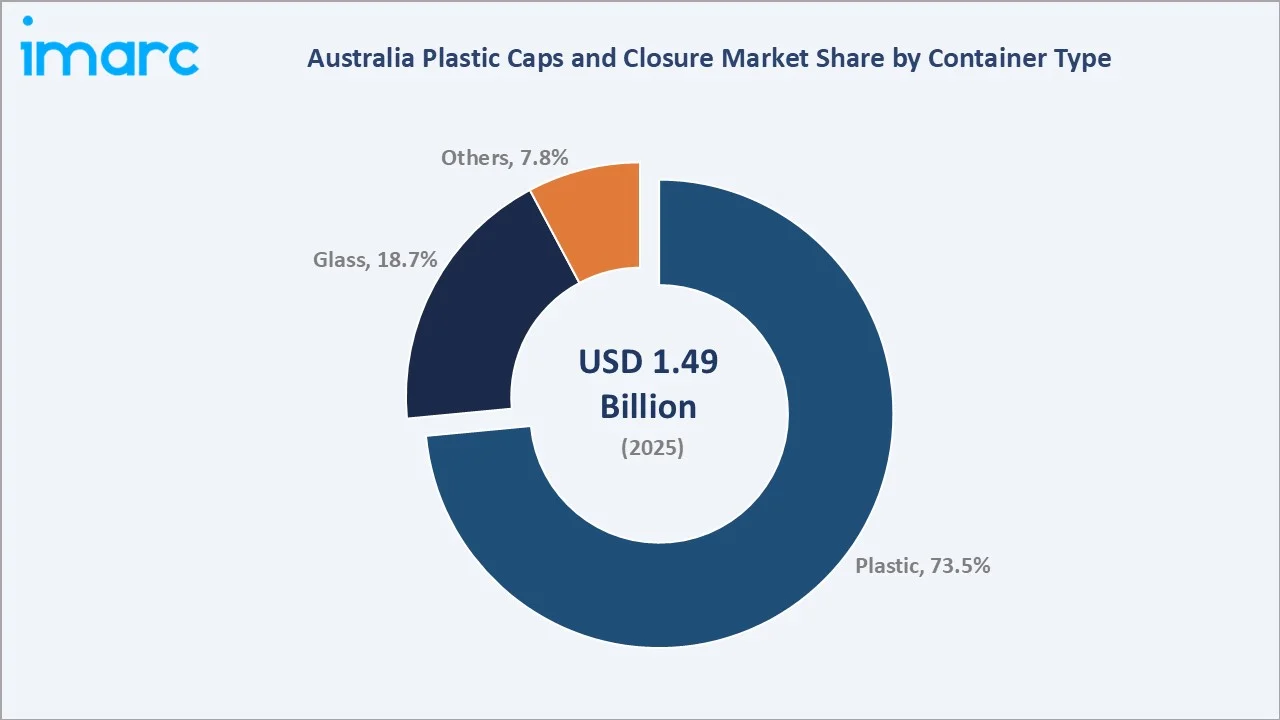
Glass at 18.7%, growing at ~6.20% CAGR, serves Australia's premium wine, spirits, specialty food, and craft beer markets where glass packaging commands premium pricing and consumer quality perception. Others at 7.8% covers metal can ends, composite container closures, and specialty packaging formats.
Regional Market Insights
|
Region |
Share (2025) |
Key Plastic Caps & Closure Market Drivers & Characteristics |
|
Australia Capital Territory & New South Wales |
39.4% |
Dominates due to strong presence of beverage manufacturers, food processing industries, and packaging companies. |
|
Victoria & Tasmania |
24.8% |
Supported by established food and beverage sectors, manufacturing facilities, and increasing adoption of sustainable packaging solutions. |
|
Queensland |
16.2% |
Driven by expanding FMCG production, beverage consumption, and growing need for lightweight and recyclable closure solutions. |
|
Western Australia |
11.0% |
Supported by mining-related workforce demand, food supply chains, and increasing packaging requirements across industries. |
|
Northern Territory & Southern Australia |
8.6% |
Supported by regional retail growth, beverage consumption, and gradual expansion of sustainable packaging practices. |
Australia Capital Territory & New South Wales’s 39.4% market dominance is due to strong demand from beverage, food processing, pharmaceutical, and consumer goods industries. Victoria and Tasmania’s 24.8% represent a significant market share, supported by developed FMCG industries, beverage production, and increasing adoption of sustainable packaging solutions.
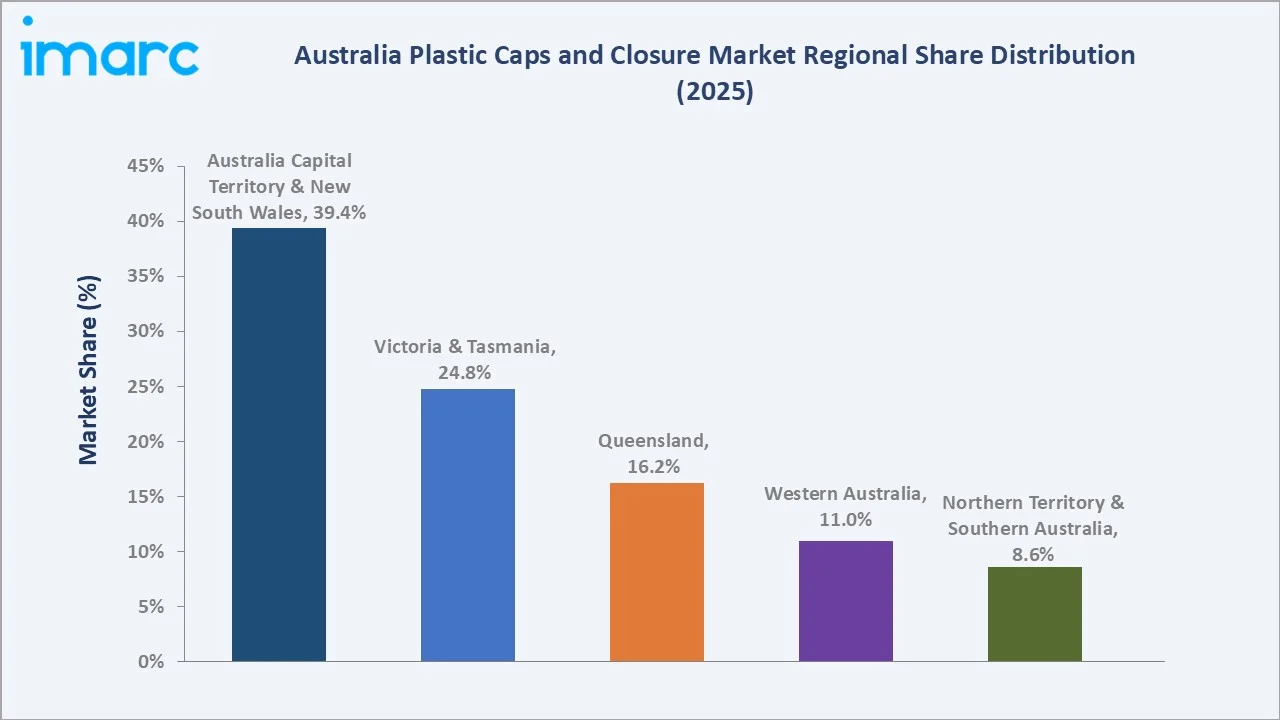
Queensland’s 16.2% is witnessing steady growth driven by rising beverage consumption, expanding food processing activities, and demand for lightweight and recyclable closure products. Western Australia’s 11.0% is supported by industrial activities, mining-related supply chains, and increasing demand for packaged goods across remote and urban areas. The Northern Territory and Southern Australia’s 8.6% markets are gradually expanding due to growth in retail consumption, regional manufacturing, and improved packaging infrastructure.
Competitive Landscape
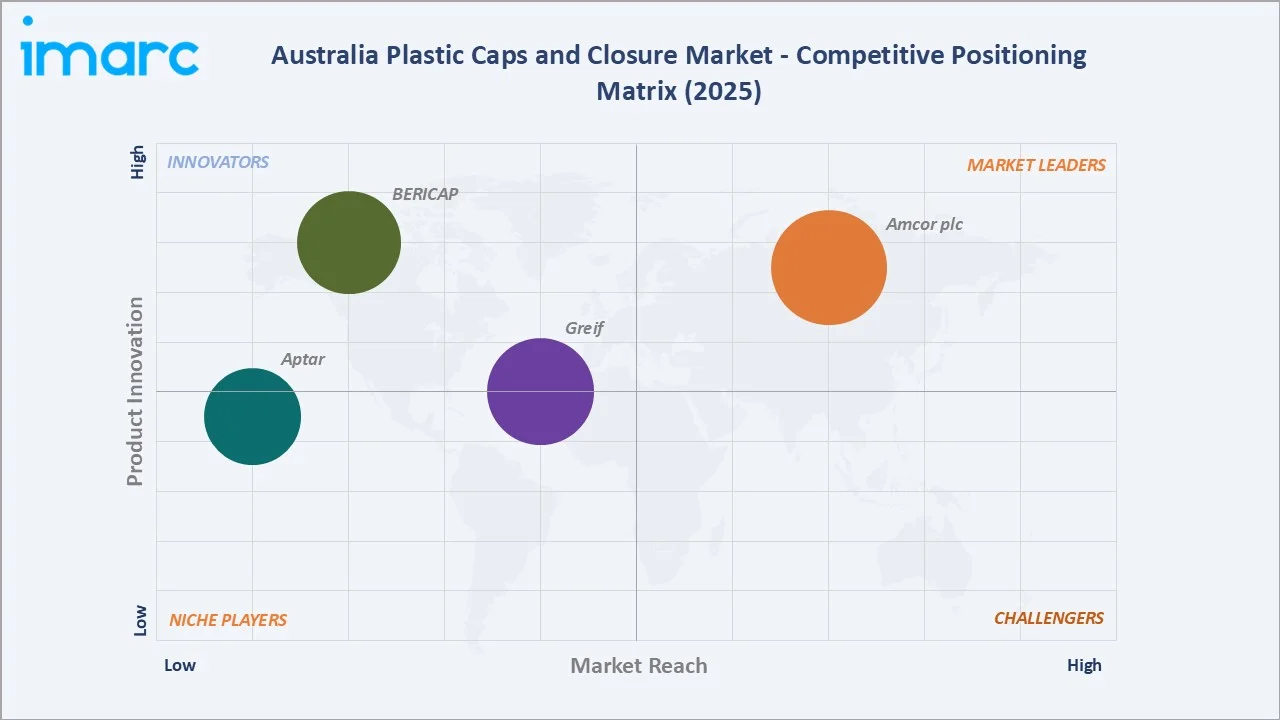
The Australia plastic caps and closure market is moderately concentrated, while a competitive set of international manufacturers supplying Australia through agents and distribution partnerships and domestic specialty manufacturers serve specific product and end-use segments. Market competition is most intense in the commodity beverage closure segment where imported Asian closures compete on price and manufacturing scale.
|
Company |
Key Products |
Market Position |
Core Strength |
|
Amcor plc |
Ultra-Lite Flip-Top Dispensing Closure, 24-410 PP Flip-Top Dispensing Closure, 30mm Classic Flip Top Tube Closure Screw On |
Market Leader |
Amcor plc drives the Australian plastics and closure industry primarily through import supply, material innovation, and sustainability partnerships. |
|
Aptar |
Ultra LT Snap Top, 2-1/8″ Ecolite Snap Top, 2-1/8″ Ultra LT Snap Top, Directional Flip Top, Habanero Snap Top |
Established Player |
Aptar is a leading designer and manufacturer of highly engineered plastic dispensing caps, closures, and flow control valves. |
|
BERICAP |
SK 28/16 CR EPE, SK 28/11,5 EPE (SP400), E-SMOCAP, SK 45/26 NG MAB MDR, SK 31,5/21 PV PEPVDC |
Innovator |
BERICAP is a key international player in the Australian plastic caps and closures market. They supply innovative, sustainable, and high-security closures across sectors like food, beverage, agriculture, and industrial applications. |
|
Greif |
Push-Lock Cap, PLASTICAP-60 Screwcap, PLASTICAP-51 Screwcap, PLASTICAP-70 Screwcap, PLASTICAP AGRO Screwcaps |
Established Player |
Greif plays a prominent role in the Australian plastic caps and closures market through its subsidiary Tri-Sure. |
The competitive landscape is increasingly differentiated by sustainability capability, where manufacturers with demonstrated PCR content integration, tethered closure development, and recyclability compliance provide brand owner customers with the environmental credentials required to meet sustainability commitments, creating a competitive threshold that commodity price-competitive suppliers must meet to sustain shelf position in the premium Australian FMCG closure market.
Key Company Profiles
Amcor plc
Amcor plc is a packaging solutions provider offering flexible and rigid packaging products for food, beverage, healthcare, and consumer goods industries. The company provides a wide range of sustainable packaging solutions, including plastic packaging components and closure-related solutions that support product protection, convenience, and recyclability. In the Australia plastic caps and closures market, Amcor serves major beverage, food, and consumer product manufacturers by providing innovative packaging solutions focused on lightweighting, material efficiency, and sustainability.
- Key Products: Ultra-Lite Flip-Top Dispensing Closure, 24-410 PP Flip-Top Dispensing Closure, 30mm Classic Flip Top Tube Closure Screw On.
- Strategic Focus: Developing recyclable and lower-carbon packaging solutions by increasing the use of recycled materials and improving packaging design efficiency. The company aims to support Australia’s transition toward circular plastic packaging systems.
Greif
Greif is an industrial packaging manufacturer providing rigid packaging solutions, container products, and closure systems for industries including chemicals, food ingredients, pharmaceuticals, and consumer products. The company offers a range of packaging components, including plastic closures, caps, and accessories designed for safe handling, storage, and transportation of various products. In the Australia plastic caps and closures market, Greif supports industrial and specialty packaging applications through durable closure solutions that enhance product protection, security, and supply chain efficiency.
- Key Products: Push-Lock Cap, PLASTICAP-60 Screwcap, PLASTICAP-51 Screwcap, PLASTICAP-70 Screwcap, PLASTICAP AGRO Screwcaps.
- Strategic Focus: Developing sustainable packaging solutions by increasing the use of recycled materials and improving packaging recyclability. The company aims to support customers in reducing environmental impact and meeting circular economy objectives.
Market Concentration Analysis
The Australia plastic caps and closures market is moderately concentrated, with global packaging companies holding significant market presence. Leading players benefit from strong manufacturing capabilities, established customer relationships, and advanced closure production technologies. The market has moderate entry barriers due to requirements for specialized tooling, injection molding expertise, quality standards, and sustainable material capabilities. Competition is increasingly focused on recyclable closures, recycled content adoption, lightweight designs, and compliance with circular economy regulations. Regional manufacturers and specialized packaging suppliers continue to compete by offering customized solutions for beverage, food, pharmaceutical, and industrial applications. Overall, the market is driven by innovation and sustainability initiatives, with major players maintaining competitive advantages through technology investments and supply chain capabilities.
Investment & Growth Opportunities
Highest Growth Segments
NT and Southern Australia (~6.80% CAGR), dispensing caps (~6.50% CAGR), glass container closures (~6.20% CAGR), Western Australia (~6.10% CAGR), and pharmaceutical child-resistant closures represent the Australia plastic caps and closure market's highest-growth investment vectors through 2034.
Investment Themes
- Tethered Closure Manufacturing Investment: Investment in tethered closure manufacturing is creating opportunities as beverage packaging regulations increasingly require caps to remain attached to bottles to improve recycling efficiency. Manufacturers can invest in specialized tooling, injection molding equipment, and production upgrades to meet rising demand for compliant and sustainable closure solutions.
- PCR Content Closure Manufacturing Capacity: Expanding post-consumer recycled (PCR) content closure manufacturing capacity offers growth opportunities as brands and regulators emphasize circular packaging solutions. Investments in recycled resin processing, advanced manufacturing technologies, and recycling partnerships can help producers meet sustainability targets while reducing dependence on virgin plastic materials.
Future Market Outlook (2026-2034)
The Australia plastic caps and closure market is projected to grow from USD 1.49 Billion in 2025 to USD 2.51 Billion by 2034, delivering a 5.68% CAGR that reflects the convergence of Australia's sustained FMCG market expansion, the progressive premiumization of Australian consumer product categories driving closure value growth above unit volume growth, and the sustainability-driven redesign cycle that brand owner commitments are creating across the Australian packaging industry. The anchor value of USD 1.97 Billion in 2030 is driven by three structural forces that compound through the forecast period.
First, Australia's FMCG industry expansion creates a structural volume demand growth for closures that tracks Australian FMCG output at above GDP growth. The fastest-growing closure demand comes from the beverage category's ongoing product diversification, where each new product requires a distinct closure specification and generates new tooling and product development investment. Second, the Australian government sustainability policy framework is creating a redesign-driven growth catalyst within the closure market that is distinct from volume-driven demand expansion: as brand owners implement compliant packaging specifications, they create tooling investment and product development cycles in the closure manufacturing industry that generate revenue above the baseline volume growth trajectory. Third, the premiumization of Australian consumer products is progressively increasing the average price per closure across all product categories: wine and spirits switching from synthetic corks to premium PP screw closures, personal care brands adopting elevated dispensing closure specifications for premium brand positioning, pharmaceutical products requiring active packaging closures with desiccant integration, and specialty food brands selecting premium closure designs that communicate quality differentiation on retail shelves.
Research Methodology
Primary Research
Primary research comprised in-depth interviews with closure manufacturing executives, FMCG packaging procurement managers, packaging sustainability directors, Packaging Council of Australia industry representatives, Australian Materials Handling Institute professionals, and independent packaging consultants. Discussions validated market size estimates, product type and container type segment dynamics, regional demand patterns, competitive positioning, and technology adoption timelines.
Secondary Research
Secondary research encompassed National Packaging Targets progress reports, Australian Container Deposit Scheme operational data, food packaging regulations, pharmaceutical packaging requirements, company annual reports and investor presentations, and joint venture press releases.
Forecasting Models
Forecasting models were developed using historical Australia plastic caps and closure market data, FMCG volume growth projection by sector (beverage, food, personal care, pharmaceutical), Australian population growth demographic modelling, sustainability redesign cycle investment estimation, PCR content integration timeline and cost impact modelling, regional market growth differential analysis across Australian regions, tethered closure adoption rate scenario analysis, premiumization-driven average selling price increase estimation, and competitive market share trajectory by key manufacturer. Both top-down and bottom-up approaches were validated through primary research.
Australia Plastic Caps and Closure Market Report Coverage:
| Report Features | Details |
|---|---|
| Base Year of the Analysis | 2025 |
| Historical Period | 2020-2025 |
| Forecast Period | 2026-2034 |
| Units | Billion USD |
| Scope of the Report | Exploration of Historical Trends and Market Outlook, Industry Catalysts and Challenges, Segment-Wise Historical and Future Market Assessment:
|
| Product Types Covered | Screw-On Caps, Dispensing Caps, Others |
| Raw Materials Covered | PET, PP, HDPE, LDPE, Others |
| Container Types Covered | Plastic, Glass, Others |
| Technologies Covered | Injection Molding, Compression Molding, Post-Mold Tamper-Evident Band |
| End Uses Covered | Beverages, Industrial Chemicals, Food, Cosmetics, Household Chemicals, Pharmaceuticals, Others |
| Regions Covered | Australia Capital Territory & New South Wales, Victoria & Tasmania, Queensland, Northern Territory & Southern Australia, Western Australia |
| Companies Covered | Amcor plc, Aptar, BERICAP, Greif, etc. |
| Customization Scope | 10% Free Customization |
| Post-Sale Analyst Support | 10-12 Weeks |
| Delivery Format | PDF and Excel through Email (We can also provide the editable version of the report in PPT/Word format on special request) |
Key Benefits for Stakeholders:
- IMARC’s industry report offers a comprehensive quantitative analysis of various market segments, historical and current market trends, market forecasts, and dynamics of the Australia plastic caps and closure market from 2020-2034.
- The research report provides the latest information on the market drivers, challenges, and opportunities in the Australia plastic caps and closure market.
- Porter's five forces analysis assist stakeholders in assessing the impact of new entrants, competitive rivalry, supplier power, buyer power, and the threat of substitution. It helps stakeholders to analyze the level of competition within the Australia plastic caps and closure industry and its attractiveness.
- Competitive landscape allows stakeholders to understand their competitive environment and provides an insight into the current positions of key players in the market.
Frequently Asked Questions About the Australia Plastic Caps and Closure Market Report
The Australia plastic caps and closure market reached USD 1.49 Billion in 2025, driven by FMCG sector expansion with bottled water and RTD beverage category growth creating beverage closure volume demand, recyclable packaging design requiring closure redesign investment, pharmaceutical sector growth requiring child-resistant and tamper-evident closures, and Australia's Container Deposit Scheme expansion driving recycled content specification requirements.
The market grows at 5.68% CAGR, reaching USD 2.51 Billion by 2034. Growth is driven by rising FMCG and beverage consumption, increasing demand for sustainable packaging solutions, recycled content closures, and advancements in lightweight and recyclable closure technologies.
Screw-on caps lead at 68.5% (2025) through application in Australia's highest-volume consumer packaging formats: HDPE food and dairy closures, household chemical container caps, and industrial packaging closures.
Plastic leads at 73.5% (2025) through PET beverage bottle closures, HDPE household chemical containers, HDPE dairy containers, and food PP/PE containers.
Australia Capital Territory & New South Wales lead at 39.4% (2025) through closure manufacturing, Sydney FMCG distribution hub concentration, and the NSW food processing sector.
Leading companies include Amcor plc, Aptar, BERICAP, and Greif, among others.
The market is projected to reach USD 1.97 Billion by 2030, driven by FMCG beverage and food sector volume growth from Australian population expansion, Australian market tethered closure specification adoption in alignment with global brand packaging platform, craft spirits and premium wine glass closure segment growth, and pharmaceutical sector closure volume growth from aging population demographics and NDIS pharmaceutical coverage expansion.
Top opportunities include tethered closure tooling investment, PCR-content closure manufacturing, pharmaceutical child-resistant closure, premium dispensing closure import/distribution, South Australia/NT industrial closure manufacturing, and craft beverage specialty closures.
Need more help?
- Speak to our experienced analysts for insights on the current market scenarios.
- Include additional segments and countries to customize the report as per your requirement.
- Gain an unparalleled competitive advantage in your domain by understanding how to utilize the report and positively impacting your operations and revenue.
- For further assistance, please connect with our analysts.
 Request Customization
 Speak to an Analyst
 Request Brochure
 Inquire Before Buying
Benefits of Customization
- Personalize this research
- Triangulate with your data
- Get data as per your format and definition
- Gain a deeper dive into a specific application, geography, customer, or competitor
- Any level of personalization
Get in Touch With Us
UNITED STATES
Phone: +1-201-971-6302
INDIA
Phone: +91-120-433-0800
UNITED KINGDOM
Phone: +44-753-714-6104
Email: [email protected]
Client Testimonials




.webp)




.webp)













Related Reports

Choose your plan
*Please note that the prices mentioned below are starting prices for each bundle type. Kindly contact our team for further details.*
Single User License
- 1 User License, Access on 2 Devices
- PDF Report + Excel Dataset (Password Protected)
- Lifetime Access
- No Printing Rights
- 10% Free Report Customization
- 10–12 Weeks of Analyst Support
Five User License
- Access for 5 Users, 2 Devices per User
- PDF Report + Excel Dataset (Password Protected)
- Lifetime Access
- Dedicated Account Manager
- 12–14 Weeks of Analyst Support
- No Printing Rights
- 15% Free Report Customization
- 25% Discount on Your Next Purchase
Corporate User License
- Unlimited User Access (Within Your Organization)
- PDF Report + Excel Dataset
- Lifetime Access
- Dedicated Account Manager
- 14–20 Weeks of Analyst Support
- No Printing Rights
- 20% Free Report Customization
- 30% Discount on Your Next Purchase
Essential Insights
What's included:
3 reports
- Lifetime Access
- PDF Reports
- Excel Datasets
- 2 Weeks of Free Analyst Support
- 2 User Licenses
- Access on 2 Devices
- Printing Rights
- Complimentary PowerPoint (PPT) Version
- Complimentary License Upgrade
Professional Access
What's included:
5 reports
- Lifetime Access
- PDF Reports
- Excel Datasets
- 8 Weeks of Free Analyst Support
- 2 User Licenses
- Access on 2 Devices
- Printing Rights
- Complimentary PowerPoint (PPT) Version
- Complimentary License Upgrade
Business Advantage
What's included:
8 reports
- Lifetime Access
- PDF Reports
- Excel Datasets
- 14 Weeks of Free Analyst Support
- 2 User Licenses
- Access on 2 Devices
- Printing Rights
- Complimentary PowerPoint (PPT) Version
- Complimentary License Upgrade
Enterprise Intelligence
What's included:
10 reports
- Lifetime Access
- PDF Reports
- Excel Datasets
- 20 Weeks of Free Analyst Support
- 2 User Licenses
- Access on 2 Devices
- Printing Rights
- Complimentary PowerPoint (PPT) Version
- Complimentary License Upgrade