
Australia Port Infrastructure Market Size, Share, Trends and Forecast by Port Type, Construction Type, Application, and Region, 2026-2034
Australia Port Infrastructure Market Overview:
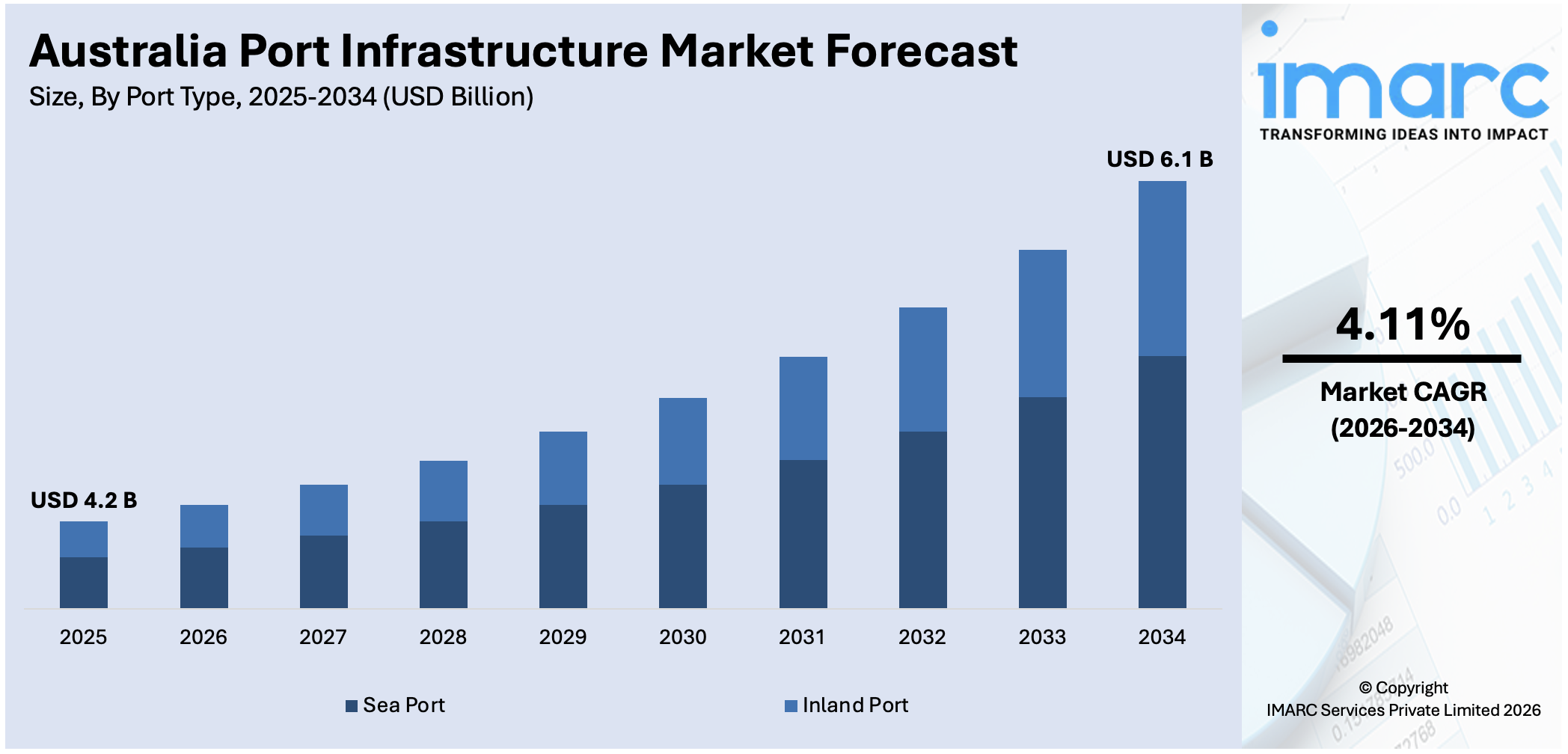
The Australia Port Infrastructure market size reached USD 4.2 Billion in 2025. Looking forward, the market is projected to reach USD 6.1 Billion by 2034, exhibiting a growth rate (CAGR) of 4.11% during 2026-2034. Increased international trade, large investments in port facility upgrades, an increase in import/export activity, the growth of container shipping, and the government's emphasis on improving logistics efficiency are some of the major factors propelling the market. Modernization initiatives are also being impacted by sustainability objectives and environmental regulations.
|
Report Attribute
|
Key Statistics
|
|---|---|
|
Base Year
|
2025 |
|
Forecast Years
|
2026-2034
|
|
Historical Years
|
2020-2025
|
| Market Size in 2025 | USD 4.2 Billion |
| Market Forecast in 2034 | USD 6.1 Billion |
| Market Growth Rate (2026-2034) | 4.11% |
Key Trends of Australia Port Infrastructure Market:
Digital Transformation in Port Operations
Australia's port infrastructure is increasingly adopting digital solutions to enhance operational efficiency. The integration of IoT, blockchain, and big data analytics is transforming port management systems. These technologies enable real-time monitoring of shipping, cargo movement, and logistics processes, reducing congestion and improving supply chain visibility. Port operators are using advanced digital platforms to optimize resource allocation, streamline operations, and reduce turnaround times for vessels. As demand for faster, more efficient port services grows, the digital transformation is becoming critical in maintaining Australia's competitive edge in the global shipping industry. Moreover, these advancements contribute to improved safety protocols, minimizing human error and ensuring smoother port operations. For instance, in September 2023, Beca collaborated with the Port of Melbourne to future-proof its operations through a long-term strategy aimed at enhancing port capacity and efficiency by 2050. This includes the development of an Asset Visualisation Strategy, focusing on digitising port infrastructure and leveraging smart technologies to meet growing international trade demands. Key to this approach is problem-oriented digital transformation, grounded in understanding real-world issues and long-term goals. The collaboration highlights the importance of a strong foundation in asset data and flexible planning to enable ongoing technological adaptation. Beca’s expertise helps the port explore sustainable, smart solutions, thereby supporting market’s expansion.
To get more information on this market Request Sample
Sustainability and Green Initiatives
There is a growing trend in Australia's port infrastructure to implement green initiatives aimed at reducing environmental impact. Ports are investing in sustainable technologies, such as shore power for vessels, which allows ships to plug into the local power grid rather than running engines while docked. This reduces carbon emissions and air pollution. In addition, many Australian ports are exploring renewable energy sources, such as wind and solar power, to support port operations. Waste management and water conservation strategies are also being integrated into infrastructure upgrades to promote sustainability. For instance, in September 2024, the Clean Energy Finance Corporation (CEFC) planned to invest AUD 70 million through the Albanese Government to electrify South Australian ports, marking Australia's first green financing for container stevedoring operations. This initiative targets emissions reduction and operational cost savings at Flinders Port Holdings (FPH), including solar system installations, replacing light vehicles with electric vehicles (EVs), and potentially using an all-electric crane at Port Adelaide. Additionally, the project explores connecting berthed ships to the grid to reduce diesel dependence. This effort aligns with Australia’s broader goal to decarbonize ports and the maritime industry. Hence, as environmental regulations become stricter and demand for eco-friendly logistics increases, these green initiatives are key to aligning with global sustainability trends.
Privatization and Public-Private Partnerships (PPP)
In recent years, Australia's port infrastructure has seen a shift toward privatization and public-private partnerships (PPPs), with government authorities increasingly collaborating with private investors to fund development projects. A prime example of this trend is the AUD 95 million upgrade of Papua New Guinea’s Kimbe Port, supported by the Albanese Government in February 2025. Funded by the AIFFP, the project aims to improve freight services, climate resilience, and economic growth by reconstructing wharf structures and rehabilitating existing facilities. This initiative is part of the broader AIFFP-funded PNG Ports Infrastructure Investment Program, which includes upgrades to Oro Bay, Daru, Lae, and Kavieng ports. The shift toward PPPs in Australia's port infrastructure is driven by the need for substantial capital investments to modernize facilities, improve technology, and expand capacity, with the private sector contributing expertise and efficiency.
Growth Drivers of Australia Port Infrastructure Market:
Rising International Trade Volumes
Increasing volumes of international trade are a significant driver behind Australia port infrastructure market growth. The country's growing export portfolio including minerals, energy, and agricultural products necessitates efficient and high-capacity port facilities to handle the rising cargo throughput. Likewise, booming import activities fueled by manufacturing and retail growth are leading to the large-scale modernization of terminals and logistics networks. Both governmental and private entities are making substantial investments in deep-water ports, advanced cargo handling technologies, and digital management systems to enhance efficiency and alleviate congestion. Improved multimodal connectivity between ports, rail, and road transportation further facilitates smooth trade operations. Strengthened trade relations with countries in the Asia-Pacific region, along with a trend toward sustainable, technology-driven practices, continue to drive infrastructure enhancements, bolstering Australia port infrastructure market demand and establishing the nation as a prominent maritime hub in the area.
Expansion of Maritime Logistics and Supply Chains
The increasing intricacy of maritime logistics and supply chains is necessitating considerable upgrades in Australia’s port infrastructure. Effective cargo movement, decreased vessel turnaround times, and streamlined operations have become essential for preserving Australia’s competitiveness in trade. Ports are embracing digital tracking systems, automated cranes, and integrated logistics platforms to enhance throughput and coordination among shipping companies, freight operators, and inland transportation networks. These upgrades are critical for accommodating the rising volumes of containerized and bulk cargo, driven by industrial growth and consumer needs. Furthermore, integrating ports within global supply chains boosts reliability and minimizes operational bottlenecks. As supply chains grow more interconnected and reliant on technology, investments in port modernization are on the rise, enhancing operational resilience and increasing Australia port infrastructure market share in the regional maritime sector.
Government Investments and Policy Support
Government initiatives and policy frameworks are vital in propelling Australia’s port infrastructure forward. Through targeted public funding, infrastructure development grants, and regulatory changes, the government promotes modernization, capacity enhancement, and sustainable development across major ports. Strategic programs aimed at trade facilitation, regional connectivity, and economic diversification are accelerating port enhancements. Additionally, long-term maritime strategies highlight private sector collaboration through public-private partnerships (PPPs), ensuring balanced investment and innovation within port operations. These initiatives contribute to improved logistics efficiency, job creation, and export competitiveness, positioning Australia as a significant hub in the Asia-Pacific trade corridor. According to Australia port infrastructure market analysis, by aligning infrastructure development with environmental and economic objectives, policymakers are nurturing a more resilient and forward-looking maritime sector.
Australia Port Infrastructure Market Segmentation:
IMARC Group provides an analysis of the key trends in each segment of the market, along with forecasts at the region/country level for 2026-2034. Our report has categorized the market based on port type, construction type, and application.
Port Type Insights:
- Sea Port
- Inland Port
The report has provided a detailed breakup and analysis of the market based on the port type. This includes sea port and inland port.
Construction Type Insights:
- Terminal
- Equipment
The report has provided a detailed breakup and analysis of the market based on the construction type. This includes terminal and equipment.
Application Insights:
Access the comprehensive market breakdown Request Sample
- Passenger
- Cargo
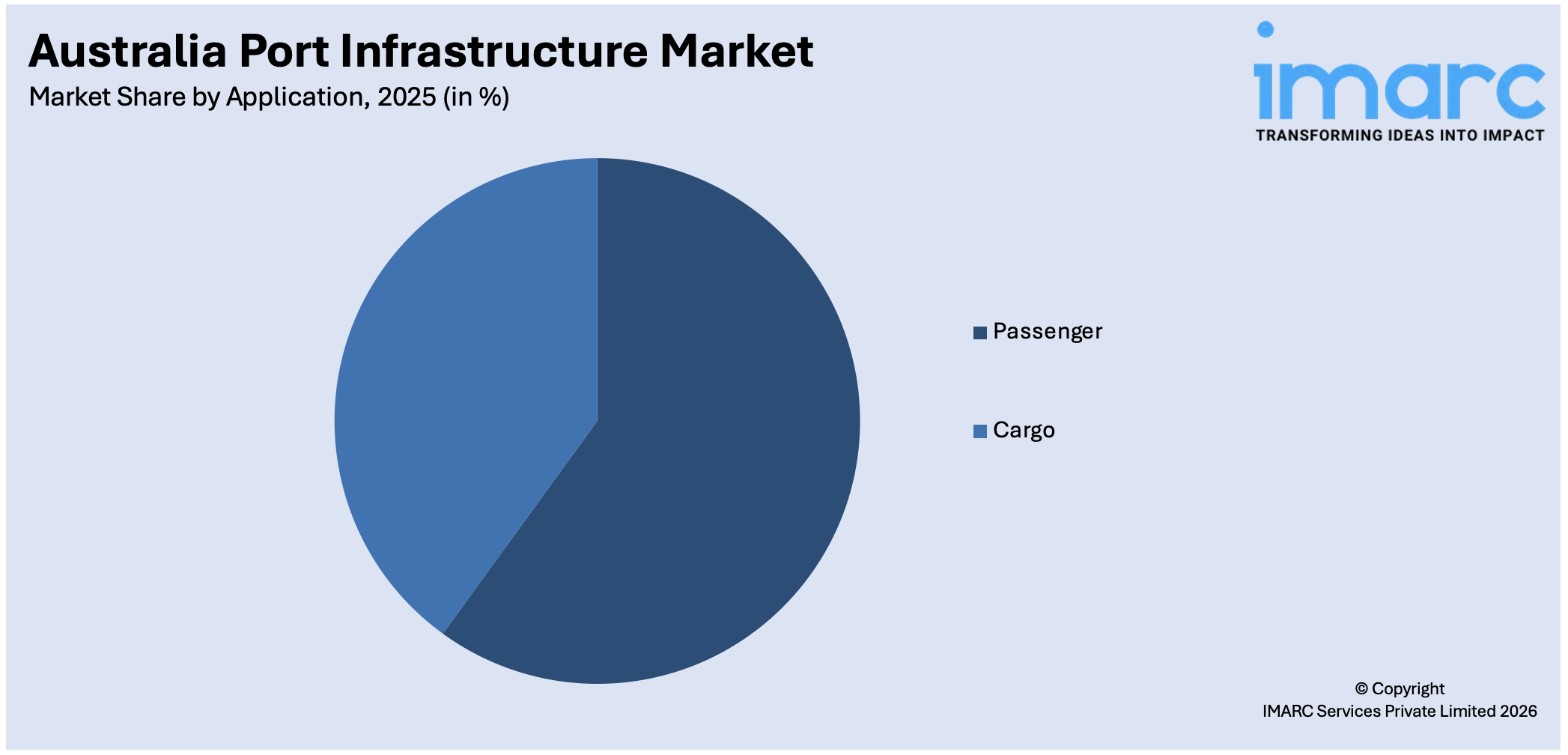
The report has provided a detailed breakup and analysis of the market based on the application. This includes passenger and cargo.
Regional Insights:
- Australia Capital Territory & New South Wales
- Victoria & Tasmania
- Queensland
- Northern Territory & Southern Australia
- Western Australia
The report has also provided a comprehensive analysis of all the major regional markets, which include Australia Capital Territory & New South Wales, Victoria & Tasmania, Queensland, Northern Territory & Southern Australia, and Western Australia.
Competitive Landscape:
The market research report has also provided a comprehensive analysis of the competitive landscape. Competitive analysis such as market structure, key player positioning, top winning strategies, competitive dashboard, and company evaluation quadrant has been covered in the report. Also, detailed profiles of all major companies have been provided.
Australia Port Infrastructure Market News:
- In December 2024, Auriga Group expanded its marine services in northern Australia by acquiring Darwin Tug and Line Services (DTLS), which operates a fleet of 17 vessels. This acquisition enhances Auriga's capabilities in the Northern Territory, adding six tugboats, four workboats, and other specialized vessels.
- In January 2025, Engage Marine broadened its fleet after securing towage contracts for several Queensland ports, including Townsville, Cairns, Lucinda, and Mourilyan. The contracts, awarded by Port of Townsville and Ports North, will replace services from Svitzer and Smit Lamnalco. Engage Marine will introduce a fleet of seven new tugs by mid-2025, growing its owned vessels to over 40.
Australia Port Infrastructure Market Report Coverage:
| Report Features | Details |
|---|---|
| Base Year of the Analysis | 2025 |
| Historical Period | 2020-2025 |
| Forecast Period | 2026-2034 |
| Units | Billion USD |
| Scope of the Report |
Exploration of Historical Trends and Market Outlook, Industry Catalysts and Challenges, Segment-Wise Historical and Future Market Assessment:
|
| Port Types Covered | Sea Port, Inland Port |
| Construction Types Covered | Terminal, Equipment |
| Applications Covered | Passenger, Cargo |
| Regions Covered |
Australia Capital Territory & New South Wales, Victoria & Tasmania, Queensland, Northern Territory & Southern Australia, Western Australia |
| Customization Scope | 10% Free Customization |
| Post-Sale Analyst Support | 10-12 Weeks |
| Delivery Format | PDF and Excel through Email (We can also provide the editable version of the report in PPT/Word format on special request) |
Key Benefits for Stakeholders:
- IMARC’s industry report offers a comprehensive quantitative analysis of various market segments, historical and current market trends, market forecasts, and dynamics of the Australia port infrastructure market from 2020-2034.
- The research report provides the latest information on the market drivers, challenges, and opportunities in the Australia port infrastructure market.
- Porter's five forces analysis assist stakeholders in assessing the impact of new entrants, competitive rivalry, supplier power, buyer power, and the threat of substitution. It helps stakeholders to analyze the level of competition within the Australia port infrastructure industry and its attractiveness.
- Competitive landscape allows stakeholders to understand their competitive environment and provides an insight into the current positions of key players in the market.
Frequently Asked Questions About the Australia Port Infrastructure Market Report
The port infrastructure market in Australia was valued at USD 4.2 Billion in 2025.
The Australia port infrastructure market is projected to exhibit a compound annual growth rate (CAGR) of 4.11% during 2026-2034.
The Australia port infrastructure market is expected to reach a value of USD 6.1 Billion by 2034.
The Australia port infrastructure market is witnessing trends such as the adoption of smart port technologies, automation in cargo handling, and the integration of digital tracking systems. Sustainability initiatives, including green port designs and renewable energy use, are also shaping development, alongside rising investments in intermodal connectivity.
Key factors driving the Australia port infrastructure market include expanding international trade volumes, government funding for maritime upgrades, and growing private sector participation. The surge in exports of minerals and agricultural commodities, coupled with logistics modernization and port capacity expansion projects, continues to strengthen market growth momentum.
Need more help?
- Speak to our experienced analysts for insights on the current market scenarios.
- Include additional segments and countries to customize the report as per your requirement.
- Gain an unparalleled competitive advantage in your domain by understanding how to utilize the report and positively impacting your operations and revenue.
- For further assistance, please connect with our analysts.
 Request Customization
 Speak to an Analyst
 Request Brochure
 Inquire Before Buying
Benefits of Customization
- Personalize this research
- Triangulate with your data
- Get data as per your format and definition
- Gain a deeper dive into a specific application, geography, customer, or competitor
- Any level of personalization
Get in Touch With Us
UNITED STATES
Phone: +1-201-971-6302
INDIA
Phone: +91-120-433-0800
UNITED KINGDOM
Phone: +44-753-714-6104
Email: [email protected]
Client Testimonials




.webp)




.webp)













Related Reports

Choose your plan
*Please note that the prices mentioned below are starting prices for each bundle type. Kindly contact our team for further details.*
Single User License
- 1 User License, Access on 2 Devices
- PDF Report + Excel Dataset (Password Protected)
- Lifetime Access
- No Printing Rights
- 10% Free Report Customization
- 10–12 Weeks of Analyst Support
Five User License
- Access for 5 Users, 2 Devices per User
- PDF Report + Excel Dataset (Password Protected)
- Lifetime Access
- Dedicated Account Manager
- 12–14 Weeks of Analyst Support
- No Printing Rights
- 15% Free Report Customization
- 25% Discount on Your Next Purchase
Corporate User License
- Unlimited User Access (Within Your Organization)
- PDF Report + Excel Dataset
- Lifetime Access
- Dedicated Account Manager
- 14–20 Weeks of Analyst Support
- No Printing Rights
- 20% Free Report Customization
- 30% Discount on Your Next Purchase
Essential Insights
What's included:
3 reports
- Lifetime Access
- PDF Reports
- Excel Datasets
- 2 Weeks of Free Analyst Support
- 2 User Licenses
- Access on 2 Devices
- Printing Rights
- Complimentary PowerPoint (PPT) Version
- Complimentary License Upgrade
Professional Access
What's included:
5 reports
- Lifetime Access
- PDF Reports
- Excel Datasets
- 8 Weeks of Free Analyst Support
- 2 User Licenses
- Access on 2 Devices
- Printing Rights
- Complimentary PowerPoint (PPT) Version
- Complimentary License Upgrade
Business Advantage
What's included:
8 reports
- Lifetime Access
- PDF Reports
- Excel Datasets
- 14 Weeks of Free Analyst Support
- 2 User Licenses
- Access on 2 Devices
- Printing Rights
- Complimentary PowerPoint (PPT) Version
- Complimentary License Upgrade
Enterprise Intelligence
What's included:
10 reports
- Lifetime Access
- PDF Reports
- Excel Datasets
- 20 Weeks of Free Analyst Support
- 2 User Licenses
- Access on 2 Devices
- Printing Rights
- Complimentary PowerPoint (PPT) Version
- Complimentary License Upgrade