
Australia Programmable Logic Controller (PLC) Market Size, Share, Trends and Forecast by Type, End Use Industry, and Region, 2026-2034
Australia Programmable Logic Controller (PLC) Market Summary:
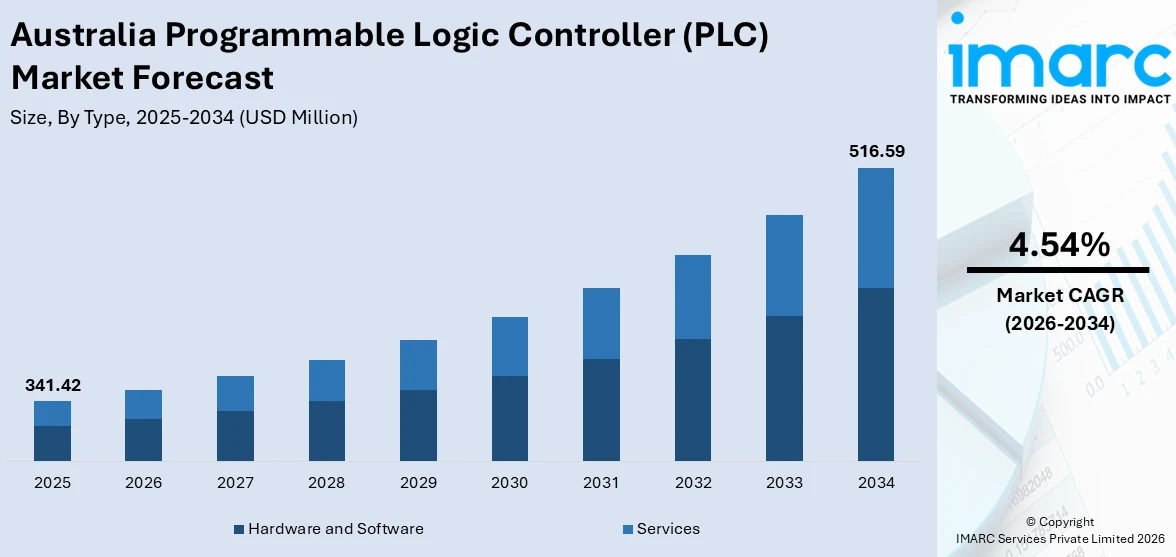
The Australia programmable logic controller (PLC) market size was valued at USD 341.42 Million in 2025 and is projected to reach USD 516.59 Million by 2034, growing at a compound annual growth rate of 4.54% from 2026-2034.
The Australia programmable logic controller market is experiencing sustained expansion, underpinned by the nation’s accelerating transition toward Industry 4.0 and smart manufacturing frameworks. Growing demand for automated process control across mining, energy, food processing, and water treatment sectors is reinforcing the need for advanced PLC solutions. Government-backed initiatives promoting sovereign manufacturing capability, coupled with rising integration of IoT-enabled systems and AI-driven analytics into industrial operations, are creating a favorable environment for PLC adoption. Additionally, investments in critical minerals processing and renewable energy infrastructure are generating new applications for programmable controllers, further strengthening the Australia programmable logic controller (PLC) market share.
Key Takeaways and Insights:
- By Type: Hardware and software dominate the market with a share of 72.5% in 2025, driven by the essential role of physical controllers and integrated software platforms in managing complex industrial automation processes across diverse sectors.
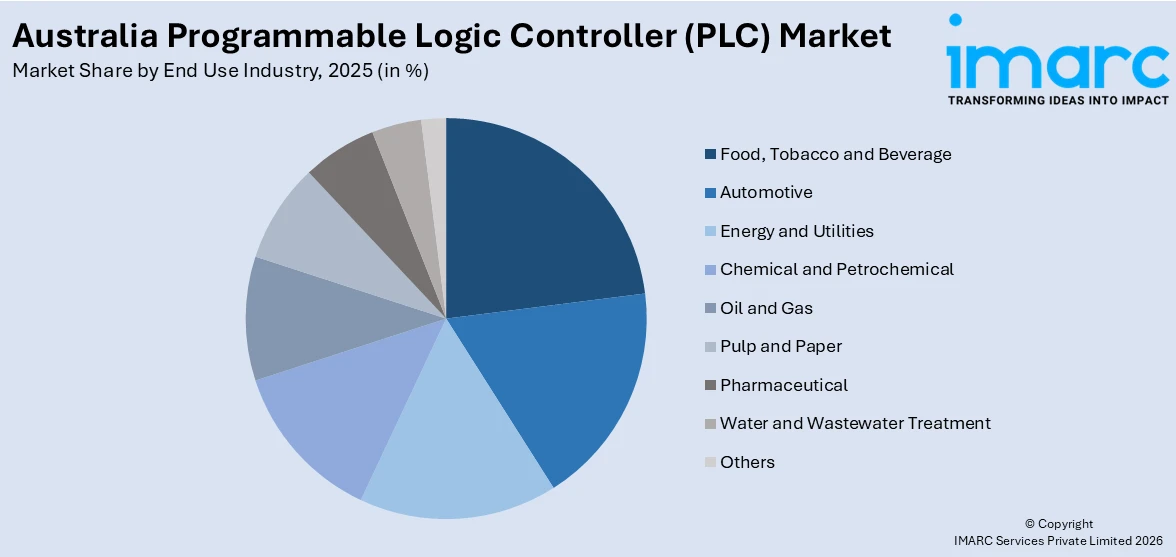
- By End Use Industry: Food, tobacco and beverage represent the largest segment with a market share of 18.5% in 2025, owing to stringent food safety regulations and rising automation adoption for quality assurance and production efficiency.
- By Region: Australia Capital Territory & New South Wales dominates the market with a share of 34.8% in 2025, supported by its concentration of manufacturing facilities, advanced technology hubs, and major infrastructure investments.
- Key Players: The Australia PLC market features a moderately consolidated competitive landscape, with established multinational automation providers competing through technological innovation, integrated solution offerings, localized service networks, and strategic partnerships with regional distributors to strengthen market positioning.
To get more information on this market Request Sample
The Australia programmable logic controller market is advancing as industries across the nation embrace digital transformation and automated process control to enhance productivity and operational efficiency. The growing complexity of manufacturing operations, combined with stringent regulatory requirements for product quality and workplace safety, is accelerating the deployment of PLC-based automation systems. Key sectors including food and beverage processing, energy generation, mining, and water treatment, are investing in modernized control infrastructure to meet rising demand and sustainability targets. For instance, in May 2025, OMRON opened its first Proof of Concept Centre in Parramatta, Sydney, co-located with Western Sydney University, projected to contribute over $150 million to the local economy within five years. The facility supports manufacturers in trialing advanced automation technologies, including robotics, AI, machine vision, and IoT solutions, underscoring Australia’s commitment to building sovereign manufacturing capabilities and fostering innovation-driven industrial growth.
Australia Programmable Logic Controller (PLC) Market Trends:
Integration of Artificial Intelligence and Edge Computing in PLC Platforms
The convergence of artificial intelligence and edge computing with traditional PLC architectures is transforming industrial automation across Australia. Modern PLC systems are increasingly incorporating AI-driven capabilities for predictive maintenance, real-time process optimization, and autonomous decision-making at the machine level. This evolution enables manufacturers to reduce unplanned downtime, improve energy efficiency, and enhance production quality without relying on cloud-based processing. For instance, in September 2024, Schneider Electric launched generative AI functionality within its PLC programming suite, allowing engineers to interact with an AI chatbot that suggests code snippets directly within the development environment, significantly reducing programming time and deployment complexity for the Australia programmable logic controller (PLC) market growth.
Rising Adoption of IIoT-Enabled PLCs for Smart Factory Ecosystems
Australian manufacturers are increasingly deploying Industrial Internet of Things-enabled programmable logic controllers to build interconnected, data-driven production environments. These advanced PLCs facilitate seamless communication between sensors, actuators, SCADA systems, and enterprise resource planning platforms, enabling real-time visibility across entire manufacturing operations. The trend supports predictive analytics, remote monitoring, and adaptive process control, helping facilities respond dynamically to changing production demands. For instance, in June 2024, Bystronic and Lowa Lighting unveiled Australia’s first Bystronic Smart Factory in Sydney, integrating advanced automation technology for large-scale LED lighting manufacturing, demonstrating how IIoT-connected systems can streamline complex production workflows in the Australian market.
Expansion of Cybersecurity-Native PLC Architectures
As PLCs become more connected through networked environments and cloud integrations, cybersecurity has emerged as a critical design consideration for industrial control systems in Australia. Manufacturers are increasingly demanding PLC platforms with built-in security features, including secure boot sequences, encrypted communications, and role-based access controls. This trend is driven by growing awareness of operational technology vulnerabilities and tightening regulatory frameworks around critical infrastructure protection. For instance, APS Industrial and Siemens recently introduced the S7-1200 G2 PLC to the Australian market, featuring native cybersecurity capabilities and Near Field Communication technology that enables instant fault diagnosis using smartphones, enhancing both security posture and maintenance efficiency.
Market Outlook 2026-2034:
The Australia programmable logic controller market is poised for sustained growth over the forecast period, supported by ongoing industrial modernization, expanding automation adoption across process and discrete manufacturing sectors, and government investment in sovereign capability building. The proliferation of smart factory initiatives, rising demand for energy-efficient production systems, and growth in critical minerals processing and renewable energy infrastructure will continue driving PLC deployment. Additionally, the integration of advanced technologies such as artificial intelligence, digital twins, and IIoT connectivity into PLC ecosystems will create new application opportunities across diverse industrial verticals. The market generated a revenue of USD 341.42 Million in 2025 and is projected to reach a revenue of USD 516.59 Million by 2034, growing at a compound annual growth rate of 4.54% from 2026-2034.
Australia Programmable Logic Controller (PLC) Market Report Segmentation:
|
Segment Category |
Leading Segment |
Market Share |
|
Type |
Hardware and Software |
72.5% |
|
End Use Industry |
Food, Tobacco and Beverage |
18.5% |
|
Region |
Australia Capital Territory & New South Wales |
34.8% |
Type Insights:
- Hardware and Software
- Large PLC
- Nano PLC
- Small PLC
- Medium PLC
- Others
- Services
Hardware and software dominate the market with a share of 72.5% of the total Australia programmable logic controller (PLC) market in 2025.
The hardware and software segment’s commanding position reflects the fundamental requirement for physical PLC hardware components, including central processing units, input/output modules, and power supply units, alongside integrated programming and configuration software that collectively form the backbone of industrial automation systems. Australian industries across mining, energy, food processing, and manufacturing rely heavily on these combined hardware-software solutions to achieve precise process control, real-time monitoring, and operational reliability in demanding production environments.
The continued dominance of this segment is further reinforced by the growing sophistication of PLC software platforms that now incorporate advanced diagnostics, remote access capabilities, and seamless integration with enterprise-level systems. For instance, in May 2025, Legrand Australia partnered with Applied Robotics to implement intelligent automation at its Sydney facility, deploying robotic vision systems and automated component feeding controlled through integrated PLC platforms, effectively doubling light switch production output while reducing labor requirements and enhancing product quality consistency.
End Use Industry Insights:
Access the comprehensive market breakdown Request Sample
- Automotive
- Energy and Utilities
- Chemical and Petrochemical
- Oil and Gas
- Pulp and Paper
- Pharmaceutical
- Water and Wastewater Treatment
- Food, Tobacco and Beverage
- Others
Food, tobacco and beverage lead the highest share of 18.5% of the total Australia programmable logic controller (PLC) market in 2025.
The food, tobacco and beverage industry’s leading position in PLC adoption reflects the sector’s stringent requirements for consistent product quality, food safety compliance, and efficient production throughput. Australian food manufacturers are deploying PLC-controlled automation systems to manage critical processes including temperature regulation, mixing, filling, packaging, and quality inspection, ensuring compliance with regulatory standards while reducing operational costs and minimizing human error in production workflows.
The continued drive toward greater automation in this sector is largely fueled by ongoing workforce shortages and the need to remain competitive in global markets. Food and grocery manufacturing represents a significant component of Australia’s industrial base, prompting manufacturers to adopt advanced automation technologies to enhance productivity, efficiency, and operational resilience. The Australian Food and Grocery Council’s Sustaining Australia 2030 report outlined a vision to double the sector’s turnover to $250 billion by 2030, with automation and technology investment identified as key enablers of this ambitious growth target.
Regional Insights:
- Australia Capital Territory & New South Wales
- Victoria & Tasmania
- Queensland
- Northern Territory & Southern Australia
- Western Australia
Australia Capital Territory & New South Wales represents the largest share of 34.8% of the total Australia programmable logic controller (PLC) market in 2025.
New South Wales and the Australian Capital Territory’s dominant market position is underpinned by the region’s dense concentration of manufacturing enterprises, advanced technology clusters, and significant government and private sector investment in industrial modernization. Sydney and its surrounding metropolitan areas serve as major hubs for food processing, pharmaceutical manufacturing, and technology-driven industries that collectively generate substantial demand for programmable automation solutions.
The region’s leadership is reinforced by continued investment in advanced manufacturing infrastructure and innovation-driven ecosystems. Collaborative facilities have been established to enable manufacturers to test and implement automation, robotics, artificial intelligence, and IoT solutions in real-world environments. These centers foster industry–academia partnerships, accelerate technology adoption, and support skills development. By providing hands-on access to next-generation automation systems, the region strengthens its reputation as a leading hub for industrial innovation and smart manufacturing in Australia.
Market Dynamics:
Growth Drivers:
Why is the Australia Programmable Logic Controller (PLC) Market Growing?
Government Investment in Sovereign Manufacturing and Industrial Modernization
The Australian government’s strategic commitment to strengthening domestic manufacturing capability is creating significant demand for industrial automation solutions, including programmable logic controllers. National policy frameworks are directing substantial funding toward advanced manufacturing, clean energy transition, and critical minerals processing, all of which require sophisticated automation infrastructure. The Future Made in Australia initiative represents a AUD 22.7 billion investment program designed to encourage onshore value-adding through manufacturing, supporting industries in adopting automation technologies to improve competitiveness and reduce dependence on imported goods. This policy environment, combined with incentive programs for technology adoption and skills development, is establishing a strong foundation for sustained PLC market expansion across industrial sectors.
Accelerating Automation Adoption Across Food, Beverage, and Process Industries
Australia’s food, beverage, and process manufacturing sectors are undergoing rapid automation transformation to address persistent workforce shortages, rising operational costs, and increasingly complex regulatory requirements. The Australia food and beverage market size reached USD 154.2 Billion in 2025. Looking forward, IMARC Group expects the market to reach USD 223.3 Billion by 2034, exhibiting a growth rate (CAGR) of 4.20% during 2026-2034. The trend towards increased use of PLC-controlled systems of process monitoring, quality control, and coordination of production lines is growing because manufacturers seek to enhance throughput and maintain high safety and compliance criteria. The increased attention to the concept of digital transformation and smart factory programs in the food and beverage industry is increasing the pressure on investment in automation technologies. This continued interest in operational efficiency and higher control solutions promises a bright future for the PLC demand in the manufacturing environment in Australia. The need to stay competitive with the cheaper offshore manufacturers is pushing manufacturers to undertake automation solutions, which provide quantifiable productivity and operational reliability.
Growth in Critical Minerals Processing and Energy Transition Infrastructure
The increased role of Australia in the global energy transition and supply chain of critical minerals creates a new demand for modern automation and control systems in the processing of resources and renewable energy sites. Massive operations in the rare earth refining, lithium processing, and hydrogen production demand PLC-based automation systems with a high level of precision in controlling the processes, a strong program of safety, and the highest efficiency of the operation. Such facilities are increasingly being controlled using integrated control platforms and distributed automation architectures to control complex industrial processes. Major infrastructure investments in mineral processing and energy transition projects are therefore accelerating demand for high-performance PLC solutions, highlighting the critical role of automation technologies in supporting Australia's expanding industrial and resource sectors.
Market Restraints:
What Challenges the Australia Programmable Logic Controller (PLC) Market is Facing?
Skilled Workforce Shortages in Industrial Automation
Australia faces a significant and growing shortage of qualified automation engineers, PLC programmers, and industrial control system specialists. The manufacturing sector alone is projected to face a gap of 120,000 workers by 2033, limiting the capacity of enterprises to implement, maintain, and optimize PLC-based automation systems effectively and constraining broader market expansion potential.
High Initial Investment Costs for Small and Medium Enterprises
The substantial upfront capital required for PLC hardware, software licensing, system integration, and installation presents a significant barrier for small and medium-sized manufacturers. While long-term operational savings and productivity gains justify the investment, limited access to financing and tight operating margins deter many smaller enterprises from undertaking comprehensive automation upgrades.
Cybersecurity Vulnerabilities in Connected Industrial Environments
The increasing connectivity of PLC systems through IIoT networks and cloud platforms exposes industrial control environments to heightened cybersecurity risks. Protecting PLCs from cyber threats while maintaining operational continuity requires ongoing investment in security infrastructure, specialized expertise, and compliance with evolving regulatory standards, creating additional cost and complexity burdens for end users.
Competitive Landscape:
The Australia programmable logic controller market exhibits a moderately consolidated competitive structure, characterized by the strong presence of established multinational automation technology providers competing alongside specialized regional integrators and distributors. Market participants differentiate themselves through comprehensive product portfolios spanning hardware, software, and services, while investing in localized technical support networks, training programs, and application engineering capabilities. Competition is increasingly shaped by the ability to deliver integrated automation solutions that combine PLC platforms with advanced technologies including AI, IIoT connectivity, and cybersecurity features. Strategic partnerships between global manufacturers and Australian distributors are strengthening market coverage and enabling faster adoption of next-generation control systems across diverse industrial sectors.
Recent Developments:
- In April 2025, Honeywell announced it would provide its Integrated Controls and Safety System for Iluka Resources’ Eneabba rare earths refinery in Western Australia. The automation package includes Experion PKS, Universal Operation Controllers, and advanced remote-control systems for what will be Australia’s first fully integrated rare earths refinery, with commissioning expected in 2027.
- In February 2025, Schneider Electric signed an agreement with Motion Solutions Australia and Motion Solutions New Zealand as its sole cobot robotics distributor for the Pacific region. The partnership aims to accelerate the adoption of Schneider Electric’s collaborative robot and industrial automation offerings across Australian manufacturing and packaging industries.
Australia Programmable Logic Controller (PLC) Market Report Coverage:
| Report Features | Details |
|---|---|
| Base Year of the Analysis | 2025 |
| Historical Period | 2020-2025 |
| Forecast Period | 2026-2034 |
| Units | Million USD |
| Scope of the Report |
Exploration of Historical Trends and Market Outlook, Industry Catalysts and Challenges, Segment-Wise Historical and Future Market Assessment:
|
| Types Covered |
|
| End Use Industries Covered | Automotive, Energy and Utilities, Chemical and Petrochemical, Oil and Gas, Pulp and Paper, Pharmaceutical, Water and Wastewater Treatment, Food, Tobacco and Beverage, Others |
| Regions Covered | Australia Capital Territory & New South Wales, Victoria & Tasmania, Queensland, Northern Territory & Southern Australia, Western Australia |
| Customization Scope | 10% Free Customization |
| Post-Sale Analyst Support | 10-12 Weeks |
| Delivery Format | PDF and Excel through Email (We can also provide the editable version of the report in PPT/Word format on special request) |
Frequently Asked Questions About the Australia Programmable Logic Controller (PLC) Market Report
The Australia programmable logic controller (PLC) market size was valued at USD 341.42 Million in 2025.
The Australia programmable logic controller (PLC) market is expected to grow at a compound annual growth rate of 4.54% from 2026-2034 to reach USD 516.59 Million by 2034.
Hardware and software held the largest market share at 72.5% in 2025, driven by the essential role of integrated PLC hardware components and software platforms in industrial automation across mining, manufacturing, energy, and food processing sectors.
Key factors driving the Australia programmable logic controller (PLC) market include government investment in sovereign manufacturing, accelerating automation across food and beverage industries, expanding critical minerals processing, rising IIoT adoption, and growing demand for energy-efficient production systems.
Major challenges include skilled workforce shortages in industrial automation, high upfront investment costs for small and medium enterprises, cybersecurity vulnerabilities in connected PLC environments, semiconductor supply chain constraints, and the complexity of integrating legacy systems with modern automation platforms.
Need more help?
- Speak to our experienced analysts for insights on the current market scenarios.
- Include additional segments and countries to customize the report as per your requirement.
- Gain an unparalleled competitive advantage in your domain by understanding how to utilize the report and positively impacting your operations and revenue.
- For further assistance, please connect with our analysts.
 Request Customization
 Speak to an Analyst
 Request Brochure
 Inquire Before Buying
Benefits of Customization
- Personalize this research
- Triangulate with your data
- Get data as per your format and definition
- Gain a deeper dive into a specific application, geography, customer, or competitor
- Any level of personalization
Get in Touch With Us
UNITED STATES
Phone: +1-201-971-6302
INDIA
Phone: +91-120-433-0800
UNITED KINGDOM
Phone: +44-753-714-6104
Email: [email protected]
Client Testimonials




.webp)




.webp)













Related Reports

Choose your plan
*Please note that the prices mentioned below are starting prices for each bundle type. Kindly contact our team for further details.*
Single User License
- 1 User License, Access on 2 Devices
- PDF Report + Excel Dataset (Password Protected)
- Lifetime Access
- No Printing Rights
- 10% Free Report Customization
- 10–12 Weeks of Analyst Support
Five User License
- Access for 5 Users, 2 Devices per User
- PDF Report + Excel Dataset (Password Protected)
- Lifetime Access
- Dedicated Account Manager
- 12–14 Weeks of Analyst Support
- No Printing Rights
- 15% Free Report Customization
- 25% Discount on Your Next Purchase
Corporate User License
- Unlimited User Access (Within Your Organization)
- PDF Report + Excel Dataset
- Lifetime Access
- Dedicated Account Manager
- 14–20 Weeks of Analyst Support
- No Printing Rights
- 20% Free Report Customization
- 30% Discount on Your Next Purchase
Essential Insights
What's included:
3 reports
- Lifetime Access
- PDF Reports
- Excel Datasets
- 2 Weeks of Free Analyst Support
- 2 User Licenses
- Access on 2 Devices
- Printing Rights
- Complimentary PowerPoint (PPT) Version
- Complimentary License Upgrade
Professional Access
What's included:
5 reports
- Lifetime Access
- PDF Reports
- Excel Datasets
- 8 Weeks of Free Analyst Support
- 2 User Licenses
- Access on 2 Devices
- Printing Rights
- Complimentary PowerPoint (PPT) Version
- Complimentary License Upgrade
Business Advantage
What's included:
8 reports
- Lifetime Access
- PDF Reports
- Excel Datasets
- 14 Weeks of Free Analyst Support
- 2 User Licenses
- Access on 2 Devices
- Printing Rights
- Complimentary PowerPoint (PPT) Version
- Complimentary License Upgrade
Enterprise Intelligence
What's included:
10 reports
- Lifetime Access
- PDF Reports
- Excel Datasets
- 20 Weeks of Free Analyst Support
- 2 User Licenses
- Access on 2 Devices
- Printing Rights
- Complimentary PowerPoint (PPT) Version
- Complimentary License Upgrade