
Australia Textile and Apparel Market Report by Material Type (Natural, Synthetic), Application (Clothing Textiles, Technical Textiles, Fashion Textiles, Homer-Décor Textiles, and Others), and Region 2026-2034
Australia Textile and Apparel Market Overview:
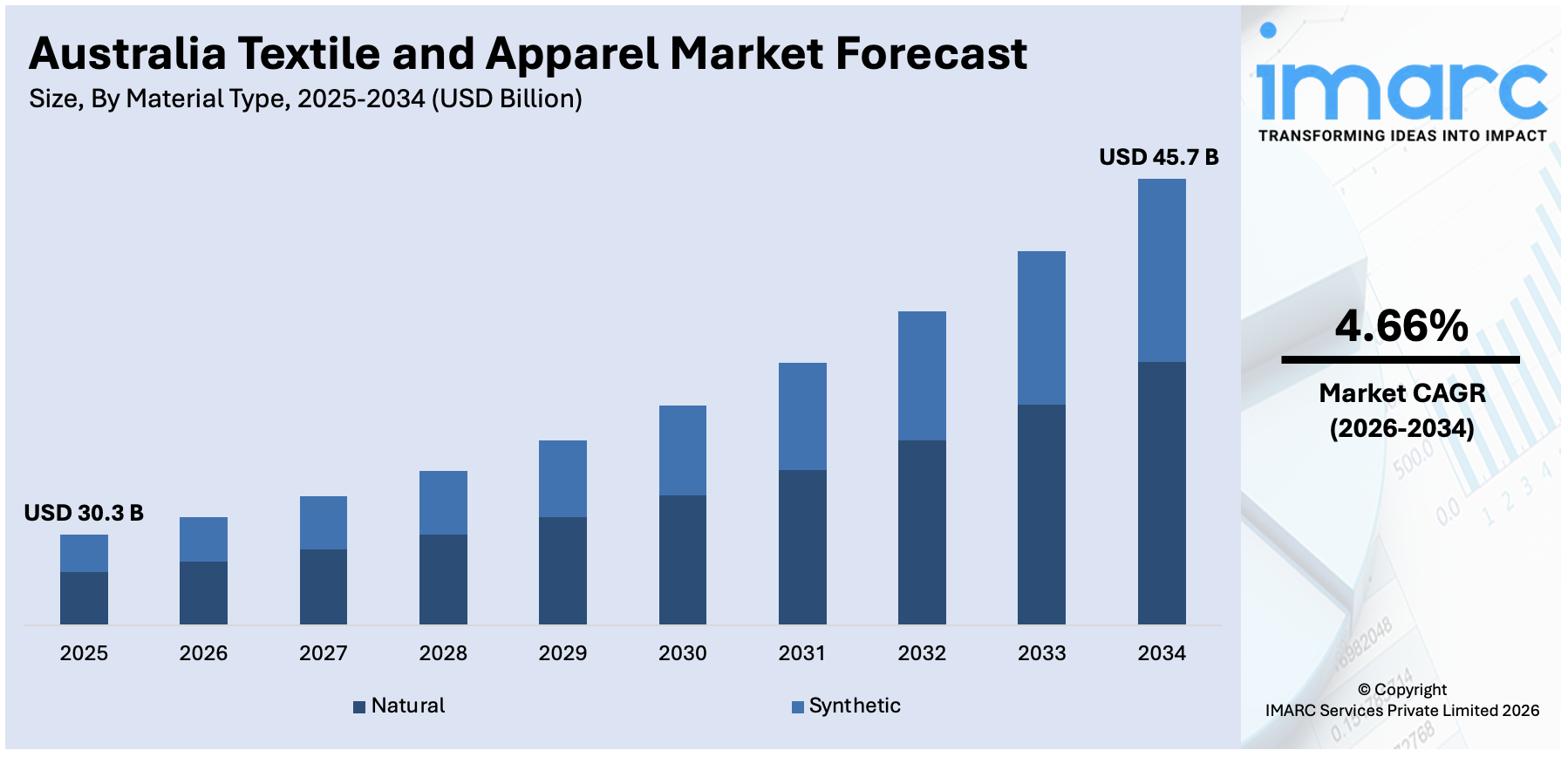
The Australia textile and apparel market size reached USD 30.3 Billion in 2025. Looking forward, the market is expected to reach USD 45.7 Billion by 2034, exhibiting a growth rate (CAGR) of 4.66% during 2026-2034. The market is driven by the growing focus on sustainability and circular economy, rapid technological advancements, rising popularity of e-commerce and digital transformation, and the increasing disposable income of consumers.
|
Report Attribute
|
Key Statistics
|
|---|---|
|
Base Year
|
2025
|
|
Forecast Years
|
2026-2034
|
|
Historical Years
|
2020-2025
|
| Market Size in 2025 | USD 30.3 Billion |
| Market Forecast in 2034 | USD 45.7 Billion |
| Market Growth Rate 2026-2034 | 4.66% |
Key Trends of Australia Textile and Apparel Market:
Increasing Focus on Sustainability and Circular Economy
The increasing focus on sustainability is one of the major factors contributing to the Australian textile and apparel market growth. There has been a rising preference among consumers and businesses for textiles that minimize environmental harm, driving the shift toward sustainable materials, recycling initiatives, and greener manufacturing methods. This growing awareness is encouraging the apparel industry to move away from conventional resource-intensive practices and adopt more responsible production approaches. Along with this, approximately 501 million kilograms of textiles and clothes are thrown annually in Australia. This is boosting the shift toward a circular economy, where materials are reused or recycled. Moreover, brands are increasingly adopting practices that minimize waste, use sustainable materials, and reduce their carbon footprint, making sustainability a core market driver.
To get more information on this market Request Sample
Rising Popularity of E-Commerce and Digital Transformation
The rise of e-commerce platforms is majorly driving the Australia textile and apparel market growth. As per the Australia Post 2023 eCommerce Industry Report, Australian retail spending in the year 2022 reached US$242 billion, which is an increase of 9.2 percent from 2021. Online shopping has seen substantial growth, driven by convenience, broader product selection, and lower product prices. The share of fashion and apparel e-commerce in the country reached 17.4%, with a year-on-year (YoY) growth of 0.9%. This data has encouraged many companies to enhance their digital presence, utilizing virtual fitting rooms and integrating advanced technologies such as artificial intelligence (AI) for personalized shopping experiences. Along with this, the seamless integration of online and offline retail, as it is critical for brands to provide an omnichannel experience to their customers, is boosting the expansion of the industry in the country.
Rapid Technological Advancements
Advancements in material science, such as the production of sustainable fabrics, are fueling the Australia textile and apparel market share. Kusaga Athletic, for example, designed 'The Greenest T-Shirt on the Planet' ECOLITE. It is a futuristic fabric created from biodegradable plant-based fibers that use a fraction of the water required by cotton. Furthermore, the adoption of digital solutions in retail that promote efficiency, quality, and innovation is driving the market expansion. For instance, Australian fashion label JAG has used three-dimensional (3D) design technology, which has reportedly reduced sample costs by 50%. Along with this, the emergence of smart textiles and wearable technologies, which provide consumers with functional apparel that interfaces with their digital life, is expanding the market growth.
Growth Factors of Australia Textile and Apparel Market:
Increasing Disposable Income and Consumer Spending Power
The growth in household incomes around Australia is also driving more and more consumers buying of apparel and textile products, a factor that is also enhancing the growth of the market. With economic conditions continuing to remain positive and employment rates being strong, Australian consumers are spending more of their budgets on fashion and home textiles. The same trend is specifically observed in the middle-class households where people make their purchase choices based on quality, fashionable style, and brand image. The increased wealth of consumers has created an increased demand for high-quality and designer clothes, luxury household appliances, and specialized technical fabrics that are specialized. In addition, more discretionary spending allows consumers to buy numerous wardrobe additions during the year as opposed to buying necessities seasonally. This shift toward frequent fashion consumption, combined with the willingness to invest in higher-priced, quality products, creates sustained revenue opportunities for textile and apparel retailers across Australia.
Urbanization and Lifestyle Evolution
Australia's continuing urbanization and evolving lifestyle patterns are driving Australia textile and apparel market demand. The growth of the metropolitan population of Australians and their adoption of an urban lifestyle also leads to a change in their taste in fashion, so that it is contemporary, versatile, and professional. City consumers are more likely to focus on trend-driven aesthetics, practical workwear, athletic-style products, and event-oriented clothes that remain in line with their always-changing lifestyles. The exposure of the city people to the trends in global fashion through social media, traveling abroad, and multicultural influences has increased fashion consciousness and brand awareness. Moreover, people in urban areas socialize, engage in work, and recreational activities more often, and this necessitates a variety of outfits. This has been a life shift that has resulted in a lot of opportunities for the fast-fashion retailers as well as the premium brands to serve the more discerning tastes of the urban consumers of Australia. The urbanization trend also supports the expansion of retail infrastructure, including flagship stores, pop-up shops, and experiential retail spaces that enhance customer engagement and drive sales.
Government Support and Trade Agreements
Government initiatives and favorable trade agreements are providing substantial support to the Australia textile and apparel market analysis and expansion. Policy measures aimed at promoting local manufacturing, supporting small and medium enterprises (SMEs), and encouraging innovation in the textile sector have created a conducive environment for industry growth. The Australian government has implemented various programs to boost domestic production capabilities, including grants, subsidies, and tax incentives for manufacturers who invest in sustainable and technologically advanced production methods. Trade agreements with key partner countries have facilitated easier access to international markets, enabling Australian brands to expand their global footprint while also allowing cost-effective importation of raw materials and finished goods. Furthermore, government procurement policies increasingly favor locally manufactured textiles, particularly for uniforms and protective equipment, which strengthens the domestic manufacturing base. These supportive regulatory frameworks, combined with investment in research and development initiatives, position the Australian textile and apparel industry for sustained growth and international competitiveness.
Opportunities of Australia Textile and Apparel Market:
Smart Textiles and Wearable Technology Integration
The integration of technology into textiles presents unprecedented opportunities for the market share. Smart textiles incorporating sensors, conductive fibers, and connectivity features are gaining traction among health-conscious consumers and technology enthusiasts. These innovative fabrics can monitor vital signs, track fitness metrics, regulate body temperature, and even charge electronic devices, creating entirely new product categories within the apparel sector. Australian companies have significant opportunities to develop and commercialize performance-enhancing sportswear, health-monitoring medical textiles, and fashion items with embedded technology. The growing adoption of Internet of Things (IoT) devices and consumers' increasing comfort with wearable technology create a receptive market for these advanced products. Collaboration between textile manufacturers, technology companies, and research institutions can accelerate innovation in this space. As Australia positions itself as a hub for technological innovation in the Asia-Pacific region, the smart textiles segment offers substantial growth potential and differentiation opportunities for forward-thinking companies.
Export Expansion to Asia-Pacific Markets
Australia's strategic geographical positioning and strong trade relationships within the Asia-Pacific region present significant export opportunities for textile and apparel brands. The growing middle class across neighboring countries, including China, Indonesia, and India, represents a massive consumer base with increasing purchasing power and appetite for quality Australian fashion. Australian brands are recognized internationally for their relaxed elegance, resort wear, swimwear, and contemporary design aesthetics that resonate particularly well with Asian consumers seeking lifestyle-oriented fashion. The "Made in Australia" label carries positive associations regarding quality, sustainability, and ethical production standards, providing competitive advantages in export markets. Government export promotion programs, participation in international trade shows, and digital marketing strategies can help Australian brands establish and expand their presence in these lucrative markets. Additionally, the growing tourism industry in Australia exposes international visitors to local brands, creating brand awareness that can translate into online and in-country sales. Strategic partnerships with regional distributors, e-commerce platforms, and retail chains can facilitate market entry and scaling in these high-growth markets.
Circular Economy and Textile Recycling Solutions
The global shift toward circular economy principles creates transformative opportunities for Australian companies to lead in textile recycling, upcycling, and sustainable production models. With over 200,000 tonnes of textile waste generated annually in Australia, there is substantial potential to develop innovative recycling technologies and business models that capture value from waste streams. Companies that invest in textile-to-textile recycling infrastructure, chemical recycling processes, and fiber regeneration technologies can position themselves at the forefront of the sustainability movement while addressing a critical environmental challenge. The development of take-back programs, resale platforms, rental services, and repair facilities can create new revenue streams while strengthening customer relationships and brand loyalty. Collaboration with government initiatives like the Seamless Scheme provides access to funding, policy support, and industry partnerships that can accelerate circular economy initiatives. Furthermore, growing consumer preference for sustainable products and regulatory pressures to reduce textile waste create favorable market conditions for businesses that embrace circularity. Australian companies that successfully develop scalable circular business models can export these solutions and best practices to international markets facing similar sustainability challenges.
Australia Textile and Apparel Market Segmentation:
IMARC Group provides an analysis of the key trends in each segment of the market, along with forecasts at the country level for 2026-2034. Our report has categorized the market based on material type and application.
Material Type Insights:
- Natural
- Cotton
- Silk
- Others
- Synthetic
- Nylon
- Polyester
- Others
The report has provided a detailed breakup and analysis of the market based on the material type. This includes natural (cotton, silk, and others) and synthetic (nylon, polyester, and others).
Application Insights:
Access the comprehensive market breakdown Request Sample
- Clothing Textiles
- Technical Textiles
- Fashion Textiles
- Home-Décor Textiles
- Others
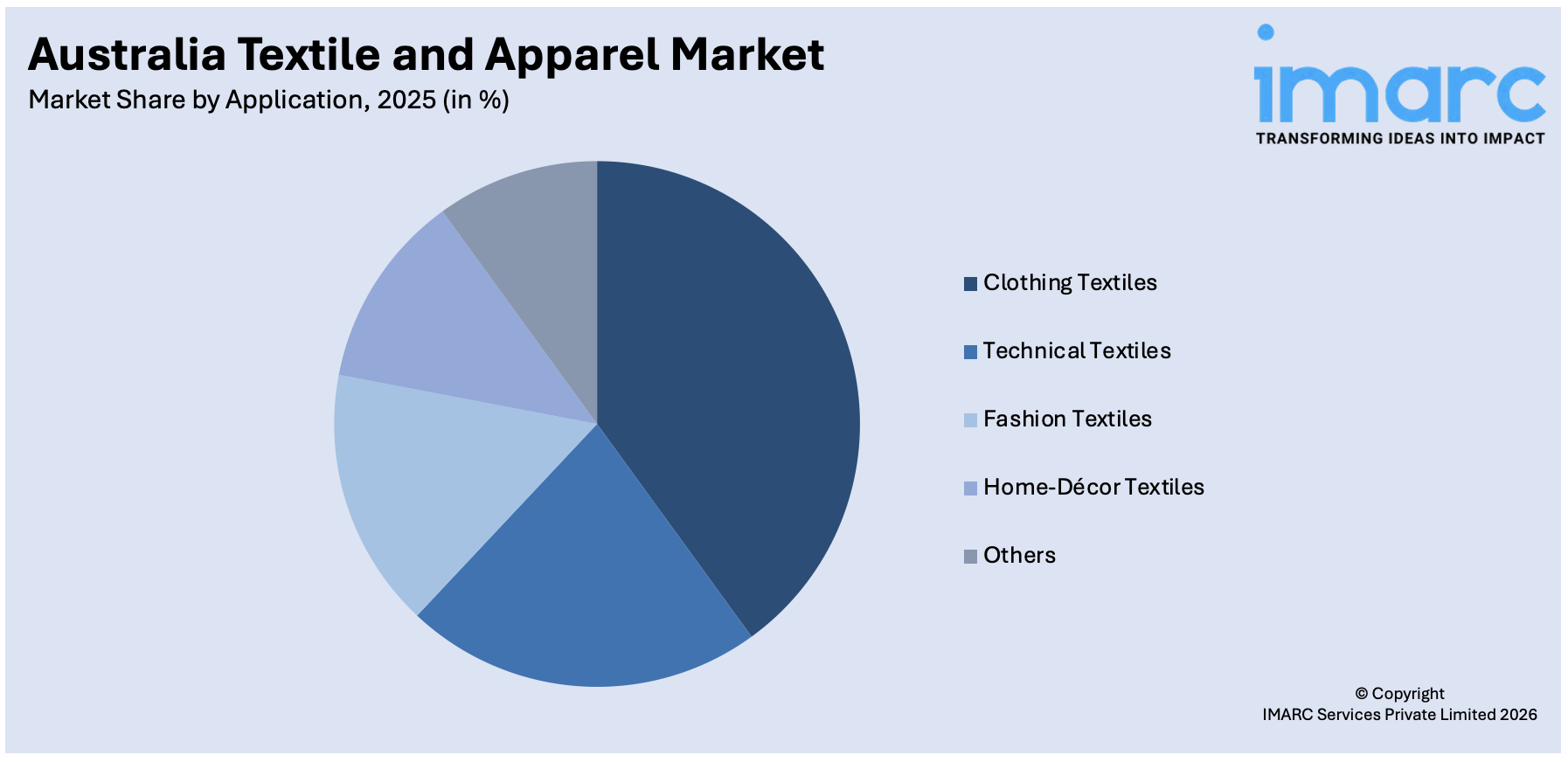
A detailed breakup and analysis of the market based on the application have also been provided in the report. This includes clothing textiles, technical textiles, fashion textiles, homer-décor textiles, and others.
Regional Insights:
- Australia Capital Territory & New South Wales
- Victoria & Tasmania
- Queensland
- Northern Territory & Southern Australia
- Western Australia
The report has also provided a comprehensive analysis of all the major regional markets, which include Australia Capital Territory & New South Wales, Victoria & Tasmania, Queensland, Northern Territory & Southern Australia, and Western Australia.

Competitive Landscape:
The market research report has also provided a comprehensive analysis of the competitive landscape. Competitive analysis such as market structure, key player positioning, top winning strategies, competitive dashboard, and company evaluation quadrant has been covered in the report. Also, detailed profiles of all major companies have been provided.
Australia Textile and Apparel Market News:
- November 2024: The Australian Fashion Council announced it would assume interim management of Australian Fashion Week following IMG's decision to terminate its Australian fashion events business. The AFC organized a coalition of 70 industry members, including designers, executives, and publicists, to ensure the resort 2026 collections showcase would proceed as planned in May 2025.
- October 2024: Designer Wardrobe, a pre-loved fashion marketplace initially launched in New Zealand with over 325,000 members, expanded into Australia. The platform now provides Australian consumers with access to thousands of second-hand clothing listings, including well-known Australian and New Zealand brands, catering to the growing sustainable fashion trend.
- April 2024: Under Armour (UA) launched a new brand platform, 'Live in UA', for the Australian market. The campaign showcases a wide range of apparel, footwear, and accessories that cater to every aspect of an athlete's journey, including training, recovery, and everyday living.
- July 2023: Nike launched the Nike AU Collection, the first Express Lane capsule collection in Australia. It is a women's collection that features a wide range of hemp and fleece crews, jackets, tracksuit pants, and T-shirts in brown and amber tones, as well as limited-edition versions of the Air Max 90, Air Max 270, and Dunk Low. The collection was inspired by the rugged Australian landscape and reimagines Nike icons with colors and textures drawn from the natural beauty of the country.
Australia Textile and Apparel Market Report Coverage:
| Report Features | Details |
|---|---|
| Base Year of the Analysis | 2025 |
| Historical Period | 2020-2025 |
| Forecast Period | 2026-2034 |
| Units | Billion USD |
| Scope of the Report | Exploration of Historical Trends and Market Outlook, Industry Catalysts and Challenges, Segment-Wise Historical and Future Market Assessment:
|
| Material Types Covered |
|
| Applications Covered | Clothing Textiles, Technical Textiles, Fashion Textiles, Homer-Décor Textiles, Others |
| Regions Covered | Australia Capital Territory & New South Wales, Victoria & Tasmania, Queensland, Northern Territory & Southern Australia, Western Australia |
| Customization Scope | 10% Free Customization |
| Post-Sale Analyst Support | 10-12 Weeks |
| Delivery Format | PDF and Excel through Email (We can also provide the editable version of the report in PPT/Word format on special request) |
Key Benefits for Stakeholders:
- IMARC’s industry report offers a comprehensive quantitative analysis of various market segments, historical and current market trends, market forecasts, and dynamics of the Australia textile and apparel market from 2020-2034.
- The research report provides the latest information on the market drivers, challenges, and opportunities in the Australia textile and apparel market.
- Porter's five forces analysis assist stakeholders in assessing the impact of new entrants, competitive rivalry, supplier power, buyer power, and the threat of substitution. It helps stakeholders to analyze the level of competition within the Australia textile and apparel industry and its attractiveness.
- Competitive landscape allows stakeholders to understand their competitive environment and provides an insight into the current positions of key players in the market.
Frequently Asked Questions About the Australia Textile and Apparel Market Report
The textile and apparel market in Australia was valued at USD 30.3 Billion in 2025.
The Australia textile and apparel market is projected to exhibit a CAGR of 4.66% during 2026-2034.
The Australia textile and apparel market is projected to reach a value of USD 45.7 Billion by 2034.
The market is experiencing rapid growth driven by sustainability initiatives and circular economy adoption, e-commerce expansion, and digital transformation with AI-powered personalization, and technological advancements, including smart textiles, 3D design technology, and biodegradable fabrics. These trends are reshaping consumer expectations and industry practices across Australia.
The Australia textile and apparel market is driven by increasing disposable income and consumer spending power on premium apparel, urbanization, and evolving lifestyles, creating demand for diverse fashion options, government support through favorable policies and trade agreements, and rising fashion consciousness among Australian consumers seeking quality and contemporary designs.
Need more help?
- Speak to our experienced analysts for insights on the current market scenarios.
- Include additional segments and countries to customize the report as per your requirement.
- Gain an unparalleled competitive advantage in your domain by understanding how to utilize the report and positively impacting your operations and revenue.
- For further assistance, please connect with our analysts.
 Request Customization
 Speak to an Analyst
 Request Brochure
 Inquire Before Buying
Benefits of Customization
- Personalize this research
- Triangulate with your data
- Get data as per your format and definition
- Gain a deeper dive into a specific application, geography, customer, or competitor
- Any level of personalization
Get in Touch With Us
UNITED STATES
Phone: +1-201-971-6302
INDIA
Phone: +91-120-433-0800
UNITED KINGDOM
Phone: +44-753-714-6104
Email: [email protected]
Client Testimonials




.webp)




.webp)













Related Reports

Choose your plan
*Please note that the prices mentioned below are starting prices for each bundle type. Kindly contact our team for further details.*
Single User License
- 1 User License, Access on 2 Devices
- PDF Report + Excel Dataset (Password Protected)
- Lifetime Access
- No Printing Rights
- 10% Free Report Customization
- 10–12 Weeks of Analyst Support
Five User License
- Access for 5 Users, 2 Devices per User
- PDF Report + Excel Dataset (Password Protected)
- Lifetime Access
- Dedicated Account Manager
- 12–14 Weeks of Analyst Support
- No Printing Rights
- 15% Free Report Customization
- 25% Discount on Your Next Purchase
Corporate User License
- Unlimited User Access (Within Your Organization)
- PDF Report + Excel Dataset
- Lifetime Access
- Dedicated Account Manager
- 14–20 Weeks of Analyst Support
- No Printing Rights
- 20% Free Report Customization
- 30% Discount on Your Next Purchase
Essential Insights
What's included:
3 reports
- Lifetime Access
- PDF Reports
- Excel Datasets
- 2 Weeks of Free Analyst Support
- 2 User Licenses
- Access on 2 Devices
- Printing Rights
- Complimentary PowerPoint (PPT) Version
- Complimentary License Upgrade
Professional Access
What's included:
5 reports
- Lifetime Access
- PDF Reports
- Excel Datasets
- 8 Weeks of Free Analyst Support
- 2 User Licenses
- Access on 2 Devices
- Printing Rights
- Complimentary PowerPoint (PPT) Version
- Complimentary License Upgrade
Business Advantage
What's included:
8 reports
- Lifetime Access
- PDF Reports
- Excel Datasets
- 14 Weeks of Free Analyst Support
- 2 User Licenses
- Access on 2 Devices
- Printing Rights
- Complimentary PowerPoint (PPT) Version
- Complimentary License Upgrade
Enterprise Intelligence
What's included:
10 reports
- Lifetime Access
- PDF Reports
- Excel Datasets
- 20 Weeks of Free Analyst Support
- 2 User Licenses
- Access on 2 Devices
- Printing Rights
- Complimentary PowerPoint (PPT) Version
- Complimentary License Upgrade