
Australia Transformer Market Size, Share, Trends and Forecast by Power Rating, Cooling Type, Transformer Type, and Region, 2026-2034
Australia Transformer Market Overview:
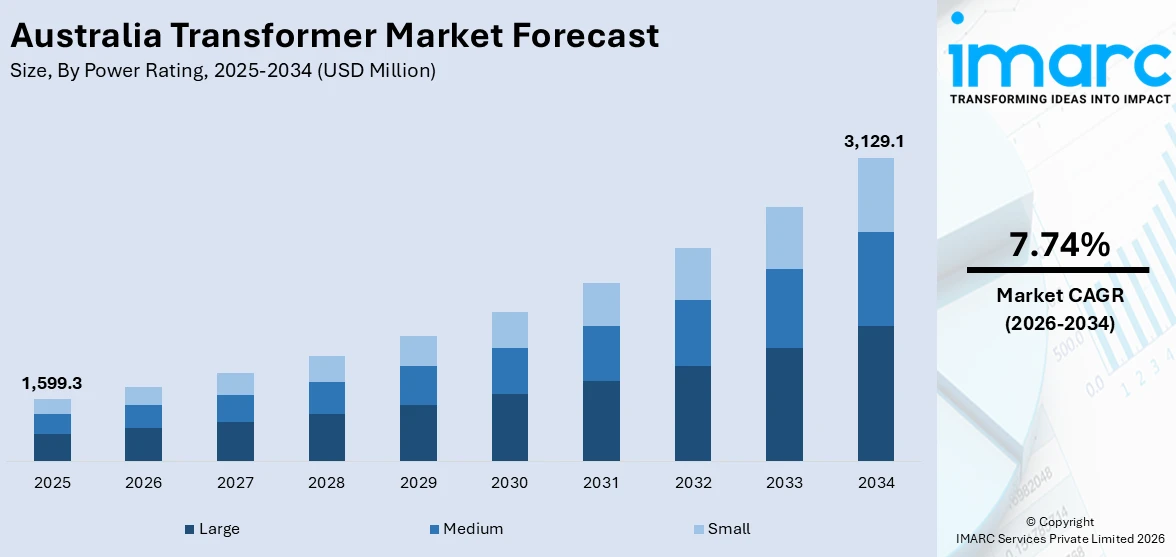
The Australia transformer market size reached USD 1,599.3 Million in 2025. Looking forward, the market is expected to reach USD 3,129.1 Million by 2034, exhibiting a growth rate (CAGR) of 7.74% during 2026-2034. Increasing investments in renewable energy projects and the necessity to upgrade aging power infrastructure are some of the factors contributing to Australia transformer market share. Rising electricity demand from expanding industrial and residential sectors, coupled with government initiatives promoting energy efficiency, further fuels market growth.
|
Report Attribute
|
Key Statistics
|
|---|---|
|
Base Year
|
2025 |
|
Forecast Years
|
2026-2034
|
|
Historical Years
|
2020-2025
|
| Market Size in 2025 | USD 1,599.3 Million |
| Market Forecast in 2034 | USD 3,129.1 Million |
| Market Growth Rate 2026-2034 | 7.74% |
Key Trends of Australia Transformer Market:
Focus on Transformer Efficiency
Australia's energy sector is placing increasing emphasis on enhancing the efficiency of its power distribution network. Recent developments indicate a proactive approach toward upgrading the energy performance of distribution transformers. Recognizing the considerable energy conservation achievable through continuously operating, more efficient units, governmental bodies are actively seeking stakeholder feedback on potential improvements. This initiative signals a move toward establishing higher minimum energy performance standards for these critical grid components. The focus is on reducing electricity losses and optimizing the overall energy efficiency of the distribution infrastructure across the nation. These factors are intensifying the Australia transformer market growth. For example, in October 2024, Australia sought input on proposed energy efficiency upgrades for distribution transformers. The Department of Climate Change, Energy, the Environment and Water emphasized the substantial electricity savings possible from efficient transformers operating continuously. This initiative, under the Equipment Energy Efficiency (E3) Program, aimed to potentially raise minimum energy performance standards.
To get more information on this market Request Sample
Growing Demand for Solar Infrastructure
The Australia transformer market demand is influenced by a notable surge in solar energy development. Recent activities point toward a robust drive in establishing new solar farms throughout the country. This expansion fuels a considerable requirement for medium-voltage power transformer stations, essential for effectively handling and connecting the produced electricity to the national grid. These undertakings are anticipated to substantially boost the nation's renewable energy capabilities, with the capacity to power a significant number of residences each year. This underscores an increasing necessity for vital electrical components and infrastructure to underpin Australia's transition toward sustainable energy sources and cater to its escalating power consumption. For instance, in April 2025, Ingeteam secured two contracts with European Energy to supply 22 medium-voltage power transformer stations for new solar plants in Australia. The projects, Lancaster (106 MW) in Victoria and Mulwala (31 MW) in New South Wales, would generate approximately 255 GWh annually, powering around 54,000 homes. This initiative strengthens Ingeteam's position as a key technology provider in Australia's energy transition, holding a 25% market share in the solar sector.
Growth Drivers of Australia Transformer Market:
Aging Grid Infrastructure and Upgrade Requirements
One of the most important drivers for growth in the Australia transformer market is the urgent requirement to replace aging grid infrastructure. A large part of Australia's power distribution and transmission infrastructure was built decades ago, and several parts, including transformers, are close to the end of their life. As the grid must handle load from contemporary consumption patterns, from home air conditioning to massive industrial processes, the aging infrastructure is working harder to preserve efficiency and reliability. Outages caused by failures in aging transformers can lead to lost customer minutes and maintenance expenses, causing utilities to invest in new, energy-efficient replacements. The trend is most pronounced in states with older grids such as Victoria and Tasmania, where upgrades are being given high priority. New transformers that incorporate enhanced insulation, cooling, and monitoring capabilities are being rolled out to enhance operational performance and system life. Such modernization contributes to system reliability and complements overall national ambitions for a more resilient and future-competitive energy network.
Urban Growth and Infrastructure Development
Australia's own urbanization and continued infrastructure works are also key growth drivers for the transformer market. Major cities such as Sydney, Melbourne, Brisbane, and Perth are increasing their residential, commercial, and industrial footprint and need strong and dependable power distribution systems. New residential developments, commercial hubs, public transport infrastructure, and industrial parks all call for distribution transformer installation to provide reliable electricity supply. Besides urban growth, government-supported infrastructure projects like airport expansions, road and rail development, and smart city programs, present additional opportunities for transformer installation. These large projects tend to need bespoke transformer solutions to accommodate the specific voltage and capacity requirements of each use case. Additionally, the trend toward energy-efficient buildings and intelligent infrastructure accelerates demand for low energy loss and digitally monitored transformers. As Australia's infrastructure continues to develop, so does the need for an up-to-date and efficient network of transformers to manage increased power usage and maintain system reliability.
Transportation and Industrial Sectors Electrification
Australia's transportation and industrial sectors electrification is another significant driver of the transformer market growth. Considering growing carbon emission concerns, public and private sectors invest in electric vehicle infrastructure and electrified rail infrastructure. These comprise installing EV charging points, electric bus garages, and upgrading city rail systems, all of which need specialized transformer capacity to support new electrical loads. Further, heavy industries like mining, manufacturing, and agriculture are moving toward electric-driven equipment and automation technology to enhance efficiency and minimize ecological damage. These changes necessitate transformers capable of withstanding greater energy loads while ensuring voltage stability and safety levels. In rural and off-grid industrial operations, transformers are also critical for connecting renewable energy sources like solar farms to operational facilities. As Australia accelerates its move toward an electric and sustainable economy, the role of transformers becomes increasingly vital in supporting this transition across multiple sectors.
Government Initiatives of Australia Transformer Market:
Investment in Energy Infrastructure Modernization
According to the Australia transformer market analysis, the government has been proactive in upgrading the country's energy infrastructure, including large-scale transformer replacement and upgrade support. Federal and state government measures have seen heavy investment to enhance the reliability and capacity of power grids, particularly as electricity consumption grows both in urban and regional zones. Such initiatives as the National Electricity Market (NEM) reform are being designed to facilitate effective energy transmission and support grid resilience, which has a direct impact on the demand for sophisticated transformer technologies. In South Australia and Queensland, respectively, government-sponsored transition projects are modernizing old substations and incorporating new transformers to accommodate changing load demands. These initiatives improve the stability of the system and lay the groundwork for higher integration of renewable energy and smart technologies. The focus on infrastructure reliability and performance, especially amid the threat of extreme weather conditions and growing electrification, is providing a supportive climate for transformer producers and service providers in Australia.
Support for Renewable Energy Integration
Government policies encouraging the shift toward clean and renewable energy resources are at the forefront of driving transformer market expansion in Australia. As the nation marches toward its climate targets, both state and federal governments are investing in large-scale wind and solar farms, many positioned far away from the power grid. To make energy from these sources efficiently transmitted and delivered, new substations and high-load transformers are being inaugurated with state support. Programs like the Renewable Energy Zones (REZs) in Victoria and New South Wales involve extensive planning for grid infrastructure, including the installation of advanced transformers having voltage regulation and smart grid suitability. These projects are supported by regulatory and financial incentives, accelerating development timelines and promoting public-private partnerships. Decentralized energy generation also calls for transformers with bidirectional power flow capabilities and support for battery storage systems, making the transformer market an essential part of Australia's energy transition strategy.
Electrification and Emissions Reduction Strategies
Australia's national drive toward decarbonization and electrification of industry is complemented by focused government policies that have a direct impact on transformer demand. Schemes encouraging take-up of electric vehicles, greener industrial processes, and energy-efficient public infrastructure are all promoting the demand for resilient electrical distribution networks. For example, financing for electric bus fleets, EV charging infrastructure, and low-emission buildings demands major upgrading of local power grids, which are projects with heavy dependence on new transformer installations. The federal government's overall emissions reduction plans also fund grid upgrading and local energy resiliency, which incentivize utilities and private firms to spend money on high-performing, environmentally friendly transformers. Also, the focus on indigenous component usage and domestic capability development is in line with government policy favorable to the local transformer sector. These multi-pronged measures collectively demonstrate the government's efforts to stimulate demand and to enhance Australia's supply capabilities for transformer infrastructure in a forward-looking energy economy.
Australia Transformer Market Segmentation:
IMARC Group provides an analysis of the key trends in each segment of the market, along with forecasts at the country and regional levels for 2026-2034. Our report has categorized the market based on power rating, cooling type, and transformer type.
Power Rating Insights:
- Large
- Medium
- Small
The report has provided a detailed breakup and analysis of the market based on the power rating. This includes large, medium, and small.
Cooling Type Insights:
Access the comprehensive market breakdown Request Sample
- Air-cooled
- Oil-cooled
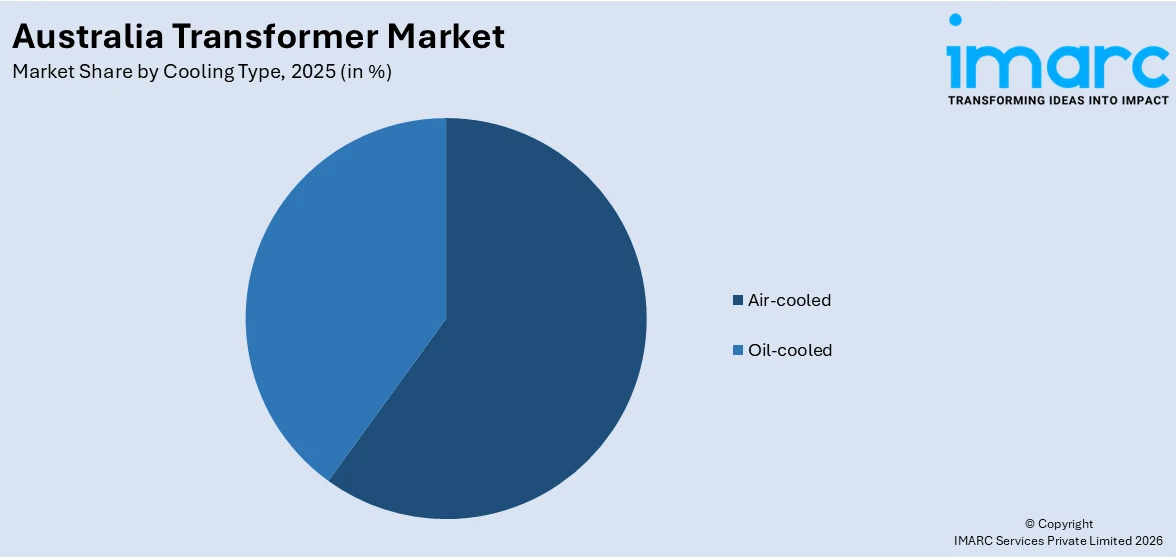
A detailed breakup and analysis of the market based on the cooling type have also been provided in the report. This includes air-cooled and oil-cooled.
Transformer Type Insights:
- Power Transformer
- Distribution Transformer
A detailed breakup and analysis of the market based on the transformer type have also been provided in the report. This includes power transformer and distribution transformer.
Regional Insights:
- Australia Capital Territory & New South Wales
- Victoria and Tasmania
- Queensland
- Northern Territory and Southern Australia
- Western Australia
The report has also provided a comprehensive analysis of all the major regional markets, which include Australia Capital Territory & New South Wales, Victoria and Tasmania, Queensland, Northern Territory and Southern Australia, and Western Australia.
Competitive Landscape:
The market research report has also provided a comprehensive analysis of the competitive landscape. Competitive analysis such as market structure, key player positioning, top winning strategies, competitive dashboard, and company evaluation quadrant has been covered in the report. Also, detailed profiles of all major companies have been provided.

Australia Transformer Market News:
- In April 2025, Australia's EnergyConnect project, linking the grids of NSW, SA, and Victoria, enhanced energy sharing and resilience. The project uses phase-shifting transformers, synchronous condensers, and shunt reactors to ensure grid stability and facilitate renewable energy transfer. The Buronga substation, a key hub, is one of the largest and most sophisticated in the southern hemisphere. EnergyConnect reduces reliance on fossil fuels.
Australia Transformer Market Report Coverage:
| Report Features | Details |
|---|---|
| Base Year of the Analysis | 2025 |
| Historical Period | 2020-2025 |
| Forecast Period | 2026-2034 |
| Units | Million USD |
| Scope of the Report | Exploration of Historical Trends and Market Outlook, Industry Catalysts and Challenges, Segment-Wise Historical and Future Market Assessment:
|
| Power Ratings Covered | Large, Medium, Small |
| Cooling Types Covered | Air-cooled, Oil-cooled |
| Transformer Types Covered | Power Transformer, Distribution Transformer |
| Regions Covered | Australia Capital Territory & New South Wales, Victoria and Tasmania, Queensland, Northern Territory and Southern Australia, Western Australia |
| Customization Scope | 10% Free Customization |
| Post-Sale Analyst Support | 10-12 Weeks |
| Delivery Format | PDF and Excel through Email (We can also provide the editable version of the report in PPT/Word format on special request) |
Key Benefits for Stakeholders:
- IMARC’s industry report offers a comprehensive quantitative analysis of various market segments, historical and current market trends, market forecasts, and dynamics of the Australia transformer market from 2020-2034.
- The research report provides the latest information on the market drivers, challenges, and opportunities in the Australia transformer market.
- Porter's five forces analysis assist stakeholders in assessing the impact of new entrants, competitive rivalry, supplier power, buyer power, and the threat of substitution. It helps stakeholders to analyze the level of competition within the Australia transformer industry and its attractiveness.
- Competitive landscape allows stakeholders to understand their competitive environment and provides an insight into the current positions of key players in the market.
Frequently Asked Questions About the Australia Transformer Market Report
The Australia transformer market was valued at USD 1,599.3 Million in 2025.
The Australia transformer market is projected to exhibit a CAGR of 7.74% during 2026-2034.
The Australia transformer market is expected to reach a value of USD 3,129.1 Million by 2034.
The Australia transformer market is witnessing trends such as increased adoption of smart and energy-efficient transformers, integration with renewable energy systems, and rising demand for digital monitoring capabilities. Emphasis on grid resilience, sustainable infrastructure, and localized manufacturing is also shaping market dynamics as the country modernizes its power transmission and distribution networks.
The Australia transformer market is driven by grid modernization, urban infrastructure expansion, and the electrification of transport and industry. Government initiatives supporting renewable energy integration and infrastructure upgrades also contribute to rising demand. These factors collectively boost the need for efficient, high-performance transformers across both urban and remote regions of the country.
Need more help?
- Speak to our experienced analysts for insights on the current market scenarios.
- Include additional segments and countries to customize the report as per your requirement.
- Gain an unparalleled competitive advantage in your domain by understanding how to utilize the report and positively impacting your operations and revenue.
- For further assistance, please connect with our analysts.
 Request Customization
 Speak to an Analyst
 Request Brochure
 Inquire Before Buying
Benefits of Customization
- Personalize this research
- Triangulate with your data
- Get data as per your format and definition
- Gain a deeper dive into a specific application, geography, customer, or competitor
- Any level of personalization
Get in Touch With Us
UNITED STATES
Phone: +1-201-971-6302
INDIA
Phone: +91-120-433-0800
UNITED KINGDOM
Phone: +44-753-714-6104
Email: [email protected]
Client Testimonials




.webp)




.webp)













Related Reports

Choose your plan
*Please note that the prices mentioned below are starting prices for each bundle type. Kindly contact our team for further details.*
Single User License
- 1 User License, Access on 2 Devices
- PDF Report + Excel Dataset (Password Protected)
- Lifetime Access
- No Printing Rights
- 10% Free Report Customization
- 10–12 Weeks of Analyst Support
Five User License
- Access for 5 Users, 2 Devices per User
- PDF Report + Excel Dataset (Password Protected)
- Lifetime Access
- Dedicated Account Manager
- 12–14 Weeks of Analyst Support
- No Printing Rights
- 15% Free Report Customization
- 25% Discount on Your Next Purchase
Corporate User License
- Unlimited User Access (Within Your Organization)
- PDF Report + Excel Dataset
- Lifetime Access
- Dedicated Account Manager
- 14–20 Weeks of Analyst Support
- No Printing Rights
- 20% Free Report Customization
- 30% Discount on Your Next Purchase
Essential Insights
What's included:
3 reports
- Lifetime Access
- PDF Reports
- Excel Datasets
- 2 Weeks of Free Analyst Support
- 2 User Licenses
- Access on 2 Devices
- Printing Rights
- Complimentary PowerPoint (PPT) Version
- Complimentary License Upgrade
Professional Access
What's included:
5 reports
- Lifetime Access
- PDF Reports
- Excel Datasets
- 8 Weeks of Free Analyst Support
- 2 User Licenses
- Access on 2 Devices
- Printing Rights
- Complimentary PowerPoint (PPT) Version
- Complimentary License Upgrade
Business Advantage
What's included:
8 reports
- Lifetime Access
- PDF Reports
- Excel Datasets
- 14 Weeks of Free Analyst Support
- 2 User Licenses
- Access on 2 Devices
- Printing Rights
- Complimentary PowerPoint (PPT) Version
- Complimentary License Upgrade
Enterprise Intelligence
What's included:
10 reports
- Lifetime Access
- PDF Reports
- Excel Datasets
- 20 Weeks of Free Analyst Support
- 2 User Licenses
- Access on 2 Devices
- Printing Rights
- Complimentary PowerPoint (PPT) Version
- Complimentary License Upgrade