
Australia Vinyl Flooring Market Size, Share, Trends and Forecast by Product Type, Sector, and Region, 2026-2034
Australia Vinyl Flooring Market Overview:
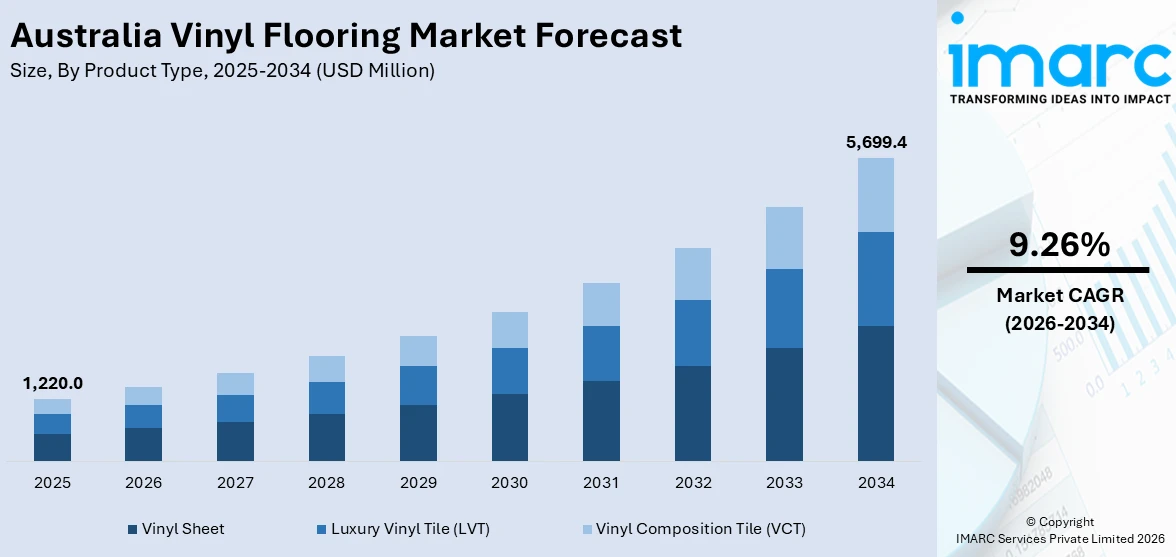
The Australia vinyl flooring market size reached USD 1,220.0 Million in 2025. Looking forward, the market is expected to reach USD 5,699.4 Million by 2034, exhibiting a growth rate (CAGR) of 9.26% during 2026-2034. The market is driven by rising demand for durable, cost-effective, and low-maintenance flooring in residential and commercial sectors. Innovations like luxury vinyl tiles and eco-friendly options with low VOC emissions further boost adoption, aligning with consumer preferences for style, performance, and sustainability in modern interiors.
|
Report Attribute
|
Key Statistics
|
|---|---|
|
Base Year
|
2025
|
|
Forecast Years
|
2026-2034
|
|
Historical Years
|
2020-2025
|
| Market Size in 2025 | USD 1,220.0 Million |
| Market Forecast in 2034 | USD 5,699.4 Million |
| Market Growth Rate 2026-2034 | 9.26% |
Key Trends of Australia Vinyl Flooring Market:
Sustainability and Eco-Friendly Innovation
Sustainability is on the rise in the Australia vinyl flooring market outlook. Buyers are looking for environmentally friendly flooring options, forcing producers to produce products that are environmentally friendly. New developments include vinyl floors with reduced volatile organic compound (VOC) emissions and recycled material use. Producers are also implementing bio-based plasticizers, which substitute conventional petroleum-based components with renewable feedstocks. These environmentally friendly products minimize the carbon footprint of vinyl flooring while still providing durability and performance. In response to stricter restrictions and growing environmental consciousness, sustainable vinyl flooring solutions are becoming popular in both the residential and commercial markets as environmental concerns continue to affect customer behavior and further increase the Australia vinyl flooring market share.
To get more information on this market Request Sample
Technological Advancements in Design and Installation
The Australia vinyl flooring market is evolving due to significant technological advancements. Innovations in digital printing and three-dimensional (3D) technology have enabled vinyl flooring to closely replicate the appearance and texture of natural materials such as wood, stone, and tile. Customers can now choose from a greater variety of styles without compromising vinyl's durability and cost advantages. Furthermore, with the need for specific equipment or expertise, emerging installation techniques such as click-lock systems are making vinyl flooring installation easier for both professionals and homeowners is aiding the Australia vinyl flooring market growth. In order to seamlessly improve residential and commercial premises, these innovations are meeting the increased demand for flooring solutions that are quick, easy, and flexible.
Rising Demand for Luxury Vinyl Tiles (LVT) and Rigid Core Products
With the increasing popularity for luxury vinyl tiles (LVT) and rigid core vinyl flooring products in the Australia market. These products provide outstanding durability, water resistance, and upscale look that resembles natural materials like hardwood and stone. LVT is a sought-after option for consumers who desire beauty without the expenses or upkeep of actual wood or stone. In the same way, rigid core products are appreciated due to their stability and simplicity of installation, making them an easy option for residential and commercial properties. These flooring products are on the rise due to their mix of functionality, style, and affordability, being appealing to many consumers.
Growth Drivers of Australia Vinyl Flooring Market:
Infrastructure Development, Housing Stock, and Urban Growth
One of the primary stimulants for Australia vinyl flooring market demand is the continued growth in housing supply and public infrastructure. Sydney, Melbourne, Brisbane and Perth's major cities continue to experience residential developments, multi‑unit housing, and urban infill schemes that need robust, affordable, and simple‑to‑install flooring. In addition, government spending on public buildings, schools, hospitals, transportation terminals, and retail facilities stimulates demand for flooring products that are both functional and attractive. The attractiveness of vinyl in such environments is enhanced by its water resistance, ease of maintenance, and durability under heavy use, making it a natural fit for commercial and institutional applications and heavy‑traffic residential environments. In most new Australian housing developments, purchasers seek wood, stone or tile finishes in a more recent look yet at reduced installation expense and greater durability against water and wear. Since most homes in Australia have wet areas (kitchen, bathroom, laundry) where moisture and humidity are concerns, vinyl flooring is particularly appealing versus hardwood or other low-resistance products. Such increase in new constructions, refurbishments, and infrastructure development thus serve as significant growth catalysts for vinyl flooring in Australia.
Design Trends, Lifestyle Influences, and Customer Awareness
Consumer preference is another strong influence responsible for the Australia vinyl flooring market growth. Australians are increasingly drawn toward interiors that reflect clean lines, contemporary looks, and natural textures, which has made vinyl flooring like luxury vinyl tiles (LVT) and rigid-core planks particularly, popular as they replicate wood, stone or ceramic convincingly and provide additional durability. Culture of renovation is firmly in place, particularly in settled suburbs, where bathrooms, kitchens, and living areas are renovated and, for flooring, people seek products that can manage moisture, clean easily, and are visually appealing. Increasingly, there is sensitivity to interior air quality too, which is why low VOC emissions, phthalate‑free plasticizers, and overall safer products are gaining prominence. People, designers, and architects are increasingly choosing green options. Australian consumers who seek sustainability are forcing producers and retailers to provide vinyl flooring versions containing recycled material, cleaner production, and environmentally friendly certification, which in turn enhances the acceptance of vinyl where, in the past, more "natural" products would have been desired.
Technological Innovation, Product Diversification, and Cost Advantages
Product innovation and technological advances are driving expansion in the Australian market for vinyl flooring. Advances in digital printing, embossing, rigid core construction, waterproofing layers, wear layers, and click‑lock or loose‑lay installation systems minimize installation time, increase durability, and enable greater ease of use. These developments are especially beneficial to installers and homeowners outside the large metropolitan areas who require flooring that can be shipped, installed with limited infrastructure, and cleaned with ease. Additionally, vinyl tends to be cost-effective compared to most natural stone, hardwood, or ceramic tile materials, particularly when total life-cycle costs (replacement, maintenance in wet areas or high-traffic regions) are considered. As material and labor prices increase in Australia, vinyl flooring's comparative affordability is an even greater selling point. As per the Australia vinyl flooring market analysis, with increasing numbers of multi‑family residences, rental units, and commercial retrofits, demand for flooring that meets cost, durability, aesthetics, and maintenance ease needs places vinyl flooring as a valued solution on many jobs.
Australia Vinyl Flooring Market Segmentation:
IMARC Group provides an analysis of the key trends in each segment of the market, along with forecasts at the region level for 2026-2034. Our report has categorized the market based on product type and sector.
Product Type Insights:
- Vinyl Sheet
- Luxury Vinyl Tile (LVT)
- Vinyl Composition Tile (VCT)
The report has provided a detailed breakup and analysis of the market based on the product type. This includes vinyl sheet, luxury vinyl tile (LVT), and vinyl composition tile (VCT).
Sector Insights:
Access the comprehensive market breakdown Request Sample
- Residential
- Commercial
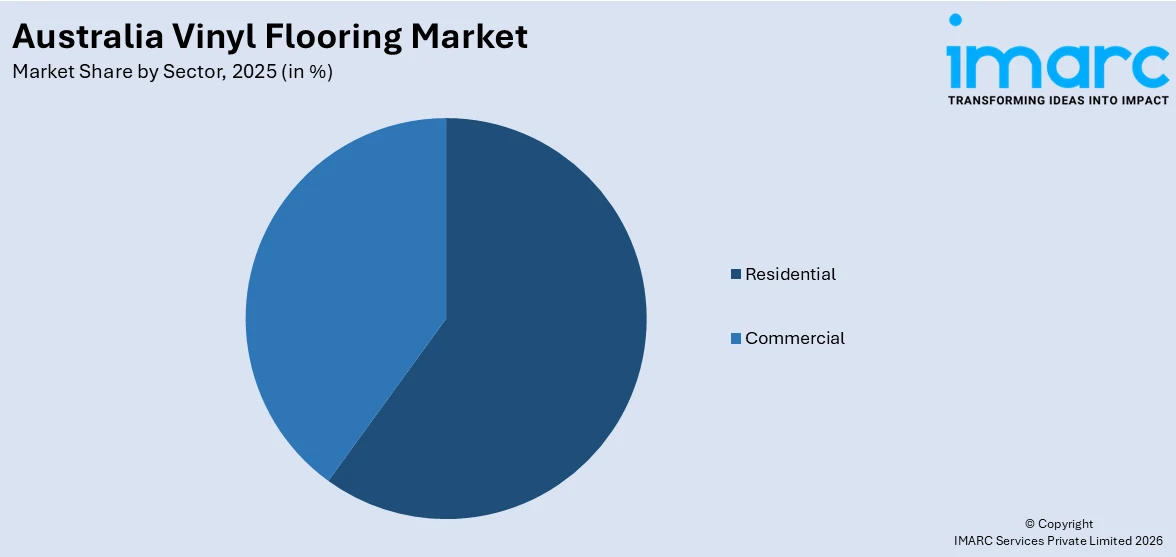
A detailed breakup and analysis of the market based on the sector have also been provided in the report. This includes residential and commercial.
Regional Insights:
- Australia Capital Territory & New South Wales
- Victoria & Tasmania
- Queensland
- Northern Territory & Southern Australia
- Western Australia
The report has also provided a comprehensive analysis of all the major regional markets, which include Australia Capital Territory & New South Wales, Victoria & Tasmania, Queensland, Northern Territory & Southern Australia, and Western Australia.
Competitive Landscape:
The market research report has also provided a comprehensive analysis of the competitive landscape. Competitive analysis such as market structure, key player positioning, top winning strategies, competitive dashboard, and company evaluation quadrant has been covered in the report. Also, detailed profiles of all major companies have been provided.
Australia Vinyl Flooring Market News:
- In February 2024, Bona®, a global leader in sustainable floor care, acquired Ezi Floor Products (EFP), its exclusive Australian distributor for over 20 years. Based in Melbourne, EFP becomes Bona’s 17th global subsidiary, enhancing Bona’s presence in the APAC region. This move allows EFP to expand offerings, grow its contractor network, and explore new channels like eCommerce, strengthening Bona’s long-term commitment to the Australian market.
Australia Vinyl Flooring Market Report Coverage:
| Report Features | Details |
|---|---|
| Base Year of the Analysis | 2025 |
| Historical Period | 2020-2025 |
| Forecast Period | 2026-2034 |
| Units | Million USD |
| Scope of the Report |
Exploration of Historical Trends and Market Outlook, Industry Catalysts and Challenges, Segment-Wise Historical and Future Market Assessment:
|
| Product Types Covered | Vinyl Sheet, Luxury Vinyl Tile (LVT), Vinyl Composition Tile (VCT) |
| Sectors Covered | Residential, Commercial |
| Regions Covered | Australia Capital Territory & New South Wales, Victoria & Tasmania, Queensland, Northern Territory & Southern Australia, Western Australia |
| Customization Scope | 10% Free Customization |
| Post-Sale Analyst Support | 10-12 Weeks |
| Delivery Format | PDF and Excel through Email (We can also provide the editable version of the report in PPT/Word format on special request) |
Key Benefits for Stakeholders:
- IMARC’s industry report offers a comprehensive quantitative analysis of various market segments, historical and current market trends, market forecasts, and dynamics of the Australia vinyl flooring market from 2020-2034.
- The research report provides the latest information on the market drivers, challenges, and opportunities in the Australia vinyl flooring market.
- Porter's five forces analysis assist stakeholders in assessing the impact of new entrants, competitive rivalry, supplier power, buyer power, and the threat of substitution. It helps stakeholders to analyze the level of competition within the Australia vinyl flooring industry and its attractiveness.
- Competitive landscape allows stakeholders to understand their competitive environment and provides an insight into the current positions of key players in the market.
Frequently Asked Questions About the Australia Vinyl Flooring Market Report
The Australia vinyl flooring market was valued at USD 1,220.0 Million in 2025.
The Australia vinyl flooring market is projected to exhibit a CAGR of 9.26% during 2026-2034.
The Australia vinyl flooring market is expected to reach a value of USD 5,699.4 Million by 2034.
Key trends in Australia vinyl flooring market include growing popularity of luxury vinyl tiles (LVT), demand for eco-friendly and low-VOC products, and rising use in wet areas due to water resistance. Technological innovations like click-lock systems and realistic textures are also influencing consumer and commercial flooring choices nationwide.
The Australia vinyl flooring market is driven by urban development, housing renovations, and rising demand for affordable, moisture-resistant flooring. Technological advancements, modern design preferences, and ease of installation boost appeal. Additionally, increased focus on sustainability and indoor air quality encourages adoption of eco-friendly vinyl products across residential and commercial sectors.
Need more help?
- Speak to our experienced analysts for insights on the current market scenarios.
- Include additional segments and countries to customize the report as per your requirement.
- Gain an unparalleled competitive advantage in your domain by understanding how to utilize the report and positively impacting your operations and revenue.
- For further assistance, please connect with our analysts.
 Request Customization
 Speak to an Analyst
 Request Brochure
 Inquire Before Buying
Benefits of Customization
- Personalize this research
- Triangulate with your data
- Get data as per your format and definition
- Gain a deeper dive into a specific application, geography, customer, or competitor
- Any level of personalization
Get in Touch With Us
UNITED STATES
Phone: +1-201-971-6302
INDIA
Phone: +91-120-433-0800
UNITED KINGDOM
Phone: +44-753-714-6104
Email: [email protected]
Client Testimonials




.webp)




.webp)













Related Reports

Choose your plan
*Please note that the prices mentioned below are starting prices for each bundle type. Kindly contact our team for further details.*
Single User License
- 1 User License, Access on 2 Devices
- PDF Report + Excel Dataset (Password Protected)
- Lifetime Access
- No Printing Rights
- 10% Free Report Customization
- 10–12 Weeks of Analyst Support
Five User License
- Access for 5 Users, 2 Devices per User
- PDF Report + Excel Dataset (Password Protected)
- Lifetime Access
- Dedicated Account Manager
- 12–14 Weeks of Analyst Support
- No Printing Rights
- 15% Free Report Customization
- 25% Discount on Your Next Purchase
Corporate User License
- Unlimited User Access (Within Your Organization)
- PDF Report + Excel Dataset
- Lifetime Access
- Dedicated Account Manager
- 14–20 Weeks of Analyst Support
- No Printing Rights
- 20% Free Report Customization
- 30% Discount on Your Next Purchase
Essential Insights
What's included:
3 reports
- Lifetime Access
- PDF Reports
- Excel Datasets
- 2 Weeks of Free Analyst Support
- 2 User Licenses
- Access on 2 Devices
- Printing Rights
- Complimentary PowerPoint (PPT) Version
- Complimentary License Upgrade
Professional Access
What's included:
5 reports
- Lifetime Access
- PDF Reports
- Excel Datasets
- 8 Weeks of Free Analyst Support
- 2 User Licenses
- Access on 2 Devices
- Printing Rights
- Complimentary PowerPoint (PPT) Version
- Complimentary License Upgrade
Business Advantage
What's included:
8 reports
- Lifetime Access
- PDF Reports
- Excel Datasets
- 14 Weeks of Free Analyst Support
- 2 User Licenses
- Access on 2 Devices
- Printing Rights
- Complimentary PowerPoint (PPT) Version
- Complimentary License Upgrade
Enterprise Intelligence
What's included:
10 reports
- Lifetime Access
- PDF Reports
- Excel Datasets
- 20 Weeks of Free Analyst Support
- 2 User Licenses
- Access on 2 Devices
- Printing Rights
- Complimentary PowerPoint (PPT) Version
- Complimentary License Upgrade