
Automotive Appearance Chemicals Market Size, Share, Trends and Forecast by Application, End Use, and Region, 2026-2034
Automotive Appearance Chemicals Market Size, Share, Trends & Forecast (2026-2034)
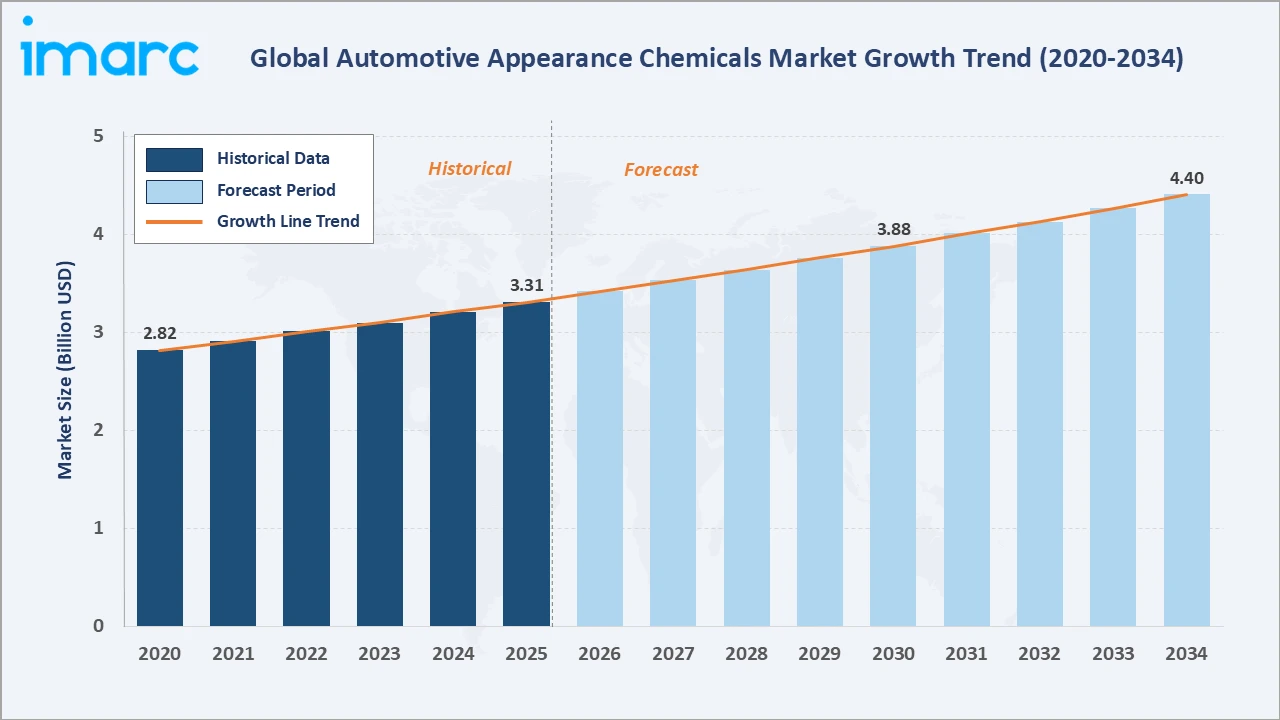
The global automotive appearance chemicals market reached USD 3.31 Billion in 2025 and is projected to reach USD 4.40 Billion by 2034, exhibiting a CAGR of 3.23% during 2026-2034. Approximately 90 million motor vehicles are sold each year globally, providing persistent demand for cleaning and protection products, the rising DIY car care culture amplified by social media and professional detailing service expansion, and rapid vehicle ownership growth in Asia-Pacific are the primary growth catalysts. Waxes and polishes lead application at 33.2%, passenger cars dominate end use at 65.0%, and Asia-Pacific accounts for the largest regional share at 37.5%.
Market Snapshot
|
Metric |
Value |
|
Market Size (2025) |
USD 3.31 Billion |
|
Forecast Market Size (2034) |
USD 4.40 Billion |
|
CAGR (2026-2034) |
3.23% |
|
Base Year |
2025 |
|
Historical Period |
2020-2025 |
|
Forecast Period |
2026-2034 |
|
Dominant Application |
Waxes and Polishes (33.2%, 2025) |
|
Dominant End Use |
Passenger Cars (65.0%, 2025) |
|
Leading Region |
Asia-Pacific (37.5%, 2025) |
The global automotive appearance chemicals market demonstrated consistent growth, rising from USD 2.82 Billion in 2020 to USD 3.31 Billion in 2025, driven by COVID-19's unexpected acceleration of DIY car care activity as consumers shifted household spending toward home-based maintenance, post-pandemic professional detailing service recovery, and rising vehicle ownership in developing economies. The market is projected to reach USD 3.88 Billion by 2030 and USD 4.40 Billion by 2034.
To get more information on this market, Request Sample
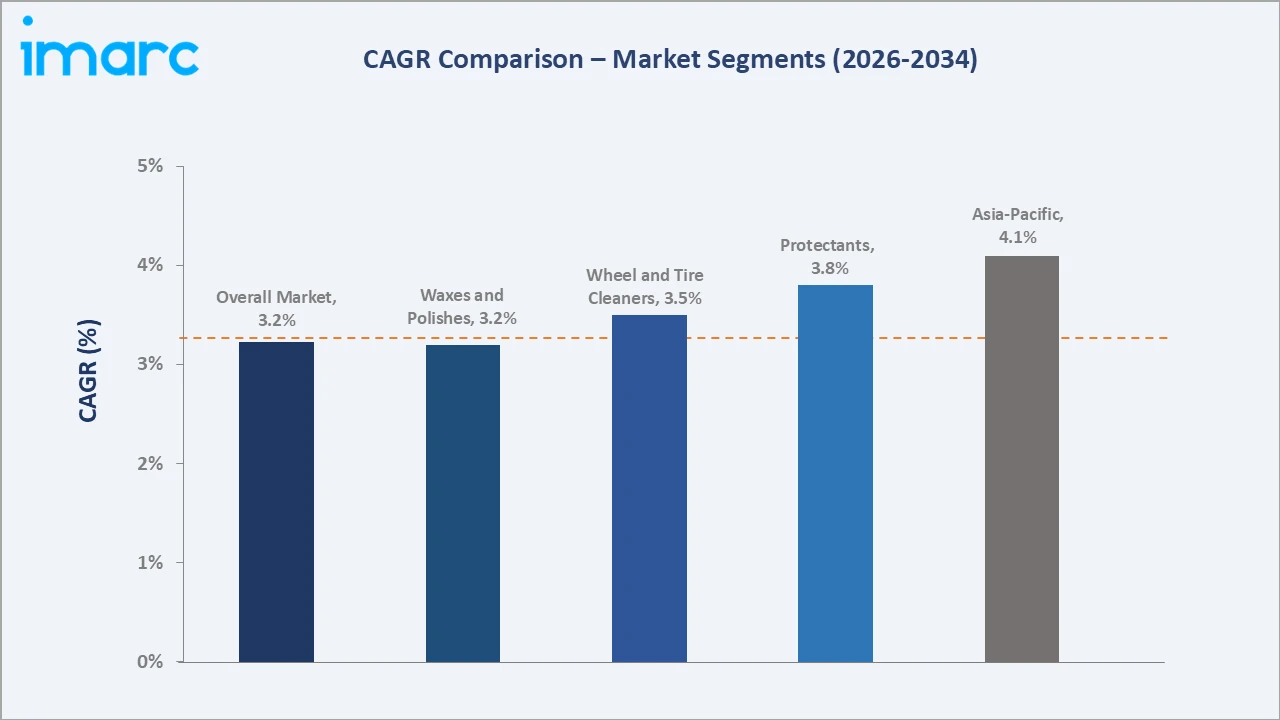
Protectants grow at ~3.8% CAGR through ceramic coating technology democratization from professional-only to consumer-accessible products. Wheel and tire cleaners grow at ~3.5% CAGR through expanding DIY care enthusiasm and the growing wheel and rim diversity in modern vehicles. Asia-Pacific leads regional growth at ~4.1% CAGR through China and India vehicle parc expansion and rising consumer spending on vehicle aesthetics and maintenance.
Executive Summary
The global automotive appearance chemicals market serves a fundamental consumer need through a broad portfolio of cleaning, polishing, protecting, and restoring chemical products. Market value stood at USD 3.31 Billion in 2025 and is forecast to reach USD 4.40 Billion by 2034. The market benefits from structural demand permanence: unlike discretionary consumer spending, vehicle appearance maintenance spending is driven by vehicle ownership combined with consumers' desire to protect the significant financial investment their vehicles represent.
Waxes and polishes lead application at 33.2% (2025), reflecting their position as the foundational category in automotive care that simultaneously delivers the most visually impactful consumer benefit (gloss and shine) while providing UV protection and surface preservation. Passenger cars dominate end use at 65.0% (2025), reflecting the global passenger vehicle parc's numerical dominance and the higher per-vehicle product spending associated with personal vehicle pride and value preservation. Asia-Pacific commands 37.5% (2025), reflecting the region's massive vehicle parc, rapidly growing disposable incomes, and emerging car care culture across China, Japan, South Korea, India, and Southeast Asia.
Key Market Insights
|
Insight |
Data |
|
Dominant Application |
Waxes and Polishes – 33.2% share (2025) |
|
Dominant End Use |
Passenger Cars – 65.0% share (2025) |
|
Leading Region |
Asia-Pacific – 37.5% share (2025) |
|
Market Opportunity |
Ceramic coating mass-market adoption; EV-specific care products; waterless formulas; Asia-Pacific premium car care expansion |
Key Analytical Observations Supporting the Above Data:
- Waxes and Polishes at 33.2% (2025): The waxes and polishes category encompasses traditional carnauba wax products, synthetic polymer sealants, paint correction compounds (cutting/polishing compounds), and emerging ceramic-infused polish hybrids.
- Passenger Cars at 65.0% (2025): Passenger cars dominate due to their large global fleet, high sales volume, and frequent need for cleaning, polishing, waxing, and surface protection. Rising consumer focus on vehicle aesthetics, resale value, and regular maintenance further supports strong demand across this segment.
- Asia-Pacific at 37.5% (2025) growing at ~4.1% CAGR: Asia-Pacific's market leadership reflects the region's vehicle parc combined with rapidly growing disposable incomes enabling premium car care product adoption in China's growing middle class, Japan and South Korea's established car care cultures with premium product preferences, and India's rapidly expanding vehicle parc from accelerating automobile penetration.
Automotive Appearance Chemicals Market Overview
The global automotive appearance chemicals market encompasses formulated chemical products used to clean, protect, restore, and enhance the aesthetic appearance of vehicles' exterior and interior surfaces. Core product categories include waxes and polishes (carnauba wax, synthetic polymer sealants, ceramic coatings, paint correction compounds), protectants (vinyl and plastic protectants, rubber dressings, UV protection coatings), wheel and tire cleaners (acid-free wheel cleaners, brake dust removers, tire shine products), windshield washer fluids (freeze-resistant, summer formula, concentrated), and specialty products (engine bay cleaners, leather conditioners, glass cleaners, odor eliminators). Products serve two primary market channels: DIY consumer (retail sales through automotive parts retailers, supermarkets, and e-commerce) and professional detailing (B2B sales to car washes, detail shops, dealership reconditioning centers, and fleet operators). Macroeconomic factors include rising disposable incomes, increasing global vehicle ownership, and steady growth in automotive production and sales.
Market Dynamics
To evaluate market opportunities, Request Sample
Market Drivers
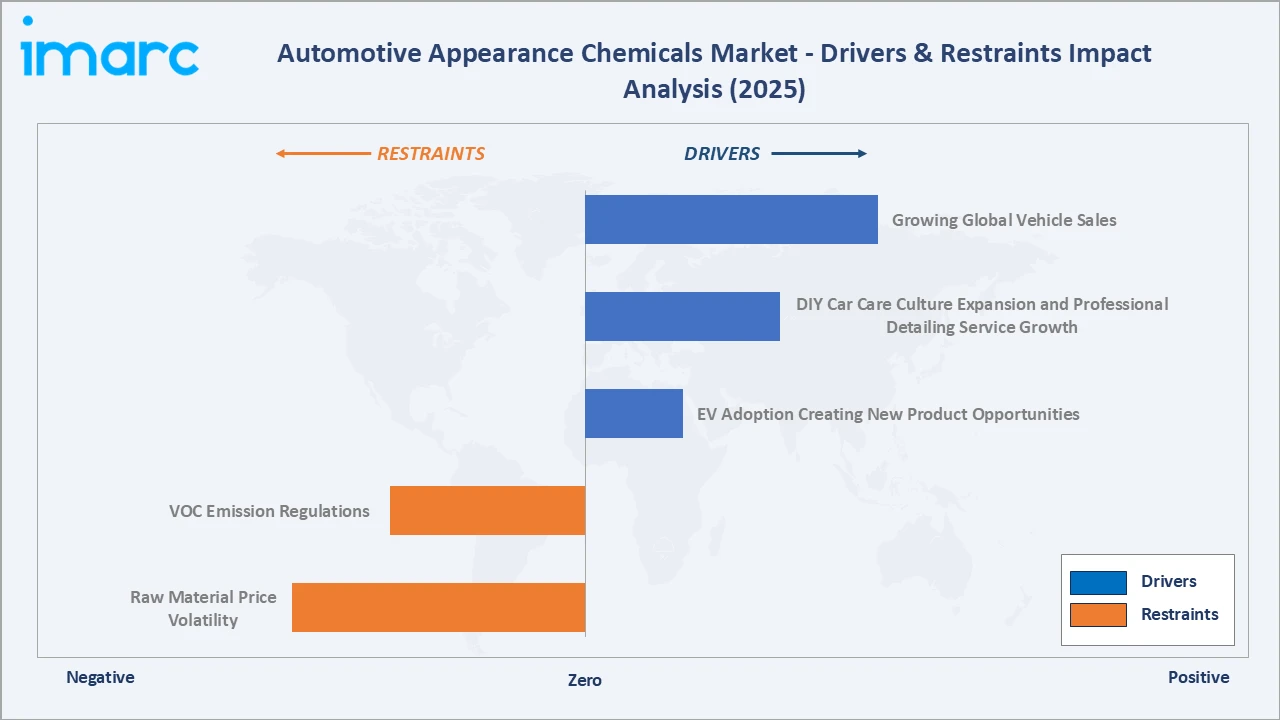
- Growing Global Vehicle Sales: Global vehicle sales reached approximately 26.96 million units by April 2026. The substantial volume of new vehicle sales continues to expand the global vehicle fleet and supports demand for automotive appearance chemicals. Products such as waxes, polishes, coatings, cleaners, and surface protectants are increasingly used to maintain vehicle aesthetics and protect interior and exterior components. Moreover, growing consumer attention to vehicle upkeep and resale value is strengthening demand for professional detailing and maintenance products.
- DIY Car Care Culture Expansion and Professional Detailing Service Growth: The COVID-19 pandemic created an inflection point for DIY car care that has sustained post-pandemic through the growth of social media car care communities. This cultural shift has created a new generation of car care enthusiasts willing to invest in premium product categories including ceramic coatings, paint correction compounds, and professional-grade car wash systems. Simultaneously, professional detailing services have expanded from a niche luxury to a mainstream service category, with detailing shops, mobile detailing businesses, and car wash-detailing hybrid facilities creating B2B demand channels for professional-grade appearance chemicals.
- EV Adoption Creating New Product Opportunities: The global electric car market achieved a new record in 2025, with sales rising by 20% compared with 2024 and surpassing 20 million units. China remained the largest EV market, selling more than 13 million electric cars and representing roughly six out of every ten electric vehicles sold worldwide. EV-specific product development, including EV-compatible waxes without silicone formulations that could damage EV battery connectors, specialized charging port protectants, and underbody sealants for EVs' battery pack exposure, represents an emerging premium product niche growing rapidly within the overall automotive appearance chemicals market.
Market Restraints
- VOC Emission Regulations: Volatile Organic Compound (VOC) emission regulations are restricting the solvent content in traditional automotive appearance chemical formulations. Traditional high-solvent polishes and cleaners that delivered superior cleaning performance are being reformulated with water-based and low-VOC alternatives that present formulation challenges in matching the performance benchmark of solvent-based predecessors.
- Raw Material Price Volatility: Automotive appearance chemicals rely on silicone polymers, petroleum-derived waxes and oils, surfactants, and specialty chemical emulsifiers critical for high-performance protectants and ceramic coating precursors. This volatility compresses manufacturer margins when raw material costs rise faster than product retail pricing, particularly for smaller specialty manufacturers with limited hedging capability.
Market Opportunities
- Ceramic Coating Democratization from Professional to Consumer Market: Ceramic coating technology is transitioning from exclusive professional application to consumer-accessible spray and wipe-on products. The ceramic consumer products segment is growing as brands make ceramic protection accessible to the mass consumer market, representing the highest-growth premium subcategory within waxes and polishes.
- Waterless and Eco-Friendly Products: Waterless car wash and detailing spray products that require no rinsing water are growing rapidly in water-scarce regions and among environmentally conscious consumers globally. In February 2025, Go Waterless introduced an advanced waterless car-cleaning formula priced at INR 699 per bottle. The product allows vehicle owners to clean their cars without using large quantities of water, helping address growing water-conservation concerns in India. Its launch is particularly relevant given NITI Aayog’s warning that around 40% of the country’s population could face severe drinking-water shortages by 2030.
Market Challenges
- E-Commerce Disruption of Traditional Distribution Models: The shift of automotive appearance chemical retail from physical automotive parts stores to e-commerce platforms is disrupting established distribution relationships and brand positioning that relied on point-of-sale merchandising, in-store product demonstrations, and physical shelf presence. E-commerce's emphasis on price transparency, rating systems, and ease of product comparison is intensifying competition from private-label and direct-to-consumer brands that can compete effectively on price without traditional brand equity investment, compressing margins for established mid-tier brands.
- Counterfeit Product Competition in Emerging Markets: Premium automotive appearance chemical brands face significant counterfeit competition in Asian and Middle Eastern markets, where counterfeit products using recognized brand names and packaging undermine brand equity, create consumer safety risks, and divert revenue from brand-investing manufacturers. Brand protection investment adds cost without direct consumer benefit, representing a competitive challenge particularly impactful for globally recognized brands operating in markets with weaker intellectual property enforcement.
Emerging Market Trends
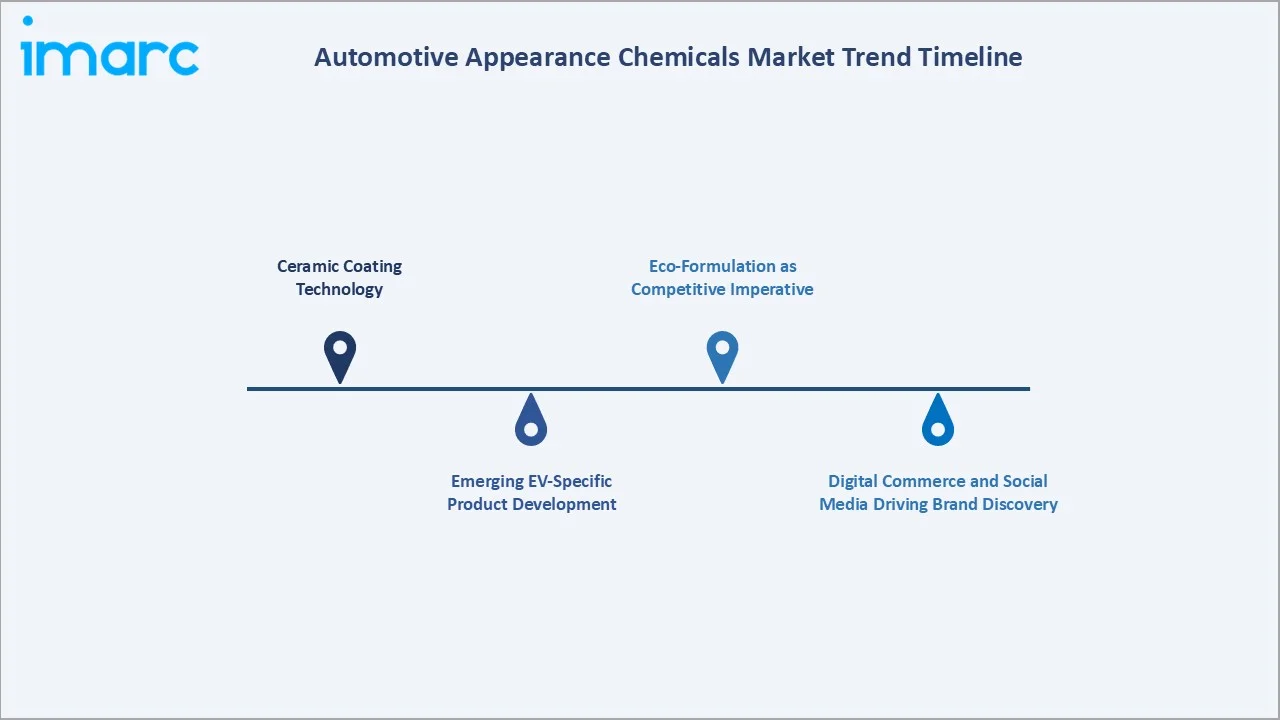
1. Ceramic Coating Technology
Ceramic coating technology is emerging due to increasing consumer demand for long-lasting paint protection, enhanced gloss, and reduced maintenance. Nano-ceramic formulations provide superior resistance to UV rays, chemicals, scratches, and environmental contaminants compared to conventional waxes and sealants. In March 2026, Cosmo Consumer entered the automotive ceramic coatings market with the launch of Cosmo Guard, a high-performance nano-ceramic solution developed to protect vehicle surfaces. The move expands the company’s automotive protection portfolio and complements its existing Paint Protection Film and Window Film businesses.
2. Eco-Formulation as Competitive Imperative
Eco-friendly formulation is emerging as manufacturers respond to stricter environmental standards and growing demand for safer vehicle-care products. Companies are developing waterless, biodegradable, low-VOC, and solvent-free cleaners, polishes, and coatings to reduce water use and chemical emissions. Brands offering high-performance sustainable solutions are gaining stronger differentiation and wider acceptance among consumers, detailing centers, and fleet operators.
3. Digital Commerce and Social Media Driving Brand Discovery
Online marketplaces, influencer demonstrations, detailing videos, and customer reviews help consumers compare products and assess performance before purchasing. Direct-to-consumer channels also enable brands to reach wider audiences, launch niche products, and build loyalty through targeted digital marketing.
4. Emerging EV-Specific Product Development
Emerging EV-specific product development is emerging as manufacturers design appearance chemicals suited to the distinctive materials and maintenance needs of electric vehicles. Specialized cleaners, coatings, and protectants are being developed for aerodynamic surfaces, sensors, cameras, touchscreens, and lightweight interior components. Global electric car sales increased by 20% in 2025, surpassing 20 million units and accounting for approximately one in every four new cars sold worldwide. The rapid expansion of the global EV fleet is encouraging brands to introduce safer, low-residue, and eco-friendly formulations tailored to this segment.
Industry Value Chain Analysis
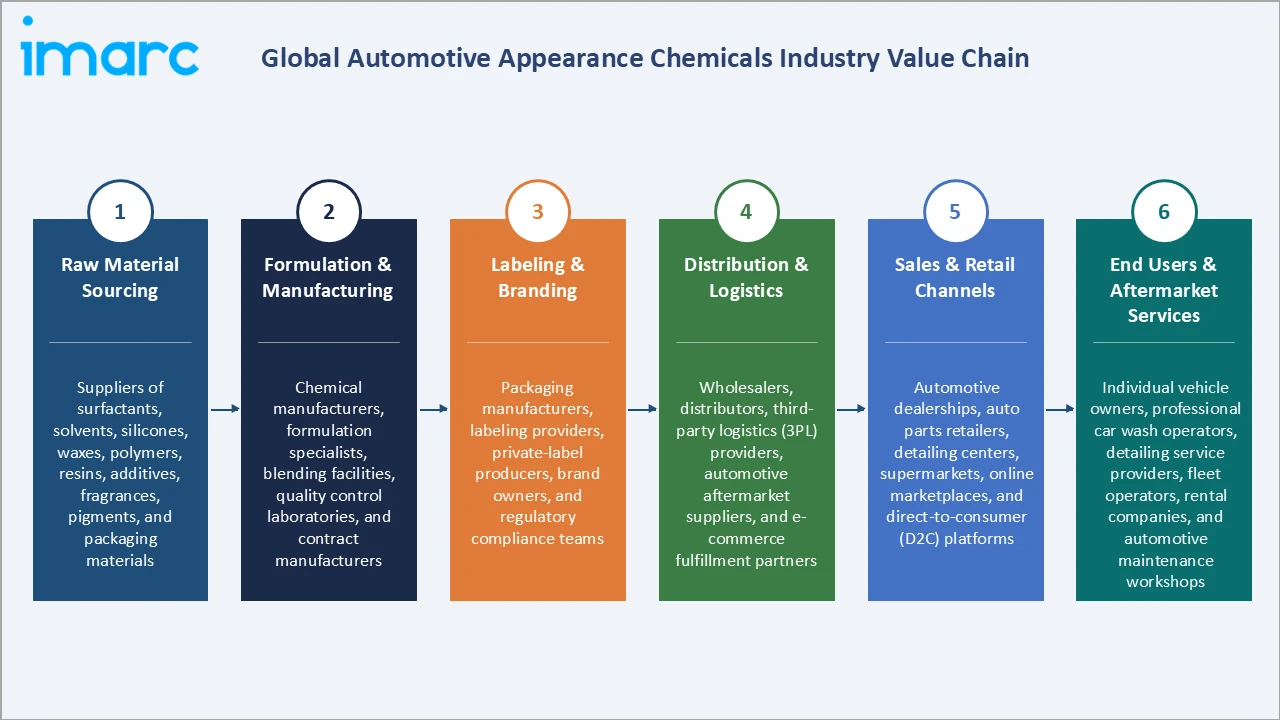
The automotive appearance chemicals value chain integrates raw material sourcing, formulation and manufacturing, labelling and branding, multi-channel distribution, consumer or professional application, and end-use vehicle maintenance outcomes.
|
Stage |
Key Participants |
|
Raw Material Sourcing |
Suppliers of surfactants, solvents, silicones, waxes, polymers, resins, additives, fragrances, pigments, and packaging materials. |
|
Formulation & Manufacturing |
Chemical manufacturers, formulation specialists, blending facilities, quality control laboratories, and contract manufacturers. |
|
Labeling & Branding |
Packaging manufacturers, labeling providers, private-label producers, brand owners, and regulatory compliance teams. |
|
Distribution & Logistics |
Wholesalers, distributors, third-party logistics (3PL) providers, automotive aftermarket suppliers, and e-commerce fulfillment partners. |
|
Sales & Retail Channels |
Automotive dealerships, auto parts retailers, detailing centers, supermarkets, online marketplaces, and direct-to-consumer (D2C) platforms. |
|
End Users & Aftermarket Services |
Individual vehicle owners, professional car wash operators, detailing service providers, fleet operators, rental companies, and automotive maintenance workshops. |
Distribution represents a critical competitive differentiator in the automotive appearance chemicals market. Brands with established physical retail presence in major automotive parts stores benefit from impulse purchase placement and consumer trust established through decades of branded shelf presence. The shift toward e-commerce distribution requires brands to invest in digital marketing and direct-to-consumer capabilities while maintaining physical retail relationships.
Technology Landscape in the Automotive Appearance Chemicals Industry
Ceramic Silica Nanoparticle Coating Technology
Ceramic silica nanoparticle coating technology provides durable, hydrophobic, and high-gloss surface protection with enhanced resistance to UV rays, chemicals, oxidation, and minor scratches. Compared with traditional waxes and sealants, these nano-coatings offer longer-lasting performance and lower maintenance requirements. Their growing adoption by professional detailing centers, OEMs, and premium vehicle owners is driving innovation in advanced vehicle surface protection solutions.
Waterless and Rinseless Wash Technology
Waterless and rinseless wash technology enables effective vehicle cleaning with minimal or no water consumption. Advanced surfactants, lubricants, and polymer-based formulations safely lift and encapsulate dirt while reducing the risk of surface scratches. In September 2025, Uno Minda Ltd. introduced a new portfolio of car care products for India’s aftermarket in response to growing demand for vehicle cleaning and maintenance solutions. The range addresses both exterior and interior care, with products such as wash shampoo, waterless wash, polish, anti-fog spray, windshield cleaners, and de-misters. Interior offerings include AC vent hygiene foam featuring silver nanotechnology, antibacterial foam, multipurpose shiners, dashboard and leather care products, and interior surface restorers.
Bio-Based and Sustainable Formulation Technology
Bio-based and sustainable formulation technology replacing petroleum-derived ingredients with renewable, biodegradable, and low-VOC alternatives. Manufacturers are developing eco-friendly cleaners, polishes, and coatings that deliver high performance while complying with increasingly stringent environmental regulations. Advances in green chemistry and plant-based raw materials are enabling brands to reduce their environmental footprint and meet growing consumer demand for sustainable vehicle care solutions.
Market Segmentation Analysis
The report covers the following segments:
|
Segment Category |
Leading Segment |
Market Share |
Year |
|
Application |
Waxes and Polishes |
33.2% |
2025 |
|
End Use |
Passenger Cars |
65.0% |
2025 |
|
Region |
Asia-Pacific |
37.5% |
2025 |

By Application
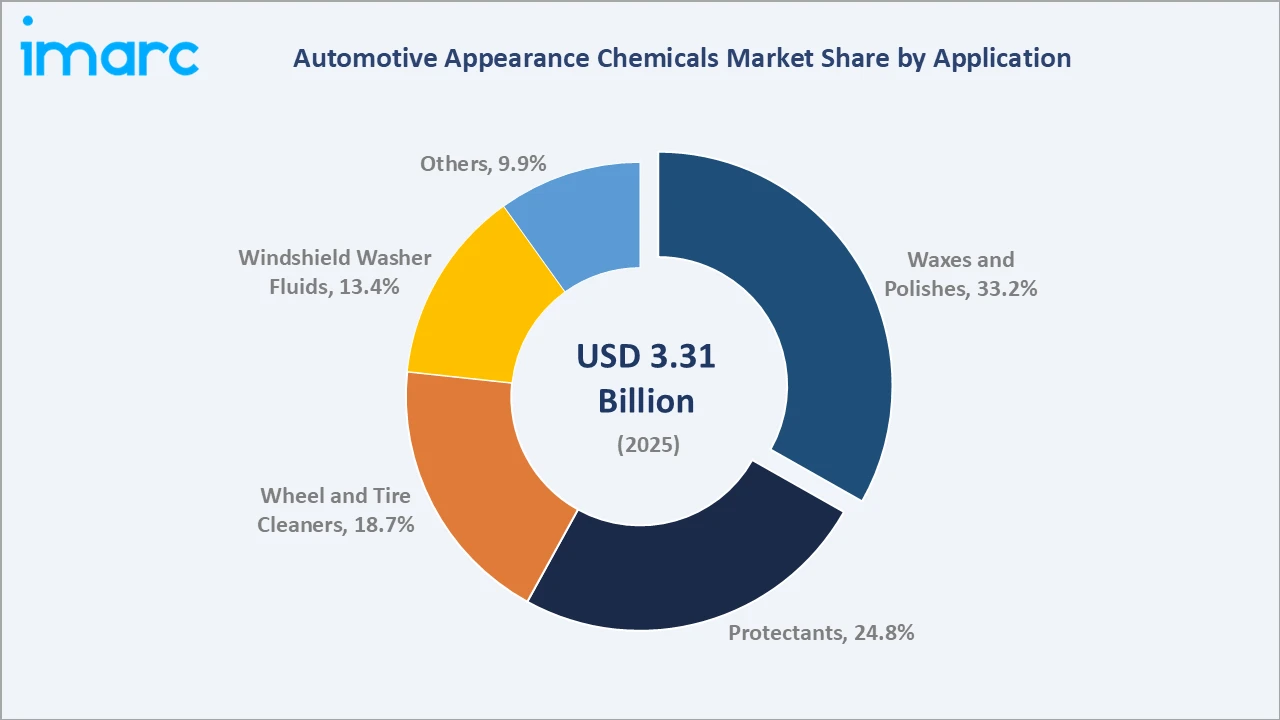
Waxes and polishes lead at 33.2% (2025), encompassing traditional carnauba wax products, synthetic polymer sealants, paint correction compounds, and ceramic-infused hybrid products. The category delivers the most visible consumer benefit, making it the highest consumer-engagement application category with the broadest product portfolio range from commodity wax to premium ceramic spray.
To access detailed market analysis, Request Sample
Protectants at 24.8% (2025) serve the interior and exterior surface protection needs beyond paint. The segment's above-market CAGR (~3.8%) reflects ceramic technology infiltration into the consumer protectant category. Wheel and tire cleaners at 18.7% (2025) address the vehicle's most contamination-prone surfaces, with brake dust requiring specialized cleaning formulations. Windshield washer fluids at 13.4% (2025) are the most commoditized application segment, characterized by high volume, low price points, and private-label competition. Others at 9.9% encompass specialty products including leather conditioners, engine bay cleaners, glass treatments, and interior odor eliminators.
By End Use
Passenger cars dominate at 65.0% (2025), reflecting passenger vehicles' numerical dominance in the global vehicle parc and the significantly higher per-vehicle appearance maintenance spending associated with personal vehicle ownership. The passenger car segment benefits from both volume and value: the largest vehicle count globally, combined with consumers' personal ownership pride motivating premium product investment that does not typically occur for commercial fleet vehicles. Premium products, including ceramic coatings, paint correction compounds, and interior detailing systems, are overwhelmingly concentrated in the passenger car segment.
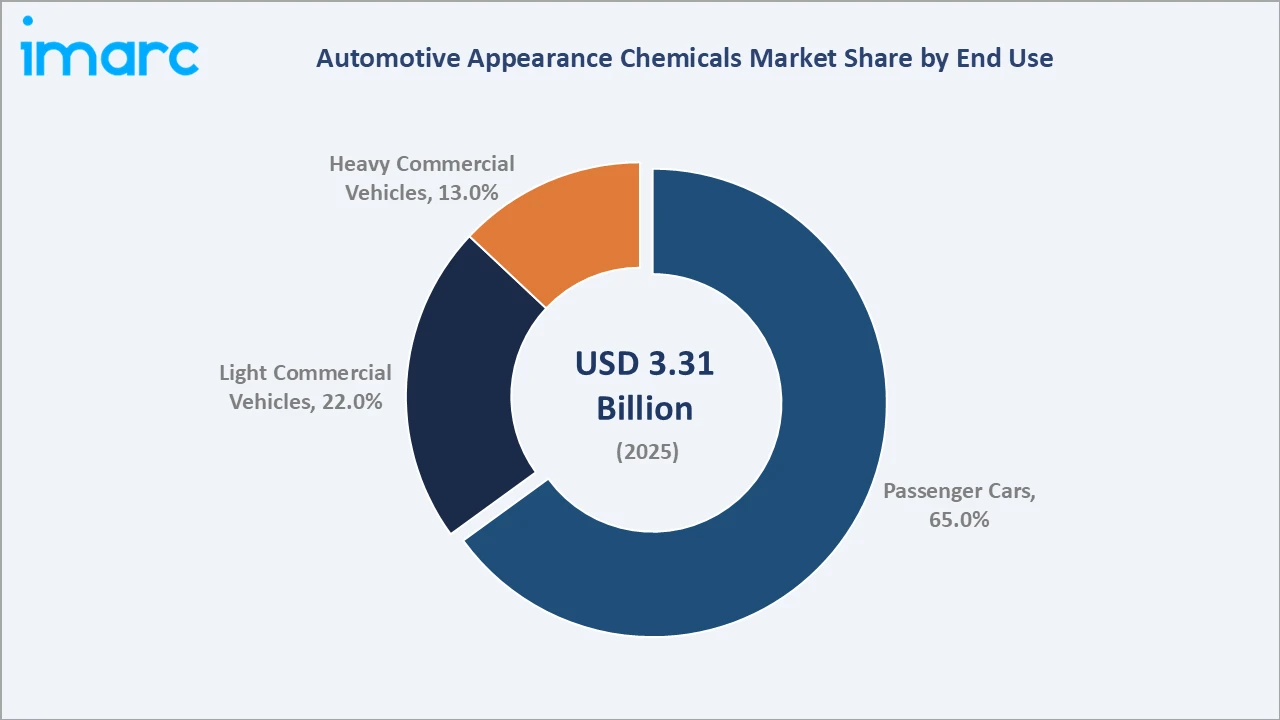
Light commercial vehicles (LCV) at 22.0% (2025) include pickup trucks, SUVs used commercially, vans, and minibuses operated as fleet or commercial vehicles requiring regular appearance maintenance for brand presentation, vehicle value preservation, and regulatory compliance. Heavy commercial vehicles (HCV) at 13.0% (2025) encompass trucks, coaches, buses, and heavy equipment requiring specialized appearance maintenance products designed for large surface area application, heavy contamination removal, and commercial washing system compatibility.
Regional Market Insights
|
Region |
Share (2025) |
Key Automotive Appearance Chemicals Market Drivers & Characteristics |
|
Asia-Pacific |
37.5% |
The largest market driven by high vehicle production and sales, an expanding middle-class population, rising vehicle ownership, and growing demand for premium car care products. |
|
North America |
26.0% |
Mature automotive aftermarket with strong consumer spending on vehicle maintenance and appearance. |
|
Europe |
23.5% |
Growth is supported by premium vehicle ownership, stringent environmental regulations, and increasing demand for eco-friendly, low-VOC, and water-saving automotive appearance chemicals. |
|
Latin America |
7.0% |
Market expansion is driven by rising vehicle ownership, improving disposable incomes, and growing awareness of vehicle maintenance. |
|
Middle East and Africa |
6.0% |
Demand is fueled by harsh climatic conditions requiring frequent vehicle cleaning and surface protection, expanding automotive sales, and the growing presence of professional car wash and detailing service providers. |
Asia-Pacific's 37.5% regional dominance reflects a large automotive manufacturing base, expanding vehicle ownership, and a rapidly growing aftermarket industry. North America at 26.0% remains a mature market characterized by strong consumer spending on premium vehicle care products, advanced detailing technologies, and a well-established DIY culture.
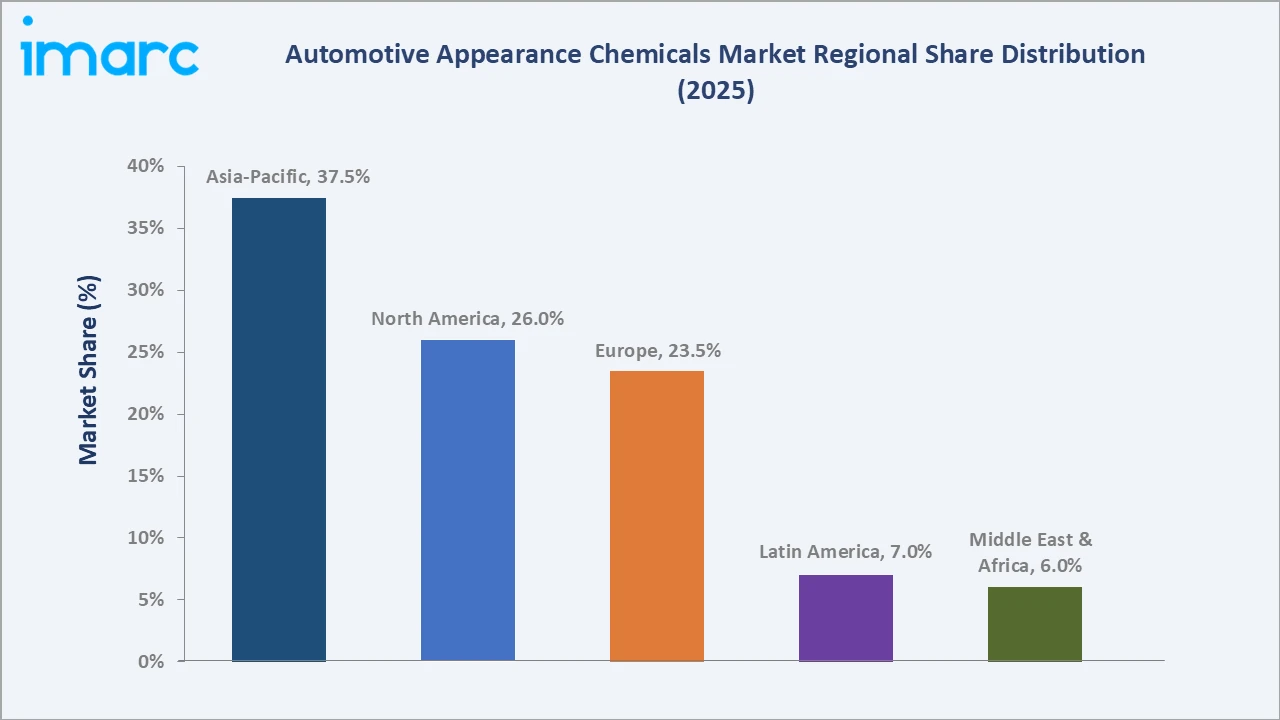
Europe, at 23.5%, benefits from high demand for sustainable, low-VOC formulations and premium surface protection products, supported by stringent environmental regulations and a large luxury vehicle fleet. Latin America is at 7.0%, witnessing steady growth as rising disposable incomes, increasing vehicle ownership, and expanding automotive aftermarket activities improve demand for appearance chemicals. Middle East and Africa, at 6.0%, are experiencing increasing adoption of vehicle care products due to harsh climatic conditions, growing automotive sales, and expanding professional detailing services.
Competitive Landscape
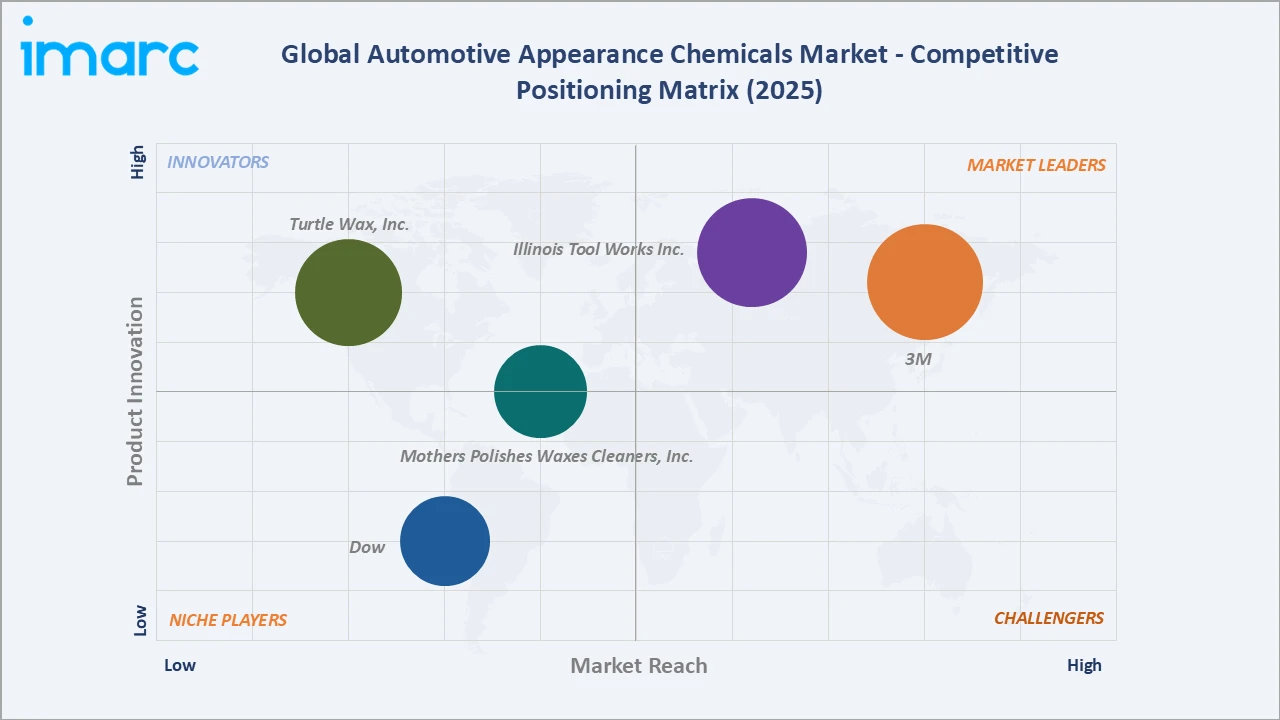
The global automotive appearance chemicals market is moderately consolidated. The market features meaningful competition from regional specialty brands and value-focused domestic manufacturers in North America. Competition is increasingly defined by formulation innovation, digital marketing capability, professional endorsement, and private-label manufacturing relationships.
|
Company |
Key Products |
Market Position |
Core Strength |
|
3M |
Adhesive Cleaners & Removers, Automotive Cleaners & Detailing, Engine Performance Chemicals, General Purpose Cleaners, Glass Cleaners |
Market Leader |
3M is a premier global innovator in automotive appearance chemicals for both professional detailers and DIY enthusiasts with premium products. Their chemical solutions restore, protect, and maintain the showroom finish of vehicle exteriors, interiors, and engine bays. |
|
Illinois Tool Works Inc. |
CFC Free Electro Contact Cleaner, EC Clean, M-CLEAN, NoFlash Electro Contact Cleaner |
Market Leader |
Illinois Tool Works Inc. (ITW) operates as a major player in the automotive appearance and aftermarket chemical industry through its Polymers & Fluids segment and subsidiary ITW Global Brands. |
|
Turtle Wax, Inc. |
Hybrid Solutions Ceramic Wax 3-in-1 Detailer, Hybrid Solutions Ceramic Wash & Wax, Max Power Car Wash, Hybrid Solutions Pure Wash, ZipWax Car Wash & Wax |
Innovator |
Turtle Wax, Inc. pioneered the modern automotive appearance chemicals industry. They created the world's first bottled car wax. The company leads the DIY retail and commercial car wash sectors globally with advanced chemical formulations for paintwork, wheels, and interior care. |
|
Dow |
XIAMETER PMX-200 Silicone Fluid, XIAMETER MEM-8035 Emulsion |
Niche Player |
Dow manufactures performance-enhancing raw materials for automotive appearance chemicals. They supply formulators with silicone-based fluids, resins, and surfactants used to create waxes, polishes, and protectants. |
|
Mothers Polishes Waxes Cleaners, Inc. |
Back-to-Black Tire Cleaner, Revision Glass + Surface Cleaner, Speed Foaming Glass & Screen Cleaner, Carpet & Upholstery Cleaner |
Established Player |
Mothers Polishes Waxes Cleaners, Inc. is a leading manufacturer of premium automotive surface treatments, specializing in consumer and professional-grade detailing products. |
Competitive dynamics are being reshaped by the ceramic coating technology transition, eco-formulation regulatory requirements, and digital marketing as the primary brand-building channel. Companies investing in these three dimensions simultaneously, premium ceramic technology, sustainable formulation, and digital community engagement, are building durable competitive positions that align with where consumer preferences and regulatory requirements are converging through 2034.
Key Company Profiles
3M
3M is a leading global manufacturer of automotive appearance and surface protection solutions, offering a comprehensive portfolio of products for vehicle cleaning, polishing, paint correction, ceramic coatings, and paint protection. Through its Automotive Aftermarket Division, the company serves OEMs, professional detailing centers, collision repair facilities, dealerships, and automotive enthusiasts worldwide. Leveraging its expertise in advanced materials, abrasives, adhesives, and protective technologies, 3M develops high-performance solutions that enhance vehicle appearance, durability, and long-term surface protection.
- Key Products: Adhesive Cleaners & Removers, Automotive Cleaners & Detailing, Engine Performance Chemicals, General Purpose Cleaners, Glass Cleaners.
- Strategic Focus: Expanding its portfolio of premium surface protection and vehicle care solutions through continuous innovation in abrasives, polishing compounds, ceramic coatings, and paint protection technologies. The company emphasizes sustainable product development, advanced material science, and digital training programs for professional detailers and collision repair centers.
Illinois Tool Works Inc.
Illinois Tool Works Inc. (ITW) is a diversified global industrial manufacturer with a strong presence in the automotive appearance chemicals market through its ITW Global Brands portfolio. The company offers a wide range of vehicle care and detailing products, including polishing compounds, rubbing compounds, waxes, cleaners, surface protectants, and paint correction solutions.
- Key Products: CFC Free Electro Contact Cleaner, EC Clean, M-CLEAN, NoFlash Electro Contact Cleaner.
- Strategic Focus: Strengthening its automotive appearance chemicals portfolio through continuous innovation in surface care, paint correction, polishing, and vehicle maintenance solutions for the professional automotive aftermarket. The company emphasizes high-performance formulations that improve efficiency, durability, and ease of application for detailing professionals and collision repair centers.
Market Concentration Analysis
The global automotive appearance chemicals market is moderately consolidated, with 3M, Illinois Tool Works Inc., Turtle Wax, Inc., Dow, and Mothers Polishes Waxes Cleaners, Inc., collectively holding an estimated 35-40% of global market revenue in 2025. The market's fragmentation below the top tier reflects the low barriers to formulation entry for regional players, the importance of local brand relationships in automotive retail channels, and the persistence of regional brand preferences that global brands cannot easily displace through price or product alone. Market concentration is expected to increase modestly through 2034 as ceramic coating technology requirements, eco-formulation compliance costs, and digital marketing investment needs advantage larger brands with resources to lead these transitions simultaneously.
Investment & Growth Opportunities
Highest Growth Segments
Protectants application (~3.8% CAGR), Asia-Pacific region (~4.1% CAGR), ceramic coating consumer products (~15-20% niche CAGR within polishes), EV-specific car care products (~10-15% niche CAGR from emerging base), and waterless/eco-formulated products (~6-8% CAGR within respective categories) represent automotive appearance chemicals market's highest-growth investment vectors through 2034.
Investment Themes
- Ceramic coating democratization for mass-market consumers: Investment in consumer-accessible ceramic protection products that bring professional-grade paint protection within reach of average consumers represents the highest-value premiumization opportunity in the global AAC market. The ceramic consumer product segment will become a multi-billion-dollar category by 2030 as technology cost reduction and consumer awareness compound.
- Asia-Pacific distribution capability and localization investment: Building domestic manufacturing, formulation, and distribution infrastructure in key Asian markets provides competitive advantages in lead time, local regulatory compliance, consumer preference alignment, and cost positioning that globally distributed brands cannot match through export supply.
Future Market Outlook (2026-2034)
The global automotive appearance chemicals market is projected to grow from USD 3.31 Billion in 2025 to USD 4.40 Billion by 2034, delivering a 3.23% CAGR over the forecast period, consistent demand-anchored growth reflecting the market's structural basis in the ever-expanding global vehicle parc and the universal consumer desire to maintain vehicle aesthetics and value. The market's anchor value of USD 3.88 Billion in 2030 is driven by the compounding effect of vehicle parc growth, Asia-Pacific market development, and ceramic technology category premiumization.
Three structural forces will define the automotive appearance chemicals market trajectory through 2034. First, the global vehicle parc provides an ever-larger installed base of demand-generating assets, with each additional vehicle representing annual recurring appearance chemical consumption. Second, ceramic coating technology democratization will structurally elevate the average revenue per vehicle occasion from the current consumer car care event toward ceramic-infused products replacing commodity wax products in premium and mass-market consumer spending. Third, sustainability regulatory compliance will transition from a competitive differentiator to a market entry requirement in leading regulatory jurisdictions.
Research Methodology
Primary Research
Primary research comprised in-depth interviews with automotive appearance chemicals manufacturer executives, retail category managers at major automotive parts retailers, professional detailing business owners, fleet maintenance managers, and independent market analysts. These discussions validated market size estimates, assessed product category demand trends, evaluated competitive dynamics, and provided insights into consumer behavior changes, professional channel development, and regional market characteristics across the five geographic regions.
Secondary Research
Secondary research encompassed company annual reports and press releases, emission regulation documentation, chemical regulations, retail sales data from automotive parts retail channels, e-commerce platform sales analytics, trade publication coverage of product launches and acquisitions, and credible market intelligence sources.
Forecasting Models
Forecasting models were developed using historical automotive appearance chemicals market data, global vehicle parc growth projections, regional GDP per capita growth rates as proxies for per-vehicle spending improvement, product category technology transition curves, and regulatory timeline analysis for eco-formulation market impact. Both top-down and bottom-up approaches were validated through primary research.
Report Coverage:
| Report Features | Details |
|---|---|
| Base Year of the Analysis | 2025 |
| Historical Period | 2020-2025 |
| Forecast Period | 2026-2034 |
| Units | Billion USD |
| Scope of the Report | Exploration of Historical Trends and Market Outlook, Industry Catalysts and Challenges, Segment-Wise Historical and Future Market Assessment:
|
| Applications Coverage | Waxes and Polishes, Protectants, Wheel and Tire Cleaners, Windshield Washer Fluids, Others |
| End Uses Coverage | Passenger Cars, Light Commercial Vehicles, Heavy Commercial Vehicles |
| Regions Covered | Asia Pacific, Europe, North America, Latin America, Middle East and Africa |
| Countries Covered | United States, Canada, Germany, France, United Kingdom, Italy, Spain, Russia, China, Japan, India, South Korea, Australia, Indonesia, Brazil, Mexico |
| Companies Covered | 3M, Illinois Tool Works Inc., Turtle Wax, Inc., Dow, Mothers Polishes Waxes Cleaners, Inc., etc. |
| Customization Scope | 10% Free Customization |
| Post-Sale Analyst Support | 10-12 Weeks |
| Delivery Format | PDF and Excel through Email (We can also provide the editable version of the report in PPT/Word format on special request) |
Frequently Asked Questions About the Automotive Appearance Chemicals Market Report
The global automotive appearance chemicals market reached USD 3.31 Billion in 2025, driven by the vehicle parc providing persistent demand, rising DIY car care culture, Asia-Pacific vehicle ownership surge, and ceramic coating consumer market democratization.
The market grows at 3.23% CAGR during 2026-2034, reaching USD 4.40 Billion by 2034. The CAGR reflects global vehicle parc expansion, Asia-Pacific's high regional CAGR, ceramic technology premiumization elevating average revenue per consumer care event, and professional detailing service expansion creating B2B demand growth.
Waxes and polishes lead at 33.2% (2025), driven by their position as the highest consumer-engagement appearance category, ceramic coating technology integration at the premium tier, and the broadest product range from commodity wax to ceramic spray targeting diverse consumer spending tiers.
Passenger cars dominate at 65.0% (2025), reflecting the global passenger vehicle parc's numerical dominance and higher per-vehicle appearance product spending driven by personal ownership pride, vehicle value preservation motivation, and premium product engagement concentrated in this segment versus commercial vehicles.
Asia-Pacific leads at 37.5% (2025), growing at ~4.1% CAGR, driven by China's vehicle parc, Japan and South Korea's premium car care cultures, India's rapidly expanding vehicle ownership, and Southeast Asia's growing middle-class vehicle adoption, creating new addressable consumer markets for global and regional AAC brands.
Leading companies include 3M, Illinois Tool Works Inc., Turtle Wax, Inc., Dow, and Mothers Polishes Waxes Cleaners, Inc., among others.
The market is projected to reach approximately USD 3.88 Billion by 2030, driven by Asia-Pacific market development acceleration, ceramic coating consumer product mainstream adoption, professional detailing service B2B channel growth, and eco-formulation transition creating premium pricing opportunities in regulated markets.
Top opportunities include consumer ceramic coating product development for mass-market accessibility, Asia-Pacific distribution capability building, eco-formulation investment for regulatory-future-proofing and sustainability premium pricing, professional detailing B2B channel development, EV-specific car care product development for the rapidly growing EV parc, and waterless product development for water-restricted global markets.
Need more help?
- Speak to our experienced analysts for insights on the current market scenarios.
- Include additional segments and countries to customize the report as per your requirement.
- Gain an unparalleled competitive advantage in your domain by understanding how to utilize the report and positively impacting your operations and revenue.
- For further assistance, please connect with our analysts.
 Request Customization
 Speak to an Analyst
 Request Brochure
 Inquire Before Buying
Benefits of Customization
- Personalize this research
- Triangulate with your data
- Get data as per your format and definition
- Gain a deeper dive into a specific application, geography, customer, or competitor
- Any level of personalization
Get in Touch With Us
UNITED STATES
Phone: +1-201-971-6302
INDIA
Phone: +91-120-433-0800
UNITED KINGDOM
Phone: +44-753-714-6104
Email: [email protected]
Client Testimonials




.webp)




.webp)













Related Reports

Choose your plan
*Please note that the prices mentioned below are starting prices for each bundle type. Kindly contact our team for further details.*
Single User License
- 1 User License, Access on 2 Devices
- PDF Report + Excel Dataset (Password Protected)
- Lifetime Access
- No Printing Rights
- 10% Free Report Customization
- 10–12 Weeks of Analyst Support
Five User License
- Access for 5 Users, 2 Devices per User
- PDF Report + Excel Dataset (Password Protected)
- Lifetime Access
- Dedicated Account Manager
- 12–14 Weeks of Analyst Support
- No Printing Rights
- 15% Free Report Customization
- 25% Discount on Your Next Purchase
Corporate User License
- Unlimited User Access (Within Your Organization)
- PDF Report + Excel Dataset
- Lifetime Access
- Dedicated Account Manager
- 14–20 Weeks of Analyst Support
- No Printing Rights
- 20% Free Report Customization
- 30% Discount on Your Next Purchase
Essential Insights
What's included:
3 reports
- Lifetime Access
- PDF Reports
- Excel Datasets
- 2 Weeks of Free Analyst Support
- 2 User Licenses
- Access on 2 Devices
- Printing Rights
- Complimentary PowerPoint (PPT) Version
- Complimentary License Upgrade
Professional Access
What's included:
5 reports
- Lifetime Access
- PDF Reports
- Excel Datasets
- 8 Weeks of Free Analyst Support
- 2 User Licenses
- Access on 2 Devices
- Printing Rights
- Complimentary PowerPoint (PPT) Version
- Complimentary License Upgrade
Business Advantage
What's included:
8 reports
- Lifetime Access
- PDF Reports
- Excel Datasets
- 14 Weeks of Free Analyst Support
- 2 User Licenses
- Access on 2 Devices
- Printing Rights
- Complimentary PowerPoint (PPT) Version
- Complimentary License Upgrade
Enterprise Intelligence
What's included:
10 reports
- Lifetime Access
- PDF Reports
- Excel Datasets
- 20 Weeks of Free Analyst Support
- 2 User Licenses
- Access on 2 Devices
- Printing Rights
- Complimentary PowerPoint (PPT) Version
- Complimentary License Upgrade