
Automotive Clutch Market Size, Share, Trends and Forecast by Vehicle Type, Transmission Type, Clutch Type, Clutch Disk/Plate Size, Distribution Channel, Material Type, and Region, 2026-2034
Automotive Clutch Market Size and Share:
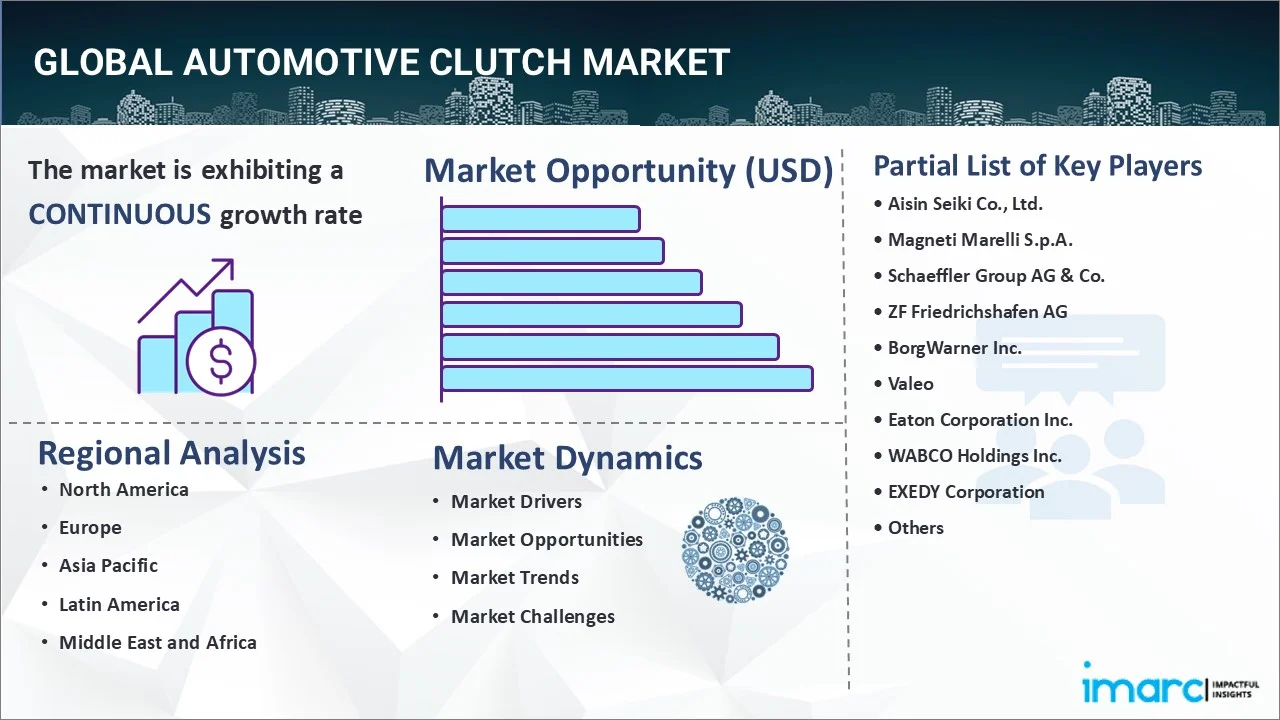
The global automotive clutch market size was valued at USD 14.2 Billion in 2025. Looking forward, IMARC Group estimates the market to reach USD 21.1 Billion by 2034, exhibiting a CAGR of 4.2% from 2026-2034. Asia Pacific currently dominates the market, holding a market share of 59.4% in 2025. The region’s dominance is attributed to its expansive vehicle production base, consistently growing consumer demand, strong adoption of manual and automated drivetrain systems, and rising automotive demand across densely populated nations, all of which solidify its leading position in the automotive clutch market share.
The global automotive clutch market is driven by sustained demand across both established and emerging economies. The rapid expansion of the global vehicle fleet has created consistent demand for clutch systems in new vehicle production as well as replacement needs. The growing penetration of automobiles in developing regions, supported by increasing disposable incomes and urbanization, has expanded the addressable customer base for clutch manufacturers. The shift toward fuel-efficient vehicles has spurred the development of lighter and more responsive clutch assemblies that comply with stringent emission norms. The rise in commercial transportation and freight activities has reinforced demand for heavy-duty clutch components. Automotive clutch market growth is further supported by advancements in clutch technology, including dual-clutch and automated systems that deliver improved performance and extended service life across modern automotive platforms.
The United States has emerged as a major region in the automotive clutch market owing to many factors. The country maintains a robust automotive industry characterized by a large fleet of passenger and commercial vehicles, generating consistent demand for both OEM and aftermarket clutch systems. In 2023, U.S.-based BorgWarner Inc. expanded its manufacturing capabilities by opening a new facility in Michigan dedicated to producing advanced clutch systems for electric vehicles, underscoring the industry’s focus on innovation and sustainability. Consumer preference for performance-oriented vehicles has driven the need for high-quality clutch assemblies capable of withstanding demanding conditions. The strong presence of domestic automotive manufacturers and an established aftermarket distribution network has further supported the flow of clutch components to end-users. Federal policies promoting domestic vehicle manufacturing have contributed to the growth of the automotive sector. Ongoing research into lightweight materials and electronically controlled clutch systems has positioned the United States as a hub for clutch technology development and innovation.
To get more information on this market Request Sample
Automotive Clutch Market Trends:
Rising Adoption of Automated Clutch Systems
The increasing adoption of automated clutch systems is reshaping demand patterns within the global automotive clutch industry. Automated clutch technologies, including dual-clutch and automated manual transmission systems, offer drivers the convenience of automatic gear shifting while retaining the mechanical efficiency associated with traditional manual drivetrains. In May 2025, automotive supplier BorgWarner Inc. secured two new dual‑clutch transmission programs with a major transmission manufacturer in China, reinforcing its role in expanding automated clutch technology deployment across global vehicle platforms and highlighting strong OEM demand for advanced clutch solutions. The performance benefits of these systems, including faster gear transitions, improved fuel economy, and reduced driver fatigue during urban commuting, have garnered strong consumer interest worldwide. As automakers seek to comply with increasingly stringent fuel efficiency mandates, the integration of advanced clutch assemblies that minimize drivetrain losses has become a key strategic priority. The ongoing refinement of electronic control units that govern clutch engagement timing and force modulation has further elevated the reliability, responsiveness, and operational durability of automated clutch systems, reinforcing their growing adoption across new vehicle platforms in both developed and developing markets.
Expanding Aftermarket Service Requirements
The sustained growth in vehicle ownership across global markets has generated robust demand for replacement clutch components in the aftermarket segment. As the average age of vehicles on the road continues to rise, the need for periodic clutch servicing, repair, and full assembly replacement has expanded considerably. In February 2026, ZF Aftermarket launched SACHS clutch discs and kits for agricultural tractors in India, the Middle East, and Africa, expanding its aftermarket portfolio and improving regional availability beyond passenger vehicles. Clutch wear is an inevitable consequence of regular vehicle use, particularly in heavy traffic conditions and hilly terrain, making aftermarket availability a critical consideration for both fleet operators and individual vehicle owners. Distributors and service networks have responded by expanding their inventories of clutch components to meet diverse vehicle specifications across different brands, vehicle ages, and models worldwide. The automotive clutch market outlook remains favorable as the aftermarket channel strengthens its position through improved logistics, online parts distribution, and the availability of cost-effective compatible clutch assemblies.
Material Innovation in Clutch Manufacturing
The development of advanced materials for clutch disc and pressure plate manufacturing has become a defining innovation focus within the global clutch industry. Organic friction materials have long dominated the market owing to their balanced performance characteristics, smooth engagement properties, and cost-effectiveness, making them suitable for a wide range of passenger vehicle applications. Simultaneously, the growing interest in ceramic and sintered metal friction materials reflects the industry’s pursuit of greater durability and thermal resistance, particularly for high-performance and commercial vehicle applications where clutches endure sustained stress. According to reports, BorgWarner Inc. announced it is supplying advanced friction technology for Volkswagen’s new hybrid dual‑clutch transmission, where optimized materials enhance heat management and shifting, highlighting innovation in next‑gen drivetrains. Material selection now plays a decisive role in determining clutch longevity, heat dissipation performance, and pedal feel, influencing both OEM specification decisions and aftermarket product offerings. Automotive clutch market trends point toward the growing integration of composite and hybrid friction materials that balance cost with performance across diverse drivetrain configurations. Continuous investment in materials research is expected to yield clutch components with enhanced resistance to wear, improved operating temperature thresholds, and reduced maintenance requirements across varied application environments.
Automotive Clutch Industry Segmentation:
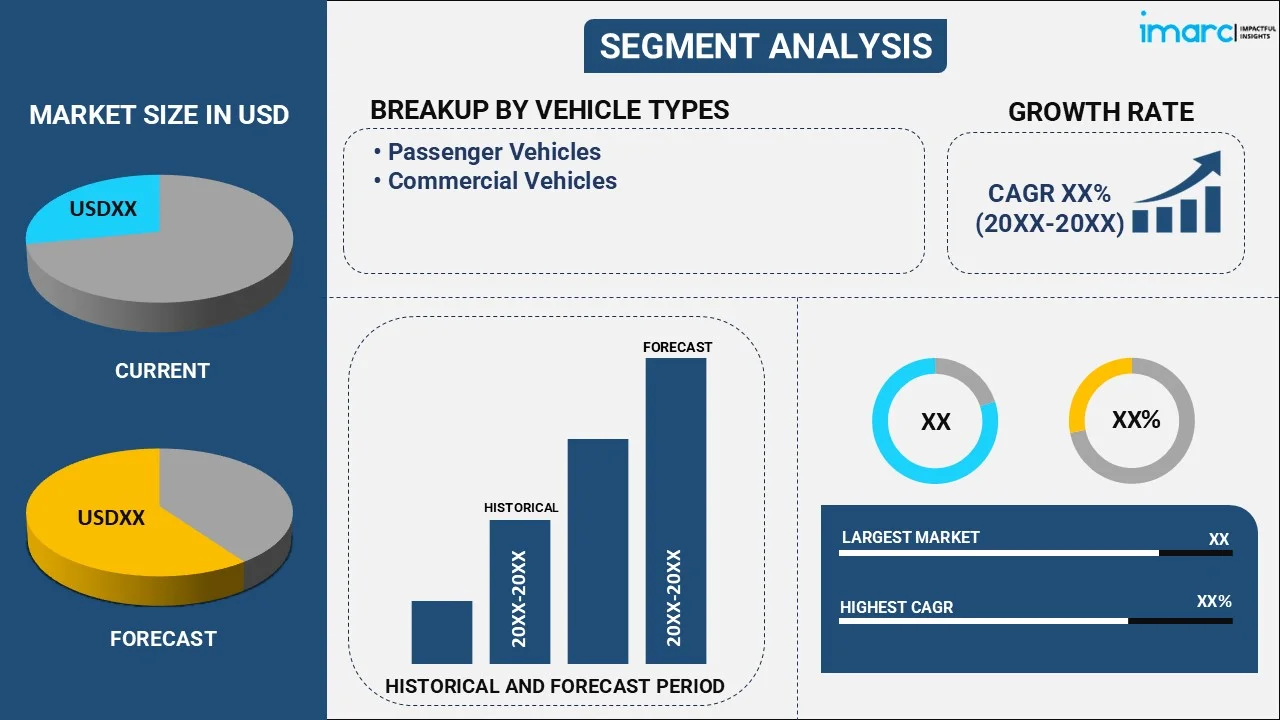
IMARC Group provides an analysis of the key trends in each segment of the global automotive clutch market, along with forecast at the global and regional levels from 2026-2034. The market has been categorized based on vehicle type, transmission type, clutch type, clutch disk/plate size, distribution channel, and material type.
Analysis by Vehicle Type:
To get detailed segment analysis of this market Request Sample
- Passenger Vehicles
- Commercial Vehicles
Passenger vehicles holds 60.5% of the market share. The dominance of passenger vehicles in the automotive clutch market reflects the sheer scale of global passenger car production and ownership relative to commercial vehicle segments. Passenger vehicles represent the largest and most diverse category, encompassing sedans, hatchbacks, SUVs, crossovers, and multipurpose vehicles, all of which rely on clutch systems for drivetrain power transmission. The widespread consumer adoption of entry-level and mid-range passenger vehicles in developing economies has significantly expanded the total addressable market for clutch assemblies, both at the OEM level and in the aftermarket. Manufacturers have responded with a broad portfolio of clutch products tailored to the specific torque, size, and performance requirements of different passenger vehicle platforms. The ongoing preference for manual and semi-automatic transmissions in cost-sensitive markets further reinforces the strong demand for clutch components across the passenger vehicle segment. Advancements in clutch engagement technology have also improved driving comfort, reducing clutch fatigue and enhancing the overall ownership experience for consumers globally.

Analysis by Transmission Type:
- Manual Transmission
- Automatic Transmission
- Automated Manual Transmission (AMT)
- Others
Manual transmission leads the market with a share of 45.2%. Manual transmission systems remain the predominant drivetrain configuration across much of the global automotive market, owing to their mechanical simplicity, lower manufacturing cost, and driver engagement benefits. In markets where fuel economy and vehicle affordability are paramount, manual transmissions continue to be widely specified by both automakers and consumers. The direct mechanical connection between the engine and drivetrain offered by manual transmissions ensures that clutch components remain central to vehicle operation, underpinning consistent demand. Clutch systems designed for manual transmissions span a wide range of specifications, from lightweight single-disc assemblies for compact vehicles to heavy-duty multi-plate configurations for commercial trucks and buses. The growing fleet of manual transmission vehicles across Asia, Africa, and Latin America creates a large and sustained replacement market for clutch components. Ongoing improvements in manual clutch design have enhanced pedal feel, engagement precision, and service longevity, maintaining the segment’s competitive relevance even as alternative drivetrain technologies continue to emerge.
Analysis by Clutch Type:
- Friction Clutch
- Dog Clutch
- Hydraulic Clutch
- Others
Friction clutch dominates the market, with a share of 72.5%. Friction clutches are the most widely deployed clutch technology in global automotive applications, owing to their mechanical reliability, compatibility with diverse transmission systems, and well-established manufacturing ecosystems. The fundamental operating principle, engaging and disengaging power transmission through controlled surface contact between the clutch disc and flywheel, has proven highly effective across varied vehicle types and performance requirements. The versatility of friction clutch designs allows optimization for applications ranging from light-duty passenger vehicles requiring smooth low-effort engagement to commercial trucks demanding high-torque capacity. Their long service track record, widespread component availability, and compatibility with both manual and automated transmission systems have cemented friction clutches as the default drivetrain power management solution globally. Continuous improvements in friction material composition, pressure plate design, and release mechanism precision continue to enhance the performance and durability of friction clutch systems across diverse automotive applications worldwide.
Analysis by Clutch Disk/Plate Size:
- Below 9 Inches
- 9 Inches to 10 Inches
- 10 Inches to 11 Inches
- 11 Inches and Above
10 Inches to 11 Inches represents the leading segment, with a market share of 38.5%. The 10 inches to 11 inches clutch disc size range has emerged as the dominant specification within the global market, reflecting its suitability across the widest range of vehicle applications. This size range provides an optimal balance between torque capacity and weight, making it well-suited for both passenger vehicles and light commercial vehicles that constitute the largest portion of global vehicle production. The mid-size disc dimensions allow manufacturers to engineer clutch assemblies that deliver adequate friction surface area for reliable power transmission without the added bulk associated with larger disc configurations. OEM suppliers commonly specify disc sizes within this range when configuring clutch systems for popular vehicle platforms, ensuring that production volumes and economies of scale favor this category. The aftermarket also benefits from the widespread standardization of the 10 to 11 inch range, as the high volume of compatible vehicles generates consistent replacement demand across multiple distribution channels.
Analysis by Distribution Channel:
- Aftermarket
- OEM
OEM secures the dominant position in the market, capturing a share of 72.5%. The original equipment manufacturer channel maintains its commanding lead within the automotive clutch market, driven by the structural integration of clutch components into vehicle assembly lines at the point of manufacture. OEM partnerships between clutch producers and vehicle manufacturers allow for the co-development of clutch systems precisely engineered to meet the torque, size, and performance specifications of specific vehicle platforms. This integration ensures strict quality control, technical compatibility, and adherence to vehicle warranty requirements, making OEM-sourced clutch components the preferred choice for automakers globally. The automotive clutch market forecast reflects continued dominance of the OEM channel as vehicle production volumes in Asia Pacific, Europe, and North America continue to sustain strong component procurement activity. Long-term supply agreements, just-in-time delivery capabilities, and deep engineering collaboration between clutch manufacturers and vehicle producers further reinforce the enduring strength of the OEM distribution pathway.
Analysis by Material Type:
- Ceramic
- Organic
- Others
Organic accounts for 58.5% of the market share. Organic friction materials have established a dominant position in the automotive clutch market owing to their broad applicability, cost-effectiveness, and predictable engagement characteristics. Composed primarily of natural and synthetic fibers, rubber compounds, and binding agents, organic friction disc materials offer smooth clutch engagement that is particularly valued in passenger vehicle applications where driver comfort is a priority. These materials are well-suited for standard driving conditions, delivering reliable torque transmission, moderate heat tolerance, and quiet operation throughout their service life. The affordability and ease of manufacturing organic friction materials have made them the standard specification across the majority of OEM clutch assemblies for passenger cars and light commercial vehicles. The widespread availability of organic friction clutch components through both direct OEM supply and the aftermarket ensures consistent access to replacement parts for the largest segment of global vehicle operators. Ongoing formulation enhancements continue to improve the temperature resilience and fade resistance of organic friction materials.
Regional Analysis:
To get more information on the regional analysis of this market Request Sample
- Asia Pacific
- Europe
- North America
- Middle East and Africa
- Latin America
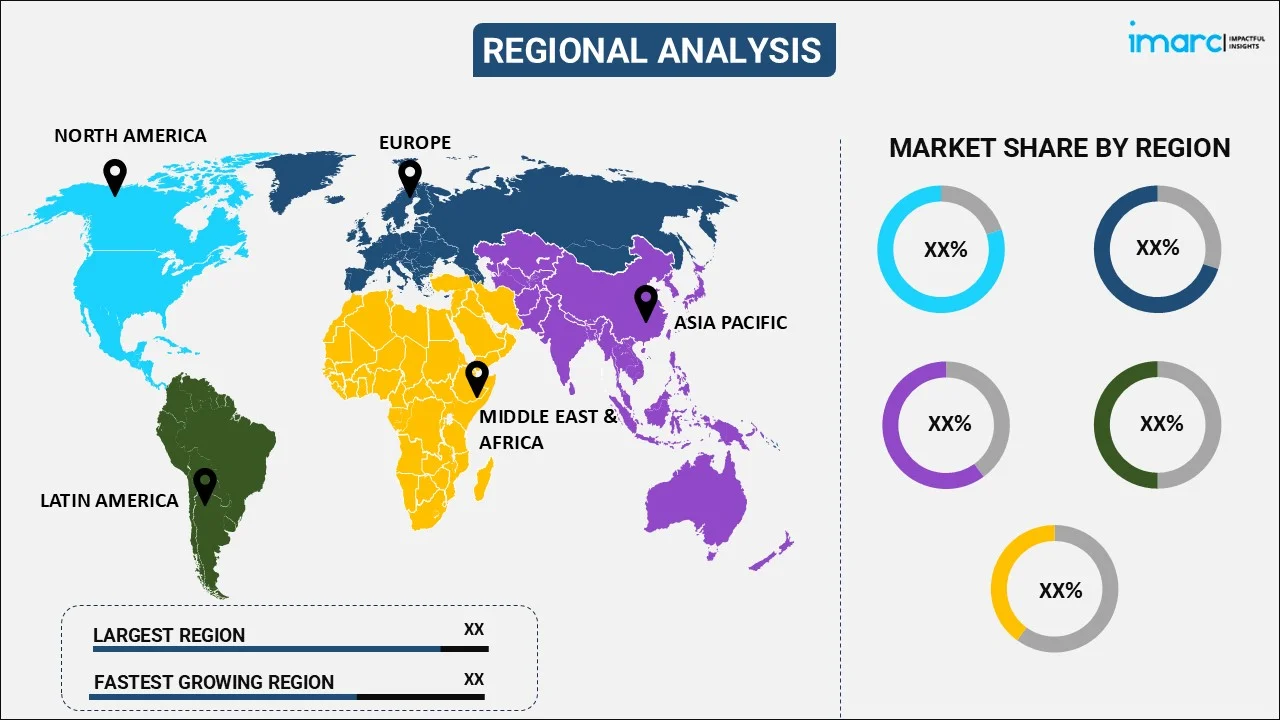
Asia Pacific, accounting for 59.4% of the share, enjoys the leading position in the market. The region’s preeminence in the global automotive clutch market is underpinned by its status as the world’s largest hub for automobile manufacturing, encompassing some of the most prolific vehicle-producing nations. Robust domestic automobile demand, supported by expanding middle-class populations and rising vehicle ownership rates across densely populated countries, has generated substantial and sustained demand for clutch systems at both OEM and aftermarket levels. The region benefits from a deep and integrated automotive supply chain that enables efficient clutch component sourcing, manufacturing, and distribution. Additionally, the high concentration of manual and automated manual transmission vehicles across Asia Pacific, particularly in cost-sensitive markets, translates into consistent demand for clutch assemblies across all price segments. Strong government investments in transportation infrastructure and automotive industry development policies have further reinforced the region’s position as the primary demand center for automotive clutch components globally.
Key Regional Takeaways:
North America Automotive Clutch Market Analysis
The North American automotive clutch market is shaped by a combination of robust vehicle production activity, strong aftermarket demand, and ongoing investment in drivetrain technology development across the region. The United States, Canada, and Mexico collectively represent a significant portion of global vehicle assembly, with well-established OEM supply chains that drive consistent procurement of clutch components across all vehicle categories. The region’s automotive manufacturing base supports demand for a broad range of clutch systems, from standard single-disc friction assemblies for passenger vehicles to heavy-duty multi-plate configurations for commercial trucks and off-highway equipment. Consumer preferences in North America increasingly favor performance-oriented vehicles and SUVs, which often require higher-capacity clutch systems, providing opportunities for manufacturers to supply premium clutch assemblies with advanced materials and engineering specifications. The growing fleet of vehicles in the aftermarket segment presents an additional avenue for sustained clutch component sales, as aging vehicles require periodic replacement and servicing. Additionally, the expansion of the electric and hybrid vehicle segment has prompted research into specialized clutch technologies adapted for use in hybrid drivetrain configurations, adding a new dimension of product development activity to the North American market.
United States Automotive Clutch Market Analysis
The United States represents the largest individual country market for automotive clutches in North America, anchored by its extensive passenger vehicle and commercial vehicle fleet as well as a mature and well-developed OEM supply network. The country’s automotive industry, concentrated in the Midwest and Southeast, produces millions of vehicles annually, each incorporating clutch systems that are either sourced directly by vehicle manufacturers or procured through tier-one and tier-two supplier networks. Consumer demand for trucks, pickup vehicles, and sport utility vehicles in the United States has created a sustained need for high-performance clutch assemblies capable of handling elevated torque loads across diverse driving conditions. The robust aftermarket ecosystem in the United States, encompassing independent repair shops, national service chains, and online parts distributors, ensures consistent demand for replacement clutch components across a wide range of vehicle makes and models. The emphasis on driver experience and vehicle performance among American consumers has also incentivized the development and adoption of advanced clutch technologies, including hydraulic actuation systems and electronically actuated self-adjusting clutch mechanisms, within the domestic market. Federal safety and emissions regulations further influence clutch specifications, encouraging adoption of lighter friction materials across new vehicle platforms.
Europe Automotive Clutch Market Analysis
Europe represents a significant regional market for automotive clutch components, supported by a well-established automotive manufacturing base that includes some of the world’s most prominent vehicle-producing nations. The region’s strong heritage in automotive engineering has fostered sophisticated demand for clutch systems that combine mechanical precision with advanced materials technology. In October 2025, French supplier Valeo won the International Automotive Innovation Award at EQUIP AUTO Paris for its remanufactured dual wet clutch (DQ250), used in over 5 million European vehicles, highlighting clutch remanufacturing innovation and aftermarket demand. The prevalence of manual transmission vehicles across many European markets, particularly in Southern and Eastern Europe, sustains consistent demand for clutch assemblies, both in the OEM and aftermarket segments. Regulatory pressure to reduce vehicle emissions has spurred vehicle manufacturers to optimize drivetrain systems, including clutch assemblies, for improved fuel efficiency and reduced mechanical loss. The European market is also notable for its relatively high proportion of commercial vehicles and vans, which generate above-average demand for heavy-duty clutch components. The strong network of automotive service providers and independent spare parts retailers across Europe ensures widespread availability of replacement clutch components, supporting aftermarket sales throughout the region.
Asia-Pacific Automotive Clutch Market Analysis
Asia-Pacific stands as the foremost regional contributor to the global automotive clutch market, driven by its unmatched scale of vehicle production and consumption. The region encompasses leading vehicle-manufacturing economies that collectively account for the majority of global automobile output, creating immense demand for clutch components at the OEM level. Rising vehicle ownership rates, expanding urban populations, and growing disposable incomes across key markets continue to accelerate demand for passenger and commercial vehicles, directly fueling clutch system procurement. The strong preference for manual and automated manual transmission vehicles across cost-sensitive markets in the region ensures that friction clutch assemblies remain the dominant product specification. A well-developed supplier ecosystem, competitive manufacturing infrastructure, and strategic proximity to major automotive assembly plants further position Asia-Pacific as both the largest demand center and manufacturing hub for automotive clutch components globally.
Latin America Automotive Clutch Market Analysis
Latin America represents a growing market for automotive clutch components, underpinned by expanding vehicle fleets and increasing automotive assembly activity across the region. Countries such as Brazil and Mexico have emerged as key manufacturing and consumption centers, with growing vehicle ownership driving demand for both OEM and aftermarket clutch components. The region’s strong preference for manual transmission vehicles, driven by vehicle affordability considerations, sustains consistent demand for friction clutch assemblies across all vehicle categories. Rising urbanization, improving road infrastructure, and the expansion of commercial transport networks are further contributing to vehicle fleet growth across Latin America, reinforcing the long-term demand outlook for clutch system suppliers operating in this dynamic regional market.
Middle East and Africa Automotive Clutch Market Analysis
The Middle East and Africa automotive clutch market is supported by growing vehicle ownership, expanding commercial transport fleets, and increasing infrastructure development activity across the region. The prevalence of manual and light commercial vehicles across many markets in this region sustains steady demand for replacement clutch components in the aftermarket segment. Rising prosperity in Gulf Cooperation Council states has accelerated vehicle imports and fleet expansion, contributing to aftermarket clutch demand. The rapidly growing logistics and transportation sector, supported by large-scale road and construction projects, is driving increased procurement of durable commercial vehicle clutch systems throughout the Middle East and Africa, creating meaningful growth opportunities for clutch suppliers.
Competitive Landscape:
The global automotive clutch market is characterized by a moderately consolidated competitive landscape, with a mix of global tier-one suppliers and regional manufacturers competing on the basis of product quality, technical innovation, pricing, and supply chain efficiency. Leading market participants focus on expanding their product portfolios to serve diverse vehicle categories, including passenger vehicles, commercial trucks, and off-highway equipment, ensuring broad market coverage across varied geographic territories. Strategic alliances with vehicle manufacturers enable clutch suppliers to secure long-term OEM contracts and co-engineer clutch systems precisely optimized for specific powertrain and drivetrain configurations. Investment in research and development has become a critical competitive differentiator, particularly as the industry navigates evolving powertrain technologies and advancing material science applications. The market also witnesses significant competitive pressure from low-cost regional manufacturers in Asia, who offer price-competitive clutch assemblies targeting aftermarket and value-tier OEM segments, intensifying margin competition among established global players.
The report provides a comprehensive analysis of the competitive landscape in the automotive clutch market with detailed profiles of all major companies, including:
- Aisin Seiki Co., Ltd.
- Magneti Marelli S.p.A.
- Schaeffler Group AG & Co.
- ZF Friedrichshafen AG,
- BorgWarner Inc.
- Valeo
- Eaton Corporation Inc.
- WABCO Holdings Inc.
- EXEDY Corporation
- F.C.C. Co. Ltd.
- NSK Ltd
- AMS Automotive LLC
- APLS Automotive Industries Pvt. Ltd.
- JATCO Ltd.
- Allison Transmission Inc.
- FTE automotive GmbH
Latest News and Developments:
- In October 2025, ZF India secured a large contract from a leading commercial vehicle manufacturer to supply its new 430-mm heavy-duty clutch system. Production will start at the company’s Chakan, Pune facility in mid-2026, with several thousand units planned for supply to support heavy-duty vehicle applications.
Automotive Clutch Market Report Scope:
| Report Features | Details |
|---|---|
| Base Year of the Analysis | 2025 |
| Historical Period | 2020-2025 |
| Forecast Period | 2026-2034 |
| Units | Billion USD |
| Scope of the Report | Exploration of Historical Trends and Market Outlook, Industry Catalysts and Challenges, Segment-Wise Historical and Future Market Assessment:
|
| Vehicle Types Covered | Passenger Vehicles, Commercial Vehicles |
| Transmission Types Covered | Manual Transmission, Automatic Transmission, Automated Manual Transmission (AMT), Others |
| Clutch Types Covered | Friction Clutch, Dog Clutch, Hydraulic Clutch, Others |
| Clutch Disks/Plate Sizes Covered | Below 9 Inches, 9 Inches to 10 Inches, 10 Inches to 11 Inches, 11 Inches and Above |
| Distribution Channels Covered | Aftermarket, OEM |
| Material Types Covered | Ceramic, Organic, Others |
| Regions Covered | Asia Pacific, Europe, North America, Latin America, Middle East and Africa |
| Companies Covered | Aisin Seiki Co., Ltd., Magneti Marelli S.p.A., Schaeffler Group AG & Co., ZF Friedrichshafen AG, BorgWarner Inc., Valeo, Eaton Corporation Inc., WABCO Holdings Inc., EXEDY Corporation, F.C.C. Co. Ltd., NSK Ltd., AMS Automotive LLC, APLS Automotive Industries Pvt. Ltd., JATCO Ltd., Allison Transmission Inc., FTE automotive GmbH, etc. |
| Customization Scope | 10% Free Customization |
| Post-Sale Analyst Support | 10-12 Weeks |
| Delivery Format | PDF and Excel through Email (We can also provide the editable version of the report in PPT/Word format on special request) |
Key Benefits for Stakeholders:
- IMARC’s report offers a comprehensive quantitative analysis of various market segments, historical and current market trends, market forecasts, and dynamics of the automotive clutch market from 2020-2034.
- The research study provides the latest information on the market drivers, challenges, and opportunities in the global automotive clutch market.
- The study maps the leading, as well as the fastest-growing, regional markets.
- Porter's Five Forces analysis assists stakeholders in assessing the impact of new entrants, competitive rivalry, supplier power, buyer power, and the threat of substitution. It helps stakeholders to analyze the level of competition within the automotive clutch industry and its attractiveness.
- Competitive landscape allows stakeholders to understand their competitive environment and provides an insight into the current positions of key players in the market.
Frequently Asked Questions About the Automotive Clutch Market Report
The automotive clutch market was valued at USD 14.2 Billion in 2025.
The automotive clutch market is projected to exhibit a CAGR of 4.2% during 2026-2034, reaching a value of USD 21.1 Billion by 2034.
The automotive clutch market is driven by the continuous expansion of global vehicle fleets, rising vehicle ownership in developing economies, growing demand for both passenger and commercial vehicles, and the widespread use of manual and automated manual transmission systems. Advancements in clutch technology, increasing aftermarket demand, and regulatory emphasis on fuel-efficient drivetrain systems further support sustained growth across the market.
Asia Pacific currently dominates the automotive clutch market, accounting for a share of 59.4%. The region benefits from its status as the world’s largest automobile manufacturing hub, expansive manual transmission vehicle fleets, rising consumer vehicle ownership, and a deeply integrated and efficient automotive supply chain that supports both OEM and aftermarket demand.
Some of the major players in the automotive clutch market include Aisin Seiki Co., Ltd., Magneti Marelli S.p.A., Schaeffler Group AG & Co., ZF Friedrichshafen AG, BorgWarner Inc., Valeo, Eaton Corporation Inc., WABCO Holdings Inc., EXEDY Corporation, F.C.C. Co. Ltd., NSK Ltd., AMS Automotive LLC, APLS Automotive Industries Pvt. Ltd., JATCO Ltd., Allison Transmission Inc., FTE automotive GmbH, etc.
Need more help?
- Speak to our experienced analysts for insights on the current market scenarios.
- Include additional segments and countries to customize the report as per your requirement.
- Gain an unparalleled competitive advantage in your domain by understanding how to utilize the report and positively impacting your operations and revenue.
- For further assistance, please connect with our analysts.
 Request Customization
 Speak to an Analyst
 Request Brochure
 Inquire Before Buying
Benefits of Customization
- Personalize this research
- Triangulate with your data
- Get data as per your format and definition
- Gain a deeper dive into a specific application, geography, customer, or competitor
- Any level of personalization
Get in Touch With Us
UNITED STATES
Phone: +1-201-971-6302
INDIA
Phone: +91-120-433-0800
UNITED KINGDOM
Phone: +44-753-714-6104
Email: [email protected]
Client Testimonials




.webp)




.webp)













Related Reports

Choose your plan
*Please note that the prices mentioned below are starting prices for each bundle type. Kindly contact our team for further details.*
Single User License
- 1 User License, Access on 2 Devices
- PDF Report + Excel Dataset (Password Protected)
- Lifetime Access
- No Printing Rights
- 10% Free Report Customization
- 10–12 Weeks of Analyst Support
Five User License
- Access for 5 Users, 2 Devices per User
- PDF Report + Excel Dataset (Password Protected)
- Lifetime Access
- Dedicated Account Manager
- 12–14 Weeks of Analyst Support
- No Printing Rights
- 15% Free Report Customization
- 25% Discount on Your Next Purchase
Corporate User License
- Unlimited User Access (Within Your Organization)
- PDF Report + Excel Dataset
- Lifetime Access
- Dedicated Account Manager
- 14–20 Weeks of Analyst Support
- No Printing Rights
- 20% Free Report Customization
- 30% Discount on Your Next Purchase
Essential Insights
What's included:
3 reports
- Lifetime Access
- PDF Reports
- Excel Datasets
- 2 Weeks of Free Analyst Support
- 2 User Licenses
- Access on 2 Devices
- Printing Rights
- Complimentary PowerPoint (PPT) Version
- Complimentary License Upgrade
Professional Access
What's included:
5 reports
- Lifetime Access
- PDF Reports
- Excel Datasets
- 8 Weeks of Free Analyst Support
- 2 User Licenses
- Access on 2 Devices
- Printing Rights
- Complimentary PowerPoint (PPT) Version
- Complimentary License Upgrade
Business Advantage
What's included:
8 reports
- Lifetime Access
- PDF Reports
- Excel Datasets
- 14 Weeks of Free Analyst Support
- 2 User Licenses
- Access on 2 Devices
- Printing Rights
- Complimentary PowerPoint (PPT) Version
- Complimentary License Upgrade
Enterprise Intelligence
What's included:
10 reports
- Lifetime Access
- PDF Reports
- Excel Datasets
- 20 Weeks of Free Analyst Support
- 2 User Licenses
- Access on 2 Devices
- Printing Rights
- Complimentary PowerPoint (PPT) Version
- Complimentary License Upgrade