
Bangladesh Animal Feed Market Size, Share, Trends and Forecast by Form, Animal Type, Ingredient, and Region, 2026-2034
Bangladesh Animal Feed Market Summary:
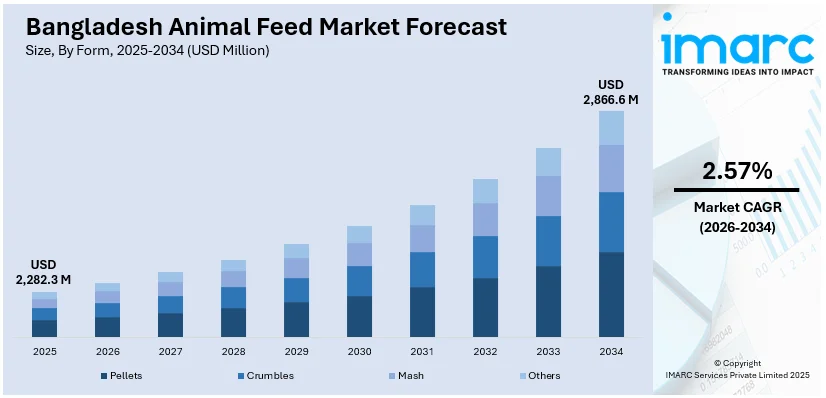
The Bangladesh animal feed market size was valued at USD 2,282.3 Million in 2025 and is projected to reach USD 2,866.6 Million by 2034, growing at a compound annual growth rate of 2.57% from 2026-2034.
The Bangladesh animal feed market is experiencing steady expansion, as the country's livestock and poultry sectors undergo significant commercialization and modernization. Increasing consumer demand for animal-derived protein, rising urbanization, and growing awareness about balanced animal nutrition are driving feed consumption. Advancements in feed formulation technologies, the integration of essential additives, and the shift towards sustainable production practices are further reshaping market dynamics, strengthening the market share.
Key Takeaways and Insights:
- By Form: Pellets dominate the market with a share of 40% in 2025, owing to their superior nutrient retention, uniform composition, and ease of handling that ensure consistent animal growth and reduce feed wastage across commercial farming operations.
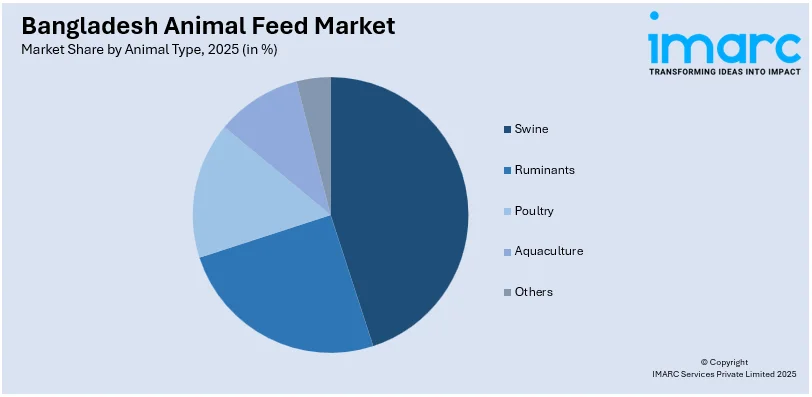
- By Animal Type: Poultry leads the market with a share of 38% in 2025, driven by the rapid expansion of commercial poultry farming, rising domestic demand for affordable meat and eggs, and strong government support for the sector.
- By Ingredient: Cereals represent the largest segment with a market share of 35% in 2025, reflecting the widespread reliance on corn and wheat as primary energy sources in poultry, aquaculture, and livestock feed formulations across Bangladesh.
- Key Players: Key players drive the Bangladesh animal feed market by expanding production capacities, investing in advanced feed formulation technologies, and strengthening distribution networks. Their efforts in research, affordability, and partnerships with farming communities boost awareness, improve feed quality, and ensure consistent product availability across the country.
To get more information on this market Request Sample
The Bangladesh animal feed market is advancing, as the country's agricultural and livestock sectors transition towards greater commercialization and efficiency. Growing consumer demand for protein-rich diets, expanding aquaculture activities, and the increasing adoption of nutrient-optimized feed formulations are reinforcing the market growth. Rising investments in modern feed milling infrastructure, favorable government policies supporting agricultural productivity, and the integration of advanced nutritional additives are further catalyzing the sector's development, positioning Bangladesh as an emerging hub for feed manufacturing in South Asia. As per IMARC Group, the Bangladesh aquaculture market size reached a volume of 2.8 Million Tons in 2024. The market is also benefiting from rising awareness among farmers about feed quality and its direct impact on animal health, productivity, and profitability. Increased penetration of commercial poultry and dairy farming, particularly in peri-urban regions, is accelerating demand for standardized and scientifically formulated feed.
Bangladesh Animal Feed Market Trends:
Shift Towards Sustainable and Alternative Feed Ingredients
The Bangladesh animal feed industry is experiencing a notable transition towards sustainable feed manufacturing practices and the adoption of alternative protein sources. Producers are increasingly incorporating plant-based proteins, insect-derived ingredients, and agricultural by-products into feed formulations to reduce dependence on imported raw materials and minimize environmental impact. This shift is also supported by research collaborations and pilot projects focused on improving feed efficiency and lowering carbon footprints. As sustainability gains importance among regulators and large integrators, eco-friendly feed solutions are expected to gain stronger commercial traction across poultry, aquaculture, and livestock segments.
Rising Adoption of Advanced Feed Processing Technologies
Feed manufacturers in Bangladesh are increasingly investing in modern processing technologies to improve feed quality, nutrient retention, and production efficiency. The adoption of automated batching, pelleting, and extrusion systems is enabling producers to deliver more consistent and nutritionally balanced products. These technologies also help reduce raw material wastage, energy consumption, and operational costs over the long term. Improved processing capabilities allow manufacturers to customize feed formulations for specific species and growth stages, enhancing farm-level productivity. Additionally, better quality control and traceability systems are strengthening compliance with safety standards and building trust among commercial farmers.
Expansion of Domestic Cereal Cultivation for Feed Production
Bangladesh is witnessing a significant expansion in domestic maize cultivation, driven by strong and sustained demand from the animal feed industry. Maize has become the preferred cereal crop for feed manufacturers due to its higher yield and profitability compared to wheat. In fiscal year 2024-25, maize acreage in Bangladesh reached a record 6.72 Lakh hectares, representing a significant increase from 6.42 Lakh hectares in the fiscal year 2023-2024, as farmers increasingly shift from wheat to maize cultivation due to consistent demand from the poultry and livestock feed sectors.
Market Outlook 2026-2034:
The Bangladesh animal feed market is poised for continued growth, as the livestock, poultry, and aquaculture sectors expand to meet the protein requirements of the country's growing population. The market generated a revenue of USD 2,282.3 Million in 2025 and is projected to reach a revenue of USD 2,866.6 Million by 2034, growing at a compound annual growth rate of 2.57% from 2026-2034. Increasing urbanization, rising per capita income, and evolving dietary preferences towards meat, eggs, and dairy products are expected to drive higher demand for commercially formulated animal feed. The growing commercialization of farming practices, expansion of contract farming models, and integration of advanced nutritional technologies into feed production are anticipated to further strengthen the market trajectory.
Bangladesh Animal Feed Market Report Segmentation:
|
Segment Category |
Leading Segment |
Market Share |
|
Form |
Pellets |
40% |
|
Animal Type |
Poultry |
38% |
|
Ingredient |
Cereals |
35% |
Form Insights:
- Pellets
- Crumbles
- Mash
- Others
Pellets dominate with a market share of 40% of the total Bangladesh animal feed market in 2025.
Pellets have emerged as the most widely adopted form in the market in Bangladesh, due to their ability to deliver consistent nutritional profiles and minimize ingredient segregation during storage and transport. The pelleting process improves feed digestibility through heat treatment and compression, enhancing nutrient absorption while reducing microbial contamination risks. Widespread use among large-scale feed producers is further supported by their easier handling and extended shelf life.
The developing commercial poultry and aquaculture industries, where consistent feed particle size and density are crucial for maximizing feed conversion ratios, are the main drivers of pellets' increasing market domination in Bangladesh. Animals that consume pelletized feed exhibit less selective feeding, which lowers waste rates and boosts overall productivity. Farmers that are concerned about expenses and want to optimize profits in the face of growing input costs will find this efficiency advantage very beneficial.
Animal Type Insights:
Access the comprehensive market breakdown Request Sample
- Swine
- Starter
- Finisher
- Grower
- Ruminants
- Calves
- Dairy Cattle
- Beef Cattle
- Others
- Poultry
- Broilers
- Layers
- Turkeys
- Others
- Aquaculture
- Carps
- Crustaceans
- Mackeral
- Milkfish
- Mollusks
- Salmon
- Others
- Others
Poultry leads with a share of 38% of the total Bangladesh animal feed market in 2025.
Poultry commands the largest share of the Bangladesh animal feed market, driven by the rapid commercialization of broiler and layer farming operations across the country. Farmers are being encouraged to expand their operations by the growing need for inexpensive animal protein, short production cycles, and high feed-to-meat conversion efficiency. The continued need for poultry feed across the country is being further strengthened by the rising integration of big poultry producers, the increased adoption of scientifically formulated compound feeds, and better farm management techniques.
In addition to volume expansion, the segment is gradually becoming more premium and advancing technologically. To enhance bird health and production, feed makers are producing specialist meals enhanced with probiotics, amino acids, enzymes, and immune-boosting chemicals. Commercial farms are increasingly demanding phase-specific feeds designed for the starter, grower, and finisher stages. Furthermore, the use of premium branded feeds is being promoted by increased understanding of biosecurity and disease control, which is fostering value growth within Bangladesh’s poultry feed industry.
Ingredient Insights:
- Cereals
- Oilseed Meal
- Molasses
- Fish Oil and Fish Meal
- Additives
- Antibiotics
- Vitamins
- Antioxidants
- Amino Acids
- Feed Enzymes
- Feed Acidifiers
- Others
- Others
Cereals exhibit a clear dominance with a 35% share of the total Bangladesh animal feed market in 2025.
Cereals serve as the foundational energy source in animal feed formulations across Bangladesh, with maize and wheat constituting the primary grain inputs for poultry, aquaculture, and livestock feed production. The 2025 wheat harvest, harvested in April, was officially projected to be at a nearly average level of 1.1 Million Tons. Feed manufacturers value cereals for their high energy density, palatability, and compatibility with both pelleting and mash processing technologies.
The supply stability of feed makers in Bangladesh is being strengthened by the consistent availability of cereals and advancements in local sourcing. Advancements in formulation science and enzyme use are enabling more efficient energy utilization from cereals, improving overall feed performance. Cereal usage efficiency is also being improved by improved storage facilities and quality control procedures, which support the cereals' ongoing status as a dependable and affordable energy source for feed formulations for livestock, poultry, and aquaculture.
Regional Insights:
- Dhaka
- Chattogram
- Khulna
- Rajshahi
- Others
Dhaka serves as one of the largest hubs for animal feed manufacturing and consumption in Bangladesh, benefiting from its proximity to major feed milling operations, extensive distribution infrastructure, and the concentration of commercial poultry and livestock farms in the surrounding districts. The region's urban demand for meat, eggs, and dairy products further drives feed consumption volumes.
Chattogram plays a vital role in the Bangladesh animal feed market due to its strategic port location, facilitating the import of key raw materials, such as soybeans, corn, and feed additives. A number of large feed mills are located in the area, and it is a vital hub for the distribution of feed products to farming communities in the southern and southeastern regions.
Khulna makes a significant contribution to the animal feed industry in Bangladesh, especially in the aquaculture feed segment. Due to the region's abundance of water resources and concentration of fish and shrimp farms, there is a high need for specialty aquafeed products that are formulated for freshwater and brackish water species production.
Rajshahi contributes to the Bangladesh animal feed market through its strong agricultural base and expanding livestock farming operations. The region benefits from growing maize cultivation that supports local feed manufacturing, while rising demand for dairy and beef products from the population drives consumption of ruminant feed formulations.
Market Dynamics:
Growth Drivers:
Why is the Bangladesh Animal Feed Market Growing?
Rapid Expansion of Commercial Poultry and Livestock Farming
The Bangladesh animal feed market is experiencing sustained growth, driven by the rapid transition from traditional backyard farming to commercial-scale poultry and livestock production. This structural transformation has created unprecedented demand for nutritionally balanced, industrially manufactured feed products. The increasing establishment of large-scale broiler farms, commercial layer operations, and integrated farming enterprises necessitates consistent supplies of high-quality compound feed. Urbanization and rising per capita income are fueling higher consumption of meat, eggs, and dairy products, which in turn strengthens the backward linkage demand for commercial animal feed. Improved access to veterinary services and extension programs is helping farmers optimize feed usage and improve farm-level efficiency. Moreover, stronger integration between feed manufacturers and commercial farms is ensuring predictable offtake and sustained growth for the Bangladesh animal feed market.
Growing Aquaculture Sector Fueling Specialized Feed Demand
Bangladesh's position as one of the largest inland fisheries producers globally has created a substantial and expanding market for specialized aquaculture feed products. The country's extensive water resources, covering ponds, lakes, canals, rivers, and estuaries, support a thriving fish farming industry that increasingly relies on commercially formulated pelleted and extruded feed. The shift from traditional farm-made feed to commercial aquafeed formulations has accelerated, as farmers adopt intensive stocking systems to maximize production yields. Per capita fish consumption in Bangladesh has risen significantly, reaching 67.8 grams per day in 2023 compared to 24 grams per day in 2000, reflecting the growing domestic appetite for fish protein that continuously expands the aquafeed market. This rising demand is encouraging feed manufacturers to expand capacity and develop species-specific, nutritionally optimized aquafeed products that improve growth rates, feed conversion efficiency, and farm profitability.
Government Support and Expanding Domestic Cereal Production
Government initiatives promoting modern agricultural practices, livestock productivity improvement, and food security are significantly supporting the Bangladesh animal feed market. Programs encouraging mechanized farming, improved breeding techniques, and enhanced animal husbandry practices have created a more favorable environment for commercial feed adoption. Simultaneously, the expansion of domestic maize cultivation has strengthened the supply chain for critical feed ingredients, reducing import dependency and production costs. Public–private partnerships (PPPs) are further accelerating knowledge transfer and technology adoption across the feed value chain. Subsidized credit facilities and investment incentives are enabling farmers and feed millers to scale operations. Training programs focused on nutrition management and efficient feed usage are improving productivity outcomes. Collectively, these measures are strengthening domestic feed manufacturing capacity and reinforcing long-term market resilience.
Market Restraints:
What Challenges the Bangladesh Animal Feed Market is Facing?
High Dependence on Imported Raw Materials
Despite growing domestic cereal production, Bangladesh remains heavily reliant on imported soybeans, soybean meal, and select feed additives for its animal feed manufacturing sector. This import dependence exposes the feed industry to global commodity price volatility, currency fluctuations, and supply chain disruptions caused by geopolitical tensions. Letters of credit restrictions at local banks have periodically disrupted raw material procurement, directly affecting feed production continuity and pricing stability.
Prevalence of Unregistered Feed Producers
The widespread operation of unregistered and unregulated feed mills across Bangladesh poses a significant challenge to market quality standards and consumer confidence. These unregistered producers often utilize substandard ingredients and lack proper storage facilities, leading to mycotoxin contamination and nutritional inconsistency that undermines the credibility of the broader feed industry.
Volatile Feed Ingredient Pricing and Market Oligopoly
The Bangladesh animal feed market faces challenges from frequent price fluctuations in key raw materials, alongside a highly concentrated industry structure dominated by a small number of large players. This environment makes it difficult for smaller feed producers to compete on cost and scale, limiting their market participation. Since feed represents a major cost component in animal protein production, volatility in input prices directly affects farmer margins and can ultimately influence the affordability of meat, eggs, and fish for end consumers.
Competitive Landscape:
The Bangladesh animal feed market features a competitive landscape, characterized by a combination of established domestic manufacturers and select international players. Leading companies focus on expanding production capacities, diversifying product portfolios across poultry, aquaculture, and cattle feed segments, and investing in advanced feed formulation technologies to enhance nutritional value and production efficiency. Competition is increasingly driven by product quality differentiation, pricing strategies, distribution network expansion, and the adoption of sustainable manufacturing practices. Strategic partnerships between feed manufacturers and farming communities, along with investments in research and development (R&D) for specialized feed additives, are shaping the competitive dynamics of the market.
Bangladesh Animal Feed Market Report Coverage:
| Report Features | Details |
|---|---|
| Base Year of the Analysis | 2025 |
| Historical Period | 2020-2025 |
| Forecast Period | 2026-2034 |
| Units | Million USD |
| Scope of the Report |
Exploration of Historical Trends and Market Outlook, Industry Catalysts and Challenges, Segment-Wise Historical and Future Market Assessment:
|
| Forms Covered | Pellets, Crumbles, Mash, Others |
| Animal Types Covered |
|
| Ingredients Covered |
|
| Regions Covered | Dhaka, Chattogram, Khulna, Rajshahi, Others |
| Customization Scope | 10% Free Customization |
| Post-Sale Analyst Support | 10-12 Weeks |
| Delivery Format | PDF and Excel through Email (We can also provide the editable version of the report in PPT/Word format on special request) |
Frequently Asked Questions About the Bangladesh Animal Feed Market Report
The Bangladesh animal feed market size was valued at USD 2,282.3 Million in 2025.
The Bangladesh animal feed market is expected to grow at a compound annual growth rate of 2.57% from 2026-2034 to reach USD 2,866.6 Million by 2034.
Pellets dominated the market with a share of 40%, driven by their superior nutrient retention, uniform composition, ease of handling, and reduced feed wastage across commercial poultry, aquaculture, and livestock operations in Bangladesh.
Key factors driving the Bangladesh animal feed market include rapid expansion of commercial poultry farming, growing aquaculture production, rising protein demand from urbanization, expanding domestic cereal cultivation, and increasing adoption of advanced feed technologies.
Major challenges include high dependence on imported raw materials, such as soybeans, volatile feed ingredient pricing, prevalence of unregistered feed producers affecting quality standards, market concentration among top players, and limited cold chain infrastructure.
Need more help?
- Speak to our experienced analysts for insights on the current market scenarios.
- Include additional segments and countries to customize the report as per your requirement.
- Gain an unparalleled competitive advantage in your domain by understanding how to utilize the report and positively impacting your operations and revenue.
- For further assistance, please connect with our analysts.
 Request Customization
 Speak to an Analyst
 Request Brochure
 Inquire Before Buying
Benefits of Customization
- Personalize this research
- Triangulate with your data
- Get data as per your format and definition
- Gain a deeper dive into a specific application, geography, customer, or competitor
- Any level of personalization
Get in Touch With Us
UNITED STATES
Phone: +1-201-971-6302
INDIA
Phone: +91-120-433-0800
UNITED KINGDOM
Phone: +44-753-714-6104
Email: [email protected]
Client Testimonials




.webp)




.webp)













Related Reports

Choose your plan
*Please note that the prices mentioned below are starting prices for each bundle type. Kindly contact our team for further details.*
Single User License
- 1 User License, Access on 2 Devices
- PDF Report + Excel Dataset (Password Protected)
- Lifetime Access
- No Printing Rights
- 10% Free Report Customization
- 10–12 Weeks of Analyst Support
Five User License
- Access for 5 Users, 2 Devices per User
- PDF Report + Excel Dataset (Password Protected)
- Lifetime Access
- Dedicated Account Manager
- 12–14 Weeks of Analyst Support
- No Printing Rights
- 15% Free Report Customization
- 25% Discount on Your Next Purchase
Corporate User License
- Unlimited User Access (Within Your Organization)
- PDF Report + Excel Dataset
- Lifetime Access
- Dedicated Account Manager
- 14–20 Weeks of Analyst Support
- No Printing Rights
- 20% Free Report Customization
- 30% Discount on Your Next Purchase
Essential Insights
What's included:
3 reports
- Lifetime Access
- PDF Reports
- Excel Datasets
- 2 Weeks of Free Analyst Support
- 2 User Licenses
- Access on 2 Devices
- Printing Rights
- Complimentary PowerPoint (PPT) Version
- Complimentary License Upgrade
Professional Access
What's included:
5 reports
- Lifetime Access
- PDF Reports
- Excel Datasets
- 8 Weeks of Free Analyst Support
- 2 User Licenses
- Access on 2 Devices
- Printing Rights
- Complimentary PowerPoint (PPT) Version
- Complimentary License Upgrade
Business Advantage
What's included:
8 reports
- Lifetime Access
- PDF Reports
- Excel Datasets
- 14 Weeks of Free Analyst Support
- 2 User Licenses
- Access on 2 Devices
- Printing Rights
- Complimentary PowerPoint (PPT) Version
- Complimentary License Upgrade
Enterprise Intelligence
What's included:
10 reports
- Lifetime Access
- PDF Reports
- Excel Datasets
- 20 Weeks of Free Analyst Support
- 2 User Licenses
- Access on 2 Devices
- Printing Rights
- Complimentary PowerPoint (PPT) Version
- Complimentary License Upgrade