
Barcode Scanner Market Size, Share, Trends and Forecast by Product, Type, Scanner Type, Technology, Component, End-Use Sector, and Region, 2026-2034
Barcode Scanner Market Size and Share:
The global barcode scanner market grew from USD 7.8 Billion in 2025 to USD 8.4 Billion in 2026. Looking forward, IMARC Group estimates the market to reach USD 13.3 Billion by 2034, exhibiting a CAGR of 5.89% from 2026-2034. Asia Pacific currently dominates the market, holding a market share of 38% in 2025. The region benefits from rapid industrialization, extensive e-commerce infrastructure, favorable governmental initiatives promoting digital technology adoption in business operations, and the escalating demand for supply chain automation, all contributing to the barcode scanner market share.
The increasing integration of barcode scanning solutions across diverse industries is a key factor driving the barcode scanner market growth. The rise in adoption of automated inventory management systems, coupled with the expanding e-commerce sector globally, is generating considerable demand for efficient and reliable data capture tools. Additionally, advancements in wireless connectivity, cloud-based data platforms, and mobile-enabled scanning technologies are enhancing the operational capabilities and versatility of barcode scanners. The growing emphasis on reducing manual errors, improving workforce productivity, and ensuring accurate real-time tracking of goods across complex supply chains is further propelling market expansion.
The United States has emerged as a major region in the barcode scanner market owing to many factors. The widespread implementation of retail automation technologies, warehouse digitization programs, and advanced logistics networks is fueling robust demand for barcode scanning solutions across the country. The nation’s expansive e-commerce ecosystem, supported by numerous large-scale fulfillment centers and distribution hubs, require high-speed and highly accurate data capture capabilities to maintain operational efficiency and meet growing consumer expectations. Moreover, the healthcare sector’s increasing reliance on barcode scanners for medication administration verification, specimen tracking, and patient safety protocols is significantly driving adoption.
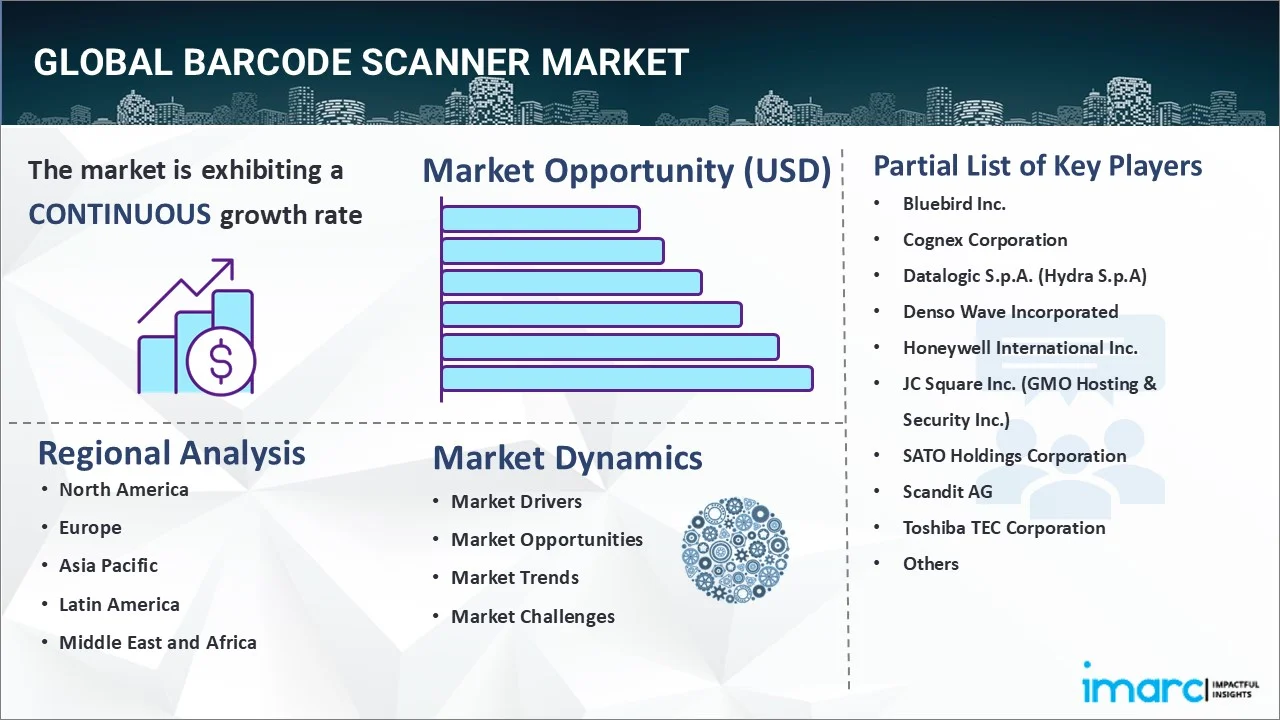
To get more information on this market Request Sample
Barcode Scanner Market Trends:
Rising Integration of AI-Powered Scanning Solutions
The growing integration of artificial intelligence into barcode scanning devices is reshaping the operational landscape across multiple industries. AI-powered decoding algorithms are enabling scanners to read damaged, low-contrast, and poorly printed barcodes with greater precision and speed. These intelligent systems can process multiple symbologies simultaneously, reducing downtime and improving throughput in high-volume environments such as manufacturing lines and distribution centers. The incorporation of machine learning capabilities allows scanners to adapt to varying conditions, including low-light environments and irregular surfaces, ensuring consistent performance. For instance, in January 2025, Cognex Corporation launched the DataMan 290 and 390 barcode readers, featuring advanced AI technology that enables reliable decoding performance across a broad range of manufacturing applications with single-click setup functionality. Moreover, the integration of AI-driven analytics with scanning devices is facilitating predictive maintenance and performance optimization, supporting businesses in achieving greater operational efficiency and the barcode scanner market forecast indicates continued expansion.
Growing Demand for Wireless and Mobile Scanning
The increasing shift toward wireless and mobile-enabled barcode scanning devices is a prominent trend accelerating market expansion. Bluetooth-enabled handheld scanners and smartphone-based scanning applications are gaining significant traction due to their portability, ease of deployment, and seamless integration with existing enterprise systems. These wireless solutions reduce infrastructure complexity and allow workers to move freely across retail floors, warehouses, and healthcare facilities without being tethered to fixed workstations. The rising demand for real-time inventory visibility and on-the-go data capture capabilities is further driving the adoption of these solutions. As per sources, Square launched the Square Handheld, a phone-like wireless payment device featuring barcode scanning and order management capabilities aimed at both small and large retailers, priced at $399. Additionally, the convergence of wireless scanning with cloud-based inventory management platforms and IoT ecosystems is enabling businesses to achieve barcode scanner market trends toward enhanced supply chain transparency and data-driven decision-making.
Expanding Adoption Across Healthcare Facilities
The accelerating adoption of barcode scanning technology in healthcare settings is a critical trend contributing to sustained market growth worldwide. Hospitals, clinics, and pharmacies are increasingly deploying barcode scanners for patient identification, medication administration verification, specimen tracking, and medical equipment management to reduce errors and improve overall safety outcomes. In October 2025, over 65% of outpatient registrations at Navi Mumbai municipal hospitals were completed via QR/barcode scanning through the Abha digital health initiative, accelerating patient processing. The integration of barcode scanning with electronic health records and hospital information systems is streamlining clinical workflows and ensuring accurate data capture at the point of care. Furthermore, the rising prevalence of chronic diseases and growing patient volumes are necessitating more efficient healthcare data management solutions that leverage automated identification technologies. The ongoing transition from manual record-keeping to automated barcode-enabled digital systems in medical facilities is supporting sustained expansion of barcode scanning technology in the global healthcare sector.
Barcode Scanner Industry Segmentation:
IMARC Group provides an analysis of the key trends in each segment of the global barcode scanner market, along with forecast at the global, regional, and country levels from 2026-2034. The market has been categorized based on product, type, scanner type, technology, component, and end-use sector.
Analysis by Product:
To get detailed segment analysis of this market Request Sample
- Handheld Barcode Scanner
- Stationary Barcode Scanner
Handheld barcode scanner holds 62% of the market share. Handheld barcode scanners represent the most widely utilized product category owing to their portability, user-friendliness, and extensive applicability across diverse sectors, including retail, logistics, healthcare, and warehouse management. These devices offer versatile scanning capabilities across different surfaces and environments, making them indispensable for mobile data capture operations. The continuous advancements in wireless connectivity, Bluetooth integration, and ergonomic design are enhancing the appeal of handheld scanners, enabling users to operate freely without physical connections to fixed systems. In March 2025, i.safe MOBILE unveiled the IS-TH2ER.1 handheld barcode scanner at LogiMAT 2025, designed for hazardous industrial zones with advanced scanning technology featuring a range up to 12 meters. Additionally, the growing deployment of handheld scanners in e-commerce fulfillment centers, retail checkout counters, and field service operations is sustaining their dominant position.
Analysis by Type:
- Wired Barcode Scanner
- Wireless Barcode Scanner
Wireless barcode scanner leads the market with a share of 56%, gaining increasing preference across industries due to their ability to offer enhanced mobility, operational flexibility, and seamless connectivity with enterprise systems. In October 2025, Socket Mobile launched CaptureSDK 2.0, enabling seamless integration of its next-generation Bluetooth LE wireless barcode scanners, enhancing connection reliability, battery life, and developer support globally. These devices utilize Bluetooth, Wi-Fi, and radio frequency technologies to transmit scanned data to connected systems without requiring physical cabling, significantly reducing deployment complexity and enabling workers to cover wider operational areas efficiently. The rising demand for real-time data capture in dynamic environments such as warehouses, distribution centers, and retail floors is driving the adoption of wireless scanning solutions across multiple sectors. Moreover, the integration of wireless barcode scanners with mobile computing platforms, cloud-based inventory management systems, and IoT-enabled networks is enhancing their overall functionality and supporting the barcode scanner market growth.

Analysis by Scanner Type:
- Rugged Barcode Scanner
- Non-Rugged Barcode Scanner
Non-rugged barcode scanner dominates the market, with a share of 59%. Non-rugged barcode scanners are widely adopted in indoor and controlled environments where extreme durability is not a primary requirement, including retail stores, offices, healthcare facilities, and light commercial settings. These scanners are preferred for their lightweight construction, cost-effectiveness, and ease of integration with point-of-sale terminals, inventory management systems, and healthcare information platforms. The expanding retail sector and the proliferation of self-checkout kiosks and automated point-of-sale systems are significantly contributing to the demand for non-rugged scanning devices. Additionally, the growing focus on enhancing customer experience through faster transaction processing, accurate inventory tracking, and streamlined checkout operations in commercial establishments is sustaining the strong market position of non-rugged barcode scanners. Their compact design, intuitive interface, and compatibility with diverse software ecosystems make them particularly suitable for environments where ease of use and rapid deployment are prioritized over industrial-grade ruggedness and impact resistance.
Analysis by Technology:
- Camera Based Reader
- Charge Coupled Device Reader
- Laser Scanner
- Omni Directional Barcode Scanners
- Pen Type Reader
- RFID Reader
- Smart Phone Based Scanner
- Others
Laser scanner represents the leading segment, with a market share of 32%. Laser barcode scanners maintain their dominant position in the technology segment due to their proven speed, accuracy, and cost-effectiveness in reading one-dimensional barcodes across various operational environments. These scanners employ focused laser beams to measure bar widths and decode information rapidly, making them ideal for high-volume applications in retail checkouts, logistics sorting operations, and manufacturing quality control processes. The durability and reliability of laser scanners in withstanding diverse working conditions, including industrial warehouses and distribution centers, further reinforce their widespread adoption. For instance, in June 2025, Omron Automation Americas introduced the VHV5 Ultra-High Performance Barcode Reader, a fixed-mount device engineered for high-speed production lines and challenging direct part marks, reflecting the ongoing innovation in laser scanning technology. Furthermore, the affordability and straightforward integration capabilities of laser scanners with existing enterprise resource planning systems are sustaining their competitive advantage in the market.
Analysis by Component:
- Solutions
- Services
Solutions account for 72% market share, which include the hardware and software elements that comprise the essence of barcode scanning solutions, such as the hardware scanning devices, software decoding tools, enterprise integration platforms, and data management applications. The increasing requirement for end-to-end scanning solutions that integrate seamlessly with point-of-sale systems, warehouse management software, and enterprise resource planning systems is resulting in strong demand in this market. Organizations in the retail, manufacturing, healthcare, and logistics industries are increasingly looking for integrated solutions that combine advanced scanning hardware with sophisticated software that has the capability to process data in real-time. The increasing expenditure on digital transformation and automation initiatives is also contributing to the increasing demand for comprehensive barcode scanning solution packages that improve the accuracy of operations, minimize human intervention, and enable efficient inventory management. Furthermore, the creation of modular scanning solutions is also allowing organizations of different sizes to implement solutions that align with their respective operational requirements.
Analysis by End-Use Sector:
- Retail and Commercial
- General Manufacturing
- Healthcare
- Logistics and Warehousing
- Commercial Aviation
- Defense
- Others
Retail and commercial holds 34% of the market share, driven by the critical need for speed, accuracy, and efficiency in daily operations. Barcode scanners are widely used in the retail sector for processing transactions at the checkout counter, inventory management, stock replenishment, price validation, and managing the supply chain. The increasing popularity of e-commerce and omnichannel retailing models is fueling the need for sophisticated scanning solutions that can seamlessly connect the physical and digital inventory management systems. The rising use of self-service kiosks, automated checkout systems, and smart retailing solutions is further fueling the adoption of barcode scanners in commercial settings across the globe. Additionally, the increasing focus on improving customer experience through faster services, accurate product information, and simplified purchasing processes is forcing retailers to adopt modern scanning solutions. The increasing adoption of modern trade formats and the expansion of organized retailing in emerging markets are also fueling demand growth.
Regional Analysis:
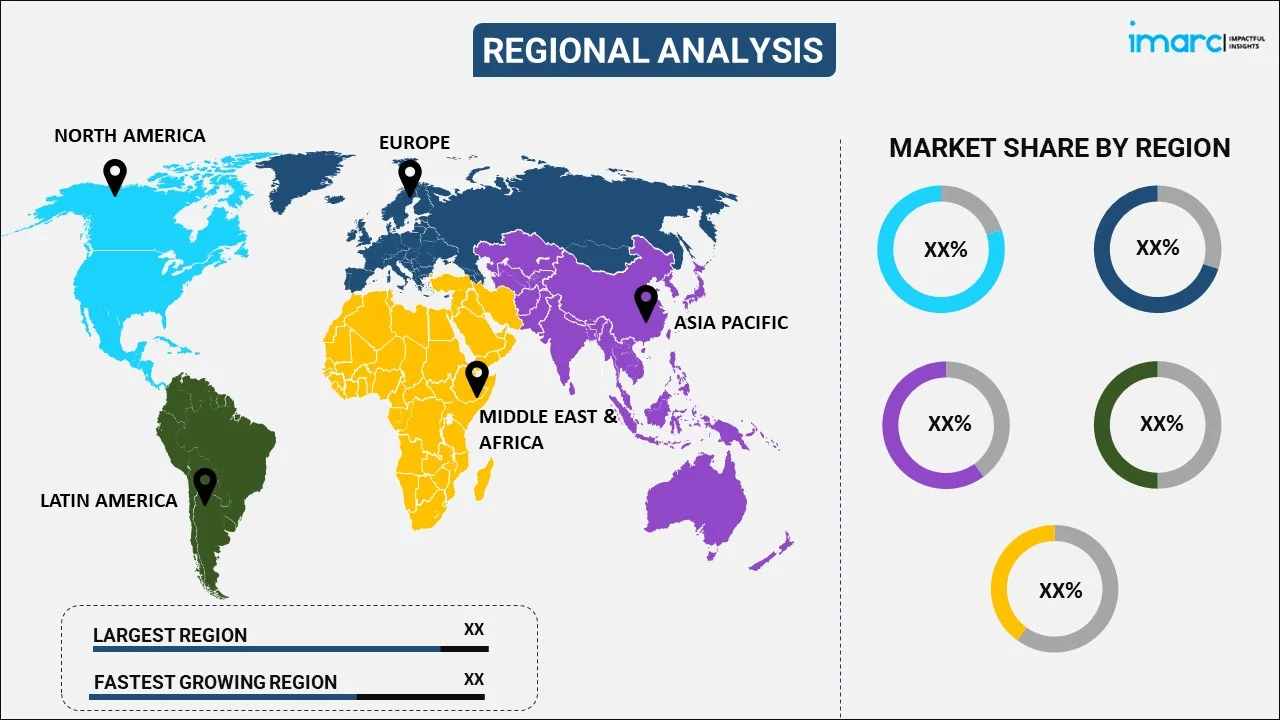
To get more information on the regional analysis of this market Request Sample
- North America
- United States
- Canada
- Asia Pacific
- China
- Japan
- India
- South Korea
- Australia
- Indonesia
- Others
- Europe
- Germany
- France
- United Kingdom
- Italy
- Spain
- Russia
- Others
- Latin America
- Brazil
- Mexico
- Others
- Middle East and Africa
Asia Pacific, accounting for 38% of the share, maintains the leading position in the market. The region’s dominance is attributed to rapid industrialization, the expansion of e-commerce ecosystems, and the escalating demand for supply chain automation across countries including China, Japan, India, South Korea, Indonesia, and Australia. The robust logistics and warehousing infrastructure, coupled with governmental initiatives promoting the adoption of modern technologies, smart manufacturing practices, and Industry 4.0 programs, is driving the demand for barcode scanning solutions. The booming retail sector and the growing adoption of mobile-enabled and wireless scanning systems across the region are creating significant opportunities for market expansion. Furthermore, the increasing focus on improving operational efficiency in manufacturing facilities, distribution centers, and retail outlets through automated data capture technologies is supporting sustained growth. The region’s large and rapidly growing consumer base, along with the continued digital transformation of commercial operations, positions Asia Pacific as the leading market for barcode scanning technology.
Key Regional Takeaways:
North America Barcode Scanner Market Analysis
The North America barcode scanner market is experiencing sustained growth, driven by the rapid expansion of e-commerce, retail modernization, and increasing automation across warehouse and logistics operations. Businesses across the region are prioritizing operational efficiency, inventory accuracy, and supply chain transparency, creating a strong foundation for barcode scanning technology deployment. The shift toward omnichannel retail strategies has accelerated demand for advanced scanning solutions capable of integrating seamlessly with enterprise resource planning and warehouse management systems, while healthcare facilities are embracing the technology to enhance patient safety, medication tracking, and asset management. Technological advancements, including the transition from traditional linear scanners to two-dimensional and wireless imaging devices, are reshaping market dynamics, with the growing preference for mobile computing enabling greater workforce flexibility on the shop floor and in distribution centers. Furthermore, the integration of barcode scanning with cloud-based platforms and IoT ecosystems is unlocking new levels of real-time visibility and operational intelligence across industries throughout the region.
United States Barcode Scanner Market Analysis
The United States represents a significant and highly developed market for barcode scanning technology, driven by its advanced retail infrastructure, expansive logistics networks, and sophisticated healthcare ecosystem. Barcode scanners are extensively deployed across e-commerce fulfillment centers, large-scale distribution hubs, retail stores, and medical facilities to ensure operational efficiency, inventory accuracy, and regulatory compliance. The rapid expansion of online retail platforms and the increasing complexity of supply chain operations are necessitating advanced data capture solutions capable of handling high-volume and high-speed scanning requirements. The widespread adoption of automated checkout systems, self-service kiosks, and contactless shopping technologies in retail establishments across the country is further stimulating demand for barcode scanning infrastructure. In November 2025, the U.S. Department of Veterans Affairs fully eliminated the backlog of over 70,000 CHAMPVA healthcare applications, with new applications processed within days, showcasing the critical role of barcode-enabled and digital workflow technologies in healthcare efficiency. Moreover, major distribution hubs across states such as California, Texas, New York, and Florida are leading the implementation of high-performance scanning solutions to manage the growing volume of e-commerce transactions and parcel shipments.
Europe Barcode Scanner Market Analysis
Europe represents a mature and steadily growing market for barcode scanning technology, driven by the region’s strong emphasis on Industry 4.0 adoption, smart manufacturing integration, and stringent regulatory compliance requirements across pharmaceutical, food and beverage, and retail sectors. The growing demand for traceability solutions supported by advanced barcode scanning technologies is a primary driver of market expansion across the region. The focus on sustainable and efficient supply chain operations is fostering the deployment of advanced data capture technologies in warehouses, distribution centers, and manufacturing facilities. Additionally, the expanding e-commerce ecosystem, particularly in Germany, the United Kingdom, France, and Spain, is generating increased demand for warehouse automation and logistics optimization solutions that rely heavily on barcode scanning infrastructure. The modernization of retail operations and the growing implementation of digital inventory management systems across both large-scale enterprises and small-to-medium businesses are also supporting market development. Furthermore, regulatory frameworks mandating pharmaceutical serialization and food traceability are compelling organizations to adopt barcode scanning systems for compliance purposes.
Asia-Pacific Barcode Scanner Market Analysis
The Asia-Pacific region leads the global barcode scanner market, supported by rapid industrialization, the explosive growth of e-commerce platforms, and increasing investments in automation across manufacturing and logistics sectors. The deployment of automated scanning and data capture solutions is being accelerated by the surge in logistics, manufacturing, and transportation activities across the region. As per sources, Datalogic exhibited its latest fixed and handheld barcode scanning solutions at NRF Asia Pacific 2025 in Singapore, underscoring strong demand for advanced retail scanning technologies across Asia’s expanding market. Governmental initiatives promoting smart manufacturing, digital transformation, and Industry 4.0 adoption in countries including China, India, Japan, and South Korea are further driving market expansion. The growing integration of mobile-enabled and wireless scanning solutions is enhancing operational efficiency across diverse industry verticals.
Latin America Barcode Scanner Market Analysis
Latin America is an emerging market for barcode scanners, due to the gradual modernization of retail infrastructure, the growing e-commerce business, and the adoption of digital supply chain management solutions. The increasing investment in warehouse automation and logistics management in Brazil and Mexico is fueling the adoption of barcode scanning solutions in commercial and industrial settings. Moreover, the retail industry’s digital transformation and the development of modern retail formats such as supermarkets, hypermarkets, and organized retail formats in Latin America are opening new avenues for the adoption of barcode scanners. The increasing interest in enhancing inventory accuracy and transparency is also fueling adoption.
Middle East and Africa Barcode Scanner Market Analysis
The Middle East and Africa market is experiencing a slow but steady adoption of barcode scanners, thanks to the continued development of digital infrastructure, modernization of the retail sector, and improvement in logistics capabilities in the region. The rising efforts aimed at diversifying the economies of the countries in the region, as well as investments in the retail, healthcare, and manufacturing industries that require efficient data capture solutions, are driving the adoption of barcode scanning technology. The rising development of modern retail formats, development of logistics hubs in the region, and execution of smart city projects that include automated identification solutions are also contributing to the adoption of barcode scanning technology.
Competitive Landscape:
The competitive landscape of the barcode scanner market outlook is characterized by the presence of several established players focusing on product innovation, strategic acquisitions, and geographic expansion to strengthen their market positions. Leading companies are investing significantly in research and development to incorporate advanced technologies, including artificial intelligence, machine learning, and enhanced wireless connectivity, into their scanning solutions. Strategic partnerships with technology integrators, software platform providers, and value-added resellers are enabling manufacturers to offer comprehensive scanning ecosystems that address diverse industry requirements across global markets. Mergers and acquisitions remain a prominent strategy, with major players acquiring complementary technology firms to expand their product portfolios, enhance their technological capabilities, and widen their addressable markets.
The report provides a comprehensive analysis of the competitive landscape in the barcode scanner market with detailed profiles of all major companies, including:
- Bluebird Inc.
- Cognex Corporation
- Datalogic S.p.A. (Hydra S.p.A)
- Denso Wave Incorporated
- Honeywell International Inc.
- JC Square Inc. (GMO Hosting & Security Inc.)
- SATO Holdings Corporation
- Scandit AG
- Toshiba TEC Corporation
- Zebra Technologies Corporation
Latest News and Developments:
- In October 2025, Munbyn unveiled the AS01 barcode scanner, featuring 27W fast charging, Android 14 upgradable to 18, rugged IP65-rated design, 7,000mAh battery, and high-precision scanning. Designed for warehouses, retail, and industrial environments, it enhances efficiency, reliability, and user experience in demanding operations.
- In August 2025, poLight ASA announced that iData Technology’s T1Pro, K3Pro, T3Pro, T5, and K8Pro barcode scanners will incorporate TLens® autofocus tunable optics, delivering ultrafast, low-power, and constant field-of-view focusing. Optimized for industrial, retail, and logistics environments, these devices significantly enhance scanning efficiency and operational productivity.
Barcode Scanner Market Report Scope:
| Report Features | Details |
|---|---|
| Base Year of the Analysis | 2025 |
| Historical Period | 2020-2025 |
| Forecast Period | 2026-2034 |
| Units | Billion USD |
| Scope of the Report | Exploration of Historical Trends and Market Outlook, Industry Catalysts and Challenges, Segment-Wise Historical and Future Market Assessment:
|
| Products Covered | Handheld Barcode Scanner, Stationary Barcode Scanner |
| Types Covered | Wired Barcode Scanner, Wireless Barcode Scanner |
| Scanner Types Covered | Rugged Barcode Scanner, Non-Rugged Barcode Scanner |
| Technologies Covered | Camera Based Reader, Charge Coupled Device Reader, Laser Scanner, Omni Directional Barcode Scanners, Pen Type Reader, RFID Reader, Smart Phone Based Scanner, Others |
| Components Covered | Solutions, Services |
| End-Use Sectors Covered | Retail and Commercial, General Manufacturing, Healthcare, Logistics and Warehousing, Commercial Aviation, Defense, Others |
| Regions Covered | North America, Asia Pacific, Europe, Latin America, Middle East and Africa |
| Countries Covered | United States, Canada, China, Japan, India, South Korea, Australia, Indonesia, Germany, France, United Kingdom, Italy, Spain, Russia, Brazil, Mexico |
| Companies Covered | Bluebird Inc., Cognex Corporation, Datalogic S.p.A. (Hydra S.p.A), Denso Wave Incorporated, Honeywell International Inc., JC Square Inc. (GMO Hosting & Security Inc.), SATO Holdings Corporation, Scandit AG, Toshiba TEC Corporation, Zebra Technologies Corporation, etc. |
| Customization Scope | 10% Free Customization |
| Post-Sale Analyst Support | 10-12 Weeks |
| Delivery Format | PDF and Excel through Email (We can also provide the editable version of the report in PPT/Word format on special request) |
Key Benefits for Stakeholders:
- IMARC’s report offers a comprehensive quantitative analysis of various market segments, historical and current market trends, market forecasts, and dynamics of the barcode scanner market from 2020-2034.
- The research study provides the latest information on the market drivers, challenges, and opportunities in the global barcode scanner market.
- The study maps the leading, as well as the fastest-growing, regional markets. It further enables stakeholders to identify the key country-level markets within each region.
- Porter's Five Forces analysis assists stakeholders in assessing the impact of new entrants, competitive rivalry, supplier power, buyer power, and the threat of substitution. It helps stakeholders to analyze the level of competition within the barcode scanner industry and its attractiveness.
- Competitive landscape allows stakeholders to understand their competitive environment and provides an insight into the current positions of key players in the market.
Frequently Asked Questions About the Barcode Scanner Market Report
The barcode scanner market size increased from USD 7.8 Billion in 2025 to USD 8.4 Billion in 2026.
The barcode scanner market is projected to exhibit a CAGR of 5.89% during 2026-2034, reaching a value of USD 13.3 Billion by 2034.
The barcode scanner market is driven by increasing demand for automated inventory management across retail and logistics, growing adoption of wireless and mobile scanning technologies, expanding e-commerce operations requiring efficient data capture, rising healthcare applications for patient safety and medication tracking, and ongoing advancements in AI-powered scanning solutions.
Asia Pacific currently dominates the barcode scanner market, accounting for a share of 38%. The region benefits from rapid industrialization, extensive e-commerce growth, escalating demand for supply chain automation, and supportive governmental initiatives promoting technology adoption in business operations.
Some of the major players in the barcode scanner market include Bluebird Inc., Cognex Corporation, Datalogic S.p.A. (Hydra S.p.A), Denso Wave Incorporated, Honeywell International Inc., JC Square Inc. (GMO Hosting & Security Inc.), SATO Holdings Corporation, Scandit AG, Toshiba TEC Corporation, Zebra Technologies Corporation, etc.
Need more help?
- Speak to our experienced analysts for insights on the current market scenarios.
- Include additional segments and countries to customize the report as per your requirement.
- Gain an unparalleled competitive advantage in your domain by understanding how to utilize the report and positively impacting your operations and revenue.
- For further assistance, please connect with our analysts.
 Request Customization
 Speak to an Analyst
 Request Brochure
 Inquire Before Buying
Benefits of Customization
- Personalize this research
- Triangulate with your data
- Get data as per your format and definition
- Gain a deeper dive into a specific application, geography, customer, or competitor
- Any level of personalization
Get in Touch With Us
UNITED STATES
Phone: +1-201-971-6302
INDIA
Phone: +91-120-433-0800
UNITED KINGDOM
Phone: +44-753-714-6104
Email: [email protected]
Client Testimonials




.webp)




.webp)













Related Reports

Choose your plan
*Please note that the prices mentioned below are starting prices for each bundle type. Kindly contact our team for further details.*
Single User License
- 1 User License, Access on 2 Devices
- PDF Report + Excel Dataset (Password Protected)
- Lifetime Access
- No Printing Rights
- 10% Free Report Customization
- 10–12 Weeks of Analyst Support
Five User License
- Access for 5 Users, 2 Devices per User
- PDF Report + Excel Dataset (Password Protected)
- Lifetime Access
- Dedicated Account Manager
- 12–14 Weeks of Analyst Support
- No Printing Rights
- 15% Free Report Customization
- 25% Discount on Your Next Purchase
Corporate User License
- Unlimited User Access (Within Your Organization)
- PDF Report + Excel Dataset
- Lifetime Access
- Dedicated Account Manager
- 14–20 Weeks of Analyst Support
- No Printing Rights
- 20% Free Report Customization
- 30% Discount on Your Next Purchase
Essential Insights
What's included:
3 reports
- Lifetime Access
- PDF Reports
- Excel Datasets
- 2 Weeks of Free Analyst Support
- 2 User Licenses
- Access on 2 Devices
- Printing Rights
- Complimentary PowerPoint (PPT) Version
- Complimentary License Upgrade
Professional Access
What's included:
5 reports
- Lifetime Access
- PDF Reports
- Excel Datasets
- 8 Weeks of Free Analyst Support
- 2 User Licenses
- Access on 2 Devices
- Printing Rights
- Complimentary PowerPoint (PPT) Version
- Complimentary License Upgrade
Business Advantage
What's included:
8 reports
- Lifetime Access
- PDF Reports
- Excel Datasets
- 14 Weeks of Free Analyst Support
- 2 User Licenses
- Access on 2 Devices
- Printing Rights
- Complimentary PowerPoint (PPT) Version
- Complimentary License Upgrade
Enterprise Intelligence
What's included:
10 reports
- Lifetime Access
- PDF Reports
- Excel Datasets
- 20 Weeks of Free Analyst Support
- 2 User Licenses
- Access on 2 Devices
- Printing Rights
- Complimentary PowerPoint (PPT) Version
- Complimentary License Upgrade