Top 10 Toys Companies in India
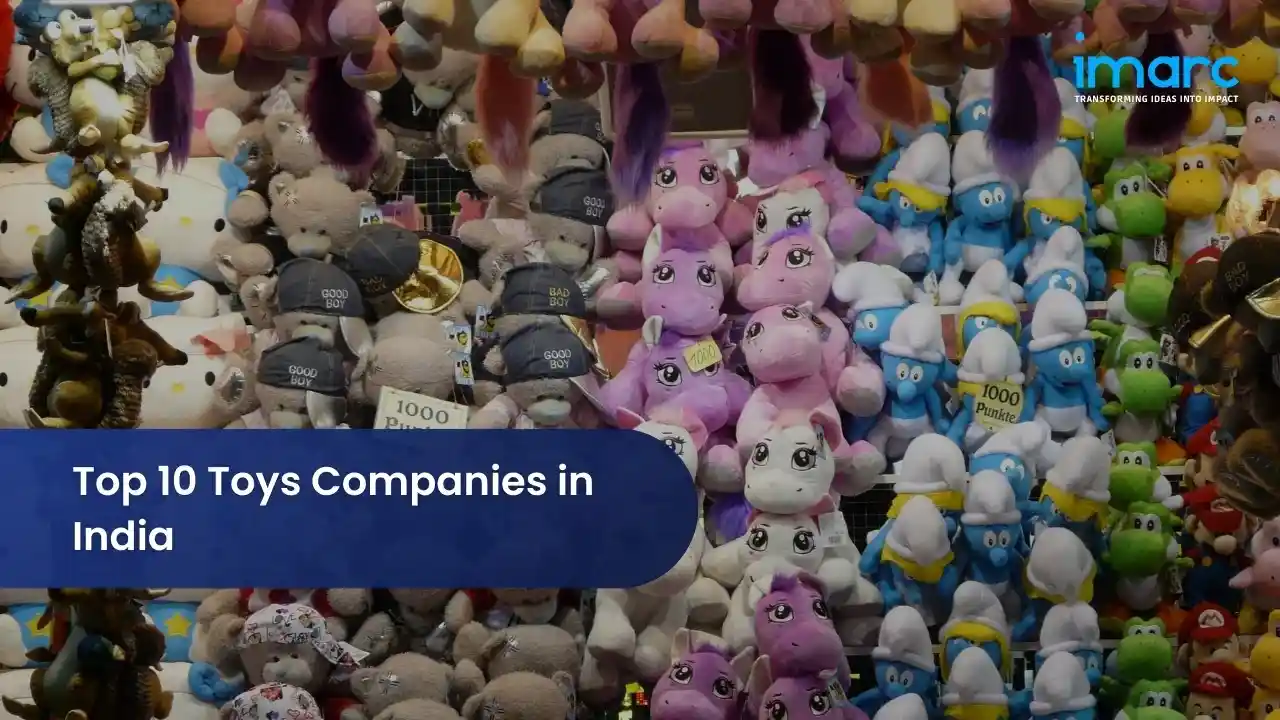
Funskoolindia, Hamleys India, and Hasbro rank among the top three companies shaping the Indian toys industry. The market was valued at USD 2.09 Billion in 2025 and is projected to reach USD 4.74 Billion by 2034, growing at a CAGR of 9.53% during 2026-2034.
India's expanding middle class has fundamentally reshaped toy purchasing behavior. Driving this shift, parents redirect growing household budgets toward products that build cognitive skills, fine motor development, and creative expression through structured play rather than relying on passive screen-based entertainment. Make in India and Atmanirbhar Bharat initiatives have since raised domestic production standards and Bureau of Indian Standards certification requirements across the organized toy sector.
AI-powered educational toys now redefine play in India. Embedding machine learning capabilities into coding robots and interactive puzzles, manufacturers deliver content that adapts to each child's developmental pace and cognitive ability, reducing reliance on passive screen-based entertainment. That said, sustainable materials technology is advancing alongside, with bio-based plastics and non-toxic components becoming prerequisites under tightening Quality Control Orders and consumer safety mandates.
Geographic Distribution:
Maharashtra leads India's toy market with a 20% revenue share. Anchored by Mumbai and Pune's dense urban consumer clusters, the state hosts Hamleys India's flagship operations alongside organized retail networks that distribute Hasbro and Mattel products to premium family buyers across high-footfall malls and specialty stores. Maharashtra's port infrastructure also functions as the primary import gateway for multinational toy brands.
Tamil Nadu anchors India's toy production base through Funskoolindia's manufacturing operations. Positioned at the center of India's export push under the Atmanirbhar Bharat framework, the state's facilities supply more than thirty international markets while meeting Bureau of Indian Standards certification mandates. Karnataka reinforces this through Micro Plastics Private Limited's Bengaluru plant, delivering precision plastic components to multinational OEM clients.
Online channels command India's toy distribution. With a 38% share in 2025, e-commerce platforms have bridged access gaps in tier-two and tier-three cities across Rajasthan, Madhya Pradesh, and Uttar Pradesh, where expanding smartphone adoption and digital payment penetration have brought brands including Toyzone and Tripple Ess Toys within reach of previously underserved price-sensitive buyers. Physical specialty stores retain share only in metro markets.
Key Market Highlights:
- Rising disposable incomes across India's expanding urban middle class, combined with a child demographic representing approximately 24% of the country's 1.44 billion population, are together driving Indian toys market expansion from USD 2.09 Billion in 2025 toward USD 4.74 Billion by 2034.
- AI-powered educational toys adapting to individual learning paces, STEM-based coding kits, and machine-learning-integrated construction toys are replacing passive entertainment as the leading technology-driven advancement reshaping product development across India's organized toy manufacturing sector.
- Plush toys lead all product categories with a 16% market share in 2025, propelled by consumer preference for safe, emotionally engaging, and culturally relevant soft toys, including licensed character merchandise and weighted sensory wellness ranges.
- Online channels dominate toy distribution with a 38% market share in 2025, driven by e-commerce platforms expanding access in tier-two and tier-three cities through improving logistics, digital payment infrastructure, and competitive seasonal pricing strategies.
- Maharashtra holds the leading domestic position with a 20% market share in 2025, supported by dense urban retail infrastructure in Mumbai and Pune and the concentration of international toy brand distribution operations within the state.
- Mandatory safety certifications, Bureau of Indian Standards Quality Control Orders, and Prime Minister Modi's order compelling toy manufacturers to use less plastic are changing compliance requirements and pushing manufacturers in the organized sector to adopt recyclable, environmentally friendly materials throughout their production lines.
- Funskoolindia, Hamleys India, and The LEGO Group are advancing competitive positioning through electronic toy expansion, omnichannel retail development, and global sustainable materials commitments, while domestic manufacturers Toyzone and Tripple Ess Toys deepen distribution reach across price-sensitive mass-market segments.
This article provides a comprehensive analysis of the top Indian toys companies in the world, including their market position, geographic presence, product offerings, and strategic developments. It highlights how leading players are shaping the Indian toys market through innovation, expansion, and competitive strategies.
Top Companies in the Indian Toys Industry:
| Company Name | Headquarters | Founded Year | Primary Market Focus |
|---|---|---|---|
| Funskoolindia | Tamil Nadu, India | 1987 | Mass Market & Export |
| Hamleys India | Mumbai, India | 2010 | Premium Retail Experience |
| Hasbro | Rhode Island, USA | 1923 | Entertainment & Licensing |
| Mattel | California, USA | 1945 | Global Toy Manufacturing |
| Micro Plastics Private Limited | Bengaluru, India | 2005 | OEM Contract Manufacturing |
| Plastech International Private Limited | Mumbai, India | 1998 | Molded Toy Manufacturing |
| Simba Toys India Pvt. Ltd. | Mumbai, India | 2009 | International Branded Toys |
| The LEGO Group | Billund, Denmark | 1932 | Construction & Educational |
| Toyzone | New Delhi, India | 2002 | Affordable Mass Market |
| Tripple Ess Toys | Noida, UP, India | 1989 | Value-Driven Domestic Market |
Company Profiles:
1. Funskoolindia
Funskoolindia stands as India's most established domestic toy brand. Founded in Tamil Nadu in 1987 when imported products dominated retail, the company built its competitive standing through a combination of local manufacturing scale and licensing agreements from internationally recognized brands, creating consistent generational relevance across India and export markets. Covering more than thirty countries today, the brand enforces international safety standards throughout its portfolio.
- Regional Dominance: Pan-India retail and e-commerce presence across Maharashtra, Tamil Nadu, Karnataka, and Delhi NCR, with export operations reaching more than thirty international markets.
- Product Line: Games, puzzles, dolls, preschool toys, action figures, outdoor toys, and internationally licensed merchandise from Hasbro, LEGO, and Takara Tomy.
- Strategic Shift: Official market entry into the electronic toys segment in December 2025, positioning Funskoolindia to capture rising demand for STEM-aligned, technology-integrated play products from India's growing digital-native child consumer base.
| Feature | Details |
|---|---|
| Establishment | 1987 |
| Headquarters | Tamil Nadu, India |
| Website | https://www.funskoolindia.com/ |
| Core Strength | Domestic manufacturing scale with global licensing partnerships |
| Key Innovation | Electronic toy segment launch in December 2025 |
2. Hamleys India
Hamleys India entered the domestic market in 2010. Through its integration into Reliance Retail's portfolio, the brand brings the world's oldest toy retail heritage into Indian consumer spaces via store formats built around live demonstrations, interactive product displays, and theatrical presentations that differentiate it from conventional shelf-stacking retail competitors across Mumbai and major metros. That said, its ongoing tier-two city expansion carries this experiential model beyond Mumbai and Delhi.
- Regional Dominance: Flagship stores in Mumbai, Delhi, Bengaluru, Hyderabad, Chennai, and Pune, with recent expansion into tier-II cities through Reliance Retail's national retail infrastructure.
- Product Line: Curated global and in-house toy brands, collectibles, games, interactive play items, and licensed merchandise spanning all age groups from infants through young adults.
- Strategic Shift: Tier-II city store rollout under Reliance Retail's national network, integrating omnichannel digital access with the experiential flagship format to capture premium family buyers outside India's largest metropolitan markets.
| Feature | Details |
|---|---|
| Establishment | 2010 |
| Headquarters | Mumbai, India |
| Website | https://www.hamleys.in/ |
| Core Strength | Experiential retail model with curated premium brand assortment |
| Key Innovation | Omnichannel expansion integrating online retail with flagship experiential stores |
3. Hasbro
Hasbro traces its origins to Rhode Island in 1923. Operating across India through licensed retail and e-commerce partnerships, the brand delivers a portfolio spanning board games, action figures, and franchise-tied entertainment products connected to internationally recognized animated and film properties that maintain strong cross-generational consumer appeal. Domestic demand continues to grow.
- Regional Dominance: India retail and e-commerce distribution through authorized partners, with global operations spanning North America, Europe, Asia-Pacific, Latin America, and the Middle East across more than one hundred countries.
- Product Line: Monopoly, Play-Doh, My Little Pony, Transformers, and Nerf, spanning board games, arts and crafts, action figures, and outdoor play categories across multiple entertainment franchise platforms.
- Strategic Shift: Integration of eco-friendly materials and sustainable packaging across product lines globally, including India, as part of Hasbro's corporate ESG framework targeting significant reduction in virgin plastic use across its full product portfolio.
| Feature | Details |
|---|---|
| Establishment | 1923 |
| Headquarters | Rhode Island, United States |
| Website | https://corporate.hasbro.com |
| Core Strength | Global brand recognition with franchise-driven entertainment integration |
| Key Innovation | Eco-friendly materials and sustainable packaging integration across product lines |
4. Mattel
Founded in California in 1945, the company answers through iconic brand power, operating across India via retail and e-commerce channels that distribute doll, vehicle, and educational toy lines to consumers who associate Barbie, Hot Wheels, and Fisher-Price with aspirational childhood play. Mattel serves more than forty countries today.
- Regional Dominance: Retail and e-commerce operations across India, supported by global infrastructure spanning more than forty countries across North America, Europe, Asia-Pacific, and Latin America.
- Product Line: Barbie, Hot Wheels, Fisher-Price, Monster High, and American Girl, spanning dolls, die-cast vehicles, electronic learning toys, and board games under entertainment licensing partnerships with Disney, Marvel, and DC Comics.
- Strategic Shift: A formal corporate target to achieve one hundred percent recycled and recyclable materials across all product and packaging inputs, representing Mattel's most comprehensive sustainability commitment across its global manufacturing and supply chain operations.
| Feature | Details |
|---|---|
| Establishment | 1945 |
| Headquarters | California, United States |
| Website | https://about.mattel.com/ |
| Core Strength | Iconic global brands with deep entertainment licensing partnerships |
| Key Innovation | 100% recycled and recyclable materials target across global product lines |
5. Micro Plastics Private Limited
Micro Plastics Private Limited is India's largest contract toy manufacturer by OEM scope. Established in Bengaluru in 2005, the company delivers end-to-end solutions from design to production, serving multinational toy clients through advanced injection molding technology that prioritizes dimensional accuracy and rigorous quality control aligned with international standards. Its client base spans global toy brands requiring Indian manufacturing efficiency.
- Regional Dominance: Bengaluru, Karnataka manufacturing base with OEM supply operations reaching multinational toy brand clients across North America, Europe, and Asia-Pacific markets through export-oriented contract manufacturing agreements.
- Product Line: High-precision plastic components, finished OEM toys, and injection-molded sub-assemblies manufactured under contract for major international toy brands across multiple product categories and volume tiers.
- Strategic Shift: Progressive integration of waste reduction protocols and sustainable materials sourcing into OEM contract manufacturing operations, positioning Micro Plastics Private Limited to meet rising environmental compliance requirements from international toy brand clients.
| Feature | Details |
|---|---|
| Establishment | 2005 |
| Headquarters | Bengaluru, India |
| Website | https://microplasticsindia.com/ |
| Core Strength | End-to-end OEM manufacturing with precision injection molding capabilities |
| Key Innovation | Sustainable waste reduction practices integrated into high-volume contract production |
6. Plastech International Private Limited
Plastech International Private Limited has operated from Mumbai since 1998. Producing molded toys and plastic goods for both mass and niche segments under its Buddyz consumer brand, the company has built expertise in precision molding and customized product development that serves India's middle-income household market where affordability and safety compliance consistently take priority over brand prestige. On the innovation side, sustainable material exploration is now underway.
- Regional Dominance: Mumbai-based operations serving India's wholesale distributors, organized retail, and growing e-commerce platforms, with a consumer market concentrated in Maharashtra and broader western India.
- Product Line: Molded plastic toys, battery-operated play items, and customized plastic goods marketed under the Buddyz consumer brand across India's mid-market retail and wholesale distribution network.
- Strategic Shift: Active integration of sustainable, non-toxic material alternatives across the Buddyz product line, aligning with Bureau of Indian Standards safety mandates and Prime Minister Modi's directive urging toy makers to adopt eco-friendly, recyclable production inputs.
| Feature | Details |
|---|---|
| Establishment | 1998 |
| Headquarters | Mumbai, India |
| Website | https://www.buddyz.in/ |
| Core Strength | Precision molding expertise with affordable product positioning for domestic market |
| Key Innovation | Sustainable material exploration and non-toxic component integration across product lines |
7. Simba Toys India Pvt. Ltd.
Simba Toys India Pvt. Ltd. has operated from Mumbai since 2009, functioning as the Indian arm of Germany's Simba Dickie Group. Drawing on its parent company's European product development pipeline, the brand delivers dolls, die-cast vehicles, and licensed franchise merchandise to India's premium buyers through organized retail, specialty stores, and e-commerce platforms. Premium play drives its positioning.
- Regional Dominance: Mumbai-anchored operations distributing to organized toy retail, specialty stores, and e-commerce platforms across India's metro markets including Delhi, Bengaluru, Hyderabad, Chennai, and Pune.
- Product Line: Dolls, die-cast vehicles, interactive games, licensed franchise merchandise from European entertainment brands, and outdoor toys from the Simba Dickie Group's global product development portfolio.
- Strategic Shift: Expansion of e-commerce distribution partnerships in India's tier-two and tier-three cities, aligning Simba Toys India Pvt. Ltd.'s international branded portfolio with the growing online toy purchasing trend that represents 38% of total domestic market distribution.
| Feature | Details |
|---|---|
| Establishment | 2009 |
| Headquarters | Mumbai, India |
| Website | https://www.simbatoys.com/ |
| Core Strength | International brand portfolio backed by Simba Dickie Group's innovation pipeline |
| Key Innovation | E-commerce distribution expansion targeting India's tier-two and tier-three city growth |
8. The LEGO Group
The LEGO Group is globally recognized as a construction toy pioneer. Founded in Billund, Denmark in 1932, the company built its reputation through interlocking plastic bricks that promote creativity, engineering thinking, and fine motor skill development among children and adult enthusiasts across every major consumer market worldwide including India. Franchise-themed sets extend its demographic reach considerably.
- Regional Dominance: India retail and e-commerce operations alongside global presence spanning North America, Europe, Asia-Pacific, and Latin America, with dedicated brand stores in Mumbai, Delhi, and Bengaluru.
- Product Line: Classic construction brick sets, LEGO Technic, LEGO Education robotics kits, franchise-themed sets from Star Wars and Harry Potter, LEGO Duplo for early childhood, and LEGO Ideas crowdsourced product lines.
- Strategic Shift: A formal commitment to manufacturing all products from sustainable materials by 2030, backed by significant investment in bio-based plastics and renewable energy integration across The LEGO Group's global production and packaging operations.
| Feature | Details |
|---|---|
| Establishment | 1932 |
| Headquarters | Billund, Denmark |
| Website | https://www.lego.com/en-in |
| Core Strength | Global brand equity with educational value and multi-generational consumer appeal |
| Key Innovation | 100% sustainable materials commitment by 2030 with bio-based plastic investment |
9. Toyzone
Toyzone, a New Delhi-based toy manufacturer established in 2002, produces plastic and battery-operated toys for the Indian market. The company follows Bureau of Indian Standards-compliant manufacturing processes and serves consumers across metropolitan and smaller urban markets. Its product portfolio focuses on toys designed for both play and developmental engagement while maintaining affordability for middle-income households.
- Regional Dominance: Pan-India retail distribution through organized trade networks and online marketplaces, with manufacturing and distribution based in Delhi NCR serving metros, tier-two cities, and smaller towns nationwide.
- Product Line: Plastic action figures, dolls, battery-operated vehicles, educational toys, and outdoor play items designed for affordability and Bureau of Indian Standards compliance across India's middle-income household segment.
- Strategic Shift: Ongoing investment in Bureau of Indian Standards certification infrastructure and child safety compliance programs, positioning Toyzone as a compliant organized-sector alternative to unorganized low-cost toy manufacturers competing in India's price-sensitive mass market.
| Feature | Details |
|---|---|
| Establishment | 2002 |
| Headquarters | New Delhi, India |
| Website | https://toyzone.in/ |
| Core Strength | Affordable mass-market toys with Bureau of Indian Standards-compliant safety standards |
| Key Innovation | BIS certification investment aligned with India's Quality Control Order requirements |
10. Tripple Ess Toys
Tripple Ess Toys has manufactured from Noida, Uttar Pradesh since 1989. Building a reputation as a value-driven domestic supplier, the company operates around scalable production, product customization, and quality certification adherence that collectively serve institutional and retail buyers from toddlers through young children across India's wholesale and e-commerce networks. That said, digital retail expansion now targets middle-class buyers beyond its original wholesale base.
- Regional Dominance: North India-focused distribution anchored in Noida, Uttar Pradesh, with wholesale and retail network reach extending across Delhi NCR, Rajasthan, Madhya Pradesh, and national e-commerce platforms.
- Product Line: Molded plastic toys, ride-ons, vehicles, educational toys, and novelty play items designed for toddlers to young children within India's value-segment middle-income household market.
- Strategic Shift: Active development of product customization capabilities and scalable manufacturing programs targeting institutional buyers, organized retail chains, and e-commerce platforms seeking reliable domestic suppliers under India's Quality Control Order compliance framework.
| Feature | Details |
|---|---|
| Establishment | 1989 |
| Headquarters | Noida, Uttar Pradesh, India |
| Website | https://trippleess.com/ |
| Core Strength | Scalable value manufacturing with deep domestic market understanding |
| Key Innovation | Product customization capability serving institutional and organized retail segment |
Frequently Asked Questions (FAQ):
Q1. What is the current market size of the Indian toys industry?
The Indian toys market was valued at USD 2.09 Billion in 2025. IMARC Group projects the market to reach USD 4.74 Billion by 2034, growing at a CAGR of 9.53% during 2026-2034.
Q2. Who are the top Indian toys companies?
The leading Indian toys companies include Funskoolindia, Hamleys India, and Hasbro alongside Mattel, Micro Plastics Private Limited, Plastech International Private Limited, Simba Toys India Pvt. Ltd., The LEGO Group, Toyzone, and Tripple Ess Toys. Individual company revenue figures from Indian toy market operations are not disclosed in the available research data.
Q3. Which segment is growing the fastest?
The plush toys segment holds the largest product category share at 16% in 2025, driven by consumer preference for safe, comforting products and licensed character merchandise demand. Manufacturers are expanding ranges with premium materials, interactive features, and sensory wellness-focused collections targeting emotionally engaged family buyers across urban and semi-urban markets.
Q4. Which region dominates the Indian market share?
Maharashtra dominates the Indian toys market, holding over 20% of domestic market share in 2025. Mumbai and Pune anchor the state's leadership through dense urban retail infrastructure and concentration of multinational toy brand distribution operations, including Hamleys India's flagship stores and major import gateway port facilities.
Q5. How are leading companies gaining a competitive advantage?
Leading companies gain advantage through product innovation, quality certification adherence, licensing partnerships, and distribution network expansion across physical retail and e-commerce channels. Funskoolindia's electronic toy segment entry, The LEGO Group's sustainability commitment by 2030, and Hamleys India's tier-two city expansion collectively illustrate the strategic diversification reshaping competitive dynamics in India's organized toy sector.
Q6. Which country is home to the highest number of top-tier brands?
India is home to the highest number of top-tier brands in this market, with six of the ten leading companies headquartered domestically. Funskoolindia, Hamleys India, Micro Plastics Private Limited, Plastech International Private Limited, Toyzone, and Tripple Ess Toys are all India-based, complemented by international players from the United States, Denmark, and Germany.
About Author:
|
Kailash Soni Senior Team Manager – Market Research (Retail) at IMARC Services Private Limited Kailash Soni is a senior team manager with deep expertise in the retail sector, covering e-commerce, brick-and-mortar formats, D2C brands, omnichannel strategies, and retail technology. He has strong experience in consumer behaviour research, footfall analysis, category management studies, and competitive retail benchmarking for clients across FMCG majors, retail chains, and digital commerce platforms. Kailash has a sharp understanding of evolving shopper journeys and the technology stack enabling next-generation retail experiences. Outside of work, he enjoys graphic design and tracking emerging consumer trends. |