
Brazil Adsorbents Market Size, Share, Trends and Forecast by Type, Application, and Region, 2026-2034
Brazil Adsorbents Market Summary:
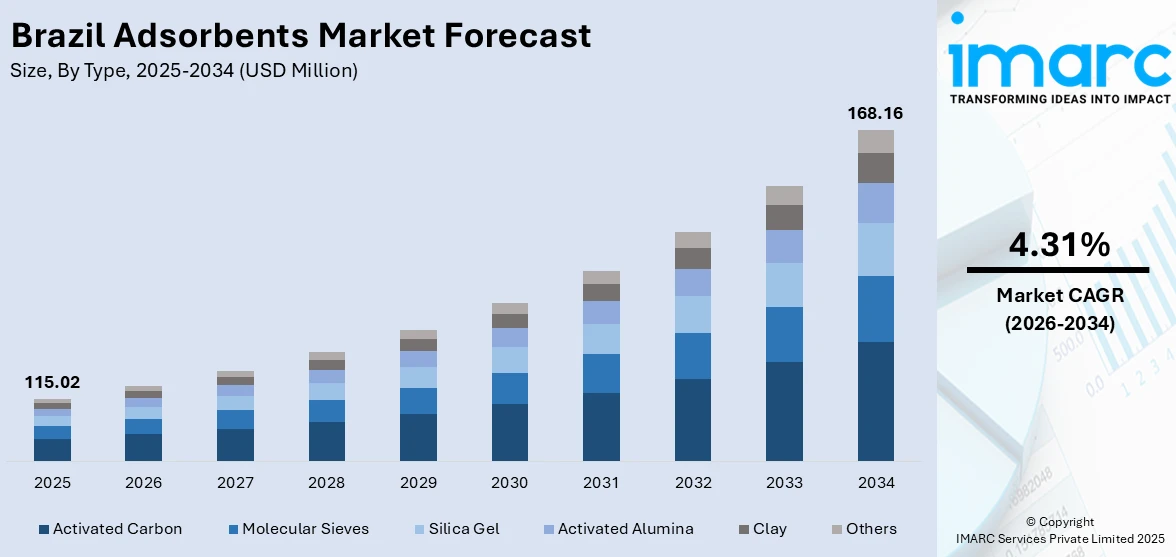
The Brazil adsorbents market size was valued at USD 115.02 Million in 2025 and is projected to reach USD 168.16 Million by 2034, growing at a compound annual growth rate of 4.31% from 2026-2034.
Strong industrial expansion, stricter environmental regulations, and rising need for purification solutions across important economic sectors are all contributing factors to the growth of the Brazilian adsorbent market. Other reasons that increase the need for adsorbents include the expansion of petroleum refining activities, increased investments in water and wastewater treatment systems, and the growing need for the production of high-purity chemicals. Moreover, the increased emphasis on best industrial practices and environmental sustainability speeds up the use of enhanced adsorption technologies, increasing the market share of adsorbents in Brazil.
Key Takeaways and Insights:
-
By Type: Activated carbon dominates the market with a share of 38.7% in 2025, driven by its extensive use in water purification, air filtration, and industrial effluent treatment across Brazil’s expanding environmental management infrastructure.
-
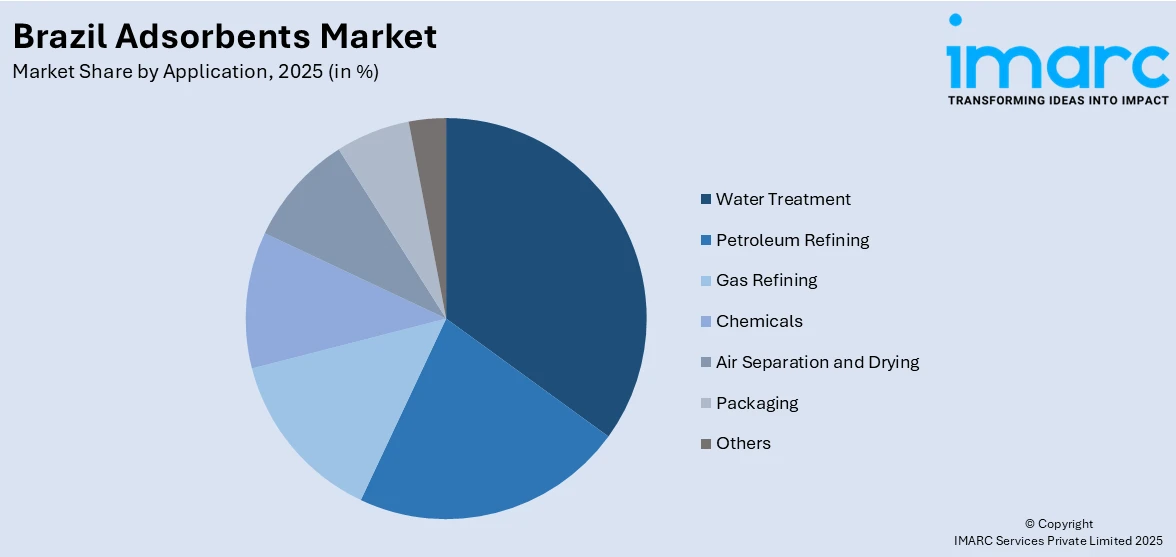
By Application: Water treatment leads the market with a share of 31.9% in 2025, reflecting Brazil’s accelerating investments in sanitation infrastructure and regulatory compliance aimed at achieving universal access to safe drinking water and sewage treatment.
-
By Region: Southeast holds the largest share of 44.6% in 2025, owing to its concentration of industrial activity, petroleum refining capacity, chemical manufacturing, and advanced water treatment operations centered around São Paulo and Rio de Janeiro.
-
Key Players: The Brazil adsorbents market exhibits a moderately competitive structure, with established international manufacturers competing alongside regional suppliers across product segments, investing in capacity expansion, product innovation, and strategic partnerships to strengthen their market positioning.
To get more information on this market Request Sample
The market for adsorbents in Brazil is changing as a result of the nation's expanding industrial base, stricter environmental laws, and rising demand for sophisticated purification technologies. Utilizing molecular sieves and activated alumina for dehydration, desulfurization, and catalytic processes crucial to fuel quality compliance, the petroleum refining industry is a major user of adsorbent materials. Activated carbon and other filtration media are in high demand as a result of Brazil's ambitious sanitation reform program, which is also directing significant public and private investment into water and wastewater treatment facilities. In July 2025, Veolia was chosen to implement Brazil’s most advanced municipal wastewater reuse facility in Vitória, enabling the recovery of 85% of treated wastewater for industrial applications. This highlights the growing role of high-performance filtration and purification technologies in national water sustainability initiatives. The chemical and petrochemical industries further contribute to adsorbent consumption through applications in solvent recovery, gas purification, and process optimization. Rising environmental consciousness, coupled with regulatory enforcement on industrial emissions and effluent discharge, is encouraging broader adoption of high-performance adsorbent technologies across multiple end-use sectors.
Brazil Adsorbents Market Trends:
Growing Adoption of Advanced Water Purification Technologies
Brazil is increasingly embracing sophisticated water treatment methodologies that rely on high-performance adsorbent materials to address contamination challenges across municipal and industrial systems. Heightened regulatory scrutiny on water quality standards and expanding sanitation coverage goals are accelerating the integration of activated carbon-based filtration, granular media systems, and hybrid adsorption solutions. In June 2025, AquiSense Technologies received the IFAT Brasil Innovative Technology Award for its UV-C LED water disinfection systems, recognized for outperforming conventional mercury-based treatment methods. This highlights Brazil’s growing adoption of advanced purification technologies to enhance water safety and contaminant control. These technologies are being deployed to remove emerging contaminants, organic pollutants, and trace impurities from drinking water and wastewater streams, supporting Brazil adsorbents market growth.
Rising Integration of Adsorbents in Petrochemical Operations
The petrochemical sector in Brazil is progressively incorporating specialized adsorbent materials into refining and processing workflows to enhance product purity, optimize catalytic performance, and comply with evolving fuel quality specifications. Molecular sieves, activated alumina, and specialty carbons are being utilized in dehydration units, gas sweetening processes, and olefin purification systems. In May 2025, Petrobras commissioned a new diesel hydrotreating unit at its REPLAN refinery in Paulínia to produce ultra-low-sulfur S-10 diesel, supporting stricter fuel quality standards and increasing reliance on advanced purification and adsorption-enabled separation systems. This trend is reinforced by the ongoing modernization of existing refining infrastructure and the expansion of downstream chemical processing capacity across the country.
Expansion of Sustainable and Bio-Based Adsorbent Solutions
A notable shift toward environmentally responsible adsorbent production is gaining traction in Brazil, driven by the availability of abundant biomass feedstocks such as coconut shells, wood residues, and sugarcane bagasse. Manufacturers are increasingly exploring renewable raw material sources to produce activated carbon and other porous media, aligning with broader sustainability objectives and circular economy principles. In October 2023, Jacobi Group announced the development of advanced coconut-shell-based activated carbon production technology designed to improve yield efficiency and significantly reduce emissions, reinforcing the global transition toward renewable, low-carbon adsorbent manufacturing. This transition is fostering innovation in production processes while reducing dependency on conventional fossil-based precursors.
Market Outlook 2026-2034:
The market for adsorbents in Brazil is expected to keep growing due to factors such ongoing industrial expansion, stricter environmental regulations, and rising energy and water treatment expenditures. Market momentum is also being supported by increased demand from chemical processing, municipal cleanliness initiatives, and petroleum refining. In the years to come, adsorbent manufacturers and suppliers operating across the nation's diverse industrial landscape are likely to have a lot of opportunities thanks to ongoing refinement modernization, ambitious sanitation universalization targets, and growing adoption of advanced purification technologies. The market generated a revenue of USD 115.02 Million in 2025 and is projected to reach a revenue of USD 168.16 Million by 2034, growing at a compound annual growth rate of 4.31% from 2026-2034.
Brazil Adsorbents Market Report Segmentation:
|
Segment Category |
Leading Segment |
Market Share |
|
Type |
Activated Carbon |
38.7% |
|
Application |
Water Treatment |
31.9% |
|
Region |
Southeast |
44.6% |
Type Insights:
- Molecular Sieves
- Activated Carbon
- Silica Gel
- Activated Alumina
- Clay
- Others
The activated carbon dominates with a market share of 38.7% of the total Brazil adsorbents market in 2025.
Due to its outstanding adaptability and demonstrated effectiveness across a broad spectrum of purification and filtration applications, activated carbon has dominated the Brazilian adsorbent market. With its huge surface area and highly porous structure, the material is very effective in removing organic contaminants, heavy metals, chlorine byproducts, and emerging pollutants from water and wastewater streams. It is observed that public utilities and private enterprises are adopting the granular and powdered formulations of activated carbon more quickly in Brazil as the country develops its municipal water treatment infrastructure and fixes more stringent environmental discharge regulations.
Outside of water treatment, other critical applications for activated carbon in Brazil include air purification, food and beverage processing, pharmaceutical manufacturing, and gold recovery operations. Growing emphasis on emissions control and workplace air quality compliance continues to support demand for gas-phase activated carbon products. Additionally, renewable biomass feedstocks-for example, coconut shells and wood residues-support local production capabilities, which enhance supply chain resilience and cost competitiveness in the Brazilian market.
Application Insights:
Access the comprehensive market breakdown Request Sample
- Petroleum Refining
- Gas Refining
- Chemicals
- Water Treatment
- Air Separation and Drying
- Packaging
- Others
The water treatment leads with a share of 31.9% of the total Brazil adsorbents market in 2025.
Water treatment stands as the largest application segment in Brazil’s adsorbents market, propelled by the country’s ambitious sanitation universalization goals and substantial infrastructure investments aimed at expanding clean water access and sewage treatment coverage. Brazil’s regulatory framework mandates progressive improvements in drinking water quality and wastewater discharge standards, creating sustained demand for activated carbon, molecular sieves, and other filtration media capable of addressing organic contaminants, turbidity, and microbiological impurities across municipal and industrial water systems. In November 2024, the International Finance Corporation (IFC) announced a financing package for Sabesp to expand and modernize water and wastewater treatment infrastructure in São Paulo, supporting improved drinking water quality and enhanced sewage treatment performance across millions of residents.
Significant capital expenditures for the building, modernization, and expansion of treatment plants are becoming possible as a result of the continuous privatization of water and sanitation concessions in several Brazilian states. Advanced adsorption technologies are being deployed in decentralized systems that serve underprivileged communities as well as large-scale metropolitan treatment facilities thanks to public-private collaborations. The need of adsorbent-based solutions in Brazil's changing water management landscape is further supported by growing awareness of water quality problems associated with industrial effluents, agricultural runoff, and new pollutants.
Regional Insights:
- Southeast
- South
- Northeast
- North
- Central-West
Southeast exhibits a clear dominance with a 44.6% share of the total Brazil adsorbents market in 2025.
The Southeast area is a market leader for adsorbents in Brazil due to its concentration of petrochemical and chemical manufacturing clusters, advanced water treatment infrastructure, and petroleum refining operations. Activated carbon, silica gel, activated alumina, and molecular sieves are in high demand for a variety of refining, purification, and environmental applications in states like São Paulo, Rio de Janeiro, and Minas Gerais, which house the majority of the nation's industrial base.
The presence of extensive municipal water supply and sanitation networks within the region will also continue to spur adsorbent consumption, especially through ongoing infrastructure modernization programs that are expected to channel a significantly higher amount of investment in upgrading treatment plants and capacity extensions. Moreover, specialized adsorbent materials also go into process purification, solvent recovery, and emissions control for the pharmaceutical, food and beverage, and automotive industries of the Southeast, further securing the region's commanding position in the national market landscape.
Market Dynamics:
Growth Drivers:
Why is the Brazil Adsorbents Market Growing?
Expanding Water and Sanitation Infrastructure Investments
Brazil's comprehensive sanitation reform agenda is channeling unprecedented public and private capital into water treatment and wastewater management infrastructure. National regulatory targets for universal access to safe drinking water and sewage treatment are compelling utilities and private concessionaires to invest in facility construction, expansion, and modernization. In 2024, the World Bank approved a major government-backed initiative to expand rural water supply and sanitation in Pernambuco, aiming to improve safely managed water access for around one million people through system upgrades, new water sources, and institutional capacity building. This sustained infrastructure buildout is generating robust demand for activated carbon, granular filtration media, and advanced adsorbent materials used in potable water purification, industrial effluent treatment, and wastewater polishing processes across the country.
Robust Petroleum Refining and Petrochemical Activity
Brazil's extensive petroleum refining infrastructure and expanding downstream petrochemical capacity are significant drivers of adsorbent consumption. Refining operations rely heavily on molecular sieves, activated alumina, and specialty adsorbents for crude oil dehydration, gas sweetening, sulfur compound removal, and catalyst support applications. In June 2025, Petrobras signed contracts worth approximately $892 million to expand its RNEST refinery, including the construction of new diesel hydrotreatment and refining units to improve fuel quality and processing capacity, reinforcing the need for advanced purification and contaminant control solutions. The ongoing modernization of existing refineries, combined with continued development of pre-salt oil reserves and natural gas processing capacity, is sustaining strong demand for high-performance adsorbent materials tailored to stringent fuel quality and environmental compliance requirements.
Strengthening Environmental Regulations and Pollution Control Mandates
Increasingly stringent environmental regulations governing industrial emissions, wastewater discharge, and air quality standards are compelling businesses across Brazil to adopt advanced adsorption technologies. Regulatory bodies are enforcing progressively tighter limits on permissible levels of volatile organic compounds, heavy metals, and organic pollutants in industrial effluents and atmospheric releases. This regulatory pressure, combined with growing emphasis on sustainable industrial practices and corporate environmental responsibility, is driving widespread adoption of activated carbon filtration systems and molecular sieve-based purification units across diverse industrial sectors.
Market Restraints:
What Challenges the Brazil Adsorbents Market is Facing?
High Cost of Specialty Adsorbent Materials
Wider commercial acceptance is severely hampered by the expensive cost of high-performance adsorbent materials, especially increased alumina formulations, modified activated carbons, and customized molecular sieves. Due to financial constraints, many small and medium-sized industrial companies are forced to rely on less expensive alternatives with lower efficiency and shorter operational lives rather than purchasing premium-grade adsorbent goods.
Dependency on Imported Raw Materials and Finished Products
Among the numerous product categories for which the Brazilian adsorbents industry is still mostly reliant on imports to satisfy demand are molecular sieves and specialty grades of activated alumina. This puts the market at risk for a range of domestic end users in critical industrial applications due to factors like extended lead times, logistical delays, trade policy uncertainty, and currency fluctuations, which could strain supplies and raise procurement costs.
Limited Domestic Manufacturing and Technical Capacity
Brazil lacks the capacity to fully meet its increasing internal demand through local production due to the relatively small scale of its domestic adsorbent manufacturing capability. The creation of a more competitive and self-sufficient local supply ecosystem is hampered by a lack of investment in current manufacturing technologies, a lack of specialized technical expertise in adsorbent engineering, and a lack of infrastructure for research and development.
Competitive Landscape:
Adsorbents in Brazil possess a more developed competitive structure, with indigenous producers and regional distributors coexisting with well-known foreign manufacturers. In order to increase their share of the demand from chemical processing, water treatment, and petroleum refining, market participants are concentrating on diversifying their product lines, improving supply chain efficiency, and fortifying their distribution networks. Key factors influencing the competitive landscape continue to be product quality, technical service capabilities, pricing strategies, and the capacity to offer tailored adsorbent solutions for value addition towards particular industrial requirements. Market participants continue to use strategic partnerships, capacity expansions, and application-specific product development expenditures as key strategies to strengthen their competitive posture and take advantage of fresh growth prospects emerging throughout Brazil's changing industrial landscape.
Recent Developments:
-
In September 2025, NetZero announced the construction of Brazil’s first industrial sugarcane based biochar plant in Minas Gerais. The facility will process sugarcane residues into biochar, an adsorbent material used for soil enhancement and carbon sequestration. Operations are expected to begin in February 2026, marking a major expansion in sustainable adsorbent production in Brazil.
Brazil Adsorbents Market Report Coverage:
|
Report Features |
Details |
|
Base Year of the Analysis |
2025 |
|
Historical Period |
2020-2025 |
|
Forecast Period |
2026-2034 |
|
Units |
Million USD |
|
Scope of the Report |
Exploration of Historical Trends and Market Outlook, Industry Catalysts and Challenges, Segment-Wise Historical and Future Market Assessment:
|
|
Types Covered |
Molecular Sieves, Activated Carbon, Silica Gel, Activated Alumina, Clay, Others |
|
Applications Covered |
Petroleum Refining, Gas Refining, Chemicals, Water Treatment, Air Separation and Drying, Packaging, Others |
|
Regions Covered |
Southeast, South, Northeast, North, Central-West |
|
Customization Scope |
10% Free Customization |
|
Post-Sale Analyst Support |
10-12 Weeks |
|
Delivery Format |
PDF and Excel through Email (We can also provide the editable version of the report in PPT/Word format on special request) |
Frequently Asked Questions About the Brazil Adsorbents Market Report
The Brazil adsorbents market size was valued at USD 115.02 Million in 2025.
The Brazil adsorbents market is expected to grow at a compound annual growth rate of 4.31% from 2026-2034 to reach USD 168.16 Million by 2034.
Activated carbon, holding the largest share of 38.7%, remains pivotal for Brazil’s adsorbents market, driven by its extensive application in water purification, air filtration, industrial effluent treatment, and food and beverage processing across multiple sectors.
Key factors driving the Brazil adsorbents market include expanding investments in water and sanitation infrastructure, strong petrochemical and petroleum refining activity, stricter environmental regulations, rising industrial demand for purification solutions, and increased use of advanced adsorption technologies.
Major challenges include high costs of specialty adsorbent materials, dependency on imported raw materials and finished products, limited domestic manufacturing capacity, currency volatility affecting procurement costs, and insufficient technical expertise in advanced adsorbent engineering.
Need more help?
- Speak to our experienced analysts for insights on the current market scenarios.
- Include additional segments and countries to customize the report as per your requirement.
- Gain an unparalleled competitive advantage in your domain by understanding how to utilize the report and positively impacting your operations and revenue.
- For further assistance, please connect with our analysts.
 Request Customization
 Speak to an Analyst
 Request Brochure
 Inquire Before Buying
Benefits of Customization
- Personalize this research
- Triangulate with your data
- Get data as per your format and definition
- Gain a deeper dive into a specific application, geography, customer, or competitor
- Any level of personalization
Get in Touch With Us
UNITED STATES
Phone: +1-201-971-6302
INDIA
Phone: +91-120-433-0800
UNITED KINGDOM
Phone: +44-753-714-6104
Email: [email protected]
Client Testimonials




.webp)




.webp)













