
Brazil Aerospace Insurance Market Size, Share, Trends and Forecast by Type, Application, and Region, 2026-2034
Brazil Aerospace Insurance Market Summary:
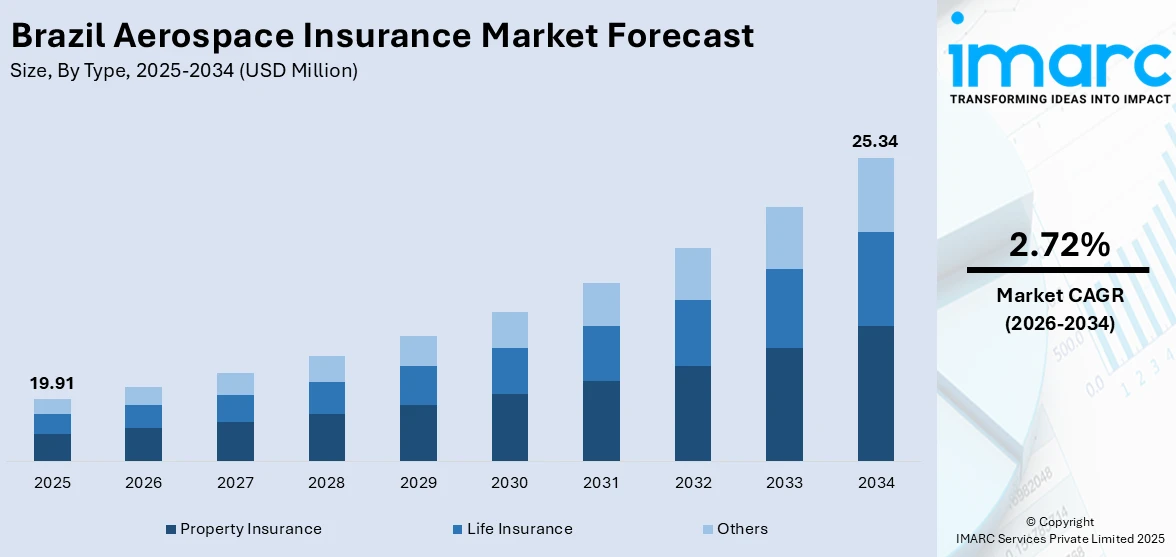
The Brazil aerospace insurance market size was valued at USD 19.91 Million in 2025 and is projected to reach USD 25.34 Million by 2034, growing at a compound annual growth rate of 2.72% from 2026-2034.
The Brazil aerospace insurance market is showing signs of rapid growth as the aerospace industry advances and diversifies in the Brazilian aviation landscape. Increased frequency and numbers of air passengers, investments in fleet, and growing importance attached to managing risks through extensive and holistic risk management practices are important factors bolstering the Brazilian aerospace insurance base. Development and modernization of aviation technology, advances in airport infrastructure through privatization, and the widening scope of insurable aerospace activities are also contributing to the Brazil aerospace insurance market share.
Key Takeaways and Insights:
- By Type: Property insurance dominates the market with a share of 56.2% in 2025, driven by increasing aviation asset valuations and growing need for comprehensive physical damage protection across fleet operations.
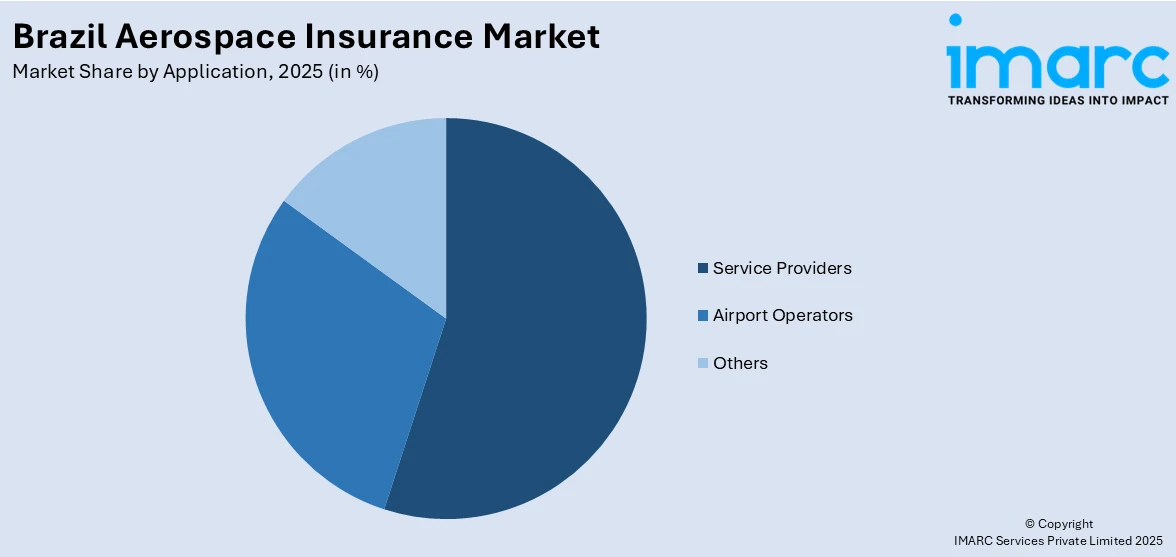
- By Application: Service providers lead the market with a share of 48.9% in 2025, owing to the expanding role of maintenance, repair, and ground handling enterprises requiring tailored liability and operational coverage.
- By Region: Southeast represents the market with a share of 51.7% in 2025, driven by the concentration of major airports, airline headquarters, and aviation manufacturing facilities in key metropolitan areas.
- Key Players: The Brazil aerospace insurance market shows moderate competition, with domestic insurers and global reinsurers competing across specialized aviation coverage segments, pricing strategies, and risk management services for airline infrastructure stakeholders.
To get more information on this market Request Sample
The Brazil aerospace insurance market is evolving in response to the country’s dynamic aviation landscape and expanding risk environment. As one of the largest aviation markets in Latin America, Brazil supports a vast network of commercial airlines, executive aviation operators, agricultural aircraft services, and a rapidly growing helicopter fleet. This diversity of aerospace operations creates a broad base of insurable risks spanning hull damage, passenger and third-party liability, war and terrorism coverage, and specialized product liability. The market benefits from a robust regulatory framework that mandates aviation insurance requirements and ensures policyholder protections. As per sources, the Brazilian Ministry of Ports and Airports launched the AmpliAR program to attract private investment into regional airport modernization, targeting infrastructure upgrades and expanded connectivity across smaller cities, which indirectly increases aviation risk exposure and insurance needs. Additionally, increasing airport privatization through concession programs and rising investment in advanced air mobility solutions are broadening the scope of aerospace insurance products, driving both premium growth and product innovation across the sector.
Brazil Aerospace Insurance Market Trends:
Rising Demand for Specialized Aviation Coverage
The increase in diversification of aerospace activities within Brazil is thus generating demand for specialized insurance plans. An increase has also been witnessed in aviation coverage, moving beyond traditional services for commercial aviation to include executive jets, agricultural planes, helicopter emergency services, and other high-end air activities. Such an increase in diversification is thus creating an impetus for creating customized insurance structures that respond to various classes of aviation activities, hence supporting growth within the Brazilian aerospace insurance industry.
Integration of Digital Underwriting Technologies
Aerospace insurers operating in Brazil are progressively adopting digital tools and data-driven underwriting methodologies. Advanced analytics platforms, real-time flight data monitoring, and predictive risk modeling are being leveraged to enhance pricing accuracy, improve claims management, and streamline policy administration. In September 2025, Brazilian insurtech 180 Seguros raised $9 million to expand AI-driven underwriting, pricing, and claims automation capabilities, supporting technology adoption relevant to aerospace insurers using data-led risk assessment and policy management in Brazil. This technological shift is enabling insurers to offer more responsive and precisely calibrated coverage to aviation stakeholders across the country.
Expanding Scope of Liability and Regulatory Coverage
Brazil’s evolving aviation regulatory environment is broadening the range of mandatory and voluntary insurance requirements across the sector. Stricter compliance standards for passenger protection, third-party liability, and environmental accountability are encouraging operators and service providers to enhance their coverage portfolios. In 2025, Brazil’s National Civil Aviation Agency (ANAC) initiated regulatory sandbox projects to develop vertiport standards and operational safety frameworks for urban air mobility, strengthening compliance obligations. This regulatory momentum is creating new opportunities for insurers to develop innovative products aligned with emerging compliance frameworks.
Market Outlook 2026-2034:
The Brazil aerospace insurance market is positioned for sustained expansion, supported by continued growth in air passenger traffic, ongoing airport infrastructure investments, and the broadening scope of insurable aerospace operations. Increasing fleet modernization efforts, rising interest in advanced air mobility solutions, and an evolving regulatory landscape are expected to create new demand channels for specialized coverage products. Strengthening reinsurance partnerships and digital underwriting innovations will further support premium growth across the forecast period. The market generated a revenue of USD 19.91 Million in 2025 and is projected to reach a revenue of USD 25.34 Million by 2034, growing at a compound annual growth rate of 2.72% from 2026-2034.
Brazil Aerospace Insurance Market Report Segmentation:
|
Segment Category |
Leading Segment |
Market Share |
|
Type |
Property Insurance |
56.2% |
|
Application |
Service Providers |
48.9% |
|
Region |
Southeast |
51.7% |
Type Insights:
- Life Insurance
- Property Insurance
- Others
Property insurance dominates with a market share of 56.2% of the total Brazil aerospace insurance market in 2025.
Property insurance plays a central role in Brazil’s aerospace insurance landscape by providing coverage for physical damage to aircraft, hangars, ground equipment, and other tangible aviation assets. As per sources, Brazil’s Guarulhos Airport received approval for infrastructure expansion and modernization under a revised concession framework, reinforcing the protection needs for high-value aviation facilities and assets. As fleet sizes expand and aircraft valuations continue to rise, operators and owners increasingly prioritize robust property insurance to mitigate financial exposure from incidents such as ground collisions, weather-related damage, and mechanical failures.
The surge in investment into airport modernization and airport privatization through concession strategies is also another factor that buttresses property insurance. Such strategies imply that there is an increase in demand for property insurance. To this end, as new airport terminals and facilities are built across the country, property insurance is also thriving. There is enough coverage from various actors within airport operation against physical and environmental hazards, given that this industry is marked by high asset value and operational complexities that necessitate continuous premium coverage.
Application Insights:
Access the comprehensive market breakdown Request Sample
- Service Providers
- Airport Operators
- Others
Service providers lead with a share of 48.9% of the total Brazil aerospace insurance market in 2025.
Service providers represent the largest application segment in Brazil’s aerospace insurance market, encompassing a wide range of entities including maintenance, repair, and overhaul organizations, ground handling companies, fueling operators, and aviation logistics firms. These entities face substantial liability and operational risks that necessitate comprehensive insurance coverage spanning third-party liability, professional indemnity, workers’ compensation, and equipment protection. In July 2024, Brazilian Embraer Services & Support expanded its global MRO network, simulators, and digital maintenance solutions, strengthening aircraft servicing capabilities and operational support for airlines and aviation service providers worldwide.
The growth in commercial aviation, along with the increased use of specialized services bought from outside sources, is driving demand for insurance by service providers. As airlines and airport operators continue to subcontract more third-party providers of major operational services, the chain of liability that results heighten demand for specially designed insurance products addressing specific risk exposures inherent in the delivery of aerospace services. This situation thus encourages insurance companies to design much more flexible and responsive coverage frameworks that better address the evolving needs of the service provider segment.
Regional Insights:
- Southeast
- South
- Northeast
- North
- Central-West
Southeast dominates with a market share of 51.7% of the total Brazil aerospace insurance market in 2025.
Southeast commands the largest share of Brazil’s aerospace insurance market, driven by the concentration of the country’s busiest airports, major airline headquarters, and leading aircraft manufacturing facilities. Key metropolitan areas in this region serve as primary aviation hubs, hosting the majority of domestic and international flight operations and attracting the highest volume of aerospace-related commercial activity. This density of aviation operations generates substantial demand for diverse insurance products covering hull, liability, and operational risks.
The region also benefits from a well-developed financial services infrastructure that supports sophisticated insurance and reinsurance transactions. The presence of major brokerage firms, reinsurance intermediaries, and regulatory bodies facilitates efficient risk transfer mechanisms and product innovation. This combination of operational density and financial sophistication reinforces the Southeast’s dominant position as the epicenter of Brazil’s aerospace insurance market, attracting both domestic and international insurers seeking exposure to the country’s largest aviation risk pool.
Market Dynamics:
Growth Drivers:
Why is the Brazil Aerospace Insurance Market Growing?
Expansion of Commercial Aviation and Fleet Modernization
Brazil's commercial aviation sector is witnessing sustained momentum as domestic and international passenger demand continues to rise. Airlines are actively modernizing their fleets by acquiring newer, fuel-efficient aircraft to replace aging models, thereby increasing the overall insurable value of aviation assets. According to reports, In February 2026, LATAM Airlines announced plans to deploy Embraer E195-E2 jets from three Brazilian airports starting in Q4 2026 and place an order for 24 of the small jets in September, reflecting fleet modernization and heightened insurance requirements. This ongoing fleet renewal cycle is generating heightened demand for hull insurance, liability protection, and component coverage.
Airport Infrastructure Investments and Privatization
Brazil's continued program of airport concessions and infrastructure upgrades is serving as a significant catalyst for aerospace insurance demand. As private operators assume management of major and regional airports, they introduce enhanced safety protocols, modernized terminal facilities, and expanded ground handling operations that require comprehensive insurance protection. According to reports, Fraport Brasil secured the concession to operate and modernize Jericoacoara Airport under the AmpliAR program, expanding regional infrastructure and increasing operational and insurance coverage requirements. The concession model mandates new risk management standards, including coverage for construction activities, operational liabilities, and asset safeguarding.
Strengthening Regulatory Framework and Compliance Requirements
Brazil's regulatory landscape for aviation insurance is becoming progressively more structured and comprehensive under the supervision of federal insurance and civil aviation authorities. Recent legislative reforms are modernizing the legal framework governing insurance contracts, enhancing transparency, and strengthening policyholder safeguards. As per sources, Brazil’s ANAC proposed new risk-based drone regulations introducing SORA, requiring operational risk assessments, liability insurance, and pilot certification to enhance UAV safety and regulatory compliance. Further, these developments are elevating compliance standards across the aviation sector, requiring operators, manufacturers, and service providers to maintain adequate coverage levels.
Market Restraints:
What Challenges the Brazil Aerospace Insurance Market is Facing?
High Premium Costs and Limited Domestic Underwriting Capacity
The specialized nature of aerospace insurance and the high capital exposure associated with aviation risks result in elevated premium levels that can strain smaller operators and service providers. Limited domestic underwriting capacity for large and complex aerospace risks necessitates significant reliance on international reinsurance markets, which can introduce pricing volatility and restrict policy flexibility.
Economic Volatility and Currency Fluctuations
Macroeconomic instability and exchange rate fluctuations present ongoing challenges for the aerospace insurance market. Since many reinsurance transactions and aircraft valuations are denominated in foreign currencies, currency depreciation can significantly increase the cost of coverage for domestic operators. Economic downturns may also reduce aviation activity, compress premium volumes and constraining overall market growth prospects.
Emerging Risk Complexity and Underwriting Uncertainty
The rapid introduction of new aviation technologies, including electric vertical takeoff and landing aircraft, commercial drones, and autonomous systems, presents underwriting challenges due to limited historical loss data and evolving risk profiles. Insurers face difficulty in accurately pricing coverage for these emerging categories, which can slow product development and create coverage gaps.
Competitive Landscape:
The Brazil aerospace insurance market features a competitive environment shaped by a combination of domestic insurers, international underwriting agencies, and global reinsurance providers. Market participants are differentiating themselves through specialized aviation underwriting expertise, advanced risk assessment capabilities, and the development of tailored policy structures for diverse aerospace operations. Competition is further intensified by the entry of managing general agents offering innovative coverage solutions backed by international capacity providers. Strategic partnerships between local insurers and global reinsurers enable broader risk distribution and product diversification, while digital transformation initiatives are enhancing underwriting efficiency, claims management, and customer engagement.
Recent Developments:
-
In July 2025, MAPFRE partnered with Ebix Latin America to launch MAPFRE AIR, a digital platform modernizing aviation insurance in Brazil. The initiative streamlines quotation, risk assessment, and policy issuance, enhancing access and efficiency for aviation operators while supporting growth in the country’s aerospace insurance sector.
Brazil Aerospace Insurance Market Report Coverage:
|
Report Features |
Details |
|
Base Year of the Analysis |
2025 |
|
Historical Period |
2020-2025 |
|
Forecast Period |
2026-2034 |
|
Units |
Million USD |
|
Scope of the Report |
Exploration of Historical Trends and Market Outlook, Industry Catalysts and Challenges, Segment-Wise Historical and Future Market Assessment:
|
|
Types Covered |
Life Insurance, Property Insurance, Others |
|
Applications Covered |
Service Providers, Airport Operators, Others |
|
Regions Covered |
Southeast, South, Northeast, North, Central-West |
|
Customization Scope |
10% Free Customization |
|
Post-Sale Analyst Support |
10-12 Weeks |
|
Delivery Format |
PDF and Excel through Email (We can also provide the editable version of the report in PPT/Word format on special request) |
Frequently Asked Questions About the Brazil Aerospace Insurance Market Report
The Brazil aerospace insurance market size was valued at USD 19.91 Million in 2025.
The Brazil aerospace insurance market is expected to grow at a compound annual growth rate of 2.72% from 2026-2034 to reach USD 25.34 Million by 2034.
Property insurance held the largest share in the Brazil aerospace insurance market, driven by the rising value of aviation assets, growing fleet investments, and the increasing need for comprehensive physical damage and asset protection coverage across diverse aerospace operations.
Key factors driving the Brazil aerospace insurance market include expanding commercial aviation operations, airport infrastructure privatization and modernization, strengthening regulatory frameworks, rising fleet valuations, and increasing demand for specialized coverage for emerging aviation technologies.
Major challenges include high premium costs due to limited domestic underwriting capacity, economic volatility and currency fluctuation impacts on reinsurance pricing, emerging risk complexity from new aviation technologies, and constrained historical loss data for evolving aerospace segments.
Need more help?
- Speak to our experienced analysts for insights on the current market scenarios.
- Include additional segments and countries to customize the report as per your requirement.
- Gain an unparalleled competitive advantage in your domain by understanding how to utilize the report and positively impacting your operations and revenue.
- For further assistance, please connect with our analysts.
 Request Customization
 Speak to an Analyst
 Request Brochure
 Inquire Before Buying
Benefits of Customization
- Personalize this research
- Triangulate with your data
- Get data as per your format and definition
- Gain a deeper dive into a specific application, geography, customer, or competitor
- Any level of personalization
Get in Touch With Us
UNITED STATES
Phone: +1-201-971-6302
INDIA
Phone: +91-120-433-0800
UNITED KINGDOM
Phone: +44-753-714-6104
Email: [email protected]
Client Testimonials




.webp)




.webp)













Related Reports

Choose your plan
*Please note that the prices mentioned below are starting prices for each bundle type. Kindly contact our team for further details.*
Single User License
- 1 User License, Access on 2 Devices
- PDF Report + Excel Dataset (Password Protected)
- Lifetime Access
- No Printing Rights
- 10% Free Report Customization
- 10–12 Weeks of Analyst Support
Five User License
- Access for 5 Users, 2 Devices per User
- PDF Report + Excel Dataset (Password Protected)
- Lifetime Access
- Dedicated Account Manager
- 12–14 Weeks of Analyst Support
- No Printing Rights
- 15% Free Report Customization
- 25% Discount on Your Next Purchase
Corporate User License
- Unlimited User Access (Within Your Organization)
- PDF Report + Excel Dataset
- Lifetime Access
- Dedicated Account Manager
- 14–20 Weeks of Analyst Support
- No Printing Rights
- 20% Free Report Customization
- 30% Discount on Your Next Purchase
Essential Insights
What's included:
3 reports
- Lifetime Access
- PDF Reports
- Excel Datasets
- 2 Weeks of Free Analyst Support
- 2 User Licenses
- Access on 2 Devices
- Printing Rights
- Complimentary PowerPoint (PPT) Version
- Complimentary License Upgrade
Professional Access
What's included:
5 reports
- Lifetime Access
- PDF Reports
- Excel Datasets
- 8 Weeks of Free Analyst Support
- 2 User Licenses
- Access on 2 Devices
- Printing Rights
- Complimentary PowerPoint (PPT) Version
- Complimentary License Upgrade
Business Advantage
What's included:
8 reports
- Lifetime Access
- PDF Reports
- Excel Datasets
- 14 Weeks of Free Analyst Support
- 2 User Licenses
- Access on 2 Devices
- Printing Rights
- Complimentary PowerPoint (PPT) Version
- Complimentary License Upgrade
Enterprise Intelligence
What's included:
10 reports
- Lifetime Access
- PDF Reports
- Excel Datasets
- 20 Weeks of Free Analyst Support
- 2 User Licenses
- Access on 2 Devices
- Printing Rights
- Complimentary PowerPoint (PPT) Version
- Complimentary License Upgrade