
Brazil Aerostat Systems Market Size, Share, Trends and Forecast by Payload, Sub-System, Product Type, Propulsion System, Class, and Region, 2026-2034
Brazil Aerostat Systems Market Summary:
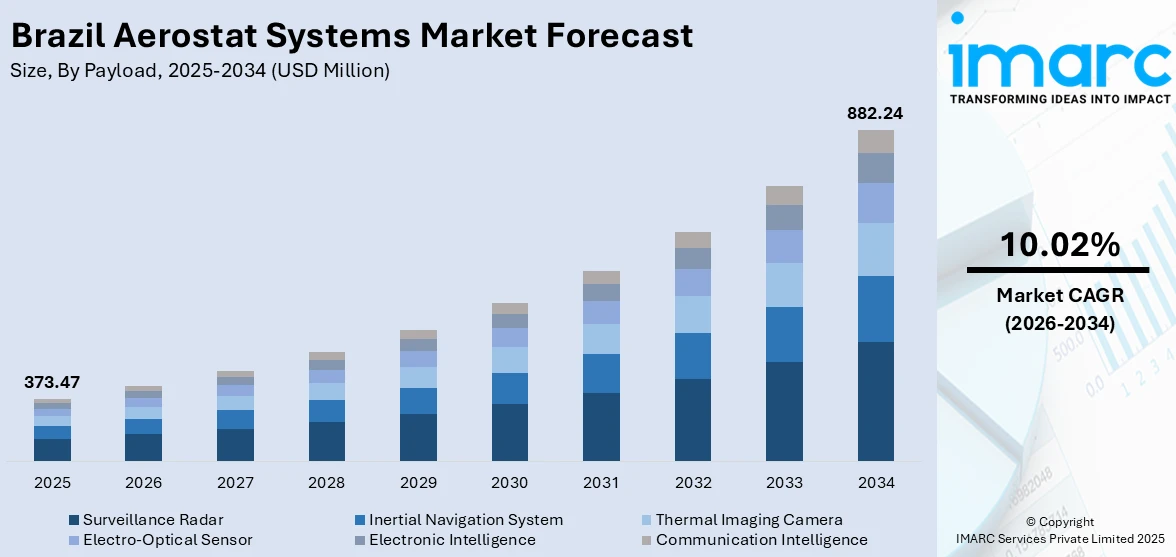
The Brazil aerostat systems market size was valued at USD 373.47 Million in 2025 and is projected to reach USD 882.24 Million by 2034, growing at a compound annual growth rate of 10.02% from 2026-2034.
The Brazil aerostat systems market is in a high-trend era due to the defense sector modernization demands and the need for intensified surveillance operations in the country. The ongoing demands for improving security over expansive territorial borders, particularly in Brazil, have created a need for cost-effective methodologies for improving surveillance operations. The trend in advancing sensor technologies, improving intelligence and reconnaissance solutions, and using lighter-than-air solutions for military as well as civilian operations is fueling a positive impact on improving the Brazil aerostat systems market, contributing to the Brazil aerostat systems market share in the region.
Key Takeaways and Insights:
- By Payload: Surveillance radar dominates the market with a share of 34.8% in 2025, driven by its critical role in providing wide-area persistent monitoring and real-time threat detection across border zones and territorial boundaries.
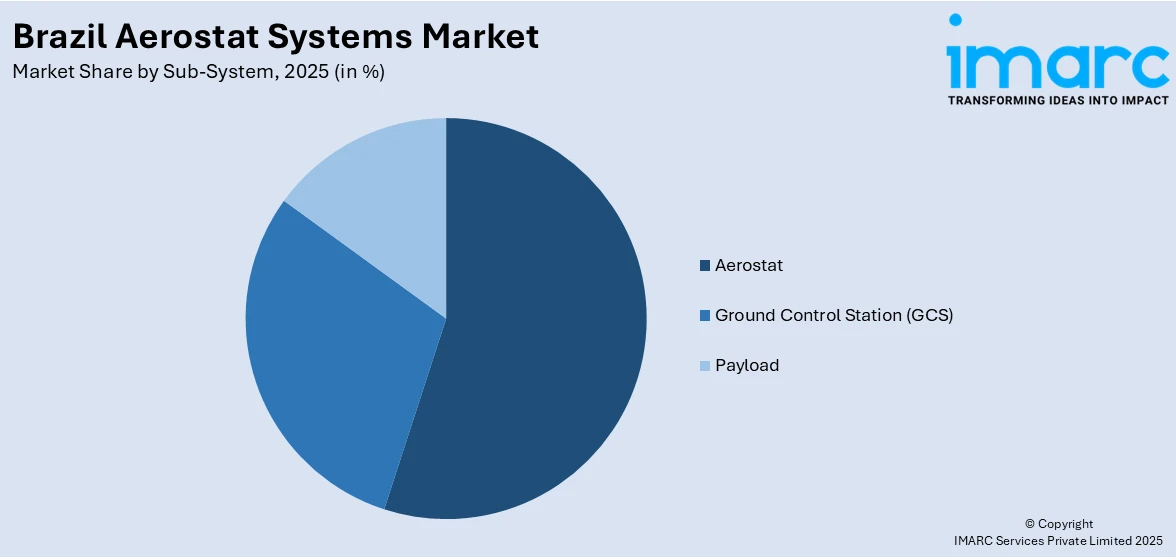
- By Sub-System: Aerostat leads the market with a share of 41.6% in 2025, reflecting its foundational importance as the primary platform enabling extended-duration aerial surveillance and sensor deployment for defense operations.
- By Product Type: Balloon holds the largest share of 46.9% in 2025, owing to its cost-effectiveness, rapid deployment capability, and proven endurance for long-duration monitoring missions requiring minimal maintenance.
- By Propulsion System: Powered aerostats dominate the market with a share of 63.5% in 2025, driven by their superior maneuverability, enhanced station-keeping ability, and capacity to carry heavier multi-sensor payloads.
- By Class: Mid-sized aerostats hold the largest market share of 39.2% in 2025, attributed to their versatile operational profile balancing payload capacity with deployment flexibility for diverse surveillance missions.
- By Region: Southeast leads the market with a share of 47.8% in 2025, driven by concentrated defense infrastructure, major military installations, and high population density requiring persistent surveillance solutions.
- Key Players: The Brazil aerostat systems market features a competitive landscape characterized by established defense contractors and specialized lighter-than-air platform manufacturers competing through technological innovation, government procurement partnerships, and localized production capabilities.
To get more information on this market Request Sample
The market for aerostat systems in Brazil is expanding as the government places a high priority on aerial surveillance capabilities to handle border security issues along its vast land borders with several bordering nations. In January 2026, Brazilian defense manufacturer Avibras announced progress in its restructuring and ongoing discussions with the federal government to resume operations and reinforce its strategic role in national defense, underscoring industry emphasis on sovereign surveillance technologies. Permanent airborne monitoring solutions are becoming more and more in demand as a result of the nation's defense modernization policy, which involves extensive programs to integrate sensors, radars, and communication platforms along boundary zones. The capacity of aerostat systems to offer continuous, wide-area coverage at a fraction of the price of manned aircraft or satellite-based alternatives is becoming more and more acknowledged. The increased emphasis on environmental monitoring, especially in Amazonian lands, expands the platforms' potential uses beyond conventional defensive functions and aids in intelligence collection and disaster relief efforts nationwide.
Brazil Aerostat Systems Market Trends:
Integration of Multi-Sensor Payloads for Enhanced Situational Awareness
The country is reportedly seeing more promising trends in terms of integrating variable sets of sensors within its aerostat system, thus unifying radar, electro-optic, camera technologies, as well as communication relays within a single airborne asset. According to reports, the LAAD Defence & Security show in São Paulo, Brazilian company Aeromot S/A signed a cooperation agreement with FBR Aviation and Germany’s HENSOLDT to develop and integrate advanced airborne sensor suites, including electro‑optical sensors, radar, and datalink systems, for surveillance platforms targeting Latin American security missions. The results permit users to attain complete situational understanding over vast and maximally diverse geographic territories for military as well as civilian purposes, thus contributing to a more expansive Brazil aerostat system market.
Growing Adoption of Aerostats for Environmental and Border Surveillance
The adoption of aerostat systems is expanding beyond traditional defense applications to encompass environmental monitoring and territorial border protection. Brazilian company Altave, a domestic developer of tethered aerostat platforms, emphasized the use of its balloons not only for security but also for environmental monitoring missions such as deforestation tracking and fire detection, illustrating how these systems are being positioned for broader civil use cases in Brazil. Persistent aerial platforms are being deployed to support deforestation tracking, wildlife conservation, and illegal activity detection across remote forested regions and extensive frontier zones, reflecting a broadening operational mandate for lighter-than-air surveillance solutions in the country.
Shift Toward Autonomous and Remotely Operated Aerostat Platforms
There is a growing trend toward autonomous and remotely managed aerostat systems that minimize crew requirements and extend operational endurance. For example, in April 2025 Israeli aerostat specialist RT LTA Systems Ltd showcased its mobile SkyStar and SkyGuard aerostat platforms designed for rapid deployment and real‑time surveillance at the Border Security Expo in Phoenix, highlighting industry momentum toward flexible, remotely operable surveillance systems that reduce the need for large ground crews and improve operational responsiveness. Advances in ground control station technologies and automated flight management are enabling longer mission durations with reduced human intervention, improving operational efficiency and lowering lifecycle costs for defense agencies deploying persistent surveillance across challenging terrain and weather conditions.
Market Outlook 2026-2034:
Brazil's aerostat systems market is positioned for sustained expansion, supported by accelerating defense modernization initiatives that prioritize advanced aerial surveillance infrastructure across military branches. Growing investments in border security programs aimed at monitoring extensive land frontiers are creating consistent demand for persistent airborne platforms. Rising requirements for intelligence, surveillance, and reconnaissance capabilities across diverse operational environments, including remote forested territories, coastal zones, and urban corridors, are further strengthening adoption. The integration of multi-sensor payloads, autonomous ground control technologies, and improved platform endurance is enhancing operational effectiveness, while increasing emphasis on indigenous production capabilities and technology transfer partnerships is fostering domestic manufacturing growth and reducing reliance on imported surveillance solutions. The market generated a revenue of USD 373.47 Million in 2025 and is projected to reach a revenue of USD 882.24 Million by 2034, growing at a compound annual growth rate of 10.02% from 2026-2034.
Brazil Aerostat Systems Market Report Segmentation:
|
Segment Category |
Leading Segment |
Market Share |
|
Payload |
Surveillance Radar |
34.8% |
|
Sub-System |
Aerostat |
41.6% |
|
Product Type |
Balloon |
46.9% |
|
Propulsion System |
Powered Aerostats |
63.5% |
|
Class |
Mid-Sized Aerostats |
39.2% |
|
Region |
Southeast |
47.8% |
Payload Insights:
- Surveillance Radar
- Inertial Navigation System
- Thermal Imaging Camera
- Electro-Optical Sensor
- Electronic Intelligence
- Communication Intelligence
The surveillance radar dominates with a market share of 34.8% of the total Brazil aerostat systems market in 2025.
Surveillance radar remains the most critical payload for aerostat systems deployed across Brazil, enabling wide-area detection and continuous monitoring of airspace and ground-level movements. In June 2024, Brazil’s Department of Airspace Control (DECEA) signed a contract with Thales for the acquisition of Ground Master 200 Multi‑Mission All‑in‑One (GM200 MM/A) tactical air surveillance radars to enhance the Brazilian Air Force’s airspace monitoring and defense capabilities. Defense agencies rely on radar-equipped aerostats to provide persistent coverage across border zones and remote territories where ground-based infrastructure is limited. The ability to detect low-altitude incursions and track movement patterns in real time makes surveillance radar an indispensable component of the country's layered security architecture.
The growing emphasis on integrating radar capabilities with other sensor technologies is further strengthening the surveillance radar payload segment. Aerostat-mounted radar platforms offer extended detection ranges and all-weather operational performance, supporting intelligence-gathering missions across geographically diverse and climatically challenging environments. As border surveillance and territorial monitoring programs continue to scale, the demand for advanced radar payloads on lighter-than-air platforms is expected to remain robust throughout the forecast period.
Sub-System Insights:
Access the comprehensive market breakdown Request Sample
- Aerostat
- Ground Control Station (GCS)
- Payload
The aerostat leads with a share of 41.6% of the total Brazil aerostat systems market in 2025.
The aerostat sub-system represents the foundational platform that enables persistent airborne surveillance, serving as the primary structure for lifting sensor packages and communication equipment to operational altitudes. As the core component of any lighter-than-air deployment, the aerostat envelope and its tethering infrastructure determine mission endurance, payload capacity, and operational reliability. Growing investments in advanced fabric materials and helium management technologies are enhancing platform performance and reducing lifecycle costs.
Brazil's defense agencies are increasingly prioritizing the procurement of robust and durable aerostat platforms capable of sustaining extended missions in tropical and equatorial environments. The demand for aerostats that can withstand high humidity, strong winds, and variable atmospheric conditions is driving innovation in envelope design and tether engineering. These advancements are expanding the operational viability of aerostat sub-systems for both fixed-site and mobile surveillance deployments across the country's vast territory.
Product Type Insights:
- Balloon
- Airship
- Hybrid
The balloon dominates with a market share of 46.9% of the total Brazil aerostat systems market in 2025.
Balloon-type aerostats hold the largest share in the product type segment, driven by their cost-effectiveness, straightforward deployment procedures, and ability to sustain prolonged missions with minimal fuel consumption. These platforms are widely used for border surveillance and territorial monitoring, offering endurance levels that can extend up to several weeks without requiring ground crew intervention. Their lower operational complexity makes them particularly suitable for deployment in remote and infrastructure-limited environments across the country.
The continued dominance of balloon-type aerostats is also supported by their proven reliability in diverse climate conditions and their ability to accommodate a range of sensor payloads. Defense agencies prefer balloon platforms for fixed-site monitoring missions where persistent presence is prioritized over mobility. As procurement programs expand and surveillance requirements intensify along frontier zones, the balloon segment is expected to maintain its leading position within the broader product type category throughout the forecast horizon.
Propulsion System Insights:
- Powered Aerostats
- Unpowered Aerostats
The powered aerostats leads with a share of 63.5% of the total Brazil aerostat systems market in 2025.
Powered aerostats are gaining strong traction in Brazil due to their enhanced station-keeping capabilities and ability to carry heavier, more sophisticated sensor payloads compared to their unpowered counterparts. The propulsion systems enable controlled positioning and limited maneuvering, which is essential for missions requiring precise coverage over specific areas of interest. This operational flexibility makes powered aerostats ideal for defense agencies managing surveillance across expansive and geographically complex territories.
The preference for powered aerostat platforms is further reinforced by their superior performance in adverse weather conditions, where wind resistance and positional stability are critical for maintaining continuous surveillance coverage. These systems offer enhanced versatility for multi-mission deployments, supporting radar surveillance, communication relay, and intelligence gathering simultaneously. The growing emphasis on multi-role airborne platforms across military and security operations is expected to sustain strong demand for powered aerostats in Brazil.
Class Insights:
- Compact-Sized Aerostats
- Mid-Sized Aerostats
- Large-Sized Aerostats
The mid-sized aerostats dominates with a market share of 39.2% of the total Brazil aerostat systems market in 2025.
Mid-sized aerostats are the most widely deployed class in Brazil, offering a balanced combination of payload capacity, operational endurance, and deployment flexibility. These platforms provide sufficient lift to accommodate advanced surveillance sensors while remaining manageable for transport and rapid deployment in diverse operational settings. Their versatility makes them suitable for both fixed-site installations along border zones and mobile tactical deployments supporting field operations.
The mid-sized aerostat segment benefits from growing demand for platforms that bridge the gap between compact tactical systems and large strategic aerostats. Defense planners increasingly favor mid-sized configurations that can deliver reliable performance across varying mission profiles without the logistical complexity associated with larger platforms. As surveillance programs scale and operational requirements diversify, mid-sized aerostats are expected to remain the preferred class for most border security and intelligence gathering deployments across the country.
Regional Insights:
- Southeast
- South
- Northeast
- North
- Central-West
Southeast exhibits a clear dominance with a 47.8% share of the total Brazil aerostat systems market in 2025.
The Southeast region dominates the Brazil aerostat systems market, driven by the concentration of major military command centers, defense research institutions, and critical infrastructure requiring persistent aerial monitoring. The region's dense population centers and strategic economic assets create heightened demand for advanced surveillance solutions. Military installations across the Southeast serve as primary deployment hubs for aerostat-based reconnaissance and communication platforms, reinforcing the region's leading position.
Additionally, the Southeast region benefits from proximity to key defense procurement agencies and industrial clusters involved in aerostat manufacturing and integration. The presence of advanced logistics networks and established supply chains supports faster deployment cycles and more efficient maintenance operations. As national defense modernization priorities continue to channel significant investment into surveillance infrastructure, the Southeast is expected to maintain its dominant share of the Brazil aerostat systems market.
Market Dynamics:
Growth Drivers:
Why is the Brazil Aerostat Systems Market Growing?
Expanding Border Security and Territorial Surveillance Programs
Brazil's extensive land border, stretching across numerous neighboring countries, demands persistent and wide-area surveillance capabilities that aerostat systems are uniquely positioned to deliver. The government has prioritized strengthening monitoring along frontier zones to counter illicit activities including drug trafficking, arms smuggling, and unauthorized border crossings. A core element of this effort is the Brazilian Army’s Sistema Integrado de Monitoramento de Fronteiras (SISFRON), the Integrated Border Surveillance System, which is one of the largest land border monitoring programs in the world, designed to integrate radars, sensors, secure communications, and command‑and‑control to detect and respond to cross‑border threats in real time across Brazil’s approximately 16,886 km of borders. National defense strategies have identified integrated border surveillance as a core strategic objective, driving sustained procurement of advanced airborne monitoring platforms. The need to cover remote, densely forested, and geographically challenging terrain further amplifies the reliance on cost-effective lighter-than-air platforms that can maintain continuous operational presence without the logistical burden of manned aircraft rotations, making aerostats an essential element of the country's border protection architecture.
Increasing Defense Modernization and Military Investment
Brazil's armed forces are undergoing comprehensive modernization to enhance command, control, communication, and intelligence capabilities across all service branches. According to defense budget documents submitted to Brazil’s National Congress, the federal government plans a 6 % increase in defence spending for 2026, including allocations for advanced surveillance systems, cyber defence, air defence, and the Army’s SISFRON (Integrated Border Monitoring System), signalling strong support for next‑generation sensor and monitoring networks. Defense spending continues to rise as the government allocates resources toward next-generation surveillance technologies and integrated sensor networks. Aerostat systems are being incorporated into broader military modernization frameworks as persistent intelligence, surveillance, and reconnaissance platforms that complement ground-based radars, satellite systems, and unmanned aerial vehicles. The emphasis on developing indigenous defense industrial capabilities and reducing dependency on foreign-manufactured surveillance platforms is encouraging investments in localized production, technology transfer partnerships, and advanced research programs that directly benefit the domestic aerostat systems market.
Rising Demand for Cost-Effective Persistent Surveillance Solutions
The operational cost advantages of aerostat systems compared to traditional manned aircraft, satellites, and drone fleets are driving broader adoption across defense and security agencies in Brazil. Aerostats provide extended mission endurance and continuous wide-area coverage at significantly lower hourly operating costs, making them particularly attractive for budget-conscious procurement programs. A real‑world example of sustained investment in cost‑effective, persistent ISR platforms is the U.S. Army’s award of a 10‑year, up to $4 billion aerostat contract, under the Product Director Aerostats program, to support integration, operations, and lifecycle support for tethered surveillance systems that deliver round‑the‑clock situational awareness. The ability to maintain airborne platforms for weeks without refueling or crew rotation represents a compelling value proposition for agencies tasked with monitoring vast territorial expanses. This cost-efficiency factor, combined with improvements in payload integration and sensor miniaturization, enables aerostat systems to deliver high-quality intelligence outputs while remaining within fiscal constraints imposed by competing defense budget priorities.
Market Restraints:
What Challenges the Brazil Aerostat Systems Market is Facing?
Operational Vulnerability to Adverse Weather Conditions
Aerostat systems are inherently sensitive to severe weather events including high winds, heavy rainfall, and tropical storms that are prevalent across many regions of Brazil. Adverse atmospheric conditions can force temporary grounding of platforms, interrupt ongoing surveillance missions, and potentially cause structural damage to envelopes and tethering infrastructure. This weather dependency limits the operational reliability of aerostat deployments in certain geographic zones and seasonal periods.
High Initial Procurement and Infrastructure Costs
Despite offering lower ongoing operational expenses compared to manned aircraft, aerostat systems require substantial upfront investment for procurement, ground control station installation, helium supply logistics, and supporting infrastructure development. For defense agencies operating under constrained budgets, the initial capital expenditure can present a significant barrier to large-scale deployment, particularly when competing against other modernization priorities within comprehensive defense spending plans.
Competition from Alternative Surveillance Technologies
The aerostat systems market faces increasing competition from rapidly advancing unmanned aerial vehicles, satellite-based monitoring platforms, and ground-based radar networks. These alternative technologies offer distinct advantages in mobility, altitude capability, and deployment flexibility that may reduce reliance on tethered aerostat platforms for certain mission profiles. The continuous evolution of drone capabilities and satellite imaging resolution poses ongoing competitive pressure on lighter-than-air surveillance solutions.
Competitive Landscape:
The Brazil aerostat systems market features a moderately concentrated competitive landscape where established international defense contractors and specialized lighter-than-air technology firms compete for government procurement contracts and defense modernization programs. Competition is primarily driven by technological differentiation in payload capacity, sensor integration capabilities, operational endurance, and mission adaptability. Market players are increasingly focusing on developing platforms optimized for tropical environmental conditions while enhancing autonomous operation features and multi-sensor payload configurations. Strategic partnerships between international manufacturers and domestic defense companies are gaining prominence as procurement policies emphasize local content requirements and technology transfer. Companies are also expanding their service offerings to include comprehensive lifecycle support, training, and maintenance programs that strengthen long-term relationships with defense agencies and create recurring revenue streams across extended contract periods.
Brazil Aerostat Systems Market Report Coverage:
|
Report Features |
Details |
|
Base Year of the Analysis |
2025 |
|
Historical Period |
2020-2025 |
|
Forecast Period |
2026-2034 |
|
Units |
Million USD |
|
Scope of the Report |
Exploration of Historical Trends and Market Outlook, Industry Catalysts and Challenges, Segment-Wise Historical and Future Market Assessment:
|
|
Payloads Covered |
Surveillance Radar, Inertial Navigation System, Thermal Imaging Camera, Electro-Optical Sensor, Electronic Intelligence, Communication Intelligence |
|
Sub-Systems Covered |
Aerostat, Ground Control Station (GCS), Payload |
|
Product Types Covered |
Balloon, Airship, Hybrid |
|
Propulsion Systems Covered |
Powered Aerostats, Unpowered Aerostats |
|
Classes Covered |
Compact-Sized Aerostats, Mid-Sized Aerostats, Large-Sized Aerostats |
|
Regions Covered |
Southeast, South, Northeast, North, Central-West |
|
Customization Scope |
10% Free Customization |
|
Post-Sale Analyst Support |
10-12 Weeks |
|
Delivery Format |
PDF and Excel through Email (We can also provide the editable version of the report in PPT/Word format on special request) |
Frequently Asked Questions About the Brazil Aerostat Systems Market Report
The Brazil aerostat systems market size was valued at USD 373.47 Million in 2025.
The Brazil aerostat systems market is expected to grow at a compound annual growth rate of 10.02% from 2026-2034 to reach USD 882.24 Million by 2034.
Surveillance radar, holding the largest revenue share of 34.8%, remains pivotal for Brazil's aerostat systems deployment, providing wide-area persistent monitoring, real-time threat detection, and all-weather operational capability across border zones and territorial surveillance missions.
Key factors driving the Brazil aerostat systems market include expanding border security programs, rising defense modernization investments, growing demand for cost-effective persistent surveillance, advancements in sensor integration technologies, and increasing emphasis on indigenous defense production capabilities.
Major challenges include operational vulnerability to adverse weather conditions, high initial procurement and infrastructure costs, competition from alternative surveillance technologies, helium supply logistics, and airspace regulatory constraints affecting tethered platform deployments.
Need more help?
- Speak to our experienced analysts for insights on the current market scenarios.
- Include additional segments and countries to customize the report as per your requirement.
- Gain an unparalleled competitive advantage in your domain by understanding how to utilize the report and positively impacting your operations and revenue.
- For further assistance, please connect with our analysts.
 Request Customization
 Speak to an Analyst
 Request Brochure
 Inquire Before Buying
Benefits of Customization
- Personalize this research
- Triangulate with your data
- Get data as per your format and definition
- Gain a deeper dive into a specific application, geography, customer, or competitor
- Any level of personalization
Get in Touch With Us
UNITED STATES
Phone: +1-201-971-6302
INDIA
Phone: +91-120-433-0800
UNITED KINGDOM
Phone: +44-753-714-6104
Email: [email protected]
Client Testimonials




.webp)




.webp)













Related Reports

Choose your plan
*Please note that the prices mentioned below are starting prices for each bundle type. Kindly contact our team for further details.*
Single User License
- 1 User License, Access on 2 Devices
- PDF Report + Excel Dataset (Password Protected)
- Lifetime Access
- No Printing Rights
- 10% Free Report Customization
- 10–12 Weeks of Analyst Support
Five User License
- Access for 5 Users, 2 Devices per User
- PDF Report + Excel Dataset (Password Protected)
- Lifetime Access
- Dedicated Account Manager
- 12–14 Weeks of Analyst Support
- No Printing Rights
- 15% Free Report Customization
- 25% Discount on Your Next Purchase
Corporate User License
- Unlimited User Access (Within Your Organization)
- PDF Report + Excel Dataset
- Lifetime Access
- Dedicated Account Manager
- 14–20 Weeks of Analyst Support
- No Printing Rights
- 20% Free Report Customization
- 30% Discount on Your Next Purchase
Essential Insights
What's included:
3 reports
- Lifetime Access
- PDF Reports
- Excel Datasets
- 2 Weeks of Free Analyst Support
- 2 User Licenses
- Access on 2 Devices
- Printing Rights
- Complimentary PowerPoint (PPT) Version
- Complimentary License Upgrade
Professional Access
What's included:
5 reports
- Lifetime Access
- PDF Reports
- Excel Datasets
- 8 Weeks of Free Analyst Support
- 2 User Licenses
- Access on 2 Devices
- Printing Rights
- Complimentary PowerPoint (PPT) Version
- Complimentary License Upgrade
Business Advantage
What's included:
8 reports
- Lifetime Access
- PDF Reports
- Excel Datasets
- 14 Weeks of Free Analyst Support
- 2 User Licenses
- Access on 2 Devices
- Printing Rights
- Complimentary PowerPoint (PPT) Version
- Complimentary License Upgrade
Enterprise Intelligence
What's included:
10 reports
- Lifetime Access
- PDF Reports
- Excel Datasets
- 20 Weeks of Free Analyst Support
- 2 User Licenses
- Access on 2 Devices
- Printing Rights
- Complimentary PowerPoint (PPT) Version
- Complimentary License Upgrade