
Brazil Agricultural Adjuvant Market Size, Share, Trends and Forecast by Type, Crop Type, Application, and Region, 2026-2034
Brazil Agricultural Adjuvant Market Summary:
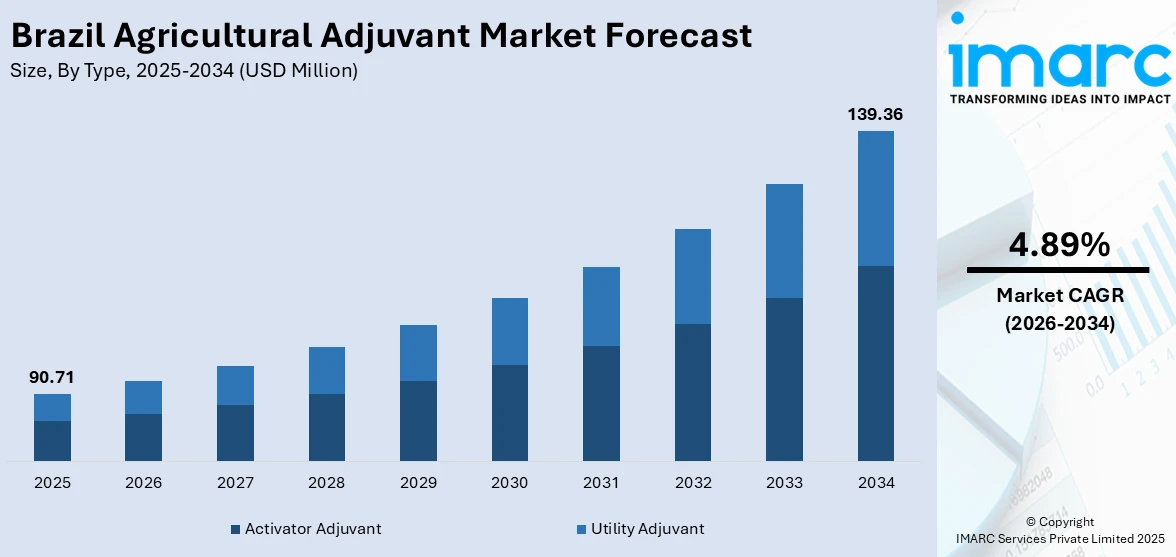
The Brazil agricultural adjuvant market size was valued at USD 90.71 Million in 2025 and is projected to reach USD 139.36 Million by 2034, growing at a compound annual growth rate of 4.89% from 2026-2034.
The Brazil agricultural adjuvant market is experiencing sustained growth driven by the expansion of cultivated acreage, increasing adoption of modern agrochemical formulations, and the rising need for improved spray efficiency across diverse cropping systems. Precision agriculture technologies are enhancing the role of adjuvants in optimizing pesticide delivery and minimizing environmental impact. Government-supported agricultural credit programs, growing awareness of herbicide-resistant weed management, and the integration of biological crop protection solutions are further accelerating demand, positioning Brazil as a leading hub for adjuvant innovation and adoption in the Latin American agricultural adjuvant market share.
Key Takeaways and Insights:
- By Type: Activator adjuvant dominates the market with a share of 57.1% in 2025, driven by its superior ability to enhance pesticide absorption and droplet spread on plant surfaces.
- By Crop Type: Cereals & oilseeds lead the market with a share of 52.6% in 2025, driven by Brazil’s widespread cultivation of soybeans and corn, which necessitates intensive use of agrochemical applications.
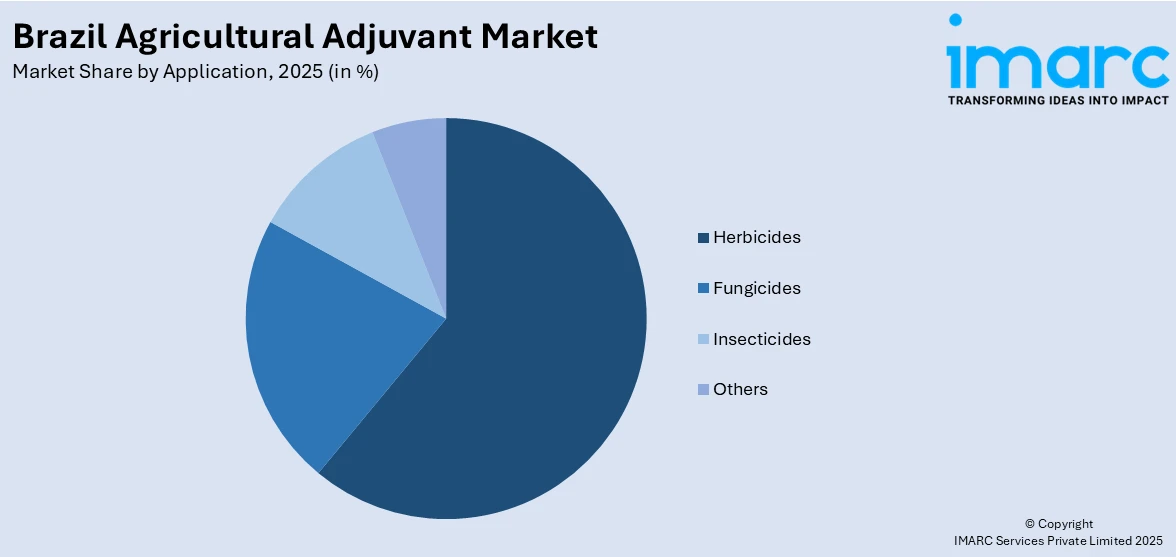
- By Application: Herbicides represent the largest segment with a market share of 61.4% in 2025, reflecting the critical need for weed management across Brazil's vast row-crop farmlands.
- By Region: Southeast dominated the market with 43.9% revenue share in 2025, supported by the concentration of agricultural research institutions and advanced farming operations.
- Key Players: The Brazil agricultural adjuvant market features moderate competitive intensity, with multinational agrochemical corporations competing alongside regional specialty manufacturers across diverse product categories. Companies focus on innovation in surfactant technologies, drift-reduction formulations, and bio-based adjuvant solutions to strengthen their market positioning.
To get more information on this market Request Sample
The Brazil agricultural adjuvant market is advancing rapidly, fueled by the country's position as one of the world's largest agricultural producers and consumers of crop protection chemicals. Brazil's vast cultivated acreage, spanning soybean, corn, cotton, sugarcane, and coffee, demands efficient agrochemical application to maximize yields while managing escalating pest and weed pressures. Adjuvants play an increasingly vital role in improving the efficacy of herbicides, fungicides, and insecticides by enhancing spray coverage, reducing drift, and facilitating better absorption on plant surfaces. For instance, in April 2024, Deere & Company began production of its See & Spray Select smart spraying technology at its expanded facility in Goias, Brazil, investing over USD 700 million, combining computer vision and artificial intelligence to apply herbicides precisely where needed. The growing adoption of precision farming techniques and sustainable crop management practices is reinforcing the strategic importance of adjuvants in modern Brazilian agriculture.
Brazil Agricultural Adjuvant Market Trends:
Rising Adoption of Precision Spraying Technologies
Precision agriculture is reshaping adjuvant usage in Brazil as farmers increasingly adopt GPS-guided sprayers, drone-based application systems, and AI-enabled weed detection technologies. These advanced tools require specially formulated adjuvants that can deliver consistent performance under targeted and variable-rate application conditions. As selective spraying and low-volume application methods become more common, demand is rising for adjuvants that improve spray coverage, adhesion, and efficacy while supporting efficient chemical use. This transition toward technology-driven crop protection practices is expanding the role of advanced adjuvants and contributing to sustained growth in Brazil’s agricultural adjuvant market. For instance, in June 2025, XAG introduced a new range of advanced agricultural drones, the P150 and P60, for the Brazilian market through a partnership with CNH. The models were showcased at Agrishow 2025, highlighting progress toward integrated smart farming solutions designed to improve efficiency across agricultural operations.
Integration of Bio-Based Adjuvant Formulations
The growing emphasis on sustainable agriculture in Brazil is accelerating the development and adoption of bio-based adjuvants derived from plant oils, natural surfactants, and biodegradable polymers. For instance, in December 2024, Brazil enacted Law No. 15,070, the Bioinputs Law, establishing a comprehensive regulatory framework for the production, use, and commercialization of biological inputs in agriculture, covering biofertilizers, biostimulants, and biocontrol agents. This legislative milestone is encouraging adjuvant manufacturers to invest in eco-friendly formulations that align with evolving regulatory requirements and consumer preferences for sustainably produced agricultural commodities, particularly in export-oriented crop segments.
Expansion of Drone-Based Crop Protection Applications
The use of agricultural drones for crop protection is gaining significant traction in Brazil, creating a specialized demand segment for adjuvants that ensure mixture stability and improved droplet deposition at low spray volumes. According to the industry report, drones operate at approximately 10 liters per hectare and lack recirculation systems, making adjuvants essential to maintain spray mixture stability and optimize retention on plant surfaces. The Brazilian agricultural drone industry is actively developing products specifically designed for aerial application, consolidating this trend and driving innovation in adjuvant formulations compatible with unmanned aerial vehicle spraying platforms.
Market Outlook 2026-2034:
The Brazil agricultural adjuvant market is poised for continued expansion as the agricultural sector prioritizes input efficiency, environmental compliance, and crop productivity enhancement. The convergence of precision agriculture technologies, expanding cultivated acreage into frontier regions such as MATOPIBA, and rising herbicide-resistant weed pressures are expected to sustain robust adjuvant demand throughout the forecast period. Additionally, government agricultural credit programs and sustainable farming initiatives are supporting technology adoption among producers of all scales. The market generated a revenue of USD 90.71 Million in 2025 and is projected to reach a revenue of USD 139.36 Million by 2034, growing at a compound annual growth rate of 4.89% from 2026-2034.
Brazil Agricultural Adjuvant Market Report Segmentation:
|
Segment Category |
Leading Segment |
Market Share |
|
Type |
Activator Adjuvant |
57.1% |
|
Crop Type |
Cereals & Oilseeds |
52.6% |
|
Application |
Herbicides |
61.4% |
|
Region |
Southeast |
43.9% |
Type Insights:
- Activator Adjuvant
- Utility Adjuvant
Activator adjuvant dominates with a market share of 57.1% of the total Brazil agricultural adjuvant market in 2025.
Activator adjuvants play a central role in crop protection programs across Brazil by enhancing the performance of agrochemical applications. Acting as surfactants, oils, and wetting agents, they improve spray coverage, adhesion, and penetration on plant surfaces, increasing the effectiveness of herbicides, fungicides, and insecticides. Their extensive use is supported by large-scale cultivation of key crops such as soybeans, corn, and cotton, where maximizing input efficiency is critical. As farmers focus on improving treatment efficacy and reducing losses, activator adjuvants continue to dominate adoption within Brazil’s agricultural adjuvant market.
The continued dominance of activator adjuvants is reinforced by the evolution of precision spraying technologies that demand superior droplet formation, reduced drift, and enhanced surface coverage at variable application rates. As Brazilian farmers increasingly adopt spot spraying and variable-rate application systems, the requirement for high-performance activator adjuvants that maintain efficacy at reduced spray volumes has intensified. The growing complexity of tank-mix combinations, involving multiple herbicide modes of action to combat resistant weed biotypes, further necessitates advanced activator adjuvant solutions.
Crop Type Insights:
- Cereals & Oilseeds
- Fruits & Vegetables
- Others
Cereals & Oilseeds leads with a share of 52.6% of the total Brazil agricultural adjuvant market in 2025.
Brazil's position as the world's largest producer and exporter of soybeans, with a record of 108.68 million metric tons in 2025, is the primary driver of adjuvant demand in the cereals and oilseeds segment. Soybean cultivation in Brazil relies heavily on intensive herbicide programs due to the widespread use of herbicide-tolerant crop varieties. Controlling resistant weed species has become increasingly challenging, requiring more complex tank-mix applications. In this context, adjuvants play a crucial role by improving spray performance, enhancing herbicide uptake, and ensuring consistent control.
Corn cultivation further strengthens this segment's dominance, with Brazil ranking as the world's largest corn exporter. The expansion of double-cropping systems, where corn follows soybeans in rotation, has intensified the demand for adjuvants that perform effectively across diverse environmental conditions. Brazil’s agricultural authorities have introduced measures to address the rising challenge of herbicide-resistant weeds, underscoring the need for more effective crop protection strategies. This growing resistance pressure in cereal and oilseed production systems is increasing reliance on adjuvants to enhance herbicide performance and improve weed control outcomes.
Application Insights:
Access the comprehensive market breakdown Request Sample
- Herbicides
- Fungicides
- Insecticides
- Others
Herbicides represent the largest share with 61.4% of the total Brazil agricultural adjuvant market in 2025.
Herbicide applications represent the dominant area of adjuvant use in Brazil, highlighting the central importance of weed control in national farming systems. Weed pressure remains a persistent challenge, as competition with crops significantly affects productivity and profitability. This dominance is further strengthened by the increasing spread of herbicide-resistant weed populations, which demand more sophisticated management approaches. Farmers are increasingly relying on complex application programs that combine multiple herbicide modes of action with specialized adjuvant formulations to improve spray effectiveness, enhance active ingredient performance, and achieve reliable weed control across diverse cropping systems.
The evolution of transgenic crop technologies, including the latest herbicide-tolerant soybean and corn traits that stack resistance to glyphosate, dicamba, and glufosinate, has diversified herbicide application programs and correspondingly increased the demand for compatible adjuvant systems. Brazilian farmers are managing increasingly sophisticated tank-mix combinations that require adjuvants to maintain spray solution stability, optimize droplet size distribution, and ensure uniform coverage across large-scale field operations, making adjuvants indispensable components of modern weed management strategies.
Regional Insights:
- Southeast
- South
- Northeast
- North
- Central-West
Southeast region exhibits a clear dominance with a 43.9% share of the total Brazil agricultural adjuvant market in 2025.
The Southeast region's market leadership is anchored by the states of Sao Paulo and Minas Gerais, which host major agricultural research institutions, advanced farming operations, and a concentration of agrochemical distribution networks. The region's diverse crop portfolio, spanning sugarcane, coffee, citrus, soybeans, and horticultural crops, drives robust demand for a wide range of adjuvant formulations. Sao Paulo state is also home to the Agrishow trade exhibition in Ribeirão Preto, where leading agricultural technology innovations are commercially launched, fostering early adoption of advanced adjuvant products.
The region benefits from strong infrastructure, close access to major ports, and well-established technical advisory networks that support the adoption of precision agriculture practices. The farmers in Southeast are increasingly adopting the idea of using foliar application methods to protect their crops, and in this case, the adjuvants to be used in the spray need to be prepared carefully to enhance the distribution of the sprays, their adhesion, and accuracy. These resolutions assist in the minimization of drift and on-target performance and foster effective utilization of chemicals. These strengths combined are solidifying the position of the Southeast in embracing the best application practices and solidifying its position as a market leader in the Brazilian agricultural adjuvant market.
Market Dynamics:
Growth Drivers:
Why is the Brazil Agricultural Adjuvant Market Growing?
Expanding Cultivated Acreage and Intensifying Crop Protection Needs
Brazil’s agricultural frontier is continuing to move outward, particularly into the MATOPIBA region, where the development of new cropland is increasing demand for crop protection inputs and associated adjuvants. As soybean cultivation expands into these emerging production areas, farmers rely more heavily on effective spray programs to manage weeds, pests, and diseases under challenging growing conditions. This geographic expansion is strengthening the need for adjuvants that improve application efficiency, enhance agrochemical performance, and support consistent results across newly cultivated and large-scale farming systems. This growth is compounded by the intensification of double-cropping systems, where corn or cotton follows soybean in rapid succession, effectively multiplying the number of agrochemical applications per growing season. The Federal Government's 2024/2025 Crop Plan allocated BRL 475.5 billion to finance Brazilian agribusiness, including credit lines for machinery modernization and technology adoption that support advanced adjuvant application practices.
Escalating Herbicide-Resistant Weed Pressures
The large-scale introduction of herbicide-resistant weeds in some of the major regions of crop production in Brazil is a significant force behind the agricultural adjuvant market. There is the use of intricate tank-mix programs comprising more than one mode of activity of herbicides, which farmers are embracing to stay effective. Resistant species like sourgrass and fleabane have now become widespread in Southern and Central-West regions, and the invasion of aggressive weeds has led to specific national management programmes. These issues render special adjuvants necessary in combating poor spray coverage, active ingredient uptake, and uniform weed control in the contemporary Brazilian agricultural systems.
Government Support for Agricultural Modernization and Sustainability
Brazilian government programs are actively encouraging the adoption of modern farming technologies, including precision application systems that support increased adjuvant use. Policies and financing initiatives provide farmers with incentives to invest in equipment and practices that improve agrochemical efficiency. Support for machinery modernization and self-propelled sprayers complements this push, while regulatory frameworks for biological crop protection are fostering the development of adjuvants compatible with biological inputs. Collectively, these initiatives are driving technology adoption, improving application effectiveness, and expanding demand for advanced adjuvant solutions across Brazil’s agricultural sector.
Market Restraints:
What Challenges the Brazil Agricultural Adjuvant Market is Facing?
Volatile Raw Material Costs and Currency Fluctuations
The adjuvant manufacturing sector relies heavily on petrochemical-derived surfactants and specialty chemicals, making production costs susceptible to fluctuations in crude oil prices and global supply chain disruptions. Additionally, the depreciation of the Brazilian Real against the US dollar, which declined approximately 11 percent between June 2023 and June 2024, increases the cost of imported raw materials and constrains manufacturer margins while potentially elevating end-user prices.
Limited Technical Awareness Among Smallholder Farmers
Despite the availability of advanced adjuvant technologies, many small and medium-scale farmers in Brazil lack adequate technical knowledge regarding proper adjuvant selection and application practices. The absence of comprehensive extension services and field-level advisory support in remote agricultural regions limits the optimal utilization of adjuvant products, restricting their market penetration beyond large-scale commercial farming operations.
Regulatory Complexity and Product Registration Challenges
The regulatory environment governing agricultural inputs in Brazil involves multiple agencies and complex registration procedures that can delay the introduction of innovative adjuvant formulations. The requirement for products to undergo separate registrations for different functional uses, combined with evolving environmental compliance standards, creates barriers for manufacturers seeking to bring new specialty adjuvant technologies to the Brazilian market.
Competitive Landscape:
The Brazil agricultural adjuvant market exhibits a moderately fragmented competitive structure, with multinational agrochemical corporations holding significant market positions alongside domestic specialty manufacturers and regional distributors. Competition is intensifying as companies invest in research and development to introduce next-generation adjuvant formulations, including drift-reduction technologies, bio-based surfactants, and precision application-compatible products. Strategic partnerships between adjuvant manufacturers and precision agriculture technology providers are creating integrated crop protection solutions that enhance market differentiation. Companies are also expanding distribution networks to penetrate emerging agricultural frontiers and strengthening technical advisory capabilities to support farmers in optimizing adjuvant utilization across diverse cropping systems and application scenarios.
Recent Developments:
- February 2025: Stara S/A launched the Eco Spray spot spraying system, integrating it into its Imperador 3000 and 4000 sprayers. The system utilizes AI-powered cameras and LED sensors developed through the ONE SMART SPRAY joint venture between Bosch and BASF to detect and target weeds precisely, reducing agrochemical usage and operational costs across Brazilian farming operations.
- August 2024: BRQ Brasilquimica, a Brazilian plant nutrition company, introduced the Asperse foliar adjuvant as part of its QualyAplic range. The product is designed to improve spray mixture efficiency for crops including soybeans, corn, and coffee, while reducing pesticide dosages, minimizing drift, and supporting sustainable agricultural practices.
- May 2024: Stara unveiled the Imperador 4000 Eco Spray crop protection sprayer at Agrishow in Ribeirao Preto, marking the first commercial launch in Latin America of a sprayer featuring the ONE SMART SPRAY precision weed management system for selective herbicide application.
Brazil Agricultural Adjuvant Market Report Coverage:
|
Report Features |
Details |
|
Base Year of the Analysis |
2025 |
|
Historical Period |
2020-2025 |
|
Forecast Period |
2026-2034 |
|
Units |
Million USD |
|
Scope of the Report |
Exploration of Historical Trends and Market Outlook, Industry Catalysts and Challenges, Segment-Wise Historical and Future Market Assessment:
|
|
Types Covered |
Activator Adjuvant, Utility Adjuvant |
|
Crop Types Covered |
Cereals & Oilseeds, Fruits & Vegetables, Others |
|
Applications Covered |
Herbicides, Fungicides, Insecticides, Others |
|
Regions Covered |
Southeast, South, Northeast, North, Central-West |
|
Customization Scope |
10% Free Customization |
|
Post-Sale Analyst Support |
10-12 Weeks |
|
Delivery Format |
PDF and Excel through Email (We can also provide the editable version of the report in PPT/Word format on special request) |
Frequently Asked Questions About the Brazil Agricultural Adjuvant Market Report
The Brazil agricultural adjuvant market size was valued at USD 90.71 Million in 2025.
The Brazil agricultural adjuvant market is expected to grow at a compound annual growth rate of 4.89% from 2026-2034 to reach USD 139.36 Million by 2034.
Activator adjuvant represents the largest market share at 57.1% in 2025, driven by its essential role in enhancing pesticide absorption, improving spray coverage, and optimizing the biological activity of agrochemical formulations across Brazil's diverse cropping systems.
Key factors driving the Brazil agricultural adjuvant market include expanding cultivated acreage, escalating herbicide-resistant weed pressures, increasing adoption of precision agriculture technologies, government-supported agricultural modernization programs, and rising demand for sustainable crop protection solutions.
Major challenges include volatile raw material costs and currency fluctuations affecting manufacturing margins, limited technical awareness among smallholder farmers, complex regulatory registration procedures, and supply chain dependencies on imported specialty chemical ingredients.
Need more help?
- Speak to our experienced analysts for insights on the current market scenarios.
- Include additional segments and countries to customize the report as per your requirement.
- Gain an unparalleled competitive advantage in your domain by understanding how to utilize the report and positively impacting your operations and revenue.
- For further assistance, please connect with our analysts.
 Request Customization
 Speak to an Analyst
 Request Brochure
 Inquire Before Buying
Benefits of Customization
- Personalize this research
- Triangulate with your data
- Get data as per your format and definition
- Gain a deeper dive into a specific application, geography, customer, or competitor
- Any level of personalization
Get in Touch With Us
UNITED STATES
Phone: +1-201-971-6302
INDIA
Phone: +91-120-433-0800
UNITED KINGDOM
Phone: +44-753-714-6104
Email: [email protected]
Client Testimonials




.webp)




.webp)













Related Reports

Choose your plan
*Please note that the prices mentioned below are starting prices for each bundle type. Kindly contact our team for further details.*
Single User License
- 1 User License, Access on 2 Devices
- PDF Report + Excel Dataset (Password Protected)
- Lifetime Access
- No Printing Rights
- 10% Free Report Customization
- 10–12 Weeks of Analyst Support
Five User License
- Access for 5 Users, 2 Devices per User
- PDF Report + Excel Dataset (Password Protected)
- Lifetime Access
- Dedicated Account Manager
- 12–14 Weeks of Analyst Support
- No Printing Rights
- 15% Free Report Customization
- 25% Discount on Your Next Purchase
Corporate User License
- Unlimited User Access (Within Your Organization)
- PDF Report + Excel Dataset
- Lifetime Access
- Dedicated Account Manager
- 14–20 Weeks of Analyst Support
- No Printing Rights
- 20% Free Report Customization
- 30% Discount on Your Next Purchase
Essential Insights
What's included:
3 reports
- Lifetime Access
- PDF Reports
- Excel Datasets
- 2 Weeks of Free Analyst Support
- 2 User Licenses
- Access on 2 Devices
- Printing Rights
- Complimentary PowerPoint (PPT) Version
- Complimentary License Upgrade
Professional Access
What's included:
5 reports
- Lifetime Access
- PDF Reports
- Excel Datasets
- 8 Weeks of Free Analyst Support
- 2 User Licenses
- Access on 2 Devices
- Printing Rights
- Complimentary PowerPoint (PPT) Version
- Complimentary License Upgrade
Business Advantage
What's included:
8 reports
- Lifetime Access
- PDF Reports
- Excel Datasets
- 14 Weeks of Free Analyst Support
- 2 User Licenses
- Access on 2 Devices
- Printing Rights
- Complimentary PowerPoint (PPT) Version
- Complimentary License Upgrade
Enterprise Intelligence
What's included:
10 reports
- Lifetime Access
- PDF Reports
- Excel Datasets
- 20 Weeks of Free Analyst Support
- 2 User Licenses
- Access on 2 Devices
- Printing Rights
- Complimentary PowerPoint (PPT) Version
- Complimentary License Upgrade