
Brazil Agricultural Inoculants Market Size, Share, Trends and Forecast by Type, Microbes, Application, Form, Crop Type and Region, 2026-2034
Brazil Agricultural Inoculants Market Summary:
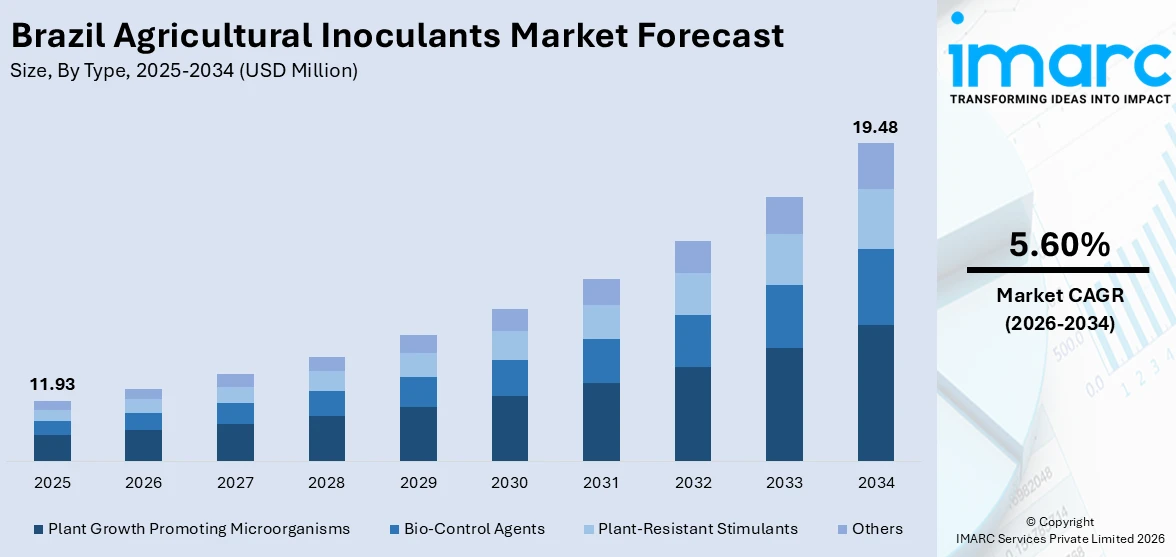
The Brazil agricultural inoculants market size was valued at USD 11.93 Million in 2025 and is projected to reach USD 19.48 Million by 2034, growing at a compound annual growth rate of 5.60% from 2026-2034.
The market is driven by the deepening integration of beneficial microbial technologies into Brazil's core agricultural systems, supportive government policies promoting low-carbon farming through preferential credit programs, and the strategic national priority of reducing dependence on costly imported synthetic fertilizers. The continued expansion of soybean and grain cultivation across the Cerrado biome, rising adoption of co-inoculation practices validated by leading research institutions, and growing commercialization of advanced multi-strain microbial formulations are further reinforcing the growth trajectory of the Brazil agricultural inoculants market share.
Key Takeaways and Insights:
-
By Type: Plant growth promoting microorganisms dominates the market with a share of 41.7% in 2025, driven by their proven efficacy in enhancing biological nitrogen fixation and root development across Brazil's leading soybean and grain cultivation areas.
-
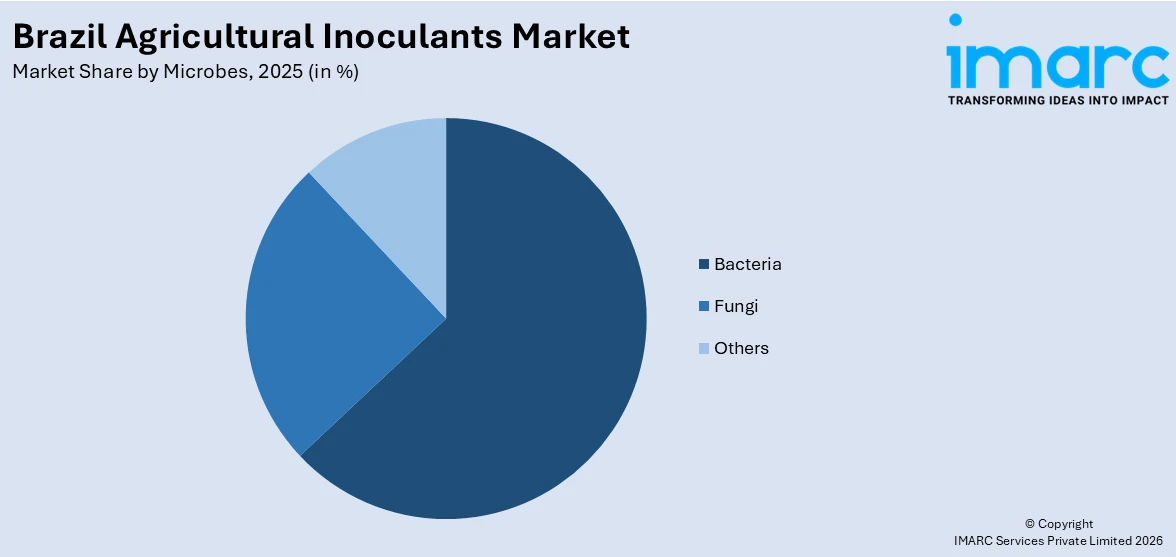
By Microbes: Bacteria lead the market with a share of 62.8% in 2025, owing to the widespread reliance on nitrogen-fixing and phosphate-solubilizing strains that serve as foundational components of standard agronomic practices across all major crop-producing regions.
-
By Mode of Application: Seed inoculation represents the largest segment with a market share of 54.3% in 2025, driven by seamless integration into large-scale mechanized planting operations and precise microbial delivery at the root zone from the earliest germination stages.
-
By Form: Liquid dominates the market with a share of 38.9% in 2025, owing to their compatibility with automated seed treatment machinery, superior coating uniformity, and growing producer preference for tank-mixable delivery platforms simplifying multi-input applications.
-
By Crop Type: Oilseeds and pulses represents the market with a share of 46.5% in 2025, driven by the near-universal adoption of biological nitrogen fixation technologies across Brazil's extensive soybean-planted areas and expanding inoculant use in pulse crops.
-
By Region: Central-West leads the market with a share of 36.4% in 2025, owing to the concentration of Brazil's most productive soybean and maize zones, advanced farm mechanization, and exceptionally high inoculant adoption among commercial growers.
-
Key Players: The Brazil agricultural inoculants market features a moderately fragmented competitive structure, with global agrochemical leaders competing alongside specialized domestic biological input producers and a growing wave of biotech startups driving microbial strain innovation.
To get more information on this market Request Sample
The Brazil agricultural inoculants market continues to gain momentum as the country solidifies its position as a global leader in the adoption of biological nitrogen fixation and microbial crop enhancement technologies. The convergence of environmental sustainability imperatives, economic pressures stemming from volatile global fertilizer markets, and proactive government support through dedicated low-carbon agriculture financing programs has created an exceptionally favorable environment for inoculant market expansion. According to reports, in September 2025, more than 205 million doses of soybean inoculants were sold in Brazil, highlighting the rapid adoption of biological inputs across the key legume sector. Brazilian producers are increasingly recognizing the dual benefits of biological inputs, which simultaneously reduce production costs and align with tightening export compliance standards for sustainably produced commodities. Furthermore, the maturation of the domestic bioinputs industry, underpinned by decades of world-class public research and a vibrant startup ecosystem, is accelerating the commercialization of next-generation microbial formulations capable of addressing diverse agronomic challenges across the country’s varied agro-ecological zones.
Brazil Agricultural Inoculants Market Trends:
Rise of Multi-Strain Microbial Consortia for Holistic Crop Management
Brazilian inoculant manufacturers are increasingly moving beyond single-strain products toward complex microbial consortia that combine nitrogen-fixing bacteria, phosphate solubilizers, and biocontrol agents in unified formulations. These multi-functional blends deliver simultaneous benefits in nutrient supply, disease suppression, and stress tolerance, reducing the need for multiple separate input applications. As per sources, in April 2024, Embrapa and Innova Agrotecnologia launched Combio, a multifunctional soybean bioinput composed of three bacterial strains, which increased grain yield by 10% while reducing reliance on chemical fungicides, demonstrating innovation in Brazil’s inoculant market.
Growing Linkage Between Carbon Credit Frameworks and Inoculant Adoption
The integration of biological nitrogen fixation into emerging carbon accounting and credit mechanisms is creating a new economic dimension for inoculant use among Brazilian farmers. As carbon-credit-linked agricultural protocols gain traction, producers who document inoculant application and reduced synthetic fertilizer usage can generate verifiable carbon offset credits that translate into direct supplementary income. In April 2025, AMAGGI and climate-tech partner NaturAll Carbon launched a regenerative agriculture project in Brazil to generate Verra‑certified carbon credits from soil management practices, creating additional income streams for participating growers
Emergence of On-Farm Biological Input Production and Localized Manufacturing
A notable trend in Brazil’s agricultural inoculants sector is the decentralization of production through on-farm biological input manufacturing facilities. Progressive cooperatives and large farming operations are investing in localized biofactories that produce custom inoculant blends tailored to specific soil conditions and crop requirements. As per sources, in 2025, Coopavel and Embrapa launched Azoscoop, the first inoculant from Biocoop, the first in‑cooperative bioinput factory in Brazil, marking localised inoculant production tailored to regional crop needs. This method overcomes tropical cold-chain issues, ensures fresher, viable microbes, and gives producers better control over quality and timing.
Market Outlook 2026-2034:
The Brazil agricultural inoculants market revenue is projected to sustain robust growth through the forecast period, propelled by the deepening institutionalization of biological inputs within the national agricultural policy architecture and the expansion of cultivated frontiers requiring soil health-building solutions. Revenue generation will be further reinforced by increasing international buyer expectations for sustainably sourced agricultural commodities, the commercialization of genomics-enhanced microbial strains with superior field performance, and the broadening of inoculant applications beyond traditional soybean cultivation into sugarcane, pasture restoration, and specialty crop segments. The market generated a revenue of USD 11.93 Million in 2025 and is projected to reach a revenue of USD 19.48 Million by 2034, growing at a compound annual growth rate of 5.60% from 2026-2034.
Brazil Agricultural Inoculants Market Report Segmentation:
|
Segment Category |
Leading Segment |
Market Share |
|
Type |
Plant Growth Promoting Microorganisms |
41.7% |
|
Microbes |
Bacteria |
62.8% |
|
Mode of Application |
Seed Inoculation |
54.3% |
|
Form |
Liquid |
38.9% |
|
Crop Type |
Oilseeds and Pulses |
46.5% |
|
Region |
Central-West |
36.4% |
Type Insights:
- Plant Growth Promoting Microorganisms
- Bio-Control Agents
- Plant-Resistant Stimulants
- Others
Plant growth promoting microorganisms dominates with a market share of 41.7% of the total Brazil agricultural inoculants market in 2025.
Plant growth promoting microorganisms anchor the Brazil agricultural inoculants market, reflecting the deep integration of beneficial microbial technologies into the country's mainstream crop production systems. In 2025, Brazilian companies Nitro and Symbiomics partnered to develop biological inoculants for tropical agriculture, leveraging over 12,000 microbial strains, 30% of which are entirely novel. These organisms enhance nutrient mobilization through biological nitrogen fixation, phosphorus solubilization, and phytohormone synthesis, directly improving plant vigor, root architecture, and yield consistency.
The continued expansion of this segment is reinforced by the Brazilian government's national bioinputs program, which positions sustainable microbial technologies as a strategic pillar of agricultural modernization and environmental stewardship. The growing availability of next-generation formulations that combine growth promotion with enhanced stress tolerance and biocontrol capabilities is broadening the appeal of these products beyond traditional soybean applications into maize, sugarcane, wheat, and specialty crop segments. Furthermore, the strengthening of collaborative public-private research partnerships is accelerating the discovery of novel microbial strains and streamlining commercial product development pipelines.
Microbes Insights:
Access the comprehensive market breakdown Request Sample
- Bacteria
- Rhizobacteria
- Nitrogen-Fixing Bacteria
- Phosphate-Solubilizing Bacteria
- Others
- Fungi
- Trichoderma Spp.
- Mycorrhiza
- Others
- Others
Bacteria lead with a share of 62.8% of the total Brazil agricultural inoculants market in 2025.
Bacteria dominate the market, driven by the foundational role of Bradyrhizobium strains in soybean nitrogen fixation and the expanding deployment of Azospirillum brasilense for cereal crop enhancement. In 2024, Brazilian company Biosphera Agro Solutions launched BioStart, combining Azospirillum brasilense and Pseudomonas fluorescens, boosting soybean growth and nutrient availability while reducing nitrogen fertilizer use. These organisms have benefited from decades of systematic strain selection and improvement programs led by national agricultural research institutions, resulting in highly adapted commercial products that deliver reliable performance under diverse Brazilian field conditions.
The segment’s commanding position is further reinforced by the scalability of bacterial fermentation and formulation processes, which enable cost-effective mass production of high-concentration inoculants. The advancement of co-inoculation protocols, which pair nitrogen-fixing Bradyrhizobium with growth-promoting Azospirillum to achieve synergistic yield improvements, represents a rapidly growing practice that expands the addressable market for bacterial products. Emerging genomic and metabolomic tools are accelerating the identification of novel bacterial strains with enhanced functional traits, positioning this segment for sustained leadership.
Mode of Application Insights:
- Seed Inoculation
- Soil Inoculation
- Others
Seed inoculation exhibits a clear dominance with a 54.3% share of the total Brazil agricultural inoculants market in 2025.
Seed inoculation commands the largest share of the application mode segment, reflecting the operational advantages this method offers within Brazil’s highly mechanized, large-scale farming systems. By applying beneficial microorganisms directly onto seeds prior to planting, producers ensure immediate microbial establishment at the root zone upon germination, maximizing early-stage nutrient acquisition and plant establishment. In 2024, Syngenta’s Brazil biologics unit launched Rizoliq UHC® Innovation, a long‑lasting liquid soybean seed inoculant with Bradyrhizobium that maintains viability up to 90 days before planting, enabling greater flexibility in pre‑inoculation scheduling.
The economic efficiency of seed inoculation relative to broadcast or in-furrow soil application methods further solidifies its market leadership, as it requires minimal product volumes per hectare while delivering precise microbial placement. Ongoing improvements in seed coating technologies, including polymeric carriers and osmoprotectant additives that shield bacteria from desiccation and chemical interference, continue to enhance the reliability and effectiveness of this application approach across diverse planting environments and seed treatment combinations.
Form Insights:
- Solid
- Liquid
- Granular
- Others
Liquid leads with a market share of 38.9% of the total Brazil agricultural inoculants market in 2025.
Liquid dominates the market in Brazil, reflecting a market-wide transition away from traditional peat-based solid carriers toward fluid formulations that offer superior handling and application characteristics. Liquid products provide homogeneous seed coverage, maintain higher microbial concentrations during storage, and integrate seamlessly into automated seed treatment lines operated by cooperatives and large farming enterprises. Their compatibility with tank-mixing protocols that combine inoculants with micronutrients, fungicides, and polymeric coatings in a single application step drives operational efficiency.
The ongoing investment in stabilization technologies, including cryoprotectants and encapsulation systems, is extending the shelf life and thermal tolerance of liquid formulations, addressing critical viability challenges in tropical supply chains. The proliferation of cooperative-level and on-farm seed treatment facilities equipped with liquid dispensing systems further entrenches this formulation type as the preferred delivery format. Manufacturers continue to innovate with concentrated liquid products that reduce packaging and transport costs while maintaining high field efficacy.
Crop Type Insights:
- Cereals and Grains
- Oilseeds and Pulses
- Fruits and Vegetables
- Others
Oilseeds and pulses exhibits a clear dominance with a 46.5% share of the total Brazil agricultural inoculants market in 2025.
The oilseeds and pulses command the largest share of inoculant consumption in Brazil, fundamentally anchored by the country’s status as the world’s foremost soybean producer. Biological nitrogen fixation through Bradyrhizobium inoculation has become an indispensable component of soybean agronomy, applied across the vast majority of planted areas as a standard practice that virtually eliminates the need for synthetic nitrogen fertilizers. This entrenched adoption pattern creates a massive and stable demand base for inoculant products, with consumption volumes closely correlated to the annual expansion of soybean-planted acreage.
The segment is further strengthened by the growing application of inoculant technologies in common bean and other pulse crops, where biological solutions enhance nitrogen availability and overall soil fertility. The increasing prominence of double-cropping rotations, where soybeans precede second-season maize, creates complementary demand cycles that sustain year-round inoculant consumption. The alignment of oilseed production with international sustainability certification requirements and carbon-neutral supply chain expectations continues to reinforce the strategic importance of biological inputs within this crop category.
Regional Insights:
- Southeast
- South
- Northeast
- North
- Central-West
Central-West dominates with a market share of 36.4% of the total Brazil agricultural inoculants market in 2025.
Central-West commands the largest share of Brazil’s agricultural inoculants market, reflecting its unrivalled position as the country’s primary agricultural production hub. The states of Mato Grosso, Goiás, and Mato Grosso do Sul collectively form the epicentre of Brazilian soybean and maize cultivation, where inoculant adoption rates are among the highest globally. The region’s large-scale commercial farming model, characterized by advanced mechanization, professional input management, and sophisticated crop rotation systems, creates favorable conditions for intensive inoculant utilization across both primary and second crop planting cycles.
The regions dominance is further underpinned by well-developed agricultural extension infrastructure, strong cooperative networks, and direct manufacturer engagement with producers through technical assistance programs. The ongoing conversion of degraded pastureland into productive cropland within the Cerrado biome generates incremental demand for soil-building biological inputs. The region also serves as a testing ground for innovative inoculant technologies, including precision application systems and next-generation microbial consortia, positioning it as both the largest market and the primary innovation adoption zone.
Market Dynamics:
Growth Drivers:
Why is the Brazil Agricultural Inoculants Market Growing?
Strategic Government Frameworks Embedding Biological Inputs into National Agricultural Policy
Brazil's comprehensive policy ecosystem supporting sustainable agriculture represents a foundational growth driver for the inoculants market. The Plano ABC+ initiative explicitly positions biological nitrogen fixation and microbial-based crop management as core strategies within the country's climate mitigation commitments. According to reports, in 2025, Brazil’s Ministry of Agriculture and Livestock approved 162 bio-input products, the highest ever, including biological, microbiological, biochemical products, plant extracts, growth regulators, and semiochemicals. Moreover, through the annual Plano Safra, dedicated rural credit lines at concessional interest rates are allocated for producers adopting biological input technologies.
Escalating Import Dependency and Price Volatility in Synthetic Fertilizer Markets
Brazil's structural dependence on imported chemical fertilizers exposes producers to persistent supply disruptions, geopolitical risks, and international commodity price swings that directly impact farm profitability. The country sources the overwhelming majority of its nitrogen, phosphorus, and potassium requirements from overseas markets, creating vulnerability to freight surcharges, currency depreciation, and trade restrictions. Agricultural inoculants offer a domestically produced, price-stable alternative that substantially reduces per-hectare input costs for nitrogen management. This economic imperative, combined with the strategic national interest in fertilizer import substitution, provides sustained structural demand for biological nitrogen fixation technologies.
Maturing Research Ecosystem and Accelerating Microbial Innovation Pipeline
Brazil's world-class agricultural research infrastructure, anchored by leading national institutions and state-level agricultural research organizations, provides a powerful innovation engine for the inoculants market. Decades of systematic microbial strain discovery, field validation, and commercial development have yielded a robust pipeline of high-performance inoculant products optimized for Brazilian conditions. The integration of advanced genomic and metagenomic tools is accelerating the identification of novel beneficial microorganisms with enhanced functional traits. Simultaneously, a vibrant biotech startup ecosystem is bringing private-sector dynamism and venture capital investment to biological input innovation nationwide.
Market Restraints:
What Challenges the Brazil Agricultural Inoculants Market is Facing?
Microbial Viability Constraints Under Tropical Storage and Distribution Conditions
The inherent sensitivity of live microbial products to elevated temperatures and humidity poses persistent challenges for product quality maintenance across Brazil’s extensive tropical supply chains. Inadequate cold chain infrastructure in remote agricultural regions can compromise inoculant efficacy before the product reaches the end user, requiring manufacturers to invest heavily in stabilization technologies and specialized logistics that increase product costs and limit distribution reach.
Inconsistent Performance Outcomes Across Heterogeneous Agro-Ecological Zones
The effectiveness of inoculant products can vary considerably based on local soil chemistry, indigenous microbial populations, moisture availability, and temperature regimes. This performance variability across Brazil’s diverse agricultural landscapes creates uncertainty for producers and complicates the development of standardized application recommendations, potentially slowing adoption in regions where extension services lack the technical capacity to provide tailored inoculation guidance.
Formulation Incompatibility with Concurrent Chemical Seed Treatment Protocols
The interaction between biological inoculants and chemical fungicides or insecticides commonly applied during seed treatment operations remains a significant practical constraint. Many conventional agrochemical seed dressers exhibit toxic effects on beneficial microorganisms, reducing bacterial survival and colonization potential when products are co-applied. Addressing these compatibility challenges requires continued development of protective encapsulation technologies and careful sequencing of treatment applications.
Competitive Landscape:
The Brazil agricultural inoculants market operates within a moderately fragmented competitive framework where established multinational crop science corporations compete alongside a diverse array of specialized domestic biological input manufacturers and agile biotech ventures. Competition is driven by differentiation in microbial strain portfolios, formulation innovation, distribution network breadth, and the ability to integrate biological solutions within comprehensive crop input packages. Strategic acquisitions of domestic biological specialists by global agrochemical groups are reshaping the competitive landscape, while public-private research collaborations continue to generate proprietary microbial technologies that confer market advantage. The expanding role of cooperatives as both distribution channels and technical advisors is influencing competitive positioning among market participants.
Brazil Agricultural Inoculants Market Report Coverage:
|
Report Features |
Details |
|
Base Year of the Analysis |
2025 |
|
Historical Period |
2020-2025 |
|
Forecast Period |
2026-2034 |
|
Units |
Million USD |
|
Scope of the Report |
Exploration of Historical Trends and Market Outlook, Industry Catalysts and Challenges, Segment-Wise Historical and Future Market Assessment:
|
|
Types Covered |
Plant Growth Promoting Microorganisms, Bio-Control Agents, Plant-Resistant Stimulants, Others |
|
Microbes Covered |
|
|
Modes of Application Covered |
Seed Inoculation, Soil Inoculation, Others |
|
Forms Covered |
Solid, Liquid, Granular, Others |
|
Crop Types Covered |
Cereals and Grains, Oilseeds and Pulses, Fruits and Vegetables, Others |
|
Regions Covered |
Southeast, South, Northeast, North, Central-West |
|
Customization Scope |
10% Free Customization |
|
Post-Sale Analyst Support |
10-12 Weeks |
|
Delivery Format |
PDF and Excel through Email (We can also provide the editable version of the report in PPT/Word format on special request) |
Frequently Asked Questions About the Brazil Agricultural Inoculants Market Report
The Brazil agricultural inoculants market size was valued at USD 11.93 Million in 2025.
The Brazil agricultural inoculants market is expected to grow at a compound annual growth rate of 5.60% from 2026-2034 to reach USD 19.48 Million by 2034.
Plant growth promoting microorganisms held the largest Brazil agricultural inoculants market share, driven by their indispensable role in enhancing biological nutrient acquisition and root development across Brazil’s dominant soybean and cereal crop production systems.
Key factors driving the Brazil agricultural inoculants market include strategic government policy frameworks promoting biological inputs through concessional credit and carbon incentives, the economic imperative of reducing costly synthetic fertilizer imports, and a world-class research ecosystem accelerating microbial innovation.
Major challenges include microbial viability constraints under tropical storage and transport conditions, inconsistent field performance across diverse agro-ecological zones, formulation incompatibility with chemical seed treatments, limited cold chain infrastructure in remote areas, and the need for expanded technical extension services.
Need more help?
- Speak to our experienced analysts for insights on the current market scenarios.
- Include additional segments and countries to customize the report as per your requirement.
- Gain an unparalleled competitive advantage in your domain by understanding how to utilize the report and positively impacting your operations and revenue.
- For further assistance, please connect with our analysts.
 Request Customization
 Speak to an Analyst
 Request Brochure
 Inquire Before Buying
Benefits of Customization
- Personalize this research
- Triangulate with your data
- Get data as per your format and definition
- Gain a deeper dive into a specific application, geography, customer, or competitor
- Any level of personalization
Get in Touch With Us
UNITED STATES
Phone: +1-201-971-6302
INDIA
Phone: +91-120-433-0800
UNITED KINGDOM
Phone: +44-753-714-6104
Email: [email protected]
Client Testimonials




.webp)




.webp)













Related Reports

Choose your plan
*Please note that the prices mentioned below are starting prices for each bundle type. Kindly contact our team for further details.*
Single User License
- 1 User License, Access on 2 Devices
- PDF Report + Excel Dataset (Password Protected)
- Lifetime Access
- No Printing Rights
- 10% Free Report Customization
- 10–12 Weeks of Analyst Support
Five User License
- Access for 5 Users, 2 Devices per User
- PDF Report + Excel Dataset (Password Protected)
- Lifetime Access
- Dedicated Account Manager
- 12–14 Weeks of Analyst Support
- No Printing Rights
- 15% Free Report Customization
- 25% Discount on Your Next Purchase
Corporate User License
- Unlimited User Access (Within Your Organization)
- PDF Report + Excel Dataset
- Lifetime Access
- Dedicated Account Manager
- 14–20 Weeks of Analyst Support
- No Printing Rights
- 20% Free Report Customization
- 30% Discount on Your Next Purchase
Essential Insights
What's included:
3 reports
- Lifetime Access
- PDF Reports
- Excel Datasets
- 2 Weeks of Free Analyst Support
- 2 User Licenses
- Access on 2 Devices
- Printing Rights
- Complimentary PowerPoint (PPT) Version
- Complimentary License Upgrade
Professional Access
What's included:
5 reports
- Lifetime Access
- PDF Reports
- Excel Datasets
- 8 Weeks of Free Analyst Support
- 2 User Licenses
- Access on 2 Devices
- Printing Rights
- Complimentary PowerPoint (PPT) Version
- Complimentary License Upgrade
Business Advantage
What's included:
8 reports
- Lifetime Access
- PDF Reports
- Excel Datasets
- 14 Weeks of Free Analyst Support
- 2 User Licenses
- Access on 2 Devices
- Printing Rights
- Complimentary PowerPoint (PPT) Version
- Complimentary License Upgrade
Enterprise Intelligence
What's included:
10 reports
- Lifetime Access
- PDF Reports
- Excel Datasets
- 20 Weeks of Free Analyst Support
- 2 User Licenses
- Access on 2 Devices
- Printing Rights
- Complimentary PowerPoint (PPT) Version
- Complimentary License Upgrade