
Brazil Agricultural Micronutrients Market Size, Share, Trends and Forecast by Type, Crop Type, Form, Application, and Region, 2026-2034
Brazil Agricultural Micronutrients Market Summary:
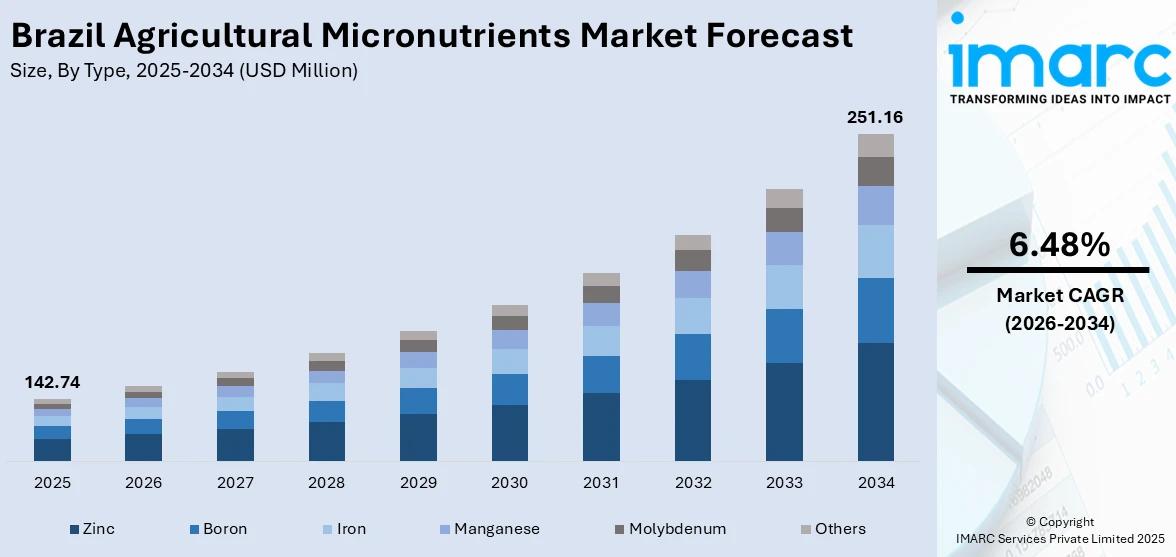
The Brazil agricultural micronutrients market size was valued at USD 142.74 Million in 2025 and is projected to reach USD 251.16 Million by 2034, growing at a compound annual growth rate of 6.48% from 2026-2034.
The market is growing with the increasing market for the farming sector, enhancing general knowledge about deficient nutrients in the farming soil, and increasing demand for techniques such as precision farming. The increasing demand for high-yielding crops and government initiatives for balanced fertilizers are also driving the market. Moreover, there is an increasing trend towards sustainable farming practices that are significantly impacting the market and offering opportunities for agricultural micronutrient market share, mainly for Brazil.
Key Takeaways and Insights:
-
By Type: Zinc dominates the market with a share of 39.5% in 2025, driven by the widespread prevalence of zinc-deficient soils across major agricultural regions and its critical role in enhancing cereal crop productivity.
-
By Crop Type: Cereals lead the market with a share of 48.7% in 2025, owing to Brazil's position as a leading global producer of staple cereal crops requiring consistent micronutrient supplementation.
-
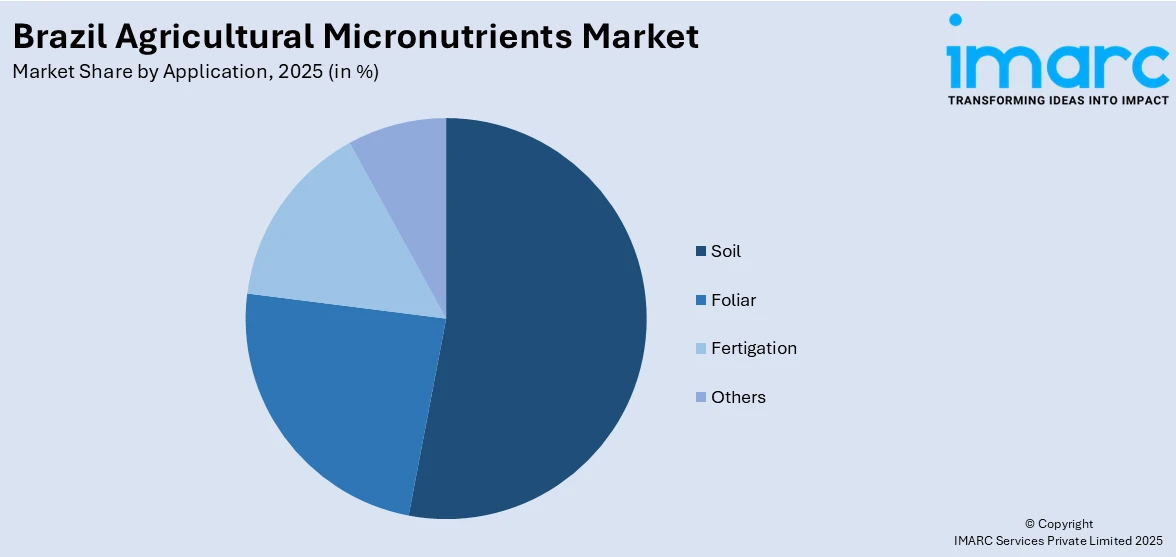
By Application: Soil dominates the market with a share of 53.1% in 2025, driven by the preference for direct soil application methods that ensure sustained nutrient availability throughout the crop growth cycle.
-
By Region: Southeast leads the market with a share of 44.3% in 2025, owing to the concentration of advanced farming operations and superior agricultural infrastructure in this region.
-
Key Players: The Brazil agricultural micronutrients market exhibits a moderately fragmented competitive landscape, with established agrochemical corporations competing alongside specialized micronutrient formulators and regional distributors across diverse application segments and crop categories.
To get more information on this market Request Sample
The Brazil agricultural micronutrients market is on an upward growth trajectory due to various factors. The search for agricultural solutions in Brazil is driven by large tracts of arable land in Brazil and its position as one of the largest agricultural export markets in the world. The continued pursuit of agricultural and crop productivity is likely to ensure a high level of demand in Brazil. The awareness level of farmers regarding crop micronutrient deficiencies and their adverse impact on crop health is exposing more farmers to agricultural micronutrients. The exploration of precision agriculture techniques is aimed at ensuring efficient use of agricultural micronutrients in Brazil. The rising awareness of sustainable agriculture practices is encouraging farmers in Brazil to adopt agricultural micronutrients in their routine agricultural practices.
Brazil Agricultural Micronutrients Market Trends:
Rising Adoption of Chelated and Complexed Micronutrient Formulations
Brazilian farmers are increasingly transitioning from conventional inorganic micronutrient salts to chelated and complexed formulations that offer superior bioavailability and nutrient uptake efficiency. These advanced formulations prevent nutrient lock-up in alkaline and calcareous soils, ensuring that micronutrients remain plant-available throughout critical growth stages. In February 2025, Haifa Group inaugurated a 30,000 ton-capacity specialty fertilizer mixing unit in Uberlândia, Brazil, aimed at supplying advanced nutrient solutions and supporting farmers’ productivity and efficiency needs. The shift is particularly prominent in high-value crop cultivation where maximizing nutrient efficiency directly correlates with improved product quality and export competitiveness in international markets.
Integration of Micronutrients with Precision Agriculture Technologies
The convergence of micronutrient management with precision agriculture is transforming application practices across Brazilian farms. Variable-rate technology and soil mapping tools enable site-specific micronutrient delivery based on real-time soil analysis and crop demand assessments. According to reports, in February 2026, Brazil-based Agrotools is developing a large-scale agricultural data platform supported by government financing to guide sustainable land use and data-driven farm management. This technology-driven approach optimizes input costs while minimizing environmental runoff and over-application risks. The trend is accelerating as digital farming platforms become more accessible to medium and large-scale producers seeking data-driven nutrient management solutions.
Growing Emphasis on Seed Treatment with Micronutrients
Seed treatment applications using micronutrient coatings are gaining significant traction as an efficient delivery mechanism in Brazilian agriculture. This method ensures early-stage nutrient availability during germination and seedling establishment, critical phases that determine overall crop vigor and yield potential. In July 2024, Boa Safra reported that around 52,000 of its seed units underwent industrial seed treatment in Brazil, marking a 37% increase over 2022 and reflecting rising adoption of treated seeds among commercial growers. The approach reduces total micronutrient volumes required compared to broadcast soil applications while delivering concentrated nutrition directly to the developing root zone, supporting uniform stand establishment across extensive planting areas.
Market Outlook 2026-2034:
The Brazil agricultural micronutrients market is poised for sustained revenue growth over the forecast period, supported by the country's expanding agricultural output and the increasing prioritization of soil health management. Ongoing investments in agricultural research and the development of innovative micronutrient delivery systems are expected to enhance product efficacy and broaden application scope. The rising integration of micronutrient programs into government-supported fertilization initiatives and the growing export orientation of Brazilian agriculture will continue driving revenue expansion throughout the forecast period. The market generated a revenue of USD 142.74 Million in 2025 and is projected to reach a revenue of USD 251.16 Million by 2034, growing at a compound annual growth rate of 6.48% from 2026-2034.
Brazil Agricultural Micronutrients Market Report Segmentation:
|
Segment Category |
Leading Segment |
Market Share |
|
Type |
Zinc |
39.5% |
|
Crop Type |
Cereals |
48.7% |
|
Application |
Soil |
53.1% |
|
Region |
Southeast |
44.3% |
Type Insights:
- Zinc
- Boron
- Iron
- Manganese
- Molybdenum
- Others
Zinc dominates with a market share of 39.5% of the total Brazil agricultural micronutrients market in 2025.
Zinc takes the leading position in the market, which is attributed mainly to the prevalence of Zinc-deficient soils across the major agricultural regions of the country. Brazilian soils, which are of tropical and sub-tropical type, have an inherently low profile in plant available Zinc. Zinc being an essential micronutrient acts as an activator of enzymes, protein synthesis, and growth hormones, thereby being indispensable to achieve maximum productivity across the agro-climate spectrum.
The dominance of zinc is further supplemented through its applicability to various types of crops, including edible crops, oil crops, horticultural crops, and cash crops. Additionally, with zinc being compatible with different modes of application, including soil application, foliar application, and seed coating, it allows farmers to have more options when managing deficiency issues. Government-backed soil testing schemes have indeed increased levels of awareness of the impacts of zinc deficiency, making zinc micronutrient fertilizers an integral part of fertilization activities of all commercial as well as medium agricultural centers across the nation.
Crop Type Insights:
- Cereals
- Pulses and Oilseeds
- Fruits and Vegetables
- Others
Cereals lead with a share of 48.7% of the total Brazil agricultural micronutrients market in 2025.
Cereals are the dominant crop category in the Brazil agricultural micronutrients market, driven by huge production volumes of crops like corn, rice, wheat, and sorghum across the nation, which have a cumulative high requirement for micronutrient application. All these staple crops are extremely responsive to micronutrient application, where deficiency symptoms usually translate into quantifiable yield losses and degraded grain quality. In 2025, Brazil’s National Supply Company (CONAB) reported that the country’s 2024/25 grain harvest is projected at over 322 million tonnes with expanded cultivated area and higher corn and rice output, reinforcing sustained demand for crop inputs such as micronutrients.
The dominance of this segment is further enhanced by the intensification of the cereal production systems in the form of widespread use of double-cropping practices, which place additional nutritional demands on existing soil reserves. Sequential plantings of corn following soybean harvests rapidly deplete soil micronutrient pools and require systematic replenishment programs to maintain productive capacity. Export quality requirements for Brazilian cereals further motivate farmers to optimize micronutrient management strategies that meet the stringent international grain quality specification, thereby assuring maximum competitive pricing advantage coupled with long-term maintenance of soil fertility.
Form Insights:
- Chelated
- Non-Chelated
The superior bioavailability and enhanced nutrient uptake efficiency of chelated micronutrients find significant growth in the Brazil agricultural micronutrients market. Advanced formulation inhibits the lock-up of micronutrients in alkaline and high-pH soils, assuring sustained plant availability during the critical growth stages. Their increasing applicability in high-value crop cultivation mirrors the farmer community's growing preference for performance-oriented nutrient solutions.
Non-chelated micronutrients continue to dominate the Brazil agricultural micronutrients market, driven largely by their affordability and easy availability to a wide range of farming communities. These conventional inorganic salt-based formulations have simple soil application compatibility and thus remain the favorite among price-conscious smallholder and medium-scale producers running extensive cereal and grain cultivation operations across various agro-ecological regions.
Application Insights:
Access the comprehensive market breakdown Request Sample
- Soil
- Foliar
- Fertigation
- Others
Soil leads with a market share of 53.1% of the total Brazil agricultural micronutrients market in 2025.
Soil commands the largest share within the segment of the Brazil agricultural micronutrients market, driven by its established effectiveness in delivering sustained micronutrient availability throughout entire crop growth cycles. Direct soil incorporation allows micronutrients to interact with the root zone over extended periods, supporting continuous plant uptake during critical vegetative and reproductive development stages. This method is particularly favored across extensive farming systems where broad-area application efficiency and uniform nutrient distribution are prioritized over more targeted localized delivery approaches.
The preference for soil is further supported by its seamless compatibility with existing fertilizer application infrastructure and mechanized farming equipment widely deployed across Brazilian agricultural operations. Farmers benefit from integrating micronutrient blends with standard macronutrient fertilizer programs, reducing application passes and lowering overall operational costs. The method's proven track record in correcting chronic micronutrient deficiencies prevalent in tropical Cerrado soils, combined with its straightforward application methodology and long-lasting residual effects, solidifies its dominant position within the market's application landscape.
Regional Insights:
- Southeast
- South
- Northeast
- North
- Central-West
Southeast dominates with a market share of 44.3% of the total Brazil agricultural micronutrients market in 2025.
Southeast leads the Brazil agricultural micronutrients market, driven by its well-established agricultural infrastructure, advanced farming practices, and proximity to major agrochemical distribution and supply networks. The region encompasses significant sugarcane, citrus, coffee, and horticultural cultivation areas that require intensive micronutrient management programs to sustain high productivity levels and premium crop quality. Superior access to technical advisory services, agricultural research institutions, and modern soil diagnostic facilities enable Southeast farmers to identify deficiency patterns early and adopt advanced micronutrient solutions more readily.
The region's dominance is also attributed to higher farmer awareness levels regarding the economic benefits of balanced crop nutrition and proactive soil health management practices. Concentrated agribusiness operations and well-organized cooperative networks facilitate efficient procurement, storage, and distribution of specialized micronutrient products across farming communities. The presence of key agricultural processing facilities and major export corridors creates additional incentives for Southeast producers to maintain optimal crop quality through comprehensive micronutrient supplementation strategies, ensuring competitiveness in both domestic and international commodity markets.
Market Dynamics:
Growth Drivers:
Why is the Brazil Agricultural Micronutrients Market Growing?
Expansion of Agricultural Activities into Nutrient-Deficient Cerrado Soils
Brazil's continuous expansion of cultivable land into the Cerrado biome is a primary driver of micronutrient market growth. These highly weathered tropical savanna soils are inherently deficient in essential micronutrients including zinc, boron, manganese, and copper, requiring substantial amendments before supporting productive agriculture. Scientific research published in the Revista Brasileira de Ciência do Solo found recurring micronutrient deficiency symptoms, particularly boron, copper, and zinc, in Cerrado soils as agriculture and forestry expanded into the region. The unique soil chemistry characterized by high aluminum toxicity and low cation exchange capacity necessitates specialized micronutrient formulations. As farming frontiers extend into previously uncultivated territories, the demand for comprehensive soil correction programs incorporating multiple micronutrient interventions increases proportionally across these expanding agricultural landscapes.
Government Soil Health Initiatives and Agricultural Extension Programs
Federal and state government initiatives promoting systematic soil testing and balanced fertilization practices are significantly accelerating micronutrient adoption across Brazilian agriculture. Public agricultural extension services actively disseminate knowledge about the economic consequences of micronutrient deficiencies and productivity gains achievable through targeted supplementation. National soil fertility mapping programs identify regional deficiency patterns, guiding farmers toward appropriate interventions. According to reports, Brazil’s Ministry of Agriculture supported initiatives promoting soil analysis and sustainable soil management under national agricultural development programs to improve productivity and environmental outcomes. These government-supported programs effectively reduce information barriers that historically limited micronutrient usage, particularly among smallholder farming communities that constitute a substantial portion of the country's overall agricultural production base.
Rising Export Demand Driving Quality-Oriented Crop Nutrition Practices
Brazil's growing prominence as a leading global exporter of agricultural commodities including soybeans, corn, coffee, and citrus fruits drives sustained demand for micronutrient products that enhance crop quality parameters. International markets increasingly impose stringent specifications regarding grain protein content, oil concentration, fruit sizing, and aesthetic attributes directly influenced by micronutrient availability during crop development. According to reports, Brazil recorded record soybean shipments of 108.68 million metric tons in 2025, underscoring its expanding role in global agricultural trade and export-oriented crop production. Farmers oriented towards export channels recognize that optimized micronutrient management translates into premium pricing and improved market access, creating consistent growth opportunities for specialized formulations tailored to meeting rigorous international quality benchmarks.
Market Restraints:
What Challenges the Brazil Agricultural Micronutrients Market is Facing?
Limited Awareness and Technical Knowledge Among Smallholder Farmers
A significant portion of Brazil's smallholder farming community remains insufficiently informed about micronutrient benefits and proper application methodologies. Limited access to soil testing facilities and agricultural advisory services in remote regions restrict adoption rates. Many small-scale producers prioritize macronutrient fertilization while overlooking micronutrient deficiencies, resulting in suboptimal crop performance and unrealized yield potential across substantial agricultural areas.
Price Sensitivity and Input Cost Constraints
Micronutrient products represent an additional cost layer beyond existing fertilizer expenditures, creating affordability challenges particularly during periods of compressed agricultural margins. Farmers facing tight budgets frequently deprioritize micronutrient purchases in favor of essential macronutrient fertilizers and crop protection inputs. Fluctuating raw material prices and currency exchange volatility further impact product affordability, constraining consistent demand across economic cycles.
Variability in Soil Conditions Complicating Standardized Application
Brazil's vast geographical diversity presents significant variability in soil types, pH levels, and existing micronutrient profiles, complicating uniform application recommendations. Farmers require location-specific soil analysis and customized supplementation programs rather than standardized application rates. This complexity increases technical knowledge requirements for effective micronutrient management, creating adoption barriers for producers lacking access to comprehensive soil diagnostic services and specialized agronomic expertise.
Competitive Landscape:
The Brazil agricultural micronutrients market features a moderately fragmented competitive structure characterized by the presence of multinational agrochemical corporations, domestic fertilizer manufacturers, and specialized micronutrient formulators. Market participants compete across multiple dimensions including product portfolio breadth, formulation innovation, distribution network reach, and technical service capabilities. Established players leverage extensive research and development infrastructure to introduce advanced chelated and complexed micronutrient products, while regional manufacturers focus on cost-competitive offerings tailored to local soil conditions and farming practices. Strategic partnerships with agricultural cooperatives and distribution networks serve as critical competitive advantages, enabling broader market penetration across diverse geographical regions and farming community segments throughout Brazil.
Recent Developments:
-
In January 2026, Brazilian specialty fertilizer producer Sulboro inaugurated a new boron micronutrient plant in Rio Grande do Sul to produce sodium octaborate tetrahydrate. The BRL 25 million facility is set to triple output of boron products like BoroTop, strengthening domestic micronutrient supply for agriculture.
Brazil Agricultural Micronutrients Market Report Coverage:
|
Report Features |
Details |
|
Base Year of the Analysis |
2025 |
|
Historical Period |
2020-2025 |
|
Forecast Period |
2026-2034 |
|
Units |
Million USD |
|
Scope of the Report |
Exploration of Historical Trends and Market Outlook, Industry Catalysts and Challenges, Segment-Wise Historical and Future Market Assessment:
|
|
Types Covered |
Zinc, Boron, Iron, Manganese, Molybdenum, Others |
|
Crop Types Covered |
Cereals, Pulses and Oilseeds, Fruits and Vegetables, Others |
|
Forms Covered |
Chelated, Non-Chelated |
|
Applications Covered |
Soil, Foliar, Fertigation, Others |
|
Regions Covered |
Southeast, South, Northeast, North, Central-West |
|
Customization Scope |
10% Free Customization |
|
Post-Sale Analyst Support |
10-12 Weeks |
|
Delivery Format |
PDF and Excel through Email (We can also provide the editable version of the report in PPT/Word format on special request) |
Frequently Asked Questions About the Brazil Agricultural Micronutrients Market Report
The Brazil agricultural micronutrients market size was valued at USD 142.74 Million in 2025.
The Brazil agricultural micronutrients market is expected to grow at a compound annual growth rate of 6.48% from 2026-2034 to reach USD 251.16 Million by 2034.
Zinc held the largest Brazil agricultural micronutrients market share, driven by the widespread prevalence of zinc-deficient tropical soils across Brazil's primary agricultural zones and its essential role in enhancing cereal and grain crop productivity and quality.
Key factors driving the Brazil agricultural micronutrients market include the expansion of agricultural activities into nutrient-deficient cerrado soils, government-led soil health programs promoting balanced fertilization, and the increasing export orientation demanding higher crop quality standards.
Major challenges include limited awareness among smallholder farmers regarding micronutrient benefits, price sensitivity and cost constraints affecting input procurement decisions, variability in soil conditions complicating standardized application, and insufficient soil testing infrastructure in remote agricultural regions.
Need more help?
- Speak to our experienced analysts for insights on the current market scenarios.
- Include additional segments and countries to customize the report as per your requirement.
- Gain an unparalleled competitive advantage in your domain by understanding how to utilize the report and positively impacting your operations and revenue.
- For further assistance, please connect with our analysts.
 Request Customization
 Speak to an Analyst
 Request Brochure
 Inquire Before Buying
Benefits of Customization
- Personalize this research
- Triangulate with your data
- Get data as per your format and definition
- Gain a deeper dive into a specific application, geography, customer, or competitor
- Any level of personalization
Get in Touch With Us
UNITED STATES
Phone: +1-201-971-6302
INDIA
Phone: +91-120-433-0800
UNITED KINGDOM
Phone: +44-753-714-6104
Email: [email protected]
Client Testimonials




.webp)




.webp)













Related Reports

Choose your plan
*Please note that the prices mentioned below are starting prices for each bundle type. Kindly contact our team for further details.*
Single User License
- 1 User License, Access on 2 Devices
- PDF Report + Excel Dataset (Password Protected)
- Lifetime Access
- No Printing Rights
- 10% Free Report Customization
- 10–12 Weeks of Analyst Support
Five User License
- Access for 5 Users, 2 Devices per User
- PDF Report + Excel Dataset (Password Protected)
- Lifetime Access
- Dedicated Account Manager
- 12–14 Weeks of Analyst Support
- No Printing Rights
- 15% Free Report Customization
- 25% Discount on Your Next Purchase
Corporate User License
- Unlimited User Access (Within Your Organization)
- PDF Report + Excel Dataset
- Lifetime Access
- Dedicated Account Manager
- 14–20 Weeks of Analyst Support
- No Printing Rights
- 20% Free Report Customization
- 30% Discount on Your Next Purchase
Essential Insights
What's included:
3 reports
- Lifetime Access
- PDF Reports
- Excel Datasets
- 2 Weeks of Free Analyst Support
- 2 User Licenses
- Access on 2 Devices
- Printing Rights
- Complimentary PowerPoint (PPT) Version
- Complimentary License Upgrade
Professional Access
What's included:
5 reports
- Lifetime Access
- PDF Reports
- Excel Datasets
- 8 Weeks of Free Analyst Support
- 2 User Licenses
- Access on 2 Devices
- Printing Rights
- Complimentary PowerPoint (PPT) Version
- Complimentary License Upgrade
Business Advantage
What's included:
8 reports
- Lifetime Access
- PDF Reports
- Excel Datasets
- 14 Weeks of Free Analyst Support
- 2 User Licenses
- Access on 2 Devices
- Printing Rights
- Complimentary PowerPoint (PPT) Version
- Complimentary License Upgrade
Enterprise Intelligence
What's included:
10 reports
- Lifetime Access
- PDF Reports
- Excel Datasets
- 20 Weeks of Free Analyst Support
- 2 User Licenses
- Access on 2 Devices
- Printing Rights
- Complimentary PowerPoint (PPT) Version
- Complimentary License Upgrade