
Brazil Air Quality Monitoring Market Size, Share, Trends and Forecast by Product Type, Pollutant, Sampling Method, End User, and Region, 2026-2034
Brazil Air Quality Monitoring Market Overview:
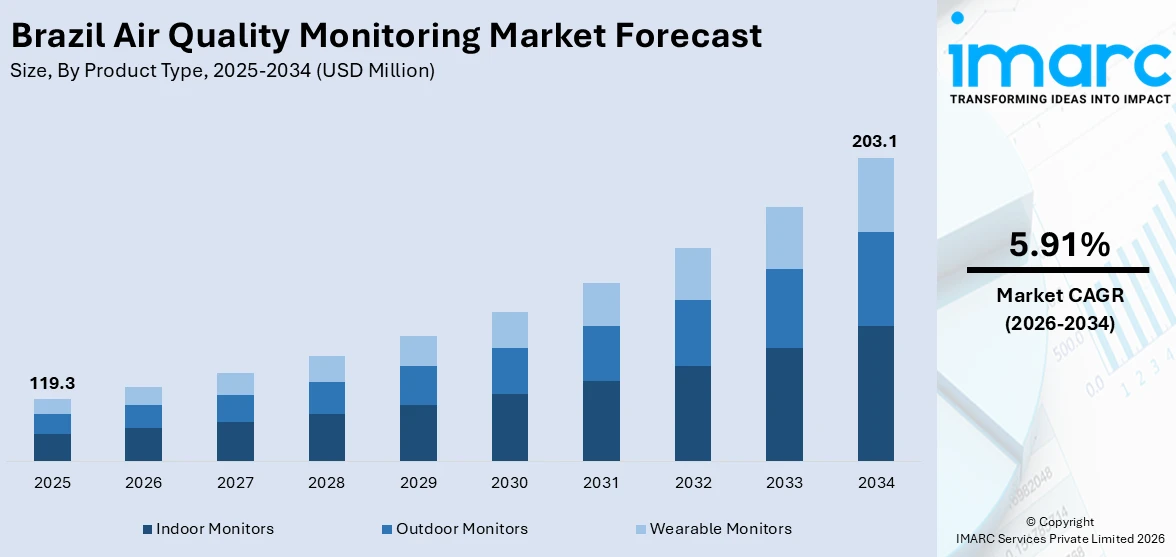
The Brazil air quality monitoring market size reached USD 119.3 Million in 2025. The market is projected to reach USD 203.1 Million by 2034, exhibiting a growth rate (CAGR) of 5.91% during 2026-2034. The market is driven by the implementation of comprehensive national air quality regulations and monitoring frameworks and the growing public health concerns stemming from widespread wildfires and industrial pollution affecting millions of residents. Additionally, the urgent need to expand monitoring infrastructure across underserved regions is fueling the Brazil air quality monitoring market share.
|
Report Attribute
|
Key Statistics
|
|---|---|
|
Base Year
|
2025
|
|
Forecast Years
|
2026-2034
|
|
Historical Years
|
2020-2025
|
| Market Size in 2025 | USD 119.3 Million |
| Market Forecast in 2034 | USD 203.1 Million |
| Market Growth Rate 2026-2034 | 5.91% |
Brazil Air Quality Monitoring Market Trends:
Rising Urbanization and Industrialization
Rapid urbanization and industrial growth in Brazil are key factors driving the market growth. Expanding cities are facing challenges, such as traffic congestion, high vehicle emissions, and industrial pollution, which deteriorate air quality. As urban centers like São Paulo and Rio de Janeiro continue to grow, air pollution is becoming a pressing issue impacting both public health and the environment. Air quality monitoring systems help governments and industries track emission sources, measure pollutants, and implement control strategies. Industries are also adopting monitoring solutions to comply with emission standards and avoid penalties. With urbanization showing no signs of slowing down, the demand for reliable, real-time air quality monitoring equipment is set to increase. These systems support policymakers in addressing pollution-related challenges, making urban growth more sustainable and driving the adoption of monitoring technologies in Brazil.
To get more information on this market Request Sample
Government Regulations and Environmental Policies
Stringent environmental regulations and government-led initiatives are bolstering the Brazil air quality monitoring market growth. Authorities are implementing stricter emission standards for industries and vehicles to tackle rising pollution levels. Air monitoring systems are essential tools for compliance, allowing industries and municipalities to measure air pollutants accurately. Government agencies also use these systems to establish baseline data, track improvements, and support enforcement of air quality laws. Brazil’s commitments to international environmental agreements are further promoting the adoption of monitoring technologies to demonstrate progress in reducing emissions. Public policies supporting clean energy, sustainable transportation, and reduced deforestation also rely on reliable air quality monitoring for assessment. As regulations continue to tighten and environmental awareness is increasing, the need for advanced monitoring solutions is growing.
Expansion of Smart Cities and Infrastructure Projects
Brazil’s investment in smart city initiatives and modern infrastructure is boosting the adoption of air quality monitoring technologies. As cities are integrating digital systems for transportation, energy, and waste management, air monitoring is becoming an important component of sustainable urban planning. Smart city projects utilize real-time monitoring networks to track pollution levels, analyze data, and implement effective measures to improve air quality. Smart traffic systems integrated with monitoring sensors help reduce congestion and emissions. Infrastructure projects, such as highways, airports, and industrial parks, also incorporate air quality monitoring to ensure compliance with environmental standards. Additionally, the use of the Internet of Things (IoT)-enabled devices and data analytics provides deeper insights for decision-making and policy implementation. The alignment of air quality monitoring with Brazil’s modernization and sustainability goals is making smart city growth a powerful driver of the market expansion.
Technological Advancements and Innovations
Technological innovations are positively influencing the market in Brazil by making monitoring systems more accurate, accessible, and affordable. Advancements in sensor technology and data analytics enable real-time tracking of multiple pollutants across wide areas. Portable and low-cost air quality monitors are gaining popularity among individuals, schools, and community groups, expanding awareness at the grassroots level. Cloud-based platforms and mobile applications provide easy access to air quality data, enhancing transparency and engagement among citizens. Industries benefit from advanced monitoring technologies that support predictive maintenance and emissions control, reducing operational risks. The introduction of artificial intelligence (AI)-oriented models for pollution forecasting is further enhancing decision-making for governments and businesses. These technological improvements are not only increasing the adoption but also expanding applications across different sectors, ensuring continuous growth of the market.
Brazil Air Quality Monitoring Market Segmentation:
IMARC Group provides an analysis of the key trends in each segment of the market, along with forecasts at the country and regional levels for 2026-2034. Our report has categorized the market based on product type, pollutant, sampling method, and end user.
Product Type Insights:
- Indoor Monitors
- Outdoor Monitors
- Wearable Monitors
The report has provided a detailed breakup and analysis of the market based on the product type. This includes indoor monitors, outdoor monitors, and wearable monitors.
Pollutant Insights:
- Chemical Pollutant
- Physical Pollutant
- Biological Pollutant
A detailed breakup and analysis of the market based on the pollutant have also been provided in the report. This includes chemical pollutant, physical pollutant, and biological pollutant.
Sampling Method Insights:
- Active/Continuous Monitoring
- Passive Monitoring
- Intermittent Monitoring
- Stack Monitoring
The report has provided a detailed breakup and analysis of the market based on the sampling method. This includes active/continuous monitoring, passive monitoring, intermittent monitoring, and stack monitoring.
End User Insights:
Access the comprehensive market breakdown Request Sample
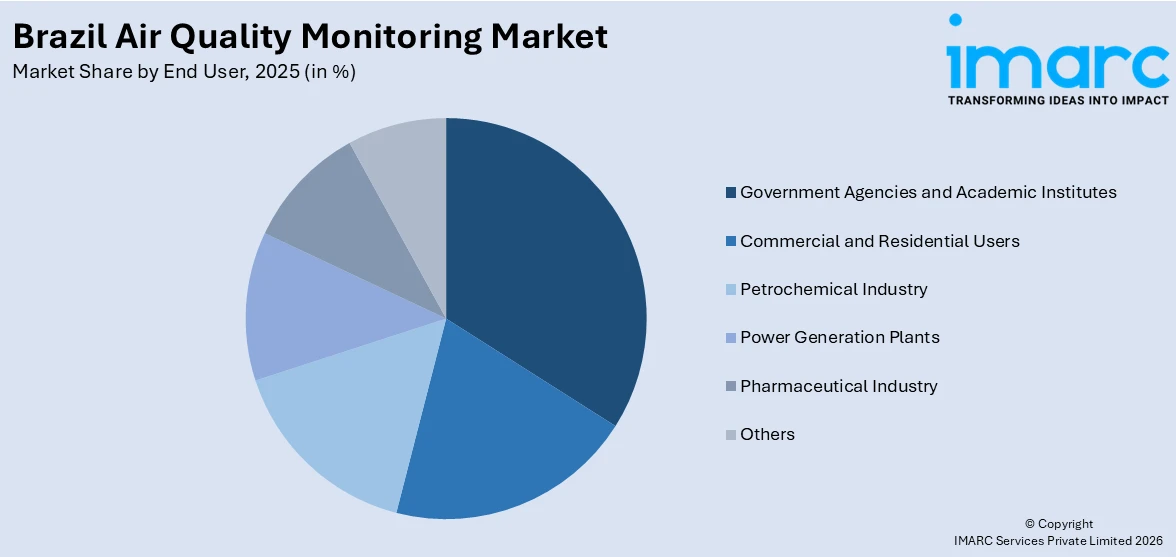
- Government Agencies and Academic Institutes
- Commercial and Residential Users
- Petrochemical Industry
- Power Generation Plants
- Pharmaceutical Industry
- Others
A detailed breakup and analysis of the market based on the end user have also been provided in the report. This includes government agencies and academic institutes, commercial and residential users, petrochemical industry, power generation plants, pharmaceutical industry, and others.
Regional Insights:
- Southeast
- South
- Northeast
- North
- Central-West
The report has also provided a comprehensive analysis of all the major regional markets, which include Southeast, South, Northeast, North, and Central-West.
Competitive Landscape:
The market research report has also provided a comprehensive analysis of the competitive landscape. Competitive analysis such as market structure, key player positioning, top winning strategies, competitive dashboard, and company evaluation quadrant has been covered in the report. Also, detailed profiles of all major companies have been provided.
Brazil Air Quality Monitoring Market News:
- In March 2025, the 2025 Climate and Clean Air Conference began in Brasília, Brazil, uniting a vibrant array of world leaders, specialists, and champions to confront super pollutants directly. Expert conversations highlighted the importance of thorough emissions inventories, sophisticated air quality modeling, and the establishment of strong air quality standards to guide focused mitigation efforts. Specialists investigated the creation of innovative planning instruments and the swift integration of satellite data to monitor and control methane emissions efficiently.
Brazil Air Quality Monitoring Market Report Coverage:
| Report Features | Details |
|---|---|
| Base Year of the Analysis | 2025 |
| Historical Period | 2020-2025 |
| Forecast Period | 2026-2034 |
| Units | Million USD |
| Scope of the Report |
Exploration of Historical Trends and Market Outlook, Industry Catalysts and Challenges, Segment-Wise Historical and Future Market Assessment:
|
| Product Types Covered | Indoor Monitors, Outdoor Monitors, Wearable Monitors |
| Pollutants Covered | Chemical Pollutant, Physical Pollutant, Biological Pollutant |
| Sampling Methods Covered | Active/Continuous Monitoring, Passive Monitoring, Intermittent Monitoring, Stack Monitoring |
| End Users Covered | Government Agencies and Academic Institutes, Commercial and Residential Users, Petrochemical Industry, Power Generation Plants, Pharmaceutical Industry, Others |
| Regions Covered | Southeast, South, Northeast, North, Central-West |
| Customization Scope | 10% Free Customization |
| Post-Sale Analyst Support | 10-12 Weeks |
| Delivery Format | PDF and Excel through Email (We can also provide the editable version of the report in PPT/Word format on special request) |
Key Questions Answered in This Report:
- How has the Brazil air quality monitoring market performed so far and how will it perform in the coming years?
- What is the breakup of the Brazil air quality monitoring market on the basis of product type?
- What is the breakup of the Brazil air quality monitoring market on the basis of pollutant?
- What is the breakup of the Brazil air quality monitoring market on the basis of sampling method?
- What is the breakup of the Brazil air quality monitoring market on the basis of end user?
- What is the breakup of the Brazil air quality monitoring market on the basis of region?
- What are the various stages in the value chain of the Brazil air quality monitoring market?
- What are the key driving factors and challenges in the Brazil air quality monitoring market?
- What is the structure of the Brazil air quality monitoring market and who are the key players?
- What is the degree of competition in the Brazil air quality monitoring market?
Key Benefits for Stakeholders:
- IMARC's industry report offers a comprehensive quantitative analysis of various market segments, historical and current market trends, market forecasts, and dynamics of the Brazil air quality monitoring market from 2020-2034.
- The research report provides the latest information on the market drivers, challenges, and opportunities in the Brazil air quality monitoring market.
- Porter's five forces analysis assist stakeholders in assessing the impact of new entrants, competitive rivalry, supplier power, buyer power, and the threat of substitution. It helps stakeholders to analyze the level of competition within the Brazil air quality monitoring industry and its attractiveness.
- Competitive landscape allows stakeholders to understand their competitive environment and provides an insight into the current positions of key players in the market.
Need more help?
- Speak to our experienced analysts for insights on the current market scenarios.
- Include additional segments and countries to customize the report as per your requirement.
- Gain an unparalleled competitive advantage in your domain by understanding how to utilize the report and positively impacting your operations and revenue.
- For further assistance, please connect with our analysts.
 Request Customization
 Speak to an Analyst
 Request Brochure
 Inquire Before Buying
Benefits of Customization
- Personalize this research
- Triangulate with your data
- Get data as per your format and definition
- Gain a deeper dive into a specific application, geography, customer, or competitor
- Any level of personalization
Get in Touch With Us
UNITED STATES
Phone: +1-201-971-6302
INDIA
Phone: +91-120-433-0800
UNITED KINGDOM
Phone: +44-753-714-6104
Email: [email protected]
Client Testimonials




.webp)




.webp)













Related Reports

Choose your plan
*Please note that the prices mentioned below are starting prices for each bundle type. Kindly contact our team for further details.*
Single User License
- 1 User License, Access on 2 Devices
- PDF Report + Excel Dataset (Password Protected)
- Lifetime Access
- No Printing Rights
- 10% Free Report Customization
- 10–12 Weeks of Analyst Support
Five User License
- Access for 5 Users, 2 Devices per User
- PDF Report + Excel Dataset (Password Protected)
- Lifetime Access
- Dedicated Account Manager
- 12–14 Weeks of Analyst Support
- No Printing Rights
- 15% Free Report Customization
- 25% Discount on Your Next Purchase
Corporate User License
- Unlimited User Access (Within Your Organization)
- PDF Report + Excel Dataset
- Lifetime Access
- Dedicated Account Manager
- 14–20 Weeks of Analyst Support
- No Printing Rights
- 20% Free Report Customization
- 30% Discount on Your Next Purchase
Essential Insights
What's included:
3 reports
- Lifetime Access
- PDF Reports
- Excel Datasets
- 2 Weeks of Free Analyst Support
- 2 User Licenses
- Access on 2 Devices
- Printing Rights
- Complimentary PowerPoint (PPT) Version
- Complimentary License Upgrade
Professional Access
What's included:
5 reports
- Lifetime Access
- PDF Reports
- Excel Datasets
- 8 Weeks of Free Analyst Support
- 2 User Licenses
- Access on 2 Devices
- Printing Rights
- Complimentary PowerPoint (PPT) Version
- Complimentary License Upgrade
Business Advantage
What's included:
8 reports
- Lifetime Access
- PDF Reports
- Excel Datasets
- 14 Weeks of Free Analyst Support
- 2 User Licenses
- Access on 2 Devices
- Printing Rights
- Complimentary PowerPoint (PPT) Version
- Complimentary License Upgrade
Enterprise Intelligence
What's included:
10 reports
- Lifetime Access
- PDF Reports
- Excel Datasets
- 20 Weeks of Free Analyst Support
- 2 User Licenses
- Access on 2 Devices
- Printing Rights
- Complimentary PowerPoint (PPT) Version
- Complimentary License Upgrade