
Brazil Automotive Composites Market Size, Share, Trends and Forecast by Production Process, Application, Material, and Region, 2026-2034
Brazil Automotive Composites Market Summary:
The Brazil automotive composites market size was valued at USD 673.99 Million in 2025 and is projected to reach USD 1,808.33 Million by 2034, growing at a compound annual growth rate of 11.59% from 2026-2034.
Market growth is propelled by stringent fuel efficiency mandates driving lightweight material adoption, rapid electric vehicle (EV) production growth requiring weight reduction solutions, and substantial government investment. The implementation of well-to-wheel carbon emission standards transforms weight savings from optional to mandatory, encouraging automakers to substitute traditional steel with advanced composite modules across structural assemblies, exterior panels, and battery enclosures. Brazil's position as a major vehicle manufacturing hub, combined with local content requirements and competitive labor costs, attracts both global composites suppliers and domestic tier-one manufacturers to expand production capacity, further expanding the Brazil automotive composites market share.
Key Takeaways and Insights:
- By Production Process: Compression molding dominates the market with a share of 36% in 2025, driven by ideal balance between cost-effectiveness, structural strength capability, and high-volume manufacturing efficiency enabling mass production of large automotive components.
- By Application: Structural assembly leads the market with a share of 30% in 2025, propelled by increasing demand for lightweight vehicle architectures, critical role in fuel economy improvement, and enhanced crash safety performance.
- By Material: Thermoset polymer represents the largest segment with a market share of 38% in 2025, favored for superior dimensional stability under heat exposure, excellent strength-to-weight characteristics, and established domestic supplier networks supporting rapid component delivery.
- Key Players: The Brazil automotive composites market exhibits moderate competitive intensity, with various multinational material producers and local manufacturers pursuing partnerships alongside regional molders managing commodity glass fiber programs across price segments.
Brazil's automotive composites sector benefits from three converging forces reshaping material selection across the vehicle supply chain. First, EV production expansion creates immediate weight reduction imperatives, as battery mass penalties necessitate compensating lightweighting throughout chassis, body panels, and interior structures. Second, the MOVER program's well-to-wheel carbon accounting methodology elevates lightweight composites from performance optimization to regulatory compliance requirement, compelling even cost-sensitive mass-market segments to evaluate composite substitution opportunities. Third, domestic content mandates and import tariff structures favor local composite manufacturing investments, with global suppliers establishing Brazilian production facilities to serve both domestic assembly plants and Latin American export markets. As BYD, Volkswagen, and General Motors expand local EV manufacturing capacity, composite penetration accelerates beyond traditional premium applications into mainstream vehicle platforms, supported by continuous process manufacturing innovations delivering shorter cycle times and improved material utilization rates. In 2024, Volkswagen, the German automobile manufacturer, announced that it plans to invest another 9 billion reais ($1.83 billion) in its operations in Brazil over the coming five years and introduce 16 new models, which will feature hybrid and electric vehicles. The additional investments would increase Volkswagen's 2022-2028 investment plan in Brazil to 16 billion reais, more than doubling it, and allow the company to manufacture four additional models, including its inaugural hybrids made in Brazil, a fully electric model, and a pick-up truck.
Brazil Automotive Composites Market Trends:
Acceleration of EV Lightweighting Solutions
EV manufacturers face critical weight management challenges as battery packs add significant mass compared to conventional powertrains, directly impacting driving range and performance. Brazilian electric vehicle production increment, demonstrated by sales growing 58% in July 2025, creates substantial demand for composite lightweight solutions across multiple vehicle systems. São Paulo alone targets deployment of 1000 battery-electric buses for 150,000 stations by 2035, establishing foundation for sustained electric mobility growth. Composite floor pans and roof skins deliver immediate weight savings versus metal alternatives, enabling automakers to offset battery mass while maintaining structural integrity. BYD's commencement of Dolphin Mini production at its Camaçari facility in July 2025, representing the company's first locally manufactured compact electric model for Latin America with 150,000 annual capacity, demonstrates how composite integration supports aggressive electric vehicle localization strategies.
Advanced Manufacturing Process Adoption Reshaping Production Economics
Traditional composite manufacturing approaches face productivity constraints limiting penetration into high-volume automotive applications, driving adoption of continuous processing technologies and automated fiber placement systems. These advanced manufacturing platforms demonstrate expanding implementation, enabling faster cycle times and superior material utilization compared to conventional compression molding or hand layup methods. The ability to bond composite components directly to mixed-material body structures aligns with Brazil's evolving multi-material vehicle architectures, while high surface repeatability reduces downstream finishing operations, offsetting carbon fiber's premium unit cost through manufacturing efficiency gains. In 2025, Envalior presented its advanced materials at Plástico Brasil 2025, emphasizing sustainability and innovation. The firm showcased items like EcoPaXX®, TEPEX®, and Stanyl® for sectors like automotive and healthcare. Envalior’s offerings support sustainability objectives and enhance product efficiency, featuring a local production site in Brazil to cater to the Latin American market. The exhibit demonstrated how Envalior’s materials are enabling advancements in hydrogen storage, electric vehicle battery enclosures, lightweight automotive parts, eco-friendly kitchenware, and healthcare devices.
Regulatory Framework Evolution Through MOVER Program Implementation
Government policy intervention through the MOVER program fundamentally alters competitive dynamics favoring composite material adoption across Brazilian automotive manufacturing. Enacted in June 2024, the program allocates BRL 19.3 billion in financial credits spanning 2024 through 2028, catalyzing over USD 26 billion in announced automaker investments targeting emission reduction and manufacturing technology advancement. The program's implementation of stringent well-to-wheel carbon thresholds replacing previous tank-to-wheel calculations transforms weight reduction from optional performance enhancement to mandatory regulatory compliance requirement. Brazilian original equipment manufacturers now confront lifecycle carbon accounting encompassing material production, vehicle manufacturing, operational emissions, and end-of-life recycling, fundamentally changing bill-of-material decisions.
Market Outlook 2026-2034:
The Brazil automotive composites market demonstrates robust growth trajectory supported by converging regulatory mandates, electric vehicle production expansion, and manufacturing technology advancement. The market generated a revenue of USD 673.99 Million in 2025 and is projected to reach a revenue of USD 1,808.33 Million by 2034, growing at a compound annual growth rate of 11.59% from 2026-2034. This expansion reflects automotive manufacturers' strategic imperative to reduce vehicle weight for fuel efficiency compliance, electric vehicle range optimization, and emission target achievement under increasingly stringent MOVER program requirements. Glass fiber composites maintain volume leadership through cost-effectiveness and established supply chains, while carbon fiber segments accelerate at premium growth rates driven by electric vehicle battery enclosure applications and structural component lightweighting requirements.
Brazil Automotive Composites Market Report Segmentation:
|
Segment Category |
Leading Segment |
Market Share |
|
Production Process |
Compression Molding |
36% |
|
Application |
Structural Assembly |
30% |
|
Material |
Thermoset Polymer |
38% |
Production Process Insights:
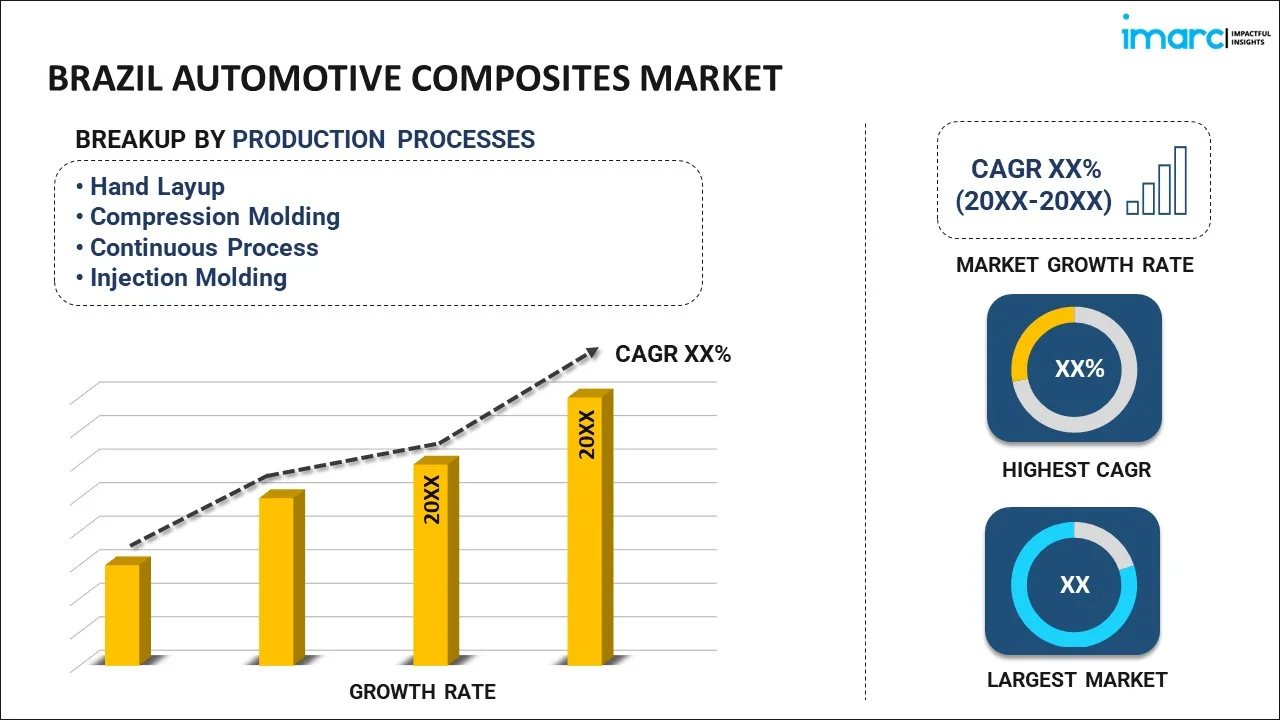
To get detailed segment analysis of this market, Request Sample
- Hand Layup
- Compression Molding
- Continuous Process
- Injection Molding
Compression molding dominates with a market share of 36% of the total Brazil automotive composites market in 2025.
Compression molding maintains market leadership position through its optimal balance between manufacturing cost efficiency, structural performance capability, and high-volume production scalability essential for automotive applications. The process enables manufacturers to produce complex geometric components with consistent dimensional accuracy and superior surface finish quality, critical requirements for visible exterior panels and load-bearing structural assemblies. Shorter cycle times compared to hand layup methods support economic mass production, while uniform material distribution throughout the molding cavity ensures predictable mechanical properties meeting stringent automotive quality standards.
The compression molding segment benefits from established domestic supplier infrastructure and mature process knowledge accumulated through decades of automotive component manufacturing experience. Tier-one suppliers operating compression molding facilities throughout São Paulo and surrounding Southeast region maintain close proximity to major automotive assembly plants, enabling responsive just-in-time delivery schedules and collaborative engineering support during new vehicle program development phases. Recent technological advances in compression molding equipment, including servo-electric press systems and intelligent process control algorithms, deliver improved part-to-part consistency while reducing energy consumption and minimizing scrap rates.
Application Insights:
- Structural Assembly
- Powertrain Component
- Interior
- Exterior
- Others
Structural assembly leads with a share of 30% of the total Brazil automotive composites market in 2025.
Structural Assembly applications command largest market share as automakers prioritize weight reduction in load-bearing vehicle components delivering maximum fuel efficiency and emission reduction benefits. These structural systems, encompassing body-in-white assemblies, chassis components, and crash management structures, represent significant vehicle mass concentration where composite substitution yields substantial lightweighting advantages without compromising occupant safety performance. Advanced composite materials enable engineers to design optimized load paths with tailored fiber orientations matching stress distribution patterns, achieving equivalent or superior structural performance compared to conventional steel architectures at fraction of component weight. The increasing production of sport utility vehicles and light commercial vehicles in Brazil intensifies demand for structural composites, as these vehicle segments particularly benefit from weight reduction to offset larger vehicle dimensions and maintain fuel economy competitiveness.
The structural assembly segment's dominance reflects fundamental automotive industry transformation toward multi-material body architectures combining steel, aluminum, and composite materials in optimized configurations maximizing strength-to-weight performance across diverse loading scenarios. Composite structural components offer additional advantages beyond mass reduction, including corrosion immunity eliminating protective coating requirements, vibration damping characteristics improving ride quality and reducing noise transmission, and design flexibility enabling part consolidation reducing assembly complexity and manufacturing cost. Domestic composite fabricators invest in advanced manufacturing capabilities including resin transfer molding and compression molding systems sized for large structural components, positioning Brazilian supply base to support accelerating structural composite adoption across passenger vehicle, light commercial vehicle, and electric vehicle platforms throughout the forecast period.
Material Insights:
- Thermoset Polymer
- Thermoplastic Polymer
- Carbon Fiber
- Glass Fiber
Thermoset polymer exhibits a clear dominance with a 38% share of the total Brazil automotive composites market in 2025.
Thermoset polymer composites maintain market leadership through superior dimensional stability under elevated temperature conditions, excellent creep resistance under sustained loading, and established processing compatibility with high-volume compression molding manufacturing systems. These materials cure through irreversible chemical crosslinking reactions creating three-dimensional polymer networks with exceptional mechanical properties, thermal resistance, and solvent immunity critical for automotive underhood applications and structural components. Sheet molding compound formulations, combining chopped glass fibers with polyester or vinyl ester resins, dominate commodity automotive applications where cost-effectiveness, processing efficiency, and adequate mechanical performance converge.
Thermoset polymer systems offer compelling economic advantages compared to thermoplastic alternatives and carbon fiber materials, particularly critical in price-sensitive Brazilian automotive market where cost-per-kilogram directly influences component sourcing decisions and vehicle retail pricing competitiveness. Established domestic supply chains for polyester resins, glass fiber reinforcements, and sheet molding compound formulations provide responsive material availability and competitive pricing structures supporting just-in-time manufacturing operations. The materials deliver proven performance across demanding automotive environments, withstanding sustained exposure to elevated temperatures, chemical fluids, and mechanical loading throughout extended vehicle service life without degradation or property loss. As original equipment manufacturers balance lightweighting objectives against budget constraints and production volume requirements, thermoset polymer composites emerge as practical solution delivering measurable weight reduction, corrosion elimination, and design flexibility at acceptable cost premiums compared to conventional steel components. The segment maintains sustained growth trajectory supported by continuous material development efforts improving mechanical properties, processing characteristics, and environmental performance while maintaining cost competitiveness essential for mass-market automotive penetration.
Regional Insights:
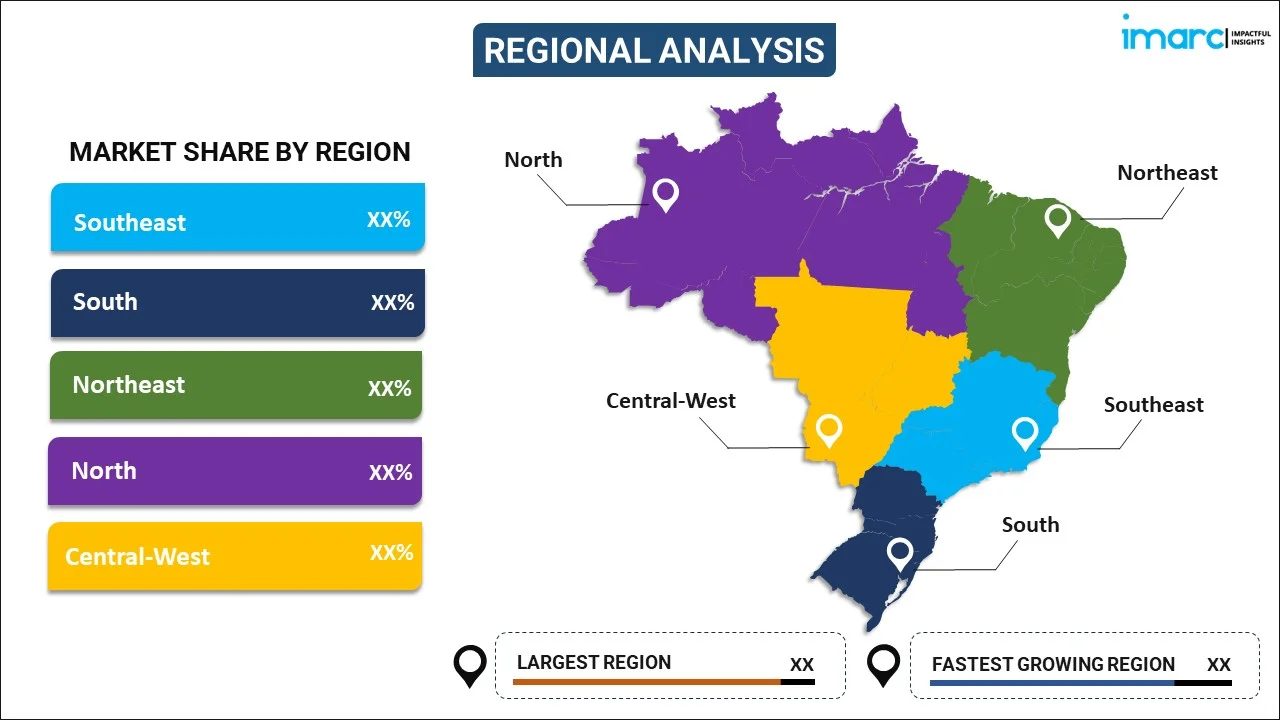
To get detailed regional analysis of this market, Request Sample
- Southeast
- South
- Northeast
- North
- Central-West
Brazil’s Southeast leads the automotive composites market, driven by strong vehicle production hubs in São Paulo and Minas Gerais. OEMs and suppliers increasingly adopt lightweight composites for fuel efficiency and emission compliance. Demand is rising for glass fiber and carbon fiber components in passenger cars and commercial fleets.
The South region, supported by industrial clusters in Paraná and Rio Grande do Sul, shows growing use of automotive composites in structural and interior applications. Expansion of export-oriented manufacturing and partnerships with global automakers encourage adoption. Local suppliers focus on cost-effective fiberglass composites for mid-range vehicles.
Northeast Brazil is an emerging market for automotive composites, backed by new assembly plants and infrastructure improvements. Growth is gradual but promising, with composites gaining attention for corrosion resistance and durability in commercial vehicles. Investment in regional manufacturing could accelerate demand over the next few years.
The North region has limited automotive production compared to other parts of Brazil, resulting in smaller composites demand. However, composites find niche applications in specialized transport and off-road vehicles suited for challenging terrains. Future growth depends on industrial development and improved supply networks.
Central-West Brazil’s automotive composites market is shaped by demand for commercial and agricultural transport vehicles. Lightweight composite parts are gaining traction to improve performance and reduce operating costs in logistics-heavy industries. Growth potential remains tied to expanding infrastructure and regional fleet modernization initiatives.
Market Dynamics:
Growth Drivers:
Why is the Brazil Automotive Composites Market Growing?
Stringent Fuel Efficiency Mandates and Emission Reduction Requirements
Brazilian automotive manufacturers confront increasingly rigorous environmental regulations through the MOVER program's implementation of well-to-wheel carbon emission thresholds, fundamentally transforming vehicle lightweighting from optional performance optimization to mandatory compliance requirement. These regulatory mandates compel automakers to pursue systematic weight reduction across all vehicle systems, with composite materials offering superior strength-to-weight performance compared to conventional steel and aluminum alternatives. The shift from traditional tank-to-wheel emission calculations to comprehensive lifecycle carbon accounting encompasses material production, vehicle manufacturing, operational emissions, and end-of-life recycling considerations, rewarding lightweight composite solutions throughout the entire vehicle lifecycle. In 2025, in accordance with international pledges to lower greenhouse gas emissions, the Brazilian Ministry of Transport has launched a program designed to reduce pollution from freight and passenger vehicles. The initiative outlines a structure for improving efforts to reduce emissions in road transportation. Its objective is to encourage national and international partnerships with both public and private entities to create sustainable solutions, enhance fuel efficiency, and harmonize freight and passenger transportation with environmental conservation objectives.
Rapid EV Production Expansion Creating Immediate Lightweighting Imperatives
Electric vehicle manufacturing growth establishes critical weight management challenges as battery pack systems add significant mass compared to conventional internal combustion powertrains, directly impacting achievable driving range and overall vehicle performance characteristics. Brazilian electric vehicle registrations surged from approximately 41,000 units in 2019 to 177,000 vehicles in 2024, representing substantial market penetration acceleration supported by expanding charging infrastructure and improving vehicle affordability. Heavier traction battery requirements oblige original equipment manufacturers to implement aggressive weight reduction strategies across vehicle bodies, roof structures, and underbody assemblies, where composite floor pans and roof skins deliver immediate mass savings versus metal alternatives while maintaining required structural performance. Electric vehicle manufacturers particularly value composite battery enclosures combining lightweight construction with integrated thermal management capabilities and fire-resistant barrier properties, addressing multiple design requirements through single integrated composite structure replacing complex multi-material assemblies.
Government Investment Incentives and Local Content Requirements Stimulating Manufacturing Capacity Expansion
The MOVER program provides substantial financial incentives totaling approximately USD 4.8 billion in research and development-linked tax credits distributed throughout 2024-2028 period, catalyzing unprecedented automotive industry investment exceeding USD 26 billion in announced manufacturing expansion and technology development programs. Local content requirements encourage global composite material suppliers to establish Brazilian manufacturing operations, reducing import dependency, minimizing currency exchange rate exposure, and shortening supply chain lead times supporting just-in-time automotive manufacturing requirements. These combined incentive structures attract both multinational composites producers pursuing local partnership strategies and domestic tier-one manufacturers expanding into advanced composite fabrication capabilities, systematically building ecosystem infrastructure supporting accelerated composite penetration across Brazilian automotive production.
Market Restraints:
What Challenges the Brazil Automotive Composites Market is Facing?
High Raw Material Costs and Import Tariff Barriers Limiting Mass Market Penetration
Carbon fiber materials command premium pricing typically running three to five times the cost of equivalent-strength steel components, creating substantial economic barriers limiting composite adoption in price-sensitive mass-market vehicle segments where cost-per-kilogram directly impacts retail pricing competitiveness. Domestic manufacturing facilities cannot yet produce aerospace-grade carbon fiber tow required for high-performance structural battery enclosure applications, compelling composite fabricators to stockpile imported materials and commit significant working capital to inventory management. Glass fiber composites, while substantially more affordable than carbon alternatives, still require premium pricing compared to conventional stamped steel components, particularly challenging in entry-level vehicle segments where consumer price sensitivity constrains manufacturers' ability to pass material cost increases to retail pricing. Fleet operators evaluating composite body panels must carefully weigh upfront acquisition cost premiums against potential operational savings through reduced fuel consumption and corrosion elimination, economic calculations complicated by volatile diesel pricing and uncertain vehicle residual values at end of service life.
Capital-Intensive Manufacturing Infrastructure Requirements Creating Entry Barriers
Compression molding equipment investments reach USD 3 to 5 million per press installation, requiring production volume certainty and long-term original equipment manufacturer program commitments that niche specialty applications rarely justify. These substantial capital requirements create significant entry barriers for smaller regional composite manufacturers attempting to compete against established multinational suppliers with existing equipment bases and amortized tooling investments. Labor-intensive hand layup processes, while offering manufacturing flexibility for low-volume specialty applications, fundamentally clash with automotive industry's high-volume production requirements and stringent takt time disciplines governing assembly line operations. Domestic production facilities lack specialized equipment necessary for spinning aerospace-grade carbon fiber precursor materials, forcing converters to maintain substantial imported material inventories and absorb working capital costs while managing currency exchange rate fluctuations affecting raw material procurement costs. The transition to continuous processing technologies, while delivering superior cycle times and material utilization improvements, demands additional capital investment in automated fiber placement systems and specialized tooling infrastructure before manufacturers can access promised productivity advantages.
Limited Recycling Infrastructure and End-of-Life Material Recovery Challenges
Thermoset composite materials' inherent chemical crosslinking structure prevents remelting and reformation, fundamentally limiting recycling options compared to thermoplastic polymers and conventional automotive metals readily processed through established scrap recycling infrastructure. The low recyclability characteristics restrict composite penetration into entry-level passenger vehicle segments where manufacturers face increasing regulatory pressure to demonstrate circular economy compliance and material recovery capabilities at vehicle end-of-life. Current recycling technologies for composite materials typically involve energy-intensive grinding processes producing short fiber fillers suitable only for non-structural applications, failing to capture full material value and creating economic disincentives for systematic recovery programs. Automotive manufacturers implementing composite body panels must develop specialized repair procedures and train collision repair technicians in composite damage assessment and restoration techniques, adding complexity and cost to vehicle service infrastructure throughout product lifecycle. The absence of standardized composite material identification systems complicates sorting and separation during vehicle dismantling operations, limiting material recovery effectiveness and constraining development of economically viable composite recycling business models supporting circular economy objectives.
Competitive Landscape:
The Brazil automotive composites market demonstrates moderately fragmented competitive structure, with established multinational material producers pursuing strategic local partnership models or greenfield manufacturing investments to satisfy domestic content requirements while reducing exposure to import tariff fluctuations. Global composite suppliers leverage extensive material science research capabilities, established original equipment manufacturer relationships developed through international operations, and proven manufacturing process expertise to secure premium applications including carbon fiber structural components and advanced thermoplastic composite systems. These multinational organizations typically focus on high-value automotive applications requiring specialized material formulations, stringent quality certifications, and comprehensive technical support throughout product development cycles, capturing substantial revenue share despite relatively modest unit volume contributions. Regional composite fabricators and material converters address commodity glass fiber applications across door modules, underbody shields, and interior trim components, where established local supply chains, competitive labor costs, and responsive customer service offset multinational suppliers' technical advantages. The competitive landscape features active collaboration between global material producers providing advanced resin systems and fiber reinforcements with regional molding operations delivering finished components directly to automotive assembly plants, creating interdependent ecosystem supporting market expansion across diverse application requirements and performance specifications. Market concentration remains moderate as numerous smaller fabricators serve niche applications and specialty vehicle segments, while industry consolidation pressures intensify as original equipment manufacturers pursue supplier rationalization strategies and demand integrated design-to-delivery composite solutions.
Brazil Automotive Composites Market Report Coverage:
| Report Features | Details |
|---|---|
| Base Year of the Analysis | 2025 |
| Historical Period | 2020-2025 |
| Forecast Period | 2026-2034 |
| Units | Million USD |
| Scope of the Report | Exploration of Historical and Forecast Trends, Industry Catalysts and Challenges, Segment-Wise Historical and Predictive Market Assessment:
|
| Production Processes Covered | Hand Layup, Compression Molding, Continuous Process, Injection Molding |
| Applications Covered | Structural Assembly, Powertrain Component, Interior, Exterior, Others |
| Materials Covered | Thermoset Polymer, Thermoplastic Polymer, Carbon Fiber, Glass Fiber |
| Regions Covered | Southeast, South, Northeast, North, Central-West |
| Customization Scope | 10% Free Customization |
| Post-Sale Analyst Support | 10-12 Weeks |
| Delivery Format | PDF and Excel through Email (We can also provide the editable version of the report in PPT/Word format on special request) |
Frequently Asked Questions About the Brazil Automotive Composites Market Report
The Brazil automotive composites market size was valued at USD 673.99 Million in 2025.
The Brazil automotive composites market is expected to grow at a compound annual growth rate of 11.59% from 2026-2034 to reach USD 1,808.33 Million by 2034.
Compression molding dominated the Brazil Automotive Composites market with 36% market share in 2025, driven by its optimal balance between cost-effectiveness, structural strength capability, and high-volume manufacturing efficiency. The process enables manufacturers to produce large structurally demanding components including pickup truck beds, front-end modules, and underbody floor panels with consistent dimensional accuracy and superior surface finish quality.
Key factors driving the Brazil Automotive Composites market include stringent fuel efficiency mandates implementing well-to-wheel carbon emission thresholds transforming lightweighting into regulatory compliance requirement, rapid electric vehicle production expansion creating immediate weight reduction imperatives to offset battery mass penalties, and substantial government investment through MOVER program providing approximately USD 4.8 billion in research and development tax credits catalyzing automaker investments targeting emission reduction and advanced manufacturing capabilities.
Major challenges include high raw material costs with carbon fiber commanding premium pricing three to five times equivalent-strength steel while import tariff increases elevated polymer costs, capital-intensive manufacturing infrastructure requiring compression press investments creating entry barriers for regional manufacturers, limited recycling capabilities as thermoset materials' chemical crosslinking prevents remelting restricting end-of-life material recovery, and domestic production limitations requiring importation of aerospace-grade carbon fiber tow compelling manufacturers to stockpile materials and commit significant working capital.
Need more help?
- Speak to our experienced analysts for insights on the current market scenarios.
- Include additional segments and countries to customize the report as per your requirement.
- Gain an unparalleled competitive advantage in your domain by understanding how to utilize the report and positively impacting your operations and revenue.
- For further assistance, please connect with our analysts.
 Request Customization
 Speak to an Analyst
 Request Brochure
 Inquire Before Buying
Benefits of Customization
- Personalize this research
- Triangulate with your data
- Get data as per your format and definition
- Gain a deeper dive into a specific application, geography, customer, or competitor
- Any level of personalization
Get in Touch With Us
UNITED STATES
Phone: +1-201-971-6302
INDIA
Phone: +91-120-433-0800
UNITED KINGDOM
Phone: +44-753-714-6104
Email: [email protected]
Client Testimonials




.webp)




.webp)













Related Reports

Choose your plan
*Please note that the prices mentioned below are starting prices for each bundle type. Kindly contact our team for further details.*
Single User License
- 1 User License, Access on 2 Devices
- PDF Report + Excel Dataset (Password Protected)
- Lifetime Access
- No Printing Rights
- 10% Free Report Customization
- 10–12 Weeks of Analyst Support
Five User License
- Access for 5 Users, 2 Devices per User
- PDF Report + Excel Dataset (Password Protected)
- Lifetime Access
- Dedicated Account Manager
- 12–14 Weeks of Analyst Support
- No Printing Rights
- 15% Free Report Customization
- 25% Discount on Your Next Purchase
Corporate User License
- Unlimited User Access (Within Your Organization)
- PDF Report + Excel Dataset
- Lifetime Access
- Dedicated Account Manager
- 14–20 Weeks of Analyst Support
- No Printing Rights
- 20% Free Report Customization
- 30% Discount on Your Next Purchase
Essential Insights
What's included:
3 reports
- Lifetime Access
- PDF Reports
- Excel Datasets
- 2 Weeks of Free Analyst Support
- 2 User Licenses
- Access on 2 Devices
- Printing Rights
- Complimentary PowerPoint (PPT) Version
- Complimentary License Upgrade
Professional Access
What's included:
5 reports
- Lifetime Access
- PDF Reports
- Excel Datasets
- 8 Weeks of Free Analyst Support
- 2 User Licenses
- Access on 2 Devices
- Printing Rights
- Complimentary PowerPoint (PPT) Version
- Complimentary License Upgrade
Business Advantage
What's included:
8 reports
- Lifetime Access
- PDF Reports
- Excel Datasets
- 14 Weeks of Free Analyst Support
- 2 User Licenses
- Access on 2 Devices
- Printing Rights
- Complimentary PowerPoint (PPT) Version
- Complimentary License Upgrade
Enterprise Intelligence
What's included:
10 reports
- Lifetime Access
- PDF Reports
- Excel Datasets
- 20 Weeks of Free Analyst Support
- 2 User Licenses
- Access on 2 Devices
- Printing Rights
- Complimentary PowerPoint (PPT) Version
- Complimentary License Upgrade