
Brazil Biodegradable Food Service Disposables Market Size, Share, Trends and Forecast by Raw Material Type, Product Type, Distribution Channel, and Region, 2026-2034
Brazil Biodegradable Food Service Disposables Market Overview:
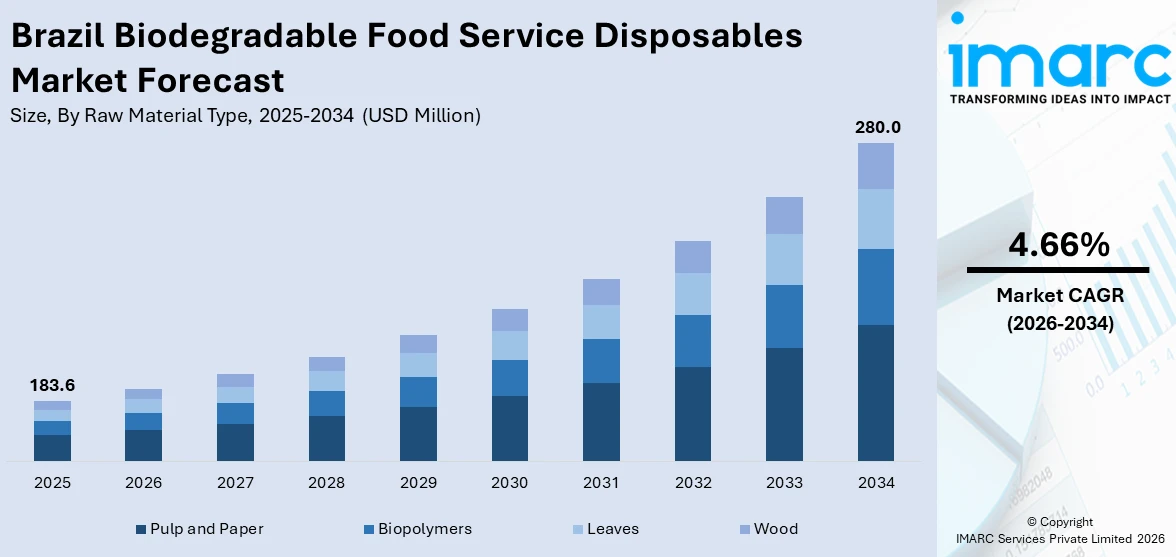
The Brazil biodegradable food service disposables market size reached USD 183.6 Million in 2025. The market is projected to reach USD 280.0 Million by 2034, exhibiting a growth rate (CAGR) of 4.66% during 2026-2034. The market is driven by strengthening regulatory frameworks promoting circular economy practices and municipal-level plastic restrictions, the rapid expansion of food delivery platforms and quick service restaurants creating substantial demand for sustainable packaging solutions, and significant corporate investments in biopolymer production infrastructure and green manufacturing capabilities. Additionally, Brazil's robust agro-industrial sector provides abundant access to raw materials such as sugarcane bagasse and cassava starch, further supporting the Brazil biodegradable food service disposables market share.
|
Report Attribute
|
Key Statistics
|
|---|---|
|
Base Year
|
2025
|
|
Forecast Years
|
2026-2034
|
|
Historical Years
|
2020-2025
|
| Market Size in 2025 | USD 183.6 Million |
| Market Forecast in 2034 | USD 280.0 Million |
| Market Growth Rate 2026-2034 | 4.66% |
Brazil Biodegradable Food Service Disposables Market Trends:
Government Policies and Regulatory Push
The most important driver for the growth of the Brazilian market for biodegradable food service disposables is the tightening of environmental regulation at the municipal and federal levels. Because a number of Brazilian municipalities have restricted or banned the distribution of conventional single-use plastics, demand has grown for biodegradable alternatives. Though this is part of a general national goal to reduce pollution and promote sustainable consumption, there is also demand for eco-friendly disposable products from public buildings and institutions such as schools. Tax incentives and certifications for manufacturers using recyclable, compostable, or biodegradable materials are encouraging local production of biodegradable packaging. Collaborations of environmental organizations and trade organizations are encouraging advances in material science and waste management. Composability standards, labeling, and other regulations may help consumers buy more sustainable products and materials. These also incentivize businesses to improve procurement and supply chain practices. Compliance becomes mandatory. Manufacturers can increase production capacity to meet the growing market demand. Such a policy-driven shift can change the food service environment by adopting sustainability in their business models. By matching regulation and market innovation, authorities are increasing demand and protecting social objectives towards the industry.
To get more information on this market Request Sample
Technological Advancements and Material Innovation
Technological innovation is playing a crucial role in advancing the biodegradable food service disposables market in Brazil. Manufacturers are investing in modern production techniques to develop high-performance products that match the durability of traditional plastics while remaining environmentally safe. Research initiatives are focusing on sourcing raw materials from agricultural waste such as sugarcane fiber, cassava starch, and palm residues. These bio-based materials offer a local and abundant supply, reducing dependency on imports. Improvements in molding technology and biodegradable coatings are enhancing the functionality of disposable items, making them suitable for hot and cold foods, liquids, and heavy usage. Partnerships between universities, startups, and packaging companies are accelerating the commercialization of new biodegradable composites. Additionally, advancements in waste processing infrastructure, including industrial composting facilities, are supporting end-of-life management for these products. Businesses in the hospitality and quick-service restaurant sectors are increasingly adopting certified biodegradable solutions to align with sustainability goals. This technological progress is lowering production costs and increasing product availability. As innovation continues to evolve, the market is expected to witness greater adoption across mainstream food service providers, reinforcing Brazil’s transition toward environmentally responsible consumption.
Rising Demand for Eco-Friendly Alternatives
The Brazil biodegradable food service disposables market growth is being primarily driven by increasing environmental awareness and growing consumer preference for sustainable products. With concerns over plastic pollution and landfill waste, food service businesses such as restaurants, cafés, and catering services are shifting toward biodegradable plates, cups, and cutlery. Government regulations discouraging single-use plastics are further accelerating this transition. Consumers are actively choosing establishments that adopt green practices, pushing companies to rethink their packaging strategies. The food delivery and takeaway sectors, which have expanded significantly, are also contributing to the demand for compostable and plant-based packaging solutions. Local manufacturers are investing in research to develop cost-effective biodegradable materials made from sugarcane bagasse, bamboo, and cornstarch. Additionally, multinational brands are entering the Brazilian market, offering certified eco-friendly alternatives. Educational campaigns promoting responsible consumption and waste management are supporting this shift. As sustainability becomes a key competitive factor, businesses adopting biodegradable disposables are gaining a stronger brand image. This movement reflects a broader national commitment to circular economy principles. The growing alignment between industry innovation, regulatory support, and consumer expectations is positioning biodegradable food service disposables as a vital segment within Brazil’s evolving packaging landscape.
.webp)
Brazil Biodegradable Food Service Disposables Market Segmentation:
IMARC Group provides an analysis of the key trends in each segment of the market, along with forecasts at the country and regional levels for 2026-2034. Our report has categorized the market based on raw material type, product type, and distribution channel.
Raw Material Type Insights:
- Pulp and Paper
- Biopolymers
- Leaves
- Wood
The report has provided a detailed breakup and analysis of the market based on the raw material type. This includes pulp and paper, biopolymers, leaves, and wood.
Product Type Insights:
- Cups
- Clamshells and Containers
- Plates
- Cutleries
- Others
A detailed breakup and analysis of the market based on the product type have also been provided in the report. This includes cups, clamshells and containers, plates, cutleries, and others.
Distribution Channel Insights:
Access the comprehensive market breakdown Request Sample
- Business to Business (B2B)
- Business to Customer (B2C)
- Supermarkets and Hypermarkets
- Online Stores
- Others
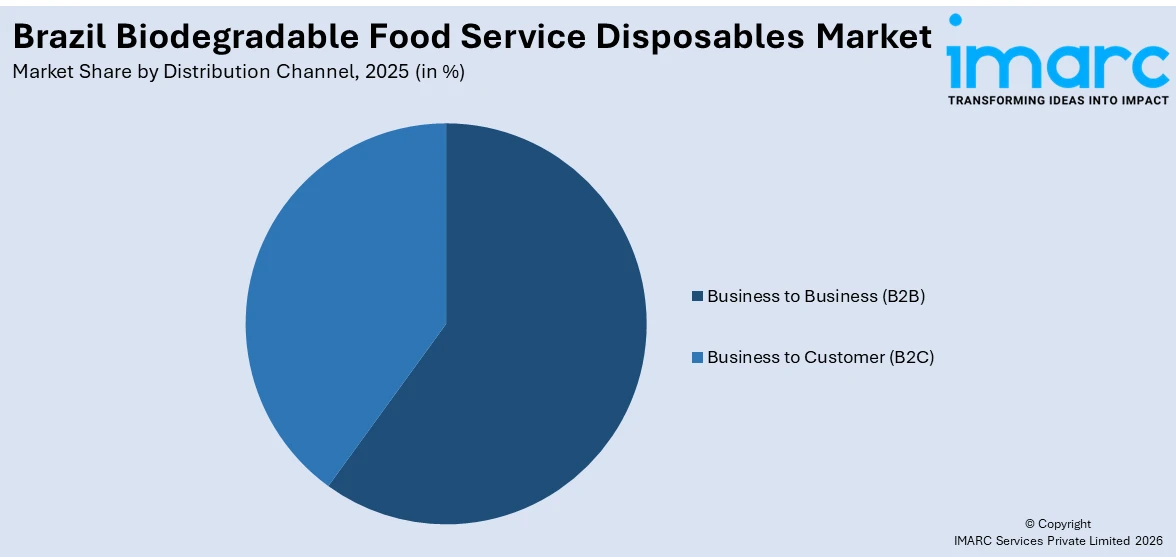
The report has provided a detailed breakup and analysis of the market based on the distribution channel. This includes business to business (B2B) and business to customer (B2C) (supermarkets and hypermarkets, online stores, and others).
Regional Insights:
- Southeast
- South
- Northeast
- North
- Central-West
The report has also provided a comprehensive analysis of all the major regional markets, which include Southeast, South, Northeast, North, and Central-West.
Competitive Landscape:
The market research report has also provided a comprehensive analysis of the competitive landscape. Competitive analysis such as market structure, key player positioning, top winning strategies, competitive dashboard, and company evaluation quadrant has been covered in the report. Also, detailed profiles of all major companies have been provided.
Brazil Biodegradable Food Service Disposables Market News:
- June 2025: Luzhou Pack (OASIS) showcased sugarcane pulp-based biodegradable tableware at FISPAL in São Paulo, Brazil. The exhibition highlighted eco-friendly, compostable, and heat-resistant disposables, strengthening market awareness, promoting sustainable packaging adoption, and positively driving the growth of Brazil’s biodegradable food service disposables market.
Brazil Biodegradable Food Service Disposables Market Report Coverage:
| Report Features | Details |
|---|---|
| Base Year of the Analysis | 2025 |
| Historical Period | 2020-2025 |
| Forecast Period | 2026-2034 |
| Units | Million USD |
| Scope of the Report |
Exploration of Historical Trends and Market Outlook, Industry Catalysts and Challenges, Segment-Wise Historical and Future Market Assessment:
|
| Raw Material Types Covered | Pulp and Paper, Biopolymers, Leaves, Wood |
| Product Types Covered | Cups, Clamshells and Containers, Plates, Cutleries, Others |
| Distribution Channels Covered |
|
| Regions Covered | Southeast, South, Northeast, North, Central-West |
| Customization Scope | 10% Free Customization |
| Post-Sale Analyst Support | 10-12 Weeks |
| Delivery Format | PDF and Excel through Email (We can also provide the editable version of the report in PPT/Word format on special request) |
Key Questions Answered in This Report:
- How has the Brazil biodegradable food service disposables market performed so far and how will it perform in the coming years?
- What is the breakup of the Brazil biodegradable food service disposables market on the basis of raw material type?
- What is the breakup of the Brazil biodegradable food service disposables market on the basis of product type?
- What is the breakup of the Brazil biodegradable food service disposables market on the basis of distribution channel?
- What is the breakup of the Brazil biodegradable food service disposables market on the basis of region?
- What are the various stages in the value chain of the Brazil biodegradable food service disposables market?
- What are the key driving factors and challenges in the Brazil biodegradable food service disposables market?
- What is the structure of the Brazil biodegradable food service disposables market and who are the key players?
- What is the degree of competition in the Brazil biodegradable food service disposables market?
Key Benefits for Stakeholders:
- IMARC’s industry report offers a comprehensive quantitative analysis of various market segments, historical and current market trends, market forecasts, and dynamics of the Brazil biodegradable food service disposables market from 2020-2034.
- The research report provides the latest information on the market drivers, challenges, and opportunities in the Brazil biodegradable food service disposables market.
- Porter's Five Forces analysis assists stakeholders in assessing the impact of new entrants, competitive rivalry, supplier power, buyer power, and the threat of substitution. It helps stakeholders to analyze the level of competition within the Brazil biodegradable food service disposables industry and its attractiveness.
- Competitive landscape allows stakeholders to understand their competitive environment and provides an insight into the current positions of key players in the market.
Need more help?
- Speak to our experienced analysts for insights on the current market scenarios.
- Include additional segments and countries to customize the report as per your requirement.
- Gain an unparalleled competitive advantage in your domain by understanding how to utilize the report and positively impacting your operations and revenue.
- For further assistance, please connect with our analysts.
 Request Customization
 Speak to an Analyst
 Request Brochure
 Inquire Before Buying
Benefits of Customization
- Personalize this research
- Triangulate with your data
- Get data as per your format and definition
- Gain a deeper dive into a specific application, geography, customer, or competitor
- Any level of personalization
Get in Touch With Us
UNITED STATES
Phone: +1-201-971-6302
INDIA
Phone: +91-120-433-0800
UNITED KINGDOM
Phone: +44-753-714-6104
Email: [email protected]
Client Testimonials




.webp)




.webp)













Related Reports

Choose your plan
*Please note that the prices mentioned below are starting prices for each bundle type. Kindly contact our team for further details.*
Single User License
- 1 User License, Access on 2 Devices
- PDF Report + Excel Dataset (Password Protected)
- Lifetime Access
- No Printing Rights
- 10% Free Report Customization
- 10–12 Weeks of Analyst Support
Five User License
- Access for 5 Users, 2 Devices per User
- PDF Report + Excel Dataset (Password Protected)
- Lifetime Access
- Dedicated Account Manager
- 12–14 Weeks of Analyst Support
- No Printing Rights
- 15% Free Report Customization
- 25% Discount on Your Next Purchase
Corporate User License
- Unlimited User Access (Within Your Organization)
- PDF Report + Excel Dataset
- Lifetime Access
- Dedicated Account Manager
- 14–20 Weeks of Analyst Support
- No Printing Rights
- 20% Free Report Customization
- 30% Discount on Your Next Purchase
Essential Insights
What's included:
3 reports
- Lifetime Access
- PDF Reports
- Excel Datasets
- 2 Weeks of Free Analyst Support
- 2 User Licenses
- Access on 2 Devices
- Printing Rights
- Complimentary PowerPoint (PPT) Version
- Complimentary License Upgrade
Professional Access
What's included:
5 reports
- Lifetime Access
- PDF Reports
- Excel Datasets
- 8 Weeks of Free Analyst Support
- 2 User Licenses
- Access on 2 Devices
- Printing Rights
- Complimentary PowerPoint (PPT) Version
- Complimentary License Upgrade
Business Advantage
What's included:
8 reports
- Lifetime Access
- PDF Reports
- Excel Datasets
- 14 Weeks of Free Analyst Support
- 2 User Licenses
- Access on 2 Devices
- Printing Rights
- Complimentary PowerPoint (PPT) Version
- Complimentary License Upgrade
Enterprise Intelligence
What's included:
10 reports
- Lifetime Access
- PDF Reports
- Excel Datasets
- 20 Weeks of Free Analyst Support
- 2 User Licenses
- Access on 2 Devices
- Printing Rights
- Complimentary PowerPoint (PPT) Version
- Complimentary License Upgrade