
Brazil Blockchain Gaming Market Size, Share, Trends and Forecast by Game Type, Platform, and Region, 2026-2034
Brazil Blockchain Gaming Market Size, Share, Trends & Forecast (2026-2034)
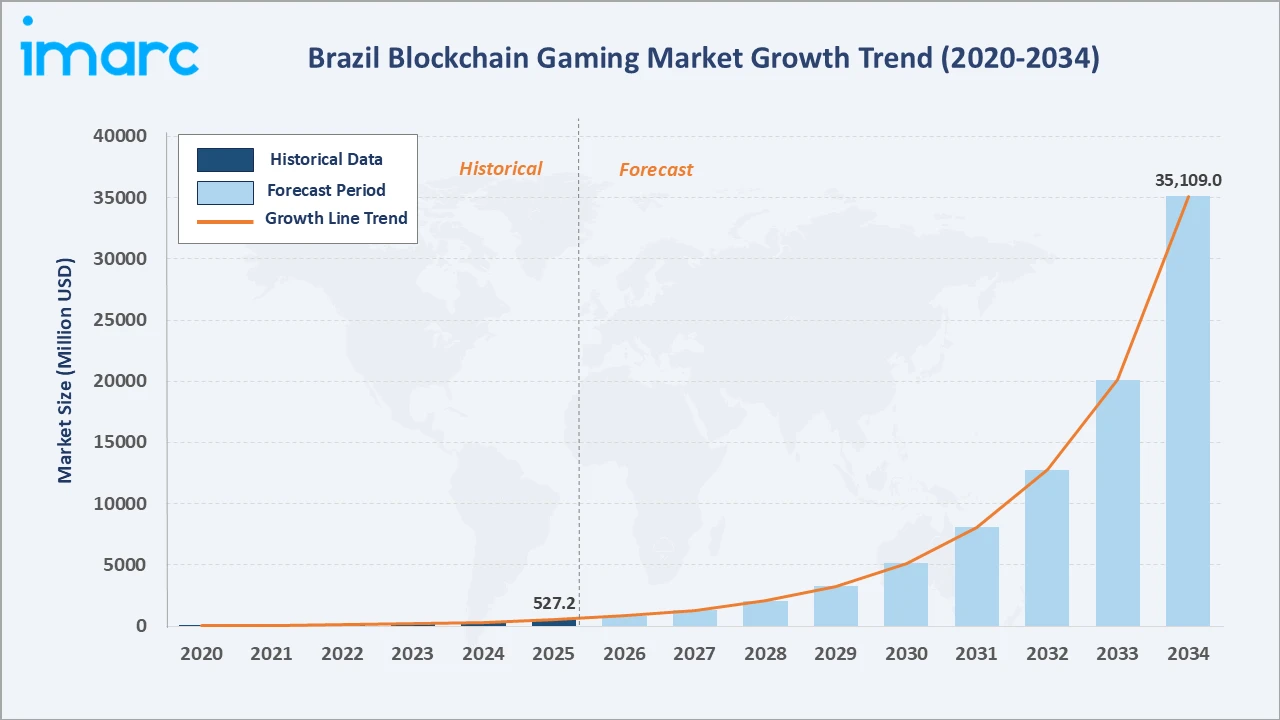
The Brazil blockchain gaming market grew from USD 527.2 Million in 2025 to USD 831.2 Million in 2026 and is projected to reach USD 35,109.0 Million by 2034, exhibiting a CAGR of 57.66% during 2026-2034. Surging adoption of play-to-earn gaming models, rising digital asset ownership among Brazilian consumers, and expanding integration of non-fungible tokens into interactive entertainment platforms are the primary forces shaping market growth.
Role playing games lead the game type segment at 45.0%, ETH dominates the platform segment at 45.0%, and Southeast commands 55.0% of regional share.
Market Snapshot
| Metric | Value |
|---|---|
| Base Year Market Size (2025) | USD 527.2 Million |
| Market Size (2026) | USD 831.2 Million |
| Forecast Market Size (2034) | USD 35,109.0 Million |
| CAGR (2026-2034) | 57.66% |
| Base Year | 2025 |
| Historical Period | 2020-2025 |
| Forecast Period | 2026-2034 |
| Largest Region | Southeast (55.0%, 2025) |
| Second Largest Region | South (18.0%, 2025) |
| Leading Game Type | Role Playing Games (45.0%, 2025) |
| Leading Platform | ETH (45.0%, 2025) |
The Brazil blockchain gaming market size increased from USD 54.1 Million in 2020 to USD 527.2 Million in 2025 and is estimated to reach USD 831.2 Million in 2026. The market is further expected to grow to USD 5,135.6 Million by 2030 and USD 35,109.0 Million by 2034. The market occupies a commercially distinctive position within Latin America's gaming sector, underpinned by one of the region's most digitally engaged youth populations, a rapidly expanding play-to-earn ecosystem driven by decentralized finance integration, and deepening developer and institutional investment in blockchain-based interactive entertainment infrastructure.
To get more information on this market, Request Sample
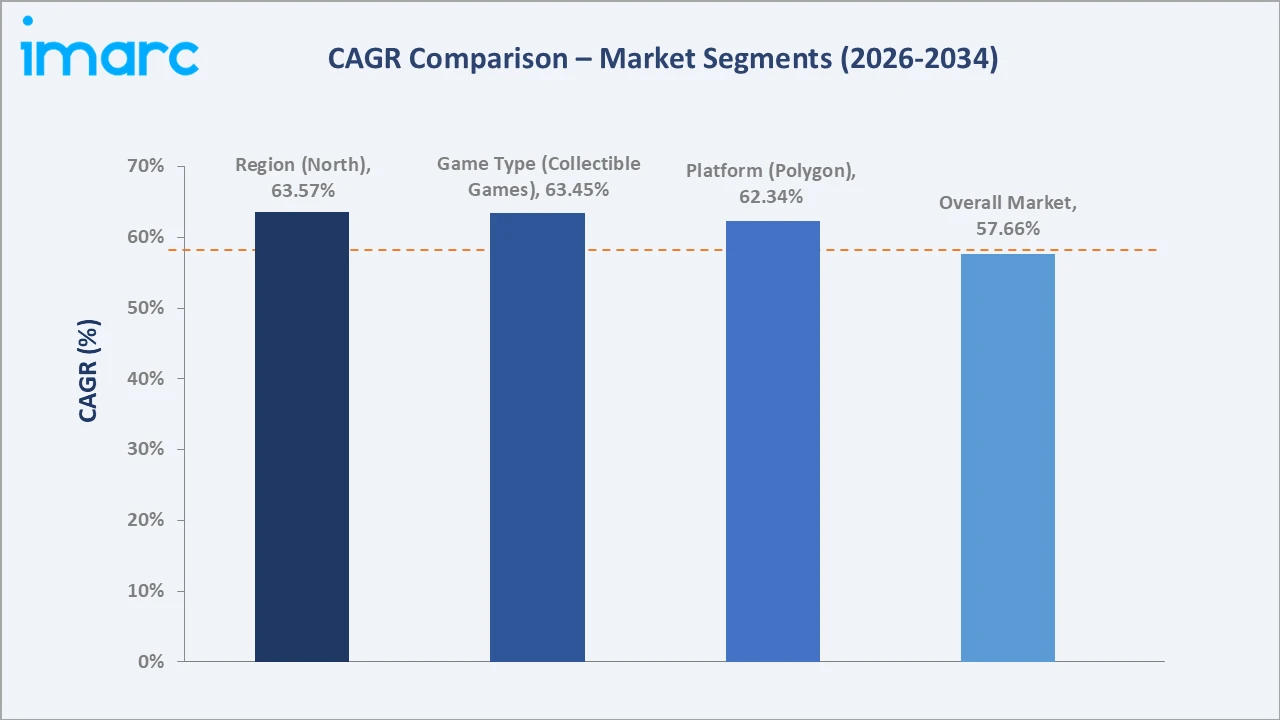
CAGR trajectories across game type, platform, and regional sub-segments show collectible games and North expanding faster than the overall 57.66% market CAGR, driven by increasing demand for tradeable in-game digital assets, growing rural connectivity infrastructure investment, and rising government support for digital economy initiatives across Brazil's emerging northern regions.
Executive Summary
The Brazil blockchain gaming market expanded from USD 527.2 Million in 2025 to an estimated USD 831.2 Million in 2026, positioning it among Latin America's fastest-growing blockchain entertainment markets by growth rate. The market expansion is underpinned by Brazil's large and digitally engaged gaming population, the rapid proliferation of play-to-earn platforms, and increasing institutional investment in decentralized gaming infrastructure.
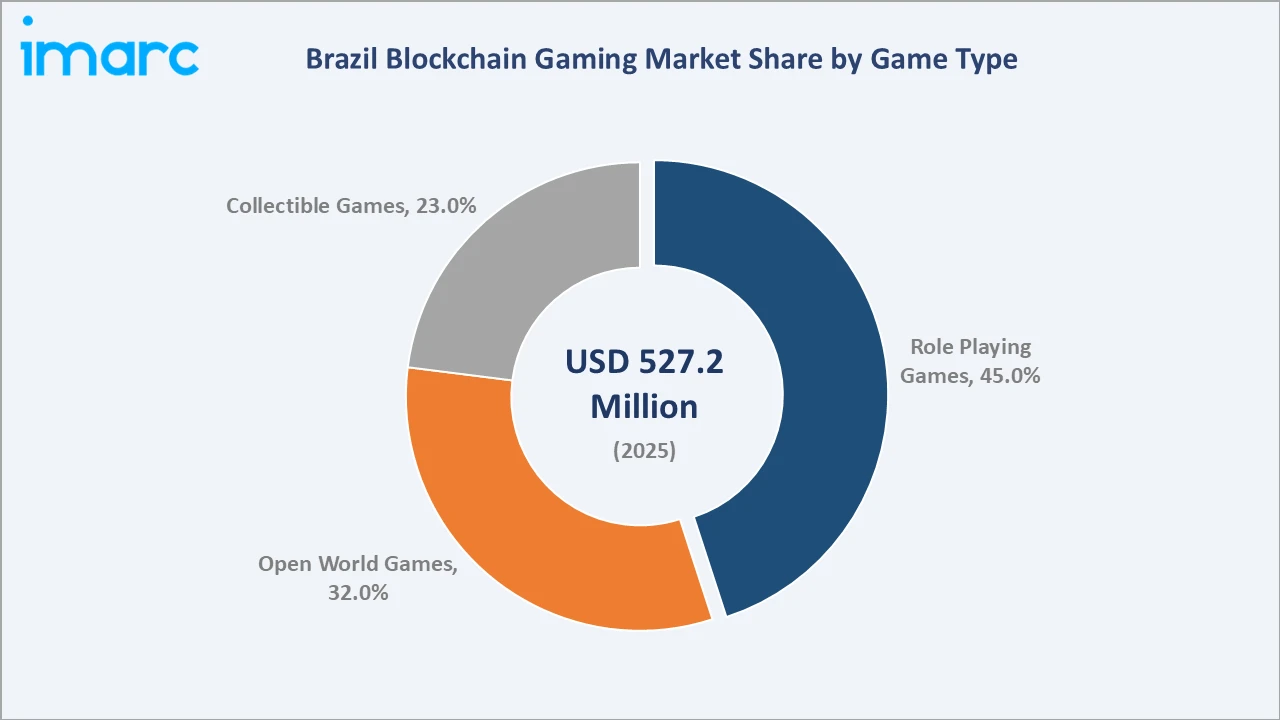
Role playing games command 45.0% game type share, reflecting their narrative depth, immersive world-building mechanics, and high player engagement potential, which make them well-suited to blockchain-based ownership and token economy structures. ETH represents 45.0% of the platform segment, anchored by its established smart contract infrastructure, deep liquidity pools, and large developer community. Southeast leads regional share at 55.0%, driven by São Paulo and Rio de Janeiro's large urban gaming populations, high smartphone penetration rates, and concentration of blockchain technology development hubs.
Key Market Insights
| Insight | Data |
|---|---|
| Leading Game Type | Role Playing Games – 45.0% share (2025) |
| Second Largest Game Type | Open World Games – 32.0% share (2025) |
| Leading Platform | ETH – 45.0% share (2025) |
| Second Largest Platform | BNB Chain – 35.0% share (2025) |
| Leading Region | Southeast – 55.0% share (2025) |
| Second Largest Region | South – 18.0% share (2025) |
| Top Companies | Sky Mavis Pte. Ltd., Animoca Brands Corporation Ltd., Dapper Labs Inc., Immutable Pty Ltd |
Key Analytical Observations Expanding On the Data Above:
- Role playing games leadership at 45.0% reflects the high engagement intensity of narrative-driven blockchain games, where ownership of in-game assets and characters through NFTs creates strong player retention and monetization potential in Brazil's gaming market.
- Open world games at 32.0% are supported by their sandbox mechanics and expansive virtual environments, which offer diverse asset ownership opportunities and attract both casual gamers and digital asset collectors.
- ETH dominance at 45.0% is driven by its established developer ecosystem, deep liquidity for NFT transactions, and extensive compatibility with the leading blockchain game titles operating in Brazil.
- BNB Chain at 35.0% is growing as game developers prioritize lower transaction fees and faster processing speeds, particularly for play-to-earn titles that involve frequent micro-transactions.
- Southeast at 55.0% leads regional share due to São Paulo and Rio de Janeiro concentrating high digital connectivity rates, large gamer population, and active blockchain technology and fintech ecosystems.
Brazil Blockchain Gaming Market Overview
Blockchain gaming refers to interactive digital entertainment platforms that integrate distributed ledger technology to enable verifiable ownership of in-game assets through non-fungible tokens, as well as token-based economic systems that allow players to earn, trade, and exchange value within and across gaming ecosystems. Applications range from play-to-earn models in role-playing environments to tradeable digital collectibles and open virtual world economies.
The Brazilian blockchain gaming ecosystem integrates game developers and studios, blockchain protocol providers, NFT marketplace operators, digital wallet providers, exchange platforms, and retail and institutional investors. Government digital economy initiatives, fintech infrastructure, and a large youth gaming demographic form the market's macro foundation. Together, these elements create an expanding, technically sophisticated, and commercially viable blockchain gaming market across Brazil's major urban and emerging regional centers.
Market Dynamics
To evaluate market opportunities, Request Sample
Market Drivers
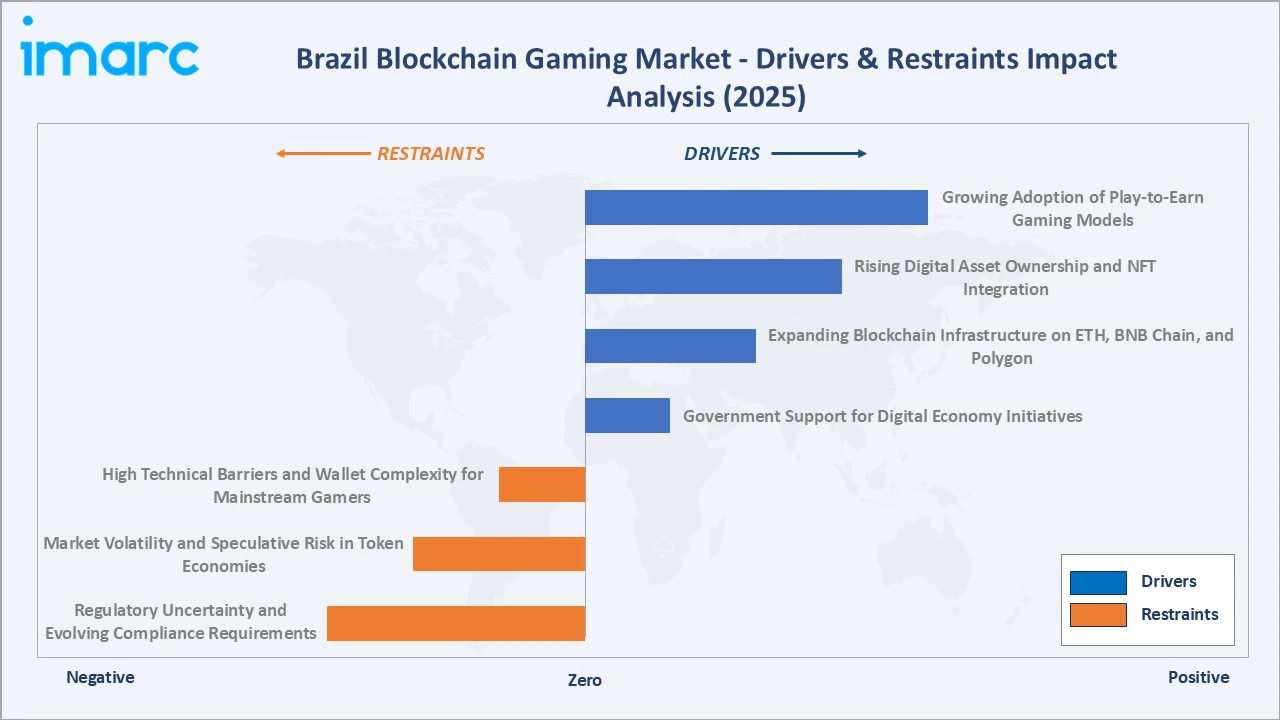
- Growing Adoption of Play-to-Earn Gaming Models: Brazil's gaming community has demonstrated strong engagement with play-to-earn mechanics, driven by economic incentives and the ability to convert in-game achievements into tradeable digital assets. The integration of decentralized finance tools into gaming platforms is creating new revenue streams for players and developers alike.
- Rising Digital Asset Ownership and NFT Integration: The growing acceptance of NFTs as a medium for in-game asset ownership is driving adoption across role-playing and collectible game segments. Cryptocurrency adoption is increasing, providing a strong foundation for blockchain gaming growth in the country. As per IMARC Group, the Brazil cryptocurrency market size reached USD 59,116.9 Million in 2025.
- Expanding Blockchain Infrastructure on ETH, BNB Chain, and Polygon: The availability of scalable, developer-friendly blockchain platforms is enabling a growing number of gaming studios to build and deploy blockchain-integrated titles. Each platform's specific strengths in throughput, transaction cost, and developer tools create a diverse and competitive game development environment.
- Government Support for Digital Economy Initiatives: Brazil's federal government has advanced regulatory frameworks for digital assets, providing increased clarity for blockchain gaming platforms, NFT markets, and play-to-earn operators. These initiatives are encouraging institutional investment and international game studio expansion into the Brazilian market.
Market Restraints
- Regulatory Uncertainty and Evolving Compliance Requirements: The Brazilian regulatory environment for digital assets and blockchain gaming remains in active development, creating compliance complexity for operators navigating tax treatment of in-game tokens, NFT classification, and financial service registration requirements.
- High Technical Barriers and Wallet Complexity for Mainstream Gamers: Blockchain game adoption among mainstream Brazilian gamers is constrained by the technical complexity of setting up digital wallets, managing private keys, and navigating token exchange processes, limiting the addressable market to digitally experienced early adopters.
- Market Volatility and Speculative Risk in Token Economies: The price volatility of in-game tokens and NFTs creates financial risk for both players and developers, limiting participation from risk-averse segments of Brazil's gaming population and complicating long-term product planning for game studios.
Market Opportunities
- Expansion of Mobile-First Blockchain Gaming for Brazil's Smartphone Majority: Brazil's mobile gaming penetration creates a substantial opportunity for mobile-optimized blockchain games that simplify wallet integration and reduce onboarding friction, expanding the addressable market to mainstream players across all regions.
- Cross-Border Play-to-Earn Revenue for Brazilian Gamers: Brazilian players participating in global play-to-earn ecosystems can generate USD-denominated earnings, which carry significant real-world value given Brazil's local currency dynamics, creating strong economic incentives for continued market participation and growth.
Market Challenges
- On-Ramp and Off-Ramp Complexity for Local Currency Conversion: Converting Brazilian Real earnings into or out of blockchain gaming tokens involves navigating exchange rate volatility, local banking restrictions, and varying platform fee structures that add friction to the player economic experience.
- Developer Retention and Quality Content Production at Scale: Sustaining a pipeline of high-quality, engaging blockchain game content requires experienced developer talent with cross-disciplinary expertise in game design, smart contract development, and token economics, which remains a constrained resource in Brazil's current market.
Emerging Market Trends
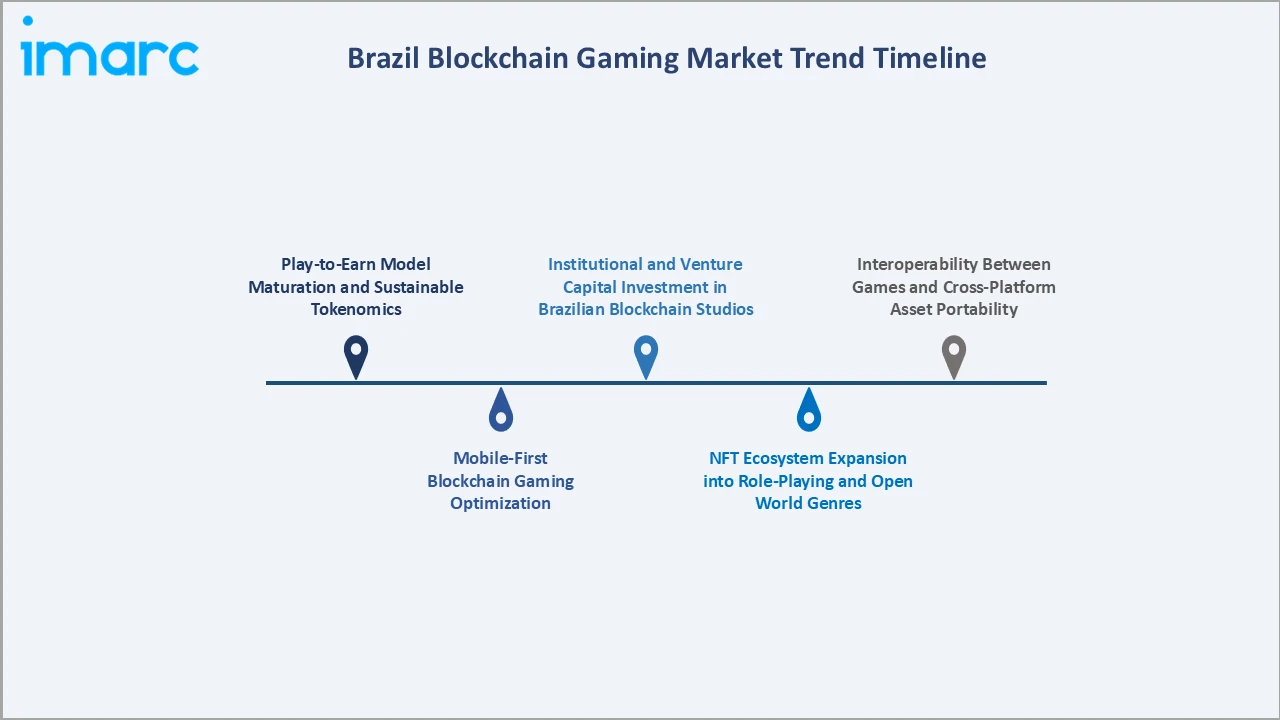
1. Play-to-Earn Model Maturation and Sustainable Tokenomics
Play-to-earn mechanics are evolving from early inflationary token models toward sustainable dual-token economic structures that balance player rewards with long-term ecosystem health. Developers in Brazil are increasingly adopting tokenomics frameworks that separate governance and utility tokens to prevent reward dilution. This trend is improving player retention and attracting longer-term capital to blockchain gaming platforms operating in the country.
2. Mobile-First Blockchain Gaming Optimization
Brazil's gaming market is predominantly mobile-driven, and blockchain game developers are actively optimizing user interfaces and wallet integration for mobile platforms. Simplified on-boarding flows that abstract wallet management from the gaming experience are improving accessibility for mainstream Brazilian gamers.
3. NFT Ecosystem Expansion into Role-Playing and Open World Genres
The integration of NFTs into role-playing and open world game genres is deepening, with developers creating persistent digital asset layers where in-game characters, land parcels, and equipment have verifiable on-chain ownership. This creates secondary market liquidity and investor participation alongside traditional player bases, driving rapid expansion in Brazil's collectibles and gaming NFT marketplace segments.
4. Institutional and Venture Capital Investment in Brazilian Blockchain Studios
Domestic and international venture capital interest in Brazilian blockchain gaming studios is rising, as investors recognize Brazil's large youth gaming demographic and high cryptocurrency engagement as differentiating market advantages. Strategic investment from global gaming and blockchain funds is accelerating studio formation, platform development, and international co-publishing partnerships for Brazilian developers.
5. Interoperability Between Games and Cross-Platform Asset Portability
Blockchain gaming developers are exploring technical standards for cross-game asset portability, allowing players to use NFTs and digital characters across multiple gaming titles and platforms. Early-stage interoperability protocols being tested on Polygon and ETH networks are positioning Brazilian game studios to participate in multi-game metaverse ecosystems that expand total addressable market reach.
Industry Value Chain Analysis
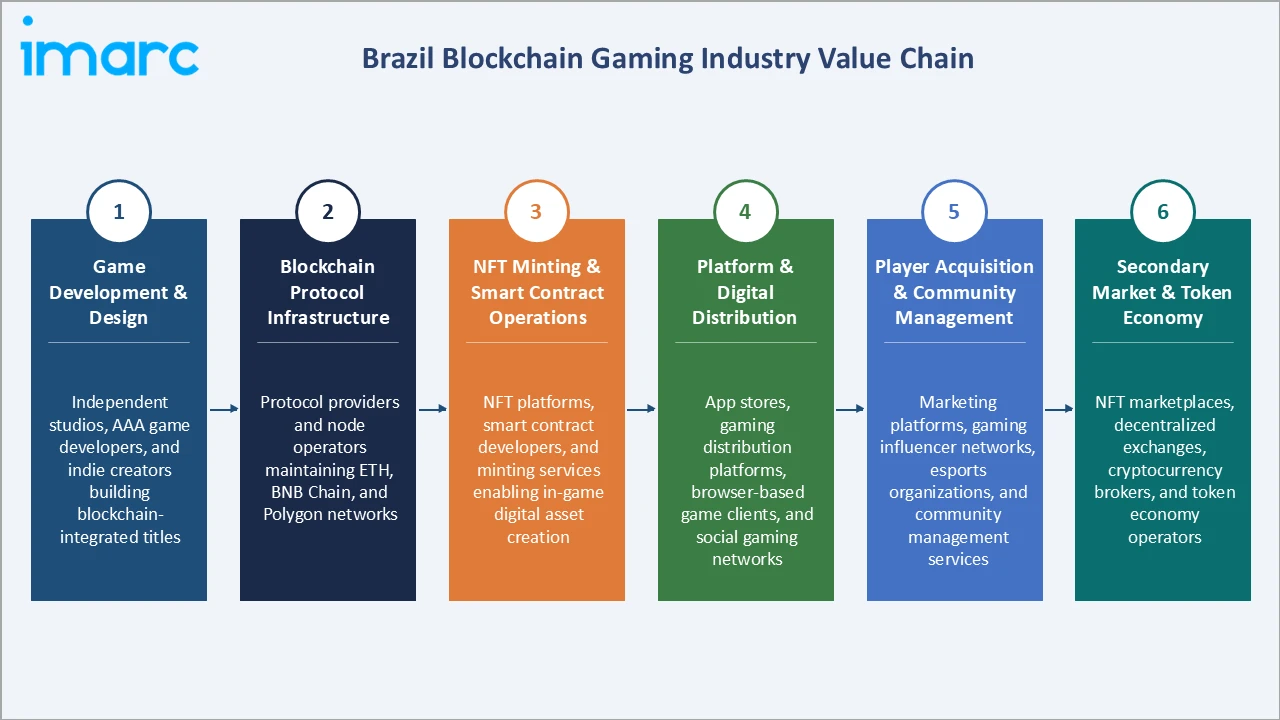
The Brazil blockchain gaming value chain spans six stages, from intellectual property creation and blockchain infrastructure provisioning through NFT minting, platform distribution, player engagement, and secondary market token economies. Smart contract development and NFT marketplace operation capture high value-add, while game studio IP creation and player acquisition form the competitive differentiation anchors across the ecosystem.
| Stage | Key Players / Examples |
|---|---|
| Game Development & Design | Independent studios, AAA game developers, and indie creators building blockchain-integrated titles across role-playing, open world, and collectible game genres |
| Blockchain Protocol Infrastructure | Protocol providers and node operators maintaining the ETH, BNB Chain, and Polygon networks that underpin smart contract execution and NFT transactions |
| NFT Minting & Smart Contract Operations | NFT platforms, smart contract developers, and minting services enabling the creation, authentication, and transfer of in-game digital assets on-chain |
| Platform & Digital Distribution | App stores, gaming distribution platforms, browser-based game clients, and social gaming networks facilitating player access to blockchain game titles |
| Player Acquisition & Community Management | Marketing platforms, gaming influencer networks, esports organizations, and community management services driving player engagement and retention |
| Secondary Market & Token Economy | NFT marketplaces, decentralized exchanges, cryptocurrency brokers, and token economy operators enabling secondary trading and monetization of in-game assets |
Vertically integrated operators controlling game development, smart contract infrastructure, and NFT marketplace operations are positioned to capture greater economic value than single-stage participants dependent on third-party platforms and spot NFT liquidity.
Technology Landscape in the Brazil Blockchain Gaming Industry
Smart Contract Platforms
Smart contracts on ETH, BNB Chain, and Polygon form the foundational technology layer of Brazil's blockchain gaming market. Each platform offers distinct trade-offs in transaction throughput, gas cost, and security, influencing developer platform choices. ETH dominates for high-value NFT games requiring maximum security, while BNB Chain and Polygon attract developers prioritizing cost efficiency and speed for play-to-earn models.
Layer-2 Scaling Solutions
Layer-2 scaling technologies, including Polygon's Proof-of-Stake sidechain and ETH rollup solutions, are being adopted to reduce transaction fees and improve game responsiveness. These solutions enable micro-transactions within gaming environments that would be cost-prohibitive on Ethereum Layer 1, expanding the range of blockchain game mechanics that can be viably deployed for Brazil's cost-sensitive gaming market.
Wallet Integration and On-Boarding Technology
Improvements in Web3 wallet technology, including embedded wallet solutions and social login integrations, are significantly reducing barriers to blockchain game adoption among mainstream Brazilian gamers. Browser-native wallet extensions, mobile wallet applications, and custodial wallet options offered within gaming platforms are simplifying the onboarding experience and expanding the addressable market for blockchain games across Brazil's diverse gamer demographics.
Market Segmentation Analysis
The report covers the following segments:
| Segment Category | Leading Segment | Market Share | Year |
|---|---|---|---|
| Game Type | Role Playing Games | 45.0% | 2025 |
| Platform | ETH | 45.0% | 2025 |
| Region | Southeast | 55.0% | 2025 |

By Game Type
Role playing games command a 45.0% majority share in 2025, driven by the genre's strong engagement mechanics, narrative depth, and player investment in character development that maps naturally to NFT-based ownership of in-game characters, equipment, and progression attributes. The genre benefits from Brazil's established RPG gaming culture, large gaming communities, and willingness to invest in character customization and advancement.
To access detailed market analysis, Request Sample
Open world games at 32.0% are the second-largest segment, supported by their sandbox mechanics and virtual land ownership models that attract both gamers and digital real estate investors. The genre's diverse asset types-including land parcels, vehicles, and cosmetic items-create multiple layers of NFT ownership opportunity that drive sustained player engagement and secondary market liquidity.
By Platform
ETH represents 45.0% of the platform segment in 2025, directly reflecting its first-mover advantage, largest developer community, and established liquidity infrastructure for NFT gaming assets. Its deep ecosystem of tools, security auditing services, and integration with major NFT marketplaces makes it the platform of choice for high-value blockchain gaming titles entering the Brazilian market.
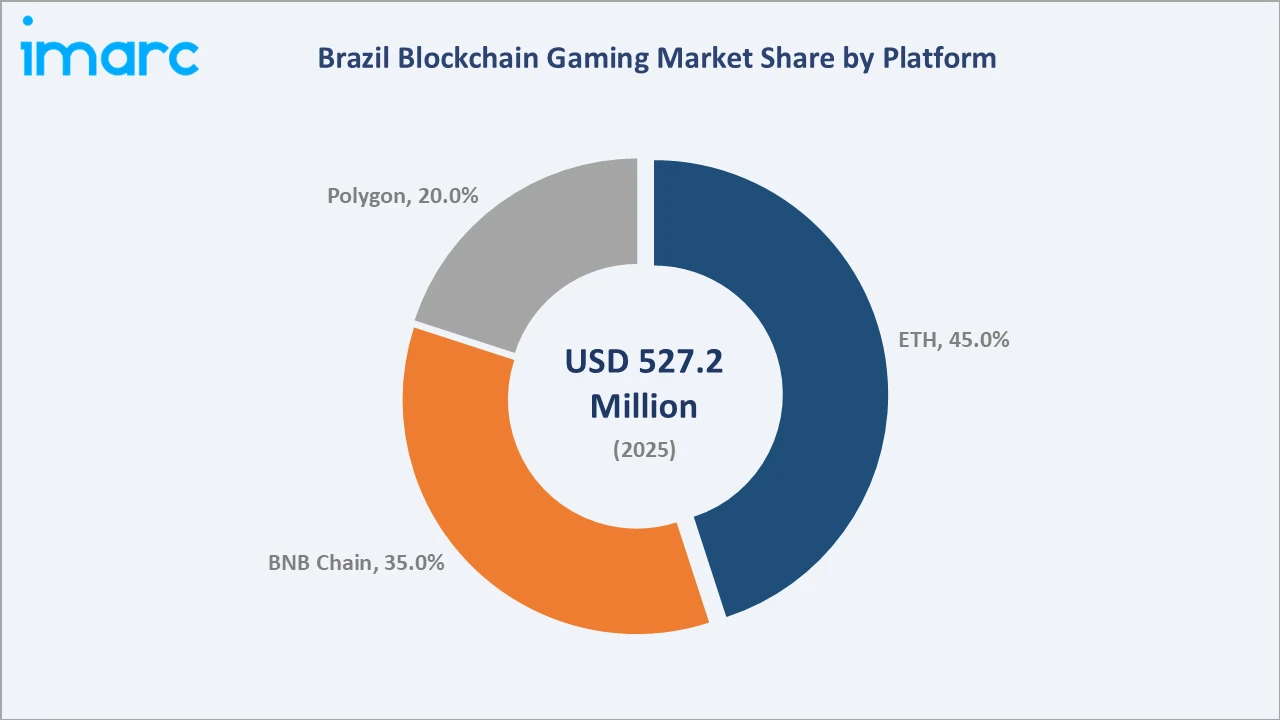
BNB Chain at 35.0% is the second-largest platform segment, supported by its significantly lower transaction fees and faster block confirmation times, which are critical for play-to-earn games requiring frequent micro-transactions. Its compatibility with established DeFi infrastructure and large user base across Latin America makes it a preferred platform for play-to-earn game launches targeting Brazil's cost-sensitive gaming demographic.
Regional Market Insights
| Region | Share (2025) | Key Growth Drivers |
|---|---|---|
| Southeast | 55.0% | Large urban gaming populations in São Paulo and Rio de Janeiro, high digital infrastructure concentration, active blockchain and fintech startup ecosystems, and strong smartphone penetration |
| South | 18.0% | High per-capita digital engagement in Paraná and Santa Catarina, growing university-driven blockchain adoption, strong developer community formation, and rising play-to-earn awareness |
| Northeast | 12.0% | Expanding internet and mobile connectivity, government digital inclusion programs, growing youth gaming population, and rising awareness of play-to-earn income opportunities across the region |
| Central-West | 9.0% | Improving digital infrastructure in Brasília and surrounding states, growing government and enterprise digital economy investments, and rising mobile gaming penetration |
| North | 6.0% | Expanding connectivity through digital inclusion initiatives, rising digital literacy among younger populations, growing awareness of blockchain gaming income opportunities, and improving urban internet access |
Southeast at 55.0% in 2025 leads the regional landscape, anchored by São Paulo and Rio de Janeiro's large gaming populations, high digital infrastructure concentration, and active blockchain and fintech startup ecosystems driving blockchain game development and player adoption.
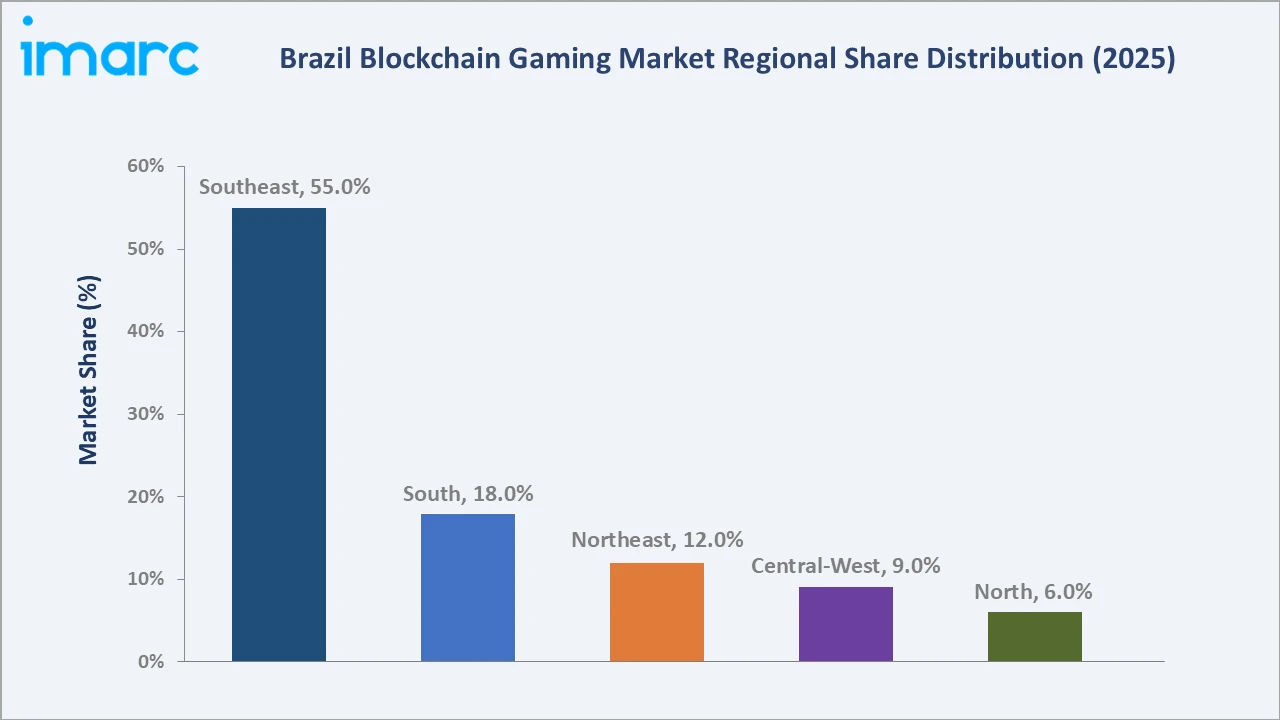
North, while currently the smallest regional contributor at 6.0%, is expanding as internet and mobile connectivity improves across Brazil's northern states through government digital inclusion programs, and as growing awareness of play-to-earn income opportunities drives new player adoption among the region's younger demographic.
Competitive Landscape
The Brazil blockchain gaming market is fragmented, with a mix of globally recognized blockchain gaming studios, established gaming conglomerates expanding into blockchain, and domestic and regional developers building play-to-earn and NFT-integrated titles. Technology depth, platform compatibility, and strength of community ecosystems form the key competitive differentiators across the industry.
| Company Name | Brand / Key Product | Position | Strategic Focus |
|---|---|---|---|
| Sky Mavis Pte. Ltd. | Axie Infinity | Leader | Expanding play-to-earn engagement through improved game mechanics, sustainable tokenomics, and broadening ecosystem partnerships across Latin America |
| Animoca Brands Corporation Ltd. | The Sandbox | Leader | Building open metaverse ecosystem through creator-driven content expansion, strategic brand partnerships, and deepening DeFi integrations |
| Dapper Labs Inc. | NBA Top Shot | Challenger | Strengthening licensed consumer NFT applications and sports digital collectibles portfolio through new league partnerships and platform expansion |
| Immutable Pty Ltd | Gods Unchained | Challenger | Establishing Ethereum Layer-2 platform as the leading NFT gaming infrastructure through zero-gas-fee transactions and growing studio partnerships |
Key players include Sky Mavis Pte. Ltd., Animoca Brands Corporation Ltd., Dapper Labs Inc., and Immutable Pty Ltd, among others.
Key Company Profiles
Sky Mavis Pte. Ltd.
Sky Mavis Pte. Ltd. is a blockchain gaming company with a significant operational and market presence in Brazil and Latin America. The company operates Axie Infinity, a blockchain-based play-to-earn game that pioneered the NFT pet battling genre and introduced millions of players globally to blockchain gaming economics.
- Product Portfolio: Axie Infinity play-to-earn NFT game, the Ronin blockchain sidechain developed to support high-volume micro-transactions, and the Axie Infinity Shards (AXS) governance token powering the broader Axie ecosystem.
- Recent Developments: The company continues to expand its ecosystem with new game modes, evolving tokenomics, and strengthened security infrastructure following ongoing protocol improvements to its Ronin sidechain.
- Strategic Focus: Rebuilding and expanding play-to-earn engagement through improved game mechanics and sustainable token economy design.
Animoca Brands Corporation Ltd.
Animoca Brands Corporation Ltd. is a Hong Kong-based digital entertainment, blockchain, and gamification company with a substantial portfolio of blockchain gaming investments and proprietary titles. The company operates The Sandbox, a user-generated content metaverse platform where players can build, own, and monetize virtual experiences and assets through SAND tokens and NFTs.
- Product Portfolio: The Sandbox metaverse platform, the SAND utility token, and a broad portfolio of blockchain gaming investments and licensed IP integrations spanning gaming, sports, and entertainment verticals.
- Recent Developments: The company continues to expand The Sandbox's creator economy, bringing new brand partnerships, virtual real estate activations, and play-to-earn game experiences to its global user base.
- Strategic Focus: Building the leading open metaverse ecosystem through creator-driven content expansion and strategic brand partnerships.
Dapper Labs Inc.
Dapper Labs Inc. is a blockchain technology company that created the Flow blockchain, designed specifically for high-throughput consumer-facing blockchain applications including gaming and digital collectibles. The company operates NBA Top Shot, a licensed digital collectibles platform for NBA highlight moments represented as NFTs.
- Product Portfolio: Flow blockchain infrastructure, NBA Top Shot digital collectibles, NFL All Day licensed sports NFTs, and a growing portfolio of consumer applications built on the Flow network targeting sports and entertainment audiences.
- Recent Developments: The company continues to expand its licensed sports NFT portfolio and build developer adoption of the Flow blockchain through tooling improvements, grant programs, and strategic sports licensing agreements.
- Strategic Focus: Strengthening the Flow blockchain's position as the leading infrastructure for licensed consumer NFT applications and sports digital collectibles, while expanding into new sports leagues and entertainment verticals.
Market Concentration Analysis
The Brazil blockchain gaming market is fragmented, with a small number of globally recognized studios accounting for a majority of active player share, while a large number of domestic and regional developers occupy specialized niches.
Barriers to entry include the technical complexity of smart contract development and security auditing, the capital cost of NFT marketplace integration and liquidity provision, the need for compelling game IP and community building, and the challenge of competing with established global studios for developer talent and player acquisition budgets. These factors favor studios with strong IP, established community trust, and sufficient capital to sustain development and marketing cycles.
Consolidation is at an early stage, with strategic investments and acquisitions by larger gaming and blockchain holding companies beginning to create platform-level consolidation. Partnership structures between global studios and local Brazilian developers are emerging as an alternative consolidation pathway, allowing global platforms to access Brazil's market without full acquisition commitments.
Investment & Growth Opportunities
Fastest-Growing Segments
Collectible games are expanding fastest among game type sub-segments, driven by the appeal of tradeable digital collectibles to Brazil's large social media-engaged youth demographic and the low technical complexity required to participate. Polygon is expected to grow at an above-average platform CAGR as its low transaction costs make it the preferred infrastructure for high-volume collectible NFT applications targeting cost-sensitive gaming markets.
Emerging Markets
North is the fastest-growing regional market, supported by expanding internet and mobile connectivity through government digital inclusion programs, rising digital literacy among younger populations, and growing awareness of play-to-earn income opportunities. The region represents significant untapped opportunity for platforms able to establish early-mover position ahead of mainstream adoption across Brazil's northern states.
Venture & Investment Trends
Investment activity is concentrated in play-to-earn platform development, mobile blockchain game studio formation, and cross-platform NFT marketplace infrastructure. Capital is also flowing into Layer-2 scaling solutions compatible with Brazil's gaming infrastructure, sustainable tokenomics design, and mobile-first wallet integration platforms that reduce onboarding friction for mainstream Brazilian gamers.
Future Market Outlook (2026-2034)
The Brazil blockchain gaming market is projected to grow from USD 527.2 Million in 2025 to USD 831.2 Million in 2026, reaching USD 35,109.0 Million by 2034, registering a CAGR of 57.66% during 2026-2034.
Four forces will shape the market through 2034 maturation of play-to-earn tokenomics into sustainable dual-token economic models; expansion of mobile-first blockchain game development optimized for Brazil's smartphone-majority gaming population; regulatory framework development providing greater legal clarity for token economies and NFT asset ownership; and deepening institutional investment from global venture capital and game publishing companies targeting Brazil's high-growth blockchain gaming demographic.
By 2034, the Brazil blockchain gaming market is expected to be characterized by a mix of globally recognized blockchain gaming platforms, domestic AAA-quality blockchain studios, and specialized play-to-earn applications targeting Brazil's diverse regional gamer segments. Continued growth in smartphone penetration, digital financial inclusion, and blockchain technology literacy will sustain strong player base expansion through the forecast period.
Research Methodology
Primary Research
Primary research included structured discussions with blockchain gaming developers, NFT platform operators, digital asset exchange representatives, and gaming community managers, validating market sizing, segment distribution, and regional adoption patterns across Brazil's blockchain gaming ecosystem.
Secondary Research
Secondary sources included Brazilian Central Bank publications, Receita Federal digital asset regulatory guidance, Ministry of Science, Technology and Innovation reports, Chainalysis cryptocurrency adoption data, and public disclosures from listed gaming companies and blockchain infrastructure providers operating in Brazil.
Forecasting Models
Market forecasts used top-down and bottom-up models combining Brazilian gaming market size data, blockchain gaming adoption rate projections, play-to-earn engagement metrics, and digital asset ownership trends. Scenario analysis addressed regulatory development pace, technology platform adoption trajectories, and institutional investment flow assumptions across the 2026–2034 forecast period.
Brazil Blockchain Gaming Market Report Coverage:
| Report Features | Details |
|---|---|
| Base Year of the Analysis | 2025 |
| Historical Period | 2020-2025 |
| Forecast Period | 2026-2034 |
| Units | Million USD |
| Scope of the Report |
Exploration of Historical Trends and Market Outlook, Industry Catalysts and Challenges, Segment-Wise Historical and Future Market Assessment:
|
| Game Types Covered | Role Playing Games, Open World Games, Collectible Games |
| Platforms Covered | ETH, BNB Chain, Polygon |
| Regions Covered | Southeast, South, Northeast, North, Central-West |
| Companies Covered | Sky Mavis Pte. Ltd., Animoca Brands Corporation Ltd., Dapper Labs Inc., Immutable Pty Ltd, etc. |
| Customization Scope | 10% Free Customization |
| Post-Sale Analyst Support | 10-12 Weeks |
| Delivery Format | PDF and Excel through Email (We can also provide the editable version of the report in PPT/Word format on special request) |
Key Benefits for Stakeholders:
- IMARC's industry report offers a comprehensive quantitative analysis of various market segments, historical and current market trends, market forecasts, and dynamics of the Brazil blockchain gaming market from 2020-2034.
- The research report provides the latest information on the market drivers, challenges, and opportunities in the Brazil blockchain gaming market.
- Porter's five forces analysis assist stakeholders in assessing the impact of new entrants, competitive rivalry, supplier power, buyer power, and the threat of substitution. It helps stakeholders to analyze the level of competition within the Brazil blockchain gaming industry and its attractiveness.
- Competitive landscape allows stakeholders to understand their competitive environment and provides an insight into the current positions of key players in the market.
Frequently Asked Questions About the Brazil Blockchain Gaming Market Report
The Brazil blockchain gaming market size is estimated at USD 831.2 Million in 2026, driven by play-to-earn adoption, expanding NFT integration across game types, and Brazil's large and digitally engaged gaming population.
The market is projected to grow at a CAGR of 57.66% from 2026-2034, reaching USD 35,109.0 Million, supported by blockchain infrastructure expansion, rising digital asset ownership, and growing institutional investment.
Role playing games dominate the market at 45.0% game type share in 2025, driven by high player engagement intensity, NFT character ownership mechanics, and Brazil's established RPG gaming culture.
ETH represents 45.0% of the platform segment in 2025, driven by its established smart contract infrastructure, deep NFT liquidity, and large developer community supporting high-value blockchain gaming titles.
Southeast commands 55.0% share in 2025, led by São Paulo and Rio de Janeiro's large gaming populations, high digital infrastructure concentration, and active blockchain technology ecosystems.
North is the fastest-growing region, supported by expanding connectivity through digital inclusion initiatives, rising digital literacy, and surging awareness of play-to-earn income opportunities among younger populations.
Key players include Sky Mavis Pte. Ltd., Animoca Brands Corporation Ltd., Dapper Labs Inc., and Immutable Pty Ltd, among others operating in Brazil's blockchain gaming ecosystem.
Key drivers include growing play-to-earn adoption, rising NFT integration across game genres, expanding blockchain infrastructure, and increasing institutional and venture capital investment in Brazilian gaming studios.
Key challenges include regulatory uncertainty around digital asset classification, high technical barriers for mainstream gamer adoption, and the complexity of local currency conversion for play-to-earn earnings.
Need more help?
- Speak to our experienced analysts for insights on the current market scenarios.
- Include additional segments and countries to customize the report as per your requirement.
- Gain an unparalleled competitive advantage in your domain by understanding how to utilize the report and positively impacting your operations and revenue.
- For further assistance, please connect with our analysts.
 Request Customization
 Speak to an Analyst
 Request Brochure
 Inquire Before Buying
Benefits of Customization
- Personalize this research
- Triangulate with your data
- Get data as per your format and definition
- Gain a deeper dive into a specific application, geography, customer, or competitor
- Any level of personalization
Get in Touch With Us
UNITED STATES
Phone: +1-201-971-6302
INDIA
Phone: +91-120-433-0800
UNITED KINGDOM
Phone: +44-753-714-6104
Email: [email protected]
Client Testimonials








Related Reports
Choose your plan
*Please note that the prices mentioned below are starting prices for each bundle type. Kindly contact our team for further details.*
Single User License
- 1 User License, Access on 2 Devices
- PDF Report + Excel Dataset (Password Protected)
- Lifetime Access
- No Printing Rights
- 10% Free Report Customization
- 10–12 Weeks of Analyst Support
Five User License
- Access for 5 Users, 2 Devices per User
- PDF Report + Excel Dataset (Password Protected)
- Lifetime Access
- Dedicated Account Manager
- 12–14 Weeks of Analyst Support
- No Printing Rights
- 15% Free Report Customization
- 25% Discount on Your Next Purchase
Corporate User License
- Unlimited User Access (Within Your Organization)
- PDF Report + Excel Dataset
- Lifetime Access
- Dedicated Account Manager
- 14–20 Weeks of Analyst Support
- No Printing Rights
- 20% Free Report Customization
- 30% Discount on Your Next Purchase
Essential Insights
What's included:
3 reports
- Lifetime Access
- PDF Reports
- Excel Datasets
- 2 Weeks of Free Analyst Support
- 2 User Licenses
- Access on 2 Devices
- Printing Rights
- Complimentary PowerPoint (PPT) Version
- Complimentary License Upgrade
Professional Access
What's included:
5 reports
- Lifetime Access
- PDF Reports
- Excel Datasets
- 8 Weeks of Free Analyst Support
- 2 User Licenses
- Access on 2 Devices
- Printing Rights
- Complimentary PowerPoint (PPT) Version
- Complimentary License Upgrade
Business Advantage
What's included:
8 reports
- Lifetime Access
- PDF Reports
- Excel Datasets
- 14 Weeks of Free Analyst Support
- 2 User Licenses
- Access on 2 Devices
- Printing Rights
- Complimentary PowerPoint (PPT) Version
- Complimentary License Upgrade
Enterprise Intelligence
What's included:
10 reports
- Lifetime Access
- PDF Reports
- Excel Datasets
- 20 Weeks of Free Analyst Support
- 2 User Licenses
- Access on 2 Devices
- Printing Rights
- Complimentary PowerPoint (PPT) Version
- Complimentary License Upgrade