
Brazil Cheese Market Size, Share, Trends and Forecast by Source, Type, Product, Distribution Channel, Format, and Region, 2026-2034
Brazil Cheese Market Size, Share, Trends & Forecast (2026-2034)
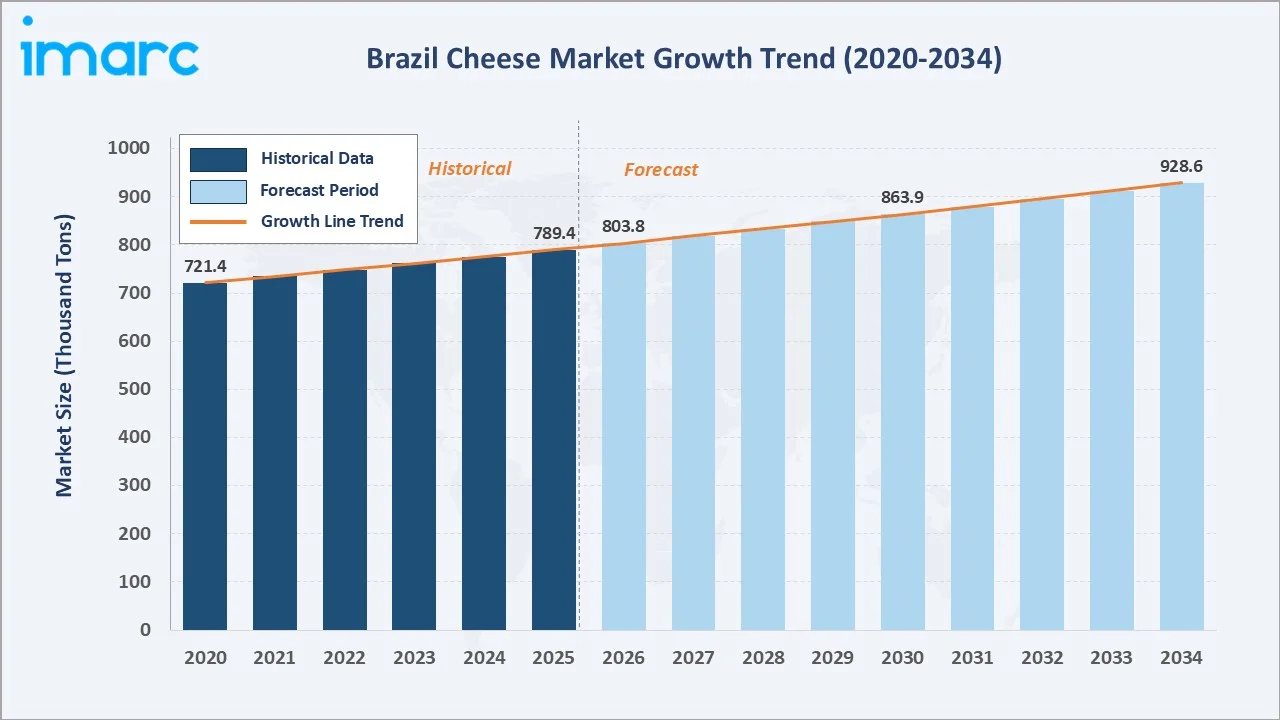
The Brazil cheese market grew from 789.4 Thousand Tons in 2025 to 803.8 Thousand Tons in 2026 and is projected to reach 928.6 Thousand Tons by 2034, growing at a CAGR of 1.82% during 2026-2034. Cheese enjoys widespread acceptance in Brazil, with approximately 85% of the population consuming cheese. However, annual per capita consumption remains relatively modest at around 7 kg, indicating considerable scope for further market penetration. Cow milk dominates cheese production at 88.6% by source, natural cheese leads at 67.8% by type, and the Southeast region commands the largest share at 44.8%.
Market Snapshot
|
Metric |
Value |
|
Base Year Market Size (2025) |
789.4 Thousand Tons |
|
Market Size (2026) |
803.8 Thousand Tons |
|
Forecast Market Size (2034) |
928.6 Thousand Tons |
|
CAGR (2026-2034) |
1.82% |
|
Base Year |
2025 |
|
Historical Period |
2020-2025 |
|
Forecast Period |
2026-2034 |
|
Dominant Source |
Cow Milk (88.6%, 2025) |
|
Dominant Type |
Natural Cheese (67.8%, 2025) |
|
Leading Region |
Southeast (44.8%, 2025) |
The Brazil cheese market grew from 721.4 Thousand Tons in 2020 to 789.4 Thousand Tons by 2025 and is estimated to reach 803.8 Thousand Tons in 2026. The market is projected to reach 863.9 Thousand Tons by 2030 and 928.6 Thousand Tons by 2034.
To get more information on this market, Request Sample
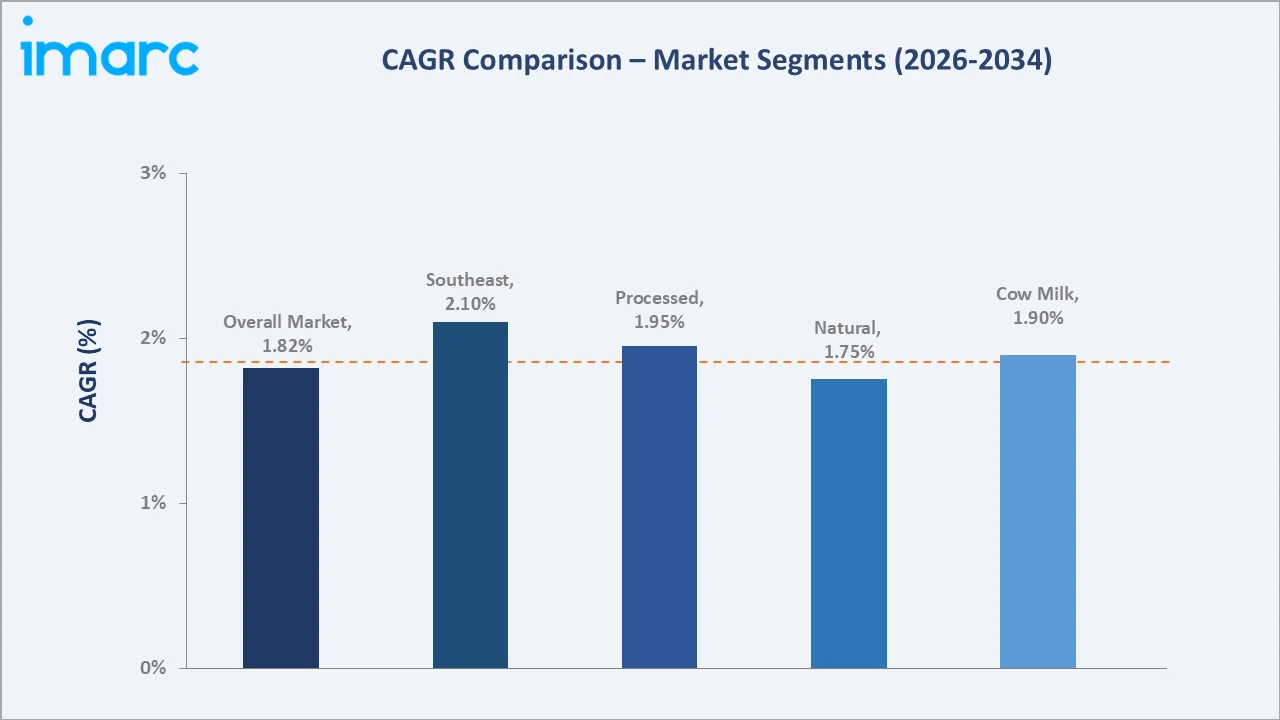
Cow milk cheese grows at ~1.90% CAGR through continued dominance of traditional mozzarella and prato cheese production. Processed cheese expands at ~1.95% CAGR through affordable requeijao and sliced cheese market penetration. Southeast region leads growth at ~2.10% CAGR through urban foodservice expansion and premium cheese adoption.
Executive Summary
The Brazil cheese market is experiencing steady volume growth anchored by rising per-capita cheese consumption, foodservice sector expansion driven by the pizza and fast-casual dining boom, and growing consumer interest in specialty and premium natural cheese varieties. The market is driven by urbanization-led dietary shifts, increasing retail distribution of chilled dairy, and product innovation in lactose-free and premium cheese categories.
Cow milk dominates production at 88.6%, reflecting Brazil's cattle dairy heritage and the competitive economics of bovine milk production. Natural cheese commands 67.8% through the dominance of mozzarella, prato, coalho, and Minas varieties in both retail and foodservice channels. The Southeast region anchors market leadership at 44.8% through traditional cheese production heritage and a large urban consumer market.
Key Market Insights
|
Insight |
Data |
|
Dominant Source |
Cow Milk - 88.6% share (2025) |
|
Dominant Type |
Natural Cheese - 67.8% share (2025) |
|
Leading Region |
Southeast - 44.8% (2025) |
|
Key Market Opportunity |
Growing mozzarella and specialty cheese demand from Brazil's expanding pizza and foodservice sector represents an incremental volume opportunity by 2030 as per-capita cheese consumption rises toward the Latin American average. |
Key analytical observations supporting the above data:
- Cow Milk at 88.6%: Cow's milk dominates Brazil's cheese production supply chain through the country's large-scale cattle dairy industry, with Brazil maintaining a large dairy cow herd. The economics of bovine milk collection, with established cooperative infrastructure, processing expertise, and consumer familiarity with cow-milk cheese textures and flavors, create a durable structural advantage for cow-milk cheese versus alternative sources.
- Natural Cheese at 67.8%: Brazil's natural cheese segment is anchored by four dominant product types: mozzarella (the single largest cheese category driven by the pizza industry), prato (a mild semi-hard table cheese), queijo Minas (fresh and cured varieties with geographical indication protection), and queijo coalho (a traditional Northeastern cheese).
- Southeast at 44.8% (2025): Southeast region leads due to its large and affluent consumer base, high urbanization, and strong concentration of retail and foodservice establishments. The region also benefits from a well-developed dairy processing and distribution network, supporting widespread cheese availability and consumption.
Brazil Cheese Market Overview
The Brazil cheese market encompasses the production, processing, and consumption of all cheese varieties produced from cow, buffalo, goat, and other milk sources across Brazil's five regional markets. Key natural cheese categories include mozzarella, prato, queijo Minas (fresh, half-cured, and cured), queijo coalho, queijo de manteiga, provolone, and a growing specialty category including artisan varieties, imported-style cheeses, and premium denomination of origin products. Processed cheese categories include requeijao cremoso and firme, processed slices, cheese spreads, and industrial cheese used as food processing ingredients.
Market Dynamics
To evaluate market opportunities, Request Sample
Market Drivers
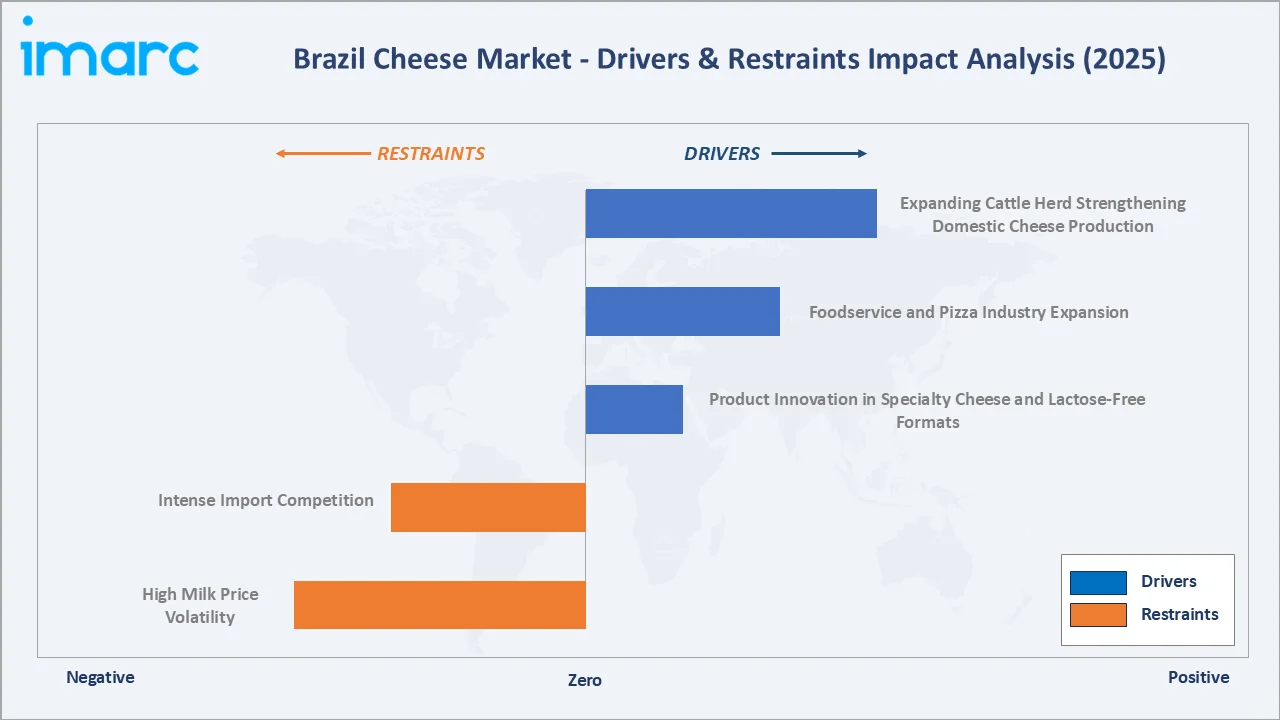
- Expanding Cattle Herd Strengthening Domestic Cheese Production: Brazil’s cattle population reached an all-time high of over 234 million head, underscoring the country’s substantial livestock resource base. The large cattle herd supports the availability of dairy animals and domestic milk production, providing cheese manufacturers with a strong raw material base. This established supply ecosystem can facilitate higher cheese output, improve supply reliability, and support the continued expansion of the Brazil cheese market.
- Foodservice and Pizza Industry Expansion: Brazil's foodservice sector recovered strongly post-COVID, with restaurant revenue growth. The pizza delivery segment is creating consistent structural mozzarella demand. Frozen pizza retail, growing at double-digit rates through supermarket channels, is generating additional processed mozzarella and mixed cheese blend demand from food industry buyers.
- Product Innovation in Specialty Cheese and Lactose-Free Formats: Brazil's large lactose-intolerant population is driving demand for lactose-free cheese formats, with lactose-free mozzarella, prato, and requeijao lines achieving significant retail velocity. In September 2026, in Brazil, Anvisa allows dairy products to be labeled as “zero lactose” when lactose content does not exceed 100 milligrams per 100 grams or 100 milliliters. Cheese manufacturers can achieve this level through processes such as whey removal and bacterial fermentation, although the designation indicates compliance with the prescribed threshold rather than the complete absence of lactose.
Market Restraints
- High Milk Price Volatility: Brazilian raw milk prices have exhibited significant cyclical volatility driven by feed cost inflation, drought impacting pasture availability, and currency fluctuations affecting imported feed grain costs. Milk price spikes compressed cheese manufacturer margins significantly, as retail price rigidity in competitive supermarket negotiations prevented full cost pass-through. This volatility creates planning and profitability uncertainty for cheese producers across all size segments.
- Intense Import Competition: Intense competition from imported cheese is increasing pricing pressure on domestic manufacturers, particularly in premium and specialty categories. International suppliers often offer diverse varieties and established brands, making it challenging for local producers to differentiate their products. This competition can compress profit margins and limit the ability of smaller domestic cheese manufacturers to expand their market presence.
Market Opportunities
- Online Grocery and Direct-to-Consumer Specialty Cheese: E-commerce grocery penetration in Brazil is creating efficient direct-to-consumer channels for specialty cheese producers previously dependent on limited specialty retail shelf space. Artisan cheese clubs, subscription boxes, and producer-direct sales platforms are enabling small and medium-sized specialty cheese producers to access premium urban consumers without the margins and logistics burden of traditional retail channel penetration.
- Plant-Based and Alternative Cheese Innovation: Brazil's growing flexitarian consumer population is creating demand for plant-based cheese alternatives in both retail and foodservice channels. Plant-based food companies are launching plant-based cheese products, while major dairy players are exploring plant-based innovation strategies to capture consumers, reducing but not eliminating dairy consumption.
Market Challenges
- Cold Chain Infrastructure Gaps in Northern and Northeastern Brazil: Natural cheese distribution requires continuous refrigeration throughout the supply chain from production plant to consumer, representing a significant logistics infrastructure challenge in Brazil's North and Northeast regions where cold storage coverage, refrigerated transport availability, and retail refrigeration density remain below the national average. These cold chain gaps limit natural cheese market penetration in non-urban Northeastern and Northern markets, sustaining traditional ambient-distributed processed cheese dominance in these regions.
- Informal Production and Counterfeiting of Traditional Cheese Varieties: Informal production and counterfeiting of traditional cheese varieties pose challenges by creating unfair competition for regulated manufacturers that bear higher compliance and quality-control costs. In addition, imitation products can undermine consumer confidence, weaken the value of regional cheese identities, and constrain the growth of formal producers.
Emerging Market Trends
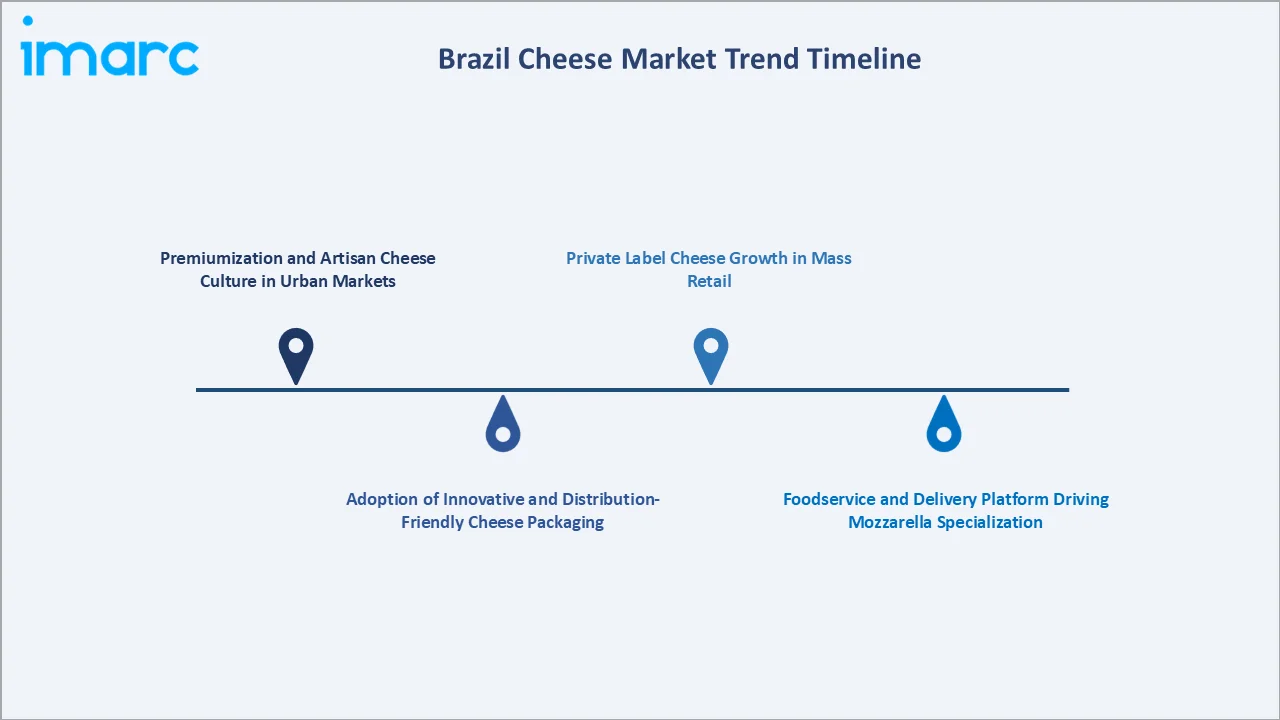
1. Premiumization and Artisan Cheese Culture in Urban Markets
Brazilian urban consumers, particularly in the AB socioeconomic classes, are driving a significant premiumization trend in the cheese market. Artisan queijo Minas, buffalo mozzarella, and imported-style varieties including burrata, stracciatella, and aged goat cheeses are achieving rapid growth in specialty retail, gastronomic restaurants, and direct-to-consumer platforms. This premiumization is expanding cheese board culture as a social dining format and elevating Brazilian consumers' willingness to pay for provenance, certification, and unique flavor profiles.
2. Adoption of Innovative and Distribution-Friendly Cheese Packaging
Manufacturers are increasingly adopting advanced processing and packaging technologies to improve distribution efficiency, product handling, and shelf stability while differentiating their offerings in the competitive market. In July 2026, Embaré launched the Brazil’s first carton-packaged cheese under its Camponesa brand. The innovative technology allows the cheese to coagulate inside the carton after packaging, helping improve distribution efficiency and address supply chain challenges.
3. Private Label Cheese Growth in Mass Retail
Brazil's major supermarket chains are expanding private label cheese programs targeting price-sensitive consumers seeking value alternatives to national brands. Private label mozzarella, prato, requeijao, and processed slices are gaining meaningful market share in the value tier, particularly in cash-and-carry wholesale formats popular with lower-income consumers and food service micro-entrepreneurs. Private label growth is creating margin pressure for mid-tier branded cheese manufacturers.
4. Foodservice and Delivery Platform Driving Mozzarella Specialization
Brazil's food delivery economy is driving mozzarella specialization and value-chain integration between cheese suppliers and pizza and fast-food chains. Dairy companies are developing pizza-specific mozzarella formulations with optimized melt, stretch, and browning characteristics demanded by foodservice buyers. Customized B2B cheese supply agreements between dairy processors and national restaurant chains are becoming an increasingly important commercial model alongside traditional retail distribution.
Industry Value Chain Analysis
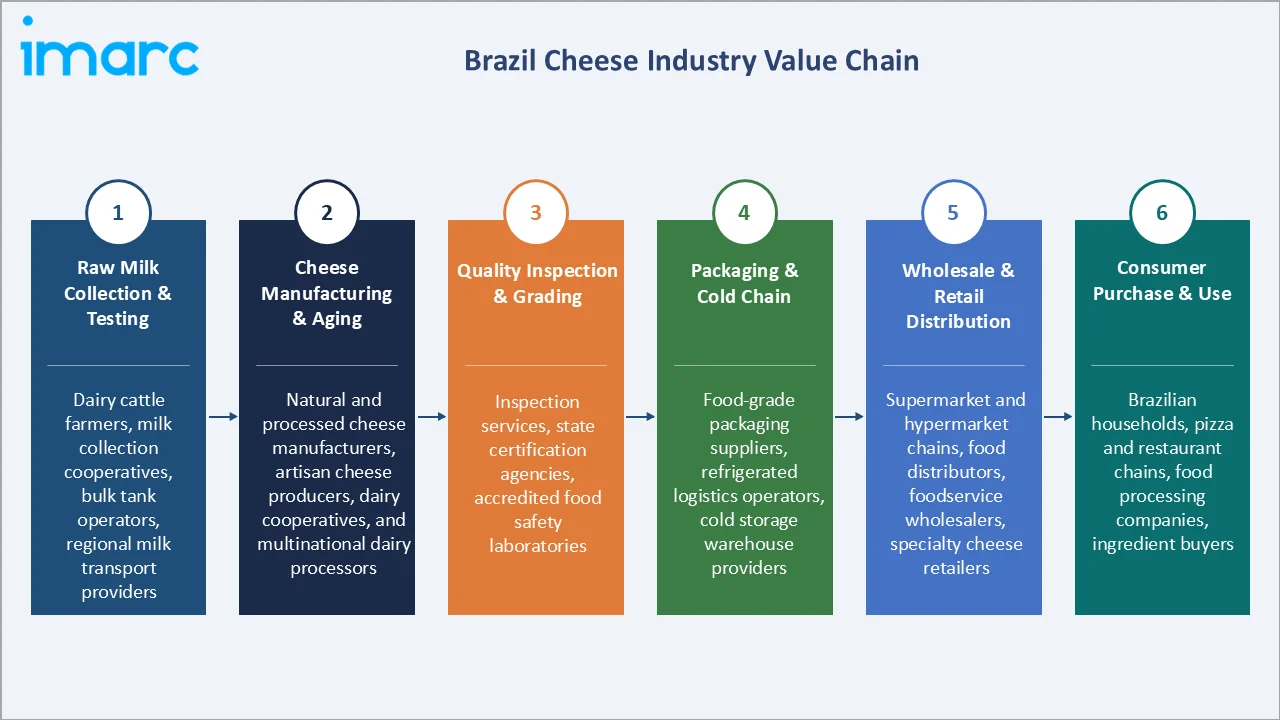
The Brazil cheese value chain encompasses raw milk collection, cheese manufacturing and aging, quality inspection and certification, cold chain logistics, retail and foodservice distribution, and final consumer or food industry use.
|
Stage |
Key Players |
|
Raw Milk Collection & Testing |
Dairy cattle farmers, milk collection cooperatives, bulk tank operators, regional milk transport providers. |
|
Cheese Manufacturing & Aging |
Natural and processed cheese manufacturers, artisan cheese producers, dairy cooperatives, and multinational dairy processors. |
|
Quality Inspection & Grading |
Inspection services, state certification agencies, accredited food safety laboratories. |
|
Packaging & Cold Chain |
Food-grade packaging suppliers, refrigerated logistics operators, cold storage warehouse providers. |
|
Wholesale & Retail Distribution |
Supermarket and hypermarket chains, food distributors, foodservice wholesalers, specialty cheese retailers. |
|
Consumer Purchase & Use |
Brazilian households, pizza and restaurant chains, food processing companies, ingredient buyers. |
Cheese manufacturing and aging represent the primary value creation stage, where raw milk is transformed into differentiated natural and processed cheese products through varying levels of technology, recipe expertise, and regulatory compliance investment. Brazil's formal registered manufacturers generate premium pricing through certification, consistent quality, and brand investment, while informal artisan producers serve traditional regional markets at lower price points with cultural product authenticity.
Technology Landscape in the Brazil Cheese Industry
Automated Mozzarella and Prato Production Lines
Brazil's major cheese producers have invested in automated continuous mozzarella production systems capable of processing 10,000-50,000 liters of milk per day with minimal manual intervention. Automated brining, stretching, and molding systems from Italian equipment manufacturers enable consistent texture and yield performance that manual artisan methods cannot replicate at industrial scale. Inline process monitoring using NIR (near-infrared) spectroscopy enables real-time control of moisture, fat, and protein parameters critical for pizza mozzarella melt performance specifications.
Lactose Reduction Technology in Cheese Processing
Lactase enzyme addition during milk standardization, the primary technology for lactose-free cheese production, has been widely adopted by Brazilian dairy processors following the success of lactose-free milk in the Brazilian market. Ultrafiltration membrane technology enabling whey removal (which carries most of the residual lactose) is being used by larger producers for more complete lactose reduction in natural cheese formats. These technologies enable lactose-free cheese production without significant organoleptic differences from conventional equivalents, supporting the premium pricing that justifies technology investment.
E-Commerce and Cold Chain Technology Integration
Online grocery platforms are driving investment in urban last-mile cold chain technology for cheese delivery. Insulated packaging with gel pack cold chain protection enabling 12-24 hour temperature stability, real-time temperature monitoring using IoT sensors in refrigerated delivery vehicles, and micro-fulfillment center infrastructure in major Brazilian cities are enabling reliable natural cheese delivery in e-commerce channels. Companies are building technological infrastructure that will enable significant share shift from traditional retail to e-commerce cheese purchasing through 2034.
Market Segmentation Analysis
The report covers the following segments:
|
Segment Category |
Leading Segment |
Market Share |
Year |
|
Source |
Cow Milk |
88.6% |
2025 |
|
Type |
Natural |
67.8% |
2025 |
|
Product |
🔒 |
🔒 |
2025 |
|
Distribution Channel |
🔒 |
🔒 |
2025 |
|
Format |
🔒 |
🔒 |
2025 |
|
Region |
Southeast |
44.8% |
2025 |

By Source
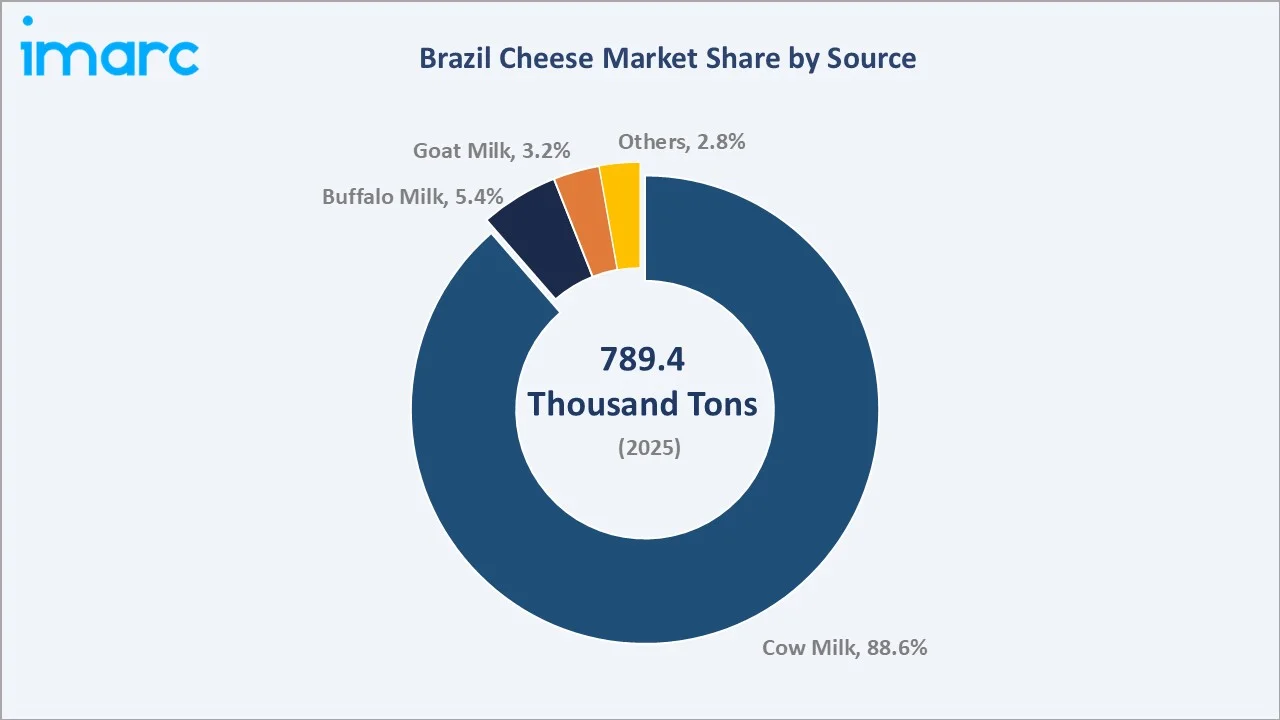
Cow milk commands 88.6% in 2025, reflecting the structural dominance of bovine dairy in Brazil's agricultural economy and the established preference of Brazilian consumers for cow-milk cheese flavors and textures in traditional varieties. Brazil's dairy sector benefits from large-scale pasture-based cattle herding across the South and Central-West, established cooperative milk collection infrastructure, and significant processing scale advantages versus other milk sources.
To access detailed market analysis, Request Sample
Buffalo milk at 5.4% commands significant premium positioning in the mozzarella and fresh cheese segment, particularly Mozzarella di Bufala from Para state and artisan buffalo cheese from interior dairy regions. Goat milk at 3.2% serves the artisan and specialty segment, with Northeastern Brazilian goat cheeses, including queijo de coalho de cabra gaining recognition in gastronomy channels. Others at 2.8% include mixed-milk cheeses combining cow and goat or buffalo milk for specialty artisan production.
By Type
Natural cheese dominates at 67.8% in 2025, encompassing Brazil's core traditional cheese varieties, mozzarella, prato, queijo Minas in its fresh, half-cured, and cured formats, queijo coalho, and a growing range of Italian-style and specialty artisan varieties. The natural cheese segment benefits from growing consumer preference for less-processed, additive-free dairy products aligned with clean-label nutrition trends among urban Brazilian consumers.
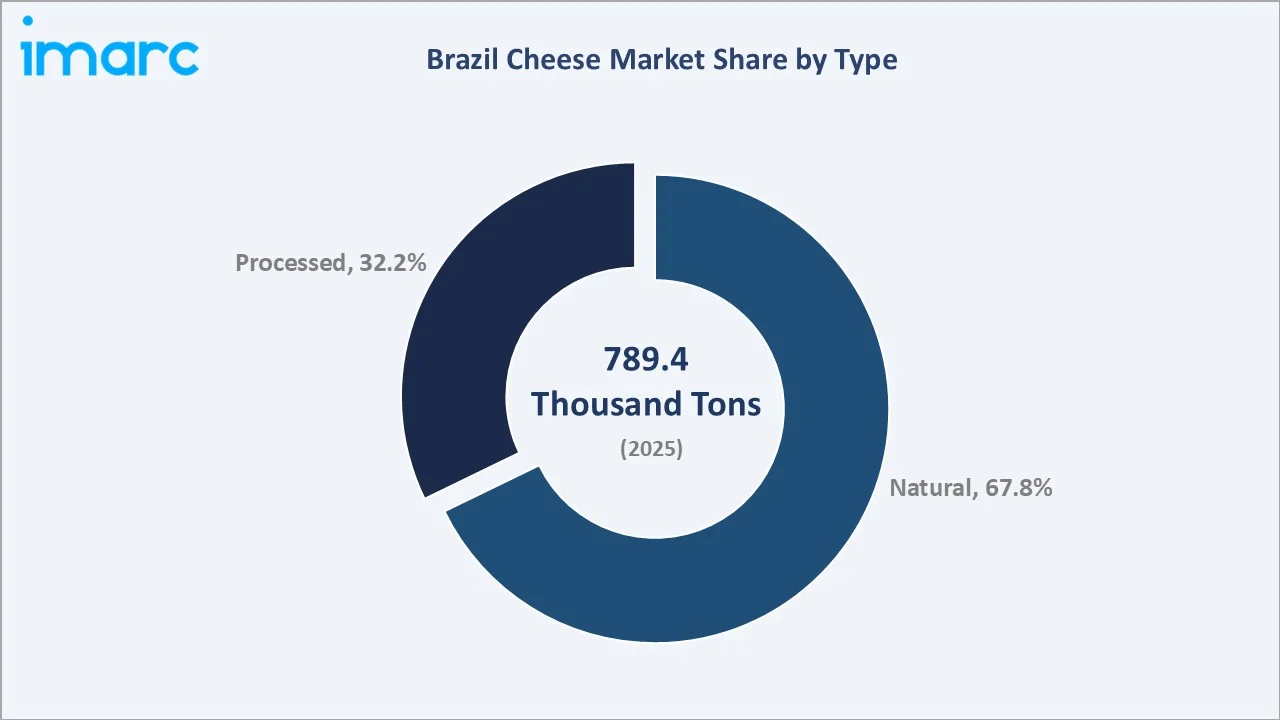
Processed cheese at 32.2% is anchored by requeijao, Brazil's iconic cream cheese spread, alongside processed cheese slices, cheese spreads for bread and snack applications, and industrial processed cheese used in food manufacturing. Requeijao's unique position as an ambient-distributed, long-shelf-life product enables distribution in regions with limited cold chain infrastructure, making it the dominant dairy product in many Northeastern and Northern market segments.
Regional Market Insights
|
Region |
Share (2025) |
Key Brazil Cheese Market Drivers & Characteristics |
|
Southeast |
44.8% |
Reflecting Brazil's primary cheese production and consumption hubs, with traditional Queijo Minas heritage, the highest urban consumer cheese spending per capita, and concentration of major dairy processors and pizza chain headquarters. |
|
South |
24.6% |
Reflecting the strong European dairy heritage, with well-established dairy cooperative infrastructure, high-quality specialty cheese production, and significant exports to other Brazilian regions and international markets. |
|
Northeast |
15.3% |
Reflecting the region's traditional cheese production for regional consumption, growing urbanization driving modern cheese format adoption, and increasing retail penetration of national dairy brands in state capitals. |
|
Central-West |
8.2% |
Reflecting the expanding agribusiness economy, growing middle-class urban consumption, and investment in dairy processing infrastructure serving regional demand from Brazil's fastest-growing interior cities. |
|
North |
7.1% |
Reflecting lower per-capita dairy consumption relative to the national average, challenging cold-chain logistics, and predominantly informal cheese production and distribution - though urban growth is driving formal retail cheese adoption. |
The Southeast region's 44.8% share reflects the dual engines of production leadership and consumption leadership as the most populous and highest per-capita income state. The combination of production heritage and urban consumption demand density makes the Southeast region the structural center of gravity for Brazil's cheese market. The South region's 24.6% reflects the strong European dairy cooperative heritage, where Italian and German immigrant traditions established premium cheese-making capabilities that supply both the South and national markets.
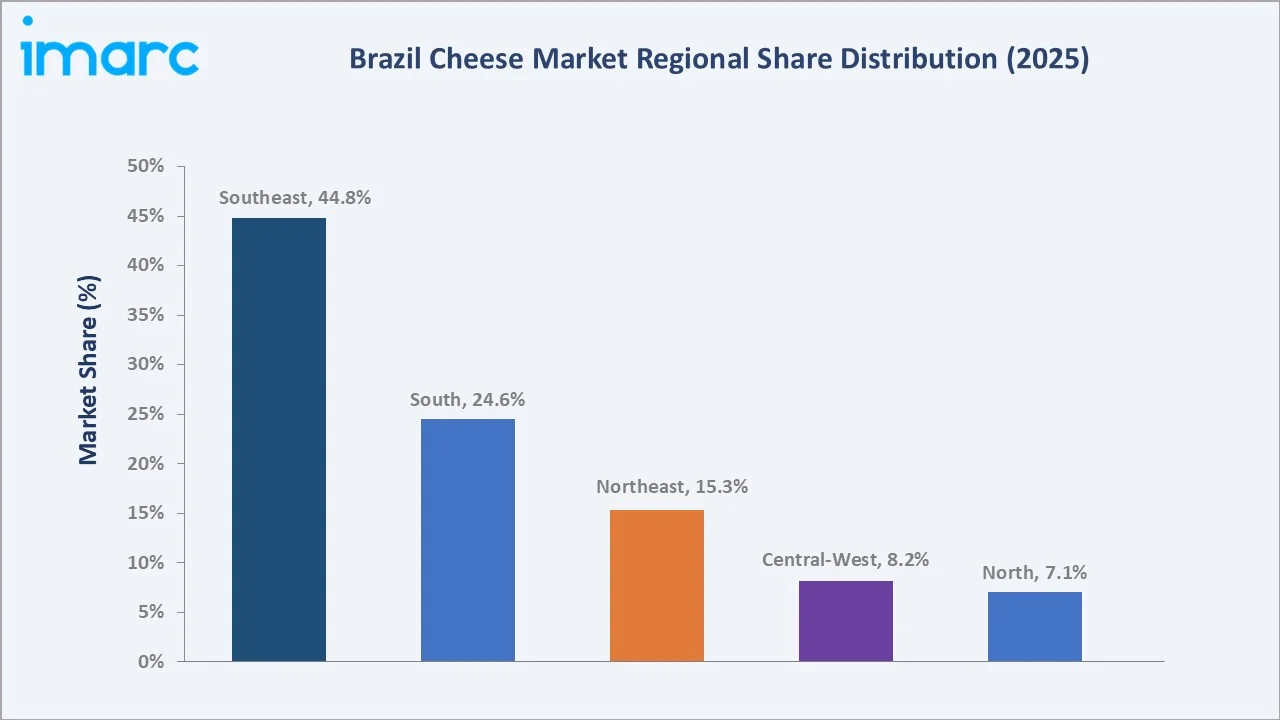
The Northeast at 15.3% is growing through urbanization of state capitals and formal retail expansion despite significant informal market competition. The Central-West at 8.2% is benefiting from the region's rapid economic development, and the North at 7.1% remains the lowest-penetration region due to cold chain and income constraints but represents the highest growth potential as infrastructure investment expands formal retail reach.
Competitive Landscape
The Brazil cheese market features a competitive landscape combining multinational dairy groups, large Brazilian dairy corporations, regional cooperatives, and established Brazilian private dairy brands. Market leadership is contested through brand recognition, product portfolio breadth, distribution reach, price positioning, and innovation capability across natural and processed cheese categories.
|
Company |
Key Brands |
Market Position |
Core Strength |
|
BSA International SA |
President, Galbani, Poços de Caldas |
Market Leader |
BSA International SA plays a foundational corporate role in Brazil's cheese and dairy industry as the holding company of Groupe Lactalis. |
|
Tirolez Dairy Products Ltd |
Tirolez |
Market Leader |
Tirolez Dairy Products Ltd is one of the largest, most traditional, and most awarded cheese and dairy brands in Brazil. |
|
Savencia SA |
Polenghi, Saint Albray, Chavroux |
Established Player |
Savencia SA holds a dominant, market-leading position in the Brazilian cheese industry. |
|
SCALA |
Scala |
Established Player |
Scala is one of the leading cheese manufacturers and dairy producers in Brazil, known for supplying large-scale commercial dairy products like mozzarella, butter, and parmesan. |
|
CATUPIRY |
Catupiry |
Innovator |
Catupiry is a famous brand of requeijão (a creamy, mild dairy spread) that acts as a culinary staple and rich melting filler in Brazilian cuisine. |
Competitive dynamics are evolving as large-format cash-and-carry retailers grow their cheese category private label programs, creating margin pressure on mid-tier national brands. Premium and artisan producers are growing share in urban specialty channels. Multinationals are leveraging global R&D capabilities to introduce premium innovations while Brazilian cooperatives compete through local milk procurement advantages and regional distribution relationships.
Key Company Profiles
BSA International SA
BSA International SA operates in Brazil’s dairy sector with a portfolio spanning milk-based products and cheese offerings. The company serves the domestic market through established production and distribution capabilities, addressing demand across retail and food service channels. Its activities in the cheese segment emphasize product quality, portfolio diversification, and broad market availability to cater to evolving Brazilian consumer preferences.
- Key Brands: President, Galbani, Poços de Caldas.
- Strategic Focus: Strengthening its position through product portfolio diversification, quality enhancement, and broader distribution. The company also emphasizes innovation and operational efficiency to address evolving consumer preferences and competitive pressures.
Tirolez Dairy Products Ltd
Tirolez Dairy Products Ltd. is a Brazilian dairy company specializing in the production and commercialization of a broad range of cheese products. Its portfolio includes traditional, specialty, processed, and value-added cheese varieties catering to household, retail, and foodservice demand. The company maintains an extensive presence across Brazil, supported by established manufacturing and distribution capabilities and a strong focus on product quality and innovation.
- Key Brands: Tirolez.
- Strategic Focus: Expanding its cheese portfolio through product innovation, premiumization, and offerings aligned with evolving consumer preferences. The company also emphasizes distribution expansion, production efficiency, and brand strengthening to enhance its presence across Brazil.
Market Concentration Analysis
The Brazil cheese market is moderately concentrated in the formal registered sector, with the top five manufacturers BSA International SA, Tirolez Dairy Products Ltd, Savencia SA, SCALA, and CATUPIRY, collectively accounting for an estimated 40-50% of formal sector production volume. The remaining market volume is distributed among a large number of regional dairy cooperatives, medium-sized dairy processors, and artisan producers operating across Brazil's diverse production regions. The significant informal production sector for traditional regional cheeses represents an additional 30-40% of total volume outside formal market accounting.
Market consolidation is gradually occurring in the formal sector through acquisitions by multinational dairy groups and large Brazilian food companies, while the artisan and specialty tier is simultaneously fragmenting as new premium producers emerge to serve the growing urban gastronomy market. Private label growth through cash-and-carry retail is challenging mid-tier branded manufacturers and is likely to drive further consolidation among brands unable to differentiate sufficiently from commodity private label cheese pricing.
Investment & Growth Opportunities
Highest Growth Segments
Lactose-free natural cheese (~3%+ CAGR premium), buffalo milk mozzarella and artisan specialty cheese (~2.5%+ CAGR), Southeast and South urban premium retail channel expansion, foodservice B2B mozzarella customization, e-commerce specialty cheese direct-to-consumer, and geographical indication cheese premiumization represent the highest-return investment vectors in the Brazil cheese market through 2034.
Investment Themes
- Geographical Indication and Premium Origin Cheese Development: Investing in formal registration, quality protocols, and international marketing of Brazilian GI cheeses, particularly Canastra, Serro, and other queijo Minas artesanal varieties, creates premium pricing power and differentiation from commodity alternatives. International export potential for recognized Brazilian GI cheese varieties to Portuguese-speaking markets and global specialty retailers represents an underdeveloped revenue opportunity.
- Foodservice Customization and B2B Supply Chain Integration: Developing customized mozzarella formulations, specific moisture levels, melt profiles, browning characteristics, and shred configurations for major pizza chains and food processors creates sticky B2B revenue relationships with lower price sensitivity than retail commodity cheese. As Brazilian foodservice chains scale nationally and internationally, supplier relationships established early generate growing volume commitments.
Future Market Outlook (2026-2034)
The Brazil cheese market is projected to grow from 789.4 Thousand Tons in 2025 to 803.8 Thousand Tons in 2026, reaching 928.6 Thousand Tons by 2034, exhibiting a CAGR of 1.82% during 2026-2034. The market is projected to reach an anchor volume of 863.9 Thousand Tons by 2030, representing the mid-period milestone at which per capita consumption, foodservice and pizza sector cheese demand achieves critical mass in secondary cities, and lactose-free and premium natural cheese segments reach mainstream retail visibility.
Three structural forces will define the Brazil cheese market through 2034. First, Brazil's continuing urbanization trajectory creates persistent demand growth for modern retail-distributed, refrigerated natural cheese formats as urban consumers systematically replace informal and traditional food procurement patterns with supermarket and e-commerce shopping. Second, the foodservice economy will continue to generate strong mozzarella and processed cheese demand that sustains volume market growth above GDP growth rates. Third, the income growth and dietary diversification of Brazil's middle and upper-middle classes will drive continued premiumization within the cheese category.
Research Methodology
Primary Research
Primary research comprised in-depth interviews with cheese manufacturers, dairy cooperative managers, foodservice procurement directors, retail category managers, Brazilian dairy industry association representatives, and regulatory officials. These discussions validated market volume estimates, source and type demand dynamics, regional consumption patterns, and technology adoption trajectories for the 2026-2034 forecast period.
Secondary Research
Secondary research encompassed dairy production statistics, food consumption surveys, Brazilian Association of Dairy Industries sector data, dairy research publications, IMARC Group proprietary food and dairy databases, company annual reports, and industry publications covering Brazilian dairy and cheese market developments through 2025.
Forecasting Models
Forecasting models incorporated historical cheese consumption correlations with per-capita income growth, urbanization rates, and foodservice sector revenue; product innovation adoption curves for lactose-free and premium segments, regional cold-chain infrastructure development trajectories, and macroeconomic indicators including Brazilian GDP growth, consumer confidence, and dairy commodity price scenarios. Both bottom-up source and type volume modeling and top-down market sizing approaches were cross-validated for forecast consistency across all segments and regions.
Brazil Cheese Market Report Coverage:
| Report Features | Details |
|---|---|
| Base Year of the Analysis | 2025 |
| Historical Period | 2020-2025 |
| Forecast Period | 2026-2034 |
| Units | Thousand Tons |
| Scope of the Report |
Exploration of Historical Trends and Market Outlook, Industry Catalysts and Challenges, Segment-Wise Historical and Future Market Assessment:
|
| Sources Covered | Cow Milk, Buffalo Milk, Goat Milk, Others |
| Types Covered | Natural, Processed |
| Products Covered | Mozzarella, Cheddar, Feta, Parmesan, Roquefort, Others |
| Distribution Channels Covered | Supermarkets and Hypermarkets, Convenience Stores, Specialty Stores, Online, Others |
| Formats Covered | Slices, Diced/Cubes, Shredded, Blocks, Spreads, Liquid, Others |
| Regions Covered | Southeast, South, Northeast, North, Central-West |
| Companies Covered | BSA International SA, Tirolez Dairy Products Ltd, Savencia SA, SCALA, CATUPIRY, etc. |
| Customization Scope | 10% Free Customization |
| Post-Sale Analyst Support | 10-12 Weeks |
| Delivery Format | PDF and Excel through Email (We can also provide the editable version of the report in PPT/Word format on special request) |
Key Benefits for Stakeholders:
- IMARC’s industry report offers a comprehensive quantitative analysis of various market segments, historical and current market trends, market forecasts, and dynamics of the Brazil cheese market from 2020-2034.
- The research report provides the latest information on the market drivers, challenges, and opportunities in the Brazil cheese market.
- Porter's five forces analysis assist stakeholders in assessing the impact of new entrants, competitive rivalry, supplier power, buyer power, and the threat of substitution. It helps stakeholders to analyze the level of competition within the Brazil cheese industry and its attractiveness.
- Competitive landscape allows stakeholders to understand their competitive environment and provides an insight into the current positions of key players in the market.
Frequently Asked Questions About the Brazil Cheese Market Report
The Brazil cheese market reached 803.8 Thousand Tons in 2026, driven by rising per capita cheese consumption, foodservice sector expansion, pizza industry mozzarella demand, and urbanization-driven adoption of modern retail cheese formats across all regions.
The Brazil cheese market is projected to grow at a CAGR of 1.82% during 2026-2034, driven by steady urbanization, pizza and foodservice sector growth, lactose-free and premium cheese segment expansion, and gradual per capita consumption increases as income levels rise across Brazilian consumer segments.
The market is projected to reach 863.9 Thousand Tons by 2030, the mid-period milestone, as rising per capita consumption, foodservice mozzarella demand expands into secondary cities, and premium and specialty cheese segments achieve mainstream retail visibility and consumer trial.
Cow milk leads with an 88.6% share in 2025, reflecting Brazil's large-scale bovine dairy industry, established cooperative milk collection infrastructure, and consumer familiarity with cow-milk cheese varieties.
Natural cheese leads with a 67.8% share in 2025, anchored by mozzarella, prato, queijo Minas, and coalho as the dominant Brazilian cheese varieties in both retail and foodservice applications, supported by growing consumer preference for less-processed, natural dairy formats.
The Southeast leads with a 44.8% share in 2025, driven by traditional cheese production heritage and Brazil's most diverse cheese culture, combined with a consumer urban market representing the highest per-capita cheese spending in the country.
Key players include BSA International SA, Tirolez Dairy Products Ltd, Savencia SA, SCALA, and CATUPIRY, among others.
The Brazil cheese market is projected to reach 928.6 Thousand Tons by 2034, driven by sustained urbanization and per-capita consumption growth, foodservice and delivery platform expansion, premium and lactose-free segment development, and growing artisan and specialty cheese culture in Brazilian cities.
Key opportunities include geographical indication cheese development for international premium markets, foodservice B2B mozzarella customization for pizza chains, e-commerce and direct-to-consumer artisan cheese channels, lactose-free product line extensions, Northeast and North regional distribution infrastructure investment, and plant-based cheese innovation for urban flexitarian consumers.
Need more help?
- Speak to our experienced analysts for insights on the current market scenarios.
- Include additional segments and countries to customize the report as per your requirement.
- Gain an unparalleled competitive advantage in your domain by understanding how to utilize the report and positively impacting your operations and revenue.
- For further assistance, please connect with our analysts.
 Request Customization
 Speak to an Analyst
 Request Brochure
 Inquire Before Buying
Benefits of Customization
- Personalize this research
- Triangulate with your data
- Get data as per your format and definition
- Gain a deeper dive into a specific application, geography, customer, or competitor
- Any level of personalization
Get in Touch With Us
UNITED STATES
Phone: +1-201-971-6302
INDIA
Phone: +91-120-433-0800
UNITED KINGDOM
Phone: +44-753-714-6104
Email: [email protected]
Client Testimonials




















Related Reports

Choose your plan
*Please note that the prices mentioned below are starting prices for each bundle type. Kindly contact our team for further details.*
Single User License
- 1 User License, Access on 2 Devices
- PDF Report + Excel Dataset (Password Protected)
- Lifetime Access
- No Printing Rights
- 10% Free Report Customization
- 10–12 Weeks of Analyst Support
Five User License
- Access for 5 Users, 2 Devices per User
- PDF Report + Excel Dataset (Password Protected)
- Lifetime Access
- Dedicated Account Manager
- 12–14 Weeks of Analyst Support
- No Printing Rights
- 15% Free Report Customization
- 25% Discount on Your Next Purchase
Corporate User License
- Unlimited User Access (Within Your Organization)
- PDF Report + Excel Dataset
- Lifetime Access
- Dedicated Account Manager
- 14–20 Weeks of Analyst Support
- No Printing Rights
- 20% Free Report Customization
- 30% Discount on Your Next Purchase
Essential Insights
What's included:
3 reports
- Lifetime Access
- PDF Reports
- Excel Datasets
- 2 Weeks of Free Analyst Support
- 2 User Licenses
- Access on 2 Devices
- Printing Rights
- Complimentary PowerPoint (PPT) Version
- Complimentary License Upgrade
Professional Access
What's included:
5 reports
- Lifetime Access
- PDF Reports
- Excel Datasets
- 8 Weeks of Free Analyst Support
- 2 User Licenses
- Access on 2 Devices
- Printing Rights
- Complimentary PowerPoint (PPT) Version
- Complimentary License Upgrade
Business Advantage
What's included:
8 reports
- Lifetime Access
- PDF Reports
- Excel Datasets
- 14 Weeks of Free Analyst Support
- 2 User Licenses
- Access on 2 Devices
- Printing Rights
- Complimentary PowerPoint (PPT) Version
- Complimentary License Upgrade
Enterprise Intelligence
What's included:
10 reports
- Lifetime Access
- PDF Reports
- Excel Datasets
- 20 Weeks of Free Analyst Support
- 2 User Licenses
- Access on 2 Devices
- Printing Rights
- Complimentary PowerPoint (PPT) Version
- Complimentary License Upgrade