
Brazil Commercial Vehicles Lubricants Market Size, Share, Trends and Forecast by Product Type, and Region, 2026-2034
Brazil Commercial Vehicles Lubricants Market Summary:
The Brazil commercial vehicles lubricants market size reached 445.09 Million Litres in 2025 and is projected to reach 596.45 Million Litres by 2034, growing at a compound annual growth rate of 3.31% from 2026-2034.
The Brazil commercial vehicles lubricants market demonstrates consistent growth driven by the expanding commercial vehicle fleet, increasing freight transportation activities, and modernization of logistics infrastructure across the country. The market benefits from Brazil's position as South America's largest economy and commercial vehicle market, with strong demand emanating from road freight transport, public transit systems, and agricultural machinery operations. Rising awareness regarding vehicle maintenance and the adoption of high-performance lubricants to extend equipment lifespan are reinforcing positive market dynamics throughout the forecast period.
Key Takeaways and Insights:
- By Product Type: Engine oils dominate the market with a share of 42% in 2025, driven by their essential role in ensuring optimal engine performance, reducing friction-induced wear, and extending the operational lifespan of commercial vehicle engines across diverse fleet applications.
- By Region: Southeast leads the market with a share of 35% in 2025, owing to its concentration of industrial hubs, extensive road networks connecting major ports, and the presence of key logistics centers in São Paulo and Rio de Janeiro metropolitan areas.
- Key Players: The Brazil commercial vehicles lubricants market exhibits moderate competitive intensity, characterized by the presence of multinational energy corporations operating alongside established domestic manufacturers, with competition centered on product performance specifications, distribution network reach, and technical service capabilities.
The commercial vehicles lubricants market in Brazil continues to evolve alongside developments in the transportation and logistics sectors. The country's heavy reliance on road freight transport for cargo movement creates sustained demand for specialized lubricants designed to withstand extended operating hours and challenging terrain conditions. Fleet operators increasingly prioritize lubricant solutions that deliver enhanced fuel efficiency, reduced maintenance intervals, and compliance with evolving emission standards. The implementation of PROCONVE P-8 emission regulations, equivalent to Euro VI standards, has accelerated the adoption of advanced lubricant formulations compatible with modern after-treatment systems. Additionally, Brazil's growing agricultural sector and mining activities generate substantial requirements for heavy-duty lubricants capable of performing under extreme operational stress, further broadening the market's addressable base.
Brazil Commercial Vehicles Lubricants Market Trends:
Shift Toward Synthetic and High-Performance Formulations
The commercial vehicle lubricants market is experiencing rising demand for synthetic and semi-synthetic products that perform reliably under challenging operating conditions. Fleet operators increasingly recognize the cost advantages of premium formulations, which allow longer drain intervals, reduce vehicle downtime, and lower overall maintenance expenses. Advanced synthetic lubricants provide superior thermal stability, enhanced protection during cold starts, and stronger resistance to oxidation compared with conventional mineral oils. These benefits support fleet efficiency, prolong engine life, and improve operational reliability across demanding transport and logistics applications.
Growing Emphasis on Environmental Sustainability
Environmental considerations are increasingly influencing procurement decisions in the commercial vehicle sector. Fleet operators and logistics companies are turning to eco-friendly lubricants that reduce environmental impact while maintaining performance standards. This shift aligns with corporate sustainability initiatives and regulatory efforts promoting lower emissions and responsible resource use. Bio-based lubricant solutions are gaining popularity, especially among organizations prioritizing environmental stewardship, helping fleets achieve both operational efficiency and compliance with sustainability objectives, while contributing to greener transport practices.
Integration of Digital Fleet Management Technologies
The adoption of telematics and digital fleet management systems is transforming lubricant consumption patterns and maintenance scheduling. Advanced monitoring technologies enable real-time tracking of lubricant condition, facilitating predictive maintenance approaches that optimize lubricant replacement timing based on actual performance degradation rather than fixed intervals. This technology-driven approach enhances cost efficiency while ensuring consistent vehicle performance and reliability across commercial fleets. For instance, in October 2025, Polestar launched a new connected service for fleet operators, providing real-time access to electric vehicle data and analytics. Known as Polestar Fleet Telematics, the platform enables fleet managers to track and optimize vehicle performance and utilization without requiring additional hardware or installation costs. The system seamlessly integrates with existing fleet management solutions, offering a streamlined approach to monitoring and improving operational efficiency across electric vehicle fleets.
Market Outlook 2026-2034:
The Brazil commercial vehicles lubricants market outlook remains positive through the forecast period, supported by sustained investment in transportation infrastructure, expanding e-commerce logistics requirements, and ongoing fleet modernization initiatives. Government infrastructure programs targeting highway improvements and intermodal connectivity enhancements are expected to stimulate freight transport volumes, consequently driving lubricant demand. The Southeast region is investing substantially in road network upgrades and intermodal facility expansions, strengthening its position as the primary logistics hub. The market size was estimated at 445.09 Million Litres in 2025 and is expected to reach 596.45 Million Litres by 2034, reflecting compound annual growth rate of 3.31% over the 2026-2034.
Brazil Commercial Vehicles Lubricants Market Report Segmentation:
| Segment Category | Leading Segment | Market Share |
|---|---|---|
| Product Type | Engine Oils | 42% |
| Region | Southeast | 35% |
Product Type Insights:
To get detailed segment analysis of this market Request Sample
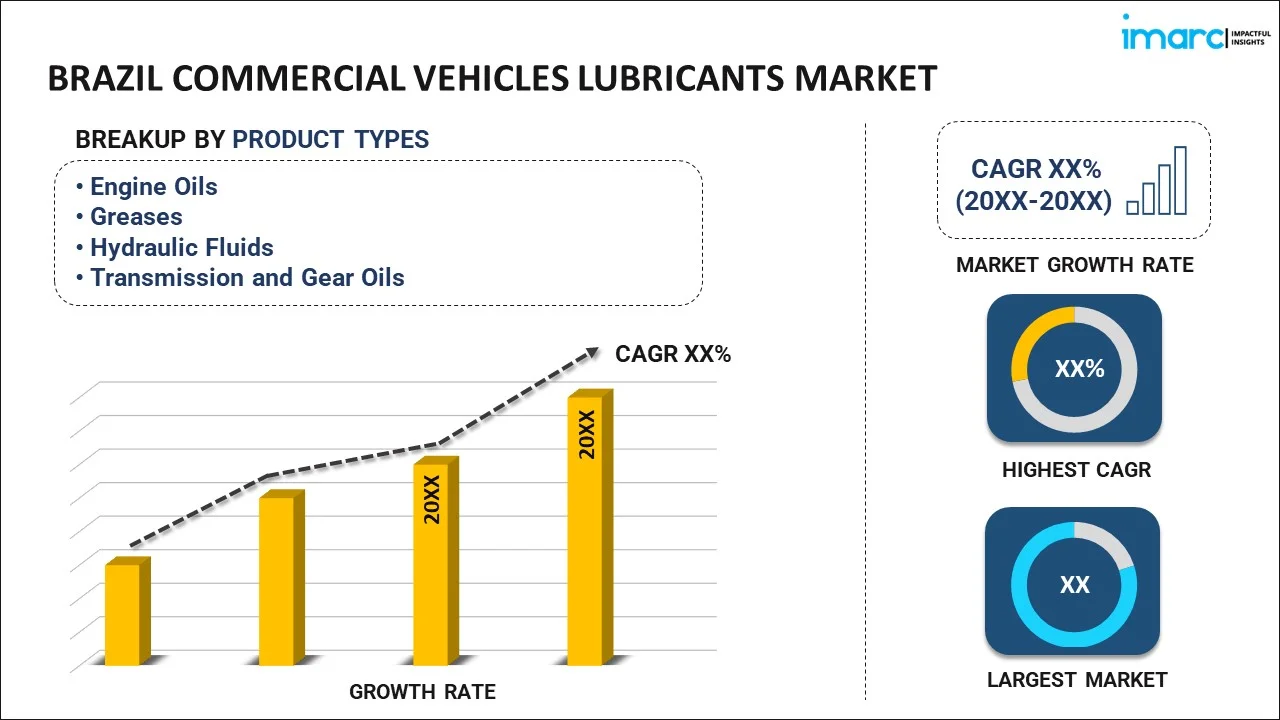
- Engine Oils
- Greases
- Hydraulic Fluids
- Transmission and Gear Oils
Engine oils dominate with a market share of 42% of the total Brazil commercial vehicles lubricants market in 2025.
Engine oils represent the cornerstone of commercial vehicle maintenance, serving critical functions in protecting engine components from wear, managing operating temperatures, and ensuring optimal fuel combustion efficiency. The segment's commanding position reflects the fundamental requirement for regular engine oil replacement across all commercial vehicle categories, from light commercial vehicles to heavy-duty trucks and buses. Brazil's commercial vehicle fleet, exceeding several million units, generates substantial recurring demand for engine oils designed to meet manufacturer specifications and operating conditions unique to the country's diverse geographic and climatic zones. The Brazil automotive engine oil market size was valued at USD 833.5 Million in 2025. Looking forward, IMARC Group estimates the market to reach USD 1,082.3 Million by 2034, exhibiting a CAGR of 2.95% from 2026-2034.
The adoption of stringent emission standards has significantly increased the demand for engine oil formulations, requiring compatibility with advanced exhaust after-treatment systems such as particulate filters and selective catalytic reduction technologies. These regulations are encouraging a shift toward higher-specification oils that protect emission control equipment while providing enhanced engine performance. At the same time, improvements in synthetic formulations supporting longer oil drain intervals are reshaping consumption patterns, driving a trend toward premium engine oils and influencing the overall structure of demand within the commercial vehicle lubricants segment.
Regional Insights:
To get detailed regional analysis of this market Request Sample
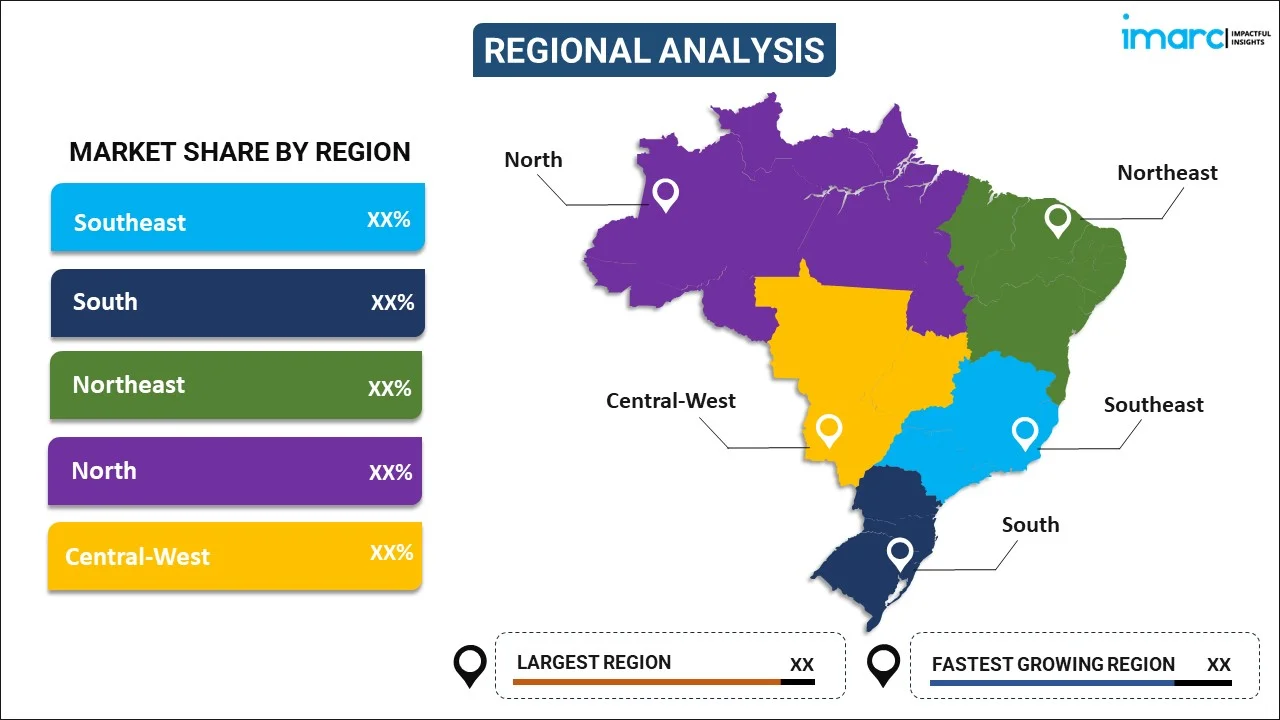
- Southeast
- South
- Northeast
- North
- Central-West
Southeast leads with a share of 35% of the total Brazil commercial vehicles lubricants market in 2025.
The Southeast region's market leadership stems from its position as Brazil's economic and logistical epicenter. Comprising the states of São Paulo, Rio de Janeiro, Minas Gerais, and Espírito Santo, this region concentrates the nation's largest industrial manufacturing facilities, most active seaports, and densest highway networks. São Paulo alone accounts for a significant portion of Brazil's GDP and hosts the country's primary distribution centers serving both domestic consumption and export activities. The Port of Santos, Latin America's largest container port, generates substantial commercial vehicle traffic requiring regular lubricant consumption for trucks operating along coastal routes.
Infrastructure investments targeting highway improvements and intermodal connectivity enhancements continue strengthening the Southeast's logistical capabilities. Major roadways, including SP-330 and SP-348, are undergoing capacity expansions to accommodate growing freight volumes driven by e-commerce expansion and manufacturing sector activity. The region's well-developed service infrastructure, including authorized service centers and specialized lubricant distributors, ensures convenient access to quality products and technical expertise for commercial fleet operators throughout the area.
Market Dynamics:
Growth Drivers:
Why is the Brazil Commercial Vehicles Lubricants Market Growing?
Expanding Commercial Vehicle Fleet and Road Freight Dominance
Brazil's road freight transport sector accounts for the majority of domestic cargo movement, creating substantial and sustained demand for commercial vehicle lubricants. The country's extensive highway network exceeding one million kilometers supports logistics operations connecting agricultural production zones, industrial manufacturing centers, and consumer markets across its continental territory. Commercial vehicle production demonstrated strong recovery momentum, with truck and bus manufacturing increasing substantially as manufacturers respond to fleet renewal requirements and replacement demand from aging vehicles. This vehicle population expansion directly correlates with increased lubricant consumption across all product categories, from engine oils to transmission fluids and hydraulic systems. The average age of Brazil's commercial vehicle fleet creates recurring maintenance requirements that sustain lubricant demand even during periods of slower new vehicle sales.
Implementation of Stringent Emission Regulations
The adoption of PROCONVE P-8 emission standards, equivalent to Euro VI regulations, has fundamentally transformed lubricant requirements for commercial vehicles operating in Brazil. These regulations mandate significant reductions in particulate matter and nitrogen oxide emissions, necessitating advanced exhaust after-treatment systems including diesel particulate filters and selective catalytic reduction technologies. Lubricants compatible with these emission control systems require specific formulation characteristics including reduced ash content, lower sulfur levels, and enhanced additive packages that protect sensitive catalytic components. This regulatory framework accelerates the premiumization trend within the lubricants market as fleet operators transition toward higher-specification products that ensure both regulatory compliance and optimal vehicle performance. The transition to P-8 compliant vehicles continues driving demand for corresponding lubricant upgrades across the commercial vehicle population. For instance, the PROCONVE L8, the newest stage of Brazil’s Vehicle Emission Control Program, which came into effect on January 1st, brings substantial changes to the country’s automotive sector aimed at sharply reducing pollutant emissions. Established in line with the 2018 CONAMA Resolution 492 from the Brazilian Environment Council, these regulations harmonize with global standards and directly influence the design and development of new vehicles, necessitating the adoption of advanced technologies to achieve environmental and sustainability objectives.
Growing E-Commerce and Last-Mile Logistics Expansion
The rapid expansion of e-commerce activities across Brazil is driving increased demand for commercial vehicle lubricants through growing last-mile delivery requirements. The Brazil e-commerce market size reached USD 513.3 Billion in 2025. Looking forward, IMARC Group expects the market to reach USD 1,501.8 Billion by 2034, exhibiting a growth rate (CAGR) of 12.67% during 2026-2034. Urban distribution centers are proliferating in major metropolitan areas as online retail penetration continues to accelerate, particularly following digital adoption patterns established during recent years. This logistics expansion translates to higher utilization rates for light commercial vehicles and delivery fleets, consequently increasing lubricant consumption through more frequent maintenance intervals. Major logistics operators are expanding distribution networks and vehicle fleets to meet consumer expectations for faster delivery timeframes. The intensification of urban freight movements, particularly in densely populated regions, generates consistent demand for lubricant products across diverse commercial vehicle categories serving the expanding delivery ecosystem.
Market Restraints:
What Challenges the Brazil Commercial Vehicles Lubricants Market is Facing?
Extended Drain Intervals Reducing Consumption Frequency
Advancements in lubricant formulation technology are enabling significantly extended oil drain intervals compared to conventional products. While these developments deliver operational benefits to fleet operators, they simultaneously reduce overall lubricant consumption volumes as fewer oil changes are required over vehicle service life. The adoption of synthetic formulations capable of maintaining protective properties across extended operational periods may moderate market volume growth despite increasing vehicle populations.
Economic Volatility and Currency Fluctuations
Brazil's economic environment remains susceptible to currency volatility and inflationary pressures that affect input costs for lubricant manufacturers and purchasing decisions by commercial fleet operators. Currency depreciation increases the cost of imported base oils and additive components, potentially compressing manufacturer margins or elevating product pricing. Economic uncertainty may lead fleet operators to defer maintenance expenditure or substitute premium products with lower-cost alternatives.
Emerging Alternative Powertrain Technologies
The gradual introduction of electric and alternative fuel commercial vehicles presents a long-term consideration for traditional lubricant demand patterns. While internal combustion engine vehicles continue dominating the commercial fleet, the increasing availability of electric trucks and buses may progressively influence market dynamics. Alternative powertrain vehicles require different lubricant types and quantities compared to conventional diesel-powered commercial vehicles.
Competitive Landscape:
The Brazil commercial vehicles lubricants market demonstrates a moderately consolidated competitive structure, with established multinational corporations maintaining significant market positions alongside regional manufacturers and distributors. Competition centers on product performance specifications, brand reputation, distribution network reach, and technical service capabilities that support fleet operator maintenance requirements. Leading market participants leverage integrated supply chain advantages, including local blending facilities and established distribution partnerships with automotive dealerships and service centers. Strategic investments in research and development capabilities enable the introduction of advanced formulations addressing evolving regulatory requirements and customer performance expectations. Price competitiveness remains relevant, particularly in segments serving cost-sensitive fleet operators, while premium segments emphasize value propositions centered on extended equipment protection and operational efficiency improvements. Distribution channel management represents a critical competitive dimension, with companies developing multi-channel strategies encompassing authorized workshops, retail networks, and direct supply arrangements with major fleet operators.
Recent Developments:
- In July 2025, CNH, a leading global provider of equipment, technology, and services, collaborated with PETRONAS Lubrificants International (PLI) and its Brazilian subsidiary, PETRONAS Lubrificantes Brasil (PLB), to introduce the FLEETPRO Cycle line of products. This new offering underscores the companies’ commitment to delivering advanced lubricant solutions tailored for commercial vehicle fleets in Brazil.
- In January 2024, Gulf Oil International Ltd. expanded its footprint in Brazil with the launch of its local subsidiary, Gulf Oil Brazil. The company has started manufacturing and distributing lubricants from its own facility and is extending its brand through licensing agreements with fuel stations. The move underscores Gulf Oil’s commitment to the Latin American market and marks a strategic step toward growth and collaboration in the country.
Brazil Commercial Vehicles Lubricants Market Report Coverage:
| Report Features | Details |
|---|---|
| Base Year of the Analysis | 2025 |
| Historical Period | 2020-2025 |
| Forecast Period | 2026-2034 |
| Units | Million Litres |
| Scope of the Report | Exploration of Historical and Forecast Trends, Industry Catalysts and Challenges, Segment-Wise Historical and Predictive Market Assessment:
|
| Product Types Covered | Engine Oils, Greases, Hydraulic Fluids, Transmission and Gear Oils |
| Regions Covered | Southeast, South, Northeast, North, Central-West |
| Customization Scope | 10% Free Customization |
| Post-Sale Analyst Support | 10-12 Weeks |
| Delivery Format | PDF and Excel through Email (We can also provide the editable version of the report in PPT/Word format on special request) |
Frequently Asked Questions About the Brazil Commercial Vehicles Lubricants Market Report
The Brazil commercial vehicles lubricants market reached a volume of 445.09 Million Litres in 2025.
The Brazil commercial vehicles lubricants market is expected to grow at a compound annual growth rate of 3.31% from 2026-2034 to reach 596.45 Million Litres by 2034.
Engine oils dominated the market with a 42% share in 2025, driven by their essential role in protecting engine components, managing operating temperatures, and ensuring optimal fuel combustion efficiency across all commercial vehicle categories.
Key factors driving the Brazil commercial vehicles lubricants market include expanding commercial vehicle fleet and road freight dominance, implementation of stringent PROCONVE P-8 emission regulations requiring advanced lubricant formulations, and growing e-commerce and last-mile logistics expansion.
Major challenges include extended drain intervals reducing consumption frequency, economic volatility and currency fluctuations affecting input costs, and the gradual emergence of alternative powertrain technologies that require different lubricant specifications.
Need more help?
- Speak to our experienced analysts for insights on the current market scenarios.
- Include additional segments and countries to customize the report as per your requirement.
- Gain an unparalleled competitive advantage in your domain by understanding how to utilize the report and positively impacting your operations and revenue.
- For further assistance, please connect with our analysts.
 Request Customization
 Speak to an Analyst
 Request Brochure
 Inquire Before Buying
Benefits of Customization
- Personalize this research
- Triangulate with your data
- Get data as per your format and definition
- Gain a deeper dive into a specific application, geography, customer, or competitor
- Any level of personalization
Get in Touch With Us
UNITED STATES
Phone: +1-201-971-6302
INDIA
Phone: +91-120-433-0800
UNITED KINGDOM
Phone: +44-753-714-6104
Email: [email protected]
Client Testimonials




.webp)




.webp)













Related Reports

Choose your plan
*Please note that the prices mentioned below are starting prices for each bundle type. Kindly contact our team for further details.*
Single User License
- 1 User License, Access on 2 Devices
- PDF Report + Excel Dataset (Password Protected)
- Lifetime Access
- No Printing Rights
- 10% Free Report Customization
- 10–12 Weeks of Analyst Support
Five User License
- Access for 5 Users, 2 Devices per User
- PDF Report + Excel Dataset (Password Protected)
- Lifetime Access
- Dedicated Account Manager
- 12–14 Weeks of Analyst Support
- No Printing Rights
- 15% Free Report Customization
- 25% Discount on Your Next Purchase
Corporate User License
- Unlimited User Access (Within Your Organization)
- PDF Report + Excel Dataset
- Lifetime Access
- Dedicated Account Manager
- 14–20 Weeks of Analyst Support
- No Printing Rights
- 20% Free Report Customization
- 30% Discount on Your Next Purchase
Essential Insights
What's included:
3 reports
- Lifetime Access
- PDF Reports
- Excel Datasets
- 2 Weeks of Free Analyst Support
- 2 User Licenses
- Access on 2 Devices
- Printing Rights
- Complimentary PowerPoint (PPT) Version
- Complimentary License Upgrade
Professional Access
What's included:
5 reports
- Lifetime Access
- PDF Reports
- Excel Datasets
- 8 Weeks of Free Analyst Support
- 2 User Licenses
- Access on 2 Devices
- Printing Rights
- Complimentary PowerPoint (PPT) Version
- Complimentary License Upgrade
Business Advantage
What's included:
8 reports
- Lifetime Access
- PDF Reports
- Excel Datasets
- 14 Weeks of Free Analyst Support
- 2 User Licenses
- Access on 2 Devices
- Printing Rights
- Complimentary PowerPoint (PPT) Version
- Complimentary License Upgrade
Enterprise Intelligence
What's included:
10 reports
- Lifetime Access
- PDF Reports
- Excel Datasets
- 20 Weeks of Free Analyst Support
- 2 User Licenses
- Access on 2 Devices
- Printing Rights
- Complimentary PowerPoint (PPT) Version
- Complimentary License Upgrade