
Brazil Data Center Construction Market Size, Share, Trends and Forecast by Construction Type, Data Center Type, Tier Standards, Vertical, and Region, 2026-2034
Brazil Data Center Construction Market Overview:
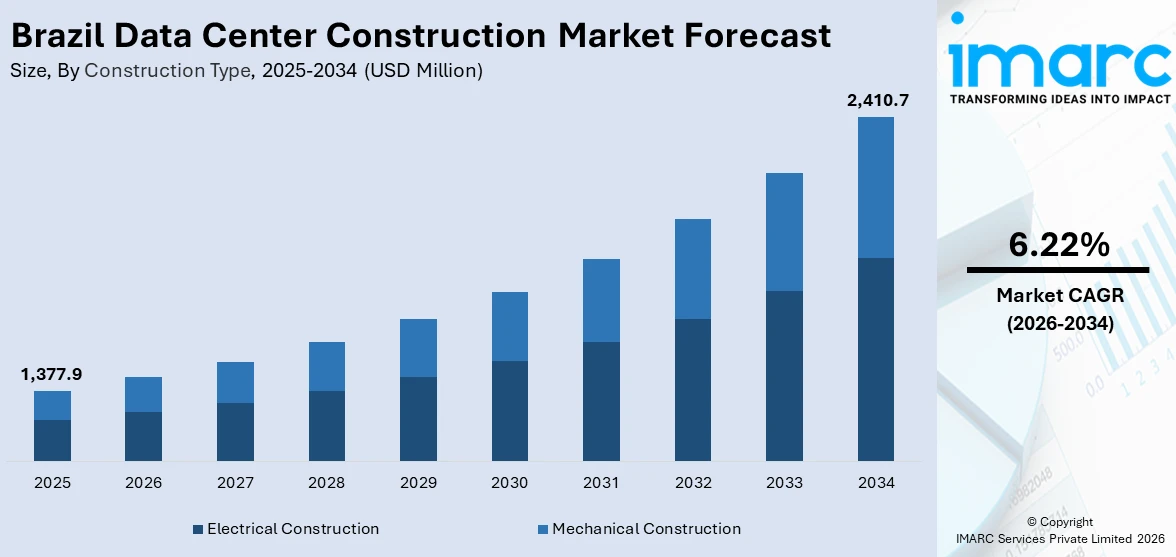
The Brazil data center construction market size reached USD 1,377.9 Million in 2025. The market is projected to reach USD 2,410.7 Million by 2034, exhibiting a growth rate (CAGR) of 6.22% during 2026-2034. The market is driven by massive cloud and artificial intelligence (AI) infrastructure investments from technology firms and the growing regulatory frameworks and data sovereignty requirements. Besides this, the broadening of e-commerce platforms and the thriving digital payment ecosystem are fueling the Brazil data center construction market share.
|
Report Attribute
|
Key Statistics
|
|---|---|
|
Base Year
|
2025
|
|
Forecast Years
|
2026-2034
|
|
Historical Years
|
2020-2025
|
| Market Size in 2025 | USD 1,377.9 Million |
| Market Forecast in 2034 | USD 2,410.7 Million |
| Market Growth Rate 2026-2034 | 6.22% |
Brazil Data Center Construction Market Trends:
Rising Cloud Computing and Digital Services Adoption
The rise in cloud computing and the utilization of digital services are fueling the market growth in Brazil. As businesses are shifting workloads to the cloud, hyperscale providers and regional cloud firms are significantly investing in infrastructure to meet the increasing demand. Industries, such as e-commerce, banking, healthcare, and education, depend on cloud platforms for enhanced efficiency and scalability, necessitating strong data center capabilities. Brazil's role as a prominent digital center in Latin America is driving cloud adoption among local and global businesses. As digital-first approaches are becoming more important, major cloud providers are collaborating with local operators to enhance physical infrastructure. The rising need for scalable, secure, and high-performance cloud services is directly resulting in the ongoing development of new data centers throughout Brazil, leading to sustained market expansion and investment prospects.
To get more information on this market Request Sample
Regulatory Compliance and Data Sovereignty Requirements
Rising regulatory frameworks and data sovereignty requirements are impelling the Brazil data center construction market growth. Legislation mandating that sensitive personal and financial information be stored domestically is prompting companies to establish or collaborate with local data centers. Sectors like banking, insurance, healthcare, and government are notably impacted, as they manage essential data that needs to adhere to stringent legal regulations. This generates possibilities for establishing new, compliant facilities equipped with enhanced security and redundancy measures. Global companies are also investing in localized infrastructure to guarantee regulatory compliance while preserving service quality. With the reinforcement of data protection regulations, companies are focusing on investing in secure, locally operated data centers.
Expansion of E-commerce
The thriving e-commerce and digital payments ecosystem in Brazil is driving the demand for data centers to ensure fast, secure, and reliable transactions. Online retail platforms require massive computational capacity to manage large inventories, real-time logistics, and customer interactions. At the same time, the widespread adoption of digital payment solutions, mobile wallets, and instant transactions adds pressure on infrastructure to process sensitive data securely. With Brazilian consumers increasingly shopping online and embracing fintech, e-commerce companies and payment providers are investing in advanced information technology (IT) systems hosted within robust data centers. Additionally, peak seasonal events drive higher transaction volumes, necessitating strong and scalable infrastructure. To meet this demand, more data centers are being constructed, providing businesses with the agility and reliability needed for Brazil’s digital commerce growth.
Investments by Hyperscale and Colocation Providers
Heavy investments from hyperscale cloud providers and colocation operators are significantly strengthening the market in Brazil. Global technology giants view Brazil as a strategic hub for Latin America, leading to large-scale construction of hyperscale facilities to support regional demand. Colocation services are also expanding rapidly, offering flexible and cost-efficient solutions for enterprises that cannot afford their own facilities but require robust infrastructure. These investments include state-of-the-art technologies like modular construction, green building practices, and advanced cooling systems, which enhance the efficiency and sustainability of data centers. The entry of international players is also promoting competition, innovations, and partnerships with local firms. As hyperscale and colocation providers continue to expand their footprints, Brazil’s data center landscape is undergoing rapid transformation, with new projects driving long-term growth and modernization.
.webp)
Brazil Data Center Construction Market Segmentation:
IMARC Group provides an analysis of the key trends in each segment of the market, along with forecasts at the country and regional levels for 2026-2034. Our report has categorized the market based on construction type, data center type, tier standards, and vertical.
Construction Type Insights:
- Electrical Construction
- Mechanical Construction
The report has provided a detailed breakup and analysis of the market based on the construction type. This includes electrical construction and mechanical construction.
Data Center Type Insights:
- Mid-Size Data Centers
- Enterprise Data Centers
- Large Data Centers
A detailed breakup and analysis of the market based on the data center type have also been provided in the report. This includes mid-size data centers, enterprise data centers, and large data centers.
Tier Standards Insights:
- Tier I and II
- Tier III
- Tier IV
The report has provided a detailed breakup and analysis of the market based on the tier standards. This includes tier I and II, tier III, and tier IV.
Vertical Insights:
Access the comprehensive market breakdown Request Sample
- Public Sector
- Oil and Energy
- Media and Entertainment
- IT and Telecommunication
- Banking, Financial Services and Insurance (BFSI)
- Healthcare
- Retail
- Others
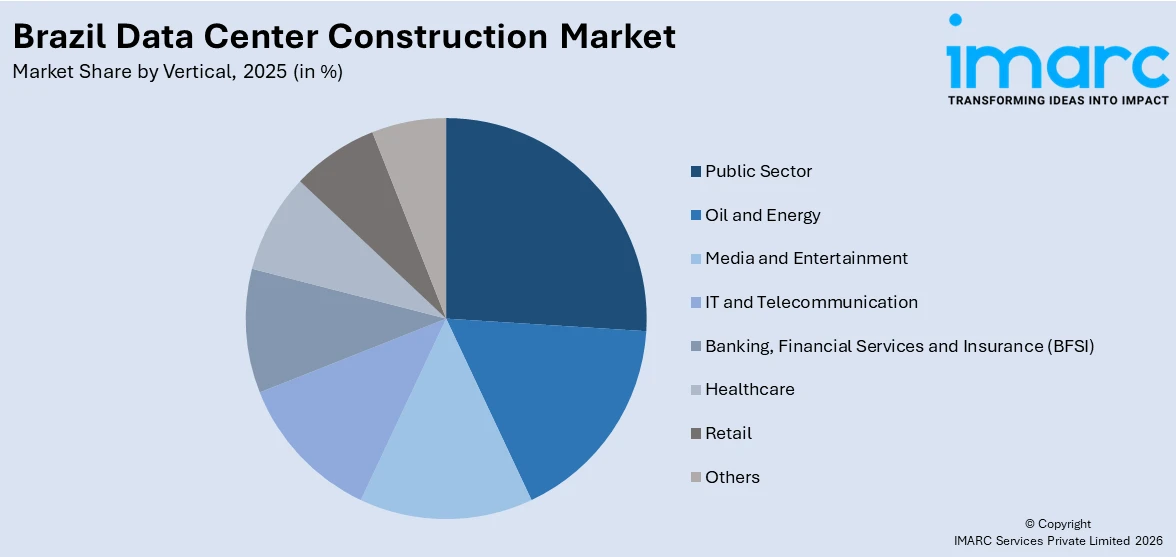
A detailed breakup and analysis of the market based on the vertical have also been provided in the report. This includes public sector, oil and energy, media and entertainment, IT and telecommunication, banking, financial services and insurance (BFSI), healthcare, retail, and others.
Regional Insights:
- Southeast
- South
- Northeast
- North
- Central-West
The report has also provided a comprehensive analysis of all the major regional markets, which include Southeast, South, Northeast, North, and Central-West.
Competitive Landscape:
The market research report has also provided a comprehensive analysis of the competitive landscape. Competitive analysis such as market structure, key player positioning, top winning strategies, competitive dashboard, and company evaluation quadrant has been covered in the report. Also, detailed profiles of all major companies have been provided.
Brazil Data Center Construction Market News:
- In September 2025, during the Apsara Conference 2025, Alibaba Cloud revealed intentions to establish its first data centers in Brazil, France, and the Netherlands, with more data centers set to open in Mexico, Japan, South Korea, Malaysia, and Dubai. The firm’s strategic infrastructure growth aimed to meet the rising demand from innovative clients.
- In August 2025, Brazil intended to unveil a tax incentive initiative, designed to lure foreign tech firms to establish data centers within its borders. Brazilian officials indicated that the incentives for data centers could redirect discussions towards investments that could benefit both parties.
Brazil Data Center Construction Market Report Coverage:
| Report Features | Details |
|---|---|
| Base Year of the Analysis | 2025 |
| Historical Period | 2020-2025 |
| Forecast Period | 2026-2034 |
| Units | Million USD |
| Scope of the Report |
Exploration of Historical Trends and Market Outlook, Industry Catalysts and Challenges, Segment-Wise Historical and Future Market Assessment:
|
| Construction Types Covered | Electrical Construction, Mechanical Construction |
| Data Center Types Covered | Mid-Size Data Centers, Enterprise Data Centers, Large Data Centers |
| Tier Standards Covered | Tier I and II, Tier III, Tier IV |
| Verticals Covered | Public Sector, Oil and Energy, Media and Entertainment, IT and Telecommunication, Banking, Financial Services and Insurance (BFSI), Healthcare, Retail, Others |
| Regions Covered | Southeast, South, Northeast, North, Central-West |
| Customization Scope | 10% Free Customization |
| Post-Sale Analyst Support | 10-12 Weeks |
| Delivery Format | PDF and Excel through Email (We can also provide the editable version of the report in PPT/Word format on special request) |
Key Questions Answered in This Report:
- How has the Brazil data center construction market performed so far and how will it perform in the coming years?
- What is the breakup of the Brazil data center construction market on the basis of construction type?
- What is the breakup of the Brazil data center construction market on the basis of data center type?
- What is the breakup of the Brazil data center construction market on the basis of tier standards?
- What is the breakup of the Brazil data center construction market on the basis of vertical?
- What is the breakup of the Brazil data center construction market on the basis of region?
- What are the various stages in the value chain of the Brazil data center construction market?
- What are the key driving factors and challenges in the Brazil data center construction market?
- What is the structure of the Brazil data center construction market and who are the key players?
- What is the degree of competition in the Brazil data center construction market?
Key Benefits for Stakeholders:
- IMARC's industry report offers a comprehensive quantitative analysis of various market segments, historical and current market trends, market forecasts, and dynamics of the Brazil data center construction market from 2020-2034.
- The research report provides the latest information on the market drivers, challenges, and opportunities in the Brazil data center construction market.
- Porter's five forces analysis assist stakeholders in assessing the impact of new entrants, competitive rivalry, supplier power, buyer power, and the threat of substitution. It helps stakeholders to analyze the level of competition within the Brazil data center construction industry and its attractiveness.
- Competitive landscape allows stakeholders to understand their competitive environment and provides an insight into the current positions of key players in the market.
Need more help?
- Speak to our experienced analysts for insights on the current market scenarios.
- Include additional segments and countries to customize the report as per your requirement.
- Gain an unparalleled competitive advantage in your domain by understanding how to utilize the report and positively impacting your operations and revenue.
- For further assistance, please connect with our analysts.
 Request Customization
 Speak to an Analyst
 Request Brochure
 Inquire Before Buying
Benefits of Customization
- Personalize this research
- Triangulate with your data
- Get data as per your format and definition
- Gain a deeper dive into a specific application, geography, customer, or competitor
- Any level of personalization
Get in Touch With Us
UNITED STATES
Phone: +1-201-971-6302
INDIA
Phone: +91-120-433-0800
UNITED KINGDOM
Phone: +44-753-714-6104
Email: [email protected]
Client Testimonials




.webp)




.webp)













Related Reports

Choose your plan
*Please note that the prices mentioned below are starting prices for each bundle type. Kindly contact our team for further details.*
Single User License
- 1 User License, Access on 2 Devices
- PDF Report + Excel Dataset (Password Protected)
- Lifetime Access
- No Printing Rights
- 10% Free Report Customization
- 10–12 Weeks of Analyst Support
Five User License
- Access for 5 Users, 2 Devices per User
- PDF Report + Excel Dataset (Password Protected)
- Lifetime Access
- Dedicated Account Manager
- 12–14 Weeks of Analyst Support
- No Printing Rights
- 15% Free Report Customization
- 25% Discount on Your Next Purchase
Corporate User License
- Unlimited User Access (Within Your Organization)
- PDF Report + Excel Dataset
- Lifetime Access
- Dedicated Account Manager
- 14–20 Weeks of Analyst Support
- No Printing Rights
- 20% Free Report Customization
- 30% Discount on Your Next Purchase
Essential Insights
What's included:
3 reports
- Lifetime Access
- PDF Reports
- Excel Datasets
- 2 Weeks of Free Analyst Support
- 2 User Licenses
- Access on 2 Devices
- Printing Rights
- Complimentary PowerPoint (PPT) Version
- Complimentary License Upgrade
Professional Access
What's included:
5 reports
- Lifetime Access
- PDF Reports
- Excel Datasets
- 8 Weeks of Free Analyst Support
- 2 User Licenses
- Access on 2 Devices
- Printing Rights
- Complimentary PowerPoint (PPT) Version
- Complimentary License Upgrade
Business Advantage
What's included:
8 reports
- Lifetime Access
- PDF Reports
- Excel Datasets
- 14 Weeks of Free Analyst Support
- 2 User Licenses
- Access on 2 Devices
- Printing Rights
- Complimentary PowerPoint (PPT) Version
- Complimentary License Upgrade
Enterprise Intelligence
What's included:
10 reports
- Lifetime Access
- PDF Reports
- Excel Datasets
- 20 Weeks of Free Analyst Support
- 2 User Licenses
- Access on 2 Devices
- Printing Rights
- Complimentary PowerPoint (PPT) Version
- Complimentary License Upgrade