
Brazil Dental Care Market Size, Share, Trends and Forecast by Product Type, Application, Age Group, Distribution Channel, and Region, 2026-2034
Brazil Dental Care Market Summary:
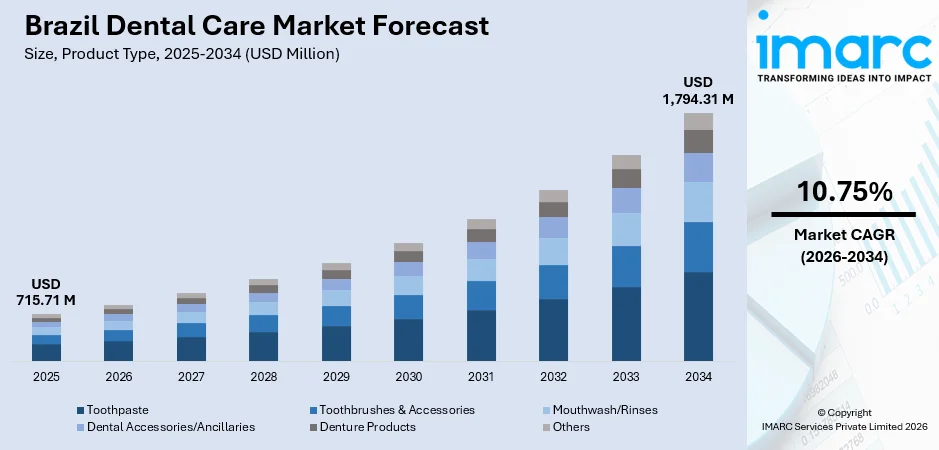
The Brazil dental care market size was valued at USD 715.71 Million in 2025 and is projected to reach USD 1,794.31 Million by 2034, growing at a compound annual growth rate of 10.75% from 2026-2034.
The Brazil dental care market is expanding steadily as rising oral health awareness, an aging population, and government-backed initiatives drive preventive care adoption across the country. Growing consumer preference for premium, natural, and specialized dental products is reshaping purchasing patterns. Expansion of pharmacy networks, increasing e-commerce penetration, and sustained investments in sustainable packaging innovations are further strengthening the Brazil dental care market share.
Key Takeaways and Insights:
- By Product Type: Toothpaste dominates the market with a share of 34.8% in 2025, owing to its essential role in daily oral hygiene, widespread availability across retail and pharmacy channels, and growing consumer demand for specialized formulations including whitening, sensitivity relief, and natural ingredients.
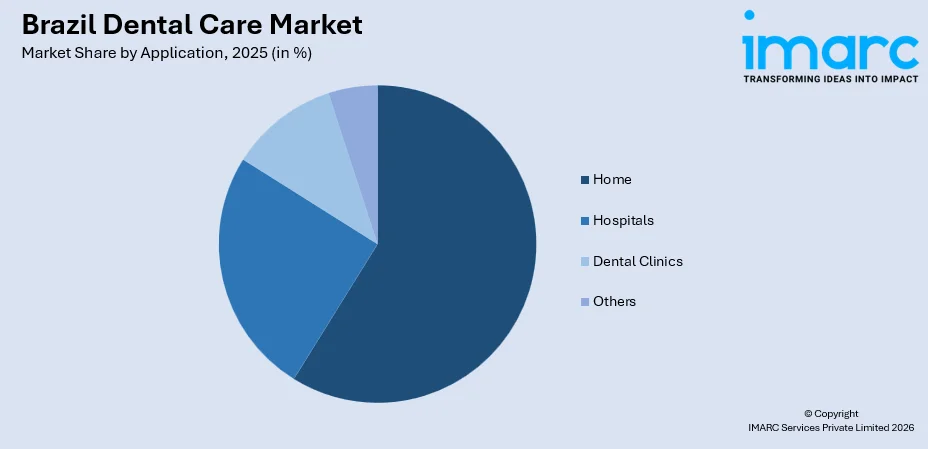
- By Application: Home leads the market with a share of 58.6% in 2025, driven by increasing consumer emphasis on preventive oral care routines, expanding product accessibility through supermarkets and online platforms, and heightened awareness of at-home dental hygiene practices across all demographics.
- By Age Group: Adults account for the largest share with 63.2% in 2025, reflecting the broad consumer base and higher spending power of working-age populations who seek diverse oral care solutions ranging from basic hygiene maintenance to advanced cosmetic and therapeutic formulations.
- By Distribution Channel: Pharmacies lead the market with a share of 39.7% in 2025, supported by healthcare-related trust associations, professional product assortment depth, and the extensive pharmacy network across Brazilian urban and semi-urban areas that ensures convenient consumer access.
- By Region: Southeast represents the largest segment with a market share of 43.5% in 2025, driven by higher population density, economic activity, and access to healthcare services in this region.
- Key Players: The market is competitive and fragmented, with private clinics and chains vying on service quality, pricing, and technology. Rising demand for cosmetic and preventive treatments boosts competition, while digital adoption and insurance partnerships shape differentiation among local providers and international entrants.
To get more information on this market Request Sample
The Brazil dental care market is progressing as consumer awareness of oral hygiene deepens and preventive care practices gain prominence across the population. The country’s extensive network of registered dental surgeons underscores the robust dental healthcare infrastructure supporting product demand. Government initiatives, particularly the Smiling Brazil program, continue embedding oral care within primary health offerings, expanding access to underserved communities. Rising disposable incomes among the expanding middle class are fueling premiumization trends, with consumers increasingly gravitating toward specialized formulations offering whitening, sensitivity protection, and natural ingredients. According to industry reports, real gross disposable household income increased at an average annual rate of 5% between 2022 and 2024, slowing to 4.1% in 2025. Simultaneously, the rapid growth of e-commerce platforms is transforming traditional purchasing patterns, enabling consumers in both urban and rural areas to access a wider assortment of dental care products. The convergence of demographic shifts, digital transformation, and heightened health consciousness positions the market for sustained expansion across product categories and distribution channels.
Brazil Dental Care Market Trends:
Rising demand for sustainable and eco-friendly dental products
Brazilian consumers are increasingly prioritizing environmental sustainability in their oral care purchasing decisions, driving demand for recyclable packaging and natural formulations. For instance, in 2025, Colgate-Palmolive announced that 100% of its toothpaste tubes produced in Brazil are now fully recyclable, transitioning to high-density polyethylene designs that eliminate aluminium layers. This shift toward circular economy principles is encouraging other manufacturers to adopt sustainable packaging solutions, reshaping competitive dynamics and consumer expectations across the Brazil dental care market growth.
Premiumization and growth of specialized oral care formulations
Consumers are shifting toward premium and therapeutically focused dental care products that address specific oral health concerns beyond basic hygiene. The elmex brand gained significant traction in Brazil, becoming the fastest-growing brand in drugstores in the toothpaste sensitivity segment during 2024, according to industry reports. This trend reflects increasing willingness among middle-class consumers to invest in advanced formulations offering targeted benefits such as enamel protection, gum care, and professional-grade whitening solutions.
Accelerating e-commerce penetration in oral care distribution
Digital retail channels are transforming Brazil’s dental care market by challenging traditional distribution networks and offering consumers enhanced convenience and wider product choices. Manufacturers are increasingly expanding their online presence through direct-to-consumer platforms and collaborations with major e-commerce marketplaces. This shift is reshaping purchasing behaviors, allowing consumers in both urban and regional areas to access products more efficiently. As digital adoption grows, companies are leveraging online strategies to strengthen brand visibility, improve customer engagement, and optimize distribution, creating a more agile and competitive market landscape.
Market Outlook 2026-2034:
The Brazil dental care market is positioned for robust expansion over the forecast period, supported by favorable demographic trends, rising health consciousness, and continued premiumization of oral hygiene products. According to the most recent SB Brasil national oral health survey, more than 80% of Brazilian adolescents have experienced at least one tooth affected by caries. Growing emphasis on preventive dental care, expanding pharmacy infrastructure, and increasing adoption of natural and specialty formulations are expected to drive sustained demand across product categories. The integration of e-commerce channels is enhancing accessibility to diverse oral care products, particularly in underserved regions. Furthermore, continued government investment in public oral health programs, coupled with innovations in sustainable packaging and advanced product technologies, will create favorable conditions for market participants to capture emerging opportunities and expand their consumer reach throughout Brazil. The market generated a revenue of USD 715.71 Million in 2025 and is projected to reach a revenue of USD 1,794.31 Million by 2034, growing at a compound annual growth rate of 10.75% from 2026-2034.
Brazil Dental Care Market Report Segmentation:
|
Segment Category |
Leading Segment |
Market Share |
|
Product Type |
Toothpaste |
34.8% |
|
Application |
Home |
58.6% |
|
Age Group |
Adults |
63.2% |
|
Distribution Channel |
Pharmacies |
39.7% |
|
Region |
Southeast |
43.5% |
Product Type Insights:
- Toothpaste
- Toothbrushes & Accessories
- Mouthwash/Rinses
- Dental Accessories/Ancillaries
- Denture Products
- Others
Toothpaste dominates with a market share of 34.8% of the total Brazil dental care market in 2025.
Toothpaste remains the cornerstone of daily oral hygiene routines across Brazil, valued for its role in cavity prevention, breath freshening, and overall dental health maintenance. The segment benefits from continuous product innovation, with manufacturers introducing specialized formulations targeting sensitivity relief, whitening, and gum protection to meet evolving consumer preferences. For example, in September 2025, Colgate-Palmolive plans to revive its Kolynos toothpaste brand in Brazil. Sorriso launched a limited-edition formula and packaging inspired by Kolynos, returning to shelves over 25 years after its discontinuation.
Widespread availability across pharmacies, supermarkets, and online platforms enables consumers to access products which in turn supports business expansion. Rising disposable incomes encourage trading up to premium and therapeutic variants, while manufacturers increasingly invest in sustainable packaging to address environmental consciousness, which leads to industry standards of responsibility and sustainability.
Application Insights:
Access the comprehensive market breakdown Request Sample
- Home
- Hospitals
- Dental Clinics
- Others
Home leads with a share of 58.6% of the total Brazil dental care market in 2025.
Home-use dental care products form the foundation of oral hygiene practices in Brazil, as consumers increasingly adopt comprehensive daily routines that encompass brushing, rinsing, and flossing for complete oral health management. The segment's dominance reflects the widespread availability of affordable and premium dental care products through diverse retail channels, enabling households across all income levels to maintain regular oral hygiene practices effectively. According to IBGE, the population aged 65 and older grew 57% from 14.1 million in 2010 to 22.2 million in 2022, now representing 11% of Brazil’s total population, further expanding household demand for specialized dental care solutions tailored to age-related oral health needs.
Digital health awareness campaigns together with social media platforms now reach more people, which results in better consumer education about preventive oral care. This situation enables different demographic groups to purchase home dental products. Manufacturers create family-friendly product lines that include dental solutions for all household members. The Brazilian market sees home applications as its top segment because of rising health awareness, better product access through e-commerce, and increasing demand for preventive healthcare.
Age Group Insights:
- Adults
- Children
- Geriatric
Adults account for the highest revenue with a 63.2% share of the total Brazil dental care market in 2025.
The adult demographic represents the largest consumer base for dental care products in Brazil, driven by higher disposable incomes and diverse oral health needs spanning basic hygiene, cosmetic enhancement, and therapeutic treatment categories. Adults actively seek products addressing sensitivity, whitening, and gum health concerns, creating sustained demand across multiple product categories simultaneously. A recent survey on dental care utilization among Brazilian adults found that approximately 42.5% sought dental care services, highlighting sustained engagement with oral health maintenance practices that extends to regular product purchases and preventive care investments.
Adult consumers in Brazil select oral care products based on both aesthetic factors and professional dental recommendations. The market for dental products shows premiumization growth because consumers now understand how to use specialized toothpastes, electric toothbrushes and therapeutic mouthwashes for complete oral health. Manufacturers sustain their market leadership through dedicated marketing campaigns and new product development which targets specific adult needs for enamel protection, gum disease prevention and teeth whitening solutions.
Distribution Channel Insights:
- Supermarkets/Hypermarkets
- Pharmacies
- Online Stores
- Others
Pharmacies represent the leading segment with a 39.7% share of the total Brazil dental care market in 2025.
Pharmacies serve as the primary distribution channel for dental care products in Brazil, leveraging healthcare-related trust associations and professional product curation to attract health-conscious consumers seeking reliable oral care solutions. The channel's leadership reflects the extensive pharmacy network across the country, with Brazil maintaining approximately 100,000 private pharmacies that ensure widespread accessibility in both urban and semi-urban areas. Major pharmacy chains including Raia Drogasil and Grupo DPSP are strategically expanding their oral care product assortments to include premium and specialty formulations, strengthening channel dominance and enhancing consumer engagement through personalized recommendations.
The pharmacy distribution channel, which relies on consumer perception of pharmaceutical retail environments, achieves success through consumer behavior, which leads to higher sales of therapeutic and medicated oral care products at premium prices. The Brazilian retail pharmacy market experiences rapid expansion because of three main factors which include growing chain pharmacy networks, rising consumer health expenditures and the adoption of digital health solutions in retail settings. Pharmacies use personalized product recommendations together with professional consultations and loyalty programs to create competitive advantages, which lead to repeat dental care product purchases by all consumer groups.
Regional Insights:
- Southeast
- South
- Northeast
- North
- Central-West
Southeast comprises the largest region with a 43.5% share of the total Brazil dental care market in 2025.
The Southeast region commands the largest share of the Brazil dental care market, driven by the concentration of population density, economic activity, and healthcare infrastructure in major metropolitan areas including São Paulo and Rio de Janeiro. Accordingly, in February 2025, Capim, a São Paulo-based BNPL startup for dental care, raised USD 26.7 Million in Series A funding to expand services, including a POS terminal integrating flexible payments, lower transaction fees, and support for credit, debit, and PIX systems. The region benefits from higher disposable incomes, greater consumer health awareness, and the densest pharmacy networks in the country, creating favorable conditions for premium product adoption.
The Southeast’s dominance is further reinforced by its robust network of dental clinics, specialist practitioners, and diagnostic facilities, which support high patient volumes and advanced treatment options. This infrastructure enables faster adoption of innovative oral care products, digital payment solutions, and subscription-based services, making the region a strategic testing ground for new dental technologies and business models that can later expand into other Brazilian markets.
Market Dynamics:
Growth Drivers:
Why is the Brazil Dental Care Market Growing?
Expanding government oral health programs and public awareness campaigns
The Brazilian government's sustained commitment to oral health through programs such as Brasil Sorridente (Smiling Brazil) is significantly expanding access to dental care services and raising public awareness about preventive hygiene practices. This national policy, recognized as the largest public oral health care program globally, has embedded oral care within primary health offerings through the Unified Health System. Brazil has around 360,865 practicing dentists, equating to roughly 168 dentists per 100,000 inhabitants. Additionally, the country employs approximately 36,144 oral health technicians, according to an industry report, reflecting the country's robust dental healthcare workforce that supports product demand and oral hygiene awareness across diverse communities and socioeconomic groups.
Rising disposable incomes and premiumization of oral care products
Brazil's expanding middle class and rising disposable income levels are driving consumers toward premium and specialized dental care products that offer targeted therapeutic benefits. This economic shift is encouraging manufacturers to develop advanced formulations addressing specific concerns such as sensitivity, whitening, and enamel protection. In 2024, Colgate-Palmolive reported that its Latin America division delivered 14.2% organic sales growth, with its elmex brand becoming the fastest-growing sensitivity toothpaste brand in Brazilian drugstores, demonstrating strong consumer willingness to invest in higher-value oral care solutions and fueling market expansion.
Demographic shifts and increasing prevalence of dental health concerns
Brazil's rapidly aging population is creating sustained demand for dental care products across multiple categories, particularly denture products, therapeutic toothpastes, and specialized oral hygiene solutions. The country's 60-plus population grew, with long-term projections indicating rapid expansion in the 65-plus and 80-plus age cohorts. This demographic transition, combined with increasing prevalence of chronic oral health conditions such as periodontitis and edentulism, is driving consumers toward preventive and restorative dental care products, expanding the addressable market significantly.
Market Restraints:
What Challenges the Brazil Dental Care Market is Facing?
Regional disparities in oral healthcare access and infrastructure
Significant inequalities persist in oral healthcare access across Brazilian regions, with northern and northeastern areas experiencing substantially lower dental professional density compared to the southeastern metropolitan centers. Rural and remote communities face limited availability of specialized dental care products and professional services, constraining market penetration in these underserved territories. These geographic disparities in healthcare infrastructure and consumer purchasing power create uneven demand distribution that limits the market's overall growth potential.
Counterfeit and substandard product proliferation
The Brazilian dental care market faces ongoing challenges from counterfeit and low-quality products that undermine brand credibility and consumer trust, particularly in price-sensitive market segments. These unauthorized products often bypass regulatory oversight, posing potential health risks to consumers and creating unfair competitive pressures on legitimate manufacturers. The persistence of counterfeit oral care products in informal retail channels and online marketplaces complicates enforcement efforts and can erode consumer confidence in product safety and efficacy standards.
E-cigarette adoption and emerging oral health concerns
The growing adoption of electronic cigarettes and alternative tobacco products in Brazil is raising new oral health concerns that create complex challenges for the dental care market. Research conducted by the University of São Paulo indicates that prolonged exposure to e-cigarette vapour can demineralize enamel and dentin while increasing bacterial adhesion, heightening cavity risk. This emerging public health challenge creates demand uncertainty as manufacturers navigate the evolving oral health landscape, requiring adaptation of product formulations and marketing strategies to address novel oral health threats.
Competitive Landscape:
The Brazil dental care market features a competitive landscape characterized by a mix of established multinational corporations and emerging domestic players vying for consumer attention through product innovation and strategic distribution expansion. Companies are focusing on developing specialized formulations, sustainable packaging solutions, and premium product lines to differentiate themselves in an increasingly health-conscious marketplace. Strategic partnerships with pharmacy chains, healthcare providers, and e-commerce platforms are strengthening market positioning and consumer reach. Investment in research and development, coupled with targeted marketing campaigns emphasizing oral health education and product efficacy, is intensifying competitive dynamics across all segments and distribution channels.
Recent Developments:
- In September 2025, ALPINE WHITE launched Brazil’s first peroxide-free at-home dental whitening strips using patented PAP technology. Clinically tested and ANVISA-approved, the strips deliver visible results in three days while protecting enamel and reducing sensitivity. Available nationwide through major pharmacies and online, the brand also offers complementary foam and charcoal powder products.
- In June 2025, Marquette University School of Dentistry launched a virtual externship with São Leopoldo Mandic in Brazil, starting fall 2025. Twenty students and ten instructors collaborate in small groups to explore dental education, techniques, and cultural differences, fostering peer learning, global perspectives, and cross-country insights without offering credit.
Brazil Dental Care Market Report Coverage:
|
Report Features |
Details |
|
Base Year of the Analysis |
2025 |
|
Historical Period |
2020-2025 |
|
Forecast Period |
2026-2034 |
|
Units |
Million USD |
|
Scope of the Report |
Exploration of Historical Trends and Market Outlook, Industry Catalysts and Challenges, Segment-Wise Historical and Future Market Assessment:
|
|
Product Types Covered |
Toothpaste, Toothbrushes & Accessories, Mouthwash/Rinses, Dental Accessories/Ancillaries, Denture Products, Others |
|
Applications Covered |
Home, Hospitals, Dental Clinics, Others |
|
Age Groups Covered |
Adults, Children, Geriatric |
|
Distribution Channels Covered |
Supermarkets/Hypermarkets, Pharmacies, Online Stores, Others |
|
Regions Covered |
Southeast, South, Northeast, North, Central-West |
|
Customization Scope |
10% Free Customization |
|
Post-Sale Analyst Support |
10-12 Weeks |
|
Delivery Format |
PDF and Excel through Email (We can also provide the editable version of the report in PPT/Word format on special request) |
Frequently Asked Questions About the Brazil dental care market Report
The Brazil dental care market size was valued at USD 715.71 Million in 2025.
The Brazil dental care market is expected to grow at a compound annual growth rate of 10.75% from 2026-2034 to reach USD 1,794.31 Million by 2034.
Toothpaste dominated the market with a share of 34.8%, driven by its essential role in daily oral hygiene, continuous product innovation in specialized formulations, and widespread availability across pharmacy and retail distribution channels throughout Brazil.
Key factors driving the Brazil dental care market include expanding government oral health programs, rising disposable incomes fueling premiumization, demographic shifts toward an aging population, growing e-commerce penetration, and increasing consumer awareness of preventive oral care practices.
Major challenges include regional disparities in oral healthcare access and infrastructure, counterfeit product proliferation undermining brand trust, emerging oral health concerns from e-cigarette adoption, currency fluctuations affecting imported product pricing, and limited dental care penetration in rural communities.
Need more help?
- Speak to our experienced analysts for insights on the current market scenarios.
- Include additional segments and countries to customize the report as per your requirement.
- Gain an unparalleled competitive advantage in your domain by understanding how to utilize the report and positively impacting your operations and revenue.
- For further assistance, please connect with our analysts.
 Request Customization
 Speak to an Analyst
 Request Brochure
 Inquire Before Buying
Benefits of Customization
- Personalize this research
- Triangulate with your data
- Get data as per your format and definition
- Gain a deeper dive into a specific application, geography, customer, or competitor
- Any level of personalization
Get in Touch With Us
UNITED STATES
Phone: +1-201-971-6302
INDIA
Phone: +91-120-433-0800
UNITED KINGDOM
Phone: +44-753-714-6104
Email: [email protected]
Client Testimonials




.webp)




.webp)













Related Reports

Choose your plan
*Please note that the prices mentioned below are starting prices for each bundle type. Kindly contact our team for further details.*
Single User License
- 1 User License, Access on 2 Devices
- PDF Report + Excel Dataset (Password Protected)
- Lifetime Access
- No Printing Rights
- 10% Free Report Customization
- 10–12 Weeks of Analyst Support
Five User License
- Access for 5 Users, 2 Devices per User
- PDF Report + Excel Dataset (Password Protected)
- Lifetime Access
- Dedicated Account Manager
- 12–14 Weeks of Analyst Support
- No Printing Rights
- 15% Free Report Customization
- 25% Discount on Your Next Purchase
Corporate User License
- Unlimited User Access (Within Your Organization)
- PDF Report + Excel Dataset
- Lifetime Access
- Dedicated Account Manager
- 14–20 Weeks of Analyst Support
- No Printing Rights
- 20% Free Report Customization
- 30% Discount on Your Next Purchase
Essential Insights
What's included:
3 reports
- Lifetime Access
- PDF Reports
- Excel Datasets
- 2 Weeks of Free Analyst Support
- 2 User Licenses
- Access on 2 Devices
- Printing Rights
- Complimentary PowerPoint (PPT) Version
- Complimentary License Upgrade
Professional Access
What's included:
5 reports
- Lifetime Access
- PDF Reports
- Excel Datasets
- 8 Weeks of Free Analyst Support
- 2 User Licenses
- Access on 2 Devices
- Printing Rights
- Complimentary PowerPoint (PPT) Version
- Complimentary License Upgrade
Business Advantage
What's included:
8 reports
- Lifetime Access
- PDF Reports
- Excel Datasets
- 14 Weeks of Free Analyst Support
- 2 User Licenses
- Access on 2 Devices
- Printing Rights
- Complimentary PowerPoint (PPT) Version
- Complimentary License Upgrade
Enterprise Intelligence
What's included:
10 reports
- Lifetime Access
- PDF Reports
- Excel Datasets
- 20 Weeks of Free Analyst Support
- 2 User Licenses
- Access on 2 Devices
- Printing Rights
- Complimentary PowerPoint (PPT) Version
- Complimentary License Upgrade