
Brazil Digital Identity Solutions Market Size, Share, Trends and Forecast by Component, Identity Type, Solution Type, Organization Size, Deployment, Vertical, and Region, 2026-2034
Brazil Digital Identity Solutions Market Size, Share, Trends & Forecast (2026-2034)
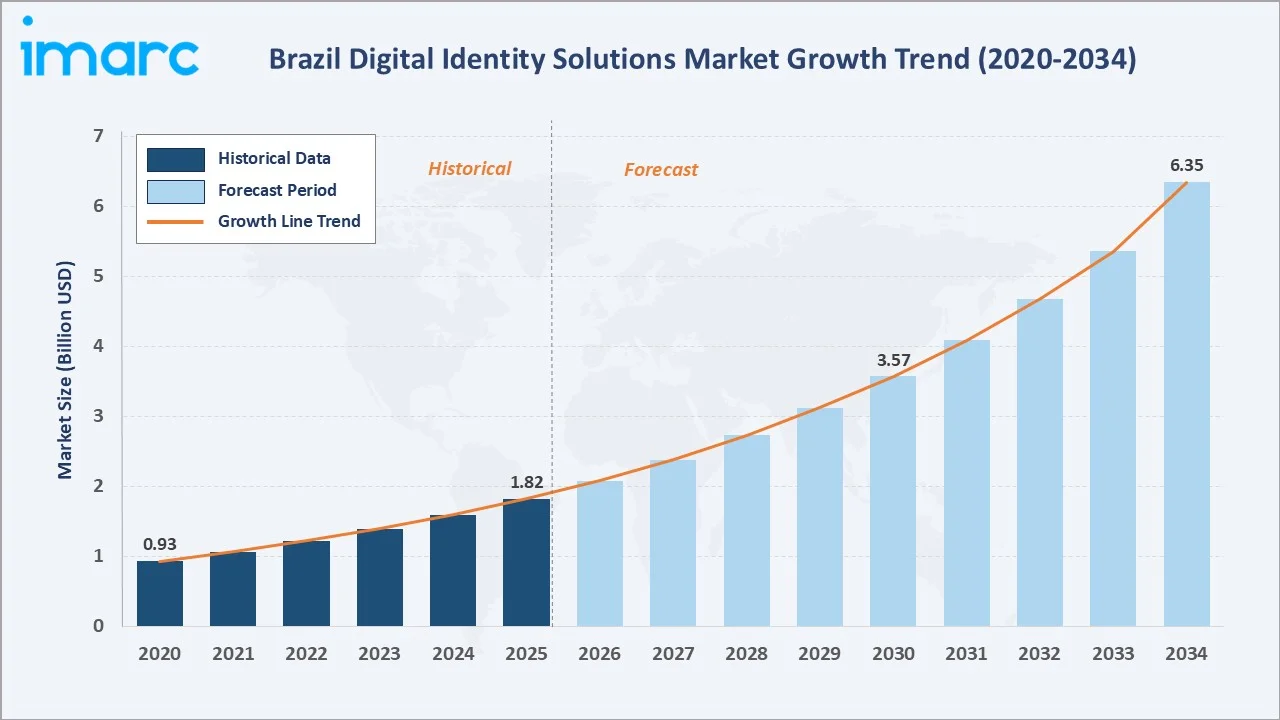
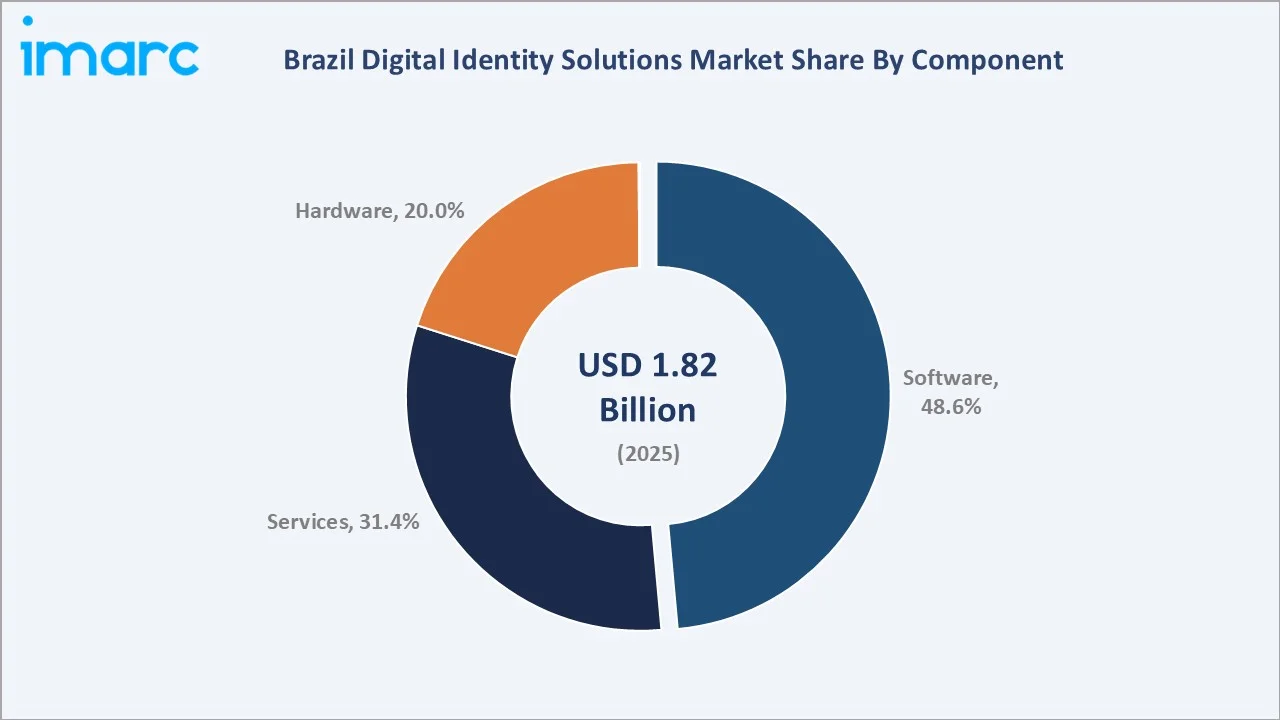
The Brazil digital identity solutions market reached USD 1.82 Billion in 2025 and is projected to reach USD 6.35 Billion by 2034, growing at a CAGR of 14.45% during 2026-2034. The market is driven by the government's accelerating digital transformation initiatives, expanding e-government services, and rising adoption of secure digital authentication across banking, healthcare, and public administration. Brazil’s GOV.BR platform, developed through a partnership between the World Bank and Brazil’s Digital Government Secretariat, evolved from 20 million users into a core national digital identity infrastructure serving over 170 million people. It now enables access to more than 4,000 federal services, supports 370 million digital signatures, and has generated around R$12.98 billion in savings through secure and interoperable digital identity. This is driving the market by increasing public trust in digital authentication and accelerating the adoption of secure online identity systems. Software leads the component at 48.6%. Cloud leads deployment at 64.8%. Southeast leads regionally at 42.8%.
Market Snapshot
|
Metric |
Value |
|
Market Size (2025) |
USD 1.82 Billion |
|
Forecast Market Size (2034) |
USD 6.35 Billion |
|
CAGR (2026-2034) |
14.45% |
|
Base Year |
2025 |
|
Historical Period |
2020-2025 |
|
Forecast Period |
2026-2034 |
|
Dominant Component |
Software (48.6%, 2025) |
|
Dominant Deployment |
Cloud (64.8%, 2025) |
|
Leading Region |
Southeast (42.8%, 2025) |
The Brazil digital identity solutions market grew from USD 0.93 Billion in 2020 to USD 1.82 Billion in 2025, supported by the rapid digitalization of public and private services. The market is expected to reach USD 3.57 Billion by 2030, driven by wider adoption of secure authentication, e-KYC, and biometric verification. By 2034, it is forecast to reach USD 6.35 Billion, reflecting rising demand across banking, healthcare, telecom, government, and digital service platforms.
To get more information on this market, Request Sample
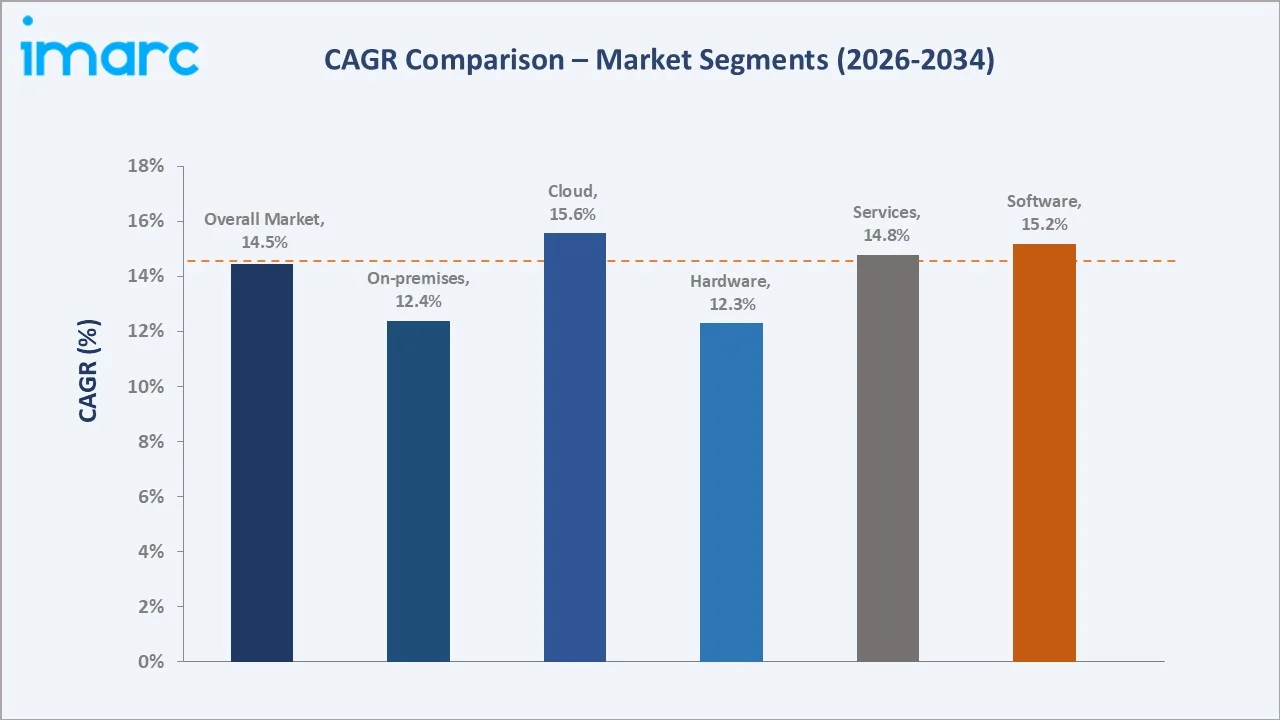
Software grows fastest at ~15.2% CAGR through facial liveness AI and fraud detection. Cloud grows fastest at ~15.6% CAGR through fintech API-first KYC and open finance. Services grow at ~14.8% CAGR through system integration and consulting.
Executive Summary
The Brazil digital identity solutions market is expanding rapidly as government-led digital platforms, e-services, and secure authentication systems become central to public service delivery. Rising use of e-KYC, biometrics, digital signatures, and identity verification across banking, telecom, healthcare, and fintech is strengthening demand. The market is also supported by growing cybersecurity needs, fraud prevention requirements, and regulatory compliance. Continued integration of GOV.BR and private-sector digital platforms are expected to sustain strong growth through 2034. Software at 48.6% leads through identity verification platforms. Cloud at 64.8% leads through SaaS KYC and fintech API. Southeast leads regionally at 42.8%.
Key Market Insights
|
Insight |
Data |
|
Dominant Component |
Software - 48.6% share (2025) |
|
Dominant Deployment |
Cloud - 64.8% market share (2025) |
|
Leading Region |
Southeast - 42.8% share (2025) |
|
Market Opportunity |
GOV.BR national digital ID platform scale; KYC onboarding instant payment; Open Finance Brazil decentralized identity; facial liveness deepfake prevention; rural digital inclusion biometric; CPF digital identity unification |
Key Analytical Observations Supporting the Above Data:
- Software at 48.6%: Software dominates as organizations increasingly rely on identity verification platforms, authentication tools, e-KYC systems, biometric matching, and digital signature solutions. Its scalability, easy integration, and recurring SaaS-based deployment make it central to digital identity adoption.
- Cloud at 64.8%: Cloud dominates due to its scalability, faster deployment, lower infrastructure burden, and easy integration with digital platforms. It enables real-time identity verification, e-KYC, authentication, and secure access across government, banking, telecom, and enterprise applications.
- Southeast at 42.8%: Southeast Brazil dominates regionally due to its strong concentration of banks, fintechs, telecom firms, healthcare providers, and government service users. Higher digital adoption, urbanization, and enterprise IT spending make the region a key hub for digital identity deployment.
Brazil Digital Identity Solutions Market Overview
The Brazil digital identity solutions market encompasses identity verification software, biometric authentication, e-KYC platforms, digital signatures, credential management, and access control solutions. It serves government portals, banking and fintech platforms, telecom operators, healthcare providers, and enterprise digital services. The market also includes cloud-based identity platforms, fraud detection tools, and interoperable authentication systems. Macroeconomic factors include Brazil’s expanding digital economy, rising internet and smartphone penetration, and growing adoption of online banking, e-commerce, and public digital services. Increased cybersecurity spending, fintech growth, and government digitalization initiatives are further supporting demand for secure digital identity solutions.
Market Dynamics
To evaluate market opportunities, Request Sample
Market Drivers
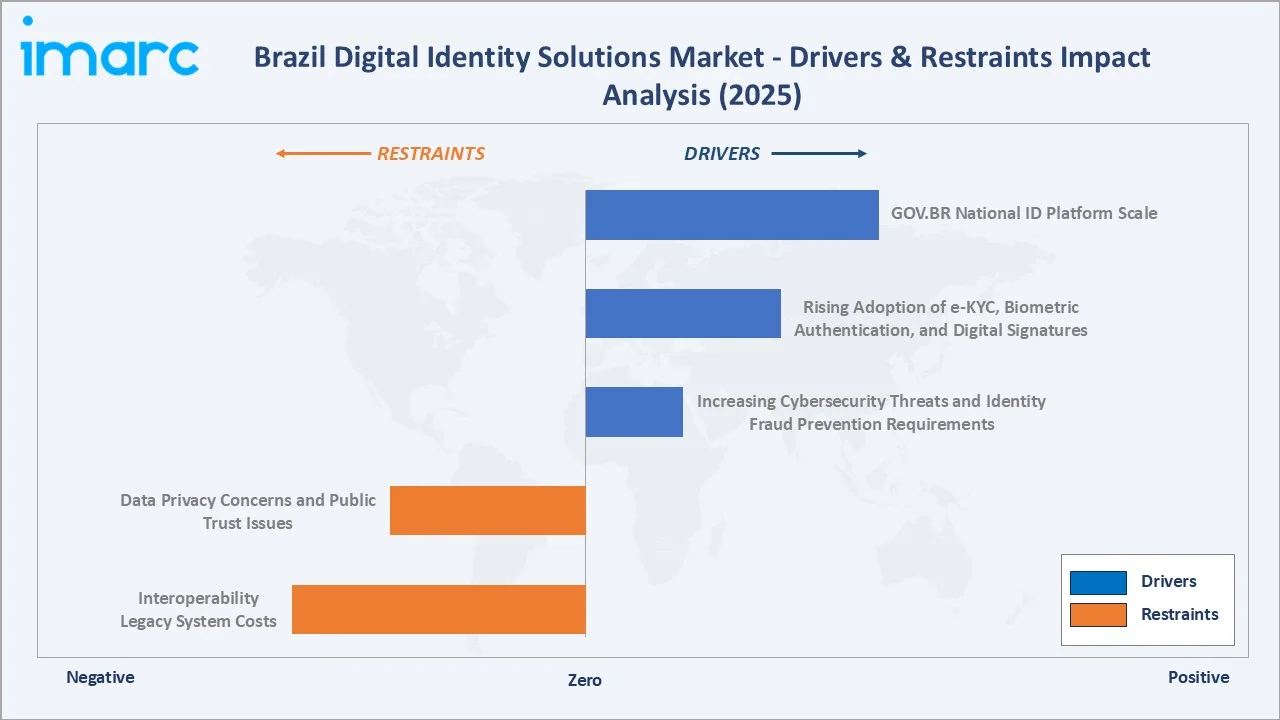
- GOV.BR National ID Platform Scale: GOV.BR's national ID platform scale is accelerating the adoption of secure digital authentication across both public and private sectors. The platform serves more than 170 million users, enabling 4,000+ federal services, supporting 370 million digital signatures, and generating R$12.98 billion in savings through secure, interoperable digital identity. Its widespread use has increased demand for biometric verification, digital signatures, e-KYC, and identity management technologies. As organizations integrate with the GOV.BR ecosystem, investment in scalable and interoperable digital identity solutions continues to grow across banking, healthcare, telecom, and e-government services.
- Rising Adoption of e-KYC, Biometric Authentication, and Digital Signatures: Rising adoption of e-KYC, biometric authentication, and digital signatures is enabling faster, safer, and paperless user verification. Banks, fintechs, telecom firms, healthcare providers, and government portals are using these tools to reduce fraud, improve compliance, and streamline onboarding. Biometric checks such as facial recognition and fingerprint verification strengthen identity assurance in digital transactions. As more services move online, demand for secure authentication and legally valid digital signatures continues to accelerate.
- Increasing Cybersecurity Threats and Identity Fraud Prevention Requirements: Increasing cybersecurity threats and identity fraud prevention requirements are driving the market as organizations seek stronger tools to verify users and protect digital transactions. Brazil remains one of the leading global targets for cyberattacks and financial fraud. Between 2023 and 2024, organizations in the country represented nearly 19% of all cyberattacks across the region, highlighting the growing need for stronger cybersecurity, fraud prevention, and digital identity verification systems. Solutions such as biometrics, multi-factor authentication, fraud analytics, and digital signatures help reduce financial losses and improve regulatory compliance. As Brazil’s digital economy expands, secure identity infrastructure is becoming essential for trust, safety, and seamless online service delivery.
Market Restraints
- Data Privacy Concerns and Public Trust Issues: Data privacy concerns and public trust issues are making citizens and organizations cautious about sharing sensitive personal and biometric data. Concerns around data misuse, cyber breaches, surveillance, and unauthorized access can slow adoption of digital ID platforms. Enterprises also face higher compliance pressure under data protection regulations, increasing implementation complexity and costs. As a result, vendors must invest heavily in encryption, consent management, transparency, and secure data governance to build user confidence.
- Interoperability Legacy System Costs: Interoperability issues and legacy system costs make integration with older government, banking, telecom, and enterprise IT systems complex and expensive. Many organizations still operate fragmented databases and outdated authentication systems, limiting seamless data exchange. Upgrading these systems requires high investment in APIs, security layers, cloud migration, and compliance controls. This can delay digital identity rollouts, especially among smaller institutions and public-sector bodies with limited budgets.
Market Opportunities
- Expansion of Cloud-based Identity-as-a-Service (IDaaS) Solutions: The expansion of cloud-based Identity-as-a-Service (IDaaS) solutions enables organizations to deploy secure identity platforms without heavy on-premise infrastructure investment. IDaaS supports scalable authentication, e-KYC, single sign-on, access management, and fraud monitoring across digital channels. It is especially attractive for fintechs, SMEs, telecom firms, and public agencies seeking faster rollout and lower operating costs. As cloud adoption rises, demand for flexible, subscription-based digital identity solutions is expected to grow significantly.
- Increasing Digital Identity Deployment in Healthcare, Education, and Telecom: Hospitals and insurers can use secure digital IDs for patient verification, telemedicine access, and medical record protection. Education institutions can adopt identity tools for online admissions, exams, student portals, and certificate verification. Telecom operators can use e-KYC and biometric onboarding to reduce SIM fraud, improve compliance, and accelerate customer activation.
Market Challenges
- Identity Solution Vendor Fragmentation: Identity solution vendor fragmentation creates multiple platforms with different standards, APIs, authentication methods, and compliance approaches. This makes integration difficult for banks, telecom firms, healthcare providers, and government agencies that need seamless identity verification across systems. Fragmentation can also increase switching costs, vendor lock-in risks, and delays in large-scale deployment. As a result, organizations may face higher implementation complexity while trying to build interoperable and secure digital identity ecosystems.
- Balancing Strong Security with Seamless User Experience: Balancing strong security with seamless user experience is challenging, as strict verification steps can create friction during onboarding and transactions. Multi-factor authentication, biometric checks, and document verification improve security but may increase drop-offs if the process is slow or complex. Organizations must protect users from fraud while still offering fast, convenient digital access. This requires investment in risk-based authentication, AI fraud detection, and user-friendly identity workflows.
Emerging Market Trends
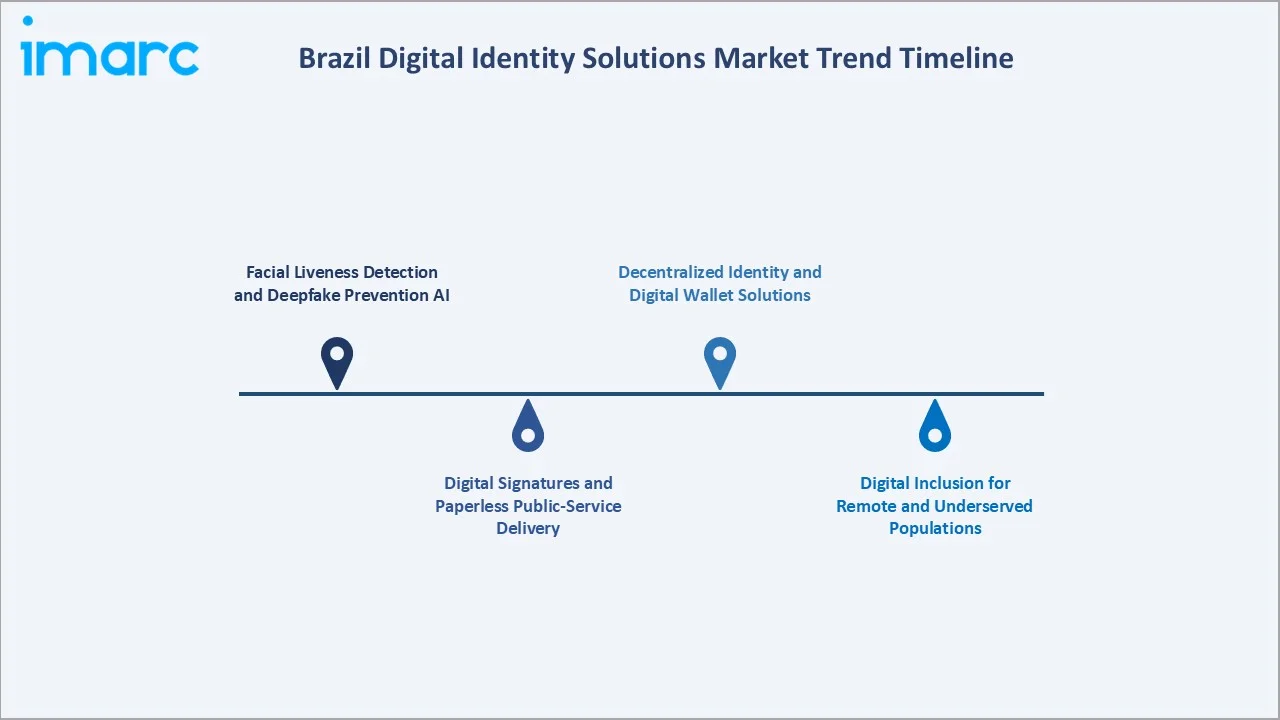
1. Facial Liveness Detection and Deepfake Prevention AI
Facial liveness detection and deepfake prevention AI is emerging as organizations strengthen defenses against identity fraud and synthetic media attacks. Banks, fintechs, telecom firms, and government platforms are adopting AI-based liveness checks to confirm that users are real people, not photos, masks, videos, or deepfake attempts. These tools improve the reliability of remote onboarding, e-KYC, and biometric authentication. As digital transactions rise, demand for advanced anti-spoofing and deepfake detection technologies is expected to grow.
2. Digital Signatures and Paperless Public-Service Delivery
Digital signatures and paperless public-service delivery are emerging as government agencies shift more services online. Secure digital IDs allow citizens to sign documents, submit applications, access benefits, and complete approvals without physical paperwork. This improves service speed, reduces administrative costs, and increases transparency across public platforms. As GOV.BR and CIN adoption expand, demand for trusted authentication, e-signature, and digital document verification solutions is expected to grow.
3. Digital Inclusion for Remote and Underserved Populations
Digital inclusion for remote and underserved populations is emerging as government programs expand secure ID access beyond major urban centers. Initiatives targeting vulnerable communities and remote areas are increasing demand for biometric enrollment, mobile identity verification, and interoperable digital ID platforms. In March 2026, Brazil’s Ministry of Management and Innovation introduced the PROCIN program to accelerate the rollout of the National Identity Card (Carteira de Identidade Nacional – CIN) by allocating R$44.25 million to the states of Bahia, Amapá, Amazonas, and Maranhão. The initiative focuses on expanding identity coverage in underserved and remote communities while improving biometric data quality, reducing identity fraud, and strengthening digital inclusion. This helps more citizens access welfare benefits, healthcare, education, banking, and e-government services online.
4. Decentralized Identity and Digital Wallet Solutions
Decentralized identity and digital wallet solutions are emerging as users and institutions seek more secure, portable, and privacy-focused identity management. These solutions allow individuals to store verified credentials, identity documents, certificates, and access permissions in digital wallets. They reduce dependence on centralized databases while improving user control over personal data sharing. As Brazil expands CIN, GOV.BR, digital signatures, and e-government services, decentralized ID models can support more interoperable and citizen-centric digital identity ecosystems.
Industry Value Chain Analysis
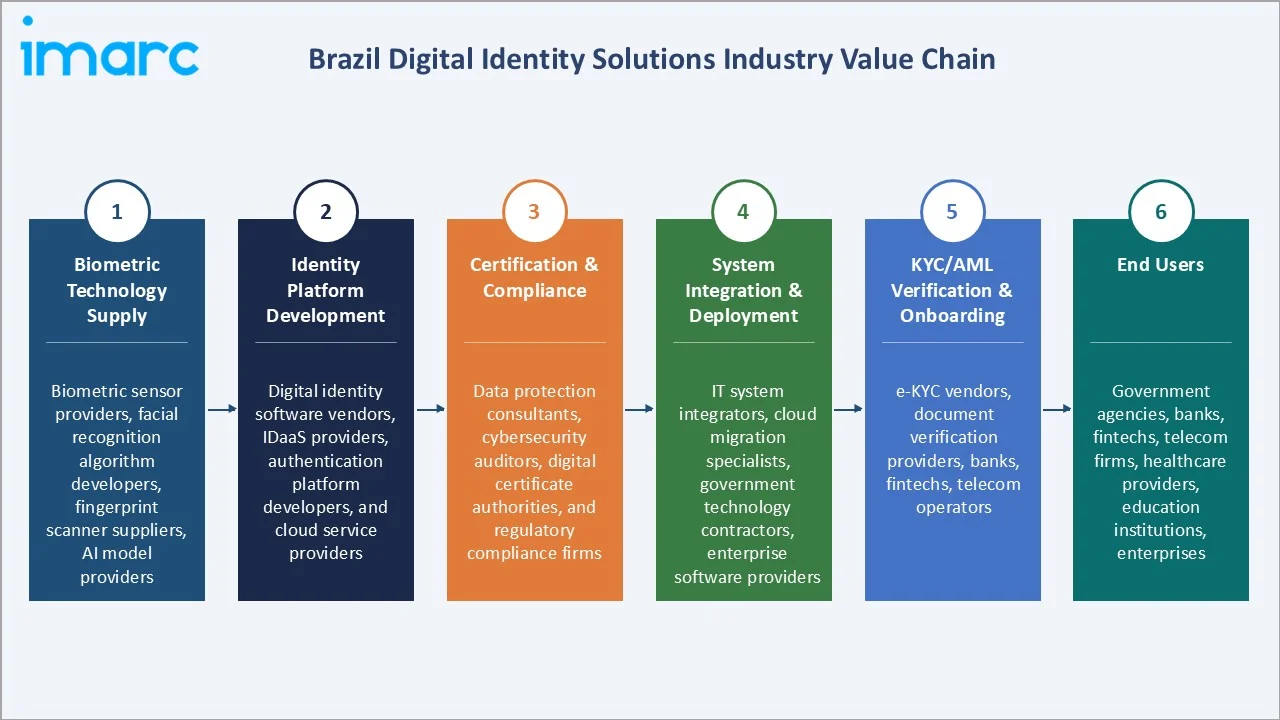
Brazil digital identity value chain integrates biometric technology supply, identity platform development, certification & compliance, system integration & deployment, KYC/AML verification & onboarding, and end users.
|
Stage |
Key Participants |
|
Biometric Technology Supply |
Biometric sensor providers, facial recognition algorithm developers, fingerprint scanner suppliers, AI model providers |
|
Identity Platform Development |
Digital identity software vendors, IDaaS providers, authentication platform developers, and cloud service providers |
|
Certification & Compliance |
Data protection consultants, cybersecurity auditors, digital certificate authorities, and regulatory compliance firms |
|
System Integration & Deployment |
IT system integrators, cloud migration specialists, government technology contractors, enterprise software providers |
|
KYC/AML Verification & Onboarding |
e-KYC vendors, document verification providers, banks, fintechs, telecom operators |
|
End Users |
Government agencies, banks, fintechs, telecom firms, healthcare providers, education institutions, enterprises |
Identity platform development is the most value-added stage in the Brazil digital identity solutions value chain. It is where core technologies such as biometric authentication, identity orchestration, digital wallets, e-KYC, identity lifecycle management, and API integrations are developed and differentiated. This stage generates the highest intellectual property, recurring software revenues, and long-term customer value while enabling secure, scalable digital identity services across government and enterprise applications.
Technology Landscape in the Brazil Digital Identity Solutions Industry
Biometric and AI Authentication Technology
Biometric and AI authentication technology enables faster, more secure, and highly accurate identity verification. AI-powered facial recognition, fingerprint authentication, liveness detection, and behavioral biometrics help prevent identity fraud while improving remote onboarding and e-KYC processes. Financial institutions, government agencies, telecom providers, and healthcare organizations are increasingly adopting these technologies to strengthen security and enhance user convenience. Continuous advances in AI are also improving authentication accuracy, reducing false positives, and supporting scalable digital identity ecosystems.
Identity Platform and API Technology
Identity platform and API technology enable secure integration between government portals, banks, fintechs, telecom firms, and enterprise systems. API-based platforms support real-time identity verification, e-KYC, digital signatures, user authentication, and access management across multiple digital channels. They also improve interoperability with systems such as GOV.BR, CIN databases, and private-sector onboarding platforms. As digital services expand, scalable identity platforms and open APIs are becoming essential for building connected, secure, and user-friendly digital identity ecosystems.
Digital Government Platforms
Digital government platforms provide a unified and secure framework for delivering public services online. Platforms such as GOV.BR integrate digital identity, authentication, digital signatures, and citizen service portals to enable seamless access across multiple government agencies. They rely on cloud infrastructure, APIs, and interoperable identity systems to improve efficiency, security, and user experience. In June 2026, Serpro and Brazil’s Ministry of Foreign Affairs advanced a strategic agenda to strengthen global cooperation in digital government and promote Brazilian public technology internationally. The meeting, led by Serpro President Wilton Mota, included MRE representatives focused on digital affairs, innovation diplomacy, international cooperation, and technology service promotion. As Brazil expands digital public services and international digital government cooperation, demand for scalable identity platforms and secure authentication technologies continues to increase.
Market Segmentation Analysis
The report covers the following segments:
|
Segment Category |
Leading Segment |
Market Share |
Year |
|
Component |
Software |
48.6% |
2025 |
|
Identity Type |
🔒 |
🔒 |
2025 |
|
Solution Type |
🔒 |
🔒 |
2025 |
|
Organization Size |
🔒 |
🔒 |
2025 |
|
Deployment |
Cloud |
64.8% |
2025 |
|
Vertical |
🔒 |
🔒 |
2025 |
|
Region |
Southeast |
42.8% |
2025 |

By Component
Software leads at 48.6% (2025) through facial biometric verification platforms, KYC/AML SaaS for banking and fintech, identity access management, fraud analytics, and digital certificate software.
To access detailed market analysis, Request Sample
Services at 31.4% reflect system integration for bank and government identity deployment, managed identity services, and identity strategy advisory. Hardware at 20.0% reflects biometric sensors, smart card tokens and readers, and government ID document issuance terminals.
By Deployment
Cloud leads at 64.8% (2025) due to its scalability, faster deployment, and lower infrastructure costs. It supports real-time authentication, e-KYC, biometric verification, and secure access across government, banking, telecom, and enterprise platforms.
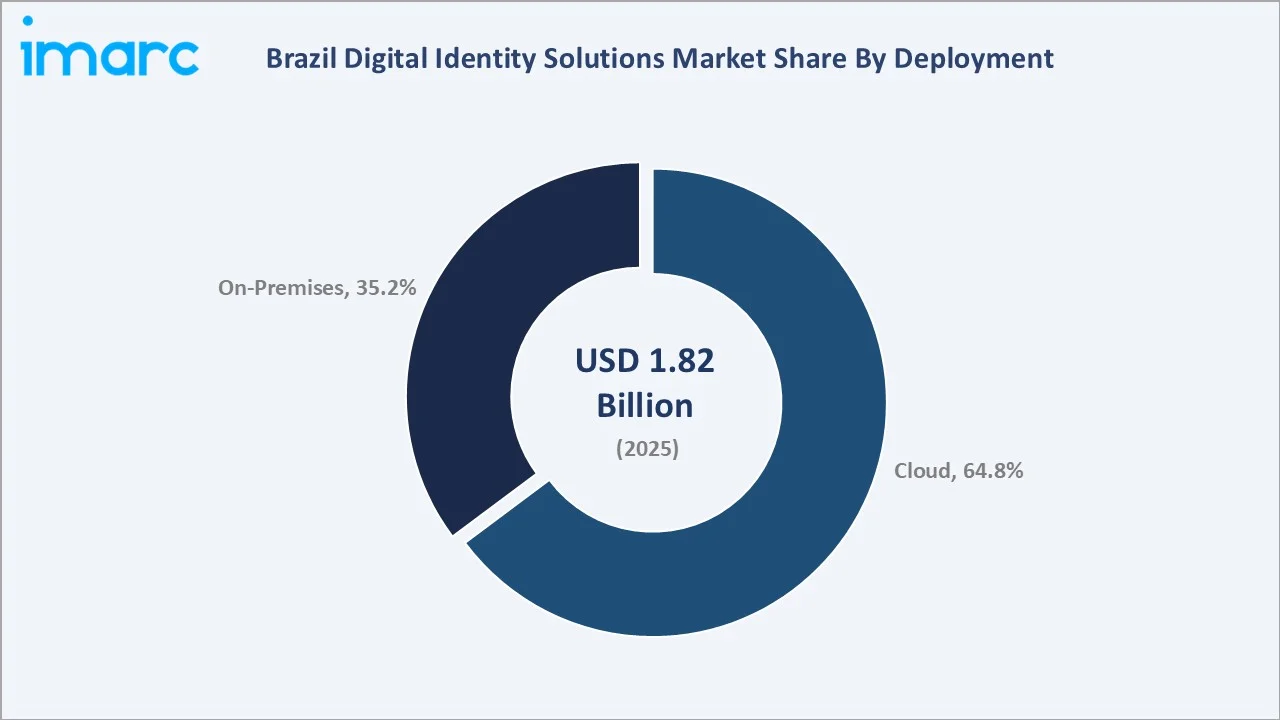
On-premises at 35.2% reflects government sovereign deployment, state-owned bank legacy core systems, and large enterprise security-sensitive on-premises identity infrastructure for regulatory compliance and data sovereignty requirements.
Regional Market Insights
|
Region |
Share (2025) |
Key Brazil Digital Identity Market Drivers & Characteristics |
|
Southeast |
42.8% |
Reflecting the country's highest concentration of financial institutions, government agencies, technology companies, and digital service adoption. Strong cloud infrastructure and widespread use of e-KYC, biometrics, and GOV.BR services support market leadership. |
|
South |
22.7% |
Reflects strong enterprise digitalization, a growing fintech ecosystem, and increasing deployment of secure authentication, identity verification, and digital signature solutions across businesses. |
|
Northeast |
16.4% |
Reflects expanding digital inclusion initiatives, wider adoption of government digital identity programs, and increasing investments in connectivity and public digital services across the region. |
|
Central-West |
10.3% |
Reflects rising adoption of digital identity solutions across government administration, agribusiness enterprises, financial institutions, and public-sector modernization projects. |
|
North |
7.8% |
Reflects growing investments in digital governance, expansion of internet connectivity, biometric identity enrollment programs, and improved access to secure digital public services in remote communities. |
Southeast's 42.8% dominance is supported by its strong base of banks, fintechs, technology firms, telecom operators, and government service users. South's 22.7% follows with rising enterprise digitalization, secure onboarding, and digital signature adoption.
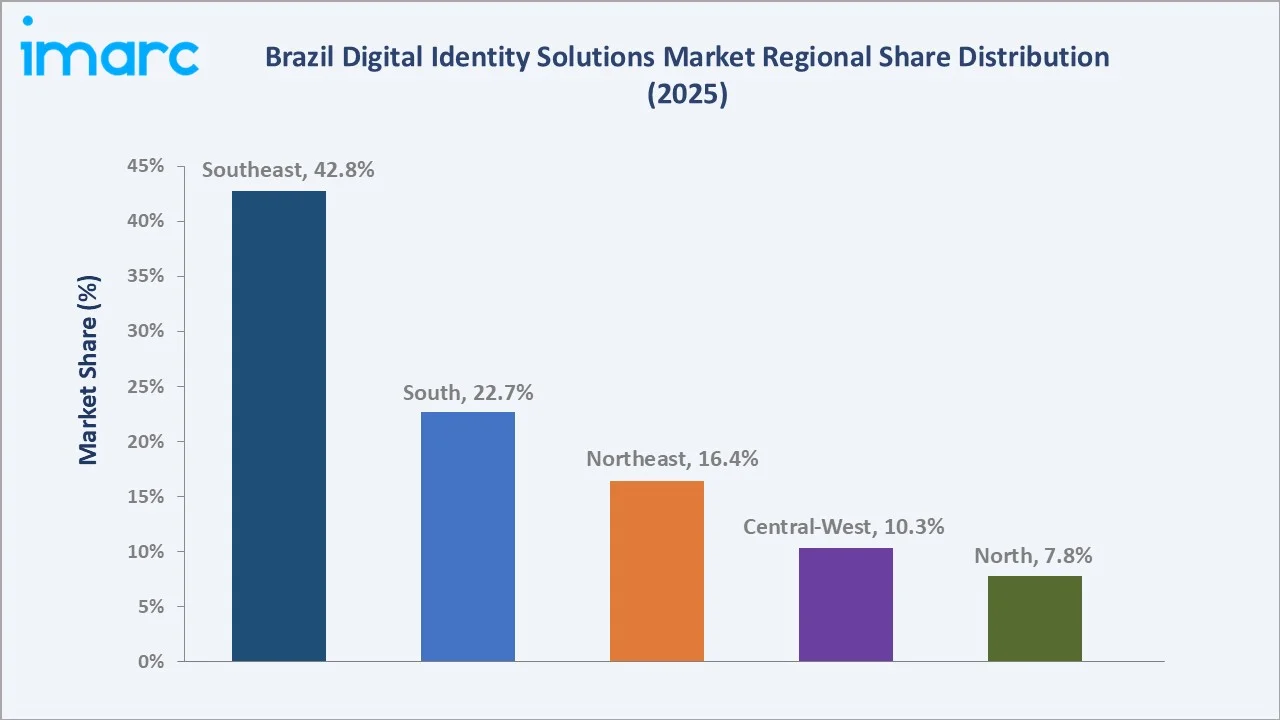
Northeast's 16.4% is gaining momentum through digital inclusion programs, CIN rollout, and wider use of public digital platforms. Central-West's 10.3% is supported by government modernization, agribusiness digitization, and financial inclusion initiatives. North's 7.8% remains smaller but is expanding through connectivity improvements, biometric enrollment, and digital public-service access in remote areas.
Competitive Landscape
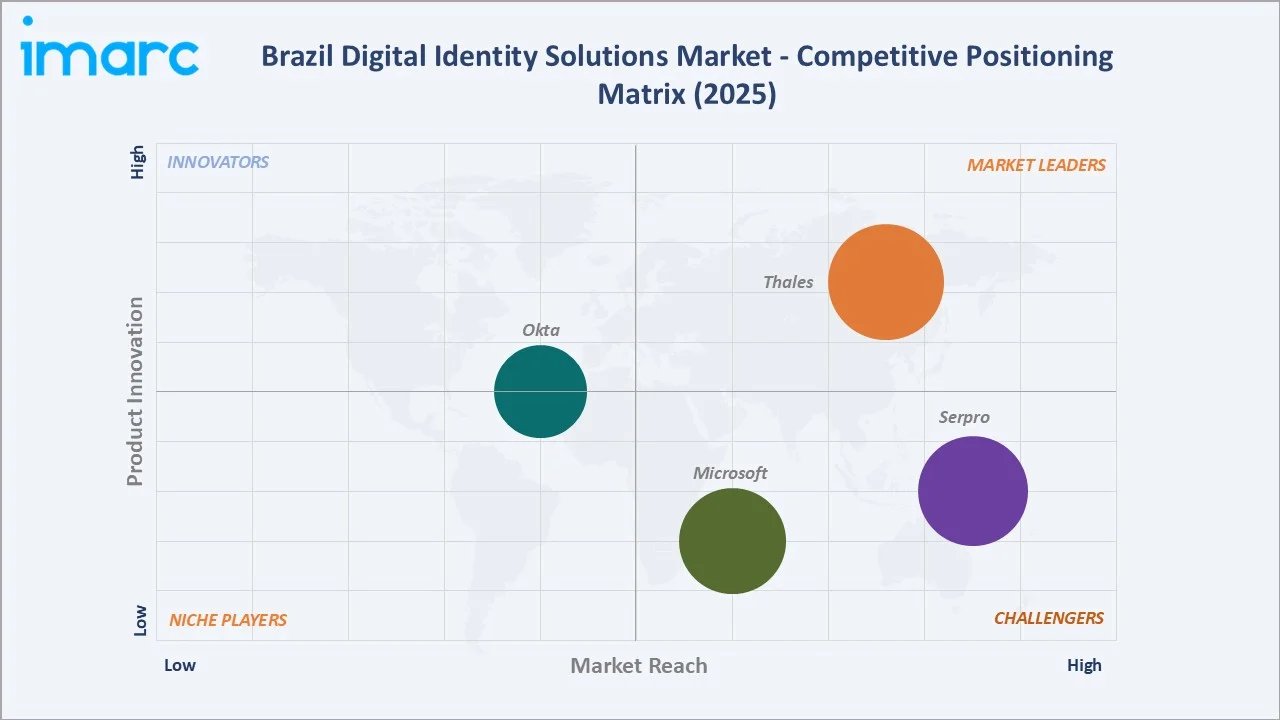
The Brazil digital identity solutions market is moderately competitive, with global technology providers, cybersecurity firms, biometric solution vendors, cloud platforms, and local GovTech players competing across authentication, e-KYC, digital signatures, and fraud prevention. Competition is shaped by platform scalability, API interoperability, biometric accuracy, and integration with government and enterprise systems.
|
Company |
Key Solutions |
Market Position |
Core Strength |
|
Thales |
End-to-End Digital Identity Capability across Identity Management, Identity Governance and Access Management |
Market Leader |
Thales plays a foundational role in Brazil's digital identity and public security infrastructure. The company provides biometrics, hardware security, and cryptographic solutions to major government bodies, financial institutions, and telecom operators across the country. |
|
Serpro |
Datavalid, Vio, ProID |
Strong Challenger |
Serpro is the technological backbone of Brazil's digital identity framework. As the state-owned federal IT company, it operates the critical cloud infrastructure, APIs, and biometric databases that allow public agencies and private enterprises to securely verify citizens' identities in real-time. |
|
Microsoft |
Entra ID |
Strong Challenger |
Microsoft's role in Brazil's digital identity solutions centers on empowering enterprises, healthcare networks, and the public sector to securely manage and verify identities. |
|
Okta |
Identity & Access Management |
Established Player |
In Brazil, Okta and its developer-focused subsidiary, Auth0, play a critical role in securing Customer Identity and Access Management for fintechs, banks, and enterprises. Their platforms deliver scalable authentication, prevent pervasive digital fraud, and ensure strict compliance with Brazil's evolving digital financial regulations. |
Vendors are increasingly focusing on cloud-based IDaaS, AI-driven fraud analytics, liveness detection, and secure digital onboarding. Local public technology providers and system integrators play a strong role in government digital identity projects. The market is expected to see rising partnerships, product innovation, and consolidation as demand for secure digital identity infrastructure expands.
Key Company Profiles
Thales
Thales is a leading provider of digital identity, cybersecurity, biometric authentication, and data protection solutions, with a strong presence in Brazil's digital identity ecosystem. The company offers technologies including biometric enrollment, identity verification, digital authentication, hardware security modules (HSMs), digital ID issuance, and cloud-based identity management. Its solutions support government agencies, financial institutions, telecom operators, healthcare organizations, and enterprises in delivering secure digital services while complying with Brazil's data protection regulations.
- Key Solutions: End-to-End Digital Identity Capability across Identity Management, Identity Governance and Access Management.
- Strategic Focus: Centers on strengthening secure digital identity, biometric verification, cybersecurity, and trusted data protection solutions for government and enterprise users. The company is likely to prioritize digital ID issuance, e-KYC, authentication, digital signatures, encryption, and cloud security to support Brazil’s expanding GOV.BR, CIN, fintech, telecom, and public-service ecosystems.
Serpro
Serpro is Brazil’s federal data processing and public technology company, playing a central role in the country’s digital government and digital identity ecosystem. The company supports secure public platforms, citizen authentication, digital service delivery, data exchange, and government technology infrastructure. In the Brazil digital identity solutions market, Serpro is closely associated with e-government modernization, interoperability, cybersecurity, digital authentication, and trusted public-sector technology services.
- Key Solutions: Datavalid, Vio, ProID.
- Recent Developments: In June 2026, Serpro and Brazil’s Ministry of Foreign Affairs advanced a strategic plan to enhance international collaboration in digital government and promote Brazilian public technology abroad. Led by Serpro President Wilton Mota, the meeting included MRE representatives focused on digital affairs, innovation diplomacy, global cooperation, and technology service promotion.
- Strategic Focus: Strengthening digital government infrastructure, secure citizen authentication, and interoperable public-service platforms. The company prioritizes technologies that support GOV.BR, CIN integration, digital signatures, data exchange, cybersecurity, and fraud prevention across federal and state agencies.
Market Concentration Analysis
The Brazil digital identity solutions market is moderately concentrated, with a mix of global identity technology providers, cybersecurity firms, cloud platforms, and domestic public technology players. Large vendors such as Thales and Serpro hold strong positions due to government relationships, secure identity infrastructure, and digital authentication capabilities. However, the market also includes several specialized e-KYC, biometric, fraud analytics, and IDaaS providers, creating competitive fragmentation. Market concentration is higher in government digital identity projects and lower in private-sector onboarding and authentication solutions. Competition is expected to intensify as cloud identity, biometric verification, digital signatures, and fraud prevention demand expand.
Investment & Growth Opportunities
Highest Growth Segments
Software facial liveness AI (~15.2% CAGR through deepfake prevention), cloud SaaS API-first (~15.6% CAGR), Southeast fintech growing (~15% CAGR), open finance decentralized identity (~18% CAGR from emerging base), GOV.BR rural Northeast expansion (~16% CAGR) and rural biometric inclusion (~14% CAGR) represent Brazil digital identity highest-growth investment vectors through 2034.
Investment Themes
- Facial liveness AI and deepfake prevention: Investment is accelerating in AI-powered liveness detection, behavioral biometrics, and deepfake detection technologies to strengthen digital onboarding, reduce identity fraud, and enhance trust in remote authentication.
- Rural and Northeast GOV.BR digital inclusion: Expanding GOV.BR and National Identity services in rural and underserved regions are creating opportunities for biometric enrollment, mobile identity verification, cloud-based identity platforms, and secure citizen access to digital public services.
Future Market Outlook (2026-2034)
Brazil digital identity solutions market is projected to grow from USD 1.82 Billion in 2025 to USD 6.35 Billion by 2034, delivering a 14.45% CAGR over the forecast period through GOV.BR national platform structural scale, Pix instant payment KYC mainstream, facial liveness AI deepfake prevention, and emerging open finance decentralized identity. The market's anchor value of USD 3.57 Billion in 2030 represents Brazil digital identity at facial liveness AI mainstream and Open Finance inflection.
Three structural forces are expected to shape the growth of Brazil’s digital identity solutions market through 2034. First, continued government-led digital transformation through initiatives such as GOV.BR and the National Identity Card (CIN) will expand secure digital identity adoption across public services. Second, rapid digitalization of banking, fintech, healthcare, telecom, and e-commerce will accelerate demand for biometric authentication, e-KYC, and digital signature solutions. Third, rising cybersecurity threats, identity fraud, and stricter data privacy requirements under LGPD will drive sustained investment in AI-powered identity verification, cloud-based identity platforms, and advanced fraud prevention technologies.
Research Methodology
Primary Research
Primary research comprised interviews with digital identity solution providers, biometric technology vendors, cloud platform companies, system integrators, and cybersecurity experts. Inputs were also gathered from banks, fintechs, telecom operators, government agencies, and enterprise users to assess adoption trends, deployment challenges, and regulatory requirements. The research helped validate market sizing, technology preferences, regional demand patterns, and future growth opportunities.
Secondary Research
Secondary research encompassed government digital identity programs, GOV.BR and CIN updates, regulatory publications, company reports, and industry databases. It also reviewed cybersecurity trends, fintech adoption, digital signature usage, cloud identity deployment, and biometric authentication developments. These sources supported market validation, competitive benchmarking, regional analysis, and long-term demand forecasting.
Forecasting Models
Forecasting models combined historical market trends, digital service adoption rates, cloud deployment growth, and biometric authentication uptake. CAGR-based projections were refined using demand drivers such as GOV.BR expansion, CIN rollout, fintech growth, and cybersecurity spending. Scenario modeling assessed baseline, optimistic, and conservative growth paths through 2034.
Brazil Digital Identity Solutions Market Report Coverage:
| Report Features | Details |
|---|---|
| Base Year of the Analysis | 2025 |
| Historical Period | 2020-2025 |
| Forecast Period | 2026-2034 |
| Units | Billion USD |
| Scope of the Report |
Exploration of Historical Trends and Market Outlook, Industry Catalysts and Challenges, Segment-Wise Historical and Future Market Assessment:
|
| Components Covered | Hardware, Software, Services |
| Identity Types Covered |
|
| Solution Types Covered |
|
| Organization Sizes Covered | Large Enterprises, Small and Medium Enterprises |
| Deployments Covered | On-Premises, Cloud |
| Verticals Covered | Banking, Financial Services, And Insurance, Retail and E-Commerce, Travel and Hospitality, Government And Defense, Healthcare, IT And Telecommunication, Energy And Utilities, Others |
| Regions Covered | Southeast, South, Northeast, North, Central-West |
| Companies Covered | Thales, Serpro, Microsoft, Okta, etc. |
| Customization Scope | 10% Free Customization |
| Post-Sale Analyst Support | 10-12 Weeks |
| Delivery Format | PDF and Excel through Email (We can also provide the editable version of the report in PPT/Word format on special request) |
Key Benefits for Stakeholders:
- IMARC's industry report offers a comprehensive quantitative analysis of various market segments, historical and current market trends, market forecasts, and dynamics of the Brazil digital identity solutions market from 2020-2034.
- The research report provides the latest information on the market drivers, challenges, and opportunities in the Brazil digital identity solutions market.
- Porter's five forces analysis assist stakeholders in assessing the impact of new entrants, competitive rivalry, supplier power, buyer power, and the threat of substitution. It helps stakeholders to analyze the level of competition within the Brazil digital identity solutions industry and its attractiveness.
- Competitive landscape allows stakeholders to understand their competitive environment and provides an insight into the current positions of key players in the market.
Frequently Asked Questions About the Brazil Digital Identity Solutions Market Report
The Brazil digital identity solutions market reached USD 1.82 Billion in 2025, driven by the rapid expansion of GOV.BR and government-led digital service transformation. Rising adoption of e-KYC, biometrics, digital signatures, fintech onboarding, and cybersecurity solutions is further accelerating demand for secure and scalable identity platforms.
The Brazil digital identity solutions market grows at 14.45% CAGR during 2026-2034, reaching USD 6.35 Billion by 2034. The CAGR reflects GOV.BR national platform scale, Pix instant payment KYC, and banking fraud prevention structural demand.
Software leads at 48.6% as it forms the core layer for identity verification, authentication, e-KYC, digital signatures, and fraud detection. Its scalability, frequent upgrades, API integration, and cloud deployment capabilities make it essential for government, banking, fintech, telecom, and enterprise digital identity systems.
Cloud leads at 64.8% due to its scalability, faster deployment, and lower infrastructure cost compared to on-premises systems. It enables real-time authentication, e-KYC, biometric verification, fraud monitoring, and secure access across government, fintech, banking, telecom, and enterprise platforms.
Southeast leads at 42.8% due to its high concentration of financial institutions, technology companies, government agencies, and enterprise headquarters. Strong digital infrastructure, widespread adoption of cloud services, and extensive use of e-KYC, biometric authentication, and digital government platforms continue to drive regional demand.
Leading companies include Thales, Serpro, Microsoft, and Okta, among others.
The market is projected to reach approximately USD 3.57 Billion by 2030, driven by the continued expansion of digital government services, fintech adoption, and enterprise digital transformation. Increasing deployment of biometric authentication, cloud-based identity platforms, and AI-powered fraud prevention solutions will support sustained market growth over the forecast period.
Three priority investment opportunities in the Brazil digital identity solutions market include expanding AI-powered biometric authentication and fraud prevention platforms to combat rising cyber threats and identity fraud. Another attractive area is cloud-based Identity-as-a-Service (IDaaS) solutions that enable scalable identity management, e-KYC, and digital onboarding across enterprises. Significant potential also exists in government digital identity and digital inclusion initiatives, including GOV.BR, CIN rollout, and secure digital public services, creating demand for interoperable identity platforms, digital signatures, and authentication technologies across underserved regions.
Need more help?
- Speak to our experienced analysts for insights on the current market scenarios.
- Include additional segments and countries to customize the report as per your requirement.
- Gain an unparalleled competitive advantage in your domain by understanding how to utilize the report and positively impacting your operations and revenue.
- For further assistance, please connect with our analysts.
 Request Customization
 Speak to an Analyst
 Request Brochure
 Inquire Before Buying
Benefits of Customization
- Personalize this research
- Triangulate with your data
- Get data as per your format and definition
- Gain a deeper dive into a specific application, geography, customer, or competitor
- Any level of personalization
Get in Touch With Us
UNITED STATES
Phone: +1-201-971-6302
INDIA
Phone: +91-120-433-0800
UNITED KINGDOM
Phone: +44-753-714-6104
Email: [email protected]
Client Testimonials




.webp)




.webp)













Related Reports

Choose your plan
*Please note that the prices mentioned below are starting prices for each bundle type. Kindly contact our team for further details.*
Single User License
- 1 User License, Access on 2 Devices
- PDF Report + Excel Dataset (Password Protected)
- Lifetime Access
- No Printing Rights
- 10% Free Report Customization
- 10–12 Weeks of Analyst Support
Five User License
- Access for 5 Users, 2 Devices per User
- PDF Report + Excel Dataset (Password Protected)
- Lifetime Access
- Dedicated Account Manager
- 12–14 Weeks of Analyst Support
- No Printing Rights
- 15% Free Report Customization
- 25% Discount on Your Next Purchase
Corporate User License
- Unlimited User Access (Within Your Organization)
- PDF Report + Excel Dataset
- Lifetime Access
- Dedicated Account Manager
- 14–20 Weeks of Analyst Support
- No Printing Rights
- 20% Free Report Customization
- 30% Discount on Your Next Purchase
Essential Insights
What's included:
3 reports
- Lifetime Access
- PDF Reports
- Excel Datasets
- 2 Weeks of Free Analyst Support
- 2 User Licenses
- Access on 2 Devices
- Printing Rights
- Complimentary PowerPoint (PPT) Version
- Complimentary License Upgrade
Professional Access
What's included:
5 reports
- Lifetime Access
- PDF Reports
- Excel Datasets
- 8 Weeks of Free Analyst Support
- 2 User Licenses
- Access on 2 Devices
- Printing Rights
- Complimentary PowerPoint (PPT) Version
- Complimentary License Upgrade
Business Advantage
What's included:
8 reports
- Lifetime Access
- PDF Reports
- Excel Datasets
- 14 Weeks of Free Analyst Support
- 2 User Licenses
- Access on 2 Devices
- Printing Rights
- Complimentary PowerPoint (PPT) Version
- Complimentary License Upgrade
Enterprise Intelligence
What's included:
10 reports
- Lifetime Access
- PDF Reports
- Excel Datasets
- 20 Weeks of Free Analyst Support
- 2 User Licenses
- Access on 2 Devices
- Printing Rights
- Complimentary PowerPoint (PPT) Version
- Complimentary License Upgrade