
Brazil Digital Workplace Market Size, Share, Trends and Forecast by Component, Enterprise Size, Verticals, and Region, 2026-2034
Brazil Digital Workplace Market Summary:
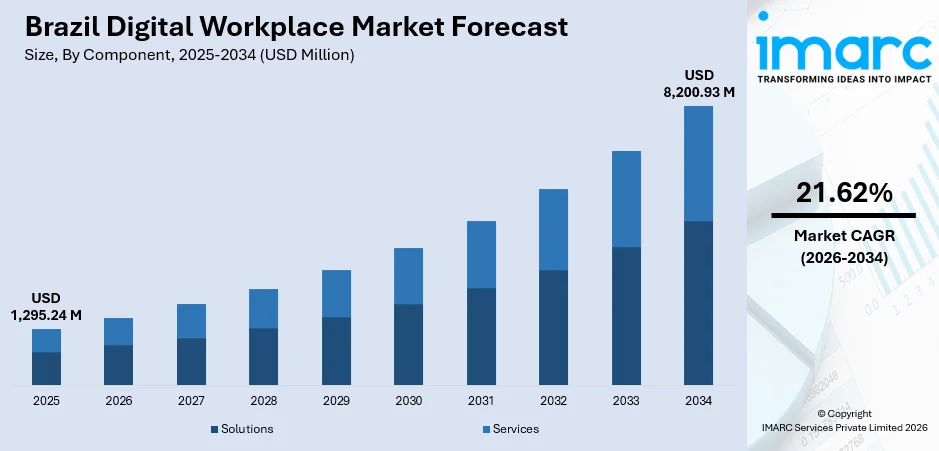
The Brazil digital workplace market size was valued at USD 1,295.24 Million in 2025 and is projected to reach USD 8,200.93 Million by 2034, growing at a compound annual growth rate of 21.62% from 2026-2034.
The Brazil digital workplace market is experiencing robust expansion as enterprises accelerate digital transformation initiatives to modernize communication, collaboration, and operational workflows. Increasing adoption of cloud-based platforms, growing reliance on AI-driven productivity tools, and the widespread shift toward hybrid work models are strengthening demand. Government-backed digitalization programs and rising enterprise technology spending are further reinforcing growth, positioning Brazil as a leading hub for digital workplace innovation across Latin America.
Key Takeaways and Insights:
- By Component: Solutions dominate the market with a share of 62.4% in 2025, owing to the growing enterprise preference for integrated platforms that unify communication, project management, and data analytics.
- By Enterprise Size: Large enterprises lead the market with a share of 68.7% in 2025. This dominance is driven by substantial IT budgets, complex operational requirements, and the need for scalable digital infrastructure that supports geographically distributed workforces across Brazil.
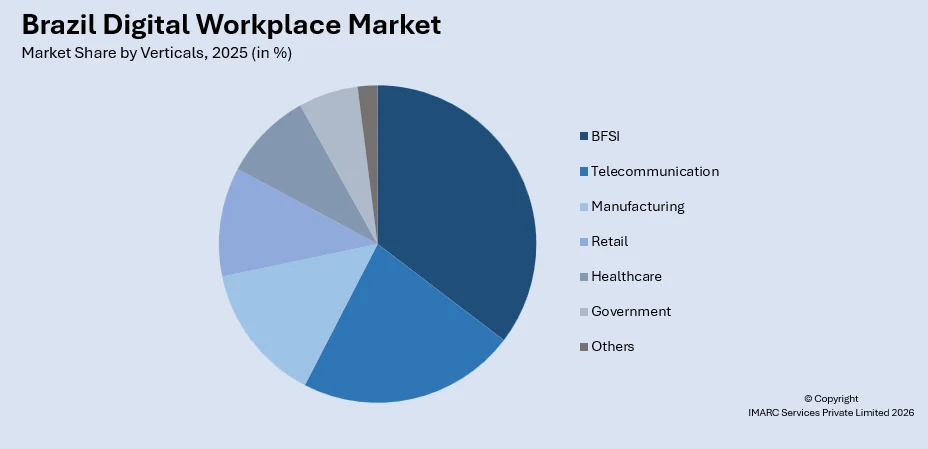
- By Vertical: BFSI represents the largest segment with a market share of 24.9% in 2025, reflecting the financial sector's accelerated investment in digital tools for secure collaboration, regulatory compliance, and AI-enhanced customer engagement across banking and insurance operations.
- By Region: Southeast region comprises the largest region with 46.3% share in 2025, driven by the concentration of corporate headquarters, technology hubs, and financial institutions in Sao Paulo and Rio de Janeiro metropolitan areas, coupled with superior digital infrastructure availability.
- Key Players: The market is competitive, with global technology vendors, local IT service providers, and niche software firms vying for share. Key differentiation factors include cloud integration, collaboration tools, cybersecurity features, and scalability, while partnerships and tailored solutions drive adoption across enterprises.
To get more information on this market Request Sample
The Brazil digital workplace market is advancing as organizations, industries, and government bodies embrace modern collaboration platforms and intelligent workplace technologies to enhance productivity and operational agility. A major driver shaping this progress is the country's accelerating investment in cloud and AI infrastructure, which supports the long-term scalability of digital workplace environments. For instance, in September 2024, Microsoft announced a BRL 14.7 Billion investment in cloud and AI infrastructure in Brazil over three years, the largest single investment in the company's 35-year history in the country, aimed at expanding Azure data center regions in Sao Paulo and Rio de Janeiro. This initiative aligns with growing enterprise demand for secure, compliant, and high-performance digital workplace solutions. Policy encouragement through national digital government strategies, expanding hybrid work ecosystems, and rising enterprise technology spending are contributing to a more favorable environment for digital workplace adoption across Brazil.
Brazil Digital Workplace Market Trends:
Integration of Generative AI into Workplace Platforms
Brazilian enterprises are rapidly embedding generative AI capabilities into their digital workplace environments to enhance productivity and automate routine tasks. Organizations are deploying AI-powered assistants for content creation, meeting summarization, and workflow automation. For instance, Globo, the largest media conglomerate in Brazil, implemented Microsoft 365 Copilot across its operations through a structured initiative called "Voce Mais IA," achieving a reported 97% reduction in execution time for certain operational processes. This trend toward AI-augmented work is reshaping employee interactions with technology and accelerating Brazil digital workplace market growth.
Expansion of Hybrid and Remote Work Ecosystems
Brazil is witnessing a sustained shift toward hybrid work models as organizations invest in unified communication and collaboration platforms that enable seamless remote operations. According to a study released in early 2025, remote and hybrid work models in Brazil exhibit greater workplace maturity at 62.5% compared to in-person office settings at 59.7%, demonstrating the effectiveness of digital-first environments. Cloud-based collaboration suites, video conferencing tools, and virtual desktop infrastructure are becoming standard across industries, driving enterprise investment in scalable digital workplace solutions.
Rising Focus on Cybersecurity and Regulatory Compliance
As digital workplace adoption accelerates, Brazilian organizations are prioritizing cybersecurity frameworks and compliance with data protection regulations to safeguard enterprise collaboration environments. The Lei Geral de Protecao de Dados heightened the importance of secure digital workplace platforms that ensure data sovereignty and regulatory adherence. According to a study, only 16% of Brazilian companies implement advanced alerts for suspicious emails, while 41% lack direct mechanisms to identify and report threats. This cybersecurity gap is driving investment in AI-powered threat detection, encryption protocols, and compliance-ready collaboration solutions.
Market Outlook 2026-2034:
The Brazil digital workplace market is positioned for sustained advancement, supported by continued enterprise digitalization, expanding cloud ecosystems, and the growing integration of AI-powered tools into workplace operations. In line with this, increasing enterprise investments in unified communication platforms, hybrid work infrastructure, and intelligent automation are expected to drive higher revenue streams. As such, in June 2025, Motorola Solutions was selected to unify Brazil’s federal defense and public safety communications, integrating land mobile radio and broadband MCX services to enhance interoperability, situational awareness, and emergency response nationwide. Moreover, government initiatives focused on digital government modernization and AI ecosystem development, coupled with rising demand for LGPD-compliant collaboration solutions, are fostering a more competitive and mature digital workplace landscape across Brazil. The market generated a revenue of USD 1,295.24 Million in 2025 and is projected to reach a revenue of USD 8,200.93 Million by 2034, growing at a compound annual growth rate of 21.62% from 2026-2034.
Brazil Digital Workplace Market Report Segmentation:
|
Segment Category |
Leading Segment |
Market Share |
|
Component |
Solutions |
62.4% |
|
Enterprise Size |
Large Enterprises |
68.7% |
|
Verticals |
BFSI |
24.9% |
|
Region |
Southeast |
46.3% |
Component Insights:
- Solutions
- Services
Solutions dominate with a market share of 62.4% of the total Brazil digital workplace market in 2025.
The solutions segment leads the Brazil digital workplace market as enterprises increasingly adopt integrated software platforms that consolidate communication, collaboration, document management, and analytics into unified ecosystems. Demand for cloud-native solutions offering enterprise mobility management, unified communications, and endpoint management is accelerating as organizations modernize legacy infrastructure. The growing emphasis on AI-enhanced features such as intelligent search, automated content creation, and predictive analytics is further strengthening the preference for comprehensive digital workplace solution suites across Brazilian enterprises.
The segment's dominance is reinforced by the expanding adoption of enterprise collaboration platforms from global technology providers. For instance, the 2025 ISG Provider Lens Microsoft AI and Cloud Ecosystem report for Brazil evaluated 45 providers across six quadrants, naming Brasoftware, Kumulus, and TIVIT as leaders in all six categories, highlighting the depth of the solutions ecosystem in the country. Brazilian organizations across industries are investing in scalable, compliant platforms that support distributed workforces while meeting LGPD regulatory requirements for data security and governance.
Enterprise Size Insights:
- Large Enterprises
- SMEs
Large enterprises lead with a share of 68.7% of the total Brazil digital workplace market in 2025.
Large enterprises account for the highest revenue share in the Brazil digital workplace market, driven by substantial IT budgets, complex operational structures, and the need for scalable, secure digital infrastructure. These organizations require enterprise-grade platforms that support multi-location operations, advanced security protocols, and integration with existing enterprise resource planning and customer relationship management systems. The shift toward multi-cloud strategies, has created significant demand for sophisticated digital workplace solutions.
The segment's strength is further supported by the growing emphasis on AI-augmented workforce services among major Brazilian corporations. According to the 2025 ISG Provider Lens Future of Work Services report for Brazil, enterprises are training intelligent digital agents for functions such as sales and human resources, expanding beyond traditional customer service applications. Large enterprises are leveraging these advanced capabilities to reduce response times, improve accuracy, and enhance employee experience, positioning them as the primary consumers of premium digital workplace technologies in the country.
Verticals Insights:
Access the comprehensive market breakdown Request Sample
- BFSI
- Telecommunication
- Manufacturing
- Retail
- Healthcare
- Government
- Others
BFSI is the largest segment, accounting for 24.9% of the total Brazil digital workplace market in 2025.
The BFSI sector commands the largest vertical share in the Brazil digital workplace market, driven by the financial industry's aggressive investment in digital transformation, AI integration, and cloud-based collaboration platforms. Brazilian financial institutions are prioritizing digital tools to enhance operational efficiency, regulatory compliance, and employee productivity across distributed banking networks. According to the Febraban Banking Technology Survey 2025, Brazilian banks are projected to invest over BRL 47.8 Billion in technology in 2025 alone, representing a 13% increase over the previous year, with significant spending directed toward AI, cloud migration, and digital workplace modernization.
The sector's digital workplace adoption is further strengthened by the rapid expansion of mobile banking infrastructure and open finance initiatives that require advanced collaboration and communication tools. Brazil's financial ecosystem, with 75% of banking transactions conducted via mobile devices in 2024, necessitates robust digital workplace platforms that support real-time communication, secure document management, and cross-functional collaboration. Major banks such as Bradesco have partnered with technology providers to implement AI-powered workplace solutions, including audit automation tools that have achieved significant efficiency gains in operational processes.
Regional Insights:
- Southeast
- South
- Northeast
- North
- Central-West
Southeast holds the largest share at 46.3% of the total Brazil digital workplace market in 2025.
The Southeast region dominates the Brazil digital workplace market, anchored by the economic and technological concentration in Sao Paulo and Rio de Janeiro. The region hosts the headquarters of major financial institutions, multinational corporations, and technology companies that drive enterprise demand for advanced digital workplace solutions. For example, in November 2025, Taara, a Google X startup, began deploying the world’s first wireless optical mesh network in Rio de Janeiro, connecting schools, hospitals, and public buildings to improve high-speed, reliable Internet access. Sao Paulo serves as the primary hub for cloud data centers, with Microsoft, AWS, and Oracle operating major infrastructure facilities that support local digital workplace deployments.
The growing adoption of remote and hybrid work models across Brazil is further accelerating demand for digital workplace solutions, including collaboration platforms, cloud productivity tools, and secure communication systems. Enterprises are increasingly investing in unified digital ecosystems that integrate video conferencing, document management, and workflow automation to maintain operational efficiency and employee engagement. Additionally, government initiatives to expand broadband connectivity and promote digital inclusion in urban and semi-urban areas are enhancing the accessibility and scalability of these solutions, reinforcing the Southeast region’s leadership in Brazil’s digital workplace market.
Market Dynamics:
Growth Drivers:
Why is the Brazil Digital Workplace Market Growing?
Accelerating Enterprise Digital Transformation Initiatives
Brazilian organizations are rapidly modernizing their workplace environments through comprehensive digital transformation strategies that prioritize cloud migration, intelligent automation, and enhanced employee experiences. The country's Digital Transformation Index climbed from 3.3 in 2023 to 3.7 in 2024, yet still trails mature economies, encouraging firms to seek external expertise and invest in advanced digital workplace platforms. Enterprises across sectors including finance, manufacturing, and retail are replacing legacy systems with integrated cloud-based solutions that unify communication, collaboration, and business process management. This transformation momentum is supported by a robust technology services ecosystem, with Brazil's local IT sector growing by 13.9% in 2024, significantly outpacing the global 10.8% baseline. Heightened merger and acquisition activity in the technology sector, with 169 tech deals valued at BRL 26 Billion in 2024, signals accelerated capability building in AI, cybersecurity, and cloud services that directly supports digital workplace modernization across the enterprise landscape.
Massive Cloud and AI Infrastructure Investments
Global hyperscalers and technology providers are channeling substantial investments into Brazil's cloud and AI infrastructure, creating a robust foundation for scalable digital workplace deployments. These investments are expanding data center capacity, improving network performance, and enabling Brazilian enterprises to access world-class collaboration and productivity platforms with low-latency performance and local data residency. The scale of recent commitments underscores the strategic importance of Brazil's digital ecosystem. In September 2024, AWS announced a USD 1.8 Billion investment in Brazil to expand its data center operations through 2034, while in May 2025, Patria Investimentos launched Omnia, a USD 1 Billion hyperscale data center platform focused on AI and cloud services, with the first facility planned in Brazil using exclusively renewable energy. These infrastructure expansions are reducing adoption barriers and empowering organizations to implement advanced digital workplace solutions with enhanced reliability, security, and compliance.
Government-Led Digitalization and Regulatory Framework
The Brazilian government is actively promoting digital transformation through strategic policies, investment programs, and regulatory frameworks that encourage enterprise adoption of modern workplace technologies. National initiatives targeting public sector modernization and digital skills development are creating a supportive environment for digital workplace growth across government and private organizations. Efforts to digitize federal services and migrate sensitive data to secure cloud environments are expanding demand for collaborative, efficient, and secure digital workplace solutions. These policies demonstrate the government’s commitment to fostering technology adoption and enabling scalable, resilient digital infrastructure nationwide.
Market Restraints:
What Challenges the Brazil Digital Workplace Market is Facing?
Cybersecurity Vulnerabilities and Data Protection Gaps
Despite the accelerating adoption of digital workplace platforms, significant cybersecurity gaps persist across Brazilian enterprises, creating barriers to full-scale deployment. Many organizations lack robust security protocols for digital collaboration environments, leaving them vulnerable to data breaches and compliance violations under the LGPD framework. The shortage of cybersecurity professionals and limited investment in advanced threat detection systems further complicate the adoption of comprehensive digital workplace solutions, particularly among mid-market enterprises with constrained security budgets.
Integration Complexity with Legacy Systems
Many Brazilian enterprises continue to operate on legacy IT infrastructure that presents significant integration challenges when deploying modern digital workplace platforms. The complexity of connecting disparate systems across departments and business units increases implementation timelines, raises costs, and creates interoperability issues. Organizations in sectors such as manufacturing and government face particular difficulties in migrating from established workflows to cloud-based digital workplace environments while maintaining operational continuity and data integrity.
Digital Skills Gap and Change Management Barriers
The adoption of advanced digital workplace technologies is constrained by a persistent skills gap among the Brazilian workforce, particularly in areas related to AI literacy, cloud management, and digital collaboration tools. Resistance to change among employees accustomed to traditional work processes, combined with insufficient corporate training programs, slows the effective utilization of new digital workplace platforms. Organizations must invest significantly in upskilling initiatives and cultural transformation to realize the full productivity benefits of their digital workplace investments.
Competitive Landscape:
The Brazil digital workplace market features a dynamic competitive landscape characterized by the presence of both global technology providers and established Brazilian IT services firms. Companies are differentiating through AI-augmented workforce solutions, managed workplace services, and compliance-ready platforms tailored to local regulatory requirements. Strategic partnerships, acquisitions, and investments in cloud infrastructure are intensifying competition as providers seek to capture growing enterprise demand. Service providers are expanding local operations and investing in Portuguese-language interfaces, LGPD compliance capabilities, and ESG-aligned workplace solutions to strengthen their market positioning and deliver contextually relevant digital workplace experiences across Brazil.
Recent Developments:
- In February 2026, Microsoft brought two new data halls online in São Paulo as part of its AI and cloud infrastructure expansion in Brazil. The facilities support Azure services, complement existing regions, and align with government incentives. Microsoft emphasizes AI’s role in boosting national competitiveness, productivity, and innovation.
- In November 2025, Infosys launched a Grid Modernization Center of Excellence in Brazil to advance digital transformation in the power sector. The CoE focuses on AI, analytics, IoT, and grid technologies, supports local talent development, and drives sustainable energy transition while enabling collaboration with North American utilities.
Brazil Digital Workplace Market Report Coverage:
|
Report Features |
Details |
|
Base Year of the Analysis |
2025 |
|
Historical Period |
2020-2025 |
|
Forecast Period |
2026-2034 |
|
Units |
Million USD |
|
Scope of the Report |
Exploration of Historical Trends and Market Outlook, Industry Catalysts and Challenges, Segment-Wise Historical and Future Market Assessment:
|
|
Components Covered |
Solutions, Services |
|
Enterprise Sizes Covered |
Large Enterprises, SMEs |
|
Verticals Covered |
BFSI, Telecommunication, Manufacturing, Retail, Healthcare, Government, Others |
|
Regions Covered |
Southeast, South, Northeast, North, Central-West |
|
Customization Scope |
10% Free Customization |
|
Post-Sale Analyst Support |
10-12 Weeks |
|
Delivery Format |
PDF and Excel through Email (We can also provide the editable version of the report in PPT/Word format on special request) |
Frequently Asked Questions About the Brazil Digital Workplace Market Report
The Brazil digital workplace market size was valued at USD 1,295.24 Million in 2025.
The Brazil digital workplace market is expected to grow at a compound annual growth rate of 21.62% from 2026-2034 to reach USD 8,200.93 Million by 2034.
Solutions dominated the market with a share of 62.4%, driven by increasing enterprise demand for integrated cloud-based platforms that unify communication, collaboration, and analytics capabilities across distributed workforces.
Key factors driving the Brazil digital workplace market include accelerating enterprise digital transformation, massive cloud and AI infrastructure investments by global technology providers, supportive government digitalization policies, expanding hybrid work adoption, and growing demand for LGPD-compliant collaboration platforms.
Major challenges include cybersecurity vulnerabilities and data protection gaps, integration complexity with legacy enterprise systems, digital skills shortages among the workforce, change management barriers, inconsistent broadband connectivity in remote regions, and the high cost of comprehensive digital workplace implementations.
Need more help?
- Speak to our experienced analysts for insights on the current market scenarios.
- Include additional segments and countries to customize the report as per your requirement.
- Gain an unparalleled competitive advantage in your domain by understanding how to utilize the report and positively impacting your operations and revenue.
- For further assistance, please connect with our analysts.
 Request Customization
 Speak to an Analyst
 Request Brochure
 Inquire Before Buying
Benefits of Customization
- Personalize this research
- Triangulate with your data
- Get data as per your format and definition
- Gain a deeper dive into a specific application, geography, customer, or competitor
- Any level of personalization
Get in Touch With Us
UNITED STATES
Phone: +1-201-971-6302
INDIA
Phone: +91-120-433-0800
UNITED KINGDOM
Phone: +44-753-714-6104
Email: [email protected]
Client Testimonials




.webp)




.webp)













Related Reports

Choose your plan
*Please note that the prices mentioned below are starting prices for each bundle type. Kindly contact our team for further details.*
Single User License
- 1 User License, Access on 2 Devices
- PDF Report + Excel Dataset (Password Protected)
- Lifetime Access
- No Printing Rights
- 10% Free Report Customization
- 10–12 Weeks of Analyst Support
Five User License
- Access for 5 Users, 2 Devices per User
- PDF Report + Excel Dataset (Password Protected)
- Lifetime Access
- Dedicated Account Manager
- 12–14 Weeks of Analyst Support
- No Printing Rights
- 15% Free Report Customization
- 25% Discount on Your Next Purchase
Corporate User License
- Unlimited User Access (Within Your Organization)
- PDF Report + Excel Dataset
- Lifetime Access
- Dedicated Account Manager
- 14–20 Weeks of Analyst Support
- No Printing Rights
- 20% Free Report Customization
- 30% Discount on Your Next Purchase
Essential Insights
What's included:
3 reports
- Lifetime Access
- PDF Reports
- Excel Datasets
- 2 Weeks of Free Analyst Support
- 2 User Licenses
- Access on 2 Devices
- Printing Rights
- Complimentary PowerPoint (PPT) Version
- Complimentary License Upgrade
Professional Access
What's included:
5 reports
- Lifetime Access
- PDF Reports
- Excel Datasets
- 8 Weeks of Free Analyst Support
- 2 User Licenses
- Access on 2 Devices
- Printing Rights
- Complimentary PowerPoint (PPT) Version
- Complimentary License Upgrade
Business Advantage
What's included:
8 reports
- Lifetime Access
- PDF Reports
- Excel Datasets
- 14 Weeks of Free Analyst Support
- 2 User Licenses
- Access on 2 Devices
- Printing Rights
- Complimentary PowerPoint (PPT) Version
- Complimentary License Upgrade
Enterprise Intelligence
What's included:
10 reports
- Lifetime Access
- PDF Reports
- Excel Datasets
- 20 Weeks of Free Analyst Support
- 2 User Licenses
- Access on 2 Devices
- Printing Rights
- Complimentary PowerPoint (PPT) Version
- Complimentary License Upgrade