
Brazil E-Commerce Logistics Market Size, Share, Trends and Forecast by Product, Service Type, Operational Area, and Region, 2026-2034
Brazil E-Commerce Logistics Market Summary:
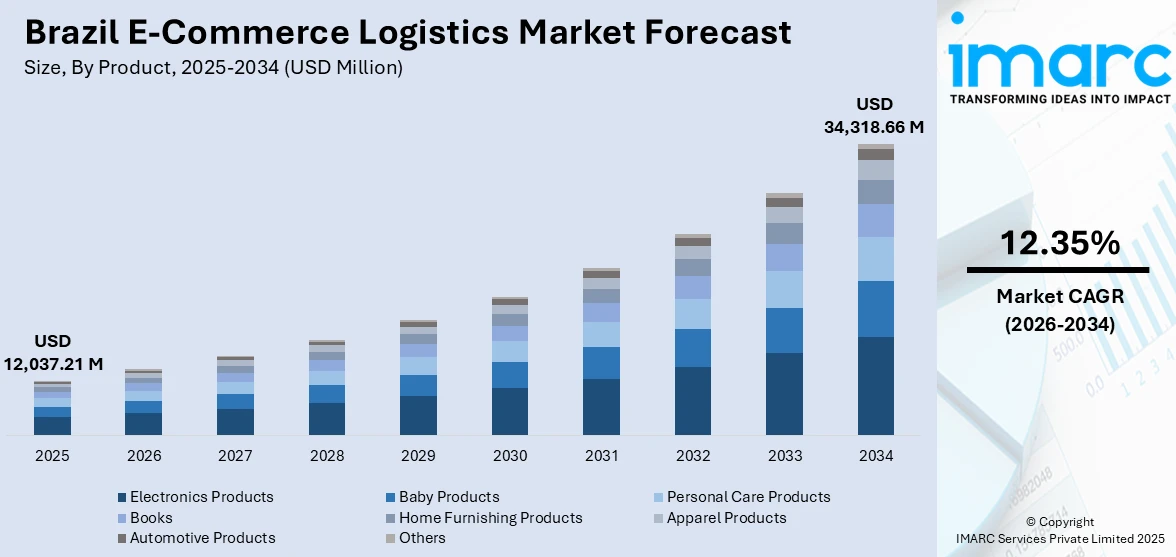
The Brazil e-commerce logistics market size was valued at USD 12,037.21 Million in 2025 and is projected to reach USD 34,318.66 Million by 2034, growing at a compound annual growth rate of 12.35% from 2026-2034.
The Brazil e-commerce logistics business is seeing significant expansion driven by increased online shopping penetration, evolving consumer expectations for speedier deliveries, and continuing infrastructural upgrades. The trend toward online shopping is being accelerated by rising smartphone usage and the implementation of digital payments. In order to meet the nation's increasing fulfillment expectations across its diversified geographic terrain, logistics providers are improving distribution networks and using cutting-edge technologies.
Key Takeaways and Insights:
- By Product: Electronics products dominate the market with a share of 29.4% in 2025, due to the increased demand from customers for laptops, smartphones, and other electronic devices via internet channels. The industry is expanding due to rising digital literacy and a growing inclination to compare specs online.
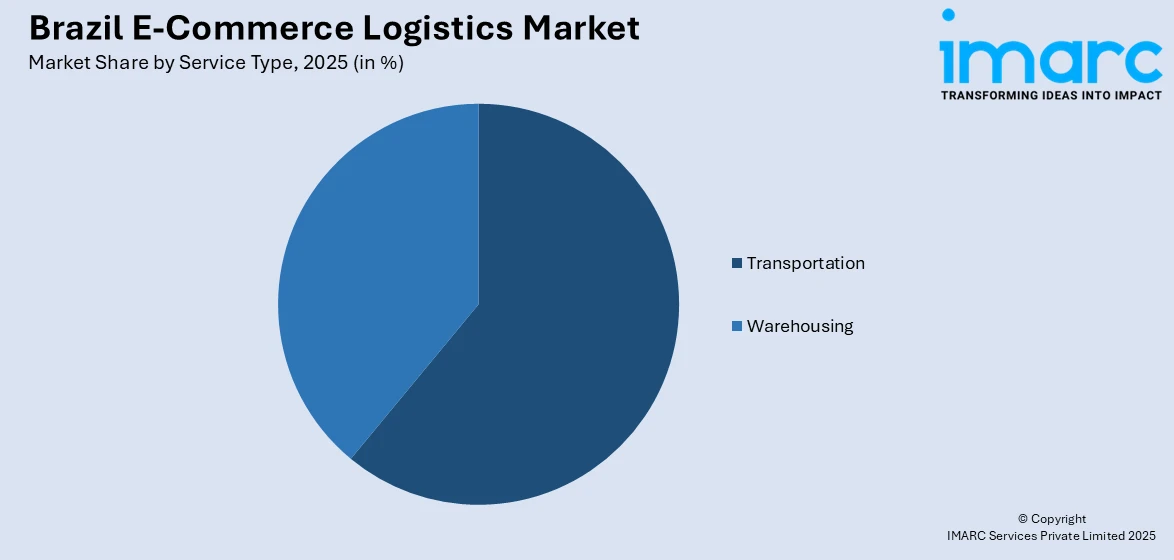
- By Service Type: Transportation leads the market with a share of 61.2% in 2025. This supremacy is fueled by the nation's increasing emphasis on expedited delivery services and the vital requirement for dependable freight transit over long geographic areas.
- By Operational Area: Domestic exhibits a clear dominance in the market with 78.5% share in 2025, demonstrating a considerable consumer preference for goods sourced locally and quicker delivery times. The establishment of regional fulfillment facilities is bolstering domestic logistics capabilities countrywide.
- By Region: Southeast is the largest region with 42.6% share in 2025, propelled by the concentration of important economic centers in the cities of Rio de Janeiro and São Paulo. Premium delivery services are made possible by increased population density and sophisticated logistics infrastructure.
- Key Players: By building last-mile capabilities, investing in same-day delivery infrastructure, and growing fulfillment center networks, major players propel the Brazilian e-commerce logistics sector. They increase operational efficiency, speed up delivery, and guarantee consistent service availability across various geographic locations through their investments in automation technology, fleets of electric vehicles, and collaborations with regional couriers.
To get more information on this market Request Sample
As online shopping continues to grow rapidly throughout the country, the Brazilian e-commerce logistics business is expected to increase significantly. The growth of digital payment solutions, particularly immediate payment platforms, has improved checkout processes and lowered cart abandonment rates, consequently increasing order volumes necessitating fulfillment services. In order to facilitate speedier delivery alternatives, including same-day and next-day services, which are increasingly demanded by online customers, logistics providers are deliberately placing distribution hubs closer to consumer populations. The integration of innovative technology such as route optimization algorithms, real-time tracking systems, and automated warehousing solutions is revolutionizing operational efficiency across the supply chain. Additionally, the growing middle class and their rising disposable incomes are increasing the number of consumers who shop online, which is generating a steady demand for all-inclusive logistics services that include value-added fulfillment, shipping, and warehousing. Retailers are under pressure to fortify their logistical alliances and make investments in delivery infrastructure that satisfies changing demands for speed, dependability, and transparency throughout the order fulfillment process due to the continuous shift in customer behavior toward digital commerce platforms.
Brazil E-Commerce Logistics Market Trends:
Integration of Advanced Automation Technologies
Automation technologies are being adopted more quickly in the e-commerce logistics sector to improve operational efficiency and shorten processing times. Robotic systems are being used more by fulfillment centers for picking, packing, and inventory management. Logistics companies can manage increasing order quantities with precision and speed because of these technologies. The push toward automated warehousing systems is driven by increased labor costs and the requirement to meet consumer expectations for speedy delivery. Demand forecasting technologies driven by artificial intelligence are also lowering storage costs and optimizing inventory location.
Expansion of Same-Day and Next-Day Delivery Services
The market's logistics techniques are changing due to consumer expectations for quick delivery. In order to place inventory closer to final customers and give faster delivery alternatives, service providers are setting up micro-fulfillment centers in cities. The competitive character of the e-commerce market, where speed has emerged as a crucial difference, is reflected in the growth of same-day delivery services. Logistics operators are working with local courier networks and using dedicated delivery fleets to maintain consistent service standards. In large cities, where population density facilitates effective last-mile operations, this trend is especially noticeable.
Sustainable Logistics and Electric Vehicle Adoption
Environmental sustainability is developing as an important factor in e-commerce logistics operations. In order to lower carbon emissions and adhere to changing urban mobility requirements, logistics companies are switching to electric vehicle fleets for last-mile deliveries. In order to reduce fuel consumption, route optimization algorithms and the use of sustainable packing materials are becoming more popular. This transition is driven by customer preferences for ecologically responsible purchasing options and company sustainability pledges. Initiatives in green logistics are increasingly seen as competitive benefits in drawing in eco-aware customers.
Market Outlook 2026-2034:
The Brazil e-commerce logistics market outlook remains highly favorable as online retail penetration continues its upward trajectory. Rising internet connectivity, expanding smartphone adoption, and evolving consumer shopping behaviors are creating sustained demand for comprehensive logistics solutions. The market generated a revenue of USD 12,037.21 Million in 2025 and is projected to reach a revenue of USD 34,318.66 Million by 2034, growing at a compound annual growth rate of 12.35% from 2026-2034. Infrastructure investments by logistics providers are expanding fulfillment capabilities across varied geographic locations, cutting delivery times and enhancing service quality. Online purchase volumes are increasing and transaction processes are being streamlined by the ongoing adoption of digital payment platforms. Strategic relationships between e-commerce platforms and logistics operators are supporting integrated supply chain solutions that answer growing consumer demands for speed, reliability, and transparency.
Brazil E-Commerce Logistics Market Report Segmentation:
|
Segment Category |
Leading Segment |
Market Share |
|
Product |
Electronics Products |
29.4% |
|
Service Type |
Transportation |
61.2% |
|
Operational Area |
Domestic |
78.5% |
|
Region |
Southeast |
42.6% |
Product Insights:
- Baby Products
- Personal Care Products
- Books
- Home Furnishing Products
- Apparel Products
- Electronics Products
- Automotive Products
- Others
Electronics products dominate with a market share of 29.4% of the total Brazil e-commerce logistics market in 2025.
The electronics products segment leads Brazil's e-commerce logistics market owing to strong consumer preference for purchasing smartphones, laptops, tablets, and consumer electronics through online channels. The category benefits from extensive product comparison capabilities available online, competitive pricing from multiple sellers, and convenient doorstep delivery options. Brazilian consumers increasingly rely on digital platforms for electronics purchases due to better selection availability compared to physical retail stores. The high-value nature of electronic goods drives demand for premium logistics services that ensure secure and timely delivery to end consumers nationwide.
The logistics requirements for electronics products are characterized by specialized handling needs including secure packaging, temperature considerations for certain components, and insurance coverage for high-value items. Fulfillment centers have developed dedicated processing areas equipped with appropriate materials to protect electronic goods during transit. The segment demands sophisticated tracking systems that enable customers to monitor their valuable purchases throughout the delivery journey. Additionally, reverse logistics capabilities are essential for managing product returns and exchanges, which occur more frequently in electronics due to compatibility concerns and technical specifications that may not meet consumer expectations upon delivery.
Service Type Insights:
Access the comprehensive market breakdown Request Sample
- Transportation
- Warehousing
Transportation leads with a share of 61.2% of the total Brazil e-commerce logistics market in 2025.
Transportation services dominate Brazil's e-commerce logistics landscape due to the critical role of freight movement across the nation's vast geographic expanse. The segment encompasses first-mile collection from sellers, line-haul movement between distribution centers, and last-mile delivery to end consumers. Road transportation remains the primary mode owing to extensive highway networks connecting major population centers, while air cargo supports time-sensitive deliveries to distant regions. Multimodal transportation solutions combining road, rail, and air freight are gaining traction as logistics providers seek to optimize delivery timelines while managing operational costs effectively.
The transportation segment is experiencing transformation through technology integration including real-time tracking, route optimization algorithms, and dynamic scheduling systems that enhance delivery efficiency. Service providers are expanding dedicated delivery fleets to meet growing demand for expedited shipping options while maintaining cost competitiveness. The increasing consumer expectation for same-day and next-day delivery is driving investments in urban delivery networks and micro-fulfillment strategies. Additionally, partnerships between e-commerce platforms and specialized courier services are enabling broader geographic coverage and improved service reliability for shipments destined to remote and underserved areas throughout the country.
Operational Area Insights:
- International
- Domestic
Domestic exhibits a clear dominance with a 78.5% share of the total Brazil e-commerce logistics market in 2025.
Domestic e-commerce logistics dominate the Brazilian market as consumers strongly prefer purchasing from local sellers who offer faster delivery times and easier return processes. The segment benefits from established distribution networks, familiar payment methods, and customer service in the local language. Brazilian sellers operating through domestic marketplaces account for the majority of e-commerce transactions, creating substantial demand for internal logistics services.
The domestic logistics infrastructure has expanded significantly with the establishment of fulfillment centers, sorting facilities, and last-mile delivery networks across diverse regions. Major e-commerce platforms have invested heavily in building owned logistics capabilities to ensure consistent service quality and competitive delivery speeds for domestic transactions. The regulatory environment for cross-border e-commerce has also favored domestic logistics through import taxation policies that increase costs for international purchases. These policy measures have encouraged consumers to shift toward local sellers, further strengthening demand for domestic fulfillment services and prompting logistics providers to expand their nationwide operational footprint.
Regional Insights:
- Southeast
- South
- Northeast
- North
- Central-West
Southeast represents the leading segment with 42.6% share of the total Brazil e-commerce logistics market in 2025.
The Southeast region commands the largest share of Brazil's e-commerce logistics market owing to its position as the nation's economic powerhouse, housing major metropolitan areas including São Paulo and Rio de Janeiro. The region benefits from superior logistics infrastructure, higher population density, and greater concentration of e-commerce activity compared to other regions. The Southeast leads Brazil's online sales by a substantial margin, generating significant logistics demand throughout the value chain. Higher disposable incomes and greater internet penetration among the regional population further reinforce the dominant market position.
The Southeast's logistics ecosystem features the highest concentration of fulfillment centers, distribution hubs, and last-mile delivery networks in the country. Major logistics providers maintain their primary operations in São Paulo, which serves as the central hub for nationwide distribution. The region's well-developed transportation infrastructure, including extensive road networks and international port facilities at Santos, enables efficient goods movement. The majority of Brazil's logistics condominiums are concentrated in São Paulo and Rio de Janeiro states, providing the warehousing capacity and operational flexibility required to support the region's commanding e-commerce logistics market position.
Market Dynamics:
Growth Drivers:
Why is the Brazil E-Commerce Logistics Market Growing?
Rapid Expansion of Online Retail and Digital Commerce Penetration
The exponential growth of online retail in Brazil serves as the primary catalyst propelling the e-commerce logistics market forward. Brazilian consumers have increasingly embraced digital shopping channels, drawn by competitive pricing, extensive product selection, and the convenience of doorstep delivery. The shift in consumer behavior from traditional brick-and-mortar retail toward e-commerce platforms has created unprecedented demand for logistics services capable of handling growing order volumes. The expanding base of online shoppers includes demographics previously underrepresented in digital commerce, including older consumers and residents of smaller cities who are now accessing online retail for the first time. This broadening customer base necessitates logistics networks that can serve diverse geographic areas with varying infrastructure capabilities. E-commerce platforms are competing intensely on delivery speed and reliability, compelling logistics providers to enhance their service offerings continuously. The integration of marketplace models that aggregate numerous sellers under single platforms has multiplied logistics complexity while creating opportunities for specialized fulfillment services.
Widespread Adoption of Digital Payment Solutions and Financial Inclusion
The transformation of Brazil's payment landscape through digital solutions has significantly reduced barriers to online purchasing, directly stimulating e-commerce logistics demand. Instant payment platforms have revolutionized transaction processing by enabling real-time, cost-effective transfers that benefit both consumers and merchants. The elimination of traditional payment friction points has increased conversion rates and reduced cart abandonment, translating into higher order volumes requiring fulfillment. Financial inclusion initiatives have brought previously unbanked populations into the digital economy, expanding the potential customer base for online retailers. Digital wallets and mobile payment applications have simplified the checkout process, particularly for consumers who previously lacked access to traditional credit instruments. The integration of installment payment options through digital platforms has made higher-value purchases more accessible, driving demand for logistics services across diverse product categories. This payment ecosystem evolution has created a virtuous cycle where improved transaction experiences encourage repeat purchasing and increased overall e-commerce activity.
Strategic Infrastructure Investments and Logistics Network Expansion
Substantial capital investments in logistics infrastructure are enabling market expansion by addressing geographic challenges and improving service capabilities across Brazil. Major market participants are allocating significant resources toward establishing new fulfillment centers, distribution hubs, and last-mile delivery networks throughout the country. These investments are strategically positioned to reduce delivery distances, enable faster shipping options, and serve previously underserved regions with reliable logistics services. The decentralization of logistics infrastructure beyond traditional hubs in the Southeast region is extending e-commerce access to consumers in the Northeast, North, and Central-West regions. Automation technologies deployed within warehousing facilities are increasing processing capacity while maintaining accuracy and reducing operational costs. Investments in air cargo capabilities are enabling expedited delivery services to distant locations where ground transportation timelines are prohibitive. The collaborative approach between e-commerce platforms and logistics providers is fostering integrated supply chain solutions that optimize resource utilization across the entire fulfillment journey.
Market Restraints:
What Challenges the Brazil E-Commerce Logistics Market is Facing?
Inadequate Transportation Infrastructure and Road Network Limitations
Brazil's transportation infrastructure presents significant challenges for e-commerce logistics operations, with only a limited percentage of roads adequately paved and maintained for efficient commercial vehicle movement. Poor road conditions, particularly in rural and remote regions, increase delivery times, vehicle maintenance costs, and overall operational expenses. The insufficient connectivity between certain geographic areas restricts the ability of logistics providers to offer consistent service levels nationwide, creating disparities in delivery capabilities between urban and rural markets.
High Operational Costs and Profitability Pressures
Elevated operational costs pose persistent challenges for e-commerce logistics providers seeking to maintain profitability while meeting consumer expectations for affordable shipping. Fuel prices, labor expenses, and vehicle maintenance costs contribute significantly to total logistics expenditures, particularly for last-mile delivery operations. The competitive pressure to offer free or subsidized shipping places additional strain on profit margins. Investments required for technology infrastructure, warehouse automation, and fleet expansion further burden operational budgets, requiring careful balance between service enhancement and cost management.
Complex Geographic Distribution and Delivery Time Variability
Brazil's vast territorial expanse creates inherent complexities for e-commerce logistics operations, resulting in significant delivery time variations across different regions. The substantial distances between major distribution centers and remote consumer locations extend transit times and increase shipping costs for deliveries beyond primary urban markets. Metropolitan traffic congestion in cities like São Paulo and Rio de Janeiro compounds delivery challenges, creating unpredictable service timelines. These geographic and logistical constraints limit the ability to provide uniform delivery experiences nationwide.
Competitive Landscape:
The Brazil e-commerce logistics market exhibits a dynamic competitive landscape characterized by the presence of established logistics operators, integrated e-commerce platforms with proprietary delivery networks, and specialized last-mile delivery providers. Market participants are differentiating through service speed, geographic coverage, technological capabilities, and value-added offerings. Competition intensifies around delivery time commitments, with same-day and next-day services becoming key battlegrounds for customer acquisition. Strategic partnerships between marketplace platforms and logistics providers are reshaping competitive dynamics by combining fulfillment expertise with consumer access. Investment in automation technologies and fulfillment infrastructure serves as a primary competitive strategy for gaining operational efficiency advantages. The market witnesses ongoing consolidation activities as larger players acquire specialized logistics startups to enhance capabilities.
Recent Developments:
- In April 2025, Mercado Libre announced plans to invest 34 Billion reais (approximately USD 5.8 Billion) in Brazil, representing a 48% increase from its 2024 investment of 23 Billion reais. The investment focuses on logistics infrastructure expansion, technology development, and marketing initiatives, with plans to hire an additional 14,000 employees to reach a total workforce of 50,000 by year-end.
Brazil E-Commerce Logistics Market Report Coverage:
|
Report Features |
Details |
|
Base Year of the Analysis |
2025 |
|
Historical Period |
2020-2025 |
|
Forecast Period |
2026-2034 |
|
Units |
Million USD |
|
Scope of the Report |
Exploration of Historical Trends and Market Outlook, Industry Catalysts and Challenges, Segment-Wise Historical and Future Market Assessment:
|
|
Products Covered |
Baby Products, Personal Care Products, Books, Home Furnishing Products, Apparel Products, Electronics Products, Automotive Products, Others |
|
Service Types Covered |
Transportation, Warehousing |
|
Operational Areas Covered |
International, Domestic |
|
Regions Covered |
Southeast, South, Northeast, North, Central-West |
|
Customization Scope |
10% Free Customization |
|
Post-Sale Analyst Support |
10-12 Weeks |
|
Delivery Format |
PDF and Excel through Email (We can also provide the editable version of the report in PPT/Word format on special request) |
Frequently Asked Questions About the Brazil E-Commerce Logistics Market Report
The Brazil e-commerce logistics market size was valued at USD 12,037.21 Million in 2025.
The Brazil e-commerce logistics market is expected to grow at a compound annual growth rate of 12.35% from 2026-2034 to reach USD 34,318.66 Million by 2034.
Electronics products dominated the market with a share of 29.4%, driven by strong consumer preference for online purchasing of smartphones, laptops, and consumer electronics due to convenient price comparison and doorstep delivery options.
Key factors driving the Brazil e-commerce logistics market include rapid expansion of online retail penetration, widespread adoption of digital payment solutions, strategic infrastructure investments by logistics providers, and growing consumer expectations for faster delivery services.
Major challenges include inadequate transportation infrastructure with limited paved roads, high operational costs encompassing fuel and labor expenses, complex geographic distribution across vast territories, urban traffic congestion affecting delivery timelines, and inconsistent logistics capabilities between urban and rural markets.
Need more help?
- Speak to our experienced analysts for insights on the current market scenarios.
- Include additional segments and countries to customize the report as per your requirement.
- Gain an unparalleled competitive advantage in your domain by understanding how to utilize the report and positively impacting your operations and revenue.
- For further assistance, please connect with our analysts.
 Request Customization
 Speak to an Analyst
 Request Brochure
 Inquire Before Buying
Benefits of Customization
- Personalize this research
- Triangulate with your data
- Get data as per your format and definition
- Gain a deeper dive into a specific application, geography, customer, or competitor
- Any level of personalization
Get in Touch With Us
UNITED STATES
Phone: +1-201-971-6302
INDIA
Phone: +91-120-433-0800
UNITED KINGDOM
Phone: +44-753-714-6104
Email: [email protected]
Client Testimonials




.webp)




.webp)













Related Reports

Choose your plan
*Please note that the prices mentioned below are starting prices for each bundle type. Kindly contact our team for further details.*
Single User License
- 1 User License, Access on 2 Devices
- PDF Report + Excel Dataset (Password Protected)
- Lifetime Access
- No Printing Rights
- 10% Free Report Customization
- 10–12 Weeks of Analyst Support
Five User License
- Access for 5 Users, 2 Devices per User
- PDF Report + Excel Dataset (Password Protected)
- Lifetime Access
- Dedicated Account Manager
- 12–14 Weeks of Analyst Support
- No Printing Rights
- 15% Free Report Customization
- 25% Discount on Your Next Purchase
Corporate User License
- Unlimited User Access (Within Your Organization)
- PDF Report + Excel Dataset
- Lifetime Access
- Dedicated Account Manager
- 14–20 Weeks of Analyst Support
- No Printing Rights
- 20% Free Report Customization
- 30% Discount on Your Next Purchase
Essential Insights
What's included:
3 reports
- Lifetime Access
- PDF Reports
- Excel Datasets
- 2 Weeks of Free Analyst Support
- 2 User Licenses
- Access on 2 Devices
- Printing Rights
- Complimentary PowerPoint (PPT) Version
- Complimentary License Upgrade
Professional Access
What's included:
5 reports
- Lifetime Access
- PDF Reports
- Excel Datasets
- 8 Weeks of Free Analyst Support
- 2 User Licenses
- Access on 2 Devices
- Printing Rights
- Complimentary PowerPoint (PPT) Version
- Complimentary License Upgrade
Business Advantage
What's included:
8 reports
- Lifetime Access
- PDF Reports
- Excel Datasets
- 14 Weeks of Free Analyst Support
- 2 User Licenses
- Access on 2 Devices
- Printing Rights
- Complimentary PowerPoint (PPT) Version
- Complimentary License Upgrade
Enterprise Intelligence
What's included:
10 reports
- Lifetime Access
- PDF Reports
- Excel Datasets
- 20 Weeks of Free Analyst Support
- 2 User Licenses
- Access on 2 Devices
- Printing Rights
- Complimentary PowerPoint (PPT) Version
- Complimentary License Upgrade