
Brazil Electric Motor for Household Appliances Market Size, Share, Trends and Forecast by Type, Voltage, Application, and Region, 2026-2034
Brazil Electric Motor for Household Appliances Market Summary:
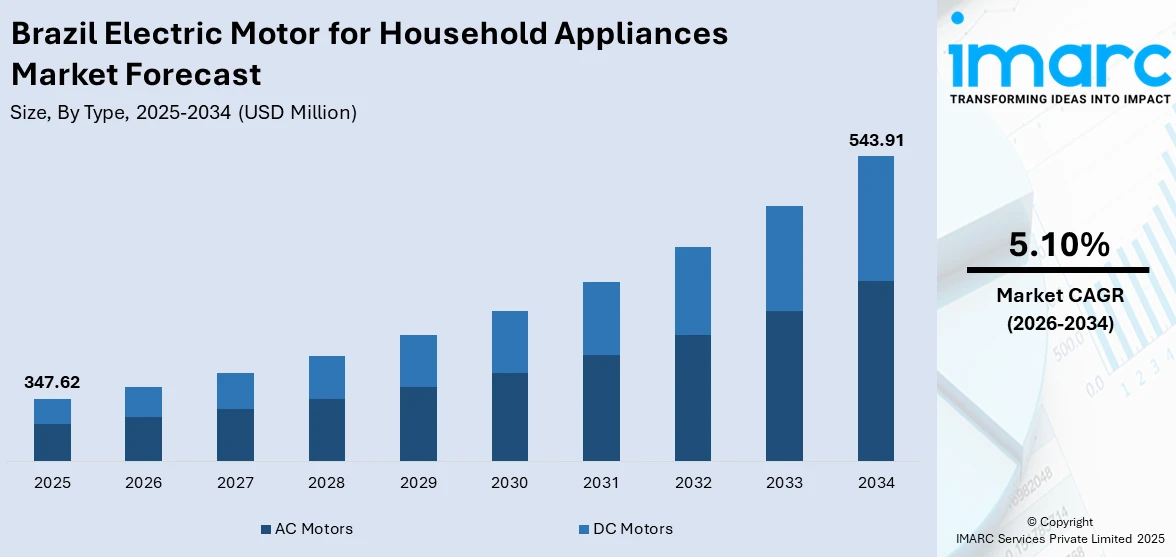
The Brazil electric motor for household appliances market size was valued at USD 347.62 Million in 2025 and is projected to reach USD 543.91 Million by 2034, growing at a compound annual growth rate of 5.10% from 2026-2034.
The Brazil electric motor for household appliances market is experiencing robust growth driven by the expanding middle-class population, rapid urbanization, and the rising demand for energy-efficient home appliances. Manufacturers are focusing on developing advanced motor technologies that deliver superior performance while minimizing energy consumption. The market benefits from Brazil's comprehensive regulatory framework governing energy efficiency standards, which encourages innovation in motor design. Additionally, the integration of smart technologies in household appliances is creating demand for precise and efficient motor solutions that support automation and connectivity features.
Key Takeaways and Insights:
- By Type: AC motors dominate the market with a share of 65% in 2025, driven by their widespread adoption in major household appliances including refrigerators, washing machines, and air conditioning units, owing to their reliability, durability, and compatibility with standard household electrical systems.
- By Voltage: Above 120 V leads the market with a share of 56% in 2025, attributed to the higher voltage requirements of major appliances such as air conditioners, washing machines, and refrigerator compressors that demand robust motor performance for optimal operation.
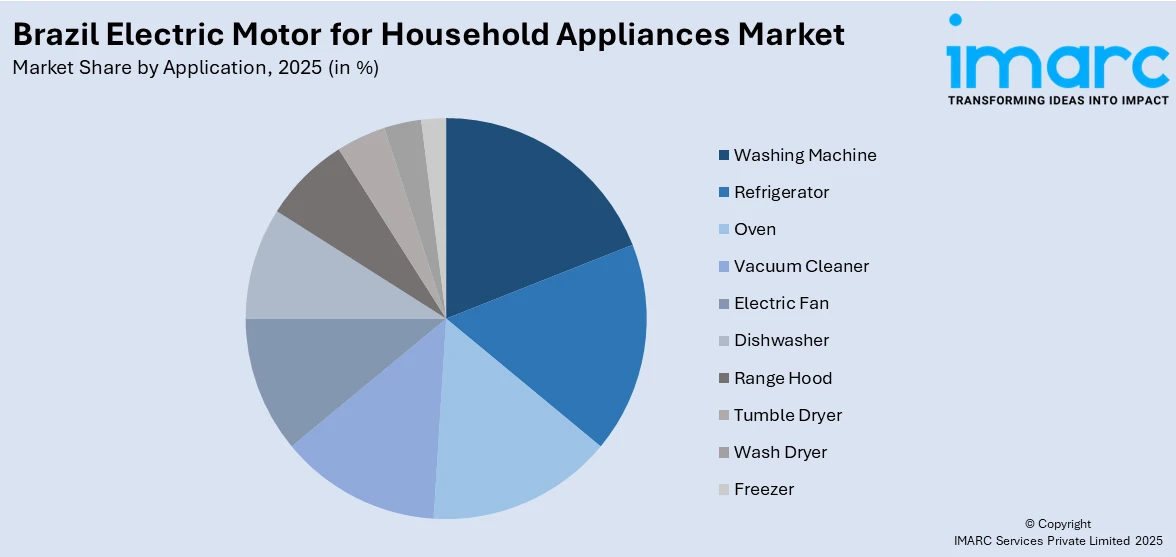
- By Application: Washing machine represents the largest segment with a market share of 15% in 2025, fueled by increasing household formation rates, urbanization trends, and growing consumer preference for advanced washing machines featuring inverter technology and smart connectivity.
- By Region: Southeast region dominates the market with 42% revenue share in 2025, driven by the concentration of Brazil's population in São Paulo and Rio de Janeiro metropolitan areas, higher disposable incomes, robust retail infrastructure, and proximity to major appliance manufacturing facilities.
- Key Players: The Brazil electric motor for household appliances market exhibits moderate to high competitive intensity, with established domestic manufacturers competing alongside multinational corporations across various price segments. Market participants are focusing on technological innovation, production capacity expansion, and strategic partnerships to strengthen their market positions and meet the growing demand for energy-efficient motor solutions.
To get more information on this market Request Sample
The market is witnessing significant transformation driven by the implementation of stringent energy efficiency regulations under Brazil's National Electric Energy Conservation Program (PROCEL) and the Brazilian Labeling Program (PBE) coordinated by INMETRO. These regulatory frameworks mandate energy efficiency labeling and encourage manufacturers to develop power-optimized motors that align with evolving standards. The growing adoption of Internet of Things (IoT) technologies in household appliances is creating demand for motors that support smart functionalities, remote monitoring, and automation capabilities. For instance, in July 2023, WEG invested R$48 million to expand its Manaus motors plant, enabling the production of a new series of permanent magnet electric motors for split-type air conditioners, with the facility manufacturing approximately 3.5 million motors annually. This investment exemplifies the industry's commitment to advancing motor technology and meeting the rising demand for energy-efficient solutions in Brazil's household appliances sector.
Brazil Electric Motor for Household Appliances Market Trends:
Rising Adoption of Inverter Technology and Brushless DC Motors
The shift from conventional induction motors toward brushless DC motors and inverter-based technologies is significantly reshaping the household appliance market. Appliances equipped with inverter systems provide variable speed control, improved energy efficiency, and quieter operation compared with fixed-speed alternatives. This transition aligns closely with consumer demand for high-performing appliances that reduce power consumption and operating costs. Manufacturers are increasingly integrating BLDC motors into premium appliance categories, including air conditioners, refrigerators, and washing machines. The growing adoption of these advanced motor technologies reflects a broader industry focus on enhancing appliance durability, operational efficiency, and user comfort, while supporting long-term sustainability and improved overall product performance.
Growing Integration of Smart Technologies and IoT Connectivity
The proliferation of smart home ecosystems is driving demand for electric motors that support advanced connectivity features and automation capabilities. According to Agência de Notícias IBGE, approximately 11.6 million Brazilian households utilized smart devices including connected refrigerators and air conditioners in 2023, representing a significant increase from the previous year. This trend is encouraging motor manufacturers to develop solutions that enable precise speed control, remote monitoring, and integration with voice assistants and mobile applications. The Brazilian Association of Internet Things estimates that connected devices in Brazil could reach 27.1 billion by 2025, creating substantial opportunities for motors designed to power smart appliances that offer energy optimization, predictive maintenance alerts, and seamless ecosystem integration.
Strengthening Energy Efficiency Regulatory Framework
Brazil’s evolving regulatory framework for energy efficiency is driving innovation in motor technologies. Updated certification requirements and stricter performance benchmarks for household appliances are encouraging manufacturers to develop motors that surpass minimum efficiency standards. Programs recognizing top-performing products, such as special efficiency seals for air conditioners, highlight the government’s focus on promoting premium, energy-saving appliances. These regulations are motivating companies to invest in research and development to produce motors that combine superior energy efficiency with enhanced performance, durability, and reliability, meeting the expectations of environmentally conscious consumers while supporting broader sustainability goals across the household appliance market.
Market Outlook 2026-2034:
The Brazil electric motor for household appliances market is positioned for sustained expansion over the forecast period, underpinned by favorable demographic trends, technological advancement, and supportive regulatory environment. The growing middle-class population's aspiration for modern, energy-efficient appliances, combined with urbanization rates exceeding, creates robust demand fundamentals. Domestic manufacturing investments, exemplified by Midea's December 2024 inauguration of a new factory in Pouso Alegre with the capacity to produce 600,000 washing machines and 700,000 refrigerators annually, are strengthening the supply ecosystem. The market generated a revenue of USD 347.62 Million in 2025 and is projected to reach a revenue of USD 543.91 Million by 2034, growing at a compound annual growth rate of 5.10% from 2026-2034.
Brazil Electric Motor for Household Appliances Market Report Segmentation:
|
Segment Category |
Leading Segment |
Market Share |
|
Type |
AC Motors |
65% |
|
Voltage |
Above 120 V |
56% |
|
Application |
Washing Machine |
15% |
|
Region |
Southeast |
42% |
Type Insights:
- AC Motors
- DC Motors
The AC motors dominate with a market share of 65% of the total Brazil electric motor for household appliances market in 2025.
AC motors dominate the Brazil electric motor market for household appliances due to their reliability, simplicity, and cost-effectiveness. These motors are widely used in appliances such as refrigerators, washing machines, air conditioners, and fans, where consistent and durable performance is essential. AC motors are easier to manufacture and maintain compared with DC or BLDC motors, making them a preferred choice for mass-produced household appliances. Their compatibility with Brazil’s standard power supply further reinforces their widespread adoption across residential settings.
Another key factor driving AC motor dominance is their energy efficiency and versatility in household applications. They can handle varying load conditions and operate effectively for long durations without frequent maintenance, which is critical for appliances that run continuously. Additionally, AC motors support various design configurations, enabling manufacturers to develop a wide range of appliance models without significant cost increases. This combination of operational reliability, ease of integration, and manufacturing scalability makes AC motors the leading choice in Brazil’s household appliance sector.
Voltage Insights:
- Up To 50 V
- Above 120 V
- 50 V-120 V
Above 120 V leads with a share of 56% of the total Brazil electric motor for household appliances market in 2025.
The above 120 V voltage segment dominates the market primarily due to the power requirements of major household appliances that constitute the largest demand category. Air conditioners, washing machines, refrigerators, and dishwashers typically require motors operating at higher voltage levels to deliver the torque and power necessary for their core functions. Brazil's standard household electrical supply of 127V and 220V supports the widespread deployment of these higher-voltage motors across residential applications.
The segment benefits from the growing demand for energy-efficient major appliances as consumers increasingly prioritize products that reduce electricity consumption while maintaining performance standards. Motor manufacturers are developing higher-voltage solutions that incorporate advanced insulation materials and optimized electromagnetic designs to maximize efficiency. The regulatory framework governing energy efficiency labeling further incentivizes the adoption of high-performance motors in this voltage category.
Application Insights:
Access the comprehensive market breakdown Request Sample
- Refrigerator
- Oven
- Washing Machine
- Vacuum Cleaner
- Electric Fan
- Dishwasher
- Range Hood
- Tumble Dryer
- Wash Dryer
- Freezer
Washing machine exhibits a clear dominance with a 15% share of the total Brazil electric motor for household appliances market in 2025.
The washing machine segment commands the largest application share, driven by Brazil's cultural emphasis on laundry care and the rising penetration of automatic washing machines across urban and semi-urban households. Motor requirements for washing machines are particularly demanding, necessitating robust designs capable of handling variable loads, multiple wash cycles, and high-speed spin functions. The segment benefits from the growing preference for front-loading models and combination washer-dryers that require sophisticated motor systems.
The adoption of inverter technology in washing machines is accelerating, with major manufacturers introducing models featuring direct drive motors that eliminate the need for belts and pulleys. For instance, Samsung's Bespoke AI Washer and Dryer launched in Brazil in October 2024, featuring AI Wash and AI Dry capabilities with heat pump technology, reducing energy consumption significantly. These technological advancements are creating demand for premium motor solutions that support intelligent washing algorithms, load sensing, and energy optimization.
Regional Insights:
- Southeast
- South
- Northeast
- North
- Central-West
Southeast region dominates with a 42% share of the total Brazil electric motor for household appliances market in 2025.
The Brazil electric motor market for household appliances in the Southeast region is being driven by rapid urbanization and rising household income, which are fueling demand for modern appliances such as refrigerators, washing machines, air conditioners, and fans. Increasing consumer preference for energy-efficient and technologically advanced appliances is encouraging manufacturers to integrate high-performance electric motors. Additionally, the Southeast region, being an industrial and economic hub, attracts investment in appliance manufacturing and assembly, enabling better availability and faster adoption of appliances equipped with reliable electric motor systems.
Infrastructure development and supportive government policies also play a significant role in market growth. Widespread electricity access, expanding smart grid initiatives, and incentives for energy-efficient appliances encourage households to adopt motor-driven appliances. The region’s robust retail and e-commerce networks make advanced household appliances more accessible to urban consumers. Moreover, the presence of key manufacturers and a well-established supply chain ensures consistent quality and availability of electric motors, collectively driving demand and shaping the expansion of the Southeast Brazil electric motor market for household appliances.
Market Dynamics:
Growth Drivers:
Why is the Brazil Electric Motor for Household Appliances Market Growing?
Rising Demand for Energy-Efficient Household Appliances
Increasing costs of electricity and growing environmental consciousness among Brazilian consumers are driving the demand for products that use less energy in their operation, and these are directly fueling the market increase in the electric motor market. Since an appliance is a significant proportion of household power consumption, the manufacturers are working on designing motors that would consume less energy but offer stable functionality. This change is further enhanced using policy frameworks that promote the use of energy-saving and efficient adoption of appliances. Simultaneously, the regulatory demands of energy efficiency are compelling manufacturers to keep advancing the design and the degree of efficiency of the motors. Energy labeling and performance standards have also contributed to the preferences of consumers for more efficient appliances, which strengthens the shift towards highly developed and power-efficient motor technologies throughout the household appliance industry.
Expanding Middle-Class Population and Urbanization Trends
Rapid urbanization and the expanding middle-class population in Brazil are positively influencing the electric motor market for household appliances. With urbanization rates exceeding and continued migration to urban areas, there is a rising demand for modern, convenient, and energy-efficient appliances that improve the quality of life. The United Nations projects that Brazil’s urban population will account for about 90% of the total by 2050, significantly exceeding the global average urbanization level of around 70%. This demographic shift is creating a larger consumer base for electric motor-driven household appliances, particularly in metropolitan regions where space considerations, convenience requirements, and energy efficiency are decisive purchasing factors. Middle-class households are increasingly seeking technologically advanced and durable appliances, generating higher demand for premium electric motors that enhance performance and reliability. The formation of new households, particularly among younger urban populations establishing independent residences, creates recurring demand for essential appliances including refrigerators, washing machines, and air conditioners.
Technological Advancements and Smart Appliance Integration
The integration of smart technologies in household appliances is creating favorable conditions for the electric motor market as consumers increasingly seek appliances with advanced features including automation, connectivity, and remote-control capabilities. These smart functionalities require precise and efficient motor performance to deliver responsive operation and maintain reliability under variable usage patterns. The rise of the Internet of Things in home appliances is encouraging motor manufacturers to develop solutions that enhance the functionality and durability of smart appliances. Innovations in motor technology, such as brushless DC motors and permanent magnet designs, are gaining popularity due to their improved energy efficiency, extended lifespan, and quieter operation characteristics that are essential for modern smart home environments. The development of motors compatible with artificial intelligence-driven appliance functions, such as load sensing and automatic cycle optimization, represents a significant growth opportunity. For instance, in May 2024, Tuya Smart partnered with Brazil-based Hometree Casa Inteligente to develop advanced whole-home smart solutions, aiming to modernize living spaces and deliver a seamless smart living experience for Brazilian consumers.
Market Restraints:
What Challenges the Brazil Electric Motor for Household Appliances Market is Facing?
Economic Volatility and Consumer Spending Constraints
Brazil's economic environment presents challenges for the electric motor market, as fluctuations in consumer purchasing power directly impact household appliance demand. Rising interest rates and inflationary pressures constrain discretionary spending, potentially delaying appliance replacement cycles and dampening demand for premium products incorporating advanced motor technologies. Currency volatility affects the cost of imported motor components and raw materials, creating pricing pressures across the supply chain.
High Technology Transition Costs
The transition from traditional induction motors to advanced technologies such as brushless DC motors and inverter systems involves significant capital investment for manufacturers. Production line modifications, specialized component sourcing, and workforce training requirements create barriers to rapid technology adoption. These costs may be passed through to consumers, potentially limiting the market penetration of premium motor technologies in price-sensitive segments.
Intense Price Competition and Margin Pressures
The Brazilian household appliance market is characterized by intense price competition, with manufacturers facing pressure to minimize costs while maintaining quality standards. Import competition from lower-cost manufacturing regions challenges domestic motor producers, particularly in the value-oriented market segment. This competitive intensity can constrain investment in research and development activities necessary for technological advancement.
Competitive Landscape:
The Brazil electric motor for household appliances market exhibits a moderately concentrated competitive structure, with established domestic manufacturers maintaining significant positions alongside multinational corporations. The market features both vertically integrated appliance manufacturers with in-house motor production capabilities and specialized motor suppliers serving multiple original equipment manufacturers. Competition centers on technological innovation, energy efficiency performance, reliability, and cost competitiveness. Leading market participants are investing in production capacity expansion and technology upgrades to strengthen their competitive positions. Strategic acquisitions and partnerships are facilitating market consolidation and technology transfer. The regulatory emphasis on energy efficiency is driving differentiation based on motor performance characteristics, with manufacturers competing to achieve superior efficiency ratings that enable premium positioning and regulatory compliance advantages.
Recent Developments:
- In September 2024, WEG announced the complete acquisition of Volt Electric Motors, a subsidiary of Saya Group, for USD 88 Million. Volt manufactures up to 1 Million Motors annually and operates a 27,000 m² factory in Izmir, Turkey. The acquisition strengthened WEG's presence in Europe, the Middle East, and Central Asia.
Brazil Electric Motor for Household Appliances Market Report Coverage:
| Report Features | Details |
|---|---|
| Base Year of the Analysis | 2025 |
| Historical Period | 2020-2025 |
| Forecast Period | 2026-2034 |
| Units | Million USD |
| Scope of the Report |
Exploration of Historical Trends and Market Outlook, Industry Catalysts and Challenges, Segment-Wise Historical and Future Market Assessment:
|
| Types Covered | AC Motors, DC Motors |
| Voltages Covered | Up To 50 V, Above 120 V, 50 V-120 V |
| Applications Covered | Refrigerator, Oven, Washing Machine, Vacuum Cleaner, Electric Fan, Dishwasher, Range Hood, Tumble Dryer, Wash Dryer, Freezer |
| Regions Covered | Southeast, South, Northeast, North, Central-West |
| Customization Scope | 10% Free Customization |
| Post-Sale Analyst Support | 10-12 Weeks |
| Delivery Format | PDF and Excel through Email (We can also provide the editable version of the report in PPT/Word format on special request) |
Frequently Asked Questions About the Brazil Electric Motor for Household Appliances Market Report
The Brazil electric motor for household appliances market size was valued at USD 347.62 Million in 2025.
The Brazil electric motor for household appliances market is expected to grow at a compound annual growth rate of 5.10% from 2026-2034 to reach USD 543.91 Million by 2034.
AC motors dominated the market with a 65% share in 2025, driven by their widespread adoption in major household appliances including refrigerators, washing machines, and air conditioning units, owing to their reliability, durability, and compatibility with standard household electrical systems.
Key factors driving the Brazil electric motor for household appliances market include rising demand for energy-efficient appliances, implementation of stringent energy efficiency regulations under PROCEL and PBE programs, expanding middle-class population and urbanization trends, technological advancements in motor design including inverter technology and brushless DC motors, and growing integration of smart technologies in household appliances.
Major challenges include economic volatility affecting consumer purchasing power, high technology transition costs for manufacturers adopting advanced motor technologies, intense price competition and margin pressures from import competition, currency fluctuations impacting component costs, and the need for significant capital investment to meet evolving energy efficiency regulatory requirements.
Need more help?
- Speak to our experienced analysts for insights on the current market scenarios.
- Include additional segments and countries to customize the report as per your requirement.
- Gain an unparalleled competitive advantage in your domain by understanding how to utilize the report and positively impacting your operations and revenue.
- For further assistance, please connect with our analysts.
 Request Customization
 Speak to an Analyst
 Request Brochure
 Inquire Before Buying
Benefits of Customization
- Personalize this research
- Triangulate with your data
- Get data as per your format and definition
- Gain a deeper dive into a specific application, geography, customer, or competitor
- Any level of personalization
Get in Touch With Us
UNITED STATES
Phone: +1-201-971-6302
INDIA
Phone: +91-120-433-0800
UNITED KINGDOM
Phone: +44-753-714-6104
Email: [email protected]
Client Testimonials




.webp)




.webp)













Related Reports

Choose your plan
*Please note that the prices mentioned below are starting prices for each bundle type. Kindly contact our team for further details.*
Single User License
- 1 User License, Access on 2 Devices
- PDF Report + Excel Dataset (Password Protected)
- Lifetime Access
- No Printing Rights
- 10% Free Report Customization
- 10–12 Weeks of Analyst Support
Five User License
- Access for 5 Users, 2 Devices per User
- PDF Report + Excel Dataset (Password Protected)
- Lifetime Access
- Dedicated Account Manager
- 12–14 Weeks of Analyst Support
- No Printing Rights
- 15% Free Report Customization
- 25% Discount on Your Next Purchase
Corporate User License
- Unlimited User Access (Within Your Organization)
- PDF Report + Excel Dataset
- Lifetime Access
- Dedicated Account Manager
- 14–20 Weeks of Analyst Support
- No Printing Rights
- 20% Free Report Customization
- 30% Discount on Your Next Purchase
Essential Insights
What's included:
3 reports
- Lifetime Access
- PDF Reports
- Excel Datasets
- 2 Weeks of Free Analyst Support
- 2 User Licenses
- Access on 2 Devices
- Printing Rights
- Complimentary PowerPoint (PPT) Version
- Complimentary License Upgrade
Professional Access
What's included:
5 reports
- Lifetime Access
- PDF Reports
- Excel Datasets
- 8 Weeks of Free Analyst Support
- 2 User Licenses
- Access on 2 Devices
- Printing Rights
- Complimentary PowerPoint (PPT) Version
- Complimentary License Upgrade
Business Advantage
What's included:
8 reports
- Lifetime Access
- PDF Reports
- Excel Datasets
- 14 Weeks of Free Analyst Support
- 2 User Licenses
- Access on 2 Devices
- Printing Rights
- Complimentary PowerPoint (PPT) Version
- Complimentary License Upgrade
Enterprise Intelligence
What's included:
10 reports
- Lifetime Access
- PDF Reports
- Excel Datasets
- 20 Weeks of Free Analyst Support
- 2 User Licenses
- Access on 2 Devices
- Printing Rights
- Complimentary PowerPoint (PPT) Version
- Complimentary License Upgrade