
Brazil Factoring Market Size, Share, Trends and Forecast by Type, Organization Size, Application, and Region, 2026-2034
Brazil Factoring Market Summary:
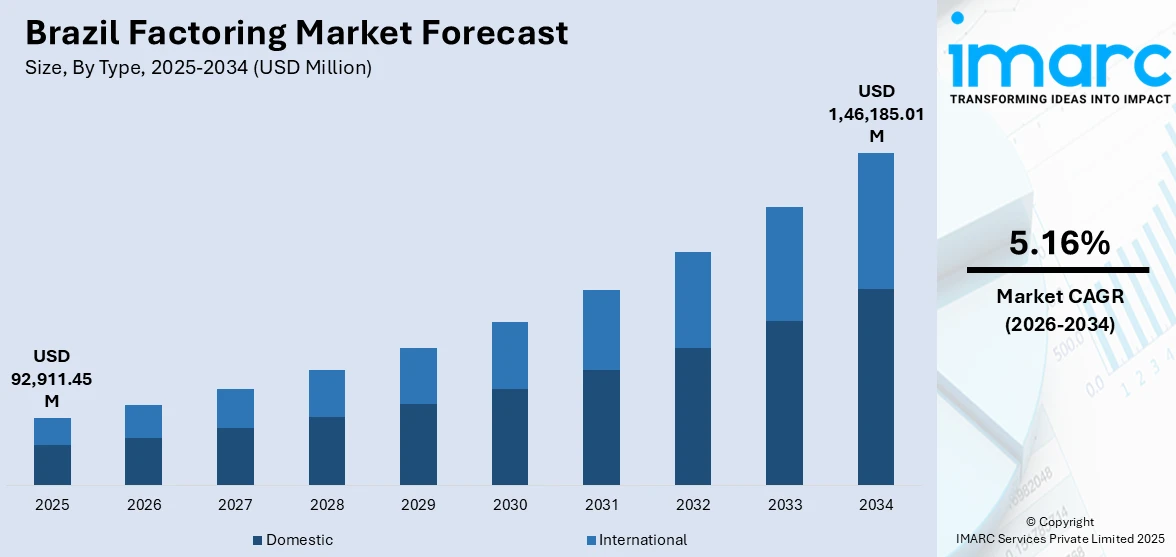
The Brazil factoring market size was valued at USD 92,911.45 Million in 2025 and is projected to reach USD 1,46,185.01 Million by 2034, growing at a compound annual growth rate of 5.16% from 2026-2034.
The Brazil factoring market is experiencing sustained expansion, as businesses increasingly adopt receivables financing to strengthen working capital management and operational liquidity. Rising demand from diverse industry verticals, coupled with the growing digital transformation in financial services, is accelerating the adoption of factoring solutions. Supportive regulatory frameworks, expanding trade activities, and the proliferation of alternative financing platforms are reinforcing market momentum across the country.
Key Takeaways and Insights:
- By Type: Domestic dominates the market with a share of 74% in 2025, owing to the relative simplicity of local transactions, established legal frameworks, familiar customer relationships, and reduced risks associated with currency fluctuations. Rising trade activity among regional enterprises is fueling the segment expansion.
- By Organization Size: Small and medium enterprises lead the market with a share of 62% in 2025. This dominance is driven by limited access to traditional banking credit, higher bank lending rates, and the growing need for flexible short-term working capital solutions among smaller businesses.
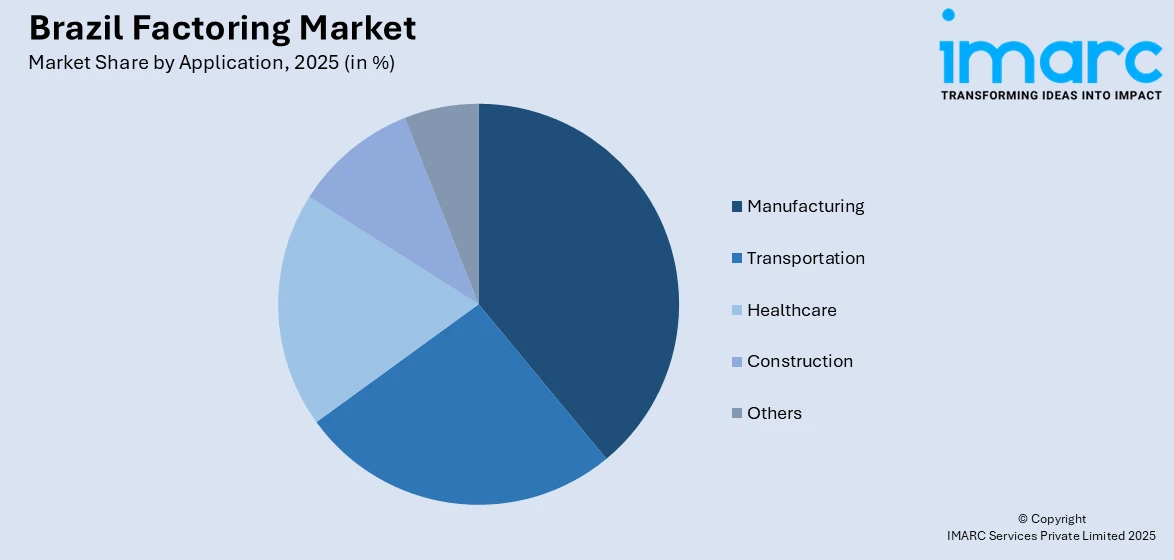
- By Application: Manufacturing comprises the largest segment with a market share of 29% in 2025, reflecting the sector’s extensive reliance on receivables financing to manage extended payment cycles, optimize supply chain operations, and maintain consistent production workflows.
- By Region: Southeast represents the largest region with 58% share in 2025, driven by the concentration of industrial output, financial infrastructure, and corporate headquarters in São Paulo, Rio de Janeiro, and Minas Gerais metropolitan areas.
- Key Players: Key players drive the Brazil factoring market by expanding service portfolios, investing in digital platforms, strengthening receivables management capabilities, and forming strategic partnerships with financial institutions to improve accessibility, accelerate transaction processing, and ensure consistent service availability across diverse business segments.
To get more information on this market Request Sample
The Brazil factoring market is advancing as businesses, financial institutions, and fintech platforms collaborate to expand receivables financing solutions across diverse economic sectors. Growing industrialization, expanding trade volumes, and rising commercial activities are strengthening demand for factoring services that convert outstanding invoices into immediate working capital. The market benefits from Brazil’s evolving financial ecosystem, where digital platforms are streamlining invoice processing, reducing approval timelines, and enhancing transparency for both sellers and buyers. The increasing sophistication of credit assessment tools, integration of e-invoicing systems, and improved regulatory oversight are further reinforcing market confidence. As per IMARC Group, the Brazil e-invoicing market size reached USD 401.7 Million in 2025. Additionally, the expanding role of receivables investment funds and alternative financing channels is broadening access to factoring services beyond traditional banking networks, enabling a wider range of enterprises to participate in receivables-based financing structures across the country.
Brazil Factoring Market Trends:
Digital Transformation of Receivables Financing Platforms
The Brazil factoring market is witnessing accelerated digitalization, as fintech companies introduce online invoice-based lending platforms that reduce processing times and collateral requirements for businesses. Digital lenders are offering receivables financing through mobile applications and web dashboards, enabling freelancers and micro-entrepreneurs across major cities to access working capital seamlessly. In October 2025, CloudWalk finalized Brazil’s biggest structured credit deal of the year through a Receivables Investment Fund (FIDC), raising BRL 4.2 Billion to strengthen receivables financing operations for over 6 Million entrepreneurs served by its InfinitePay platform.
Integration of Environmental, Social, and Governance (ESG) Principles in Factoring Products
Factoring providers across Brazil are increasingly developing ESG-linked receivables finance products targeted at sustainable businesses. This trend reflects the broader alignment of financial services with responsible investment practices, attracting institutional investors and development banks. These products often offer preferential pricing or extended tenures to companies that meet defined environmental or social performance benchmarks. Strong demand is coming from renewable energy, agribusiness, and circular economy players seeking flexible working capital solutions.
Expansion of Receivables Investment Funds as Alternative Financing Channels
The receivables investment fund industry in Brazil continues to grow significantly as businesses seek alternatives to traditional bank lending for short-term liquidity needs. These funds are transforming corporate receivables into tradable assets, enabling revenue anticipation and improved cash flow for companies across diverse sectors. Increased participation from institutional investors is strengthening fund depth and market credibility. Regulatory clarity and improved risk assessment frameworks are also supporting wider adoption among mid-sized enterprises.
Market Outlook 2026-2034:
The Brazil factoring market is poised for sustained growth, as the country’s financial ecosystem continues to evolve towards greater inclusivity and digital sophistication. Expanding commercial activities, rising trade volumes across domestic and international corridors, and the continued proliferation of fintech-driven receivables financing platforms are anticipated to strengthen market momentum. The market generated a revenue of USD 92,911.45 Million in 2025 and is projected to reach a revenue of USD 1,46,185.01 Million by 2034, growing at a compound annual growth rate of 5.16% from 2026-2034. Supportive regulatory developments, including enhanced oversight of receivables investment funds and the modernization of e-invoicing frameworks, are expected to reinforce transparency and investor confidence.
Brazil Factoring Market Report Segmentation:
|
Segment Category |
Leading Segment |
Market Share |
|
Type |
Domestic |
74% |
|
Organization Size |
Small and Medium Enterprises |
62% |
|
Application |
Manufacturing |
29% |
|
Region |
Southeast |
58% |
Type Insights:
- International
- Domestic
Domestic dominates with a market share of 74% of the total Brazil factoring market in 2025.
Domestic commands the largest share of the Brazil factoring market, reflecting the inherent advantages of operating within familiar legal frameworks, established customer relationships, and reduced exposure to cross-border regulatory complexities and currency fluctuation risks. Brazilian businesses, particularly those engaged in local trade, prefer domestic factoring as it enables faster invoice processing, simpler documentation, and more predictable risk profiles, making it an efficient tool for managing short-term liquidity requirements across diverse industries.
The segment benefits significantly from Brazil’s extensive domestic trade network, which generates substantial volumes of receivables requiring financing solutions. For factoring organizations, a consistent flow of invoices is ensured by high transaction frequency throughout retail, manufacturing, agricultural, and distribution channels. Strong regional supply chains and long-standing buyer-seller connections further enhance credit visibility, lower default risk, and enable factors to set more competitive service prices, which contribute to domestic's dominance in the market as a whole.
Organization Size Insights:
- Small and Medium Enterprises
- Large Enterprises
Small and medium enterprises lead with a share of 62% of the total Brazil factoring market in 2025.
Small and medium enterprises represent the leading segment, as they constitute the backbone of the Brazilian economy. Due to their short credit histories, lack of collateral, and the prevalence of big banks that give corporate lending priority, these companies usually have trouble obtaining typical bank financing. By turning unpaid invoices into working capital, factoring provides them with instant cash flow. Because of this flexibility, small and medium enterprises can meet payroll requirements, stabilize operations, and participate in expansion without adding to their balance sheet debt.
The surging availability of digital factoring systems, which streamline invoice discounting procedures and shorten approval times for smaller enterprises, further supports the segment's growth. These platforms use data analytics, automation, and e-invoicing to save transaction costs and enhance credit evaluation. More transparency, quicker funding cycles, and easier access to financing are thus advantageous to small and medium enterprises, especially in neglected areas and unorganized sectors of the Brazilian economy.
Application Insights:
Access the comprehensive market breakdown Request Sample
- Transportation
- Healthcare
- Construction
- Manufacturing
- Others
Manufacturing exhibits a clear dominance with a 29% share of the total Brazil factoring market in 2025.
Manufacturing holds the largest share in the application segment in the market, owing to the sector’s inherent operational characteristics, including extended payment cycles, complex supply chain networks, and substantial working capital requirements that create a strong demand for receivables-based financing. Brazilian manufacturers rely on factoring to bridge the gap between invoice issuance and payment receipt, ensuring uninterrupted production schedules and timely procurement of raw materials across their value chains.
The segment is further supported by Brazil’s expansive industrial base, which has demonstrated consistent resilience. According to the Brazilian Institute of Geography and Statistics, the national industrial production recorded a 3.1% rise in 2024, with growth observed across 17 of the 18 surveyed regions. Large amounts of trade receivables are produced by this widespread industrial expansion, necessitating effective finance options. Factoring services are used by manufacturing companies, especially those in the food processing, automotive, and machinery industries, to maximize cash flow management and preserve competitive standing.
Regional Insights:
- Southeast
- South
- Northeast
- North
- Central-West
Southeast represents the leading region with a 58% share of the total Brazil factoring market in 2025.
Southeast holds the dominant position in the Brazil factoring market, underpinned by the region’s unparalleled concentration of economic activity, industrial infrastructure, and financial service networks. In 2023, the gross domestic product (GDP) of São Paulo reached EUR337.62 Billion, showcasing a year-on-year growth rate of 7.12%, alongside a 10-year annual average growth rate of 5.94% from 2013 to 2023. São Paulo serves as the country’s primary financial capital and industrial hub, which creates substantial volumes of trade receivables requiring factoring services.
By providing a variety of commercial and industrial activities, Southeast cities like Rio de Janeiro significantly contribute to bolstering the region's leadership. Short-term finance solutions are consistently in demand due to the robust presence of the manufacturing, wholesale trade, energy, logistics, and service sectors. Furthermore, the Southeast enjoys the advantages of a dense concentration of banks and factoring firms, improved financial literacy, and sophisticated digital infrastructure, which facilitate the quicker adoption of cutting-edge receivables finance solutions and maintain the region's leadership in Brazil factoring market.
Market Dynamics:
Growth Drivers:
Why is the Brazil Factoring Market Growing?
Rising Demand for Alternative Financing Among Small and Medium Enterprises (SMEs)
The growing need for accessible and flexible financing solutions among SMEs is a primary driver of the Brazil factoring market. Traditional banking in Brazil is characterized by a high concentration of assets among the top banks, which primarily focus on large corporate lending and mortgages. This structural imbalance leaves smaller enterprises with limited access to affordable credit, particularly for short-term working capital needs. Bank lending rates in Brazil remain among the highest globally, which further discourages SMEs from seeking conventional loans. As of November 2025, the interest rate set by the central bank was 15%, ranking among the highest globally. Factoring provides these businesses with an efficient alternative by converting their outstanding invoices into immediate cash without requiring traditional collateral.
Accelerating Digital Transformation of Financial Services
The rapid digitalization of Brazil’s financial sector is significantly enhancing the accessibility and efficiency of factoring services. Fintech companies are leveraging advanced technologies, including artificial intelligence (AI)-driven credit scoring, blockchain-based invoice verification, and cloud computing platforms, to streamline the receivables financing process. These digital innovations reduce processing times, lower operational costs, and improve risk assessment accuracy, making factoring more attractive to businesses of all sizes. Brazil’s fintech ecosystem has matured substantially, constituting over 1,500 active startups across diverse financial segments, as of May 2025. The Central Bank of Brazil has played a pivotal role in this transformation through progressive regulatory frameworks, including the mandatory e-invoicing system that creates standardized digital records of business-to-business commerce. Together, these developments are accelerating market transparency, strengthening investor confidence, and supporting the scalable growth of digital factoring nationwide.
Expanding Trade Activities and Industrial Growth
The continuous expansion of domestic and international trade activities in Brazil is creating growing volumes of trade receivables that require efficient financing solutions. Brazil’s diversified industrial base spans automotive manufacturing, food processing, aerospace, machinery production, and consumer goods, generating substantial invoice volumes across complex supply chain networks. Rising commercial interactions between manufacturers, distributors, and retailers create extended payment cycles that increase the need for receivables-based financing. In this environment, factoring enables companies to bridge liquidity gaps, maintain production schedules, and manage working capital more effectively. Export-oriented firms also rely on receivables finance to mitigate cash flow pressures arising from longer settlement periods and currency volatility. As trade volumes continue to expand, demand for flexible, scalable financing solutions is expected to strengthen steadily.
Market Restraints:
What Challenges the Brazil Factoring Market is Facing?
Elevated Interest Rate Environment and Macroeconomic Volatility
Brazil’s elevated interest rate environment poses a significant challenge to the factoring market. A tighter monetary policy stance increases the cost of capital for factoring companies, which can translate into higher discount rates applied to invoices and reduce affordability for end users. Additionally, currency volatility and broader macroeconomic uncertainty can weaken business confidence, potentially slowing trade activity and reducing the volume of receivables generated across key industries.
Credit Risk and Default Concerns in Receivables Portfolios
Managing credit risk remains a persistent challenge for factoring companies operating in Brazil. The quality of receivables portfolios depends heavily on the financial health of debtors, and economic downturns can increase default rates among obligors. While expected loss rates in the Brazil factoring industry have historically remained low, periods of financial stress can strain collection processes and reduce recovery rates. Accurate credit assessment and continuous portfolio monitoring remain essential to mitigate these risks effectively.
Regulatory Complexity and Compliance Burden
The evolving regulatory landscape in Brazil presents compliance challenges for factoring service providers. Frequent updates to financial regulations, including new rules governing receivables investment funds, banking-as-a-service partnerships, and virtual asset service providers, require continuous adaptation of operational processes and compliance frameworks. Smaller factoring companies may face difficulties absorbing the costs associated with maintaining regulatory compliance, potentially limiting their ability to compete effectively against larger, better-resourced institutions.
Competitive Landscape:
The Brazil factoring market is characterized by a diverse competitive landscape, comprising traditional banking institutions, specialized factoring companies, and an expanding array of fintech platforms. Market participants are investing in digital infrastructure, AI-based credit assessment tools, and automated invoice processing systems to improve service delivery and reduce operational costs. Competition is further intensified by the entry of technology-driven platforms that offer faster processing times, lower discount rates, and enhanced transparency. Strategic partnerships between financial institutions and technology companies are fostering innovation and expanding market reach. The growing sophistication of receivables investment fund structures is also attracting institutional investors, increasing capital availability and strengthening the competitive positioning of firms that can offer diversified financing solutions across multiple industry verticals.
Brazil Factoring Market Report Coverage:
|
Report Features |
Details |
|
Base Year of the Analysis |
2025 |
|
Historical Period |
2020-2025 |
|
Forecast Period |
2026-2034 |
|
Units |
USD Million |
|
Scope of the Report |
Exploration of Historical Trends and Market Outlook, Industry Catalysts and Challenges, Segment-Wise Historical and Future Market Assessment:
|
|
Types Covered |
International, Domestic |
|
Organization Sizes Covered |
Small and Medium Enterprises, Large Enterprises |
|
Applications Covered |
Transportation, Healthcare, Construction, Manufacturing, Others |
|
Regions Covered |
Southeast, South, Northeast, North, Central-West |
|
Customization Scope |
10% Free Customization |
|
Post-Sale Analyst Support |
10-12 Weeks |
|
Delivery Format |
PDF and Excel through Email (We can also provide the editable version of the report in PPT/Word format on special request) |
Frequently Asked Questions About the Brazil Factoring Market Report
The Brazil factoring market size was valued at USD 92,911.45 Million in 2025.
The Brazil factoring market is expected to grow at a compound annual growth rate of 5.16% from 2026-2034 to reach USD 1,46,185.01 Million by 2034.
Domestic dominated the market with a share of 74%, driven by the simplicity of local transactions, established legal frameworks, familiar customer relationships, and reduced currency fluctuation risks that make domestic factoring the preferred choice for Brazilian businesses.
Key factors driving the Brazil factoring market include rising demand for alternative financing among SMEs, accelerating digital transformation of financial services, expanding trade activities, growing industrial output, and supportive regulatory frameworks.
Major challenges include elevated interest rates and macroeconomic volatility, credit risk and default concerns in receivables portfolios, regulatory complexity and compliance burden, currency depreciation impacts, and limited factoring awareness among certain business segments.
Need more help?
- Speak to our experienced analysts for insights on the current market scenarios.
- Include additional segments and countries to customize the report as per your requirement.
- Gain an unparalleled competitive advantage in your domain by understanding how to utilize the report and positively impacting your operations and revenue.
- For further assistance, please connect with our analysts.
 Request Customization
 Speak to an Analyst
 Request Brochure
 Inquire Before Buying
Benefits of Customization
- Personalize this research
- Triangulate with your data
- Get data as per your format and definition
- Gain a deeper dive into a specific application, geography, customer, or competitor
- Any level of personalization
Get in Touch With Us
UNITED STATES
Phone: +1-201-971-6302
INDIA
Phone: +91-120-433-0800
UNITED KINGDOM
Phone: +44-753-714-6104
Email: [email protected]
Client Testimonials




.webp)




.webp)













Related Reports

Choose your plan
*Please note that the prices mentioned below are starting prices for each bundle type. Kindly contact our team for further details.*
Single User License
- 1 User License, Access on 2 Devices
- PDF Report + Excel Dataset (Password Protected)
- Lifetime Access
- No Printing Rights
- 10% Free Report Customization
- 10–12 Weeks of Analyst Support
Five User License
- Access for 5 Users, 2 Devices per User
- PDF Report + Excel Dataset (Password Protected)
- Lifetime Access
- Dedicated Account Manager
- 12–14 Weeks of Analyst Support
- No Printing Rights
- 15% Free Report Customization
- 25% Discount on Your Next Purchase
Corporate User License
- Unlimited User Access (Within Your Organization)
- PDF Report + Excel Dataset
- Lifetime Access
- Dedicated Account Manager
- 14–20 Weeks of Analyst Support
- No Printing Rights
- 20% Free Report Customization
- 30% Discount on Your Next Purchase
Essential Insights
What's included:
3 reports
- Lifetime Access
- PDF Reports
- Excel Datasets
- 2 Weeks of Free Analyst Support
- 2 User Licenses
- Access on 2 Devices
- Printing Rights
- Complimentary PowerPoint (PPT) Version
- Complimentary License Upgrade
Professional Access
What's included:
5 reports
- Lifetime Access
- PDF Reports
- Excel Datasets
- 8 Weeks of Free Analyst Support
- 2 User Licenses
- Access on 2 Devices
- Printing Rights
- Complimentary PowerPoint (PPT) Version
- Complimentary License Upgrade
Business Advantage
What's included:
8 reports
- Lifetime Access
- PDF Reports
- Excel Datasets
- 14 Weeks of Free Analyst Support
- 2 User Licenses
- Access on 2 Devices
- Printing Rights
- Complimentary PowerPoint (PPT) Version
- Complimentary License Upgrade
Enterprise Intelligence
What's included:
10 reports
- Lifetime Access
- PDF Reports
- Excel Datasets
- 20 Weeks of Free Analyst Support
- 2 User Licenses
- Access on 2 Devices
- Printing Rights
- Complimentary PowerPoint (PPT) Version
- Complimentary License Upgrade