
Brazil Grid-Scale Battery Market Size, Share, Trends and Forecast by Type, Ownership, Application, and Region, 2026-2034
Brazil Grid-Scale Battery Market Summary:
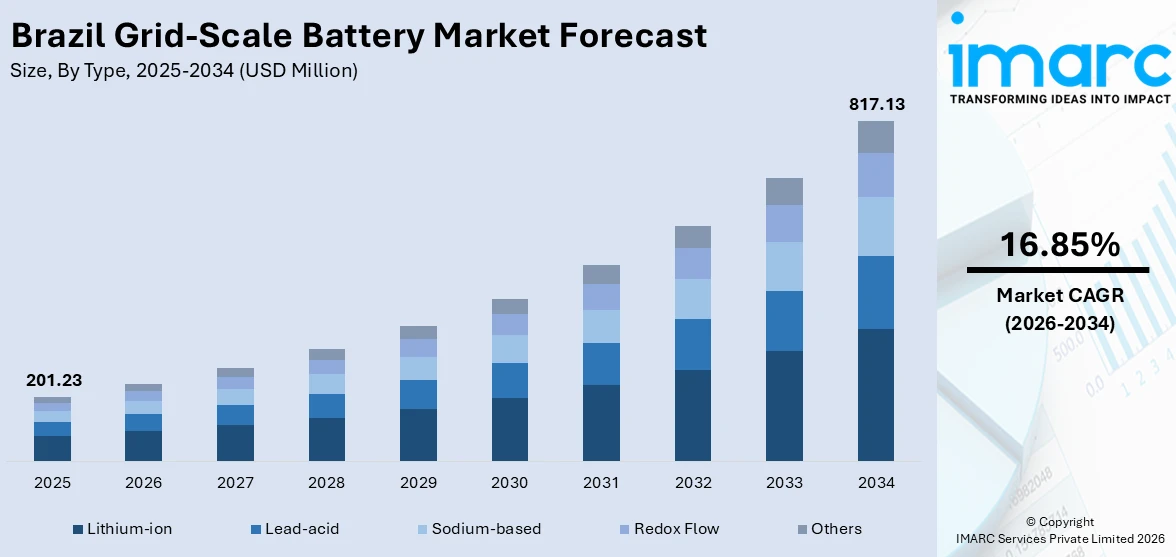
The Brazil grid-scale battery market size was valued at USD 201.23 Million in 2025 and is projected to reach USD 817.13 Million by 2034, growing at a compound annual growth rate of 16.85% from 2026-2034.
The Brazil grid-scale battery market is experiencing strong momentum driven by rapid renewable energy expansion, escalating grid curtailment challenges, and evolving regulatory frameworks that incentivize large-scale energy storage deployment. Growing demand for grid flexibility, declining lithium-ion battery costs, and increasing utility-led investments in storage infrastructure are accelerating market adoption. Favorable government initiatives, including dedicated battery auctions and tax incentives, are attracting domestic and international capital, strengthening the competitive landscape and positioning Brazil as an emerging leader in Latin America's grid-scale energy storage ecosystem and bolstering Brazil grid-scale battery market share.
Key Takeaways and Insights:
- By Type: Lithium-ion dominates the market with a share of 64.3% in 2025, owing to its superior energy density, rapid response capabilities, declining production costs, and widespread adoption across utility-scale storage applications.
- By Ownership: Utility owned leads the market with a share of 57.6% in 2025, driven by government-mandated capacity auctions, the need for grid reliability during peak demand periods, and increasing utility investment in storage assets to manage renewable energy variability across Brazil's interconnected power system.
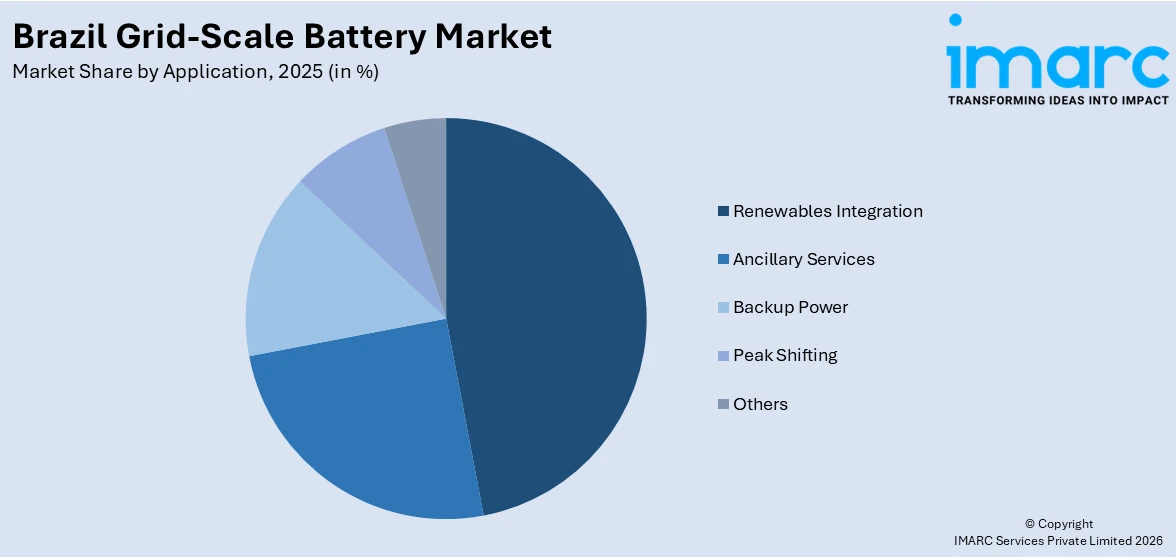
- By Application: Renewables integration represents the largest segment with a market share of 46.8% in 2025, reflecting the urgent need to absorb surplus solar and wind generation, reduce curtailment losses, and stabilize grid operations as intermittent renewable sources approach one-third of the national electricity matrix.
- By Region: Southeast comprises the largest region with 42.9% share in 2025, driven by the concentration of industrial hubs in São Paulo and Minas Gerais, robust transmission infrastructure, high electricity demand from manufacturing sectors, and the presence of Brazil's first large-scale grid-connected battery storage installation.
- Key Players: The market is competitive, driven by renewable integration needs, evolving regulatory support, and cost‑declining storage technologies. Local and international developers compete on capacity, performance, and financing, while utilities and IPPs seek reliable storage to manage peak demand, grid stability, and energy transition goals.
To get more information on this market Request Sample
The Brazil grid-scale battery market is advancing as the country confronts growing challenges in managing its rapidly expanding renewable energy capacity alongside aging grid infrastructure. Demand for battery energy storage system components surged, reflecting heightened interest in grid-scale solutions across utility, commercial, and industrial segments. Brazil accumulated 685 MWh of installed energy storage capacity by end 2024, with 269 MWh added during the year alone, marking a 29% increase over 2023. The government's enactment of Law 15.269 in November 2025 established the first comprehensive legal framework for battery storage, introducing tax incentives through the REIDI program and reducing import tariffs on storage components to zero. The upcoming capacity reserve auction scheduled for April 2026, targeting approximately 2 GW of battery storage capacity, is expected to mobilize over USD 2 Billion in procurement, signaling a transformative shift toward large-scale energy storage integration within Brazil's national interconnected power system.
Brazil Grid-Scale Battery Market Trends:
Rapid decline in stationary storage battery costs
The cost of lithium-ion battery packs for stationary storage applications has fallen sharply, unlocking new economic viability for grid-scale deployments across Brazil. BloombergNEF's 2025 battery price survey reported that stationary storage pack prices dropped to USD 70 per kWh in 2025, representing a 45% decline from 2024 and making it the cheapest lithium-ion battery segment for the first time. This price compression, driven by manufacturing overcapacity and the widespread adoption of lithium iron phosphate chemistry, is accelerating project feasibility and supporting Brazil grid-scale battery market growth.
Emergence of energy storage-as-a-service business models
Innovative commercial frameworks are reshaping how grid-scale battery solutions reach end users in Brazil, with energy-as-a-service models gaining significant traction among commercial and industrial clients. Matrix Energia, a pioneer of this approach, expanded its partnership with Huawei Digital Power in September 2024, tripling its contracted battery capacity to 750 MWh for deployment by 2027 through a total investment exceeding BRL 1.6 Billion. This model eliminates upfront capital requirements for clients and enables broader adoption of storage technologies across diverse electricity consumption profiles.
Hybrid renewable-storage project development
The growing trend of co-locating battery storage with existing wind and solar generation assets is enabling developers to maximize transmission capacity and defer costly grid infrastructure upgrades. As such, in May 2024, Norwegian developer Statkraft committed BRL 926 Million to hybridize the Ventos de Santa Eugênia and Morro do Cruzeiro wind sites in Bahia with solar generation and battery storage, with construction scheduled for completion by late 2025. This approach addresses grid congestion challenges while improving the dispatchability of variable renewable energy output.
Market Outlook 2026-2034:
The Brazil grid-scale battery market is entering a phase of transformative growth, driven by regulatory clarity, declining technology costs, and increasing integration of renewable energy. Accordingly, in August 2025, Brazil achieved a landmark achievement as solar and wind energy collectively provided more than one-third (34%) of the country’s electricity, producing a record 19 terawatt-hours (TWh), sufficient to power roughly 119 million households. Government initiatives are establishing a structured framework for large-scale storage deployment, with dedicated auctions and long-term contracts encouraging private investment. Likewise, rising solar and wind generation is creating sustained demand for reliable grid-scale storage solutions to balance intermittent supply and maintain grid stability. As the market matures, competition among local and international developers is intensifying, fostering innovation in performance, efficiency, and cost optimization, ultimately positioning Brazil as a key emerging market for energy storage solutions in Latin America. The market generated a revenue of USD 201.23 Million in 2025 and is projected to reach a revenue of USD 817.13 Million by 2034, growing at a compound annual growth rate of 16.85% from 2026-2034.
Brazil Grid-Scale Battery Market Report Segmentation:
|
Segment Category |
Leading Segment |
Market Share |
|
Type |
Lithium-ion |
64.3% |
|
Ownership |
Utility Owned |
57.6% |
|
Application |
Renewables Integration |
46.8% |
|
Region |
Southeast |
42.9% |
Type Insights:
- Lead-acid
- Sodium-based
- Lithium-ion
- Redox Flow
- Others
Lithium-ion dominates with a market share of 64.3% of the total Brazil grid-scale battery market in 2025.
Lithium-ion technology has become the undisputed standard for grid-scale battery installations in Brazil, driven by its high energy density, superior round-trip efficiency, and rapidly declining manufacturing costs. The global shift toward lithium iron phosphate chemistry has particularly benefited the Brazilian market, as LFP batteries offer enhanced thermal stability and longer cycle life suited to tropical operating conditions.
The dominance of lithium-ion chemistry is further reinforced by its proven track record in Brazil's landmark grid-scale installations and expanding commercial deployment pipeline. ISA CTEEP's 30 MW/60 MWh battery energy storage system at the Registro substation in São Paulo, which utilizes 180 lithium battery modules supplied by CATL, remains the country's only large-scale transmission-connected storage asset and serves as a critical benchmark for future utility-scale projects. The upcoming capacity reserve auction will further consolidate lithium-ion adoption as the preferred technology for meeting minimum four-hour discharge requirements.
Ownership Insights:
- Third-Party Owned
- Utility Owned
Utility owned leads with a share of 57.6% of the total Brazil grid-scale battery market in 2025.
Utility owned grid-scale battery systems dominate Brazil’s market, highlighting the pivotal role of regulated utilities and transmission operators in deploying storage to enhance grid reliability and manage peak demand. The government’s capacity reserve auction encourages long-term supply agreements, supporting structured deployment of battery projects. This utility-focused approach underscores institutional ownership as the primary pathway for grid-scale storage development, shaping market dynamics, fostering coordinated planning, and ensuring alignment with national energy transition goals. As renewable penetration grows, utilities remain central to integrating storage, balancing intermittent generation, and maintaining overall system stability.
Utility ownership of grid-scale batteries in Brazil is reinforced by established regulatory frameworks and the strategic role of transmission-connected storage in ensuring system stability. Formal recognition of electricity storage as a regulated activity provides utilities with greater regulatory certainty, enhancing the business case for directly owning and operating grid-connected battery assets. This framework supports long-term planning, investment security, and operational integration, enabling utilities to balance intermittent renewable generation, manage peak demand, and maintain reliable electricity supply. As storage adoption grows, regulated utilities remain central to Brazil’s evolving energy infrastructure.
Application Insights:
Access the comprehensive market breakdown Request Sample
- Renewables Integration
- Ancillary Services
- Backup Power
- Peak Shifting
- Others
The renewables integration exhibits a clear dominance with a 46.8% share of the total Brazil grid-scale battery market in 2025.
Renewables integration represents the most critical application for grid-scale batteries in Brazil, driven by the country's rapid expansion of solar and wind generation capacity that has outpaced transmission infrastructure development. The National System Operator reported that solar curtailment reached 14% in 2024 and escalated to 21% in the first half of 2025, while Volt Robotics estimated that total renewable energy curtailment in 2025 caused economic losses of approximately BRL 6.5 Billion. Grid-scale batteries address this imbalance by absorbing surplus generation during peak production hours and discharging stored energy during evening demand ramps.
The urgency for renewables integration storage continues to intensify as Brazil's photovoltaic capacity expands toward its projected trajectory. According to the National System Operator's 2025-2029 Energy Operation Plan, solar power's share of Brazil's electricity matrix is projected to increase from 22.2% in December 2024 to 32.9% by end 2029, with installed capacity growing from 51.7 GW to 88.2 GW. This anticipated addition of solar capacity will generate unprecedented demand for grid-scale storage solutions capable of smoothing output variability, preventing curtailment, and enabling the dispatchability of intermittent renewable resources.
Regional Insights:
- Southeast
- South
- Northeast
- North
- Central-West
Southeast holds the largest share accounting for 42.9% of the total Brazil grid-scale battery market in 2025.
Brazil’s Southeast region leads the grid-scale battery market due to its concentration of industrial hubs, advanced transmission infrastructure, and high electricity demand. According to CEIC data, electricity consumption on the grid in São Paulo reached 6,581,108.176 MWh in December 2025, up from 6,232,673.112 MWh recorded in November 2025, reflecting a notable month-on-month increase. Key states such as São Paulo and Minas Gerais act as primary demand centers, driving both renewable integration and storage adoption. The region’s strategic importance is further underscored by hosting transmission-connected battery systems that support grid reliability and peak management.
The dominance of the Southeast also attracts significant private and institutional investment, as developers and utilities prioritize the region for pilot projects and large-scale deployments. Its mature market environment allows for faster permitting, easier grid interconnection, and efficient integration with existing generation assets. This concentration of activity creates a feedback loop, where increased storage deployment encourages further renewable adoption, enhances operational expertise, and strengthens supply chains for battery technology, reinforcing the Southeast’s position as Brazil’s central hub for grid-scale energy storage and a benchmark for emerging markets nationwide.
Market Dynamics:
Growth Drivers:
Why is the Brazil Grid-Scale Battery Market Growing?
Escalating renewable energy curtailment
Brazil's rapid expansion of solar and wind generation capacity has severely outpaced transmission infrastructure development, creating an unprecedented curtailment crisis that directly drives grid-scale battery demand. Volt Robotics reported in its Annual Curtailment Balance 2025 that Brazil curtailed approximately 20% of its solar and wind output during the year, with average generation cuts reaching 4,021 MW and economic losses. The problem intensified sharply, with 16 days in 2025 seeing curtailment exceed reference generation, compared to only one such event in 2024. Grid-scale batteries offer a direct solution by absorbing excess renewable generation during daytime peaks and releasing stored energy during evening demand ramps, making storage investment increasingly essential to preserve the viability of renewable energy projects.
Landmark regulatory framework and government incentive programs
The Brazilian government has created a robust policy framework to support the accelerated deployment of grid-scale battery systems, offering both regulatory clarity and financial incentives. Electricity storage is now formally recognized as a distinct regulated activity, providing utilities and developers with long-term certainty for project planning and investment. Fiscal measures, including tax exemptions and reductions on imports of battery systems and components, further enhance the business case for storage deployment. Alongside these incentives, ANEEL’s regulatory roadmap establishes clear guidelines for storage remuneration, grid access, and integration with transmission and distribution networks. This combination of regulatory support and financial benefits is fostering a favorable environment that attracts domestic and international investors, encourages large-scale project development, and underpins Brazil’s transition toward a more resilient, renewable-integrated electricity grid.
First dedicated government battery storage auction mobilizing investment
Brazil’s upcoming capacity reserve auction for battery energy storage systems, is set to be a major driver of grid-scale battery market growth. The auction will secure long-term supply contracts for large-scale storage projects, with minimum performance requirements ensuring meaningful contribution to grid reliability and peak management. A substantial pipeline of battery projects is prepared for participation, reflecting strong market readiness. As such, Brazilian mining giant Vale planned to build the country’s largest energy storage project, a 5 MW/10 MWh lithium-ion system at a Rio de Janeiro port, using Tesla Megapacks for industrial peak shaving and supporting clean energy integration. International and domestic technology providers are actively engaging with the government, signaling significant investor confidence. The auction is expected to accelerate deployment, attract private investment, and reinforce Brazil’s strategic transition toward a renewable-integrated, resilient electricity grid.
Market Restraints:
What Challenges the Brazil Grid-Scale Battery Market is Facing?
Regulatory uncertainty around grid usage fees and remuneration models
Despite the passage of Law 15.269, critical regulatory details governing how battery storage projects will pay for grid access and be compensated for services remain unresolved. The ongoing debate over whether batteries should be charged as generators, consumers, or both creates significant financial uncertainty for project developers. ANEEL's regulatory roadmap has experienced repeated delays, and the battery storage auction has been postponed multiple times from its original mid-2025 timeline. This ambiguity discourages final investment decisions and complicates financial modeling for both domestic and international developers.
Absence of domestic battery cell manufacturing capacity
Brazil lacks domestic battery cell manufacturing capabilities, making the grid-scale storage market entirely dependent on imported cells, predominantly from Chinese manufacturers such as CATL and BYD. This reliance creates supply chain vulnerabilities, exposes projects to currency fluctuation risks, and lengthens procurement timelines. While Brazil possesses the world's seventh-largest lithium reserves across Minas Gerais, Pernambuco, and other states, no integrated cell manufacturing facility currently exists in the country, limiting value chain localization and increasing project costs.
High capital costs and tax burden on storage systems
High upfront capital costs continue to pose a major challenge for grid-scale battery projects in Brazil, especially for developers unable to access subsidized financing or incentive programs. Existing taxes and import duties significantly increase project expenses, creating a cost gap compared to international markets. Although recent legislation offers exemptions and reduced import tariffs, delays in regulatory implementation leave many near-term projects subject to the full tax burden, limiting deployment and slowing the growth of utility-scale energy storage.
Competitive Landscape:
The Brazil grid-scale battery market is becoming increasingly competitive as international technology providers and domestic energy companies position themselves to capture emerging opportunities driven by regulatory reforms and the upcoming government battery auction. The landscape features a mix of global battery manufacturers, transmission system operators, and integrated energy platforms competing across technology supply, project development, and service delivery. Companies are differentiating through strategic partnerships, storage-as-a-service offerings, and vertically integrated supply chains. As regulatory clarity improves and auction frameworks take shape, competition is expected to intensify further, with players leveraging cost leadership, technology reliability, and local market expertise.
Recent Developments:
- In February 2026, WEG planned a 2 GWh battery energy storage plant in Itajaí, Brazil, featuring automated assembly, testing labs, and autonomous logistics. The facility, financed through BRL 280 Million, will produce high-capacity BESS, support renewable integration, enhance grid resilience, and generate approximately 90 direct jobs, boosting local economic development.
- In August 2025, UCB Power, in partnership with the Sustainable Amazon Foundation, launched Brazil’s first photovoltaic plant with sodium battery storage in the remote Amazon community of Tumbira. The 7.5 kWp PV system with 38.4 kWh storage supports off-grid energy access, building on UCB Power’s extensive deployments for thousands of remote Brazilian households.
Brazil Grid-Scale Battery Market Report Coverage:
|
Report Features |
Details |
|
Base Year of the Analysis |
2025 |
|
Historical Period |
2020-2025 |
|
Forecast Period |
2026-2034 |
|
Units |
Million USD |
|
Scope of the Report |
Exploration of Historical Trends and Market Outlook, Industry Catalysts and Challenges, Segment-Wise Historical and Future Market Assessment:
|
|
Types Covered |
Lead-acid, Sodium-based, Lithium-ion, Redox Flow, Others |
|
Ownerships Covered |
Third-Party Owned, Utility Owned |
|
Applications Covered |
Renewables Integration, Ancillary Services, Backup Power, Peak Shifting, Others |
|
Regions Covered |
Southeast, South, Northeast, North, Central-West |
|
Customization Scope |
10% Free Customization |
|
Post-Sale Analyst Support |
10-12 Weeks |
|
Delivery Format |
PDF and Excel through Email (We can also provide the editable version of the report in PPT/Word format on special request) |
Frequently Asked Questions About the Brazil Grid-Scale Battery Market Report
The Brazil grid-scale battery market size was valued at USD 201.23 Million in 2025.
The Brazil grid-scale battery market is expected to grow at a compound annual growth rate of 16.85% from 2026-2034 to reach USD 817.13 Million by 2034.
Lithium-ion, holding the largest revenue share of 64.3%, remains the dominant technology for grid-scale battery deployments in Brazil, driven by declining pack prices, superior energy density, and proven performance in utility-scale installations.
Key factors driving the Brazil grid-scale battery market include escalating renewable energy curtailment, landmark regulatory frameworks with tax incentives, the first government-led battery storage auction, declining lithium-ion costs, and growing utility investment in grid modernization.
Major challenges include regulatory uncertainty around grid usage fees and remuneration models, absence of domestic battery cell manufacturing, high capital costs compounded by a substantial tax burden, supply chain dependencies on imports, and delayed auction timelines.
Need more help?
- Speak to our experienced analysts for insights on the current market scenarios.
- Include additional segments and countries to customize the report as per your requirement.
- Gain an unparalleled competitive advantage in your domain by understanding how to utilize the report and positively impacting your operations and revenue.
- For further assistance, please connect with our analysts.
 Request Customization
 Speak to an Analyst
 Request Brochure
 Inquire Before Buying
Benefits of Customization
- Personalize this research
- Triangulate with your data
- Get data as per your format and definition
- Gain a deeper dive into a specific application, geography, customer, or competitor
- Any level of personalization
Get in Touch With Us
UNITED STATES
Phone: +1-201-971-6302
INDIA
Phone: +91-120-433-0800
UNITED KINGDOM
Phone: +44-753-714-6104
Email: [email protected]
Client Testimonials




.webp)




.webp)













