
Brazil Healthcare Analytics Market Size, Share, Trends and Forecast by Component, Deployment Mode, Type, Application, End User, and Region, 2026-2034
Brazil Healthcare Analytics Market Summary:
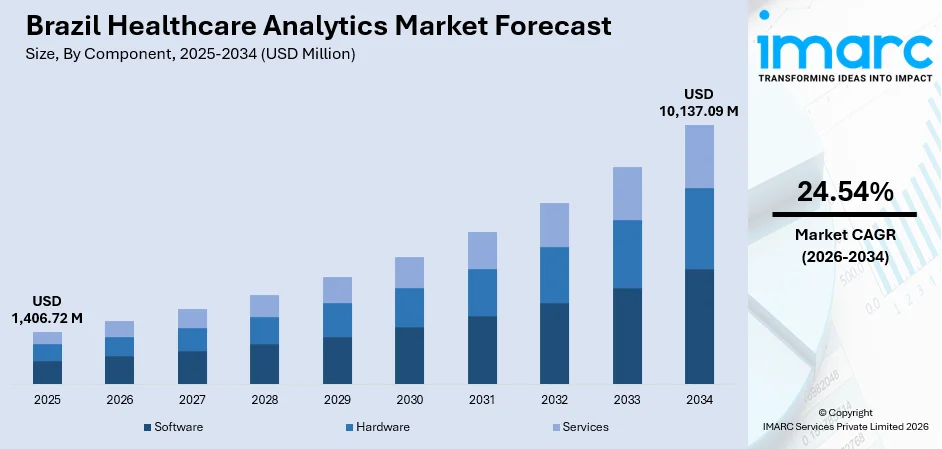
The Brazil Healthcare Analytics market size was valued at USD 1,406.72 Million in 2025 and is projected to reach USD 10,137.09 Million by 2034, growing at a compound annual growth rate of 24.54% from 2026-2034.
The Brazil healthcare analytics market is experiencing accelerated growth, driven by large-scale government investment in health data infrastructure, rising adoption of artificial intelligence across public and private healthcare institutions, and the rapid digitization of clinical and operational workflows. Structural tailwinds including the deployment of the National Health Data Network (RNDS), the Brazilian AI Plan 2024–2028 and expanding cloud computing capacity are creating a high-momentum environment that is consistently expanding the Brazil healthcare analytics market share across hospital systems, health insurers, and public health agencies nationwide.
Key Takeaways and Insights:
- By Component: Software dominates the market with a share of 46.8% in 2025, owing to the rapid proliferation of AI-enabled health IT platforms, electronic health record (EHR) analytics modules, and clinical decision support systems that integrate directly into hospital and insurer workflows across Brazil’s public and private healthcare sectors.
- By Deployment Mode: Cloud leads the market with a share of 52.4% in 2025, reflecting strong institutional preference for scalable, cost-efficient cloud infrastructure that enables real-time health data sharing and analytics interoperability between heterogeneous health systems across Brazil’s geographically diverse regions.
- By Type: Predictive analytics exhibits a clear dominance in the market with 41.6% share in 2025, driven by the high clinical and operational value of forecasting models for patient risk stratification, disease outbreak detection, hospital readmission reduction, and resource allocation optimization across Brazil’s Unified Health System and private care networks.
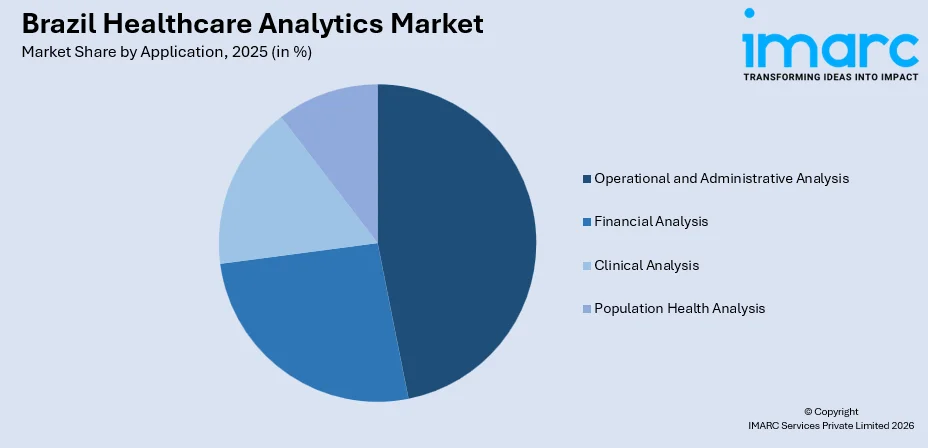
- By Application: Operational and administrative analysis is the largest segment with a market share of 38.9% in 2025, reflecting the primary focus of Brazilian health systems on improving throughput efficiency, reducing administrative costs, and optimizing capacity planning, priorities amplified by the financial pressures facing both the SUS network and private hospital operators.
- By End User: Healthcare providers represent the leading segment with a share of 49.2% in 2025, underpinned by the expanding network of hospitals, primary care facilities, and diagnostic centers across Brazil investing in analytics tools to improve patient outcomes, meet RNDS interoperability mandates, and optimize clinical operations under tightening reimbursement conditions.
- By Region: Southeast comprises the biggest region with 57.3% share in 2025, driven by the concentration of Brazil’s largest hospital groups, health insurance operators, and health IT vendors in São Paulo and Rio de Janeiro, combined with the highest density of digitalized healthcare infrastructure and per capita healthcare spending in the country.
- Key Players: The market is competitive, featuring domestic tech firms, global software providers, and specialized data service companies. Competition centers on advanced data integration, predictive analytics, interoperability, and regulatory compliance, with innovation and strategic partnerships driving differentiation and market share growth.
To get more information on this market Request Sample
The Brazil healthcare analytics market is driven by government-led digitization, rising AI adoption, and a growing health data ecosystem. The country’s public health system generates vast volumes of clinical, administrative, and epidemiological data, increasingly integrated through the National Health Data Network (RNDS). This convergence creates opportunities for advanced analytics, predictive modeling, and data-driven decision-making, enabling providers, payers, and policymakers to enhance patient outcomes, optimize operational efficiency, and support population health management nationwide. According to Black Book Research’s 2026 report on Brazil’s acute care EHR and digital health landscape, the RNDS has accumulated 4.3 billion records and experienced 476% growth since its initial deployment, providing an unprecedented data foundation for analytics applications across hospital systems, insurers, and public health agencies. Simultaneously, Brazil’s AI Plan 2024–2028 prioritizes health-focused AI initiatives, including predictive diagnostics, public health system optimization, and automated teleconsultation support. This policy-driven approach generates sustained demand for healthcare analytics solutions, reinforcing market growth and encouraging adoption of advanced, AI-enabled tools across the sector.
Brazil Healthcare Analytics Market Trends:
Health Data Interoperability Boosts Analytics Investments
Brazil’s accelerating push for health data interoperability is creating a structural demand base for healthcare analytics platforms. In July 2025, Decree No. 12,560/2025 formally established the National Health Data Network (RNDS) as the SUS’s official data integration platform, mandating interoperability standards across all public and private health entities. The SUS Digital Programme has been adopted by all 27 Brazilian states and 3,874 municipalities. This policy momentum is compelling hospital groups, insurers, and primary care networks to upgrade their analytics infrastructure to meet RNDS compliance requirements, generating sustained investment across software and cloud-based healthcare analytics segments.
Rapid Adoption of AI-Powered Clinical Decision Support and Diagnostic Analytics
Artificial intelligence is gaining significant traction across Brazilian healthcare analytics applications, particularly in clinical decision support, medical imaging analysis, and predictive diagnostics. For instance, in November 2024, ANVISA implemented AI to streamline impurity qualification in pharmaceuticals, enhancing drug registration efficiency, reusing prior data, accelerating approvals, and improving safety and transparency in Brazil’s regulatory processes. By improving transparency and regulatory efficiency, AI adoption demonstrates Brazil’s commitment to leveraging advanced analytics for both public health protection and operational modernization, signaling broader growth potential across the country’s healthcare analytics sector.
Cloud Migration and Scalable Analytics Transforming Health Operations
Cloud-based deployment is becoming the dominant model for healthcare analytics in Brazil, driven by cost efficiency, scalability, and the interoperability requirements of the RNDS. By 2026, approximately 185 million Brazilians will be using mobile internet, supporting the digital connectivity infrastructure that underpins cloud health analytics adoption. This shift enhances operational efficiency, supports population health initiatives, and strengthens Brazil’s digital health infrastructure, positioning cloud analytics as a cornerstone of the country’s healthcare modernization.
Market Outlook 2026-2034:
The Brazil healthcare analytics market is positioned for sustained, high-trajectory growth throughout the forecast period, propelled by the convergence of policy-driven digitization, technology investment, and a rapidly expanding health data ecosystem. Accordingly, in July 2025, UniSALESIANO invested approximately BRL 1.6 Million in tablets for Araçatuba’s primary care, enabling real-time access to electronic medical records for community health agents, improving efficiency, accuracy, and speed in patient monitoring. Similarly, the formal institutionalization of the RNDS as the national health data integration backbone, will catalyze widespread investment in analytics platforms among healthcare providers, payers, and third-party administrators seeking to meet interoperability and governance requirements. The growing adoption of cloud-based analytics infrastructure, expanding EHR coverage across primary and secondary care, and increasing institutional demand for operational analytics tools within the SUS network and private hospital groups are expected to collectively sustain robust, compounding market growth. The deepening penetration of AI-enabled software across diagnostic imaging, clinical risk stratification, and financial analytics will further diversify and deepen the Brazil healthcare analytics market throughout the forecast period. The market generated a revenue of USD 1,406.72 Million in 2025 and is projected to reach a revenue of USD 10,137.09 Million by 2034, growing at a compound annual growth rate of 24.54% from 2026-2034.
.webp)
Brazil Healthcare Analytics Market Report Segmentation:
|
Segment Category |
Leading Segment |
Market Share |
|
Component |
Software |
46.8% |
|
Deployment Mode |
Cloud |
52.4% |
|
Type |
Predictive Analytics |
41.6% |
|
Application |
Operational and Administrative Analysis |
38.9% |
|
End User |
Healthcare Providers |
49.2% |
|
Region |
Southeast |
57.3% |
Component Insights:
- Hardware
- Software
- Services
Software dominates the market with a market share of 46.8% of the total Brazil Healthcare Analytics market in 2025.
Software commands the leading position in Brazil’s healthcare analytics component landscape, underpinned by the rapid proliferation of AI-enabled health IT platforms, EHR analytics modules, clinical decision support systems, and population health management applications across the country’s public and private healthcare sectors. The Brazilian government’s mandate for RNDS compliance across all health entities has accelerated institutional demand for analytics software capable of processing, integrating, and deriving actionable insights from large-scale standardized health datasets.
The software segment’s dominance is further reinforced by Brazil’s strategic commitment to health AI development under the Brazilian AI Plan 2024–2028, which designates nearly one-third of its 31 planned projects to health-specific software applications. These include automated systems for SUS diagnostic optimization, AI-powered teleconsultation transcription tools, and predictive analytics platforms for the early detection of complex diseases including cancer. In 2024, the Latin American and Caribbean Center on Health Sciences Information (BIREME), in collaboration with Brazil’s Ministry of Health Secretariat of Information and Digital Health (SEIDIGI), launched “Decision Aids”, data-driven software tools empowering patients and healthcare providers with analytics-based decision support, illustrating the practical expansion of healthcare analytics software into clinical and patient-facing environments across Brazil.
Deployment Mode Insights:
- On-Premises
- Cloud
Cloud leads the market with a share of 52.4% of the total Brazil Healthcare Analytics market in 2025.
Cloud deployment has emerged as the dominant modality for healthcare analytics in Brazil, reflecting the sector’s need for scalable, interoperable, and cost-efficient infrastructure capable of handling the exponential growth of health data generated across the country’s distributed healthcare network. The RNDS’s HL7 FHIR-based interoperability architecture is inherently aligned with cloud-native connectivity, incentivizing health systems and analytics vendors to develop cloud-first platforms that integrate seamlessly with national health data flowsThe SUS Digital Programme’s nationwide adoption has driven strong demand for cloud analytics platforms, enabling aggregation and analysis of healthcare data across Brazil’s fragmented and geographically diverse care settings, supporting more efficient, data-driven decision-making and system integration
The Brazilian Ministry of Health’s investment in digital health infrastructure is accelerating cloud analytics adoption across public health institutions, primary care networks, and hospital systems that previously relied on outdated IT environments. Global cloud providers are actively supporting this transformation, enabling advanced AI and analytics applications. These developments allow healthcare organizations to deploy predictive models, operational dashboards, and real-time epidemiological surveillance tools at scale, improving efficiency and decision-making while avoiding prohibitive upfront costs associated with on-premises hardware and infrastructure upgrades.
Type Insights:
- Predictive Analytics
- Prescriptive Analytics
- Descriptive Analytics
Predictive analytics exhibits a clear dominance with a market share of 41.6% of the total Brazil Healthcare Analytics market in 2025.
Predictive analytics holds the leading position among healthcare analytics types in Brazil, reflecting the high clinical, operational, and financial value of forward-looking models that enable proactive interventions across health systems managing complex, chronic, and rapidly evolving disease burdens. The SUS manages the healthcare needs of beneficiaries, generating an unprecedented volume of longitudinal patient data that serves as the foundation for training predictive models in areas including hospital readmission risk, chronic disease progression, epidemiological trend detection, and surgical outcome prediction.
The clinical validation of predictive analytics tools is advancing rapidly within Brazil’s hospital sector, creating strong evidence-based momentum for broader adoption. In October 2024, Lenovo partnered with Instituto do Coração (InCor HCFMUSP), Latin America’s largest cardiology hospital, to launch TRAdA, an AI-powered wearable IoT platform that identifies arrhythmia events through real-time cardiac monitoring. This initiative exemplifies how predictive analytics is being embedded in clinical hardware and patient monitoring systems at Brazil’s most advanced hospital institutions, creating replicable models that other healthcare providers across the country are expected to adopt as the regulatory and evidence base for predictive health AI continues to mature throughout the forecast period.
Application Insights:
Access the comprehensive market breakdown Request Sample
- Financial Analysis
- Operational and Administrative Analysis
- Clinical Analysis
- Population Health Analysis
Operational and administrative analysis represents the leading segment with a market share of 38.9% of the total Brazil Healthcare Analytics market in 2025.
Operational and administrative analytics occupies the dominant application position in Brazil’s healthcare analytics market, driven by the immense scale and operational complexity of managing health service delivery across both the world’s largest public health system and a large, financially pressured private hospital sector. Brazil’s SUS operates through a network of primary care facilities and thousands of hospitals and specialty centers, making operational efficiency analytics a critical investment priority for administrators seeking to reduce waste, optimize patient flow, manage workforce allocation, and reduce service bottlenecks. The SUS Digital Programme’s mandate for digital capacity assessment across all participating municipalities has further elevated the priority of operational analytics as a governance and performance measurement tool at every level of the health system hierarchy.
In Brazil’s private healthcare sector, rising operational costs, constrained insurer reimbursements, and increasing patient volumes are driving hospitals to adopt operational analytics platforms that improve efficiency and reduce expenses. Simultaneously, government initiatives promoting digital health include provisions to evaluate and enhance the operational maturity of public health entities, embedding analytics as a core outcome metric. This alignment of public mandates and private sector pressures is reinforcing operational and administrative analytics as the most widely implemented application, ensuring sustained adoption and continued market leadership throughout the forecast period.
End User Insights:
- Healthcare Payers
- Healthcare Providers
- Third Party Administrators
- Others
Healthcare providers lead the market with a share of 49.2% of the total Brazil Healthcare Analytics market in 2025.
Healthcare providers represent the dominant end-user segment in Brazil’s healthcare analytics market, a pattern shaped by the extraordinary scale and complexity of the country’s hospital and care delivery network. Brazil’s hospital system encompasses registered hospitals and primary care facilities operating under the SUS, supplemented by thousands of private clinics, diagnostic laboratories, and specialty centers, collectively constituting one of the world’s largest institutional demand bases for healthcare analytics tools. The RNDS interoperability mandate, which requires hospitals and primary care facilities to integrate with the national health data platform, is creating a compliance-driven investment cycle that is pushing healthcare providers across all size categories to modernize their analytics infrastructure.
Private hospital groups are also investing heavily in analytics capabilities to differentiate their clinical quality and improve financial performance in a competitive, reimbursement-constrained environment. In 2024, Hospital Israelita Albert Einstein in São Paulo, consistently ranked among the best hospitals in Latin America, released Hstory, an AI-powered platform that scans patient medical records, extracts clinically relevant information, and delivers an analytical report within minutes, demonstrating the institution’s leadership in deploying advanced analytics at the point of care. As leading hospitals such as Einstein, InCor, and Sirio-Libanês continue to invest in and validate clinical analytics tools, the resulting evidence base is expected to accelerate adoption among a broader tier of Brazilian healthcare providers throughout the forecast period.
Region Insights:
- Southeast
- South
- Northeast
- North
- Central-West
Southeast exhibits a clear dominance with a 57.3% share of the total Brazil Healthcare Analytics market in 2025.
The Southeast region commands an overwhelming share of Brazil’s healthcare analytics market, a structural reality grounded in the region’s unrivaled concentration of healthcare infrastructure, health IT vendors, academic medical centers, and institutional analytics capacity. São Paulo and Rio de Janeiro together host Brazil’s most advanced hospital systems, including Hospital Israelita Albert Einstein, InCor HCFMUSP, and Hospital Sírio-Libanês, which serve as early adopters and reference institutions for healthcare analytics technology deployment. São Paulo State alone generates a disproportionate share of national electronic health record volume, and RNDS data shows that the Southeast’s health facilities contribute the largest share of data to Brazil’s national health data platform, providing both the raw material and institutional incentive for sustained analytics investment.
The Southeast’s market dominance is further reinforced by the region’s concentration of multinational health IT companies, domestic health analytics startups, and major cloud infrastructure deployments, all of which reduce implementation costs and accelerate adoption timelines for healthcare analytics purchasers. Brazil’s Ministry of Health’s Secretariat of Information and Digital Health (SEIDIGI), the national agency coordinating digital health strategy, is headquartered in Brasília but operationally centered in the Southeast’s healthcare ecosystem through partnerships with São Paulo’s academic and hospital institutions. The region’s superior digital infrastructure, higher per capita healthcare spending, and greater density of data-mature health organizations collectively ensure that Southeast Brazil will retain its commanding market leadership throughout the forecast period while continuing to serve as the national reference for healthcare analytics innovation and best practice.
Market Dynamics:
Growth Drivers:
Why is the Brazil Healthcare Analytics Market Growing?
Large-Scale Government Investment in Digital Health Infrastructure and Health AI
Brazil’s extraordinary public investment in digital health is a primary structural driver of the healthcare analytics market. The Brazilian AI Plan 2024–2028 (PBIA), backed by an estimated BRL 23 Billion, designates approximately one-third of its 31 planned initiatives to health-focused AI applications, including predictive cancer detection tools, SUS diagnostic optimization systems, automated teleconsultation transcription platforms, and population-level risk stratification models. The Brazilian Ministry of Health has coordinated multi-level investments to accelerate digital health operational capacity across federal, state, and municipal institutions. These initiatives are driving nationwide demand for healthcare analytics platforms, tools, and services. The formal establishment of the RNDS as the official SUS data integration platform further elevated analytics infrastructure from a discretionary investment to a regulatory requirement, compelling participating health entities to adopt robust data aggregation, reporting, and analysis capabilities, and fostering sustained growth in Brazil’s healthcare analytics market.
Expanding Health Data Ecosystem Through the National Health Data Network (RNDS)
The rapid expansion of Brazil’s National Health Data Network (RNDS) is creating the foundational data ecosystem that underpins healthcare analytics market growth. The RNDS platform stores over 1 Billion 400 Million vaccine registries, approximately 74 Million COVID-19 and Monkeypox test results, and 84.4 Million primary care encounters from facilities across all 27 states, data assets of enormous value for population health analytics, epidemiological surveillance, and operational performance benchmarking. The SUS Digital Programme’s adoption by all Brazilian states and many municipalities, is progressively extending the RNDS data network into primary care and community health settings. This deepening data foundation substantially expands the market for analytics tools capable of processing, integrating, and generating actionable insights from structured and unstructured health data at national scale.
Growing Demand for Predictive and Operational Analytics in Chronic Disease Management
Brazil’s growing chronic disease burden is driving strong institutional demand for healthcare analytics solutions that support proactive disease management, operational efficiency, and cost control across public and private health systems. Rising prevalence of conditions such as diabetes, cardiovascular disease, hypertension, and cancer generates complex patient data, well-suited to predictive modeling and population health analytics. Providers and insurers face pressure to deliver value-based care, incentivizing investments in platforms that identify high-risk patients, forecast disease progression, and guide preventive interventions. Both public and private sectors are increasingly adopting analytics to optimize care, reduce costs, and improve outcomes nationwide.
Market Restraints:
What Challenges the Brazil Healthcare Analytics Market is Facing?
Fragmented and Heterogeneous Health IT Infrastructure Limiting Data Integration
Brazil’s healthcare analytics market is constrained by fragmented and technologically diverse health IT systems across hospitals and primary care networks. Many public facilities continue to rely on legacy, proprietary platforms incompatible with national interoperability standards, despite RNDS mandates. This patchwork of disconnected state and municipal systems obstructs the consolidation of complete, longitudinal patient records, reducing data quality and timeliness. Consequently, analytics platforms face higher implementation complexity and cost, and insights derived from incomplete or inconsistent data are less actionable for both public and private healthcare providers.
Data Privacy Constraints and Evolving Regulatory Compliance Under LGPD
The LGPD imposes strict requirements on the collection, processing, and sharing of sensitive health data, creating compliance challenges for analytics providers. Platforms aggregating patient information across multiple institutions must manage consent, security, and legal documentation for each processing purpose. These obligations increase development complexity, cost, and legal risk. Furthermore, the absence of a dedicated AI statute and ongoing debates over AI-related legislation create regulatory uncertainty, potentially slowing adoption of AI-driven analytics solutions as risk-averse institutional buyers await clearer guidance on lawful deployment in Brazil’s healthcare ecosystem.
Shortage of Specialized Health Data Science and Analytics Talent Across Brazil
Brazil faces a critical shortage of professionals with combined expertise in healthcare, data science, and analytics model development. While technology graduates are abundant, few possess the specialized knowledge needed for clinical, informatics, and machine learning integration in healthcare applications. This talent gap increases implementation costs, extends project timelines, and limits domestic vendors’ capacity for innovation. Public hospitals and smaller regional providers are particularly affected, as they struggle to compete with multinational technology firms and private institutions offering competitive compensation to attract analytics professionals in Brazil’s growing healthcare market.
Competitive Landscape:
The Brazil healthcare analytics market presents a moderately fragmented competitive landscape, encompassing global health IT giants, multinational cloud infrastructure providers, and a growing ecosystem of domestically developed analytics startups. Competitive differentiation is driven by depth of RNDS integration, AI model performance, deployment flexibility, and domain specialization across clinical, operational, and population health applications. Key strategic priorities include forming partnerships with leading hospital networks and health insurers, securing ANVISA regulatory clearance for AI-enabled software products, and developing locally adapted predictive models that reflect Brazil’s specific epidemiological profile. Emerging entrants are focusing on cloud-native, modular platforms that minimize implementation barriers for resource-constrained public health facilities while delivering sophisticated analytics capabilities at competitive price points.
Recent Developments:
- In January 2026, Brazilian startup Revena, based in São Paulo, raised USD 8 Million seed led by Canary to automate hospital medical billing. Its AI agents convert clinical records and payer contracts into bills, reducing processing from 18 hours to 20 minutes, cutting administrative work 65–75%, and recovering 6–12% of revenue across live deployments in 30 hospitals.
- In November 2025, WIPO and ABIMED launched Brazil’s first Intellectual Property Management Clinic, to strengthen IP capabilities for MedTech and Digital Health SMEs. Through workshops, mentorship, and tailored roadmaps, participants learn IP strategy, commercialization, and valuation, enabling healthcare innovators to attract investment, expand globally, and translate IP awareness into tangible business growth.
Brazil Healthcare Analytics Market Report Coverage:
|
Report Features |
Details |
|
Base Year of the Analysis |
2025 |
|
Historical Period |
2020-2025 |
|
Forecast Period |
2026-2034 |
|
Units |
Million USD |
|
Scope of the Report |
Exploration of Historical Trends and Market Outlook, Industry Catalysts and Challenges, Segment-Wise Historical and Future Market Assessment:
|
|
Components Covered |
Hardware, Software, Services |
|
Deployment Modes Covered |
On-Premises, Cloud |
|
Types Covered |
Predictive Analytics, Prescriptive Analytics, Descriptive Analytics |
|
Applications Covered |
Financial Analysis, Operational and Administrative Analysis, Clinical Analysis, Population Health Analysis |
|
End Users Covered |
Healthcare Payers, Healthcare Providers, Third Party Administrators, Others |
|
Regions Covered |
Southeast, South, Northeast, North, Central-West |
|
Customization Scope |
10% Free Customization |
|
Post-Sale Analyst Support |
10-12 Weeks |
|
Delivery Format |
PDF and Excel through Email (We can also provide the editable version of the report in PPT/Word format on special request) |
Frequently Asked Questions About the Brazil Healthcare Analytics Market Report
The Brazil Healthcare Analytics market size was valued at USD 1,406.72 Million in 2025.
The Brazil Healthcare Analytics market is expected to grow at a compound annual growth rate of 24.54% from 2026-2034 to reach USD 10,137.09 Million by 2034.
Software dominated the market with a share of 46.8%, driven by the proliferation of AI-enabled health IT platforms, EHR analytics modules, and clinical decision support systems integrated across Brazil’s public and private healthcare sectors, supported by ANVISA’s growing approval of AI-enabled software as medical devices.
Key factors driving Brazil’s healthcare analytics market include strong government support for AI initiatives, nationwide expansion of health data networks, mandates for interoperability, a growing chronic disease burden fueling demand for predictive analytics, and sustained institutional investment in AI-powered clinical decision support and operational analytics solutions across public and private healthcare networks.
Major challenges include fragmented and heterogeneous health IT infrastructure limiting data integration across the RNDS, stringent LGPD data privacy compliance requirements for health data processing, and a significant shortage of specialized healthcare data science and analytics talent across both public health institutions and private healthcare organizations throughout Brazil.
Need more help?
- Speak to our experienced analysts for insights on the current market scenarios.
- Include additional segments and countries to customize the report as per your requirement.
- Gain an unparalleled competitive advantage in your domain by understanding how to utilize the report and positively impacting your operations and revenue.
- For further assistance, please connect with our analysts.
 Request Customization
 Speak to an Analyst
 Request Brochure
 Inquire Before Buying
Benefits of Customization
- Personalize this research
- Triangulate with your data
- Get data as per your format and definition
- Gain a deeper dive into a specific application, geography, customer, or competitor
- Any level of personalization
Get in Touch With Us
UNITED STATES
Phone: +1-201-971-6302
INDIA
Phone: +91-120-433-0800
UNITED KINGDOM
Phone: +44-753-714-6104
Email: [email protected]
Client Testimonials




.webp)




.webp)













Related Reports

Choose your plan
*Please note that the prices mentioned below are starting prices for each bundle type. Kindly contact our team for further details.*
Single User License
- 1 User License, Access on 2 Devices
- PDF Report + Excel Dataset (Password Protected)
- Lifetime Access
- No Printing Rights
- 10% Free Report Customization
- 10–12 Weeks of Analyst Support
Five User License
- Access for 5 Users, 2 Devices per User
- PDF Report + Excel Dataset (Password Protected)
- Lifetime Access
- Dedicated Account Manager
- 12–14 Weeks of Analyst Support
- No Printing Rights
- 15% Free Report Customization
- 25% Discount on Your Next Purchase
Corporate User License
- Unlimited User Access (Within Your Organization)
- PDF Report + Excel Dataset
- Lifetime Access
- Dedicated Account Manager
- 14–20 Weeks of Analyst Support
- No Printing Rights
- 20% Free Report Customization
- 30% Discount on Your Next Purchase
Essential Insights
What's included:
3 reports
- Lifetime Access
- PDF Reports
- Excel Datasets
- 2 Weeks of Free Analyst Support
- 2 User Licenses
- Access on 2 Devices
- Printing Rights
- Complimentary PowerPoint (PPT) Version
- Complimentary License Upgrade
Professional Access
What's included:
5 reports
- Lifetime Access
- PDF Reports
- Excel Datasets
- 8 Weeks of Free Analyst Support
- 2 User Licenses
- Access on 2 Devices
- Printing Rights
- Complimentary PowerPoint (PPT) Version
- Complimentary License Upgrade
Business Advantage
What's included:
8 reports
- Lifetime Access
- PDF Reports
- Excel Datasets
- 14 Weeks of Free Analyst Support
- 2 User Licenses
- Access on 2 Devices
- Printing Rights
- Complimentary PowerPoint (PPT) Version
- Complimentary License Upgrade
Enterprise Intelligence
What's included:
10 reports
- Lifetime Access
- PDF Reports
- Excel Datasets
- 20 Weeks of Free Analyst Support
- 2 User Licenses
- Access on 2 Devices
- Printing Rights
- Complimentary PowerPoint (PPT) Version
- Complimentary License Upgrade