
Brazil Healthcare Big Data Analytics Market Size, Share, Trends and Forecast by Component, Analytics Type, Delivery Model, Application, End User, and Region, 2026-2034
Brazil Healthcare Big Data Analytics Market Summary:
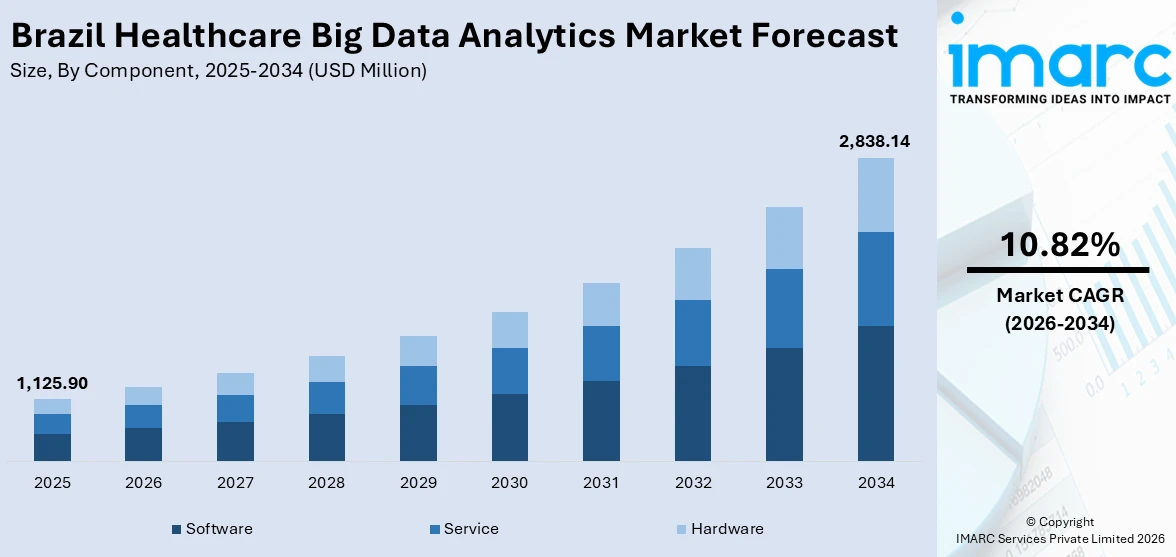
The Brazil healthcare big data analytics market size was valued at USD 1,125.90 Million in 2025 and is projected to reach USD 2,838.14 Million by 2034, growing at a compound annual growth rate of 10.82% from 2026-2034.
The Brazil healthcare big data analytics market is experiencing robust expansion as healthcare providers and policymakers increasingly prioritize data-driven decision-making to optimize patient outcomes and operational efficiency. Rising digital transformation across hospitals and clinics, coupled with expanding telemedicine infrastructure and government-led interoperability initiatives, is accelerating the integration of advanced analytics tools. Growing adoption of electronic health records, cloud-based platforms, and artificial intelligence solutions is reshaping clinical workflows and administrative processes, positioning Brazil as a key growth hub for healthcare analytics innovation and Brazil healthcare big data analytics market share.
Key Takeaways and Insights:
- By Component: Software dominates the market with a share of 46.5% in 2025, owing to the growing demand for integrated electronic health record systems, practice management platforms, and workforce management solutions that streamline hospital operations and enhance clinical decision-making across healthcare facilities.
- By Analytics Type: Descriptive analytics leads the market with a share of 34.2% in 2025, driven by healthcare providers’ reliance on historical data aggregation and reporting tools to monitor patient trends, measure treatment outcomes, and benchmark institutional performance across diverse clinical settings.
- By Delivery Model: On-demand delivery model dominates the market with a share of 59.1% in 2025, reflecting healthcare organizations’ increasing preference for scalable, cloud-based analytics platforms that reduce infrastructure costs, enable remote access, and support real-time data processing and collaboration.
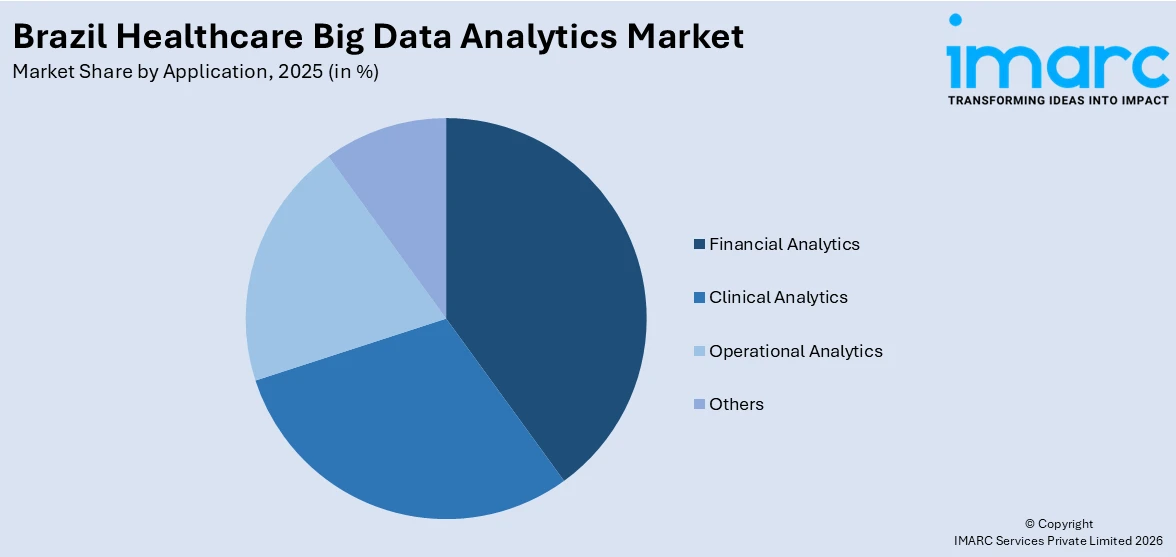
- By Application: Financial analytics leads the market with a share of 31.7% in 2025, owing to rising pressure on healthcare institutions to optimize revenue cycle management, reduce billing inefficiencies, and improve cost transparency across both public and private healthcare systems.
- By End User: Hospitals and clinics dominate the market with a share of 55.8% in 2025, driven by the concentration of patient data generation, increasing investments in clinical information systems, and regulatory mandates promoting digital health infrastructure modernization.
- By Region: Southeast is the largest region with a share of 53.6% in 2025, driven by the concentration of major hospital networks in São Paulo and Rio de Janeiro metropolitan areas, higher healthcare expenditure, and advanced digital infrastructure enabling analytics adoption.
- Key Players: Key players drive the Brazil healthcare big data analytics market by expanding analytics platforms, investing in artificial intelligence and machine learning capabilities, and strengthening cloud-based infrastructure. Their focus on interoperability standards, strategic partnerships with healthcare providers, and development of localized analytics solutions accelerates digital transformation across hospitals, clinics, and insurance organizations nationwide.
To get more information on this market Request Sample
The Brazil healthcare big data analytics market is advancing as healthcare institutions embrace digital technologies to enhance clinical outcomes, streamline operations, and reduce costs. A major catalyst propelling this evolution is the government's commitment to building a unified health data ecosystem through dedicated national data integration platforms that promote interoperability and enable technological innovation across public and private healthcare facilities. Additionally, federal artificial intelligence investment plans are directing substantial resources toward healthcare applications, including diagnostics optimization, automated teleconsultation transcription, and predictive disease detection. Expanding electronic health record adoption, growing demand for cloud-based solutions, and rising emphasis on predictive and prescriptive analytics are further reinforcing the market's upward trajectory. These developments, combined with increasing private-sector investments in healthtech innovation, are creating a favorable environment for sustained market expansion.
Brazil Healthcare Big Data Analytics Market Trends:
Accelerating integration of artificial intelligence in clinical workflows
Healthcare providers across Brazil are increasingly embedding artificial intelligence into clinical processes to enhance diagnostic precision and treatment personalization. Advanced algorithms are being deployed to analyze medical imaging, detect disease patterns, and optimize medication protocols within hospital settings. The convergence of machine learning capabilities with growing volumes of digitized patient data is enabling more proactive and predictive care delivery models. This evolution is reshaping how healthcare organizations approach population health management and operational planning, supporting sustained Brazil healthcare big data analytics market growth.
Expansion of cloud-based healthcare analytics platforms
Cloud-based analytics solutions are gaining significant traction across Brazilian healthcare institutions as organizations seek scalable, cost-effective alternatives to on-premise infrastructure. The shift toward cloud deployment is enabling hospitals, clinics, and insurance agencies to access real-time data insights without heavy capital expenditure on physical hardware. Enhanced data security frameworks and improved internet connectivity are reducing historical concerns around cloud adoption. This transition is democratizing access to advanced analytics capabilities, particularly for mid-sized healthcare providers seeking to modernize their data management and reporting workflows.
Growing emphasis on health data interoperability standards
Brazil is witnessing a pronounced shift toward standardized health data exchange frameworks that enable seamless communication between disparate healthcare systems. The adoption of international standards for clinical data sharing is improving care coordination across public and private healthcare networks. Hospitals, laboratories, and primary care units are increasingly integrating their information systems to reduce data silos and enhance clinical decision-making. This interoperability movement is strengthening the foundation for advanced analytics applications and enabling more comprehensive patient data aggregation across the national healthcare ecosystem.
Market Outlook 2026-2034:
The Brazil healthcare big data analytics market is positioned for sustained expansion over the forecast period, underpinned by accelerating digital transformation across the nation’s healthcare infrastructure. Increasing government investment in health data networks and interoperability standards is creating a robust foundation for advanced analytics adoption. The market generated a revenue of USD 1,125.90 Million in 2025 and is projected to reach a revenue of USD 2,838.14 Million by 2034, growing at a compound annual growth rate of 10.82% from 2026-2034. Healthcare providers are progressively adopting cloud-based platforms, artificial intelligence solutions, and predictive modeling tools to enhance clinical outcomes and operational efficiency. The growing emphasis on financial analytics for revenue cycle optimization, expanding electronic health record penetration, and increasing demand for real-time clinical decision support are expected to drive sustained revenue growth. Rising private-sector investment in healthtech innovation, coupled with favorable regulatory developments and expanding telemedicine infrastructure, will further reinforce the market’s upward trajectory across all major segments and regions.
Brazil Healthcare Big Data Analytics Market Report Segmentation:
|
Segment Category |
Leading Segment |
Market Share |
|
Component |
Software |
46.5% |
|
Analytics Type |
Descriptive Analytics |
34.2% |
|
Delivery Model |
On-Demand Delivery Model |
59.1% |
|
Application |
Financial Analytics |
31.7% |
|
End User |
Hospitals and Clinics |
55.8% |
|
Region |
Southeast |
53.6% |
Component Insights:
- Service
- Software
- Electronic Health Record Software
- Practice Management Software
- Workforce Management Software
- Hardware
- Data Storage
- Routers
- Firewalls
- Virtual Private Networks
- E-Mail Servers
- Others
Software dominates with a market share of 46.5% of the total Brazil healthcare big data analytics market in 2025.
The software segment's leadership in the Brazil healthcare big data analytics market reflects the critical role of digital platforms in modernizing healthcare delivery. Electronic health record systems, practice management solutions, and workforce management tools are driving significant investment as hospitals and clinics seek to digitize patient records, automate scheduling, and optimize staffing. National health data integration initiatives have further accelerated software adoption by mandating interoperability through internationally recognized clinical data exchange standards, compelling healthcare organizations to upgrade their software infrastructure for seamless data sharing across public and private systems.
The growing complexity of healthcare operations in Brazil is pushing institutions toward comprehensive software suites that integrate clinical, administrative, and financial data into unified platforms. Locally developed healthcare software solutions have gained widespread adoption across diverse Brazilian hospital settings, reflecting strong institutional demand for platforms tailored to the country's regulatory and operational requirements. Cloud-enabled software platforms are particularly gaining traction as they offer scalability and remote accessibility, allowing healthcare providers to deploy analytics capabilities without extensive hardware investment while maintaining compliance with Brazil's data protection regulations.
Analytics Type Insights:
- Descriptive Analytics
- Predictive Analytics
- Prescriptive Analytics
- Cognitive Analytics
Descriptive analytics leads with a share of 34.2% of the total Brazil healthcare big data analytics market in 2025.
Descriptive analytics holds the largest share in the Brazil healthcare big data analytics market, reflecting the foundational importance of historical data analysis and reporting in healthcare decision-making. Healthcare providers rely extensively on descriptive tools to aggregate patient records, monitor treatment outcomes, track disease prevalence patterns, and generate performance benchmarks. National health data repositories continue to accumulate vast volumes of vaccine registries, primary care encounter records, and clinical documentation, demonstrating the expanding scale of structured health data available for descriptive analysis across the unified health system.
The widespread adoption of descriptive analytics is also driven by regulatory requirements that mandate systematic reporting and quality monitoring across healthcare facilities. Public health authorities use descriptive analytics platforms to track epidemiological trends, assess resource utilization, and evaluate the effectiveness of health programs. As Brazil's healthcare data infrastructure matures through federal digital health initiatives that are progressively being adopted by municipalities nationwide, descriptive analytics capabilities are expanding to encompass increasingly diverse data sources from hospitals, clinics, laboratories, and primary care units, reinforcing the segment's continued market leadership.
Delivery Model Insights:
- On-Premise Delivery Model
- On-Demand Delivery Model
On-demand delivery model is the largest segment, accounting for 59.1% of the total Brazil healthcare big data analytics market in 2025.
The on-demand delivery model’s dominance in the Brazil healthcare big data analytics market underscores the growing preference for cloud-based analytics platforms among healthcare organizations seeking operational flexibility and cost efficiency. Cloud deployment eliminates the need for extensive on-site infrastructure, enabling hospitals and clinics to access powerful analytical tools through subscription-based models. In 2024, health-technology investment in Latin America rose by 37.6%, reaching USD 253.7 Million, with a significant portion directed toward cloud-enabled healthcare platforms, reflecting strong institutional confidence in cloud-based delivery for analytics and data management.
The shift toward on-demand solutions is further supported by improving internet infrastructure and evolving data governance frameworks in Brazil. Healthcare organizations are increasingly adopting cloud-based platforms that offer automatic updates, enhanced security protocols, and seamless integration with electronic health record systems. The scalability of on-demand models makes them particularly attractive for mid-sized hospitals and clinics that require advanced analytics capabilities but lack the capital resources for on-premise deployments, thereby broadening access to big data analytics across Brazil’s diverse healthcare landscape.
Application Insights:
Access the comprehensive market breakdown Request Sample
- Financial Analytics
- Clinical Analytics
- Operational Analytics
- Others
Financial analytics holds the largest share at 31.7% of the total Brazil healthcare big data analytics market in 2025.
Financial analytics leads the application segment in the Brazil healthcare big data analytics market, reflecting the acute pressure on healthcare institutions to optimize revenue management and control operational costs. Hospitals and clinics are deploying financial analytics solutions to streamline billing processes, reduce claim denials, and enhance transparency in payment workflows. Evolving supplementary healthcare payment models in Brazil, driven by collective plans between healthcare partnerships, are making claims processing increasingly complex, creating sustained demand for advanced financial analytics and robotic process automation within revenue cycle management.
The growing importance of financial analytics is amplified by Brazil's dual public-private healthcare system, where resource allocation efficiency is paramount. Public institutions under the Unified Health System must optimize limited budgets while maintaining care quality, while private providers face competitive pressure to reduce overhead and improve profitability. Leading diagnostic networks and hospital groups are increasingly leveraging cloud-based artificial intelligence platforms to centralize clinical archives and accelerate operational research, illustrating how integrated analytics platforms serve both financial and clinical optimization goals simultaneously across the healthcare value chain.
End User Insights:
- Hospitals and Clinics
- Finance and Insurance Agencies
- Research Organizations
Hospitals and clinics represent the leading segment with a 55.8% share of the total Brazil healthcare big data analytics market in 2025.
Hospitals and clinics constitute the largest end-user segment in the Brazil healthcare big data analytics market, driven by their position as the primary generators and consumers of healthcare data. These institutions manage vast volumes of patient records, diagnostic results, treatment protocols, and operational data that require sophisticated analytics tools for effective management. Federal health authorities are actively pursuing large-scale investments in intelligent medical infrastructure that incorporate artificial intelligence, real-time data analytics, and predictive management systems within leading university hospital complexes, signaling a strong institutional commitment to modernizing hospital-based analytics capabilities.
The continued expansion of hospital-based analytics adoption is reinforced by growing regulatory mandates and interoperability requirements that compel healthcare facilities to digitize clinical workflows. Hospitals are increasingly deploying integrated analytics platforms that combine clinical decision support, financial management, and operational efficiency tools within unified systems. The adoption of internationally recognized data exchange standards through national health data networks is enabling hospitals and clinics to exchange patient data seamlessly with laboratories, pharmacies, and primary care units, creating comprehensive datasets that enhance the value and accuracy of big data analytics applications.
Regional Insights:
- Southeast
- South
- Northeast
- North
- Central-West
Southeast comprises the largest region with 53.6% share of the total Brazil healthcare big data analytics market in 2025.
The Southeast region dominates the Brazil healthcare big data analytics market, driven by the concentration of major hospital networks, advanced digital infrastructure, and higher healthcare expenditure in states such as São Paulo, Rio de Janeiro, and Minas Gerais. This region is home to Brazil's leading private healthcare institutions, diagnostic networks, and healthtech innovation hubs that are driving analytics adoption. The region hosts a disproportionately large share of artificial intelligence-focused healthcare research activity in Brazil, with leading university hospitals serving as primary centers for clinical AI research and data analytics innovation.
The Southeast region benefits from superior broadband connectivity, a larger pool of trained data science professionals, and proximity to major technology companies and venture capital networks that support healthtech development. Brazilian healthtech companies have consistently captured a significant share of the largest funding rounds in Latin America, with a notable concentration of investment flowing to Southeast-based startups. Public-private partnerships are further strengthening the region's analytics infrastructure, with state governments directing substantial new health infrastructure investments toward metropolitan areas where digital healthcare integration is most advanced.
Market Dynamics:
Growth Drivers:
Why is the Brazil Healthcare Big Data Analytics Market Growing?
Government-led digital health infrastructure development
The Brazilian government's sustained commitment to modernizing the national health information ecosystem is a foundational driver of growth in the healthcare big data analytics market. Federal initiatives are establishing comprehensive frameworks for health data collection, storage, and exchange across the public healthcare system. The creation of dedicated digital health secretariats within the Ministry of Health has elevated the institutional priority of health information technology, leading to coordinated nationwide efforts to digitize clinical workflows and standardize data management practices. The government's investment in interoperability platforms is enabling seamless data flow between hospitals, primary care units, laboratories, and pharmacies, creating interconnected data networks that generate substantial demand for analytics tools. Additionally, regulatory developments around data protection and health information governance are compelling healthcare providers to adopt compliant, analytics-capable systems. These infrastructure-building efforts are creating a data-rich environment that serves as the foundation for advanced analytics applications, from population health monitoring to predictive disease modeling, thereby sustaining long-term demand for big data analytics solutions across Brazil's healthcare sector.
Rising adoption of electronic health records and clinical information systems
The accelerating deployment of electronic health record systems across Brazilian healthcare facilities is generating unprecedented volumes of structured clinical data, which in turn is driving demand for analytics solutions capable of processing and deriving insights from this data. Healthcare institutions are transitioning from fragmented, paper-based record-keeping to integrated digital platforms that capture patient histories, diagnostic results, medication records, and treatment outcomes in standardized formats. This digital transformation is expanding the scope and depth of data available for analysis, enabling healthcare providers to implement evidence-based clinical decision support, monitor care quality metrics, and identify operational inefficiencies. The growing sophistication of electronic health record platforms, which increasingly incorporate built-in analytics dashboards and reporting tools, is embedding data analytics into everyday clinical workflows. As more healthcare facilities complete their digital transitions and connect to national health data networks, the volume and quality of analyzable healthcare data continue to increase, sustaining strong demand for both descriptive and predictive analytics capabilities across the market.
Expanding role of artificial intelligence and machine learning in healthcare
The integration of artificial intelligence and machine learning technologies into healthcare analytics platforms is creating new capabilities that are accelerating market growth. These advanced technologies enable healthcare organizations to move beyond traditional descriptive reporting toward predictive and prescriptive analytics that can anticipate patient outcomes, optimize treatment protocols, and identify disease risks before clinical symptoms manifest. The application of artificial intelligence across diagnostics, imaging analysis, and drug discovery is particularly transformative. Brazilian healthcare institutions are increasingly recognizing the strategic value of artificial intelligence-powered analytics for improving clinical accuracy, reducing diagnostic turnaround times, and enhancing patient safety. The convergence of growing computational capacity, expanding health datasets, and maturing machine learning algorithms is enabling more sophisticated analytical applications that were previously impractical. As artificial intelligence capabilities become more accessible through cloud-based platforms and specialized healthcare analytics tools, adoption is spreading beyond large urban hospitals to regional and mid-sized healthcare providers, broadening the market's growth trajectory and creating new demand across diverse institutional settings.
Market Restraints:
What Challenges the Brazil Healthcare Big Data Analytics Market is Facing?
Digital infrastructure disparities across regions
Significant regional variations in broadband connectivity, computing infrastructure, and digital literacy create substantial barriers to uniform analytics adoption across Brazil. While major urban centers in the Southeast benefit from advanced digital ecosystems, rural and remote healthcare facilities in the North and Northeast regions often lack the internet connectivity and hardware necessary to deploy modern analytics platforms. This digital divide limits the potential reach of cloud-based analytics solutions and creates uneven data quality across the national health system, constraining the effectiveness of population-level analytics initiatives.
Data privacy and regulatory compliance complexities
The evolving regulatory landscape around health data privacy and protection in Brazil presents compliance challenges for healthcare analytics providers and adopters. Healthcare organizations must navigate the requirements of the General Personal Data Protection Law while managing sensitive patient information across increasingly interconnected digital platforms. The absence of a dedicated artificial intelligence regulatory framework creates uncertainty for organizations deploying advanced analytics and machine learning applications in clinical settings. Compliance costs and the complexity of meeting multiple overlapping regulatory requirements can deter smaller healthcare providers from investing in analytics solutions.
Shortage of skilled data science professionals in healthcare
The limited availability of trained data scientists and healthcare informatics specialists constrains the ability of Brazilian healthcare organizations to fully leverage big data analytics capabilities. Deploying, managing, and interpreting advanced analytics tools requires specialized expertise that combines clinical knowledge with data science proficiency. This talent gap is particularly acute outside major metropolitan areas, where healthcare facilities struggle to attract and retain qualified informatics professionals. The shortage of interdisciplinary professionals who can bridge the gap between clinical practice and data analytics limits the pace of adoption and the quality of insights generated.
Competitive Landscape:
The Brazil healthcare big data analytics market features a dynamic competitive landscape characterized by the coexistence of established multinational technology companies and innovative local healthcare technology firms. Market participants are differentiating themselves through the development of domain-specific analytics platforms tailored to Brazil’s unique healthcare regulatory environment and operational requirements. Competition is driven by investments in artificial intelligence integration, cloud-based delivery capabilities, and compliance with national interoperability standards such as HL7 FHIR. Strategic partnerships between global technology providers and local healthcare institutions are intensifying as organizations seek to combine international analytical capabilities with localized clinical expertise. Vendors are focusing on expanding product portfolios that address the full spectrum of healthcare analytics needs, from financial management and operational optimization to clinical decision support and population health monitoring. The competitive environment is further shaped by increasing venture capital investment in Brazilian healthtech startups, which are introducing agile, specialized solutions that challenge established players and drive continuous innovation across the market.
Brazil Healthcare Big Data Analytics Market Report Coverage:
|
Report Features |
Details |
|
Base Year of the Analysis |
2025 |
|
Historical Period |
2020-2025 |
|
Forecast Period |
2026-2034 |
|
Units |
Million USD |
|
Scope of the Report |
Exploration of Historical Trends and Market Outlook, Industry Catalysts and Challenges, Segment-Wise Historical and Future Market Assessment:
|
|
Components Covered |
|
|
Analytics Types Covered |
Descriptive Analytics, Predictive Analytics, Prescriptive Analytics, Cognitive Analytics |
|
Delivery Models Covered |
On-Premise Delivery Model, On-Demand Delivery Model |
|
Applications Covered |
Financial Analytics, Clinical Analytics, Operational Analytics, Others |
|
End Users Covered |
Hospitals and Clinics, Finance and Insurance Agencies, Research Organizations |
|
Regions Covered |
Southeast, South, Northeast, North, Central-West |
|
Customization Scope |
10% Free Customization |
|
Post-Sale Analyst Support |
10-12 Weeks |
|
Delivery Format |
PDF and Excel through Email (We can also provide the editable version of the report in PPT/Word format on special request) |
Frequently Asked Questions About the Brazil Healthcare Big Data Analytics Market Report
The Brazil healthcare big data analytics market size was valued at USD 1,125.90 Million in 2025.
The Brazil healthcare big data analytics market is expected to grow at a compound annual growth rate of 10.82% from 2026-2034 to reach USD 2,838.14 Million by 2034.
Software dominated the market with a share of 46.5%, driven by the growing adoption of electronic health record systems, practice management platforms, and workforce management solutions that digitize clinical workflows and enhance data-driven decision-making across healthcare facilities.
Key factors driving the Brazil healthcare big data analytics market include government-led digital health infrastructure development, rising electronic health record adoption, expanding artificial intelligence integration, growing cloud-based analytics deployment, and increasing demand for financial and clinical analytics across healthcare institutions.
Major challenges include significant digital infrastructure disparities across regions, evolving data privacy and regulatory compliance complexities, shortage of skilled data science professionals in healthcare, limited interoperability between legacy systems, and high implementation costs for smaller healthcare providers.
Need more help?
- Speak to our experienced analysts for insights on the current market scenarios.
- Include additional segments and countries to customize the report as per your requirement.
- Gain an unparalleled competitive advantage in your domain by understanding how to utilize the report and positively impacting your operations and revenue.
- For further assistance, please connect with our analysts.
 Request Customization
 Speak to an Analyst
 Request Brochure
 Inquire Before Buying
Benefits of Customization
- Personalize this research
- Triangulate with your data
- Get data as per your format and definition
- Gain a deeper dive into a specific application, geography, customer, or competitor
- Any level of personalization
Get in Touch With Us
UNITED STATES
Phone: +1-201-971-6302
INDIA
Phone: +91-120-433-0800
UNITED KINGDOM
Phone: +44-753-714-6104
Email: [email protected]
Client Testimonials




.webp)




.webp)













Related Reports

Choose your plan
*Please note that the prices mentioned below are starting prices for each bundle type. Kindly contact our team for further details.*
Single User License
- 1 User License, Access on 2 Devices
- PDF Report + Excel Dataset (Password Protected)
- Lifetime Access
- No Printing Rights
- 10% Free Report Customization
- 10–12 Weeks of Analyst Support
Five User License
- Access for 5 Users, 2 Devices per User
- PDF Report + Excel Dataset (Password Protected)
- Lifetime Access
- Dedicated Account Manager
- 12–14 Weeks of Analyst Support
- No Printing Rights
- 15% Free Report Customization
- 25% Discount on Your Next Purchase
Corporate User License
- Unlimited User Access (Within Your Organization)
- PDF Report + Excel Dataset
- Lifetime Access
- Dedicated Account Manager
- 14–20 Weeks of Analyst Support
- No Printing Rights
- 20% Free Report Customization
- 30% Discount on Your Next Purchase
Essential Insights
What's included:
3 reports
- Lifetime Access
- PDF Reports
- Excel Datasets
- 2 Weeks of Free Analyst Support
- 2 User Licenses
- Access on 2 Devices
- Printing Rights
- Complimentary PowerPoint (PPT) Version
- Complimentary License Upgrade
Professional Access
What's included:
5 reports
- Lifetime Access
- PDF Reports
- Excel Datasets
- 8 Weeks of Free Analyst Support
- 2 User Licenses
- Access on 2 Devices
- Printing Rights
- Complimentary PowerPoint (PPT) Version
- Complimentary License Upgrade
Business Advantage
What's included:
8 reports
- Lifetime Access
- PDF Reports
- Excel Datasets
- 14 Weeks of Free Analyst Support
- 2 User Licenses
- Access on 2 Devices
- Printing Rights
- Complimentary PowerPoint (PPT) Version
- Complimentary License Upgrade
Enterprise Intelligence
What's included:
10 reports
- Lifetime Access
- PDF Reports
- Excel Datasets
- 20 Weeks of Free Analyst Support
- 2 User Licenses
- Access on 2 Devices
- Printing Rights
- Complimentary PowerPoint (PPT) Version
- Complimentary License Upgrade