
Brazil Healthcare BPO Market Size, Share, Trends and Forecast by Payer Service, Provider Service, Pharmaceutical Service, and Region, 2026-2034
Brazil Healthcare BPO Market Summary:
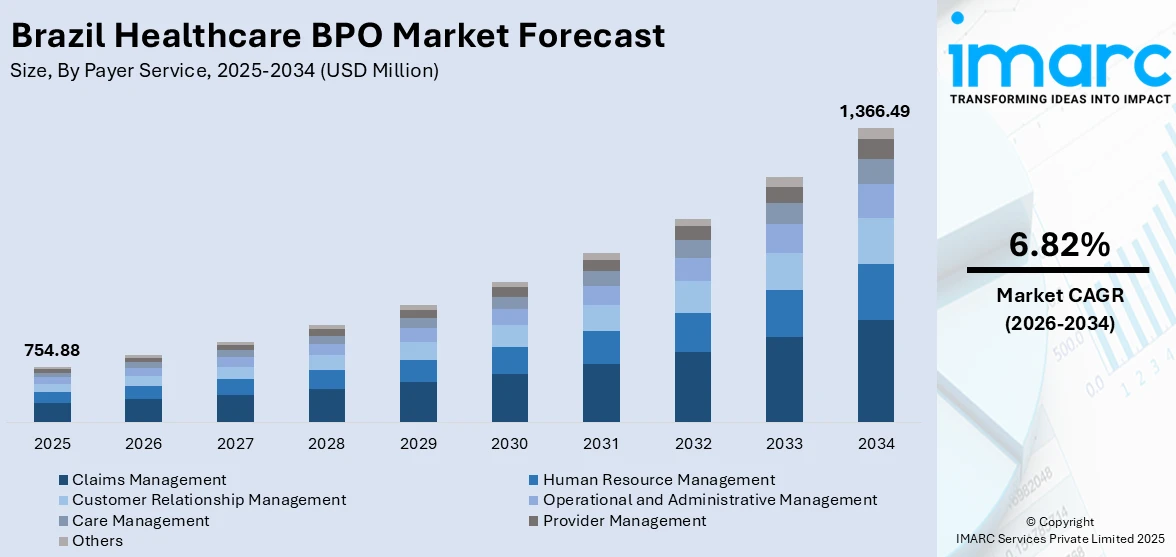
The Brazil healthcare BPO market size was valued at USD 754.88 Million in 2025 and is projected to reach USD 1,366.49 Million by 2034, growing at a compound annual growth rate of 6.82% from 2026-2034.
The Brazil healthcare BPO market is expanding, as healthcare organizations across the public and private sectors increasingly outsource non-core administrative and operational functions to improve efficiency and reduce costs. Rising demand for digital health solutions, growing regulatory complexity, and the need for specialized billing, coding, and claims processing expertise are accelerating outsourcing adoption. Advancements in automation, artificial intelligence (AI), and cloud-based platforms are further transforming healthcare BPO service delivery across the country.
Key Takeaways and Insights:
- By Payer Service: Claims management dominates the market with a share of 24.9% in 2025, owing to the rising volume of insurance claims driven by expanding private health plan enrollment, growing regulatory requirements for accurate claims processing, and the increasing adoption of outsourced solutions to minimize claim denials and improve reimbursement turnaround across the healthcare payer ecosystem.
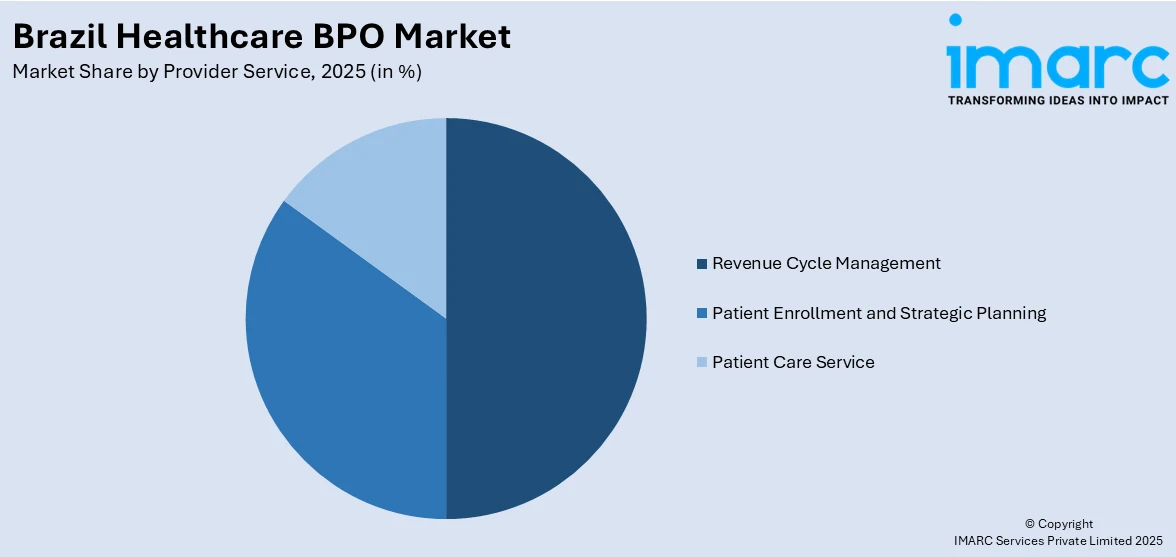
- By Provider Service: Revenue cycle management leads the market with a share of 41.3% in 2025, driven by the increasing need for healthcare providers to optimize financial workflows, ensure timely reimbursements, and reduce administrative burdens amid workforce shortages and rising operational complexities across hospitals and clinics.
- By Pharmaceutical Service: Manufacturing services exhibit a clear dominance in the market with 38.6% share in 2025, reflecting the expanding trend of pharmaceutical companies outsourcing production to contract manufacturers for cost optimization, regulatory compliance, and leveraging specialized manufacturing capabilities for generics and biologics.
- By Region: Southeast comprises the largest region with 57.4% share in 2025, driven by the concentration of major healthcare infrastructure, private hospital networks, pharmaceutical companies, and technology service providers in metropolitan areas, such as Sao Paulo, Rio de Janeiro, and Belo Horizonte.
- Key Players: Key players drive the Brazil healthcare BPO market by expanding service portfolios, investing in automation and AI technologies, strengthening partnerships with healthcare institutions, and enhancing digital capabilities to deliver efficient, compliant, and scalable outsourcing solutions across payer, provider, and pharmaceutical segments.
To get more information on this market Request Sample
The Brazil healthcare BPO market is witnessing sustained momentum, as the country's dual public-private healthcare system drives demand for specialized outsourcing services. According to the Brazilian Institute of Geography and Statistics, as of August 2025, Brazil’s Unified Healthcare System (SUS) served as the exclusive health services provider for nearly 72% of the population (164 Million individuals). Healthcare organizations face mounting pressure to manage administrative complexity while maintaining service quality. The growing adoption of digital health technologies, including telemedicine, electronic health records, and AI-driven diagnostics, is creating new outsourcing opportunities as providers seek specialized partners for technology integration and data management. Additionally, Brazil's General Data Protection Law (LGPD) compliance requirements are compelling healthcare entities to partner with BPO providers that possess regulatory expertise and robust data security frameworks, further propelling market expansion across all service segments.
Brazil Healthcare BPO Market Trends:
Accelerated Adoption of AI and Robotic Process Automation
Healthcare BPO providers in Brazil are rapidly integrating AI and robotic process automation into administrative workflows to enhance accuracy, reduce turnaround times, and lower operational costs. AI-driven tools are being deployed for claims adjudication, coding validation, denial management, and patient eligibility verification. The 2025 ISG Provider Lens Healthcare Digital Services report for Brazil found that healthcare organizations were prioritizing data integration and technology-enabled efficiency amid challenges of limited funding and regional inequality. These technological advancements are enabling BPO firms to deliver faster, more precise, and cost-effective services to payers and providers across the country.
Expansion of Cloud-Based BPO Service Delivery Models
Cloud-based platforms are transforming the Brazil healthcare BPO market growth, as organizations transition from legacy on-premises systems to scalable, secure, and remotely accessible digital environments. Cloud infrastructure enables real-time data access, seamless integration with electronic health records, and improved collaboration between healthcare entities and outsourcing partners. This shift is enhancing operational flexibility while reducing information technology (IT) maintenance costs for healthcare providers. Cloud-based BPO platforms also support advanced analytics, automation, and AI-driven workflows that improve service accuracy and turnaround times.
Rising Demand for Specialized Regulatory Compliance Outsourcing
The evolving regulatory landscape in Brazil is creating heightened demand for BPO providers with specialized compliance capabilities. Healthcare organizations are increasingly outsourcing compliance-related functions to mitigate regulatory risks, manage complex documentation requirements, and ensure adherence to data privacy standards. This trend is strengthening demand for BPO partners with deep regulatory expertise and localized knowledge of Brazilian healthcare laws. Providers are expanding compliance-focused service offerings, including audit support, reporting, and risk management solutions. As regulations continue to evolve, compliance-driven outsourcing is becoming a strategic necessity rather than a cost-saving option.
Market Outlook 2026-2034:
The Brazil healthcare BPO market is poised for robust expansion through the forecast period, underpinned by accelerating digital transformation across the healthcare value chain, rising administrative complexities, and the growing imperative for cost optimization among payers, providers, and pharmaceutical companies. The market generated a revenue of USD 754.88 Million in 2025 and is projected to reach a revenue of USD 1,366.49 Million by 2034, growing at a compound annual growth rate of 6.82% from 2026-2034. Increasing investments in AI, machine learning (ML), and cloud-based platforms will enable BPO providers to deliver more sophisticated and scalable services. The continued expansion of Brazil's private health insurance market, tightening regulatory compliance requirements under the LGPD, and the government's ongoing commitment to healthcare digitization are expected to create sustained outsourcing demand.
.webp)
Brazil Healthcare BPO Market Report Segmentation:
|
Segment Category |
Leading Segment |
Market Share |
|
Payer Service |
Claims Management |
24.9% |
|
Provider Service |
Revenue Cycle Management |
41.3% |
|
Pharmaceutical Service |
Manufacturing Services |
38.6% |
|
Region |
Southeast |
57.4% |
Payer Service Insights:
- Human Resource Management
- Claims Management
- Customer Relationship Management
- Operational and Administrative Management
- Care Management
- Provider Management
- Others
Claims management dominates with a market share of 24.9% of the total Brazil healthcare BPO market in 2025.
Claims management encompasses the complete claims lifecycle, including filing, verification, assessment, adjudication, and dispute resolution, making them critical to the financial sustainability of healthcare payers. The outsourcing of claims management has gained significant traction in Brazil as health plan operators seek to minimize claim denials, reduce turnaround times, and improve reimbursement accuracy. Outsourcing also enables payers to shift focus towards core care management and member engagement activities while lowering administrative overheads.
The need for outsourced claims management services is being further bolstered by the increasing complexity of reimbursement models and the ongoing evolution of healthcare payment structures in Brazil. The demand for robotic process automation and AI-powered solutions has increased due to the complexity of processing claims and disallowances, brought about by innovations in supplemental healthcare payment models. Payers can effectively manage large volumes of claims while adhering to regulatory requirements, due to the sophisticated technological platforms, scalable infrastructure, and in-depth domain knowledge that BPO providers offer.
Provider Service Insights:
Access the comprehensive market breakdown Request Sample
- Patient Enrollment and Strategic Planning
- Patient Care Service
- Revenue Cycle Management
Revenue cycle management leads with a share of 41.3% of the total Brazil healthcare BPO market in 2025.
Revenue cycle management encompasses end-to-end financial tracking across the patient account lifecycle, from appointment scheduling and registration through coding, billing, claims submission, and final payment collection. Healthcare providers in Brazil are increasingly outsourcing revenue cycle management functions to third-party vendors to reduce operational burdens and access specialized expertise in medical billing and coding. This shift is further supported by rising regulatory compliance requirements and the need for faster cash flow cycles amid tightening healthcare margins.
Brazil's healthcare facilities are increasingly integrating revenue cycle management solutions with electronic health records, which allows end-to-end tracking of patient encounters, from registration to final payment, and greatly reduces errors. Denial analytics is being given top priority by healthcare providers within revenue cycle management platforms in order to minimize revenue leakage from rejected or underpaid claims by identifying trends, underlying reasons, and preventive measures. As clear communication, simpler payment methods, and increased patient satisfaction become crucial differentiators for healthcare organizations in the competitive market, the increasing use of financial engagement tools and patient-centric billing solutions is also propelling revenue cycle management outsourcing.
Pharmaceutical Service Insights:
- Manufacturing Services
- Research and Development Services
- Non-clinical Services
Manufacturing services exhibit a clear dominance with a 38.6% share of the total Brazil healthcare BPO market in 2025.
Manufacturing services have emerged as a strategic imperative for pharmaceutical companies in Brazil, seeking to optimize production costs, ensure regulatory compliance, and leverage specialized capabilities for generics, biologics, and biosimilars. Companies are increasingly focusing on core competencies, such as research and marketing, while relying on contract manufacturing organizations for efficient, high-quality production at scale. This approach also helps mitigate capital expenditure risks associated with facility upgrades and capacity expansion.
Growing domestic medication demand, increased public healthcare coverage, and government programs supporting local drug production contribute to Brazil's pharmaceutical manufacturing services industry. Contract manufacturers are making investments in quality assurance systems, cutting-edge production technology, and compliance frameworks that meet strict regulatory requirements. Partnerships between pharmaceutical companies and specialist manufacturers are growing because of the surging need for biosimilars and complicated formulations. This allows increased scalability, a faster time-to-market, and consistent product quality while retaining cost efficiency throughout manufacturing cycles.
Regional Insights:
- Southeast
- South
- Northeast
- North
- Central-West
Southeast represents the leading region with a 57.4% share of the total Brazil healthcare BPO market in 2025.
Southeast dominates the Brazil healthcare BPO market, owing to its concentration of healthcare infrastructure, private hospital networks, pharmaceutical manufacturing facilities, and technology service providers. The region hosts the majority of Brazil's most advanced healthcare institutions, including internationally accredited hospitals in Sao Paulo and Rio de Janeiro. The Southeast holds a significant share of private health insurance coverage in the country, generating substantial demand for outsourced claims processing, billing, and revenue cycle management services from health plan operators and healthcare providers.
The presence of major metropolitan centers, such as Sao Paulo, Rio de Janeiro, Belo Horizonte, and Campinas, provides a robust ecosystem of skilled professionals, digital infrastructure, and corporate headquarters, which supports the healthcare BPO industry. The Sao Paulo state government's Leading Center for Innovation in Digital Health, which promotes cutting-edge digital health solutions and draws BPO investment, is one of the region's well-established technological corridors and innovation hubs. The Southeast's dominant position in healthcare outsourcing demand is further supported by increasing disposable incomes, higher health insurance penetration, and a more advanced regulatory compliance environment.
Market Dynamics:
Growth Drivers:
Why is the Brazil Healthcare BPO Market Growing?
Increasing Administrative Complexity and Cost Pressures in Healthcare
The Brazilian healthcare system faces escalating administrative complexity, driven by the dual structure of the SUS and a rapidly evolving private sector. Healthcare providers and payers confront mounting pressures from intricate reimbursement models, evolving regulatory requirements, and rising operational costs that strain internal resources. The growing burden of managing billing, coding, claims processing, and compliance functions is compelling healthcare organizations to seek cost-effective outsourcing solutions. As the country's population ages and chronic disease prevalence increases, the volume of healthcare encounters and associated administrative tasks continues to expand, creating sustained demand for BPO providers capable of delivering specialized services at scale while maintaining accuracy and regulatory adherence across the entire healthcare value chain. The population aged 65 and above (% of total population) in Brazil was recorded at 11.05 % in 2024, according to the World Bank collection of development indicators.
Rapid Digital Transformation and Technology Adoption in Healthcare
The accelerating digital transformation across Brazil's healthcare sector is creating substantial outsourcing opportunities, as organizations require specialized partners to manage technology implementation and ongoing digital operations. In 2024, the Brazilian Ministry of Health declared an investment of USD 84 Million in digital health and informatics solutions focused on the North and Northeast regions, signaling the government's commitment to healthcare digitization. Telemedicine, electronic health records, AI-driven diagnostics, and data analytics platforms are being widely adopted by both public and private healthcare entities, generating demand for BPO providers with advanced technological capabilities. BPO providers equipped with AI, ML, and cloud platforms are uniquely positioned to support this digital transition. Rising concerns around data security and interoperability are further strengthening reliance on experienced outsourcing partners.
Strengthening Regulatory Framework and Data Protection Requirements
Brazil's evolving regulatory environment, particularly the strengthening enforcement of the LGPD, is driving healthcare organizations to seek specialized BPO partners with regulatory compliance expertise. By mid-July 2024, the National Bank for Economic and Social Development (BNDES) granted credit approvals of USD 270 Million for the Brazilian pharmaceutical and pharma chemical sectors, indicating expanded industry activity requiring additional compliance support. The increasing complexity of healthcare billing regulations, insurance claim requirements, and pharmaceutical manufacturing standards necessitates outsourcing to providers with deep regulatory knowledge. Organizations that lack internal expertise to navigate these multifaceted compliance demands are increasingly relying on BPO firms to manage regulatory reporting, data protection, and audit preparedness. Heightened penalties for non-compliance and stricter regulatory scrutiny are further accelerating this shift towards compliance-focused outsourcing models.
Market Restraints:
What Challenges the Brazil Healthcare BPO Market is Facing?
Data Security and Privacy Concerns in Healthcare Outsourcing
Healthcare organizations in Brazil face persistent concerns over the security and privacy of sensitive patient data when engaging third-party BPO providers. The handling of protected health information by external vendors increases exposure to risks, such as data breaches, unauthorized access, and potential non-compliance with the LGPD. Rising cybersecurity threats across public and private sectors have heightened awareness about these vulnerabilities. As a result, healthcare entities are required to conduct rigorous vendor due diligence, establish strong contractual and governance frameworks, and maintain continuous oversight to effectively mitigate risks associated with outsourcing data-intensive operations.
High Implementation Costs and Integration Complexity
The upfront investment required for implementing comprehensive BPO solutions, including technology platform integration, staff transition, and process redesign, represents a substantial barrier for smaller healthcare providers and payers in Brazil. Many facilities, particularly those in underserved regions, lack the IT infrastructure and skilled personnel necessary for seamless integration with outsourcing partners. Interoperability challenges between legacy healthcare IT systems and modern BPO platforms further complicate adoption, creating data flow disruptions that can undermine the efficiency gains outsourcing is intended to deliver across diverse organizational environments.
Regional Disparities and Infrastructure Gaps
Significant disparities in healthcare infrastructure and digital readiness across Brazil’s regions continue to limit the uniform adoption of healthcare BPO services. While the Southeast benefits from mature technology ecosystems and strong connectivity, many healthcare facilities in remote and underserved areas struggle with inadequate digital infrastructure. These limitations reduce the ability of providers in the North, Northeast, and Central-West regions to effectively collaborate with outsourcing partners. Continued reliance on paper-based records, limited system interoperability, and shortages of digitally skilled personnel further constrain BPO market penetration beyond Brazil’s more developed healthcare hubs.
Competitive Landscape:
The Brazil healthcare BPO market features a moderately fragmented competitive landscape, characterized by the presence of both established multinational outsourcing firms and specialized domestic service providers. Companies compete on the basis of technological capabilities, regulatory expertise, service breadth, and cost efficiency. Strategic partnerships between technology providers and healthcare organizations are intensifying as firms seek to create integrated platforms for monitoring and optimizing patient care while reducing operational costs. Leading participants are differentiating through investments in AI, cloud-based platforms, and robotic process automation to deliver higher-value services.
Brazil Healthcare BPO Market Report Coverage:
|
Report Features |
Details |
|
Base Year of the Analysis |
2025 |
|
Historical Period |
2020-2025 |
|
Forecast Period |
2026-2034 |
|
Units |
USD Million |
|
Scope of the Report |
Exploration of Historical Trends and Market Outlook, Industry Catalysts and Challenges, Segment-Wise Historical and Future Market Assessment:
|
|
Payer Services Covered |
Human Resource Management, Claims Management, Customer Relationship Management, Operational and Administrative Management, Care Management, Provider Management, Others |
|
Provider Services Covered |
Patient Enrollment and Strategic Planning, Patient Care Service, Revenue Cycle Management |
|
Pharmaceutical Services Covered |
Manufacturing Services, Research and Development Services, Non-clinical Services |
|
Regions Covered |
Southeast, South, Northeast, North, Central-West |
|
Customization Scope |
10% Free Customization |
|
Post-Sale Analyst Support |
10-12 Weeks |
|
Delivery Format |
PDF and Excel through Email (We can also provide the editable version of the report in PPT/Word format on special request) |
Frequently Asked Questions About the Brazil Healthcare BPO Market Report
The Brazil healthcare BPO market size was valued at USD 754.88 Million in 2025.
The Brazil healthcare BPO market is expected to grow at a compound annual growth rate of 6.82% from 2026-2034 to reach USD 1,366.49 Million by 2034.
Claims management dominated the market with a share of 24.9%, driven by rising insurance claim volumes, growing regulatory complexity, and the increasing need for accurate and efficient claims processing across Brazil's healthcare payer ecosystem.
Key factors driving the Brazil healthcare BPO market include increasing administrative complexity in healthcare operations, rapid digital transformation and technology adoption, strengthening regulatory compliance requirements, and the growing need for cost optimization across payer, provider, and pharmaceutical segments.
Major challenges include data security and privacy concerns in healthcare outsourcing, high implementation costs and integration complexity, regional disparities in digital infrastructure, interoperability issues with legacy systems, workforce shortages in specialized billing and coding, and varying regulatory compliance standards across different healthcare segments.
Need more help?
- Speak to our experienced analysts for insights on the current market scenarios.
- Include additional segments and countries to customize the report as per your requirement.
- Gain an unparalleled competitive advantage in your domain by understanding how to utilize the report and positively impacting your operations and revenue.
- For further assistance, please connect with our analysts.
 Request Customization
 Speak to an Analyst
 Request Brochure
 Inquire Before Buying
Benefits of Customization
- Personalize this research
- Triangulate with your data
- Get data as per your format and definition
- Gain a deeper dive into a specific application, geography, customer, or competitor
- Any level of personalization
Get in Touch With Us
UNITED STATES
Phone: +1-201-971-6302
INDIA
Phone: +91-120-433-0800
UNITED KINGDOM
Phone: +44-753-714-6104
Email: [email protected]
Client Testimonials




.webp)




.webp)













Related Reports

Choose your plan
*Please note that the prices mentioned below are starting prices for each bundle type. Kindly contact our team for further details.*
Single User License
- 1 User License, Access on 2 Devices
- PDF Report + Excel Dataset (Password Protected)
- Lifetime Access
- No Printing Rights
- 10% Free Report Customization
- 10–12 Weeks of Analyst Support
Five User License
- Access for 5 Users, 2 Devices per User
- PDF Report + Excel Dataset (Password Protected)
- Lifetime Access
- Dedicated Account Manager
- 12–14 Weeks of Analyst Support
- No Printing Rights
- 15% Free Report Customization
- 25% Discount on Your Next Purchase
Corporate User License
- Unlimited User Access (Within Your Organization)
- PDF Report + Excel Dataset
- Lifetime Access
- Dedicated Account Manager
- 14–20 Weeks of Analyst Support
- No Printing Rights
- 20% Free Report Customization
- 30% Discount on Your Next Purchase
Essential Insights
What's included:
3 reports
- Lifetime Access
- PDF Reports
- Excel Datasets
- 2 Weeks of Free Analyst Support
- 2 User Licenses
- Access on 2 Devices
- Printing Rights
- Complimentary PowerPoint (PPT) Version
- Complimentary License Upgrade
Professional Access
What's included:
5 reports
- Lifetime Access
- PDF Reports
- Excel Datasets
- 8 Weeks of Free Analyst Support
- 2 User Licenses
- Access on 2 Devices
- Printing Rights
- Complimentary PowerPoint (PPT) Version
- Complimentary License Upgrade
Business Advantage
What's included:
8 reports
- Lifetime Access
- PDF Reports
- Excel Datasets
- 14 Weeks of Free Analyst Support
- 2 User Licenses
- Access on 2 Devices
- Printing Rights
- Complimentary PowerPoint (PPT) Version
- Complimentary License Upgrade
Enterprise Intelligence
What's included:
10 reports
- Lifetime Access
- PDF Reports
- Excel Datasets
- 20 Weeks of Free Analyst Support
- 2 User Licenses
- Access on 2 Devices
- Printing Rights
- Complimentary PowerPoint (PPT) Version
- Complimentary License Upgrade