
Brazil Live Streaming Market Size, Share, Trends and Forecast by Component, End User, and Region, 2026-2034
Brazil Live Streaming Market Summary:
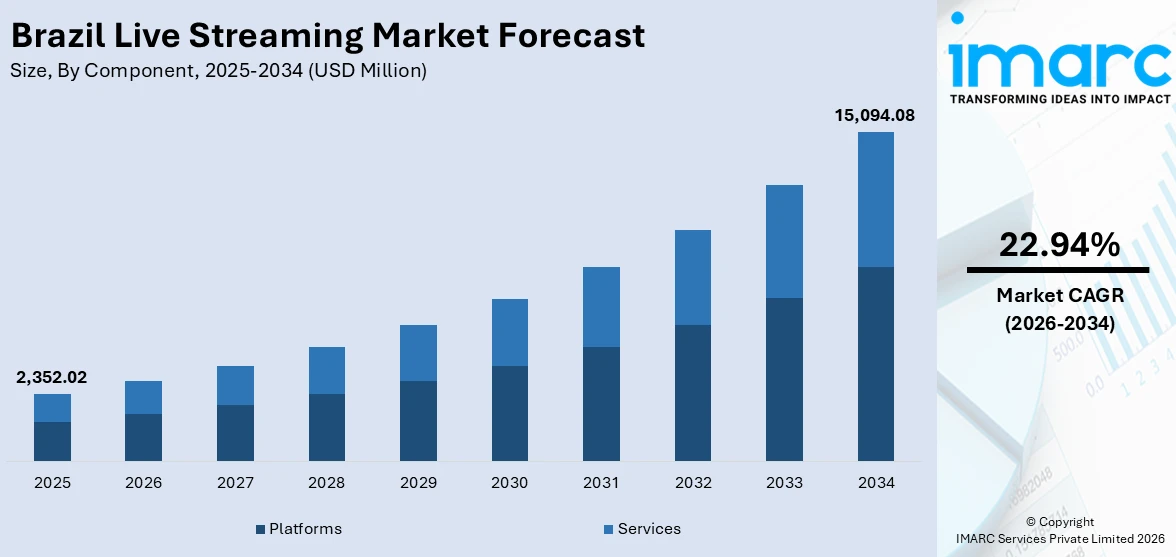
The Brazil live streaming market size was valued at USD 2,352.02 Million in 2025 and is projected to reach USD 15,094.08 Million by 2034, growing at a compound annual growth rate of 22.94% from 2026-2034.
The market is fueled by the fast-growing adoption of smartphones and mobile data services, the development of broadband infrastructure in urban and rural areas, the increasing demand for real-time interactive content, and the growing adoption of over-the-top platforms for entertainment, sports, and e-commerce. In addition, the rising impact of the creator economy and social live commerce, as well as government-backed initiatives for digital inclusion, is also boosting the adoption of live streaming services, hence the growing Brazil live streaming market share.
Key Takeaways and Insights:
-
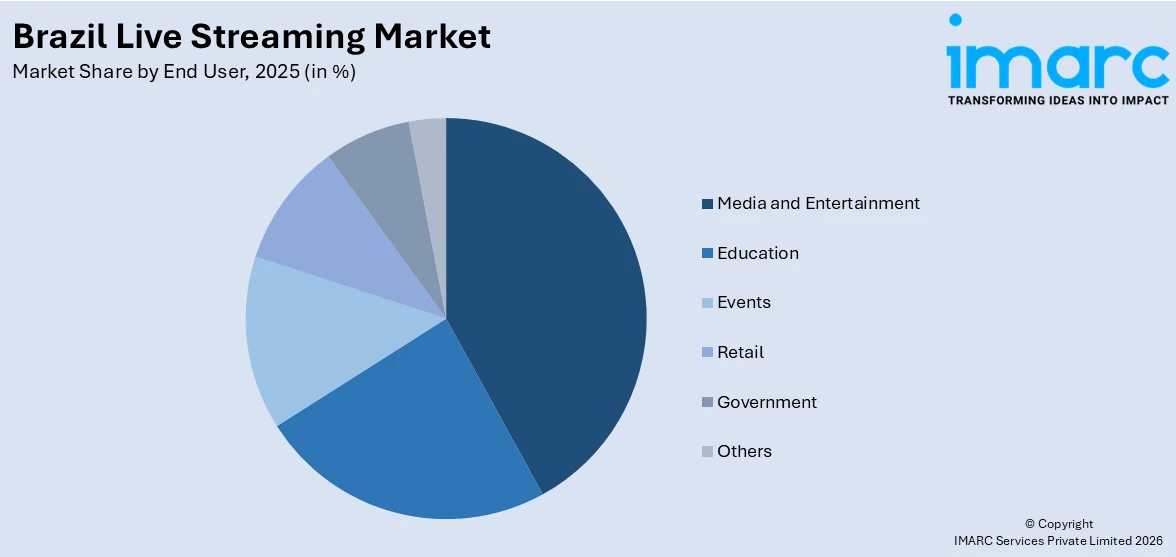
By End User: Media and entertainment lead the market with a share of 41.6% in 2025, owing to Brazil's cultural affinity for real-time entertainment, surging live sports broadcasting on digital platforms, and influencer-led interactive content.
-
By Region: Southeast dominates the market with a share of 45.1% in 2025, driven by the concentration of major metropolitan hubs, superior digital infrastructure, higher disposable incomes, and the presence of leading content creators.
-
Key Players: The Brazil live streaming market exhibits a moderately consolidated competitive landscape, with global technology-driven platforms competing alongside domestic broadcasters and regional content providers. Market participants are leveraging localized content strategies, creator partnerships, and ad-supported models to capture diverse audience segments.
To get more information on this market Request Sample
The Brazil live streaming market is experiencing robust expansion fueled by a convergence of technological, cultural, and socioeconomic factors. Widespread smartphone adoption coupled with increasingly affordable mobile data plans has made real-time video consumption accessible to a broad cross-section of the population. The country's vibrant creator economy and deeply social digital culture have made live streaming a natural extension of everyday communication and entertainment. In August 2025, Globo launched Ge TV, a free digital-first sports channel delivering live events and interactive programming across multiple online platforms, reinforcing Brazil’s live streaming ecosystem. Furthermore, the ongoing rollout of next-generation connectivity infrastructure is enabling higher-quality, lower-latency streaming experiences. Traditional broadcasters are also pivoting toward digital-first strategies, launching dedicated online channels that blend conventional programming with interactive, informal formats tailored to digitally native audiences. The simultaneous growth of live commerce, virtual events, and e-learning applications is diversifying the end-use landscape and attracting investment across multiple sectors.
Brazil Live Streaming Market Trends:
Rise of Live Social Commerce as a Mainstream Retail Channel
Live commerce is rapidly emerging as a transformative retail format in Brazil, where platforms are integrating real-time product demonstrations with influencer-led engagement to create interactive shopping experiences. The convergence of entertainment and commerce is reshaping consumer purchasing behavior, as audiences increasingly respond to flash deals, live polls, and chat-based interactions during broadcasts. In August 2024, Shopee reported its live commerce feature in Brazil surpassed 1 billion views and generated over 22 million hours of streamed content, highlighting rapid adoption of interactive shopping formats.
Expansion of Live Streaming into Education and Corporate Communication
Live video is gaining significant traction beyond entertainment, with educational institutions and corporate organizations increasingly adopting real-time streaming for classrooms, workshops, training sessions, and hybrid conferences. In November 2025, Brascam launched the EcoTalks Brascam LinkedIn Live webinar series connecting Brazilian and European experts through real-time virtual discussions and knowledge sessions. The scalability and cost-efficiency of live video make it an attractive alternative to in-person delivery, particularly for reaching geographically dispersed audiences across Brazil's vast territory. Interactive features such as real-time question-and-answer sessions, collaborative whiteboards, and breakout rooms enhance engagement and knowledge retention.
Integration of Immersive Technologies into Live Streaming Experiences
The incorporation of augmented reality, virtual reality, and artificial intelligence-driven personalization tools is fundamentally transforming the live streaming experience in Brazil. Content creators and platforms are deploying interactive overlays, virtual try-on features, and gesture-based navigation to create deeply engaging and customized viewing sessions. According to sources, AR try-on during Big Brother Brasil generated 261,245 users, 78,592 live interactions, and 22,579 leads via mobile virtual mirror integration during live broadcast. Real-time analytics powered by machine learning algorithms enable dynamic content adaptation based on viewer preferences and behavior patterns, extending average session durations and improving monetization across entertainment, fitness, and retail verticals.
Market Outlook 2026-2034:
The Brazil live streaming market is poised for sustained revenue expansion over the forecast period, driven by accelerating digital infrastructure development, deepening smartphone penetration, and the diversification of live content across entertainment, commerce, education, and corporate sectors. Revenue growth is expected to be further underpinned by the nationwide rollout of advanced connectivity networks, which will enable higher-quality streaming with reduced latency. The increasing integration of immersive technologies and AI-driven personalization will enhance viewer engagement and unlock new monetization avenues. The market generated a revenue of USD 2,352.02 Million in 2025 and is projected to reach a revenue of USD 15,094.08 Million by 2034, growing at a compound annual growth rate of 22.94% from 2026-2034.
Brazil Live Streaming Market Report Segmentation:
|
Segment Category |
Leading Segment |
Market Share |
|
End User |
Media and Entertainment |
41.6% |
|
Region |
Southeast |
45.1% |
Component Insights:
- Platforms
- Services
Platforms in the component of the Brazil live streaming market is driven by the rising demand for integrated content delivery, audience engagement, and monetization capabilities. In 2025, streaming platform Loco officially launched in Brazil with creator partnerships and interactive community features to strengthen real-time engagement and localized live content ecosystems. Brazilian consumers are gravitating toward platforms offering seamless multi-device experiences, interactive features, and creator-friendly tools that facilitate real-time broadcasting across entertainment, sports, and commerce applications.
The live streaming market in Brazil is witnessing strong growth in services, driven by the increasing demand for specialized live streaming services such as content delivery networks, cloud encoding, analytics, and support. This is because organizations in various sectors are increasingly turning into external service providers for managing live video infrastructure.
End User Insights:
Access the comprehensive market breakdown Request Sample
- Media and Entertainment
- Education
- Events
- Retail
- Government
- Others
Media and entertainment leads with a share of 41.6% of the total Brazil live streaming market in 2025.
The media and entertainment commands the largest share of the Brazil live streaming market, reflecting the country's deep cultural engagement with real-time digital content. Brazil's population has rapidly embraced live video as a primary medium for consuming entertainment, with audiences gravitating toward variety shows, music performances, live reactions, and interactive storytelling formats that foster community participation across multiple platforms. In September 2024, TikTok expanded its Subscription feature to Brazil, enabling creators to offer paid live content, exclusive perks, and tiered memberships to strengthen real-time entertainment engagement
The dominance in this segment is further supported by the paradigm shift in the traditional media players' strategy to focus on digital live content delivery, the rapid rise of the influenced-driven entertainment channels, and the rising accessibility of live sports programming on online streaming platforms. The high daily internet usage and highly social online behavior in Brazil provide a conducive environment for the continuous consumption of media and entertainment content through live streaming. This segment is expected to maintain its leading position in the market during the forecast period.
Regional Insights:
- Southeast
- South
- Northeast
- North
- Central-West
Southeast dominates with a market share of 45.1% of the total Brazil live streaming market in 2025.
Southeast holds the largest share of the Brazil live streaming market, underpinned by its status as the country's economic and demographic powerhouse. Home to major metropolitan hubs including São Paulo and Rio de Janeiro, the region benefits from superior digital infrastructure, higher broadband penetration, and greater concentrations of affluent urban consumers who drive premium content consumption and live commerce adoption. The region's advanced telecommunications networks and early adoption of next-generation connectivity solutions further enhance the quality and accessibility of live streaming experiences.
The dominance of the region can also be attributed to the fact that it is the main hub for the content creation ecosystem in Brazil, as it is home to the majority of the best digital content creators and technology companies in the country. The region attracts substantial investment from platform companies due to its large addressable audience and complex digital consumption behavior. As platforms focus on creator partnership programs, live event broadcasting, and commerce integrations, the Southeast region remains the innovation hub for live streaming in Brazil.
Market Dynamics:
Growth Drivers:
Why is the Brazil Live Streaming Market Growing?
Expanding Mobile Connectivity and Affordable Data Access
Brazil's live streaming market is experiencing significant growth driven by the rapid expansion of mobile connectivity and the increasing affordability of data plans across the country. The widespread availability of budget-friendly smartphones has democratized access to real-time video content, enabling millions of previously underserved consumers to participate in the live streaming ecosystem. In September 2024, Nokia partnered with NIC.br to upgrade Brazil’s internet exchange infrastructure, improving capacity and reliability to support rising digital traffic and streaming access. Government-backed digital inclusion initiatives are accelerating connectivity improvements in semi-urban and rural areas, broadening the addressable market for live video platforms and fostering new audience segments across diverse geographic regions.
Growing Demand for Real-Time Interactive Content Experiences
Brazilian consumers are increasingly gravitating toward content formats that offer authenticity, immediacy, and participatory engagement, fueling the demand for live streaming across multiple sectors. The cultural preference for communal digital experiences and real-time social interaction is driving audiences away from pre-recorded and scheduled programming toward live broadcasts that enable direct communication between creators and viewers. In September 2025, a YouTube-streamed NFL game broadcast from São Paulo incorporated interactive creator-led viewing segments and real-time engagement features, highlighting how live digital formats are reshaping audience participation in Brazil. This behavioral shift is encouraging platform operators and content producers to invest heavily in interactive tools, real-time chat functionalities, and audience participation features that deepen viewer loyalty and retention.
Diversification of Live Streaming Across Non-Entertainment Verticals
The expansion of live streaming applications beyond traditional entertainment into sectors such as retail, healthcare, corporate communication, and religious programming is serving as a powerful growth driver in Brazil. Organizations across these verticals are recognizing the scalability, cost-efficiency, and engagement potential of real-time video delivery for reaching geographically dispersed audiences. As per sources, Brazilian government launched a BRL 28 billion program to expand 5G, broadband, and digital TV access across education, healthcare, and public services, strengthening nationwide infrastructure for real-time video adoption.
Market Restraints:
What Challenges the Brazil Live Streaming Market is Facing?
Regional Digital Infrastructure Disparities
Brazil continues to face pronounced regional disparities in digital infrastructure quality and availability. Northern and northeastern regions lag considerably behind the affluent southeast in terms of broadband penetration, network reliability, and connection speeds. These infrastructure gaps limit the ability of live streaming platforms to reach and engage audiences in underserved areas, constraining overall market expansion.
Content Piracy and Intellectual Property Challenges
The prevalence of unauthorized content redistribution and piracy poses a persistent challenge for live streaming operators in Brazil. Unlicensed broadcasting of premium live events, particularly sports and entertainment content, undermines the revenue models of legitimate platforms and discourages investment in exclusive content acquisition. Slow regulatory enforcement further compounds this restraint.
Subscription Fatigue and Platform Fragmentation
The proliferation of competing streaming platforms in Brazil has led to increasing consumer fatigue from managing multiple subscriptions and navigating fragmented content libraries. As audiences subscribe to several services to access preferred live content, perceived value diminishes and churn rates rise, challenging platform operators to maintain subscriber loyalty and sustainable pricing models.
Competitive Landscape:
The Brazil live streaming market features a dynamic and increasingly competitive landscape characterized by the coexistence of global technology-driven platforms and established domestic media organizations. Competition is primarily centered on content differentiation, creator ecosystem development, and the deployment of advanced technological capabilities including low-latency streaming, interactive features, and integrated monetization tools. Market participants are pursuing diverse strategies ranging from exclusive sports broadcasting rights and original content production to live commerce integrations and ad-supported free streaming models. The competitive environment is further intensified by the entry of social media platforms into the live video space, blurring traditional boundaries between content consumption and social interaction.
Brazil Live Streaming Market Report Coverage:
|
Report Features |
Details |
|
Base Year of the Analysis |
2025 |
|
Historical Period |
2020-2025 |
|
Forecast Period |
2026-2034 |
|
Units |
Million USD |
|
Scope of the Report |
Exploration of Historical Trends and Market Outlook, Industry Catalysts and Challenges, Segment-Wise Historical and Future Market Assessment:
|
|
Components Covered |
Platforms, Services |
|
End Users Covered |
Media and Entertainment, Education, Events, Retail, Government, Others |
|
Regions Covered |
Southeast, South, Northeast, North, Central-West |
|
Customization Scope |
10% Free Customization |
|
Post-Sale Analyst Support |
10-12 Weeks |
|
Delivery Format |
PDF and Excel through Email (We can also provide the editable version of the report in PPT/Word format on special request) |
Frequently Asked Questions About the Brazil Live Streaming Market Report
The Brazil live streaming market size was valued at USD 2,352.02 Million in 2025.
The Brazil live streaming market is expected to grow at a compound annual growth rate of 22.94% from 2026-2034 to reach USD 1,5094.08 Million by 2034.
Media and entertainment held the largest Brazil live streaming market share, driven by Brazil's deeply ingrained digital entertainment culture, the rapid growth of influencer-driven live content formats, and the increasing availability of live sports and event broadcasting through streaming platforms.
Key factors driving the Brazil live streaming market include expanding mobile connectivity and affordable data access, the thriving creator economy generating innovative real-time content, the convergence of live video with e-commerce, and government-supported digital inclusion programs broadening audience reach.
Major challenges include significant regional disparities in digital infrastructure quality, persistent content piracy and intellectual property enforcement difficulties, growing subscription fatigue amid platform fragmentation, uneven regulatory frameworks for digital content distribution, and intensifying competition for exclusive content rights and creator partnerships.
Need more help?
- Speak to our experienced analysts for insights on the current market scenarios.
- Include additional segments and countries to customize the report as per your requirement.
- Gain an unparalleled competitive advantage in your domain by understanding how to utilize the report and positively impacting your operations and revenue.
- For further assistance, please connect with our analysts.
 Request Customization
 Speak to an Analyst
 Request Brochure
 Inquire Before Buying
Benefits of Customization
- Personalize this research
- Triangulate with your data
- Get data as per your format and definition
- Gain a deeper dive into a specific application, geography, customer, or competitor
- Any level of personalization
Get in Touch With Us
UNITED STATES
Phone: +1-201-971-6302
INDIA
Phone: +91-120-433-0800
UNITED KINGDOM
Phone: +44-753-714-6104
Email: [email protected]
Client Testimonials




.webp)




.webp)













Related Reports

Choose your plan
*Please note that the prices mentioned below are starting prices for each bundle type. Kindly contact our team for further details.*
Single User License
- 1 User License, Access on 2 Devices
- PDF Report + Excel Dataset (Password Protected)
- Lifetime Access
- No Printing Rights
- 10% Free Report Customization
- 10–12 Weeks of Analyst Support
Five User License
- Access for 5 Users, 2 Devices per User
- PDF Report + Excel Dataset (Password Protected)
- Lifetime Access
- Dedicated Account Manager
- 12–14 Weeks of Analyst Support
- No Printing Rights
- 15% Free Report Customization
- 25% Discount on Your Next Purchase
Corporate User License
- Unlimited User Access (Within Your Organization)
- PDF Report + Excel Dataset
- Lifetime Access
- Dedicated Account Manager
- 14–20 Weeks of Analyst Support
- No Printing Rights
- 20% Free Report Customization
- 30% Discount on Your Next Purchase
Essential Insights
What's included:
3 reports
- Lifetime Access
- PDF Reports
- Excel Datasets
- 2 Weeks of Free Analyst Support
- 2 User Licenses
- Access on 2 Devices
- Printing Rights
- Complimentary PowerPoint (PPT) Version
- Complimentary License Upgrade
Professional Access
What's included:
5 reports
- Lifetime Access
- PDF Reports
- Excel Datasets
- 8 Weeks of Free Analyst Support
- 2 User Licenses
- Access on 2 Devices
- Printing Rights
- Complimentary PowerPoint (PPT) Version
- Complimentary License Upgrade
Business Advantage
What's included:
8 reports
- Lifetime Access
- PDF Reports
- Excel Datasets
- 14 Weeks of Free Analyst Support
- 2 User Licenses
- Access on 2 Devices
- Printing Rights
- Complimentary PowerPoint (PPT) Version
- Complimentary License Upgrade
Enterprise Intelligence
What's included:
10 reports
- Lifetime Access
- PDF Reports
- Excel Datasets
- 20 Weeks of Free Analyst Support
- 2 User Licenses
- Access on 2 Devices
- Printing Rights
- Complimentary PowerPoint (PPT) Version
- Complimentary License Upgrade