
Brazil Location Analytics Market Size, Share, Trends and Forecast by Component, Deployment Mode, Location Type, Application, End Use Industry, and Region, 2026-2034
Brazil Location Analytics Market Summary:
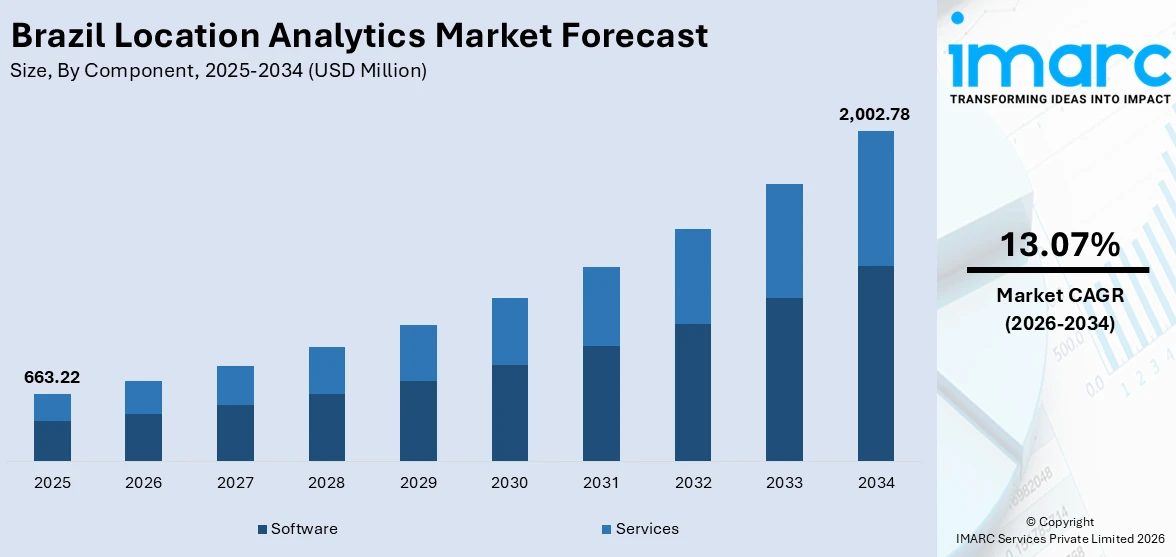
The Brazil location analytics market size was valued at USD 663.22 Million in 2025 and is projected to reach USD 2,002.78 Million by 2034, growing at a compound annual growth rate of 13.07% from 2026-2034.
The Brazil location analytics market is experiencing robust expansion driven by the proliferation of smart city initiatives, accelerating digital transformation across industries, and the rising demand for real-time geospatial intelligence. Increasing adoption of IoT-enabled devices, growing e-commerce logistics requirements, and advancements in cloud-based analytics platforms are further strengthening demand. Enhanced mobile connectivity through 5G deployment and favorable government policies supporting digital infrastructure are reinforcing the Brazil location analytics market share.
Key Takeaways and Insights:
- By Component: Software dominates the market with a share of 62.8% in 2025, owing to the growing enterprise demand for integrated analytics platforms that combine geospatial data processing, visualization, and predictive modeling capabilities within unified solutions.
- By Deployment Mode: Cloud-based leads the market with a share of 64.3% in 2025. This dominance is driven by scalable infrastructure requirements, cost-effective subscription models, and the need for real-time data accessibility across distributed operations.
- By Location Type: Outdoor represents the biggest segment with a market share of 58.7% in 2025, reflecting extensive applications in fleet management, logistics optimization, precision agriculture, and urban mobility planning across the country's expansive geography.
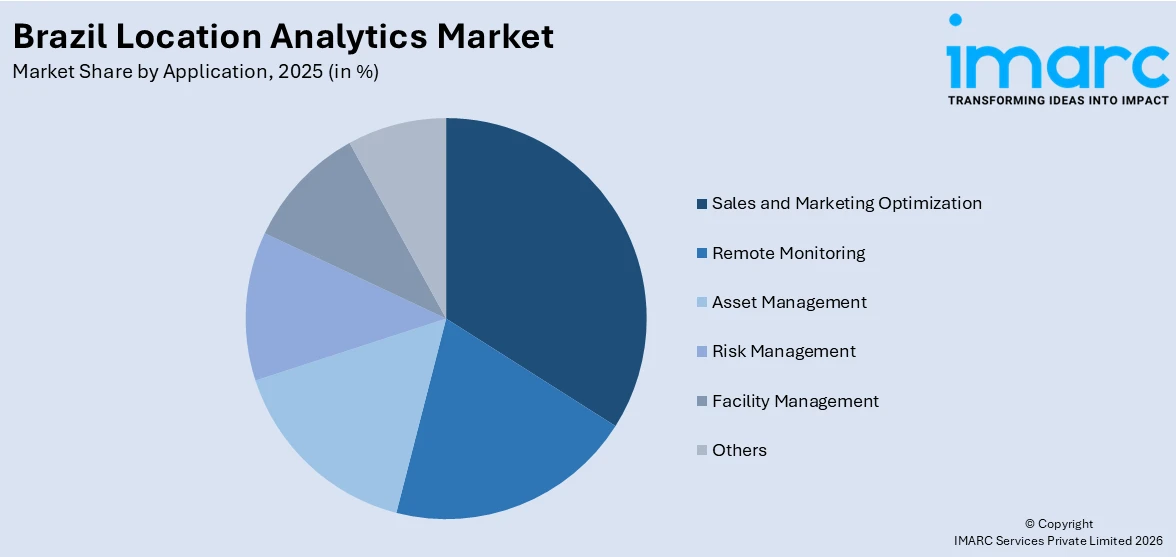
- By Application: Sales and marketing optimization dominates the market with a share of 27.6% in 2025, owing to the increasing use of location-based consumer insights for targeted advertising, store site selection, and customer engagement strategies.
- By End Use Industry: Retail and consumer goods exhibit a clear dominance in the market with 22.4% share in 2025, reflecting strong adoption of geospatial tools for site analysis, foot traffic evaluation, and omnichannel distribution strategies.
- By Region: Southeast represents the largest region with 51.9% share in 2025, driven by the concentration of technology infrastructure, corporate headquarters, and innovation ecosystems in metropolitan centers including São Paulo and Rio de Janeiro.
- Key Players: Key players in the Brazil location analytics market drive growth by investing in advanced geospatial platforms, expanding cloud-based service portfolios, forming strategic technology partnerships, and strengthening integration capabilities with AI and IoT ecosystems to deliver actionable spatial intelligence across diverse industries.
To get more information on this market Request Sample
The Brazil location analytics market is advancing as enterprises and government agencies increasingly leverage spatial data to optimize operations, enhance customer engagement, and drive strategic decision-making. The convergence of artificial intelligence, machine learning, and geospatial technologies is enabling organizations to extract deeper insights from location data, transforming how businesses approach site selection, supply chain management, and urban planning. The country's thriving digital ecosystem, anchored by a rapidly expanding cloud computing infrastructure and growing 5G deployment, provides a strong foundation for location analytics adoption. In September 2025, Alibaba Cloud announced plans to launch its first data center in Brazil as part of a global infrastructure expansion to support AI and cloud services. This investment underscores the growing demand for scalable computing resources that power advanced location analytics workloads. The integration of real-time geospatial intelligence into business workflows is becoming essential for competitive differentiation, particularly across retail, logistics, financial services, and government operations, positioning Brazil as a key growth market in Latin America.
Brazil Location Analytics Market Trends:
Integration of AI and Machine Learning with Geospatial Platforms
The integration of artificial intelligence and machine learning with location analytics platforms is transforming spatial data processing capabilities across Brazilian enterprises. Advanced algorithms are enabling predictive modeling, automated pattern recognition, and anomaly detection from geospatial datasets, enhancing decision-making accuracy in urban planning, logistics, and consumer behavior analysis. These intelligent systems allow organizations to uncover hidden spatial relationships and generate actionable insights from complex geographic data. The growing availability of cloud-based AI tools is further democratizing access to sophisticated analytical capabilities, enabling businesses of all sizes to leverage location intelligence for competitive advantage.
Expansion of Smart City Initiatives and Urban Digital Infrastructure
Brazilian cities are accelerating smart city deployments, incorporating location-based intelligence for traffic management, public safety, and resource optimization. The growing emphasis on data-driven urban governance is creating substantial demand for outdoor and indoor location analytics solutions. Municipal governments are investing in sensor networks, connected infrastructure, and intelligent monitoring systems that generate vast volumes of spatial data requiring advanced analytics capabilities. These initiatives are fostering collaboration between public agencies and technology providers, establishing integrated urban platforms that leverage real-time geospatial intelligence to improve service delivery, enhance citizen engagement, and support sustainable metropolitan development.
Rising Adoption of Cloud-Based Location Analytics Solutions
Cloud-based deployment models are gaining significant traction as enterprises seek scalable, cost-effective solutions for managing and analyzing large volumes of geospatial data. The shift toward cloud infrastructure enables real-time processing, remote accessibility, and seamless integration with existing enterprise systems. In September 2024, Microsoft committed a USD 2.7 Billion investment in Brazil for cloud and AI infrastructure through the "Microsoft Mais Brazil" program, focusing on expanding cloud capabilities in São Paulo and training nearly five million Brazilians in AI technologies, which supports the growing demand for cloud-hosted analytics solutions.
Brazil Location Analytics Market Outlook 2026-2034:
The Brazil location analytics market is poised for sustained expansion as digital transformation initiatives, smart city deployments, and e-commerce logistics modernization accelerate across the country. The market generated a revenue of USD 663.22 Million in 2025 and is projected to reach a revenue of USD 2,002.78 Million by 2034, growing at a compound annual growth rate of 13.07% from 2026-2034. Increasing investments in data center infrastructure, the expanding rollout of 5G connectivity, and growing enterprise adoption of AI-powered spatial analytics will continue to strengthen market demand across key verticals including retail, logistics, government, and financial services. The convergence of geospatial technologies with artificial intelligence and machine learning is enabling more sophisticated predictive modeling and real-time decision-making capabilities. Additionally, the growing emphasis on location-based consumer engagement, supply chain optimization, and urban resource management is creating new application opportunities that will sustain long-term market momentum.
.webp)
Brazil Location Analytics Market Report Segmentation:
|
Segment Category |
Leading Segment |
Market Share |
|
Component |
Software |
62.8% |
|
Deployment Mode |
Cloud-based |
64.3% |
|
Location Type |
Outdoor |
58.7% |
|
Application |
Sales and Marketing Optimization |
27.6% |
|
End Use Industry |
Retail and Consumer Goods |
22.4% |
|
Region |
Southeast |
51.9% |
Component Insights:
- Software
- Services
Software dominates with a market share of 62.8% of the total Brazil location analytics market in 2025.
The software segment commands the largest share in the Brazil location analytics market, driven by the increasing enterprise demand for comprehensive platforms that integrate data ingestion, spatial visualization, and advanced analytics within unified interfaces. Brazilian organizations across retail, logistics, and government are prioritizing software investments to enable real-time geospatial intelligence and predictive modeling. The growing complexity of spatial data environments is prompting businesses to adopt end-to-end software solutions that streamline workflows from data collection through actionable insight generation. These platforms offer configurable dashboards, automated reporting, and integration capabilities that align with diverse industry requirements, enabling faster and more informed strategic decisions across the organization.
The preference for software-centric deployments reflects the broader trend toward self-service analytics, where business users require intuitive tools for spatial data exploration without extensive technical expertise. Platform consolidation is accelerating as enterprises seek multipurpose solutions spanning geocoding, route optimization, and customer segmentation within single software ecosystems, reducing total cost of ownership while enhancing analytical capabilities. The continuous evolution of software functionalities, including natural language querying and automated spatial pattern detection, is further expanding the addressable user base beyond traditional geospatial specialists.
Deployment Mode Insights:
- On-premises
- Cloud-based
Cloud-based leads with a share of 64.3% of the total Brazil location analytics market in 2025.
Cloud-based deployment holds the dominant position in the Brazil location analytics market as organizations increasingly migrate geospatial workloads to scalable cloud infrastructure. The subscription-based model reduces capital expenditure while enabling elastic computing for processing large spatial datasets. Enterprises benefit from the flexibility to scale computing resources dynamically based on analytical demand, eliminating the constraints of fixed on-premises hardware. The growing availability of cloud-native geospatial tools and managed analytics services is enabling organizations to accelerate deployment timelines and reduce the complexity of maintaining spatial data infrastructure internally.
The cloud deployment model enables distributed teams to access location analytics tools in real time, facilitating collaboration across geographically dispersed operations. Enhanced data residency controls, with major cloud providers establishing local availability zones, are addressing compliance requirements under Brazil's data protection framework, further encouraging cloud adoption among enterprises managing sensitive geospatial data. The integration of cloud platforms with artificial intelligence and machine learning services is creating powerful analytical environments that combine spatial intelligence with predictive capabilities, enabling organizations to derive deeper insights and respond more effectively to evolving market conditions.
Location Type Insights:
- Indoor
- Outdoor
Outdoor exhibits a clear dominance with 58.7% share of the total Brazil location analytics market in 2025.
Outdoor location analytics leads the market, reflecting Brazil's extensive geographic territory and the critical need for spatial intelligence in logistics, agriculture, fleet management, and urban mobility. The country's growing investment in transportation infrastructure and delivery networks demands precise outdoor positioning data for route planning, asset tracking, and resource allocation. The increasing adoption of satellite-based navigation systems and real-time tracking solutions is enabling enterprises to optimize operations across vast distances.
The expansion of outdoor analytics is further supported by the deployment of GPS-enabled devices, connected vehicles, and drone-based surveying technologies across agricultural and environmental monitoring applications. These technologies provide high-precision spatial data that enhances crop health assessment, terrain mapping, and supply chain visibility across remote regions. Brazil's vast agricultural sector, which generated USD 164.4 billion in export revenue in 2024, relies heavily on outdoor spatial analytics for crop monitoring, route optimization, and supply chain management across the country's extensive rural landscape. The growing integration of IoT sensors with geospatial platforms is enabling precision farming techniques and real-time environmental surveillance.
Application Insights:
Access the comprehensive market breakdown Request Sample
- Remote Monitoring
- Sales and Marketing Optimization
- Asset Management
- Risk Management
- Facility Management
- Others
Sales and marketing optimization prevails the market with 27.6% share of the total Brazil location analytics market in 2025.
Sales and marketing optimization holds the largest application share as Brazilian enterprises increasingly leverage location intelligence for targeted consumer engagement, site selection, and trade area analysis. Retailers and franchise operators utilize geospatial tools to evaluate foot traffic patterns, demographic profiles, and competitive positioning when planning expansion strategies. The ability to map consumer concentrations, assess purchasing behavior by geographic zone, and identify optimal locations for new outlets provides a significant strategic advantage. Businesses are also using spatial analytics to design territory-specific promotional campaigns that align marketing efforts with localized consumer preferences and demand patterns.
The growing sophistication of location-based advertising and personalized marketing campaigns is driving sustained demand for spatial analytics in sales optimization. Businesses are integrating geospatial data with consumer behavior insights to refine distribution strategies, optimize promotional spending, and identify underserved market segments, creating measurable improvements in customer acquisition and retention rates. The convergence of mobile device data with spatial analytics platforms is enabling marketers to develop more precise audience targeting models, enhancing campaign effectiveness while improving return on investment across both digital and physical retail channels.
End Use Industry Insights:
- BFSI
- Healthcare
- Hospitality
- Government
- Transport and Logistic
- IT and Telecom
- Retail and Consumer Goods
- Media and Entertainment
- Others
Retail and consumer goods hold the largest share with 22.4% of the total Brazil location analytics market in 2025.
The retail and consumer goods sector leads end-use industry adoption of location analytics in Brazil, driven by the need for data-driven site selection, customer journey mapping, and omnichannel distribution optimization. The rapid expansion of e-commerce has intensified demand for spatial intelligence tools that optimize last-mile delivery networks and warehouse placement. Retailers are increasingly relying on geospatial insights to evaluate catchment areas, monitor competitive dynamics, and identify emerging consumer corridors across both established metropolitan markets and rapidly growing secondary cities. The integration of location analytics into supply chain planning is enabling more efficient inventory distribution and reducing fulfillment costs.
Brazilian retailers are deploying location analytics to understand consumer mobility patterns, assess trade area potential, and optimize store networks across diverse metropolitan and regional markets. The integration of geospatial insights with point-of-sale data enables retailers to measure store performance relative to surrounding demographics, informing decisions on product assortment, pricing strategies, and promotional targeting. The growing adoption of omnichannel retailing models further amplifies the need for spatial intelligence that connects online purchasing behavior with physical store networks, enabling seamless customer experiences across all engagement channels.
Regional Insights:
- Southeast
- South
- Northeast
- North
- Central-West
Southeast represents the leading region with 51.9% share of the total Brazil location analytics market in 2025.
The Southeast region commands the dominant share of Brazil's location analytics market, anchored by the concentration of technology companies, data center infrastructure, and corporate headquarters in the region's major metropolitan centers. The area hosts the largest share of the country's startup ecosystem and venture capital activity, creating a dense environment of demand for advanced spatial analytics solutions. The region benefits from superior digital connectivity, established cloud infrastructure, and proximity to major consumer markets, making it the natural epicenter for technology adoption and innovation in location intelligence applications across diverse industry verticals.
The Southeast's dominance is further reinforced by significant ongoing investments in digital infrastructure, including multiple hyperscale data center projects and cloud service expansions across the metropolitan corridor. The concentration of retail chains, financial institutions, and logistics operations in the region creates sustained demand for location intelligence applications across site planning, risk assessment, and customer analytics. The presence of leading universities and research institutions also supports a robust talent pipeline of geospatial professionals, data scientists, and software engineers who drive continued innovation and adoption of location analytics solutions throughout the regional economy.
Market Dynamics:
Growth Drivers:
Why is the Brazil Location Analytics Market Growing?
Accelerating Digital Transformation and Cloud Infrastructure Expansion
Brazil's digital transformation is accelerating across industries as enterprises adopt cloud-based platforms, AI-driven tools, and data analytics solutions to enhance operational efficiency and competitive positioning. The rapid expansion of cloud infrastructure provides the computational foundation necessary for processing large-scale geospatial datasets in real time. The government's proactive approach to digital infrastructure development, including dedicated policies and strategic plans targeting data center growth and artificial intelligence advancement, is creating a supportive environment for analytics adoption. Major cloud providers are expanding their presence through new facility developments and capacity expansions, strengthening the regional computing ecosystem. The increasing availability of high-performance cloud resources enables organizations of all sizes to deploy sophisticated location analytics without significant upfront capital investment, democratizing access to spatial intelligence tools and driving market expansion. The convergence of cloud computing with edge processing capabilities is further enhancing the delivery of low-latency geospatial services, enabling enterprises to process location data closer to the point of generation for faster and more responsive analytical outcomes across distributed operational environments.
Growing E-Commerce and Logistics Modernization
The rapid expansion of Brazil's e-commerce sector is driving significant demand for location analytics solutions that optimize delivery networks, warehouse placement, and last-mile logistics. As consumer expectations for faster delivery intensify, logistics providers and retailers are deploying spatial intelligence tools to analyze route efficiency, assess distribution center locations, and monitor real-time fleet movements. The growing logistics technology ecosystem, with over one thousand logistics tech startups operating in the country, reflects the scale of innovation in this space. Small and medium enterprises have emerged as key growth drivers, registering substantial increases in online commerce volumes during recent years, which has led to the expansion of logistics networks beyond traditional metropolitan corridors into secondary cities and regional hubs. The decentralization of e-commerce fulfillment is creating new demand for location analytics across previously underserved geographic areas, broadening the overall market opportunity.
Proliferation of Smart City Programs and IoT-Enabled Urban Planning
Brazilian municipalities are increasingly embracing smart city frameworks that integrate location analytics into urban governance, public safety, transportation management, and environmental monitoring. The deployment of IoT sensors, connected infrastructure, and intelligent traffic systems generates vast volumes of spatial data that require advanced analytics capabilities. Leading cities across the country are gaining international recognition for their innovative approaches to data-driven urban development, demonstrating growing expertise in leveraging spatial intelligence for municipal service delivery and citizen engagement. The implementation of intelligent surveillance networks, real-time traffic management platforms, and digitized public service portals is expanding the scope of location analytics applications within urban environments. The expansion of next-generation connectivity is further enhancing the potential for real-time location monitoring, enabling applications ranging from automated traffic management to environmental surveillance and emergency response coordination across the country's major urban centers. The growing collaboration between municipal governments and technology providers is fostering integrated urban platforms that harness geospatial intelligence for sustainable metropolitan planning and resource allocation.
Market Restraints:
What Challenges the Brazil Location Analytics Market is Facing?
Data Privacy Regulations and Compliance Complexity
Brazil's General Data Protection Law (LGPD) imposes stringent requirements on the collection, processing, and storage of location data, creating compliance challenges for analytics providers and enterprises. Navigating evolving privacy frameworks while maintaining the granularity required for effective spatial analysis demands significant investment in data governance, anonymization technologies, and regulatory monitoring.
Shortage of Skilled Geospatial Analytics Professionals
The limited availability of professionals with combined expertise in geospatial technologies, data science, and analytics platforms constrains market growth. Organizations face challenges in recruiting and retaining talent capable of deploying, managing, and interpreting complex location analytics solutions, particularly outside major metropolitan centers where the technology workforce is concentrated.
Infrastructure Disparities Across Geographic Regions
Significant disparities in digital infrastructure, connectivity, and technological readiness between Brazil's urban and rural regions limit the uniform adoption of location analytics solutions. Remote areas often lack adequate internet bandwidth, data center proximity, and IoT network coverage, creating adoption barriers that restrict market penetration beyond the country's most developed southeastern corridor.
Competitive Landscape:
The Brazil location analytics market features a competitive environment comprising global technology leaders and specialized regional providers. Companies are differentiating through investments in AI-powered analytics capabilities, cloud-native platform architectures, and industry-specific solutions tailored to Brazilian market requirements. Strategic partnerships, technology integrations, and expansion of local service infrastructure are key competitive strategies. Market participants are focusing on enhancing Portuguese-language interfaces, ensuring LGPD compliance, and establishing local data residency to strengthen their positioning. Innovation in real-time processing, predictive spatial modeling, and seamless integration with enterprise systems is driving competitive intensity across the market.
Brazil Location Analytics Market Report Coverage:
|
Report Features |
Details |
|
Base Year of the Analysis |
2025 |
|
Historical Period |
2020-2025 |
|
Forecast Period |
2026-2034 |
|
Units |
Million USD |
|
Scope of the Report |
Exploration of Historical Trends and Market Outlook, Industry Catalysts and Challenges, Segment-Wise Historical and Future Market Assessment:
|
|
Components Covered |
Software, Services |
|
Deployment Modes Covered |
On-premises, Cloud-based |
|
Location Types Covered |
Indoor, Outdoor |
|
Applications Covered |
Remote Monitoring, Sales and Marketing Optimization, Asset Management, Risk Management, Facility Management, Others |
|
End Use Industries Covered |
BFSI, Healthcare, Hospitality, Government, Transport and Logistic, IT and Telecom, Retail and Consumer Goods, Media and Entertainment, Others |
|
Regions Covered |
Southeast, South, Northeast, North, Central-West |
|
Customization Scope |
10% Free Customization |
|
Post-Sale Analyst Support |
10-12 Weeks |
|
Delivery Format |
PDF and Excel through Email (We can also provide the editable version of the report in PPT/Word format on special request) |
Frequently Asked Questions About the Brazil Location Analytics Market Report
The Brazil location analytics market size was valued at USD 663.22 Million in 2025.
The Brazil location analytics market is expected to grow at a compound annual growth rate of 13.07% from 2026-2034 to reach USD 2,002.78 Million by 2034.
Software dominated the market with a share of 62.8%, driven by the increasing enterprise demand for integrated analytics platforms that combine geospatial data processing, visualization, and predictive modeling capabilities for strategic decision-making.
Key factors driving the Brazil location analytics market include accelerating digital transformation, expanding cloud infrastructure, growing e-commerce logistics requirements, proliferation of smart city initiatives, increasing IoT device adoption, and supportive government policies for digital infrastructure development.
Major challenges include data privacy regulations under LGPD, shortage of skilled geospatial analytics professionals, infrastructure disparities between urban and rural regions, high implementation costs for smaller enterprises, and data quality and integration complexities across fragmented sources.
Need more help?
- Speak to our experienced analysts for insights on the current market scenarios.
- Include additional segments and countries to customize the report as per your requirement.
- Gain an unparalleled competitive advantage in your domain by understanding how to utilize the report and positively impacting your operations and revenue.
- For further assistance, please connect with our analysts.
 Request Customization
 Speak to an Analyst
 Request Brochure
 Inquire Before Buying
Benefits of Customization
- Personalize this research
- Triangulate with your data
- Get data as per your format and definition
- Gain a deeper dive into a specific application, geography, customer, or competitor
- Any level of personalization
Get in Touch With Us
UNITED STATES
Phone: +1-201-971-6302
INDIA
Phone: +91-120-433-0800
UNITED KINGDOM
Phone: +44-753-714-6104
Email: [email protected]
Client Testimonials




.webp)




.webp)













Related Reports

Choose your plan
*Please note that the prices mentioned below are starting prices for each bundle type. Kindly contact our team for further details.*
Single User License
- 1 User License, Access on 2 Devices
- PDF Report + Excel Dataset (Password Protected)
- Lifetime Access
- No Printing Rights
- 10% Free Report Customization
- 10–12 Weeks of Analyst Support
Five User License
- Access for 5 Users, 2 Devices per User
- PDF Report + Excel Dataset (Password Protected)
- Lifetime Access
- Dedicated Account Manager
- 12–14 Weeks of Analyst Support
- No Printing Rights
- 15% Free Report Customization
- 25% Discount on Your Next Purchase
Corporate User License
- Unlimited User Access (Within Your Organization)
- PDF Report + Excel Dataset
- Lifetime Access
- Dedicated Account Manager
- 14–20 Weeks of Analyst Support
- No Printing Rights
- 20% Free Report Customization
- 30% Discount on Your Next Purchase
Essential Insights
What's included:
3 reports
- Lifetime Access
- PDF Reports
- Excel Datasets
- 2 Weeks of Free Analyst Support
- 2 User Licenses
- Access on 2 Devices
- Printing Rights
- Complimentary PowerPoint (PPT) Version
- Complimentary License Upgrade
Professional Access
What's included:
5 reports
- Lifetime Access
- PDF Reports
- Excel Datasets
- 8 Weeks of Free Analyst Support
- 2 User Licenses
- Access on 2 Devices
- Printing Rights
- Complimentary PowerPoint (PPT) Version
- Complimentary License Upgrade
Business Advantage
What's included:
8 reports
- Lifetime Access
- PDF Reports
- Excel Datasets
- 14 Weeks of Free Analyst Support
- 2 User Licenses
- Access on 2 Devices
- Printing Rights
- Complimentary PowerPoint (PPT) Version
- Complimentary License Upgrade
Enterprise Intelligence
What's included:
10 reports
- Lifetime Access
- PDF Reports
- Excel Datasets
- 20 Weeks of Free Analyst Support
- 2 User Licenses
- Access on 2 Devices
- Printing Rights
- Complimentary PowerPoint (PPT) Version
- Complimentary License Upgrade