
Brazil Machine Learning Market Size, Share, Trends and Forecast by Component, Deployment, Enterprise Size, End Use, and Region, 2026-2034
Brazil Machine Learning Market Summary:
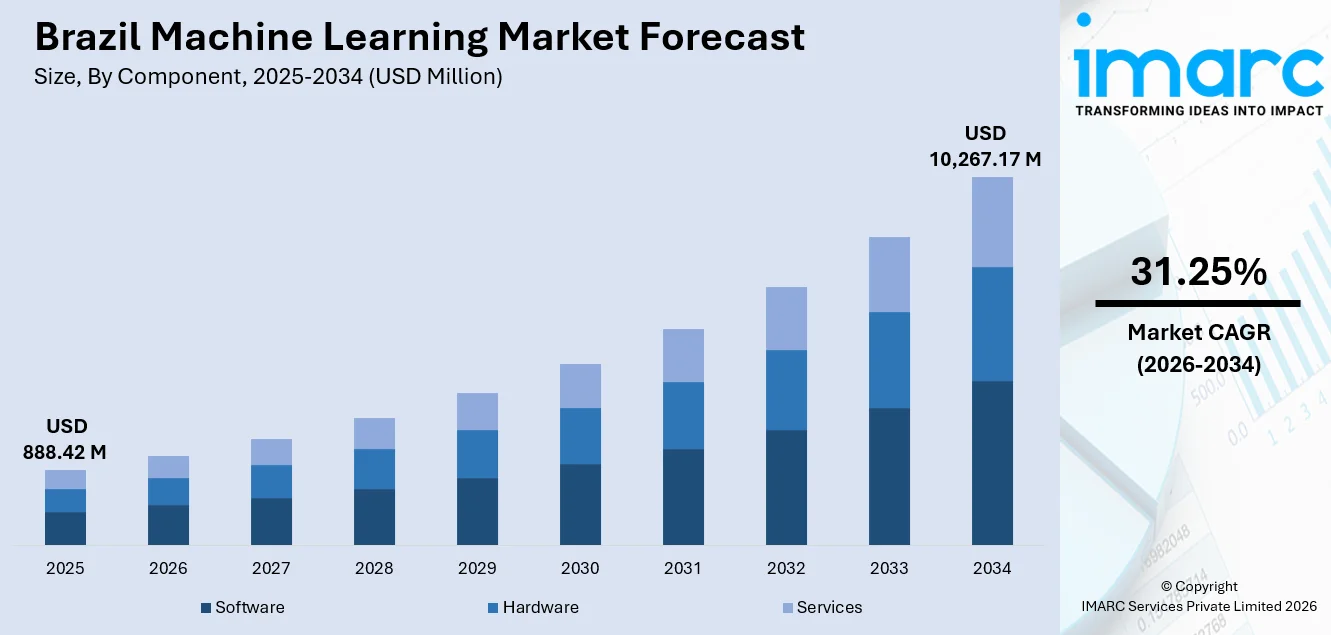
The Brazil machine learning market size was valued at USD 888.42 Million in 2025 and is projected to reach USD 10,267.17 Million by 2034, growing at a compound annual growth rate of 31.25% from 2026-2034.
The Brazil machine learning market is growing at a rapid pace as organizations in various sectors are increasing the adoption of intelligent algorithms in their core business processes. The increasing digital infrastructure, availability of large datasets, and growing demand for automation and predictive analytics in enterprises are driving the adoption of machine learning. Improvements in cloud computing power, R&D investments, and government initiatives to foster innovation in artificial intelligence are contributing to a favorable ecosystem for machine learning adoption, thereby boosting Brazil machine learning market share.
Key Takeaways and Insights:
-
By Component: Software dominates the market with a share of 47.8% in 2025, driven by the rising demand for machine learning platforms, development tools, and analytics solutions that enable enterprises to build and deploy intelligent applications.
-
By Deployment: Cloud-based leads the market with a share of 62.4% in 2025, owing to its scalability, cost-effectiveness, and ability to provide on-demand access to advanced computing resources for machine learning workloads.
-
By Enterprise Size: Large enterprises hold the largest market share of 58.7% in 2025, reflecting their greater capacity to invest in sophisticated machine learning infrastructure, talent acquisition, and enterprise-wide digital transformation initiatives.
-
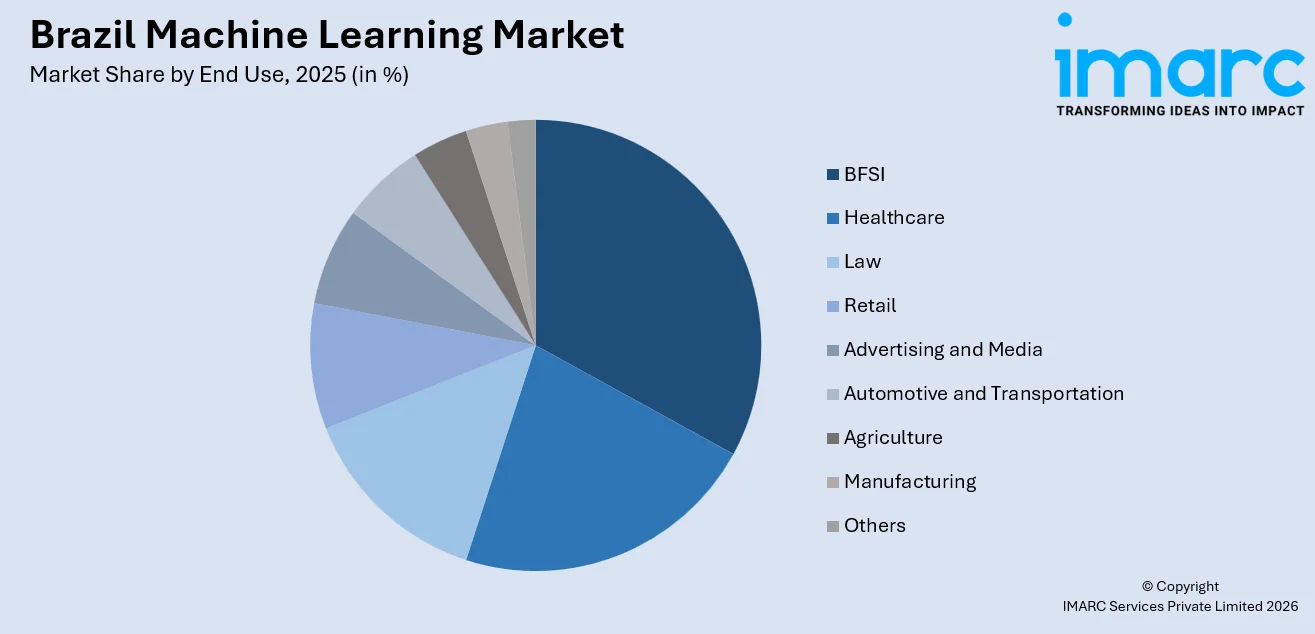
By End Use: BFSI leads the market with a share of 19.9% in 2025, fueled by the extensive adoption of machine learning for fraud detection, credit risk modeling, algorithmic trading, and customer behavior analytics across financial institutions.
-
By Region: Southeast dominates the market with a share of 46.3% in 2025, supported by the concentration of technology hubs, financial institutions, corporate headquarters, and leading research universities in states such as São Paulo and Rio de Janeiro.
-
Key Players: The Brazil machine learning market is moderately competitive, with global technology leaders and domestic innovators competing across software platforms, cloud services, and industry-specific solutions to capture growing enterprise demand for intelligent automation.
To get more information on this market Request Sample
The Brazil machine learning market is progressing as more and more organizations, government bodies, and research organizations are adopting data-driven decision-making and intelligent automation. One of the key drivers of this progress is the increasing adoption of cloud infrastructure in the country, which is making it possible for organizations to access computing power required for machine learning. For instance, in 2024, Microsoft announced its largest investment in Brazil to expand cloud and artificial intelligence infrastructure and launched the ConectAI initiative to train 5 million Brazilians in AI skills, strengthening the country’s machine learning talent pool and cloud ecosystem. The financial services industry continues to be at the forefront of machine learning adoption, using predictive analytics and natural language processing to improve customer experience and efficiency. Other industries such as agriculture, healthcare, and manufacturing are also increasingly adopting machine learning to improve processes, diagnostics, and supply chain management. Government-led artificial intelligence plans and training of the workforce are also contributing to the acceleration of the machine learning ecosystem in the country.
Brazil Machine Learning Market Trends:
Rising Integration of Machine Learning in Financial Services
The financial service sector in Brazil is increasingly integrating machine learning into its operations, ranging from credit scoring to customer engagement. The financial institutions in Brazil are using sophisticated algorithms to analyze the transactions in real time, hence making decisions faster and more accurately. For instance, in 2025, Bradesco implemented an AI-powered fraud detection platform capable of processing up to 25 million PIX payments daily, reducing fraud-related customer friction by 89% and improving real-time decision-making efficiency. This has improved the efficiency of the financial service sector in Brazil, hence contributing to the growth of the Brazil machine learning market.
Expanding Role of Machine Learning in Precision Agriculture
Machine learning is revolutionizing the way agriculture is done in Brazil by allowing farmers and agricultural companies to analyze satellite images, soil information, and weather data for optimal agricultural management. For instance, in 2025, Brazilian farms using AI-powered Solix agricultural robots developed by Solinftec achieved an 18% increase in soybean yields and reduced herbicide use by up to 85% by analyzing real-time field, soil, and crop data through machine learning platforms. Predictive algorithms can help enhance crop yield prediction, pest identification, and resource utilization, thereby promoting sustainable and productive agricultural practices. The application of intelligent analytics in agriculture is thus driving the demand for specialized machine learning solutions.
Growing Adoption of Generative AI and Large Language Models
Brazilian enterprises are increasingly exploring generative artificial intelligence and large language models to automate content creation, customer service interactions, and internal knowledge management. For instance, in 2025, Google Cloud expanded its AI infrastructure and introduced Gemini AI capabilities in Brazil, enabling organizations such as Natura, Globo, and EBANX to deploy generative AI for enterprise automation, customer engagement, and internal business optimization. Organizations across sectors are deploying conversational agents and intelligent assistants powered by advanced natural language processing capabilities. This trend is expanding the scope of machine learning applications beyond traditional analytics into creative and communication-intensive business functions.
Market Outlook 2026-2034:
The Brazil machine learning market is positioned for sustained expansion, supported by continued investments in digital infrastructure, widespread cloud computing adoption, and the implementation of enterprise-level artificial intelligence strategies. Growing demand for predictive analytics, intelligent automation, and data-driven decision-making across key industries is reinforcing long-term growth prospects. The increasing availability of scalable computing resources, combined with supportive government initiatives and a maturing startup ecosystem, is expected to strengthen innovation pipelines and broaden the deployment of machine learning solutions across diverse sectors nationwide. The market generated a revenue of USD 888.42 Million in 2025 and is projected to reach a revenue of USD 10,267.17 Million by 2034, growing at a compound annual growth rate of 31.25% from 2026-2034.
Brazil Machine Learning Market Report Segmentation:
|
Segment Category |
Leading Segment |
Market Share |
|
Component |
Software |
47.8% |
|
Deployment |
Cloud-based |
62.4% |
|
Enterprise Size |
Large Enterprises |
58.7% |
|
End Use |
BFSI |
19.9% |
|
Region |
Southeast |
46.3% |
Component Insights:
- Hardware
- Software
- Services
The software dominates with a market share of 47.8% of the total Brazil machine learning market in 2025.
The software component is propelling the Brazil machine learning market as more organizations are adopting platforms, frameworks, and analytics solutions that facilitate the development, training, and deployment of smart models. The demand for comprehensive machine learning software solutions is increasing as organizations are looking to simplify data preprocessing, model development, and evaluation in a single environment. The emergence of open-source libraries, in addition to commercial software solutions, is making machine learning more accessible to organizations of different sizes and capabilities.
Cloud-native software solutions are also gaining popularity, enabling organizations to easily scale their machine learning programs without making heavy investments in infrastructure. Sectors such as banking and financial services, retail, and healthcare are adopting specialized software solutions to derive meaningful insights from complex data sets. The increasing focus on automation, real-time analytics, and smart decision-making is further solidifying the importance of software in the Brazil machine learning market.
Deployment Insights:
- Cloud-based
- On-premises
The cloud-based leads with a share of 62.4% of the total Brazil machine learning market in 2025.
Cloud-based deployment is the most preferred method for the adoption of machine learning in Brazil, due to the flexibility, scalability, and cost-effectiveness that cloud platforms provide to organizations. Organizations are moving their machine learning workloads to cloud infrastructure to leverage on-demand computing capabilities, decrease the burden of managing infrastructure, and speed up the development time of machine learning models. The development of hyperscale data center infrastructure in Brazil is also helping the adoption of cloud-based machine learning services.
The increasing availability of managed machine learning services on popular cloud platforms is making it easier for organizations to adopt machine learning, especially when they do not have advanced technical expertise in-house. Cloud platforms make it easy to collaborate with distributed data science teams and allow rapid exploration of innovative algorithms. The factors of lower total cost of ownership, improved data accessibility, and the ability to combine machine learning with the overall cloud ecosystem are solidifying the dominance of cloud-based deployment in Brazil.
Enterprise Size Insights:
- Large Enterprises
- Small and Medium-sized Enterprises
The large enterprises dominates with a market share of 58.7% of the total Brazil machine learning market in 2025.
The main users of machine learning in Brazil are large businesses, which are taking advantage of their large technology budgets and data science teams to implement intelligent solutions in various business areas. Large businesses are using machine learning at scale in areas such as supply chain management, customer relationship management, predictive maintenance, and strategic forecasting. Their ability to invest in advanced infrastructure and data science talent makes them the biggest contributors to the market revenue.
The availability of enterprise machine learning platforms is making it easier for large businesses to standardize and manage their artificial intelligence projects. The use of machine learning models across various business areas is becoming a strategic imperative, with businesses aiming to integrate intelligence into various business areas such as human resources, marketing, finance, and product development. The focus on digital transformation and differentiation is ensuring that the demand for machine learning in large businesses in Brazil remains strong.
End Use Insights:
Access the comprehensive market breakdown Request Sample
- Healthcare
- BFSI
- Law
- Retail
- Advertising and Media
- Automotive and Transportation
- Agriculture
- Manufacturing
- Others
The BFSI leads with a share of 19.9% of the total Brazil machine learning market in 2025.
The banking, financial services, and insurance sector is the most prominent end-use segment for machine learning in Brazil, driven by the need for advanced analytics to manage risk, detect fraud, and personalize customer experiences at scale. Financial institutions are deploying machine learning models to automate credit assessments, monitor transactions in real time, and ensure compliance with evolving regulatory frameworks. The sector’s data-intensive nature and competitive dynamics are accelerating the adoption of predictive and prescriptive analytics solutions.
Brazil’s vibrant fintech ecosystem is further amplifying machine learning demand within the BFSI segment, as digital-first financial service providers leverage intelligent algorithms to differentiate their offerings and improve operational agility. Insurance companies are integrating machine learning for claims processing automation, actuarial modeling, and customer segmentation. The combination of regulatory modernization, digital banking expansion, and growing consumer expectations for seamless financial services is reinforcing the BFSI sector’s leadership in machine learning adoption across the country.
Regional Insights:
- Southeast
- South
- Northeast
- North
- Central-West
Southeast exhibits a clear dominance with a 46.3% share of the total Brazil machine learning market in 2025.
The Southeast region leads the Brazil machine learning market, anchored by the economic and technological significance of São Paulo and Rio de Janeiro. The region hosts the country’s largest concentration of technology companies, financial institutions, research universities, and innovation hubs, creating a robust ecosystem for machine learning development and deployment. The presence of major cloud infrastructure providers with data centers in São Paulo further supports the region’s dominance in machine learning adoption.
Significant corporate and government investments in artificial intelligence research and digital transformation are concentrated in the Southeast, driving demand for machine learning across financial services, healthcare, retail, and manufacturing. The region benefits from a skilled workforce of data scientists and engineers, supported by leading academic institutions conducting cutting-edge research in artificial intelligence and related disciplines. The convergence of talent, infrastructure, and enterprise demand solidifies the Southeast as the primary growth engine for machine learning in Brazil.
Market Dynamics:
Growth Drivers:
Why is the Brazil Machine Learning Market Growing?
Accelerating Digital Transformation Across Industries
Brazil is experiencing a broad-based digital transformation as organizations across sectors modernize their operations and embrace data-driven strategies. Enterprises in finance, retail, healthcare, and manufacturing are increasingly recognizing the value of machine learning in enhancing productivity, reducing costs, and unlocking new revenue streams. For instance, , Banco Central do Brasil announced the expansion of its open finance ecosystem, which enables secure sharing of customer financial data among institutions and supports the use of machine learning for personalized financial services, risk analysis, and digital innovation across the banking sector. The shift toward digital-first business models is driving sustained investment in intelligent technologies that can process vast datasets and deliver actionable insights. As companies transition from legacy systems to modern digital platforms, the demand for machine learning tools and expertise continues to expand, creating a favorable environment for market growth across the country.
Expansion of Cloud Computing Infrastructure
The rapid expansion of cloud computing infrastructure in Brazil is providing a critical foundation for machine learning adoption. Major global technology providers are making significant investments in data center facilities within the country, enhancing local access to high-performance computing resources essential for training and deploying machine learning models. For instance, in 2024, Amazon Web Services announced plans to invest approximately USD 1.8 billion in Brazil through 2034 to expand, build, and operate data centers, strengthening cloud infrastructure and supporting growing demand for artificial intelligence and machine learning applications. Cloud platforms are democratizing access to advanced analytics capabilities, enabling organizations of varying sizes and technical sophistication to leverage machine learning without prohibitive capital expenditure. The growing availability of managed machine learning services, coupled with improvements in network connectivity and data sovereignty frameworks, is lowering barriers to entry and accelerating enterprise-level adoption of intelligent solutions.
Supportive Government Policies and National AI Strategies
The Brazilian government has taken proactive steps to position the country as a regional leader in artificial intelligence through comprehensive policy frameworks and investment programs. National strategies focused on fostering innovation, strengthening research capabilities, and developing a skilled workforce are creating an enabling environment for machine learning growth. For instance, in 2024, the Brazilian government officially launched the Brazilian Artificial Intelligence Plan (PBIA) 2024–2028, allocating approximately BRL 23 billion (USD 4 billion) to support AI infrastructure, research, workforce training, and the development of national data centers and AI innovation ecosystems. Government initiatives supporting the establishment of research centers, data infrastructure development, and startup ecosystems are channeling resources toward artificial intelligence advancement. Regulatory modernization efforts, including frameworks for data protection and ethical artificial intelligence use, are building institutional confidence in machine learning adoption while ensuring responsible deployment across public and private sectors.
Market Restraints:
What Challenges the Brazil Machine Learning Market is Facing?
Shortage of Skilled Machine Learning Professionals
The demand for qualified data scientists, machine learning engineers, and artificial intelligence specialists in Brazil significantly exceeds the available talent pool. This skills gap limits the ability of many organizations to develop, deploy, and maintain machine learning solutions effectively. Despite growing educational initiatives, the pace of workforce development has not kept up with the rapid expansion of enterprise demand, constraining broader market penetration.
Data Quality and Integration Complexities
Many organizations in Brazil face challenges related to inconsistent data quality, fragmented data sources, and difficulties in integrating legacy systems with modern machine learning platforms. The effectiveness of machine learning models depends heavily on access to clean, well-structured, and comprehensive datasets. Inadequate data governance frameworks and siloed information architectures continue to hinder the ability of enterprises to realize the full potential of their machine learning investments.
High Implementation and Operational Costs
The total cost of implementing machine learning solutions, including infrastructure setup, software licensing, talent acquisition, and ongoing model maintenance, remains significant for many Brazilian organizations. Small and medium-sized enterprises, in particular, face financial barriers that limit their ability to adopt advanced machine learning capabilities. The complexity of operationalizing models at scale further adds to the cost burden, potentially slowing broader market expansion.
Competitive Landscape:
The Brazil machine learning market is becoming increasingly dynamic as both established global technology providers and emerging domestic companies compete to capture growing enterprise demand. Market participants are differentiating through innovations in platform capabilities, industry-specific solutions, and managed service offerings that simplify machine learning deployment. Competition is driven by investments in cloud infrastructure, partnerships with academic institutions, and the development of localized solutions tailored to Portuguese-language processing and Brazilian industry requirements. Strategic collaborations, startup accelerator programs, and talent development initiatives are shaping the competitive environment, with companies continually refining their strategies to strengthen market positioning and expand their reach across diverse industry verticals.
Recent Developments:
-
In September 2025, Brazilian legal-tech startup Enter raised $35 million in funding from Founders Fund and Sequoia Capital to expand its AI-native legal automation platform. Founded in 2023, the company uses machine learning to streamline legal workflows, improving efficiency in Brazil’s overloaded judicial system.
Brazil Machine Learning Market Report Coverage:
|
Report Features |
Details |
|
Base Year of the Analysis |
2025 |
|
Historical Period |
2020-2025 |
|
Forecast Period |
2026-2034 |
|
Units |
Million USD |
|
Scope of the Report |
Exploration of Historical Trends and Market Outlook, Industry Catalysts and Challenges, Segment-Wise Historical and Future Market Assessment:
|
|
Components Covered |
Hardware, Software, Services |
|
Deployments Covered |
Cloud-based, On-premises |
|
Enterprise Sizes Covered |
Large Enterprises, Small and Medium-sized Enterprises |
|
End Uses Covered |
Healthcare, BFSI, Law, Retail, Advertising and Media, Automotive and Transportation, Agriculture, Manufacturing, Others |
|
Regions Covered |
Southeast, South, Northeast, North, Central-West |
|
Customization Scope |
10% Free Customization |
|
Post-Sale Analyst Support |
10-12 Weeks |
|
Delivery Format |
PDF and Excel through Email (We can also provide the editable version of the report in PPT/Word format on special request) |
Frequently Asked Questions About the Brazil Machine Learning Market Report
The Brazil machine learning market size was valued at USD 888.42 Million in 2025.
The Brazil machine learning market is expected to grow at a compound annual growth rate of 31.25% from 2026-2034 to reach USD 10,267.17 Million by 2034.
Software, holding the largest share of 47.8%, leads the Brazil machine learning market owing to the rising demand for development platforms, analytics tools, and end-to-end deployment solutions across enterprises.
Key factors driving the Brazil machine learning market include accelerating digital transformation across industries, expansion of cloud computing infrastructure, supportive government AI strategies, and growing enterprise demand for predictive analytics.
Major challenges include a shortage of skilled machine learning professionals, data quality and integration complexities, high implementation costs, limited technical readiness among smaller enterprises, and evolving regulatory frameworks for artificial intelligence governance.
Need more help?
- Speak to our experienced analysts for insights on the current market scenarios.
- Include additional segments and countries to customize the report as per your requirement.
- Gain an unparalleled competitive advantage in your domain by understanding how to utilize the report and positively impacting your operations and revenue.
- For further assistance, please connect with our analysts.
 Request Customization
 Speak to an Analyst
 Request Brochure
 Inquire Before Buying
Benefits of Customization
- Personalize this research
- Triangulate with your data
- Get data as per your format and definition
- Gain a deeper dive into a specific application, geography, customer, or competitor
- Any level of personalization
Get in Touch With Us
UNITED STATES
Phone: +1-201-971-6302
INDIA
Phone: +91-120-433-0800
UNITED KINGDOM
Phone: +44-753-714-6104
Email: [email protected]
Client Testimonials




.webp)




.webp)













Related Reports

Choose your plan
*Please note that the prices mentioned below are starting prices for each bundle type. Kindly contact our team for further details.*
Single User License
- 1 User License, Access on 2 Devices
- PDF Report + Excel Dataset (Password Protected)
- Lifetime Access
- No Printing Rights
- 10% Free Report Customization
- 10–12 Weeks of Analyst Support
Five User License
- Access for 5 Users, 2 Devices per User
- PDF Report + Excel Dataset (Password Protected)
- Lifetime Access
- Dedicated Account Manager
- 12–14 Weeks of Analyst Support
- No Printing Rights
- 15% Free Report Customization
- 25% Discount on Your Next Purchase
Corporate User License
- Unlimited User Access (Within Your Organization)
- PDF Report + Excel Dataset
- Lifetime Access
- Dedicated Account Manager
- 14–20 Weeks of Analyst Support
- No Printing Rights
- 20% Free Report Customization
- 30% Discount on Your Next Purchase
Essential Insights
What's included:
3 reports
- Lifetime Access
- PDF Reports
- Excel Datasets
- 2 Weeks of Free Analyst Support
- 2 User Licenses
- Access on 2 Devices
- Printing Rights
- Complimentary PowerPoint (PPT) Version
- Complimentary License Upgrade
Professional Access
What's included:
5 reports
- Lifetime Access
- PDF Reports
- Excel Datasets
- 8 Weeks of Free Analyst Support
- 2 User Licenses
- Access on 2 Devices
- Printing Rights
- Complimentary PowerPoint (PPT) Version
- Complimentary License Upgrade
Business Advantage
What's included:
8 reports
- Lifetime Access
- PDF Reports
- Excel Datasets
- 14 Weeks of Free Analyst Support
- 2 User Licenses
- Access on 2 Devices
- Printing Rights
- Complimentary PowerPoint (PPT) Version
- Complimentary License Upgrade
Enterprise Intelligence
What's included:
10 reports
- Lifetime Access
- PDF Reports
- Excel Datasets
- 20 Weeks of Free Analyst Support
- 2 User Licenses
- Access on 2 Devices
- Printing Rights
- Complimentary PowerPoint (PPT) Version
- Complimentary License Upgrade