
Brazil Managed Services Market Size, Share, Trends and Forecast by Type, Deployment Mode, Enterprise Size, End Use, and Region, 2026-2034
Brazil Managed Services Market Summary:
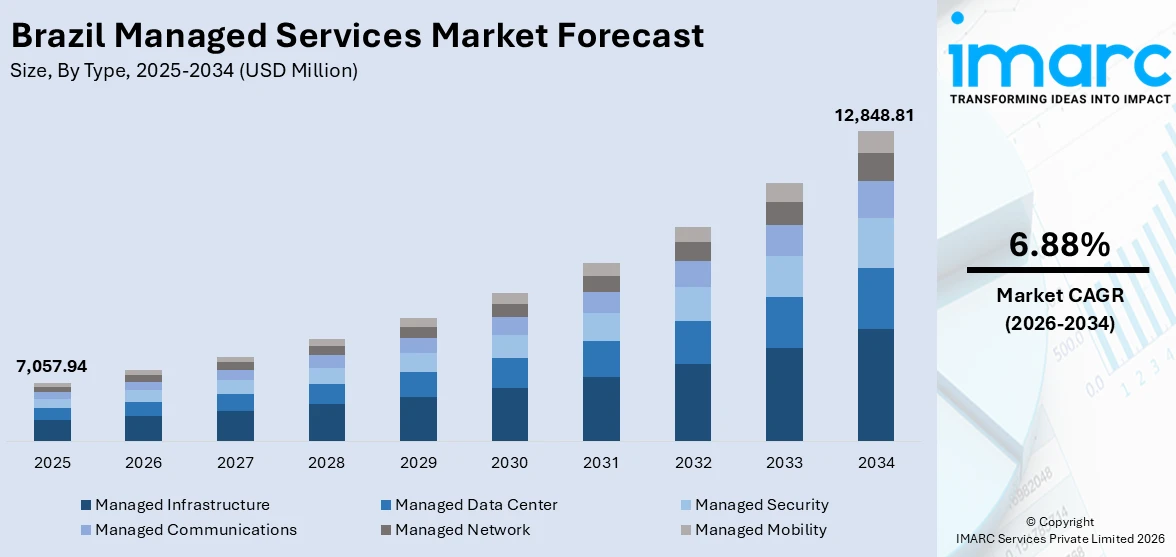
The Brazil managed services market size was valued at USD 7,057.94 Million in 2025 and is projected to reach USD 12,848.81 Million by 2034, growing at a compound annual growth rate of 6.88% from 2026-2034.
The market is driven by the accelerating pace of enterprise digital transformation, rising demand for outsourced cloud infrastructure management, and the growing need for cybersecurity solutions among Brazilian organizations. Increasing adoption of multi-cloud strategies, government-led technology modernization initiatives, and expanding internet connectivity across the country are further fueling market expansion. The shift from traditional in-house IT management toward managed service models continues to gain momentum, contributing to the growing Brazil managed services market share.
Key Takeaways and Insights:
-
By Type: Managed infrastructure dominates the market with a share of 24.6% in 2025, driven by the rising enterprise demand for outsourced servers, storage, and network management to support large-scale digital operations and optimize capital expenditure.
-
By Deployment Mode: Cloud-based leads the market with a share of 60.8% in 2025, owing to the rapid migration of Brazilian enterprises toward scalable, cost-efficient cloud platforms, supported by extensive hyperscaler investments in local data center infrastructure.
-
By Enterprise Size: Large enterprises represent the largest segment with a market share of 57.9% in 2025, driven by their complex IT architecture, higher technology budgets, and the strategic imperative to outsource non-core IT operations for improved agility.
-
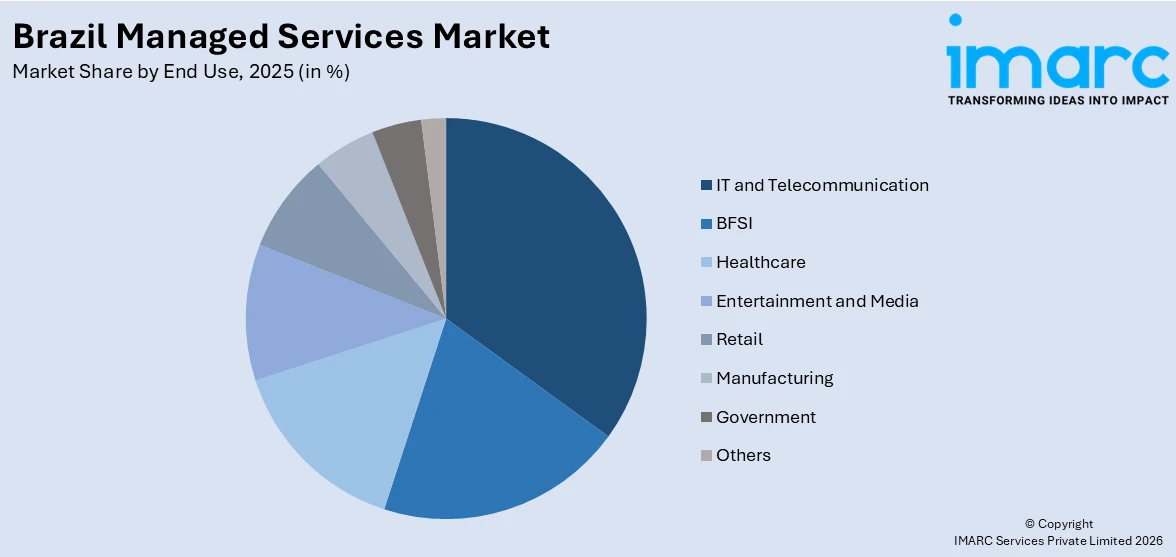
By End Use: IT and telecommunication dominate the market with a share of 28.2% in 2025, owing to the sector’s inherent reliance on advanced IT infrastructure, round-the-clock network monitoring, and the continuous need for cybersecurity and cloud management services.
-
By Region: Southeast leads the market with a share of 45.7% in 2025, driven by concentration of major corporate headquarters, technology hubs, and advanced digital infrastructure in the São Paulo and Rio de Janeiro metropolitan areas.
-
Key Players: The Brazil managed services market features a dynamic competitive landscape, with established multinational technology providers competing alongside regional IT service firms. Market participants differentiate through specialized service portfolios, vertical expertise, and strategic partnerships with global cloud platforms to address evolving enterprise demands.
To get more information on this market Request Sample
The Brazil managed services market is experiencing robust growth, fueled by the country’s accelerating enterprise digital transformation and the increasing complexity of IT environments across industries. Brazilian organizations are progressively shifting from traditional in-house IT management to outsourced managed service models, seeking enhanced operational efficiency, cost optimization, and access to specialized expertise. As per sources, TIM acquired V8.Tech to expand multicloud and AI-led managed services for enterprises across Brazil, strengthening telecom-led outsourcing capabilities nationwide and accelerating digital transformation partnerships with large corporations. The proliferation of cloud computing, big data analytics, and artificial intelligence (AI) solutions has significantly expanded the scope of managed services, enabling providers to offer end-to-end infrastructure management, cybersecurity, and application support. Furthermore, the growing emphasis on regulatory compliance, particularly around data protection mandates, has intensified demand for managed compliance and security solutions. Government-backed digital modernization programs and substantial investments in telecommunications infrastructure are further strengthening the market ecosystem.
Brazil Managed Services Market Trends:
Rising Adoption of Multi-Cloud Orchestration and Hybrid IT Management
Brazilian enterprises are increasingly embracing multi-cloud and hybrid IT strategies, creating substantial demand for managed services that can orchestrate workloads across diverse cloud environments. Organizations are seeking providers capable of delivering seamless integration between on-premises infrastructure and multiple public cloud platforms, ensuring optimal performance, cost management, and regulatory compliance. In May 2025, Ricoh acquired Go2neXt to expand managed cloud, infrastructure, and digital workplace services for enterprise clients across Brazil’s hybrid IT environments. This trend is particularly pronounced among financial services and manufacturing firms that require flexible deployment models to balance data sovereignty requirements with operational scalability.
Embedding AI and Automated Processes into Service Delivery
The incorporation of artificial intelligence and machine learning capabilities into managed service delivery is transforming the operational landscape in Brazil. Service providers are leveraging AI-driven tools for predictive infrastructure monitoring, automated incident response, and intelligent resource allocation, enabling proactive identification of potential system failures before they impact business operations. In September 2025, Brazil’s Ministry of Management and Innovation partnered with CPQD to deploy generative AI tools for public service delivery, strengthening the ecosystem supporting AI-enabled managed IT operations and digital governance. This shift toward autonomous IT management is reducing response times and enhancing service reliability.
Growing Demand for Managed Cybersecurity and Compliance Services
The escalating frequency and sophistication of cyber threats targeting Brazilian organizations has elevated managed cybersecurity services to a critical priority. Enterprises across sectors are increasingly outsourcing their security operations to specialized managed security service providers that offer continuous threat monitoring, vulnerability management, and incident response capabilities. In October 2025, HexaDigital partnered with Sophos to integrate AI-driven security operations capabilities into its SOC in Brazil, strengthening continuous monitoring and automated incident response services. The implementation of Brazil’s data protection framework has further amplified this trend, as organizations seek expert guidance in maintaining regulatory compliance while protecting sensitive data assets.
Market Outlook 2026-2034:
The Brazil managed services market is positioned for sustained expansion over the forecast period, supported by deepening enterprise reliance on outsourced IT management and the continued proliferation of cloud-native business applications. The convergence of emerging technologies, including edge computing, generative artificial intelligence, and industrial Internet of Things (IoT), is expected to create new service categories and revenue streams for managed service providers. Additionally, the expanding digital footprint of small and medium enterprises is unlocking a significant addressable market for scalable managed service offerings. The market generated a revenue of USD 7,057.94 Million in 2025 and is projected to reach a revenue of USD 12,848.81 Million by 2034, growing at a compound annual growth rate of 6.88% from 2026-2034.
Brazil Managed Services Market Report Segmentation:
|
Segment Category |
Leading Segment |
Market Share |
|
Type |
Managed Infrastructure |
24.6% |
|
Deployment Mode |
Cloud-based |
60.8% |
|
Enterprise Size |
Large Enterprises |
57.9% |
|
End Use |
IT and Telecommunication |
28.2% |
|
Region |
Southeast |
45.7% |
Type Insights:
- Managed Infrastructure
- Managed Data Center
- Managed Security
- Managed Communications
- Managed Network
- Managed Mobility
Managed infrastructure dominates with a market share of 24.6% of the total Brazil managed services market in 2025.
The managed infrastructure has established its leading position in the Brazil managed services market, driven by the growing need among enterprises to outsource the management of their core IT infrastructure, including servers, storage systems, and networking equipment. As Brazilian businesses expand their digital footprints, the demand for reliable, scalable, and professionally managed infrastructure has intensified. In 2025, NTT DATA acquired Brazil‑based SAP infrastructure specialist SPRO IT Solutions, enhancing its capability to deliver fully managed SAP landscapes and core system operations to enterprise customers.
The segment’s dominance is further reinforced by the rising capital expenditure associated with maintaining in-house infrastructure, which compels businesses to adopt outsourced models that convert fixed costs into predictable operational expenditure. Managed infrastructure services enable enterprises to access enterprise-grade hardware and network capabilities without the burden of procurement, maintenance, and lifecycle management. The expansion of data center facilities across major Brazilian cities is creating additional capacity for managed infrastructure providers to deliver localized, low-latency services to enterprises seeking compliance with domestic data residency requirements.
Deployment Mode Insights:
- On-premises
- Cloud-based
Cloud-based leads with a share of 60.8% of the total Brazil managed services market in 2025.
The cloud-based commands the largest share in the Brazil managed services market, reflecting the widespread migration of enterprise workloads to public, private, and hybrid cloud environments. Brazilian organizations are increasingly prioritizing cloud-based managed services to achieve greater scalability, operational flexibility, and cost efficiency in their IT operations. In September 2024, Microsoft announced a 14.7 billion Reais investment over three years to expand its cloud and AI infrastructure across Brazil and support skilling initiatives, reinforcing built‑out data centers that underpin cloud‑delivered managed services.
Cloud-based are gaining particular traction among small and medium enterprises that leverage these solutions to access enterprise-grade IT management capabilities without significant upfront capital investment. The growing adoption of software-as-a-service and platform-as-a-service models has created an extensive ecosystem of cloud-native applications requiring professional management and optimization. Additionally, the integration of advanced analytics, automated scaling, and intelligent monitoring capabilities within cloud-based managed service platforms is enabling Brazilian businesses to derive enhanced value from their cloud investments while maintaining robust governance and security protocols.
Enterprise Size Insights:
- Large Enterprises
- Small and Medium-sized Enterprises
Large enterprises exhibit a clear dominance with a 57.9% share of the total Brazil managed services market in 2025.
Large enterprises constitute the dominant segment in the Brazil managed services market, owing to their extensive and complex IT environments that require specialized management expertise. These organizations typically operate multi-site, multi-platform technology architectures that generate substantial demand for comprehensive managed services encompassing infrastructure management, application support, cybersecurity, and cloud orchestration. As per sources in 2025, Itaú Unibanco partnered with IBM Brazil to modernize its IT operations through a managed services agreement focused on hybrid cloud infrastructure, cybersecurity, and data analytics support for enterprise systems.
The segment’s leading position is sustained by the higher technology budgets available to large enterprises, which enable investment in premium managed service contracts with enhanced service-level agreements and dedicated support teams. These organizations are also at the forefront of adopting emerging technologies such as artificial intelligence, edge computing, and advanced data analytics, all of which require specialized managed service capabilities for effective deployment and ongoing optimization. The growing trend of digital-first business strategies among major Brazilian corporations continues to expand the scope and value of managed service engagements.
End Use Insights:
Access the comprehensive market breakdown Request Sample
- IT and Telecommunication
- BFSI
- Healthcare
- Entertainment and Media
- Retail
- Manufacturing
- Government
- Others
IT and telecommunication lead with a market share of 28.2% of the total Brazil managed services market in 2025.
IT and telecommunication represent the largest end use segment in the Brazil managed services market, driven by the sector’s fundamental dependence on robust, continuously available technology infrastructure. Telecommunications operators and IT companies require extensive managed service support for network operations, data center management, cybersecurity, and cloud platform maintenance. In November 2025, Huawei Cloud Brazil launched AI Token Service, AI Agent Platform Versatile, and Cloud Stack 8.6, supporting multi-cloud strategies and accelerating AI-driven digital transformation across finance, retail, and public sectors.
The sector’s leading market share is further supported by the increasing convergence of telecommunications and cloud services, which has created demand for integrated managed solutions spanning network infrastructure, application platforms, and security operations. IT and telecom companies are leveraging managed services to accelerate innovation cycles, reduce operational costs, and enhance customer experience through improved service reliability. The rising adoption of virtualized network functions, software-defined architectures, and edge computing solutions within the Brazilian telecom industry continues to generate substantial opportunities for managed service providers specializing in next-generation network management.
Regional Insights:
- Southeast
- South
- Northeast
- North
- Central-West
Southeast dominates with a market share of 45.7% of the total Brazil managed services market in 2025.
Southeast commands the largest share of the Brazil managed services market, anchored by the presence of the nation’s primary economic and technological centers, including São Paulo, Rio de Janeiro, and Belo Horizonte. The region hosts the headquarters of major domestic and multinational corporations, financial institutions, and technology companies, creating a dense concentration of managed services demand. The well-developed telecommunications infrastructure, extensive data center ecosystem, and availability of a skilled IT workforce in the Southeast provide a favorable operating environment for managed service providers to deliver high-quality, localized services.
The Southeast’s dominance is reinforced by ongoing government and private sector investments in expanding digital infrastructure, including data center capacity and fiber-optic network coverage. The region’s role as the financial capital of Latin America generates particularly strong demand for managed security, compliance, and cloud services from the banking, financial services, and insurance sector. Additionally, the concentration of manufacturing, retail, and healthcare industries in the Southeast creates diversified and resilient demand for managed services across multiple verticals, solidifying the region’s position as the primary market for managed services in Brazil.
Market Dynamics:
Growth Drivers:
Why is the Brazil Managed Services Market Growing?
Accelerating Enterprise Digital Transformation and Cloud Migration
The rapid pace of digital transformation across Brazilian industries is serving as a primary catalyst for the managed services market. Organizations across banking, retail, healthcare, and manufacturing are fundamentally restructuring their technology architectures to incorporate cloud computing, advanced analytics, and artificial intelligence capabilities. As per sources, ISG reported Brazilian enterprises are rapidly integrating generative AI across multi-cloud environments, enhancing productivity, modernizing applications, and driving cloud expansion in finance, healthcare, retail, and manufacturing sectors. This transformation creates substantial demand for managed service providers that can facilitate seamless cloud migration, optimize hybrid IT environments, and ensure continuous availability of digital platforms.
Escalating Cybersecurity Threats and Regulatory Compliance Requirements
The growing sophistication and frequency of cyberattacks targeting Brazilian organizations has elevated cybersecurity to a board-level strategic priority, significantly boosting demand for managed security services. Enterprises face an increasingly complex threat landscape that includes ransomware, advanced persistent threats, and supply chain attacks, requiring round-the-clock monitoring and rapid incident response capabilities that are difficult to maintain internally. In August 2025, Brazil’s government issued the National Cybersecurity Strategy (E‑Ciber) to strengthen cyber defenses, promote threat information sharing, and support cyber risk management across enterprises and critical infrastructure. Simultaneously, the enforcement of comprehensive data protection legislation has created a regulatory environment mandating robust data governance, privacy controls, and breach notification protocols, compelling enterprises to seek specialized managed compliance and security solutions.
Growing Need for Operational Cost Optimization and IT Talent Access
The persistent shortage of specialized IT professionals in Brazil, combined with rising costs of recruiting and retaining skilled technology personnel, is compelling organizations to embrace managed services as a strategic solution. Enterprises increasingly recognize that outsourcing non-core IT functions to managed service providers enables access to deep technical expertise, advanced tools, and industry best practices at a fraction of the cost of building equivalent internal capabilities. In 2025, Brazil faced an estimated deficit of 530 IT professionals, prompting employer–training collaborations such as the Assespro‑TrendsIT residency program to upskill talent for technology roles and bridge the skills gap. The managed services model transforms unpredictable capital expenditures into predictable operational costs, improving financial planning and resource allocation for mid-market and large enterprises alike.
Market Restraints:
What Challenges the Brazil Managed Services Market is Facing?
Data Sovereignty and Privacy Concerns
Concerns regarding data sovereignty and the security of sensitive information managed by third-party providers represent a significant restraint for the market. Many enterprises, particularly in regulated industries such as financial services and healthcare, remain cautious about entrusting critical data assets to external managed service providers due to apprehensions about data residency, unauthorized access, and potential regulatory non-compliance.
Integration Challenges with Legacy IT Systems
The prevalence of legacy IT systems within many Brazilian enterprises poses substantial integration challenges for managed service adoption. Organizations with deeply embedded legacy infrastructure often face compatibility issues when transitioning to modern managed service platforms, resulting in extended migration timelines, unexpected costs, and operational disruptions, particularly among traditional industries with significant historical technology investments.
Currency Volatility and Contractual Pricing Risks
The inherent volatility of the Brazilian real against major international currencies introduces significant pricing and contractual risks in the managed services market. Many managed service agreements involve international technology platforms priced in foreign currencies, exposing both providers and clients to exchange rate fluctuations that can materially impact contract economics and discourage long-term engagements.
Competitive Landscape:
The Brazil managed services market is characterized by a fragmented yet evolving competitive landscape, with a mix of global technology conglomerates, regional IT service providers, and specialized managed service firms competing for market share. Competition is increasingly defined by the ability to deliver integrated, end-to-end service portfolios that span cloud management, cybersecurity, infrastructure operations, and digital workplace solutions. Strategic partnerships with global hyperscale cloud platforms have become essential differentiators, enabling providers to offer advanced capabilities and localized service delivery. Market consolidation is gaining momentum as larger players acquire niche specialists to broaden their service capabilities, enhance vertical expertise, and strengthen geographic coverage across Brazilian regions.
Brazil Managed Services Market Report Coverage:
|
Report Features |
Details |
|
Base Year of the Analysis |
2025 |
|
Historical Period |
2020-2025 |
|
Forecast Period |
2026-2034 |
|
Units |
Million USD |
|
Scope of the Report |
Exploration of Historical Trends and Market Outlook, Industry Catalysts and Challenges, Segment-Wise Historical and Future Market Assessment:
|
|
Types Covered |
Managed Infrastructure, Managed Data Center, Managed Security, Managed Communications, Managed Network, Managed Mobility |
|
Deployment Modes Covered |
On-premises, Cloud-based |
|
Enterprise Sizes Covered |
Large Enterprises, Small and Medium-sized Enterprises |
|
End Uses Covered |
IT and Telecommunication, BFSI, Healthcare, Entertainment and Media, Retail, Manufacturing, Government, Others |
|
Regions Covered |
Southeast, South, Northeast, North, Central-West |
|
Customization Scope |
10% Free Customization |
|
Post-Sale Analyst Support |
10-12 Weeks |
|
Delivery Format |
PDF and Excel through Email (We can also provide the editable version of the report in PPT/Word format on special request) |
Frequently Asked Questions About the Brazil Managed Services Market Report
The Brazil managed services market size was valued at USD 7,057.94 Million in 2025.
The Brazil managed services market is expected to grow at a compound annual growth rate of 6.88% from 2026-2034 to reach USD 12,848.81 Million by 2034.
Managed infrastructure held largest Brazil managed services market share, driven by the increasing enterprise demand for outsourced server, storage, and network management to support expanding digital operations and achieve capital expenditure optimization across industries.
Key factors driving the Brazil managed services market include accelerating enterprise digital transformation and cloud migration, escalating cybersecurity threats and regulatory compliance demands, and the growing need for cost optimization and specialized IT talent access.
Major challenges include data sovereignty and privacy concerns among regulated enterprises, integration complexities with legacy IT systems, currency volatility affecting contractual pricing, limited skilled workforce availability, and regional disparities in digital infrastructure development
Need more help?
- Speak to our experienced analysts for insights on the current market scenarios.
- Include additional segments and countries to customize the report as per your requirement.
- Gain an unparalleled competitive advantage in your domain by understanding how to utilize the report and positively impacting your operations and revenue.
- For further assistance, please connect with our analysts.
 Request Customization
 Speak to an Analyst
 Request Brochure
 Inquire Before Buying
Benefits of Customization
- Personalize this research
- Triangulate with your data
- Get data as per your format and definition
- Gain a deeper dive into a specific application, geography, customer, or competitor
- Any level of personalization
Get in Touch With Us
UNITED STATES
Phone: +1-201-971-6302
INDIA
Phone: +91-120-433-0800
UNITED KINGDOM
Phone: +44-753-714-6104
Email: [email protected]
Client Testimonials




.webp)




.webp)













Related Reports

Choose your plan
*Please note that the prices mentioned below are starting prices for each bundle type. Kindly contact our team for further details.*
Single User License
- 1 User License, Access on 2 Devices
- PDF Report + Excel Dataset (Password Protected)
- Lifetime Access
- No Printing Rights
- 10% Free Report Customization
- 10–12 Weeks of Analyst Support
Five User License
- Access for 5 Users, 2 Devices per User
- PDF Report + Excel Dataset (Password Protected)
- Lifetime Access
- Dedicated Account Manager
- 12–14 Weeks of Analyst Support
- No Printing Rights
- 15% Free Report Customization
- 25% Discount on Your Next Purchase
Corporate User License
- Unlimited User Access (Within Your Organization)
- PDF Report + Excel Dataset
- Lifetime Access
- Dedicated Account Manager
- 14–20 Weeks of Analyst Support
- No Printing Rights
- 20% Free Report Customization
- 30% Discount on Your Next Purchase
Essential Insights
What's included:
3 reports
- Lifetime Access
- PDF Reports
- Excel Datasets
- 2 Weeks of Free Analyst Support
- 2 User Licenses
- Access on 2 Devices
- Printing Rights
- Complimentary PowerPoint (PPT) Version
- Complimentary License Upgrade
Professional Access
What's included:
5 reports
- Lifetime Access
- PDF Reports
- Excel Datasets
- 8 Weeks of Free Analyst Support
- 2 User Licenses
- Access on 2 Devices
- Printing Rights
- Complimentary PowerPoint (PPT) Version
- Complimentary License Upgrade
Business Advantage
What's included:
8 reports
- Lifetime Access
- PDF Reports
- Excel Datasets
- 14 Weeks of Free Analyst Support
- 2 User Licenses
- Access on 2 Devices
- Printing Rights
- Complimentary PowerPoint (PPT) Version
- Complimentary License Upgrade
Enterprise Intelligence
What's included:
10 reports
- Lifetime Access
- PDF Reports
- Excel Datasets
- 20 Weeks of Free Analyst Support
- 2 User Licenses
- Access on 2 Devices
- Printing Rights
- Complimentary PowerPoint (PPT) Version
- Complimentary License Upgrade