
Brazil Returnable Transport Packaging Market Size, Share, Trends and Forecast by Material, Product, Application, and Region, 2026-2034
Brazil Returnable Transport Packaging Market Summary:
The Brazil returnable transport packaging market size was valued at USD 635.86 Million in 2025 and is projected to reach USD 1,030.39 Million by 2034, growing at a compound annual growth rate of 5.51% from 2026-2034.
The Brazil returnable transport packaging market is experiencing significant momentum as industries across food and beverages, automotive, and consumer goods sectors increasingly prioritize sustainable logistics solutions. The growing emphasis on circular economy principles, coupled with stringent government regulations promoting waste reduction and recycling, is accelerating the adoption of reusable packaging systems. Technological advancements in asset tracking, enhanced material durability, and improved pooling services are reshaping supply chain dynamics. Rising e-commerce activities, expanding manufacturing outputs, and the need for cost-effective transportation solutions are further strengthening the Brazil returnable transport packaging market share.
Key Takeaways and Insights:
- By Material: Plastic dominates the market with a share of 57% in 2025, owing to its lightweight properties, durability, and cost-effectiveness for repeated use cycles. The material's versatility enables customization for various product types, and its resistance to moisture and contaminants makes it ideal for hygienic transport requirements across multiple industries.
- By Product: Containers lead the market with a share of 42% in 2025, driven by their widespread application in transporting fresh produce, automotive components, and consumer goods. Stackable and collapsible designs optimize warehouse space utilization while reducing reverse logistics costs throughout the supply chain network.
- By Application: Food and beverages represent the biggest segment with a market share of 35% in 2025, demonstrating the vital need for effective, hygienic, and temperature-controlled packaging solutions in the delivery of perishable foods. The market gains from growing retail distribution networks and rising demand for fresh produce logistics.
- By Region: Southeast is the largest region with 34% share in 2025, driven by the concentration of industrial manufacturing, major ports, and consumer markets in São Paulo and Rio de Janeiro. The region's advanced logistics infrastructure and dense commercial activity accelerate returnable packaging adoption.
- Key Players: Key players drive the Brazil returnable transport packaging market by expanding pooling networks, enhancing product durability, and integrating digital tracking technologies. Their investments in sustainable materials, automation-ready designs, and strategic partnerships strengthen nationwide distribution capabilities.
The Brazil returnable transport packaging market is advancing rapidly as businesses prioritize sustainable and cost-efficient logistics solutions across multiple industries. Growing environmental awareness and corporate sustainability commitments are driving manufacturers to transition from single-use to reusable packaging systems that minimize waste generation. In October 2025, the International Finance Corporation invested up to €65 million in America Embalagens to support circular economy packaging solutions in Brazil, with production lines capable of using up to 80% recycled content. The expansion of e-commerce activities has intensified demand for durable, standardized containers that withstand multiple transportation cycles while protecting product integrity. Technological innovations including RFID tracking and IoT-enabled monitoring systems enhance asset visibility and recovery rates throughout the supply chain. The government mandating reverse logistics systems for plastic packaging reinforces regulatory support for reusable solutions. Food and beverage companies are increasingly adopting returnable packaging to ensure product freshness during long-distance distribution while meeting stringent hygiene standards, positioning the market for sustained expansion.
Brazil Returnable Transport Packaging Market Trends:
Integration of IoT and Digital Tracking Technologies
The integration of Internet of Things technology and digital tracking systems is transforming returnable transport packaging operations throughout Brazil. Companies are deploying RFID tags and GPS-enabled sensors to monitor asset locations, optimize return logistics, and reduce loss rates across extensive supply chains. In May 2023, CHEP Brazil launched a pallet tracking pilot project utilizing IoT devices to minimize pallet losses and improve supply chain transparency. These digital innovations enable real-time visibility, predictive maintenance scheduling, and data-driven decision-making that enhance operational efficiency and asset utilization across distribution networks.
Expansion of Pallet Pooling and Rental Services
Pallet pooling and rental service models are gaining significant traction as companies seek to reduce capital expenditure while accessing high-quality returnable packaging solutions. Third-party providers manage asset maintenance, cleaning, and redistribution, allowing businesses to focus on core operations without inventory management burdens. This collaborative approach supports the circular economy by maximizing asset utilization rates and minimizing environmental impact through centralized reconditioning operations across regional service centers. The shared logistics model reduces individual ownership costs while ensuring consistent packaging quality and availability throughout supply chain networks.
Rising Adoption of Sustainable and Recyclable Materials
Sustainability considerations are reshaping material selection for returnable transport packaging as companies align with environmental regulations and consumer expectations. Manufacturers are incorporating recycled plastics, bio-based polymers, and sustainably sourced wood into their product portfolios. In July 2023, Braskem completed a 30% expansion of its bio-based ethylene facility following an investment of USD 87 Million in Rio Grande do Sul, increasing capacity to 260,000 tons annually. This shift toward eco-friendly materials supports Brazil's National Solid Waste Policy while enhancing brand reputation and meeting corporate sustainability targets for reduced carbon footprints across supply chain operations.
Brazil Returnable Transport Packaging Market Outlook 2026-2034:
The Brazil returnable transport packaging market is positioned for robust expansion driven by accelerating sustainability mandates, e-commerce growth, and industrial modernization initiatives. The market generated a revenue of USD 635.86 Million in 2025 and is projected to reach a revenue of USD 1,030.39 Million by 2034, growing at a compound annual growth rate of 5.51% from 2026-2034. Government regulations mandating reverse logistics systems and recycled content thresholds are creating favorable conditions for reusable packaging adoption. Technological advancements in material science, coupled with expanding pooling networks and automation-compatible designs, will enhance operational efficiencies. The continued expansion of food processing, automotive manufacturing, and consumer goods distribution across Brazil's diverse regional markets will sustain demand for durable, cost-effective returnable packaging solutions throughout the forecast period.
.webp)
Brazil Returnable Transport Packaging Market Report Segmentation:
| Segment Category | Leading Segment | Market Share |
|---|---|---|
| Material | Plastic | 57% |
| Product | Containers | 42% |
| Application | Food and Beverages | 35% |
| Region | Southeast | 34% |
Material Insights:
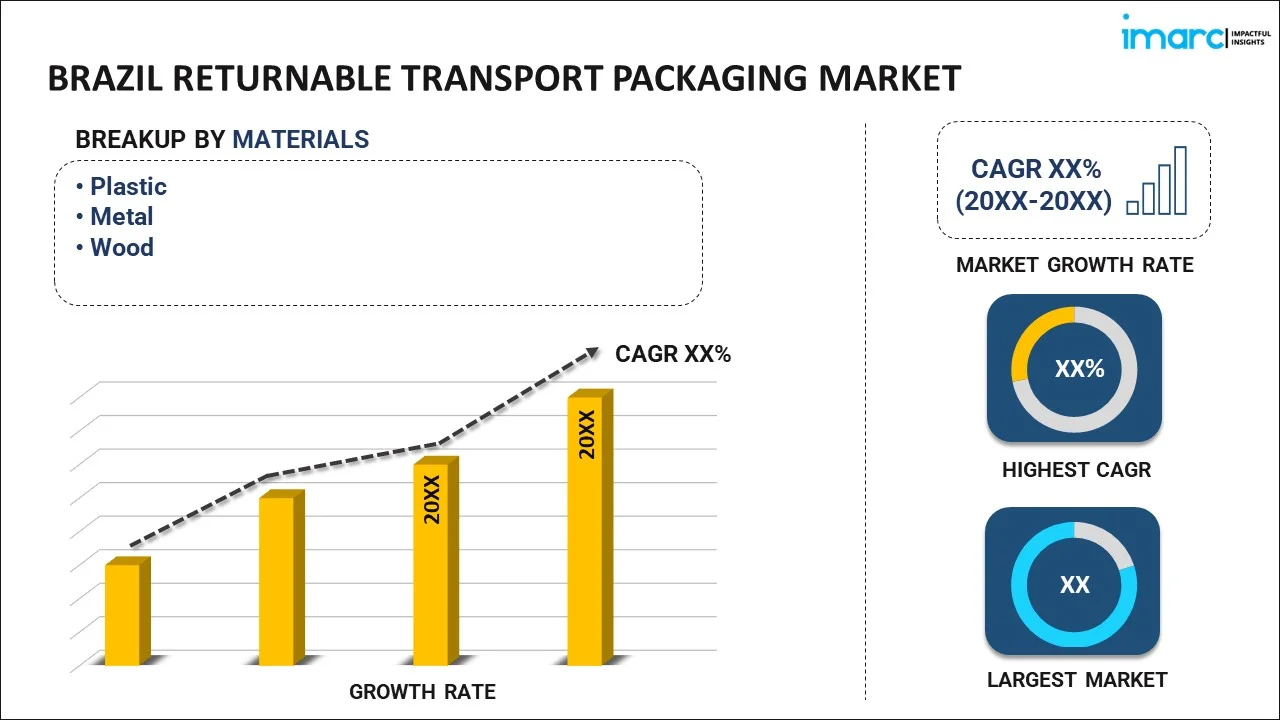
To get detailed segment analysis of this market Request Sample
- Plastic
- Metal
- Wood
Plastic dominates with a market share of 57% of the total Brazil returnable transport packaging market in 2025.
Plastic materials lead the Brazil returnable transport packaging market due to their exceptional durability, lightweight characteristics, and resistance to moisture and chemical exposure. High-density polyethylene and polypropylene formulations enable manufacturers to create stackable, collapsible containers that optimize storage and transportation efficiency. In September 2024, Braskem launched WENEW, its bio-circular polypropylene made from used cooking oil under ISCC Plus certification, promoting sustainability while maintaining identical performance to traditional materials for packaging applications. The material's inherent flexibility allows for innovative designs that reduce empty return volumes through foldable configurations.
The versatility of plastic materials enables customization for diverse industry requirements ranging from food-grade containers to automotive component trays. Advanced injection molding technologies produce precise, automation-compatible designs that integrate seamlessly with modern warehouse systems and robotic handling equipment. The growing availability of recycled plastic feedstocks supports circular economy objectives while reducing dependence on virgin materials, addressing both cost considerations and environmental compliance requirements across the Brazilian market. Additionally, plastic containers offer superior hygiene characteristics with smooth, non-porous surfaces that facilitate thorough cleaning and sanitization between use cycles, meeting stringent food safety regulations.
Product Insights:
- Containers
- Pallets
- Drums and Barrels
- Others
Containers lead with a share of 42% of the total Brazil returnable transport packaging market in 2025.
Containers represent the leading product segment due to their versatility in transporting diverse goods across food and beverages, automotive, and consumer goods industries. Foldable and stackable designs minimize space requirements during return logistics while ensuring product protection throughout distribution cycles. The standardized dimensions of reusable containers facilitate efficient palletization and maximize truck loading capacity, reducing transportation costs per unit shipped. Their robust construction withstands repeated handling across multiple supply chain touchpoints without compromising structural integrity.
Modern container designs incorporate ventilation features for perishable goods, ergonomic handling mechanisms, and compatibility with automated sorting systems. The development of specialized containers for specific product categories, including temperature-sensitive items and fragile components, expands application possibilities. Pooling services enable businesses to access high-quality containers without capital investment, reducing barriers to adoption while ensuring consistent supply of properly maintained packaging assets throughout regional distribution networks. Integrated identification systems using barcodes and RFID tags enhance inventory tracking and asset management capabilities. The shift toward retail-ready containers that transition directly from transport to store display eliminates repacking requirements, streamlining operations while reducing labor costs and product handling damage throughout the distribution chain.
Application Insights:
- Automotive
- Food and Beverages
- Consumer Goods
- Others
Food and beverages exhibit a clear dominance with a 35% share of the total Brazil returnable transport packaging market in 2025.
The food and beverages segment leads application categories due to stringent hygiene requirements, cold chain logistics needs, and high-volume distribution demands across Brazil's extensive retail network. Reusable containers designed for fresh produce, dairy products, and beverages ensure product integrity while reducing packaging waste. In March 2024, SIG partnered with DPA Brasil to produce spouted pouch packaging for the Chamyto yogurt line, reinforcing the food industry's commitment to innovative, high-performance packaging solutions in the Brazilian market.
The Brazilian food industry's continued expansion drives sustained demand for reliable returnable packaging that maintains product freshness during transportation across extensive distribution networks. Hygienic design features, including smooth surfaces suitable for sanitization and food-safe material certifications, address regulatory compliance requirements. The growing adoption of returnable plastic containers by major retailers and food producers supports waste reduction initiatives while improving supply chain efficiency through standardized handling procedures and reduced product damage rates. Ventilated container designs optimize airflow around fresh produce, extending shelf life and minimizing spoilage losses throughout the distribution chain from farm to retail store.
Regional Insights:
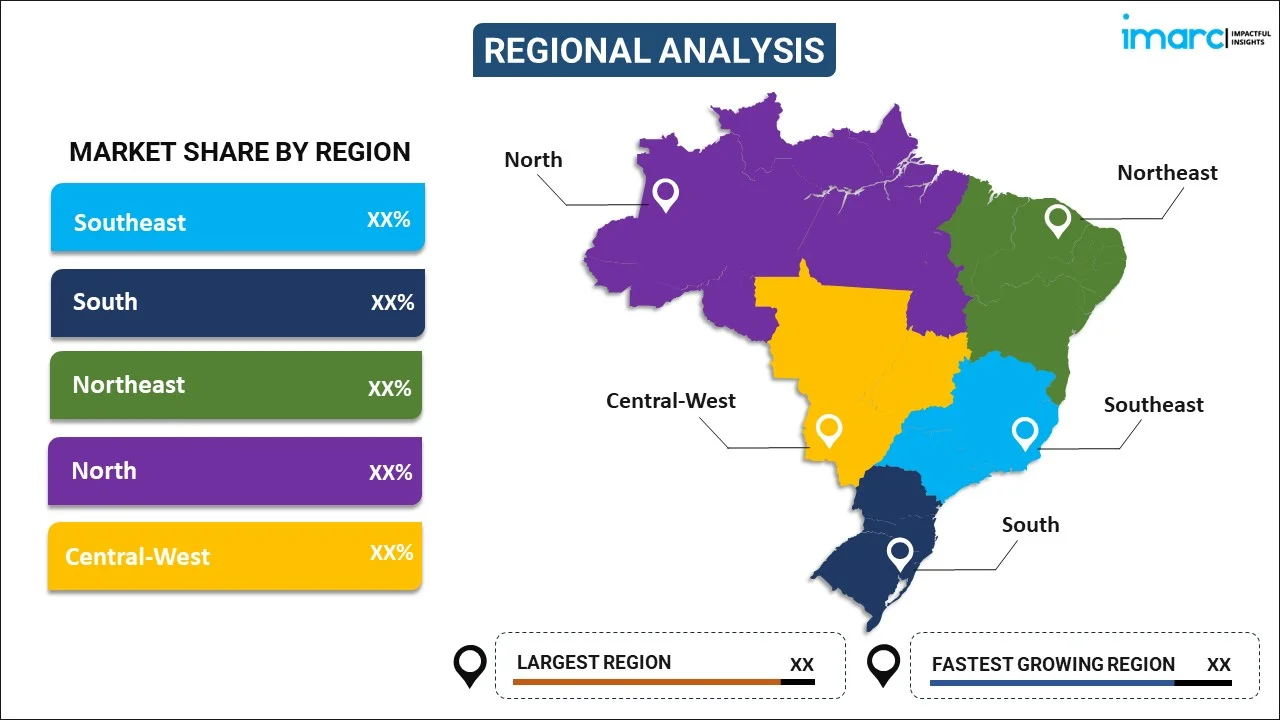
To get detailed regional analysis of this market Request Sample
- Southeast
- South
- Northeast
- North
- Central-West
Southeast represents the leading segment with a 34% share of the total Brazil returnable transport packaging market in 2025.
The Southeast region dominates the Brazil returnable transport packaging market due to its concentration of industrial manufacturing, major port infrastructure, and dense consumer markets centered around São Paulo and Rio de Janeiro. The region serves as the nation's primary economic hub, housing the largest concentration of food processing plants, automotive assembly facilities, and consumer goods manufacturers that drive substantial demand for efficient logistics packaging solutions. Advanced transportation networks connect major distribution centers to retail outlets across densely populated urban areas, facilitating the efficient circulation of returnable packaging assets.
Established pooling service providers maintain extensive networks of service centers throughout the Southeast, enabling rapid asset recovery, cleaning, and redistribution to meet fluctuating demand patterns. The proximity of manufacturing facilities to major port terminals supports export-oriented industries requiring standardized packaging compatible with international supply chain requirements. Well-developed highway and rail infrastructure reduces transit times for reverse logistics operations, improving asset turnover rates and economic viability of reusable packaging systems. The region's sophisticated warehouse automation capabilities further accelerate adoption of automation-compatible containers and pallets designed for seamless integration with modern material handling equipment.
Market Dynamics:
Growth Drivers:
Why is the Brazil Returnable Transport Packaging Market Growing?
Stringent Environmental Regulations and Sustainability Mandates
Government regulations promoting waste reduction and recycling are significantly accelerating returnable transport packaging adoption across Brazilian industries. The National Solid Waste Policy mandates producers to collect or offset plastic packaging, creating regulatory pressure for reusable alternatives. Recent legislative developments have established mandatory reverse logistics requirements for plastic packaging, compelling manufacturers, distributors, and retailers to implement closed-loop packaging systems that minimize environmental impact. These regulations set progressive targets for recycled content integration and recovery rates, driving industry-wide transformation toward sustainable practices. Corporate sustainability commitments aligned with global climate action goals further reinforce the transition toward reusable packaging. Companies seeking to reduce Scope 3 emissions find returnable transport packaging essential for achieving carbon reduction targets while maintaining operational efficiency across supply chain networks. The regulatory framework incentivizes investments in returnable packaging infrastructure by penalizing non-compliance and rewarding circular economy initiatives.
Rapid Expansion of E-commerce and Logistics Infrastructure
The accelerating growth of e-commerce activities is driving substantial demand for durable, reusable packaging solutions capable of withstanding multiple transportation cycles. The surge in online shopping has intensified requirements for efficient logistics packaging that protects products throughout complex distribution journeys. Fulfillment centers specify crush-resistant containers and standardized pallets that survive multileg journeys across extensive distribution networks spanning thousands of kilometers. Government infrastructure investments targeting transportation network improvements enhance the feasibility of closed-loop packaging systems by reducing transit times and logistics costs. Enhanced warehouse automation and last-mile delivery capabilities require automation-compatible packaging designs that integrate seamlessly with sorting systems and robotic handling equipment. The expansion of distribution centers across multiple regions creates additional demand for standardized returnable packaging that facilitates efficient inventory management and rapid order fulfillment operations.
Growing Food and Beverage Industry Demand
Brazil's expanding food and beverage industry creates sustained demand for hygienic, efficient returnable packaging solutions that protect product integrity throughout distribution networks. The Major retailers and food producers are adopting reusable plastic containers to reduce packaging waste while improving cold chain logistics performance. In December 2023, Nestlé announced plans to invest USD 1.2 Billion in food and beverage production in Brazil, creating additional demand for reliable transport packaging solutions. The industry's focus on reducing food waste through improved packaging designs aligns with sustainability objectives while addressing operational efficiency requirements across the extensive retail distribution landscape.
Market Restraints:
What Challenges the Brazil Returnable Transport Packaging Market is Facing?
High Initial Investment and Capital Requirements
The substantial upfront investment required for returnable transport packaging systems presents significant barriers for smaller enterprises seeking to transition from single-use alternatives. Durable containers, pallets, and specialized packaging solutions command higher purchase prices compared to disposable options, requiring companies to view these acquisitions as capital investments. Additional costs for tracking systems, maintenance infrastructure, and inventory management further increase implementation expenses that may strain financial resources for businesses operating with limited capital access.
Complex Reverse Logistics and Asset Management
Managing the return, cleaning, and redistribution of reusable packaging assets across Brazil's extensive geographic territory creates operational complexities that challenge supply chain efficiency. Companies must establish collection networks, maintenance facilities, and tracking systems to ensure packaging returns and maintains circulation. Loss prevention remains a persistent concern, with pallet theft and asset diversion affecting pooling system economics. The resource-intensive nature of asset administration, storage, and coordination across multiple stakeholders requires dedicated management capabilities that smaller organizations may lack.
Raw Material Price Volatility and Economic Uncertainty
Fluctuations in raw material prices, particularly petroleum-based plastics and treated wood, create cost uncertainty for returnable packaging manufacturers and users. Import duties on polyethylene, polypropylene, and PVC rose in 2024, inflating resin prices and affecting production economics. Currency volatility amplifies import cost fluctuations, impacting businesses reliant on foreign-sourced materials or equipment. Economic uncertainty can also delay investment decisions in new packaging systems, as companies prioritize short-term cost management over long-term sustainability initiatives.
Competitive Landscape:
The Brazil returnable transport packaging market exhibits a moderately consolidated competitive structure characterized by the presence of established multinational pooling providers alongside regional manufacturers and logistics companies. Market leaders focus on expanding service networks, enhancing asset tracking capabilities, and developing sustainable packaging solutions to maintain competitive advantages. Companies invest in automated service centers, digital monitoring technologies, and strategic partnerships with retailers and manufacturers to strengthen market positions. Innovation in material science, including recycled content integration and bio-based alternatives, differentiates product offerings. The growing emphasis on sustainability and regulatory compliance is driving collaboration among industry participants to develop effective closed-loop systems that optimize asset utilization and minimize environmental impact across Brazilian supply chains.
Brazil Returnable Transport Packaging Market Report Coverage:
| Report Features | Details |
|---|---|
| Base Year of the Analysis | 2025 |
| Historical Period | 2020-2025 |
| Forecast Period | 2026-2034 |
| Units | Million USD |
| Scope of the Report | Exploration of Historical and Forecast Trends, Industry Catalysts and Challenges, Segment-Wise Historical and Predictive Market Assessment:
|
| Materials Covered | Plastic, Metal, Wood |
| Products Covered | Containers, Pallets, Drums and Barrels, Others |
| Applications Covered | Automotive, Food and Beverages, Consumer Goods, Others |
| Regions Covered | Southeast, South, Northeast, North, Central-West |
| Customization Scope | 10% Free Customization |
| Post-Sale Analyst Support | 10-12 Weeks |
| Delivery Format | PDF and Excel through Email (We can also provide the editable version of the report in PPT/Word format on special request) |
Frequently Asked Questions About the Brazil Returnable Transport Packaging Market Report
The Brazil returnable transport packaging market size was valued at USD 635.86 Million in 2025.
The Brazil returnable transport packaging market is expected to grow at a compound annual growth rate of 5.51% from 2026-2034 to reach USD 1,030.39 Million by 2034.
Plastic dominated the market with a share of 57%, owing to its lightweight properties, durability, versatility for customization, and resistance to moisture, making it ideal for repeated use cycles across multiple industries.
Key factors driving the Brazil returnable transport packaging market include stringent environmental regulations, expanding e-commerce activities, growing food and beverage industry demand, sustainability mandates, and technological advancements in asset tracking systems.
Major challenges include high initial investment requirements, complex reverse logistics management, asset loss prevention, raw material price volatility, economic uncertainty, and the resource-intensive nature of managing closed-loop packaging systems.
Need more help?
- Speak to our experienced analysts for insights on the current market scenarios.
- Include additional segments and countries to customize the report as per your requirement.
- Gain an unparalleled competitive advantage in your domain by understanding how to utilize the report and positively impacting your operations and revenue.
- For further assistance, please connect with our analysts.
 Request Customization
 Speak to an Analyst
 Request Brochure
 Inquire Before Buying
Benefits of Customization
- Personalize this research
- Triangulate with your data
- Get data as per your format and definition
- Gain a deeper dive into a specific application, geography, customer, or competitor
- Any level of personalization
Get in Touch With Us
UNITED STATES
Phone: +1-201-971-6302
INDIA
Phone: +91-120-433-0800
UNITED KINGDOM
Phone: +44-753-714-6104
Email: [email protected]
Client Testimonials




.webp)




.webp)













Related Reports

Choose your plan
*Please note that the prices mentioned below are starting prices for each bundle type. Kindly contact our team for further details.*
Single User License
- 1 User License, Access on 2 Devices
- PDF Report + Excel Dataset (Password Protected)
- Lifetime Access
- No Printing Rights
- 10% Free Report Customization
- 10–12 Weeks of Analyst Support
Five User License
- Access for 5 Users, 2 Devices per User
- PDF Report + Excel Dataset (Password Protected)
- Lifetime Access
- Dedicated Account Manager
- 12–14 Weeks of Analyst Support
- No Printing Rights
- 15% Free Report Customization
- 25% Discount on Your Next Purchase
Corporate User License
- Unlimited User Access (Within Your Organization)
- PDF Report + Excel Dataset
- Lifetime Access
- Dedicated Account Manager
- 14–20 Weeks of Analyst Support
- No Printing Rights
- 20% Free Report Customization
- 30% Discount on Your Next Purchase
Essential Insights
What's included:
3 reports
- Lifetime Access
- PDF Reports
- Excel Datasets
- 2 Weeks of Free Analyst Support
- 2 User Licenses
- Access on 2 Devices
- Printing Rights
- Complimentary PowerPoint (PPT) Version
- Complimentary License Upgrade
Professional Access
What's included:
5 reports
- Lifetime Access
- PDF Reports
- Excel Datasets
- 8 Weeks of Free Analyst Support
- 2 User Licenses
- Access on 2 Devices
- Printing Rights
- Complimentary PowerPoint (PPT) Version
- Complimentary License Upgrade
Business Advantage
What's included:
8 reports
- Lifetime Access
- PDF Reports
- Excel Datasets
- 14 Weeks of Free Analyst Support
- 2 User Licenses
- Access on 2 Devices
- Printing Rights
- Complimentary PowerPoint (PPT) Version
- Complimentary License Upgrade
Enterprise Intelligence
What's included:
10 reports
- Lifetime Access
- PDF Reports
- Excel Datasets
- 20 Weeks of Free Analyst Support
- 2 User Licenses
- Access on 2 Devices
- Printing Rights
- Complimentary PowerPoint (PPT) Version
- Complimentary License Upgrade