
Brazil Smart Hospitals Market Size, Share, Trends and Forecast by Component, Product, Service Offered, Connectivity, Technology, Application, and Region 2026-2034
Brazil Smart Hospitals Market Summary:
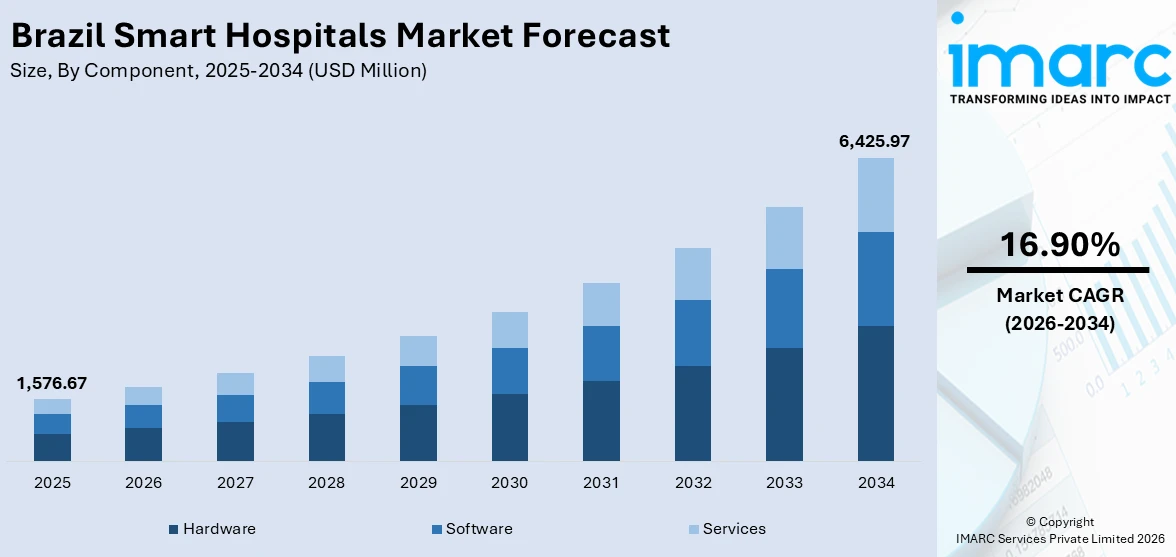
The Brazil smart hospitals market size was valued at USD 1,576.67 Million in 2025 and is projected to reach USD 6,425.97 Million by 2034, growing at a compound annual growth rate of 16.90% from 2026-2034.
Brazil’s smart hospitals market is expanding steadily, driven by increasing adoption of digital healthcare infrastructure, rising demand for advanced patient monitoring systems, and growing investments in hospital automation, while government support for health technology modernization and integration of AI, IoT, and electronic health records are improving operational efficiency and quality of care across healthcare facilities.
Key Takeaways and Insights:
- By Component: Hardware dominates the market with a share of 46.8% in 2025, driven by demand for monitoring devices, sensors, and automated hospital equipment integration.
- By Product: Electronic Health Records accounted for the highest market share of 38.7% in 2025, supported by the growing adoption of digital systems for managing patient data across hospitals nationwide.
- By Service Offered: General segment led the market in 2025, holding a 52.3% share, due to broad deployment of smart systems across routine hospital operations.
- By Connectivity: Wireless dominates the market with a share of 63.4% in 2025, enabling real-time data transfer, mobility, and flexible hospital network connectivity solutions.
- By Technology: Internet of Things leads the market with a share of 34.8% in 2025, enhancing remote monitoring, asset tracking, and intelligent infrastructure management in hospitals.
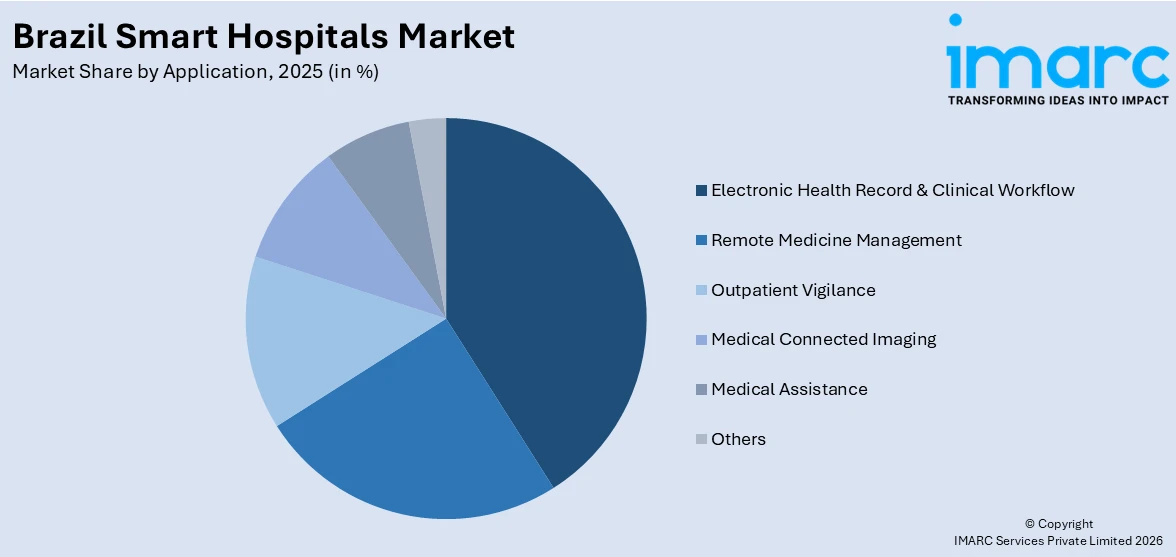
- By Application: Electronic Health Record & Clinical Workflow segment captured the highest share in the market of 41.3% in 2025, fueled by improvements in operational efficiency and streamlined patient care coordination.
- By Region: Southeast Brazil represents the largest segment with a market share of 48.1% in 2025, owing to advanced healthcare infrastructure and higher technology adoption rates.
- Key Players: The market is moderately competitive, with global health technology firms and domestic providers focusing on smart monitoring solutions, hospital automation platforms, AI-enabled clinical systems, and strategic partnerships to expand digital healthcare transformation across Brazil.
To get more information on this market Request Sample
Brazil’s smart hospitals market is gaining momentum as healthcare providers increasingly prioritize digital transformation to improve service delivery and patient outcomes. Hospitals are also adopting advanced solutions such as telemedicine integration, predictive analytics, and automated diagnostics to enhance clinical decision-making. An NCBI report from March to November 2023 states that a project conducted 6,312 telehealth sessions, training 342 professionals across three modalities. Teleconsultations resolved 85% of cases, with 15% needing in-person care. Likewise, growing pressure to reduce hospital stays, optimize resource utilization, and manage rising patient volumes is accelerating investments in intelligent infrastructure. Private healthcare networks are playing a major role in deploying smart technologies, supported by increased funding for healthcare IT modernization. The market is also benefiting from the expansion of connected care models and a stronger focus on patient safety through real-time alert systems. Moreover, demand is rising for interoperable platforms that enable seamless data exchange between departments.
Brazil Smart Hospitals Market Trends:
Expansion of AI-Enabled Diagnostic Support Systems
Driven by the urgent need for faster, more precise patient care, Brazilian smart hospitals are using AI tools to accelerate and improve the accuracy of clinical diagnoses. As such, in July 2025, NOUL partnered with Seegene Brazil to introduce its AI-driven cervical cancer diagnostic, miLab CER, expanding Latin American reach and building on prior success with miLab BCM, advancing AI-powered diagnostic automation. These systems help doctors interpret images, predict disease risks, and set treatment priorities. AI is spreading, especially in radiology, cardiology, and emergency care. This trend shows hospitals want to boost decision support, ease workloads, and raise care quality in busy settings.
Growth of Smart Patient Rooms and Automated Bedside Care
Hospitals in Brazil are gradually investing in smart patient room technologies that enable automated bedside monitoring and personalized care delivery. Connected devices track vital signs, medication adherence, and patient movement, reducing the need for manual interventions by nursing staff. Smart room infrastructure also improves patient comfort and safety through automated lighting, alerts, and communication systems. This trend is strengthening the shift toward more responsive and technology-driven inpatient care environments.
Increasing Use of Robotics in Hospital Logistics and Surgery
Robotic technologies are emerging as a significant trend within Brazil’s smart hospitals market. Hospitals are adopting robotic systems for surgical assistance, supply delivery, and sterilisation to improve precision and operational efficiency. For example, in December 2024, MicroPort MedBot’s Toumai laparoscopic surgical robot received ANVISA approval in Brazil, marking a milestone in robotic-assisted surgery. The robot offers advanced tactile feedback, precision imaging, and remote surgery capabilities, expanding access to cutting-edge surgical care in Latin America. Robotics also supports infection control by minimizing human contact in sensitive hospital zones. The trend is gaining traction in advanced private hospitals, driven by demand for high-quality outcomes and more efficient healthcare workflows.
Market Outlook 2026-2034:
Brazil’s smart hospitals market is expected to expand significantly as healthcare institutions increase investments in digital infrastructure and next-generation care delivery models. Accordingly, the Salvador Social Project in Brazil, backed by the World Bank, digitized healthcare with the Vida+ system and a Situation Room, improving patient record access, data-driven decision-making, and integrating care across 175 facilities, with future AI and mental health integration planned. Likewise, heightened adoption will be supported by rising demand for remote patient management, integrated hospital command centers, and data-driven operational planning. Continued improvements in interoperability standards and cybersecurity readiness will further strengthen technology deployment across facilities. Market growth will remain concentrated in metropolitan regions, with gradual expansion into secondary cities as healthcare modernization accelerates nationwide. The market generated a revenue of USD 1,576.67 Million in 2025 and is projected to reach a revenue of USD 6,425.97 Million by 2034, growing at a compound annual growth rate of 16.90% from 2026-2034.
Brazil Smart Hospitals Market Report Segmentation:
|
Segment Category |
Leading Segment |
Market Share |
|
Component |
Hardware |
46.8% |
|
Product |
Electronic Health Records |
38.7% |
|
Service Offered |
General |
52.3% |
|
Connectivity |
Wireless |
63.4% |
|
Technology |
Internet of Things |
34.8% |
|
Application |
Electronic Health Record & Clinical Workflow |
41.3% |
|
Region |
Southeast Brazil |
48.1% |
Component Insights:
- Hardware
- Stationary Medical Devices
- Implanted Medical Devices
- Wearable External Medical Devices
- Others
- Software
- Services
- Professional Services
- Managed Services
Hardware dominates with a market share of 46.8% of the total Brazil smart hospitals market in 2025.
The dominance in the market is driven by the increasing installation of advanced medical devices, connected monitoring systems, and automated hospital equipment required for smart care delivery. Hospitals are prioritizing hardware upgrades to support digital transformation initiatives and improve the efficiency of patient management across critical care and diagnostic settings.
The strong position of hardware is further supported by rising investments in wearable devices, implanted monitoring solutions, and stationary infrastructure for continuous patient observation. As such, in August 2025, Enable Injections’ enFuse on-body drug delivery system received regulatory approval from Brazil’s ANVISA, enabling subcutaneous medication administration nationwide. The wearable technology aims to improve patient convenience, support at-home treatment, and enhance the administration of therapies like Empaveli/Aspaveli. Modern hospitals are expanding hardware deployment to enable real-time clinical data capture and integrated smart facility operations. As healthcare modernization accelerates, hardware remains a foundational requirement for implementing broader smart hospital ecosystems in Brazil.
Product Insights:
- mHealth
- Telemedicine
- Smart Pills
- Electronic Health Record
- Others
Electronic Health Records leads with a share of 38.7% of the total Brazil smart hospitals market in 2025.
The leadership reflects the growing importance of centralized patient data management to improve clinical accuracy, reduce administrative workload, and support coordinated treatment pathways. Hospitals are increasingly adopting EHR systems to enhance decision-making and streamline patient care processes. Accordingly, Brazil’s 45 federal university hospitals, serving 27 million patients, have implemented a certified electronic health record system. Developed by Ebserh and RNP, it supports digital prescriptions, appointments, inventory management, and ensures data security, interoperability, and regulatory compliance.
The leadership of electronic health records is reinforced by regulatory push for digital documentation and the need for interoperability across departments. EHR adoption enables faster access to medical histories, improved hospital workflows, and better patient safety standards. As Brazil continues expanding its digital healthcare infrastructure, EHR solutions will remain central to smart hospital development.
Service Offered Insights:
- General Services
- Specialty
- Super Specialty
General Services exhibits a clear dominance with a 52.3% share of the total Brazil smart hospitals market in 2025.
The segment’s growth is driven by broad implementation of smart systems across routine hospital operations, including patient admission, monitoring, and general clinical care delivery. Hospitals are adopting digital platforms to enhance efficiency in everyday healthcare services.
The strong presence of general services is also supported by rising demand for smart solutions in standard inpatient and outpatient care settings. Additionally, increasing investments in automation, digital scheduling, and connected patient monitoring are improving operational performance across general hospital departments. As smart hospital adoption grows, general services continue to remain the primary focus for digital upgrades.
Connectivity Insights:
- Wireless
- Wi-Fi
- Radio Frequency Identification (RFID)
- Bluetooth
- Zigbee
- Near Field Communication (NFC)
- Others
- Wired
Wireless leads with a share of 63.4% of the total Brazil smart hospitals market in 2025.
The growing dominance of wireless connectivity in healthcare reflects the increasing demand for flexible, real-time data exchange across hospital environments. Modern hospitals require seamless integration between mobile monitoring devices, electronic health records, and remote clinical systems, ensuring that patient data is accessible anywhere, anytime. Wireless networks enable uninterrupted communication between staff, devices, and systems, supporting telemedicine, remote consultations, and connected patient care. Such infrastructure is essential for building a fully integrated smart healthcare ecosystem capable of improving clinical efficiency and patient outcomes.
The leadership of wireless connectivity in hospitals is further reinforced by the rapid adoption of IoT-enabled devices and smart monitoring applications. These technologies require continuous, reliable network coverage to function effectively, enabling real-time patient monitoring, automated alerts, and predictive analytics. Hospitals are increasingly investing in Wi-Fi, Bluetooth, and RFID systems to enhance asset tracking, patient mobility, and workflow efficiency. By integrating these technologies, healthcare facilities can improve clinical responsiveness, optimize resource utilization, and deliver safer, more personalized patient care.
Technology Insights:
- Artificial Intelligence
- Internet of Things
- Cloud Computing
- Big Data
- Others
Internet of Things exhibits a clear dominance with a 34.8% share of the total Brazil smart hospitals market in 2025.
IoT dominance is propelled by widespread adoption of connected medical devices, smart sensors, and real-time monitoring tools that improve hospital efficiency and patient safety. As such, in July 2025, Shen AI Vitals received ANVISA approval as a class II medical device in Brazil, enabling real-time, contactless monitoring of heart rate, HRV, and respiratory rate. It supports regulated digital health, telemedicine, and insurance platforms with seamless integration and compliance. Healthcare providers are increasingly relying on IoT for intelligent facility management.
The strong position of IoT is supported by its role in enabling predictive maintenance, automated alerts, and continuous tracking of critical equipment and patient conditions. Hospitals are deploying IoT-based infrastructure to support responsive care models and optimize resource utilization. As Brazil advances its digital healthcare transformation, IoT will continue to drive smart hospital innovation.
Application Insights:
Access the comprehensive market breakdown Request Sample
- Remote Medicine Management
- Electronic Health Record & Clinical Workflow
- Outpatient Vigilance
- Medical Connected Imaging
- Medical Assistance
- Others
Electronic Health Record & Clinical Workflow leads with a share of 41.3% of the total Brazil smart hospitals market in 2025.
The dominance of the segment reflects the growing demand for integrated digital platforms that enhance care coordination, reduce clinical delays, and streamline administrative procedures within hospitals. Workflow digitization is becoming essential for modern healthcare delivery.
The leadership is also reinforced by increasing focus on operational efficiency and patient-centered care pathways. Hospitals are investing in solutions that automate documentation, improve staff productivity, and support real-time clinical decision processes. As digital health adoption expands, EHR and workflow applications will remain a core driver of smart hospital growth.
Region Insights:
- Southeast
- South
- Northeast
- North
- Central-West
Southeast Brazil exhibits a clear dominance with a 48.1% share of the total Brazil smart hospitals market in 2025.
The region benefits from a strong healthcare infrastructure, a higher concentration of private hospitals, and greater investments in advanced medical technologies. Urban centres in Southeast Brazil are leading the adoption of smart healthcare solutions.
The region’s dominance is further supported by higher healthcare expenditure, greater availability of skilled professionals, and strong demand for technology-enabled care systems. An industry report indicates that Brazil is the largest healthcare market in Latin America, allocating 9.7% of its GDP to healthcare, which amounts to approximately USD 135 billion. Major hospitals in São Paulo and Rio de Janeiro are actively deploying connected infrastructure and digital platforms. Southeast Brazil is expected to continue driving national smart hospital expansion.
Market Dynamics:
Growth Drivers:
Why is the Brazil Smart Hospitals Market Growing?
Adoption of Digital Twin Technology for Hospital Operations
Brazilian smart hospitals are increasingly exploring digital twin models to simulate hospital workflows and optimize resource planning. For instance, in September 2025, Smart Spatial and CIT4LIFE partnered to bring operational digital twins to Brazil, enhancing infrastructure, healthcare, and industrial systems with real-time visibility, predictive simulations, and sustainable solutions, accelerating digital transformation and evidence-based decision-making across key sectors. These virtual replicas allow administrators to monitor patient flow, predict bottlenecks, and improve infrastructure utilization. Digital twin adoption is supporting more informed decision-making in capacity management and emergency preparedness. This trend is gaining traction in large private hospitals seeking advanced operational intelligence and improved service efficiency across complex healthcare environments.
Expansion of Connected Intensive Care Units (Smart ICUs)
Smart ICUs are emerging as a major trend in Brazil, with hospitals investing in advanced connected systems for continuous critical patient monitoring. Integrated ICU platforms combine real-time vital tracking, automated alerts, and centralized dashboards for faster clinical response. This trend is improving intensive care outcomes and reducing manual workload for staff. Smart ICU expansion reflects rising demand for high-acuity digital care solutions in Brazil’s modern hospital facilities.
Increasing Use of Blockchain for Secure Health Data Exchange
Blockchain-based solutions are gradually being introduced in Brazil’s smart hospitals to improve the security and traceability of medical information. Hospitals are leveraging blockchain to prevent data tampering, support consent-based sharing, and enhance transparency in healthcare transactions. This trend is particularly relevant for multi-provider networks requiring trusted interoperability. As cybersecurity concerns rise, blockchain adoption is strengthening confidence in secure digital healthcare ecosystems.
Market Restraints:
What Challenges the Brazil Smart Hospitals Market is Facing?
High Capital Investment Requirements for Smart Infrastructure
Brazil’s smart hospital market faces challenges due to the significant capital expenditure required for implementing advanced digital systems, automation equipment, and connected infrastructure. Many hospitals, particularly in the public sector, struggle with budget constraints that limit large-scale modernization projects. High upfront costs for technology procurement and facility upgrades can delay adoption, restricting smart hospital expansion beyond major private healthcare networks.
Shortage of Skilled Healthcare IT Professionals
A major barrier in Brazil is the limited availability of trained professionals capable of managing complex smart hospital technologies. Successful deployment requires expertise in health informatics, cybersecurity, data analytics, and system integration. Many healthcare institutions face workforce gaps that reduce implementation efficiency and increase reliance on external consultants. This skills shortage slows technology scaling and creates operational risks in maintaining advanced digital healthcare systems.
Fragmented Interoperability Across Healthcare Systems
Interoperability challenges remain a significant restraint in Brazil’s smart hospital market. Many hospitals operate with legacy software platforms that are not fully compatible with newer digital solutions. Lack of standardized data exchange frameworks limits seamless communication between departments and external healthcare providers. This fragmentation reduces the efficiency gains of smart hospital systems and complicates the development of fully integrated, connected care environments nationwide.
Competitive Landscape:
Brazil’s smart hospital market is moderately competitive, with global healthcare technology firms and domestic solution providers actively expanding their presence. Competition is further driven by innovation in hospital automation, AI-enabled clinical platforms, connected monitoring systems, and digital infrastructure services. Key players focus on strategic partnerships with private hospital networks, technology integration capabilities, and customized solutions for different care settings. Moreover, local companies are gaining traction through cost-effective digital offerings, while multinational firms leverage advanced research and development (R&D) and established product portfolios. Competitive intensity is expected to increase as digital healthcare investments continue rising.
Recent Developments:
- In November 2025, at COP30 in Belém, Brazil, PAHO launched the Belem Health Action Plan to build climate-resilient, low-emission health systems. Focusing on vulnerable populations, surveillance, capacity building, and innovation, it promotes equity, strengthens hospitals, including Smart Hospitals, and trains health professionals to safeguard communities against climate-related health risks.
- In July 2025, Brazil unveiled its first smart hospital within the Unified Health System, costing USD 320 Million and spanning 150,000 m². The facility will use AI diagnostics, telemedicine, 5G ambulances, and predictive management, focusing on emergency, ICU, and neurology, in partnership with the University of São Paulo and China.
Brazil Smart Hospitals Market Report Coverage:
|
Report Features |
Details |
|
Base Year of the Analysis |
2025 |
|
Historical Period |
2020-2025 |
|
Forecast Period |
2026-2034 |
|
Units |
Million USD |
|
Scope of the Report |
Exploration of Historical Trends and Market Outlook, Industry Catalysts and Challenges, Segment-Wise Historical and Future Market Assessment:
|
|
Components Covered |
|
|
Products Covered |
mHealth, Telemedicine, Smart Pills, Electronic Health Record, Others |
|
Services Offered Covered |
General Services, Specialty, Super Specialty |
|
Connectivity Covered |
|
|
Technologies Covered |
Artificial Intelligence, Internet of Things, Cloud Computing, Big Data, Others |
|
Applications Covered |
Remote Medicine Management, Electronic Health Record & Clinical Workflow, Outpatient Vigilance, Medical Connected Imaging, Medical Assistance, Others |
|
Regions Covered |
Southeast Brazil, South Brazil, Northeast Brazil, North Brazil, Central-West Brazil |
|
Customization Scope |
10% Free Customization |
|
Post-Sale Analyst Support |
10-12 Weeks |
|
Delivery Format |
PDF and Excel through Email (We can also provide the editable version of the report in PPT/Word format on special request) |
Frequently Asked Questions About the Brazil Smart Hospitals Market Report
The Brazil smart hospitals market size was valued at USD 1,576.67 Million in 2025.
The Brazil smart hospitals market is expected to grow at a compound annual growth rate of 16.90% from 2026-2034 to reach USD 6,425.97 Million by 2034.
Hardware dominated the market with 46.8% share in 2025, driven by investments in medical devices, networking equipment, IoT sensors, servers, and imaging systems essential for digital healthcare infrastructure.
Key factors driving the Brazil smart hospitals market include rising demand for advanced healthcare technologies, increasing adoption of digital health solutions, government support for healthcare modernization, growing awareness of preventive care, expansion of telemedicine, and investments in infrastructure and innovative medical devices.
Major challenges in the Brazil smart hospitals market include include high implementation costs, limited IT infrastructure in public hospitals, cybersecurity risks, shortage of skilled healthcare IT professionals, integration difficulties with legacy systems, regulatory compliance hurdles, and resistance to adopting new digital technologies.
Need more help?
- Speak to our experienced analysts for insights on the current market scenarios.
- Include additional segments and countries to customize the report as per your requirement.
- Gain an unparalleled competitive advantage in your domain by understanding how to utilize the report and positively impacting your operations and revenue.
- For further assistance, please connect with our analysts.
 Request Customization
 Speak to an Analyst
 Request Brochure
 Inquire Before Buying
Benefits of Customization
- Personalize this research
- Triangulate with your data
- Get data as per your format and definition
- Gain a deeper dive into a specific application, geography, customer, or competitor
- Any level of personalization
Get in Touch With Us
UNITED STATES
Phone: +1-201-971-6302
INDIA
Phone: +91-120-433-0800
UNITED KINGDOM
Phone: +44-753-714-6104
Email: [email protected]
Client Testimonials




.webp)




.webp)













Related Reports

Choose your plan
*Please note that the prices mentioned below are starting prices for each bundle type. Kindly contact our team for further details.*
Single User License
- 1 User License, Access on 2 Devices
- PDF Report + Excel Dataset (Password Protected)
- Lifetime Access
- No Printing Rights
- 10% Free Report Customization
- 10–12 Weeks of Analyst Support
Five User License
- Access for 5 Users, 2 Devices per User
- PDF Report + Excel Dataset (Password Protected)
- Lifetime Access
- Dedicated Account Manager
- 12–14 Weeks of Analyst Support
- No Printing Rights
- 15% Free Report Customization
- 25% Discount on Your Next Purchase
Corporate User License
- Unlimited User Access (Within Your Organization)
- PDF Report + Excel Dataset
- Lifetime Access
- Dedicated Account Manager
- 14–20 Weeks of Analyst Support
- No Printing Rights
- 20% Free Report Customization
- 30% Discount on Your Next Purchase
Essential Insights
What's included:
3 reports
- Lifetime Access
- PDF Reports
- Excel Datasets
- 2 Weeks of Free Analyst Support
- 2 User Licenses
- Access on 2 Devices
- Printing Rights
- Complimentary PowerPoint (PPT) Version
- Complimentary License Upgrade
Professional Access
What's included:
5 reports
- Lifetime Access
- PDF Reports
- Excel Datasets
- 8 Weeks of Free Analyst Support
- 2 User Licenses
- Access on 2 Devices
- Printing Rights
- Complimentary PowerPoint (PPT) Version
- Complimentary License Upgrade
Business Advantage
What's included:
8 reports
- Lifetime Access
- PDF Reports
- Excel Datasets
- 14 Weeks of Free Analyst Support
- 2 User Licenses
- Access on 2 Devices
- Printing Rights
- Complimentary PowerPoint (PPT) Version
- Complimentary License Upgrade
Enterprise Intelligence
What's included:
10 reports
- Lifetime Access
- PDF Reports
- Excel Datasets
- 20 Weeks of Free Analyst Support
- 2 User Licenses
- Access on 2 Devices
- Printing Rights
- Complimentary PowerPoint (PPT) Version
- Complimentary License Upgrade