
Brazil Smart Textiles Market Size, Share, Trends and Forecast by Type, Functionality, End-Use Sector, and Region, 2026-2034
Brazil Smart Textiles Market Summary:
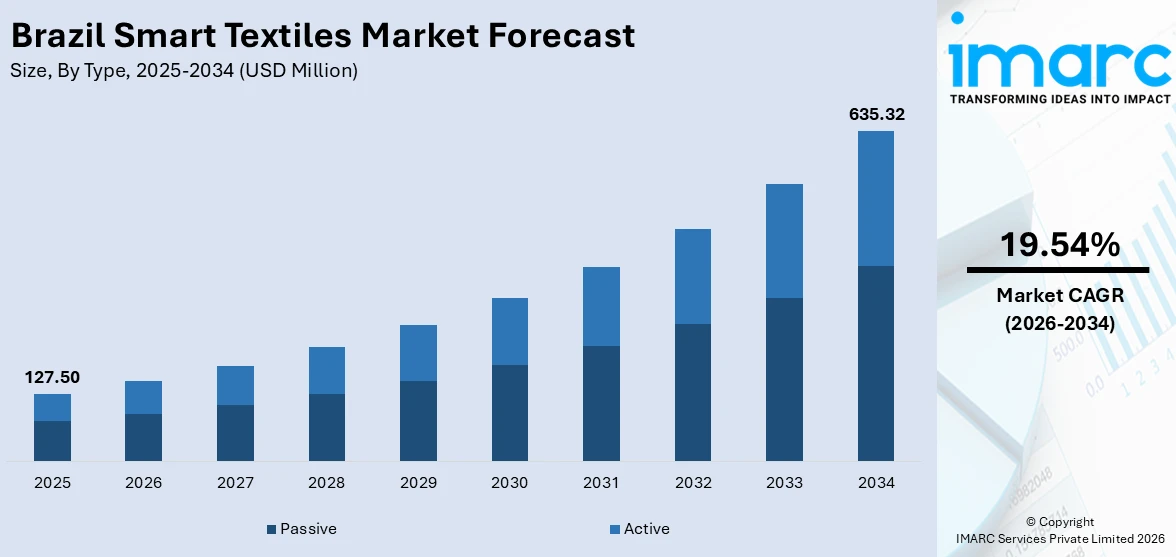
The Brazil smart textiles market size was valued at USD 127.50 Million in 2025 and is projected to reach USD 635.32 Million by 2034, growing at a compound annual growth rate of 19.54% from 2026-2034.
The Brazil smart textiles market is registering significant momentum as various industries are increasingly incorporating sophisticated features into fabric-based solutions. The rising interest in wearable health monitoring, smart protective clothing, and performance-enhancing clothing is revolutionizing the textile industry. The synergy of electronics miniaturization, the development of conductive fibers, and the rising applications in the defense, healthcare, and sports sectors is creating a positive momentum. Moreover, the rising institutional interest in technological autonomy in the high-value textile sectors and the growing research infrastructure are propelling the development and commercialization of smart textile solutions, boosting the Brazil smart textiles market share.
Key Takeaways and Insights:
- By Type: Passive dominate the market with share of 52.3% in 2025, driven by their established role in environmental sensing, UV protection, and antimicrobial functionality without requiring embedded electronics or external power sources.
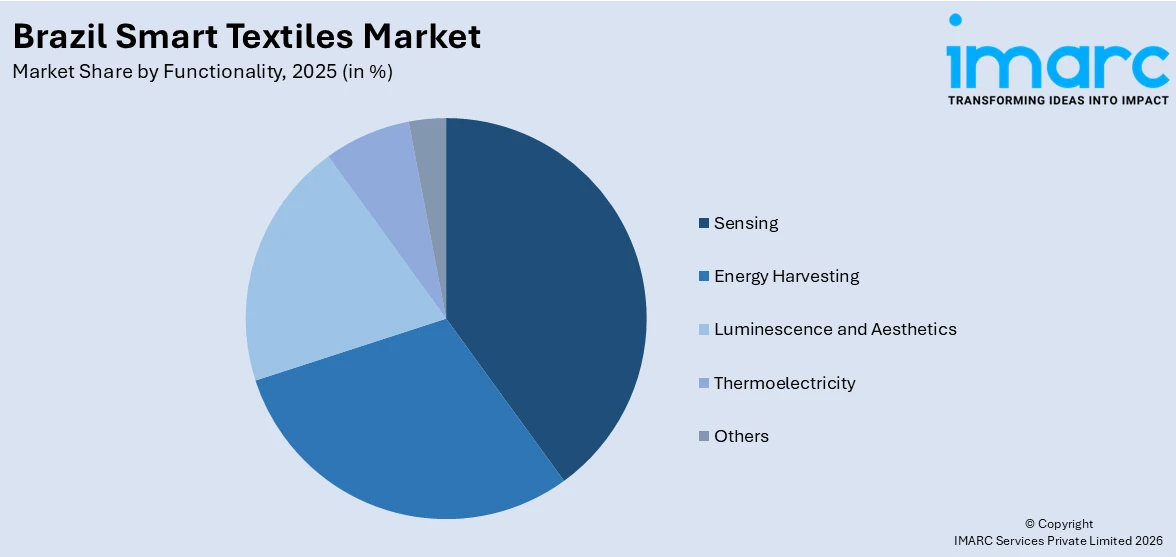
- By Functionality: Sensing leads the market with a share of 38.4% in 2025, supported by the expanding integration of sensor-based fabrics for real-time physiological and environmental monitoring across defense and healthcare applications.
- By End-Use Sector: Military and protection hold the largest share of 29.7% in 2025, reflecting the strong institutional demand for advanced protective textiles, wearable monitoring systems, and intelligent uniforms for defense personnel.
- By Region: Southeast dominates the market with a share of 44.8% in 2025, owing to its concentration of industrial infrastructure, textile research institutions, and proximity to major defense and technology establishments.
- Key Players: The Brazil smart textiles market features a moderately competitive landscape, with domestic textile innovators and international technology providers competing across defense, healthcare, and performance apparel segments through product differentiation and R&D partnerships.
To get more information on this market Request Sample
The Brazil smart textiles market is emerging as a vibrant and exciting convergence of materials science innovation, miniaturization of electronics, and industry-driven demand. The strong textile industry infrastructure in Brazil, combined with the growing institutional focus on defense sector modernization and healthcare innovation, is poised to place smart textiles on the high-growth radar. Passive smart textiles continue to form the backbone of market activity, providing innovative functionalities such as temperature control and moisture management, which do not require complex electronics. However, sensing-enabled smart textiles are quickly gaining popularity, especially in military healthcare applications and sports performance analysis. According to reports, Brazilian startup AG Têxtil, supported by the government-backed São Paulo Research Foundation (FAPESP), developed electrically conductive fabrics using nanotechnology that enable garments to interact with smartphones and wearable devices, highlighting growing domestic innovation in functional smart textiles. Government programs that focus on defense technology autonomy, combined with growing university-industry research collaborations, are building a strong innovation ecosystem. The Southeast region remains the hub of market activity, with its established industrial and research infrastructure.
Brazil Smart Textiles Market Trends:
Rising Integration of Wearable Health Monitoring in Textiles
Biometric sensing-enabled smart textiles are being increasingly used for health monitoring purposes. Physiological sensor-enabled fabrics allow the real-time monitoring of vital signs, which helps in preventive healthcare and remote patient monitoring. For example, researchers at the University of São Paulo, in collaboration with UNESP and UNICAMP, developed a wearable nanocellulose-based sensor that can be integrated into flexible materials to monitor biomarkers such as glucose, sodium, and lactate in sweat, enabling non-invasive metabolic monitoring and potential remote healthcare applications. The rising interest in personal wellness and chronic disease management is propelling the development of health solutions using textiles, which provide comfort and inconspicuousness compared to traditional wearable health monitors.
Advancement of Conductive Fiber and Nano-Enhanced Textile Technologies
Innovations in conductive yarns, nano-coated fibers, and flexible electronic integration are expanding the functional scope of smart textiles. These material-level advancements enable improved signal transmission, durability, and washability, addressing key barriers to commercial adoption. Brazilian nanotechnology company Nanox developed antimicrobial smart textile fabrics using silver nanoparticles capable of inactivating 99.9% of viruses, including SARS-CoV-2, enabling advanced applications in healthcare wearables and protective clothing. Ongoing research into energy-harvesting fibers and self-powered textile systems is further contributing to Brazil smart textiles market growth, paving the way for next-generation adaptive fabrics.
Growing Demand for Intelligent Protective and Performance Apparel
Defense organizations and professional sports sectors are increasingly seeking textiles that offer adaptive protection, environmental sensing, and performance optimization. Smart fabrics capable of temperature regulation, impact detection, and fatigue monitoring are being developed for specialized end-use applications. In April 2023, DuPont introduced Kevlar EXO, a next-generation aramid fiber engineered for lighter, more flexible body armor and wearable protection. The innovation enhances ballistic resistance, mobility, and enables integration with smart textile sensors for advanced defense and industrial safety applications. This trend reflects a broader shift toward intelligent apparel solutions that enhance operational efficiency, safety, and user comfort across demanding environments.
Market Outlook 2026-2034:
The Brazil smart textiles market is poised for sustained growth, driven by continued advancements in wearable electronics, expanding defense modernization initiatives, and increasing healthcare demand for non-invasive monitoring solutions. The convergence of material innovation with digital connectivity is expected to unlock new application areas and broaden market penetration across diverse end-use sectors. Rising institutional investments in research and development, coupled with strengthening collaborations between textile manufacturers and technology providers, are anticipated to accelerate product commercialization and enhance competitive positioning. Additionally, growing consumer awareness of intelligent textile functionalities and supportive government policies promoting technological self-reliance in high-value manufacturing segments are expected to further reinforce market momentum throughout the forecast period. The market generated a revenue of USD 127.50 Million in 2025 and is projected to reach a revenue of USD 635.32 Million by 2034, growing at a compound annual growth rate of 19.54% from 2026-2034.
Brazil Smart Textiles Market Report Segmentation:
|
Segment Category |
Leading Segment |
Market Share |
|
Type |
Passive |
52.3% |
|
Functionality |
Sensing |
38.4% |
|
End-Use Sector |
Military and Protection |
29.7% |
|
Region |
Southeast |
44.8% |
Type Insights:
- Passive
- Active
The passive dominates with a market share of 52.3% of the total Brazil smart textiles market in 2025.
Passive smart textiles form the base level of the Brazilian smart textiles market, which includes textiles with enhanced functionalities like UV protection, moisture management, antimicrobial treatment, and thermal insulation. These smart textiles offer high-performance capabilities without the need for any electronic components or external power sources, which makes them an economical and viable option for large-scale adoption. The well-established market for passive smart textiles in protective clothing, sportswear, and industrial applications continues to drive a robust market in various end-use industries across Brazil.
The dominant market position of the passive smart textiles market can be attributed to the mature nature of these technologies and their versatility in being applied to various industries. With the increasing use of nano-enhanced coatings and phase-change materials in conventional textile materials, passive smart textiles are witnessing a transition towards more advanced functionalities while retaining their ease of production and comfort factors. Increasing institutional support for functional textiles in defense and industrial safety applications is further fueling the market leadership of the passive smart textiles market.
Functionality Insights:
Access the comprehensive market breakdown Request Sample
- Sensing
- Energy Harvesting
- Luminescence and Aesthetics
- Thermoelectricity
- Others
The sensing leads with a share of 38.4% of the total Brazil smart textiles market in 2025.
Sensing-enabled smart textiles are currently leading the way in functional advancements in Brazil, where embedded sensors are being integrated into fabrics to enable real-time sensing of physiological, environmental, and mechanical parameters. Smart textiles have highly important uses in military health monitoring, sports performance analysis, and medical diagnostics, where the need for continuous and non-invasive data sensing is critical. The current trend towards connected wearable platforms and smart garment ecosystems is rapidly driving the adoption of these applications in both institutional and consumer-facing markets.
Sensing textiles are currently benefiting from advances in flexible sensor technology, conductive fiber materials, and wireless data transmission protocols. The current trend towards intelligent uniforms in defense and first-responder markets, as well as interest in remote patient monitoring in the healthcare industry, is likely to further solidify the leadership position of this functional area. Current research efforts aimed at developing multi-parameter sensing capabilities and integrating miniaturized electronics are further broadening the functional and commercial horizons for sensing-enabled smart textile solutions.
End-Use Sector Insights:
- Military and Protection
- Healthcare
- Sports and Fitness
- Fashion and Entertainment
- Transportation
- Architecture
- Others
The military and protection dominates with a market share of 29.7% of the total Brazil smart textiles market in 2025.
The military and protection industry leads in terms of end-use industry share in the Brazilian smart textiles market due to the continued modernization of the country's defense systems. Smart textiles used in this industry include fabrics that have integrated sensing, temperature control, chemical sensing, and communication functions, which are intended to improve the efficiency and safety of military personnel in high-risk environments.
The military and protection segment is supported by the government's emphasis on achieving defense technological self-reliance and strengthening indigenous manufacturing capabilities. The development of combat uniforms incorporating biometric monitoring, adaptive camouflage, and environmental sensing technologies is broadening the application scope of smart textiles within the armed forces. Institutional procurement frameworks that prioritize domestically developed solutions are stimulating innovation and fostering collaboration between textile manufacturers and defense research organizations. These policy-driven initiatives are positioning the military and protection sector as a sustained and strategic growth driver for the broader smart textiles market.
Regional Insights:
- Southeast
- South
- Northeast
- North
- Central-West
Southeast exhibits a clear dominance with a 44.8% share of the total Brazil smart textiles market in 2025.
The Southeast region anchors Brazil's smart textiles market, benefiting from its well-established industrial base, concentration of textile manufacturing hubs, and proximity to leading research universities and technology parks. States within this region host the majority of the country's advanced textile production facilities and serve as primary centers for innovation in wearable technology and functional fabrics. The presence of defense establishments and major healthcare institutions further strengthens regional demand for smart textile solutions.
The Southeast region's dominance is reinforced by its superior logistics infrastructure, skilled workforce availability, and strong institutional support for industrial research and development. Ongoing investments in textile modernization, coupled with the region's role as the primary hub for Brazil's fashion, technology, and defense sectors, ensure continued leadership in smart textile innovation and commercialization. Growing public-private partnerships focused on advanced manufacturing are further consolidating the region's competitive positioning.
Market Dynamics:
Growth Drivers:
Why is the Brazil Smart Textiles Market Growing?
Expanding Defense Modernization and Soldier System Upgrades
The Brazilian government's sustained interest in the development of its military forces is also generating a huge demand for smart textile solutions that can improve the performance and connectivity of military personnel. Smart textiles with sensing, communication, and environmental monitoring capabilities are also being increasingly incorporated into military programs aimed at developing personal military equipment. According to reports, the Brazilian Army approved Smart Uniforms made with CORDURA® fabric, developed with the Brazilian Industrial Development Agency (ABDI). The uniforms demonstrated high durability, comfort, and readiness for integration with advanced wearable sensor technologies. Smart textiles can provide real-time health monitoring, threat detection, and thermal regulation capabilities, which are also essential in today's complex military environments. The focus on developing the country's defense production capabilities is also encouraging research and development in smart textiles for military applications.
Growing Healthcare Demand for Non-Invasive Wearable Monitoring
The rising prevalence of chronic health conditions and an aging population are driving demand for textile-based health monitoring solutions that offer continuous, non-invasive data collection. Smart textiles embedded with biosensors enable real-time tracking of vital signs, physical activity, and physiological parameters, supporting preventive healthcare strategies and remote patient management models. In May 2024, Sempulse received U.S. FDA 510(k) clearance and commercially launched the Halo™ Vital Signs Monitoring System. The wearable device tracks five major vital signs for clinical, remote, and military applications, supported by the LiveCharts app and Command Cloud platform. Healthcare institutions and wellness providers are increasingly recognizing the potential of smart garments for post-operative recovery monitoring, elderly care, and sports medicine applications. The comfort and unobtrusiveness of textile-based sensors compared to conventional clinical devices make them particularly suitable for extended monitoring periods.
Advancements in Materials Science and Electronics Integration
The fast pace of innovation in conductive fibers, nano-enhanced coatings, and flexible electronics is opening up new functional capabilities in smart textiles. Advances in material science are now making it possible to create fabrics that can sense, actuate, harvest energy, and communicate without having to sacrifice wearability and durability. The cost of production of smart textile systems is now decreasing, and their reliability is increasing, making them more commercially viable. In June 2023, Brazilian startup Nanowear, operating within the Tecnopuc innovation ecosystem, developed antimicrobial smart fabrics using nanotechnology that integrate nano‑encapsulated functionalities into uniforms, medical gowns, and other textile products, showcasing practical smart textile innovations emerging from academic–industry collaboration. Research institutions and universities in Brazil are also actively engaged in this area through interdisciplinary programs that combine textile engineering, electronics, and data science, thus helping to translate innovations from the lab to the market.
Market Restraints:
What Challenges the Brazil Smart Textiles Market is Facing?
High Production Costs and Limited Scale Economies
The integration of electronic components, conductive materials, and specialized coatings into textile substrates significantly increases manufacturing costs compared to conventional fabrics. Limited scale economies in Brazil’s nascent smart textiles sector further constrain cost competitiveness. These elevated production expenses can restrict adoption, particularly in price-sensitive consumer segments and applications where budget constraints limit procurement of advanced textile solutions.
Technical Challenges in Durability and Washability
Ensuring the long-term durability and washability of smart textiles remains a significant technical challenge. Repeated laundering, mechanical stress, and environmental exposure can degrade the performance of embedded sensors, conductive pathways, and electronic components. These reliability concerns limit consumer confidence and hinder broader commercialization, particularly in applications requiring frequent washing and extended operational lifecycles.
Limited Domestic Supply Chain for Specialized Components
Brazil’s smart textiles industry faces constraints related to the limited availability of domestically manufactured specialized components such as conductive yarns, flexible sensors, and micro-electronic modules. Dependence on imports for critical inputs increases lead times, raises costs, and creates supply chain vulnerabilities. This reliance on external sourcing can slow product development cycles and reduce the agility of domestic manufacturers in responding to evolving market requirements.
Competitive Landscape:
The Brazil smart textiles market has a moderately fragmented competitive index, with the presence of both local textile companies and global technology companies. The companies are trying to achieve differentiation through R&D investments, innovation, and collaborations that leverage textile knowledge with electronics and materials science expertise. The competitive index is also influenced by collaborations between companies and research institutions, which are helping to develop application-specific smart textile solutions. The companies are trying to increase their product offerings to cater to the increasing demand from the military, healthcare, sports, and industrial protection applications. The focus on localized production capabilities and defense procurement standards is helping local companies improve their market positioning. Strategic collaborations, technology licensing, and participation in innovation programs supported by the government are the strategies being adopted to improve competitive advantages and tap into new growth opportunities.
Recent Developments:
-
In February 2025, Brazilian textile firms including Santista Têxtil, Canatiba Têxtil, and Vicunha presented advanced sustainable and technology-integrated fabrics at Colombiatex 2025. The event generated over USD 100 million in business opportunities, highlighting growing demand for functional and smart textile solutions and strengthening Brazil’s position in Latin America’s textile innovation ecosystem.
Brazil Smart Textiles Market Report Coverage:
|
Report Features |
Details |
|
Base Year of the Analysis |
2025 |
|
Historical Period |
2020-2025 |
|
Forecast Period |
2026-2034 |
|
Units |
Million USD |
|
Scope of the Report |
Exploration of Historical Trends and Market Outlook, Industry Catalysts and Challenges, Segment-Wise Historical and Future Market Assessment:
|
|
Types Covered |
Passive, Active |
|
Functionalities Covered |
Sensing, Energy Harvesting, Luminescence and Aesthetics, Thermoelectricity, Others |
|
End-Use Sectors Covered |
Military and Protection, Healthcare, Sports and Fitness, Fashion and Entertainment, Transportation, Architecture, Others |
|
Regions Covered |
Southeast, South, Northeast, North, Central-West |
|
Customization Scope |
10% Free Customization |
|
Post-Sale Analyst Support |
10-12 Weeks |
|
Delivery Format |
PDF and Excel through Email (We can also provide the editable version of the report in PPT/Word format on special request) |
Frequently Asked Questions About the Brazil Smart Textiles Market Report
The Brazil smart textiles market size was valued at USD 127.50 Million in 2025.
The Brazil smart textiles market is expected to grow at a compound annual growth rate of 19.54% from 2026-2034 to reach USD 635.32 Million by 2034.
Passive smart textiles, holding the largest share of 52.3%, lead the market owing to their cost-effectiveness, broad applicability across protection and sportswear segments, and established manufacturing processes that do not require embedded electronics.
Key factors driving the Brazil smart textiles market include expanding defense modernization programs, rising healthcare demand for wearable monitoring, advancements in conductive fiber technologies, growing sports and fitness applications, and increasing institutional support for textile innovation.
Major challenges include high production costs for electronics-integrated fabrics, technical limitations in durability and washability, limited domestic supply chains for specialized components, low consumer awareness, and the nascent stage of standardization and regulatory frameworks for smart textile products.
Need more help?
- Speak to our experienced analysts for insights on the current market scenarios.
- Include additional segments and countries to customize the report as per your requirement.
- Gain an unparalleled competitive advantage in your domain by understanding how to utilize the report and positively impacting your operations and revenue.
- For further assistance, please connect with our analysts.
 Request Customization
 Speak to an Analyst
 Request Brochure
 Inquire Before Buying
Benefits of Customization
- Personalize this research
- Triangulate with your data
- Get data as per your format and definition
- Gain a deeper dive into a specific application, geography, customer, or competitor
- Any level of personalization
Get in Touch With Us
UNITED STATES
Phone: +1-201-971-6302
INDIA
Phone: +91-120-433-0800
UNITED KINGDOM
Phone: +44-753-714-6104
Email: [email protected]
Client Testimonials




.webp)




.webp)













Related Reports

Choose your plan
*Please note that the prices mentioned below are starting prices for each bundle type. Kindly contact our team for further details.*
Single User License
- 1 User License, Access on 2 Devices
- PDF Report + Excel Dataset (Password Protected)
- Lifetime Access
- No Printing Rights
- 10% Free Report Customization
- 10–12 Weeks of Analyst Support
Five User License
- Access for 5 Users, 2 Devices per User
- PDF Report + Excel Dataset (Password Protected)
- Lifetime Access
- Dedicated Account Manager
- 12–14 Weeks of Analyst Support
- No Printing Rights
- 15% Free Report Customization
- 25% Discount on Your Next Purchase
Corporate User License
- Unlimited User Access (Within Your Organization)
- PDF Report + Excel Dataset
- Lifetime Access
- Dedicated Account Manager
- 14–20 Weeks of Analyst Support
- No Printing Rights
- 20% Free Report Customization
- 30% Discount on Your Next Purchase
Essential Insights
What's included:
3 reports
- Lifetime Access
- PDF Reports
- Excel Datasets
- 2 Weeks of Free Analyst Support
- 2 User Licenses
- Access on 2 Devices
- Printing Rights
- Complimentary PowerPoint (PPT) Version
- Complimentary License Upgrade
Professional Access
What's included:
5 reports
- Lifetime Access
- PDF Reports
- Excel Datasets
- 8 Weeks of Free Analyst Support
- 2 User Licenses
- Access on 2 Devices
- Printing Rights
- Complimentary PowerPoint (PPT) Version
- Complimentary License Upgrade
Business Advantage
What's included:
8 reports
- Lifetime Access
- PDF Reports
- Excel Datasets
- 14 Weeks of Free Analyst Support
- 2 User Licenses
- Access on 2 Devices
- Printing Rights
- Complimentary PowerPoint (PPT) Version
- Complimentary License Upgrade
Enterprise Intelligence
What's included:
10 reports
- Lifetime Access
- PDF Reports
- Excel Datasets
- 20 Weeks of Free Analyst Support
- 2 User Licenses
- Access on 2 Devices
- Printing Rights
- Complimentary PowerPoint (PPT) Version
- Complimentary License Upgrade