
Brazil Web3 Market Size, Share, Trends and Forecast by Type, Application, End Use, and Region, 2026-2034
Brazil Web3 Market Summary:
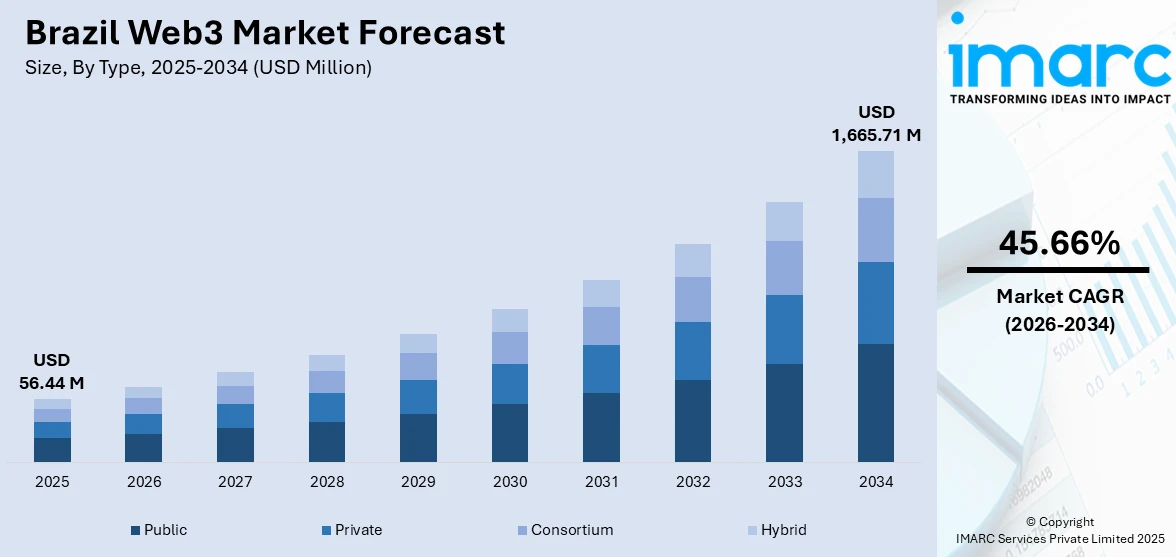
The Brazil Web3 market size was valued at USD 56.44 Million in 2025 and is projected to reach USD 1665.71 Million by 2034, growing at a compound annual growth rate of 45.66% from 2026-2034.
The Brazil Web3 market is experiencing robust expansion, as decentralized technologies gain widespread traction across financial services, retail, and enterprise operations. Increasing cryptocurrency adoption, supportive regulatory developments, and the proliferation of blockchain-based applications are driving this momentum. Advancements in tokenization, smart contract deployment, and decentralized identity solutions are reshaping digital infrastructure and fostering innovation across industries, strengthening the market share.
Key Takeaways and Insights:
- By Type: Public dominates the market with a share of 44.8% in 2025, owing to the transparent and permissionless nature of public blockchains that enable open participation, facilitate cryptocurrency trading, and support decentralized application development across diverse sectors.
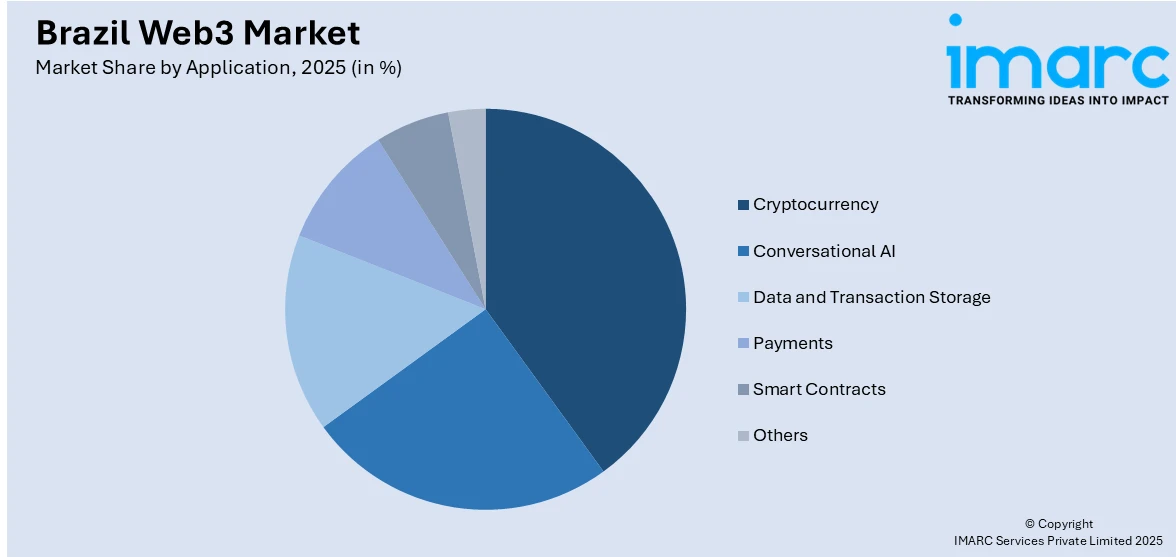
- By Application: Cryptocurrency leads the market with a share of 39.7% in 2025, driven by increasing retail and institutional adoption of digital assets, growing stablecoin usage for cross-border transactions, and expanding exchange infrastructure supporting diversified crypto portfolios.
- By End Use: BFSI comprises the largest segment with a market share of 36.9% in 2025, reflecting the financial sector's accelerating integration of blockchain technology for asset tokenization, digital payments, decentralized lending, and regulatory-compliant digital asset management services.
- By Region: Southeast represents the largest region with 55.3% share in 2025, driven by the concentration of fintech companies, blockchain startups, and major cryptocurrency exchanges in metropolitan areas, such as São Paulo and Rio de Janeiro.
- Key Players: Key players drive the Brazil Web3 market by expanding blockchain infrastructure, developing tokenization platforms, investing in decentralized finance solutions, and forming strategic partnerships to strengthen market positioning and accelerate adoption across institutional and retail segments.
To get more information on this market Request Sample
The Brazil Web3 market is advancing, as blockchain technology transitions from experimental use cases to core enterprise infrastructure across financial services, retail, and public administration. Growing consumer familiarity with digital assets is fostering a more secure and transparent environment for decentralized innovation. The country's robust fintech ecosystem, anchored by the Pix instant payment system, is facilitating seamless integration between traditional financial services and decentralized platforms. As per IMARC Group, the Brazil fintech market size reached USD 5.5 Billion in 2025 and is set to reach USD 19.1 Billion by 2034. Investments in real-world asset (RWA) tokenization, smart contract applications, and decentralized identity solutions are further broadening the scope of Web3 adoption. Expanding developer communities and growing venture capital interest are positioning Brazil as Latin America's preeminent Web3 innovation hub.
Brazil Web3 Market Trends:
Accelerating RWA Tokenization
Brazil is emerging as a global leader in RWA tokenization, as financial institutions digitize fixed-income instruments, credit receivables, and equity products on blockchain networks. For instance, in July 2025, Mercado Bitcoin announced plans to tokenize over USD 200 Million in regulated RWAs on the XRP Ledger, marking one of the largest tokenization initiatives by a Brazilian institution. The growing institutional trust in blockchain-based settlement is driving broader acceptance of tokenized products across capital markets.
Expansion of Decentralized Finance and Stablecoin Usage
Decentralized finance applications and stablecoin adoption are expanding rapidly in Brazil, transforming payment flows and savings behavior. The integration of stablecoin-linked financial products with Brazil's Pix instant payment system is creating seamless fiat-to-crypto on-ramps, enabling everyday users and businesses to participate in decentralized financial ecosystems with greater convenience and lower transaction costs. Higher transaction speed and reduced reliance on traditional intermediaries are improving efficiency for peer-to-peer transfers and merchant payments. This deeper integration of stablecoin-based services within everyday payment use cases is fueling the Brazil Web3 market growth.
Rising Developer Activity and Web3 Startup Formation
Brazil is witnessing strong growth in Web3-focused developer communities and startup ecosystems, supported by increasing access to open-source blockchain tools and global venture networks. Hackathons, incubators, and university-led innovation programs are helping cultivate blockchain talent and accelerate product development. As more locally developed platforms achieve scale, network effects are improving user adoption and ecosystem maturity. This expanding base of developers and startups is reinforcing Brazil’s position as a leading Web3 innovation hub in Latin America.
Market Outlook 2026-2034:
The Brazil Web3 market is positioned for substantial expansion, underpinned by regulatory maturity, institutional engagement, and deepening consumer adoption of decentralized technologies. The market generated a revenue of USD 56.44 Million in 2025 and is projected to reach a revenue of USD 1665.71 Million by 2034, growing at a compound annual growth rate of 45.66% from 2026-2034. Expanding tokenization of financial and physical assets, coupled with growing enterprise blockchain deployments, is expected to drive sustained revenue growth. The integration of artificial intelligence (AI) with decentralized protocols, continued advancements in smart contract applications, and the scaling of layer-2 solutions are anticipated to unlock new use cases across banking, supply chain, healthcare, and public administration, fostering a more competitive and innovative Web3 landscape across the country.
Brazil Web3 Market Report Segmentation:
|
Segment Category |
Leading Segment |
Market Share |
|
Type |
Public |
44.8% |
|
Application |
Cryptocurrency |
39.7% |
|
End Use |
BFSI |
36.9% |
|
Region |
Southeast |
55.3% |
Type Insights:
- Public
- Private
- Consortium
- Hybrid
Public dominates with a market share of 44.8% of the total Brazil Web3 market in 2025.
Public forms the backbone of the Brazil Web3 ecosystem, providing permissionless and transparent infrastructure that enables cryptocurrency transactions, decentralized application development, and smart contract execution. The open-access nature of public chains supports widespread participation from retail users, institutional investors, and developers, creating a vibrant decentralized economy. Brazilian projects can access global liquidity and user bases without depending on centralized middlemen, owing to low entry barriers and global interoperability. Because public blockchain networks allow developers to install, test, and scale apps more quickly, this openness also speeds up innovation.
The dominance of public blockchains is further reinforced by the expanding ecosystem of decentralized finance protocols, non-fungible token platforms, and tokenized asset marketplaces that operate on permissionless networks. Growing developer activity, supported by initiatives, such as Blockchain.RIO's ‘Blockchain on the Road’ program that brought Web3 education to 17 universities across 12 Brazilian cities by June 2025, is strengthening the talent pipeline and accelerating innovation on public chains across the country.
Application Insights:
Access the comprehensive market breakdown Request Sample
- Cryptocurrency
- Conversational AI
- Data and Transaction Storage
- Payments
- Smart Contracts
- Others
Cryptocurrency leads with a share of 39.7% of the total Brazil Web3 market in 2025.
Cryptocurrency remains the primary application driving the Brazil Web3 market, encompassing digital asset trading, portfolio diversification, and stablecoin-based financial services. As per IMARC Group, the Brazil cryptocurrency market size reached USD 53,894.51 Million in 2024 and is set to attain USD 1,23,893.30 Million by 2033. A wide variety of digital asset offerings is supported by the nation's quickly growing exchange infrastructure. Access to educational resources and enhanced platform usability are leading to an increase in the participation of retail investors.
As financial institutions include digital assets in their service offerings, institutional cryptocurrency usage is growing. The dominating position of the cryptocurrency segment in the Brazil Web3 market is being maintained by the convergence of institutional participation, retail demand, and growing regulatory certainty. To satisfy customer demand, banks and asset managers are providing custody, trading, and settlement services for digital assets. As compliance frameworks mature, long-term capital inflows into the cryptocurrency industry are expected to strengthen further.
End Use Insights:
- BFSI
- Retail and E-commerce
- Media and Entertainment
- Pharmaceuticals
- IT and Telecom
- Others
BFSI comprises the largest segment with a 36.9% share of the total Brazil Web3 market in 2025.
BFSI leads the Brazil Web3 market adoption by leveraging blockchain technology for asset tokenization, digital payments, decentralized lending, and regulatory compliance solutions. Financial institutions are deploying distributed ledger technology to enhance transaction efficiency, reduce intermediary costs, and enable programmable financial instruments. The BFSI sector's blockchain adoption is further accelerated by embedded finance initiatives, where major banks and fintechs integrate crypto capabilities directly into consumer-facing applications.
Furthermore, collaborations between Web3 startups and conventional financial institutions are spurring innovation by fusing regulatory expertise with flexible blockchain development skills. These partnerships are facilitating new financial products' quicker time to market while guaranteeing adherence to changing frameworks for digital assets. In order to support long-term digital transformation objectives, BFSI companies are also investing in talent development and blockchain infrastructure. As consumer expectations shift towards faster, transparent, and programmable financial services, Web3-based solutions are becoming integral to the long-term digital strategies of the BFSI segment.
Regional Insights:
- Southeast
- South
- Northeast
- North
- Central-West
Southeast represents the largest region with a 55.3% share of the total Brazil Web3 market in 2025.
Southeast dominates the Brazil Web3 market, anchored by the metropolitan hubs of São Paulo and Rio de Janeiro that concentrate the country's leading fintech companies, cryptocurrency exchanges, and blockchain startups. The region benefits from a robust technology infrastructure, deep venture capital ecosystem, and proximity to major financial institutions driving institutional blockchain adoption. Strong enterprise demand from banking, capital markets, and technology firms is generating steady use cases for blockchain deployment.
The Southeast is also the hub for Web3 talent development, with a high concentration of industry-led innovation initiatives, incubators, and accelerators. The local talent pipeline is being strengthened by the growing integration of blockchain and cryptography into the curricula of universities and commercial research institutions in São Paulo and Rio de Janeiro. Regular industry gatherings, hackathons, and investor forums help startups, businesses, and legislators work together. The Southeast's persistent Web3 adoption and product commercialization are accelerated by this confluence of capital, skills, and institutional participation.
Market Dynamics:
Growth Drivers:
Why is the Brazil Web3 Market Growing?
Supportive Regulatory Framework and Institutional Confidence
Brazil has created one of Latin America's most comprehensive regulatory frameworks for digital assets, offering legal certainty that draws in institutional investment and promotes the use of blockchain by businesses. The establishment of a central regulatory body and clear regulations for virtual asset service providers have made the market environment more organized and predictable for players. Simultaneously, government-led blockchain projects that emphasize security and transparency in public services are boosting confidence in distributed ledger technology and facilitating a wider adoption of Web3 solutions in both the public and commercial sectors. Regulatory clarity is bolstering institutional confidence and enabling global exchanges to deepen their commitment to the Brazilian market. In January 2025, Binance received regulatory approval from the Central Bank of Brazil to acquire the licensed broker-dealer Sim;paul, becoming the first cryptocurrency exchange to obtain a broker-dealer license in the country. These regulatory milestones are reducing compliance uncertainty and fostering a more predictable operating environment for Web3 enterprises.
Expanding Tokenization and Digital Asset Infrastructure
Brazil's financial markets and real economy sectors are adopting Web3 in new ways, owing to the tokenization infrastructure's rapid growth. To increase liquidity, transparency, and settlement efficiency, financial institutions and exchanges are tokenizing fixed-income instruments, credit receivables, stocks, and physical assets via Web3-based networks. A wider range of investors can access historically illiquid assets, due to tokenization in Web3 ecosystems, which permits fractional ownership and programmable asset management. This trend is encouraging deeper participation from institutional and retail investors by lowering entry barriers and improving capital efficiency. Web3-enabled tokenization also supports faster settlement cycles and real-time asset tracking, reducing operational friction across financial value chains. As supporting infrastructure, such as digital wallets, interoperable platforms, and smart contract frameworks, matures, tokenized assets are expected to be increasingly integrated into mainstream financial products.
Rising Cryptocurrency Adoption and Fintech Integration
Increasing cryptocurrency adoption and deeper fintech integration are key drivers of the Brazil Web3 market, as digital assets become embedded in everyday financial activity. Cryptocurrencies and stablecoins are increasingly used for payments, savings, and cross-platform value transfers, expanding real-world Web3 use cases beyond trading. Fintech companies are integrating crypto wallets, on-chain settlement, and tokenized services directly into user-friendly mobile applications, lowering complexity for mainstream users. This convergence improves accessibility, trust, and transaction efficiency while reducing reliance on traditional intermediaries. For businesses, crypto-enabled fintech platforms support faster settlements, improved liquidity management, and programmable financial services. As consumers grow more comfortable with digital assets through familiar fintech interfaces, Web3 adoption accelerates across both retail and enterprise segments. Together, rising crypto usage and fintech-led innovation are transforming Web3 from a niche ecosystem into a scalable component of Brazil’s digital economy.
Market Restraints:
What Challenges the Brazil Web3 Market is Facing?
Cybersecurity Vulnerabilities and Fraud Risks
The rapid expansion of decentralized platforms and digital asset usage in Brazil has increased exposure to cybersecurity threats, including phishing attacks, wallet compromises, and smart contract exploits. As more users and enterprises interact with blockchain-based systems, malicious actors are targeting weaknesses in platform security and user awareness. Limited understanding of private key management and decentralized risk models further amplifies potential losses. Addressing these challenges requires continuous investment in secure protocol design, rigorous smart contract audits, advanced authentication mechanisms, and responsive incident management frameworks to maintain user trust and ecosystem stability.
Limited Technical Talent and Infrastructure Gaps
Brazil’s Web3 ecosystem faces constraints due to a shortage of experienced blockchain developers, smart contract engineers, and decentralized systems architects. This talent gap slows application development, increases project costs, and limits enterprise-scale deployments. While interest in blockchain skills is growing, education and training ecosystems are still evolving to meet market needs. Additionally, uneven digital infrastructure outside major urban centers restricts access to high-performance networks and computing resources. These disparities hinder nationwide Web3 adoption and concentrate innovation within a limited number of technology hubs.
User Experience Complexity and Adoption Barriers
Complex user interfaces, unfamiliar terminology, and fragmented onboarding processes continue to limit mainstream Web3 adoption in Brazil. Managing wallets, private keys, and transaction fees can be intimidating for non-technical users, leading to errors and reduced engagement. Inconsistent user experiences across platforms further increase friction, especially for first-time participants transitioning from traditional digital services. Without simplified design, intuitive workflows, and clearer educational support, many potential users remain hesitant to engage deeply with decentralized applications, slowing the pace of mass-market Web3 integration.
Competitive Landscape:
The Brazil Web3 market features an increasingly competitive environment, as domestic exchanges, global cryptocurrency platforms, fintech companies, and blockchain infrastructure providers contend for market positioning. Competition is intensifying across segments, including cryptocurrency trading, asset tokenization, decentralized finance, and enterprise blockchain solutions. Market participants are differentiating through regulatory compliance, platform reliability, tokenization capabilities, and embedded financial services. Strategic partnerships between blockchain platforms and traditional financial institutions are accelerating institutional adoption, while venture capital inflows and accelerator programs are fostering innovation among emerging startups. The convergence of regulated financial infrastructure with decentralized technology is driving consolidation and reshaping competitive dynamics across the market.
Brazil Web3 Market Report Coverage:
|
Report Features |
Details |
|
Base Year of the Analysis |
2025 |
|
Historical Period |
2020-2025 |
|
Forecast Period |
2026-2034 |
|
Units |
Million USD |
|
Scope of the Report |
Exploration of Historical Trends and Market Outlook, Industry Catalysts and Challenges, Segment-Wise Historical and Future Market Assessment:
|
|
Types Covered |
Public, Private, Consortium, Hybrid |
|
Applications Covered |
Cryptocurrency, Conversational AI, Data and Transaction Storage, Payments, Smart Contracts, Others |
|
End Uses Covered |
BFSI, Retail and E-commerce, Media and Entertainment, Pharmaceuticals, IT and Telecom, Others |
|
Regions Covered |
Southeast, South, Northeast, North, Central-West |
|
Customization Scope |
10% Free Customization |
|
Post-Sale Analyst Support |
10-12 Weeks |
|
Delivery Format |
PDF and Excel through Email (We can also provide the editable version of the report in PPT/Word format on special request |
Key Questions Answered in This Report
The Brazil Web3 market size was valued at USD 56.44 Million in 2025.
The Brazil Web3 market is expected to grow at a compound annual growth rate of 45.66% from 2026-2034 to reach USD 1,665.71 Million by 2034.
Public dominated the market with a share of 44.8%, driven by the transparent and permissionless nature of public blockchain networks that support cryptocurrency trading, decentralized applications, and open participation across diverse sectors.
Key factors driving the Brazil Web3 market include supportive regulatory frameworks, expanding tokenization infrastructure, rising cryptocurrency adoption, deepening fintech integration, growing institutional investment, and increasing enterprise blockchain deployments.
Major challenges include regulatory complexity and compliance costs, cybersecurity vulnerabilities and fraud risks, limited blockchain talent supply, infrastructure gaps outside major metropolitan areas, and evolving taxation policies for digital assets.
Need more help?
- Speak to our experienced analysts for insights on the current market scenarios.
- Include additional segments and countries to customize the report as per your requirement.
- Gain an unparalleled competitive advantage in your domain by understanding how to utilize the report and positively impacting your operations and revenue.
- For further assistance, please connect with our analysts.
 Request Customization
 Speak to an Analyst
 Request Brochure
 Inquire Before Buying
Benefits of Customization
- Personalize this research
- Triangulate with your data
- Get data as per your format and definition
- Gain a deeper dive into a specific application, geography, customer, or competitor
- Any level of personalization
Get in Touch With Us
UNITED STATES
Phone: +1-201-971-6302
INDIA
Phone: +91-120-433-0800
UNITED KINGDOM
Phone: +44-753-714-6104
Email: sales@imarcgroup.com
Client Testimonials




.webp)




.webp)












