
Bulldozer Market Size, Share, Trends and Forecast by Type, Product Type, Operating Weight, Horsepower, Flywheel Power, Blade Type, Engine Capacity, End-Use Industry, and Region, 2026-2034
Bulldozer Market Size, Share, Trends & Forecast (2026-2034)
The global bulldozer market reached USD 5.58 Billion in 2025 and is projected to reach USD 8.73 Billion by 2034, growing at a CAGR of 4.94% during 2026-2034. Growth is driven by rising infrastructure investment, rapid construction and industrialization, and increasing preference for automation over manual labor. Wheeled bulldozers lead the product type segment at 48.5%, the 10,000-30,000 KG operating weight class dominates at 44.2%, and Asia Pacific commands 39.6% of the global market share.
Market Snapshot
|
Metric |
Value |
|
Market Size (2025) |
USD 5.58 Billion |
|
Forecast Market Size (2034) |
USD 8.73 Billion |
|
CAGR (2026-2034) |
4.94% |
|
Base Year |
2025 |
|
Historical Period |
2020-2025 |
|
Forecast Period |
2026-2034 |
|
Dominant Product Type |
Wheeled Bulldozers (48.5%, 2025) |
|
Dominant Operating Weight |
10,000-30,000 KG (44.2%, 2025) |
|
Leading Region |
Asia Pacific (39.6%, 2025) |
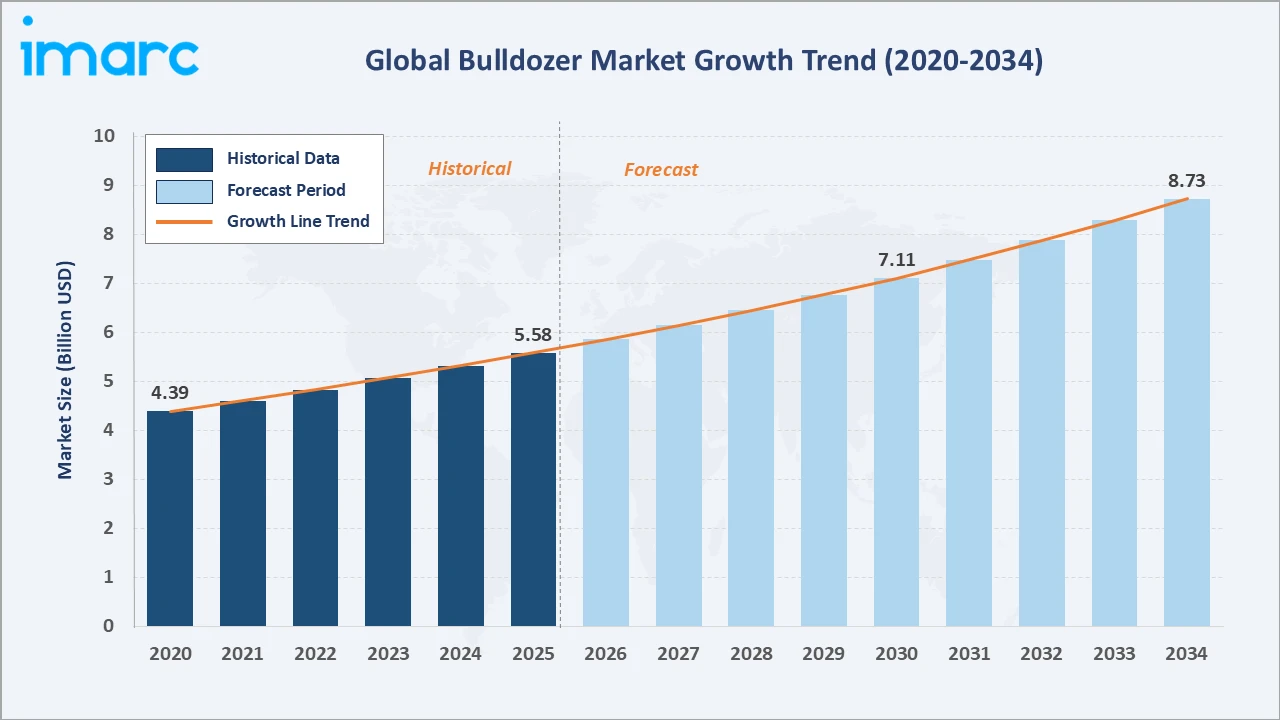
The market expanded from USD 4.39 Billion in 2020 to USD 5.58 Billion in 2025, anchored at USD 7.11 Billion in 2030 and forecast to reach USD 8.73 Billion by 2034. Pandemic-driven manufacturing shutdowns briefly constrained output, but sustained infrastructure spending and steady replacement demand restored the growth trajectory through 2023-2025, positioning the market for consistent expansion across the forecast period.
To get more information on this market, Request Sample
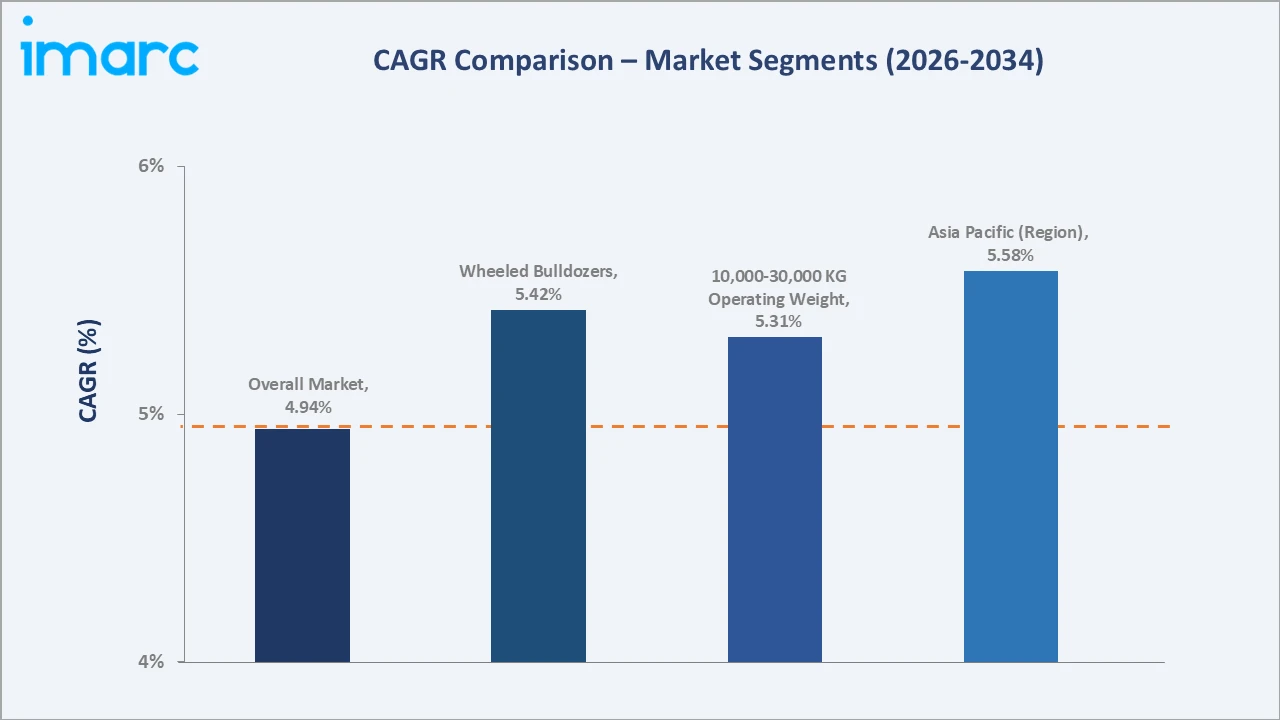
Wheeled bulldozers grow fastest at ~5.4% CAGR on rising demand for maneuverable, road-capable machines in urban infrastructure projects, while the 10,000-30,000 KG operating weight class advances at ~5.3% CAGR as the preferred specification for mid-scale construction and infrastructure applications.
Executive Summary
The global bulldozer market reached USD 5.58 Billion in 2025, reflecting sustained demand for heavy earthmoving equipment across construction, infrastructure, and mining applications. The market is projected to reach USD 8.73 Billion by 2034, supported by rising automation adoption and expanding infrastructure investment in developing economies. Steady replacement demand in mature markets, combined with new fleet expansion in emerging economies, is reinforcing consistent unit volume growth across the forecast period.
Wheeled bulldozers at 48.5% dominate the product type segment through superior road mobility and lower per-unit operating costs. The 10,000-30,000 KG operating weight class leads at 44.2%, serving the largest base of mid-scale construction and infrastructure projects. Asia Pacific leads regionally at 39.6% through China's construction scale and India's infrastructure expansion, while North America and Europe continue to contribute steady replacement-driven demand supported by established dealer and rental networks.
Key Market Insights
|
Insight |
Data |
|
Dominant Product Type |
Wheeled Bulldozers - 48.5% share (2025) |
|
Dominant Operating Weight |
10,000-30,000 KG - 44.2% market share (2025) |
|
Leading Region |
Asia Pacific - 39.6% market share (2025) |
|
Market Opportunity |
Electric and hybrid dozers; autonomous blade control; compact rental fleets; mining mechanization |
Key Analytical Observations Supporting The Above Data:
- Wheeled Bulldozers at 48.5%: Wheeled bulldozers dominate due to their versatility on paved and semi-paved surfaces, lower maintenance costs versus tracked units, and widespread adoption in road construction and urban infrastructure projects across Asia Pacific and North America.
- 10,000-30,000 KG at 44.2%: This class balances power, maneuverability, and cost for mid-scale construction, land development, and infrastructure grading tasks, making it the most commercially active specification among contractors and rental fleets worldwide.
- Asia Pacific at 39.6%: China's large-scale infrastructure programs, Japan's construction machinery manufacturing base, and India's highway and metro rail expansion collectively drive the region's leading position in bulldozer demand.
Bulldozer Market Overview
The global bulldozer market encompasses the design, manufacture, and supply of heavy-duty tracked and wheeled earthmoving machines used for grading, pushing, and leveling material across construction, mining, infrastructure, agriculture, and military applications. Bulldozers remain among the most versatile heavy-equipment categories, valued for their combination of pushing power, blade control precision, and durability across demanding terrain.
The ecosystem integrates OEM manufacturers, engine and hydraulic component suppliers, steel and undercarriage producers, dealer and distribution networks, rental fleet operators, and end-use sectors including construction contractors and mining operators. Macroeconomic drivers include infrastructure spending, urbanization, and emission regulation compliance. Equipment financing availability and government procurement cycles further shape regional demand patterns across the value chain.
Market Dynamics
To evaluate market opportunities, Request Sample
Market Drivers
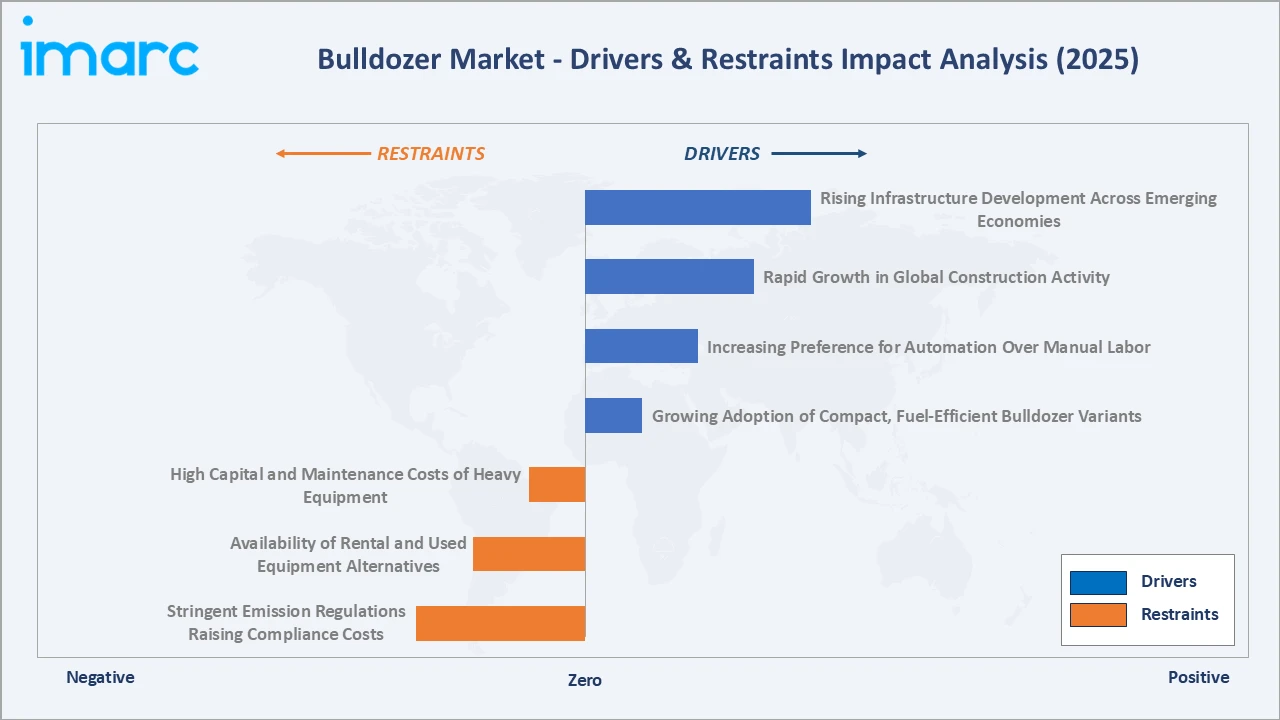
- Rising Infrastructure Development Across Emerging Economies: Significant infrastructure development, particularly road, railway, and airport construction in developing nations, is driving widespread bulldozer adoption for large-scale earthmoving and site preparation work. Government-backed connectivity programs across Asia Pacific, Latin America, and the Middle East are accelerating multi-year construction pipelines that require sustained heavy-equipment deployment. This consistent project flow is encouraging both contractors and rental fleet operators to expand their bulldozer inventories.
- Rapid Growth in Global Construction Activity: Rapid industrialization and construction activity worldwide is expanding demand for heavy equipment, with bulldozers essential to building construction, land clearing, and road development projects. Urban expansion and industrial park development are further reinforcing demand for grading and earthmoving capacity in both established and emerging economies. As construction timelines shorten, contractors increasingly prioritize equipment reliability and uptime.
- Increasing Preference for Automation Over Manual Labor: Growing preference for automation over manual labor is increasing adoption of technologically advanced bulldozers with automated blade control and remote-operation capabilities, improving productivity and reducing labor dependency. Persistent skilled-operator shortages across major construction markets are reinforcing this shift, as automated grading systems allow less-experienced operators to achieve consistent results. This trend is prompting OEMs to expand automation packages across a broader range of dozer classes.
- Growing Adoption of Compact, Fuel-Efficient Bulldozer Variants: Manufacturers are developing compact, fuel-efficient bulldozer variants capable of operating on uneven terrain and limited space, expanding the machine's applicability across agriculture and urban construction sites. These compact variants also lower fuel consumption and emissions per operating hour, aligning with tightening efficiency expectations. Their smaller footprint further supports use in space-constrained renovation and land-development projects.
Market Restraints
- High Capital and Maintenance Costs of Heavy Equipment: High upfront capital expenditure and ongoing maintenance costs for heavy bulldozers can limit adoption among small contractors, particularly in cost-sensitive and emerging markets. Financing constraints and elevated interest rates further increase the effective cost of equipment ownership for independent operators. As a result, many smaller contractors delay fleet renewal or opt for smaller, lower-capacity machines.
- Availability of Rental and Used Equipment Alternatives: The wide availability of rental and used bulldozer alternatives reduces new equipment purchases, particularly for contractors executing short-duration or seasonal earthmoving projects. Established secondary markets for refurbished equipment in North America and Europe give price-sensitive buyers a lower-cost path to fleet access. These dynamic tempers new-unit sales growth even during periods of strong construction activity.
- Stringent Emission Regulations Raising Compliance Costs: Increasingly stringent emission norms across regions raise compliance and engine redesign costs for manufacturers, which can translate into higher equipment prices for end users. Meeting evolving Tier 4 Final, Stage V, and regional equivalents requires continuous investment in engine and aftertreatment technology. Smaller manufacturers with limited R&D budgets may find it difficult to keep pace with these evolving requirements.
Market Opportunities
- Electric and Hybrid Bulldozer Development: Electric and hybrid bulldozer development offers manufacturers reduced fuel costs and lower emissions, appealing to environmentally conscious contractors and government infrastructure contracts with sustainability mandates. Early electric-drive medium dozer launches are demonstrating measurable productivity and fuel-efficiency gains, encouraging wider OEM investment in the category. As battery and electric-drive costs decline, adoption is expected to extend into compact and mid-size classes.
- Expansion in Mining Sector Mechanization: Expanding mining mechanization in emerging markets, particularly in coal, mineral, and ore extraction, is creating new procurement demand for heavy-class bulldozers designed for overburden removal and site preparation. Rising investment in critical mineral extraction for energy-transition supply chains is further widening this opportunity across Latin America, Africa, and Asia Pacific. Mining operators are also prioritizing autonomous-ready equipment to improve safety in hazardous extraction environments.
Market Challenges
- Volatile Raw Material and Steel Prices: Fluctuating prices of steel and other raw materials used in undercarriage and blade manufacturing create cost unpredictability for OEMs and can compress margins across the supply chain. Global trade policy shifts and tariff adjustments add further volatility to input costs, complicating long-term pricing strategies. Manufacturers are increasingly hedging exposure through diversified sourcing and long-term supplier agreements.
- Intensifying Competition from Chinese Domestic Manufacturers: Chinese domestic manufacturers are expanding cost-competitive product lines, intensifying pricing pressure on established global Tier-1 bulldozer OEMs, particularly in Asia Pacific markets. These manufacturers are also improving build quality and after-sales support, narrowing the perceived gap with global brands. This is prompting established OEMs to defend market share through localized manufacturing and service investments.
Emerging Market Trends
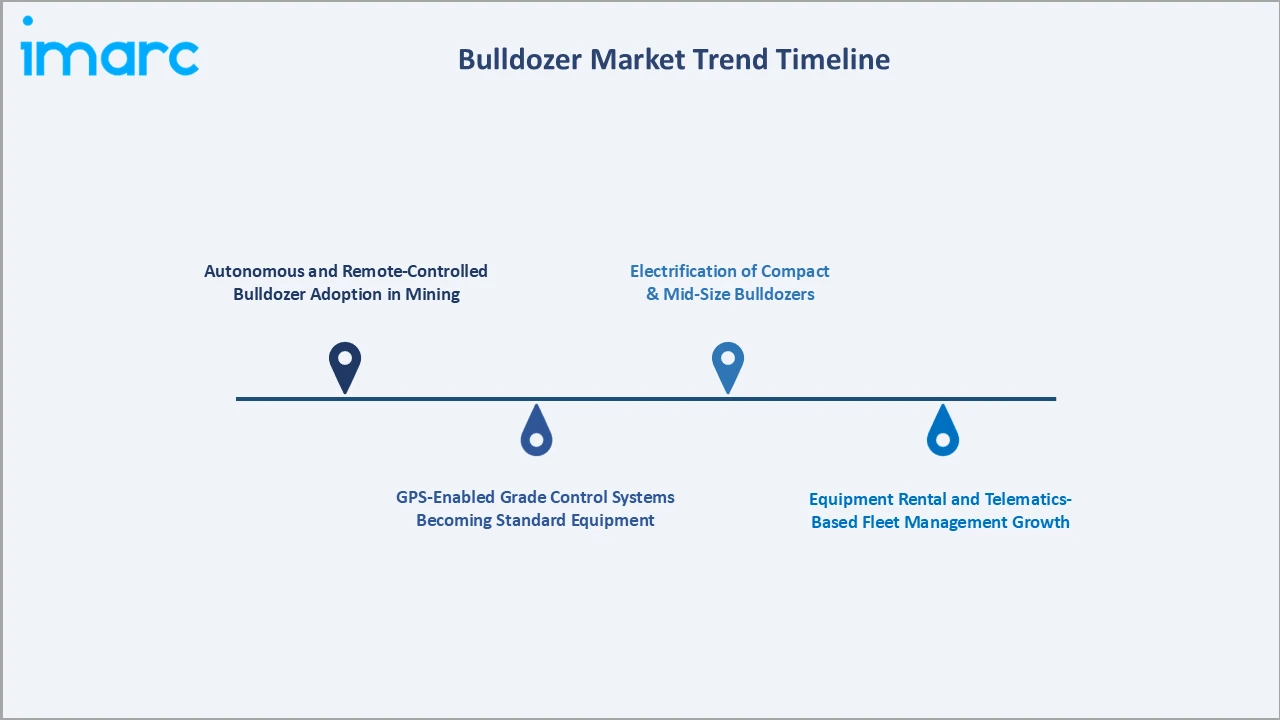
1. Autonomous and Remote-Controlled Bulldozer Adoption in Mining
Autonomous and remote-controlled bulldozers are gaining traction in mining and hazardous environments, reducing operator risk while improving site productivity. Leading OEMs are commercializing teleoperation systems that allow dozing from safe, remote locations, with several manufacturers piloting full line-of-sight and beyond-line-of-sight control configurations for mining and demolition sites.
2. GPS-Enabled Grade Control Systems Becoming Standard Equipment
GPS-based 3D grade control is increasingly offered as standard or factory-ready equipment on mid-size and large dozers, enabling faster, more precise grading with reduced rework and lower dependence on skilled operators. Integration with digital site models and drone-based surveys is further improving grading accuracy across large-scale projects.
3. Electrification of Compact and Mid-Size Bulldozers
Electric-drive dozer platforms are emerging in the medium-size class, offering fuel savings and lower maintenance requirements compared with conventional torque-converter drivetrains, with wider commercial rollout expected through 2026-2027. Early field results indicate meaningful productivity gains alongside reduced total cost of ownership.
4. Equipment Rental and Telematics-Based Fleet Management Growth
Growing preference for rental fleets, supported by telematics-enabled remote diagnostics and utilization tracking, is reshaping bulldozer procurement patterns among contractors seeking flexibility and reduced ownership costs. Rental providers are increasingly using utilization data to optimize fleet allocation across regional project pipelines.
Industry Value Chain Analysis
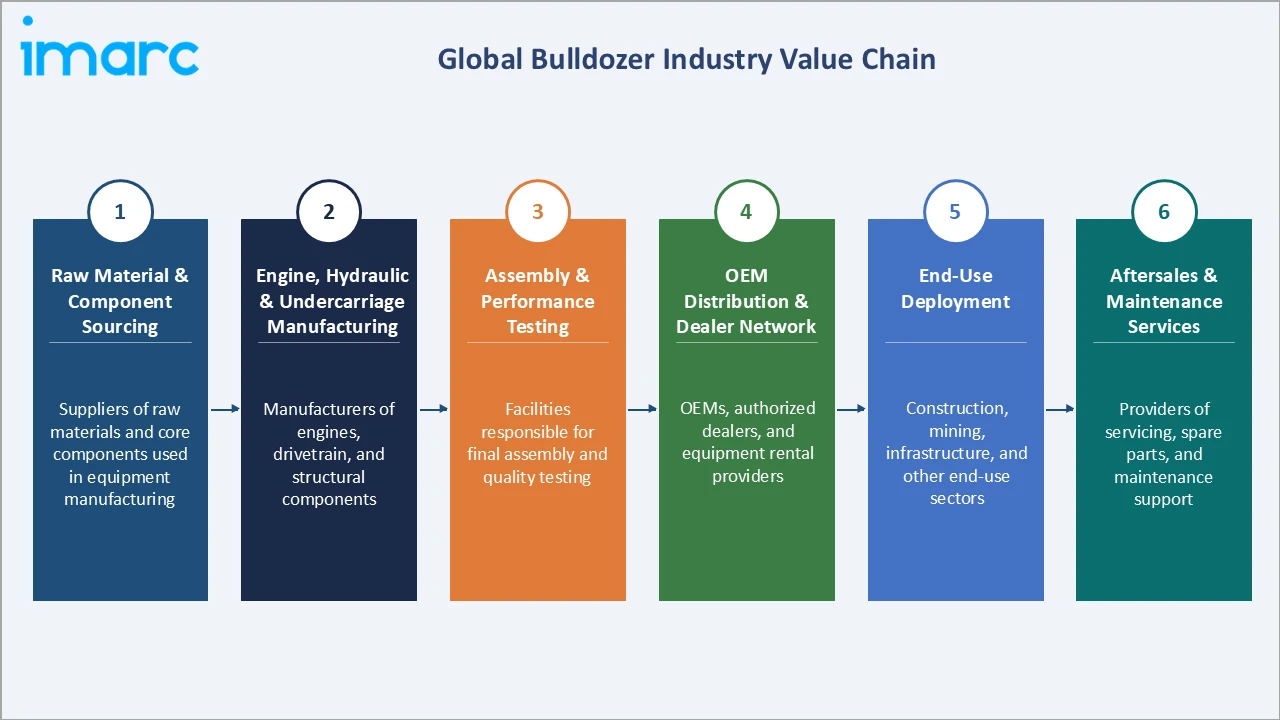
The bulldozer value chain integrates raw material and steel sourcing, engine and hydraulic component manufacturing, assembly and testing, OEM distribution through dealer networks, end-use deployment, and aftersales maintenance services.
|
Stage |
Key Participants |
|
Raw Material & Component Sourcing |
Suppliers of raw materials and core components used in equipment manufacturing |
|
Engine, Hydraulic & Undercarriage Manufacturing |
Manufacturers of engines, drivetrain, and structural components |
|
Assembly & Performance Testing |
Facilities responsible for final assembly and quality testing |
|
OEM Distribution & Dealer Network |
OEMs, authorized dealers, and equipment rental providers |
|
End-Use Deployment |
Construction, mining, infrastructure, and other end-use sectors |
|
Aftersales & Maintenance Services |
Providers of servicing, spare parts, and maintenance support |
Technology Landscape in the Bulldozer Industry
GPS and Machine Control Grading Technology
GPS-guided 3D grade control automatically adjusts blade lift and tilt using satellite positioning, improving grading accuracy and reducing rework. Factory-integrated systems are increasingly standard on medium and large dozer models, and aftermarket retrofit kits are extending the technology to older equipment.
Autonomous and Semi-Autonomous Bulldozer Systems
Intelligent machine control systems now record terrain data continuously, enabling proactive cut-and-fill decisions across a full worksite rather than only at finish grade, easing skilled-operator shortages in construction and mining. These systems are increasingly paired with remote monitoring dashboards that allow supervisors to track multiple machines simultaneously.
Electric and Hybrid Powertrain Technology
Electric-drive powertrains replace conventional torque converters with generator-electric motor systems, delivering fuel savings and lower maintenance costs while sustaining full dozing power and productivity. Manufacturers are prioritizing component commonality with existing diesel platforms to simplify servicing and parts availability for early adopters.
Market Segmentation Analysis
The report covers the following segments:
|
Segment Category |
Leading Segment |
Market Share |
Year |
|
Type |
🔒 |
🔒 |
2025 |
|
Product Type |
Wheeled Bulldozers |
48.5% |
2025 |
|
Operating Weight |
10,000-30,000 KG |
44.2% |
2025 |
|
Horsepower |
🔒 |
🔒 |
2025 |
|
Flywheel Power |
85-200 KW |
🔒 |
2025 |
|
Blade Type |
🔒 |
🔒 |
2025 |
|
Engine Capacity |
Less Than 5L |
🔒 |
2025 |
|
End-Use Industry |
Construction |
🔒 |
2025 |
|
Region |
Asia Pacific |
39.6% |
2025 |

By Product Type
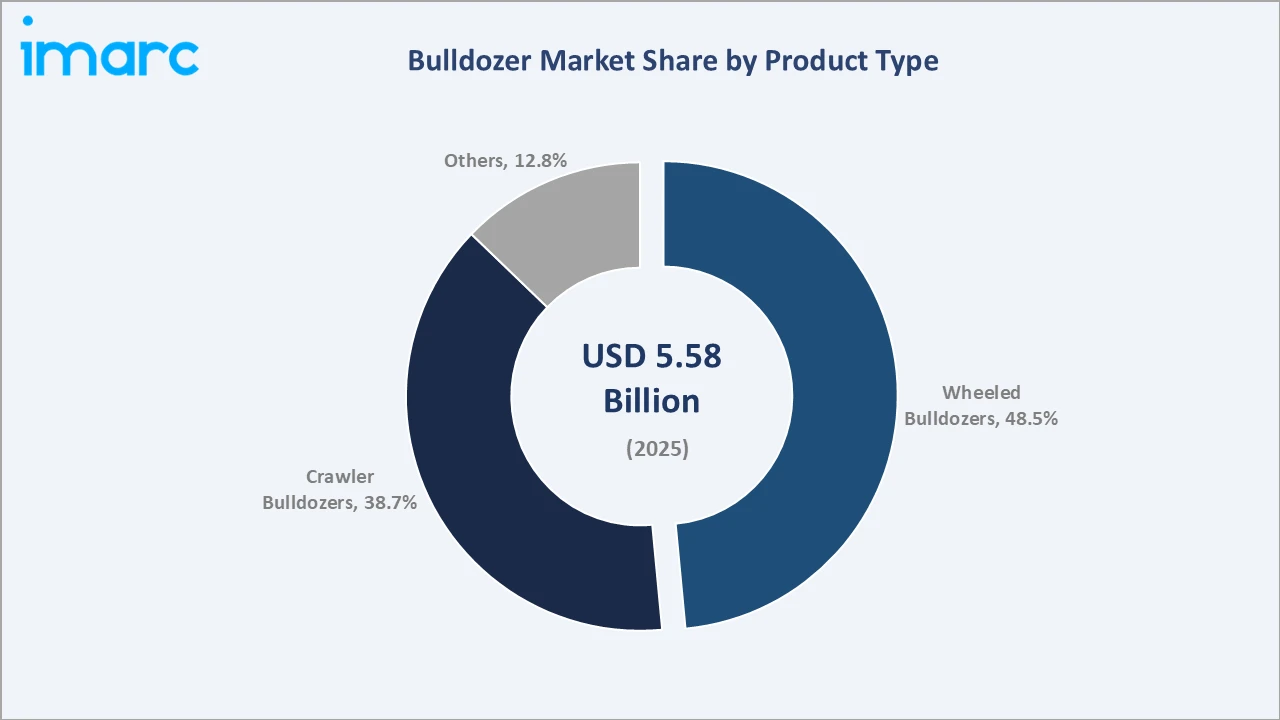
Wheeled bulldozers lead at 48.5% in 2025, valued for road mobility, lower ground pressure damage, and cost efficiency in construction and infrastructure grading applications. Their ability to travel between job sites without transport trailers further reduces operating costs for contractors managing multiple concurrent projects.
To access detailed market analysis, Request Sample
Crawler bulldozers at 38.7% remain essential for high-traction, heavy-duty earthmoving in mining and rough-terrain construction, while the others category at 12.8% includes specialized and hybrid-configuration units. Crawler variants continue to be preferred wherever soft ground, steep grades, or high drawbar pull requirements make wheeled configurations impractical.
By Operating Weight
The 10,000-30,000 KG class leads at 44.2%, capturing the largest base of mid-scale construction and infrastructure projects requiring balanced power and maneuverability. This class offers the broadest application range across grading, land clearing, and general earthmoving tasks.
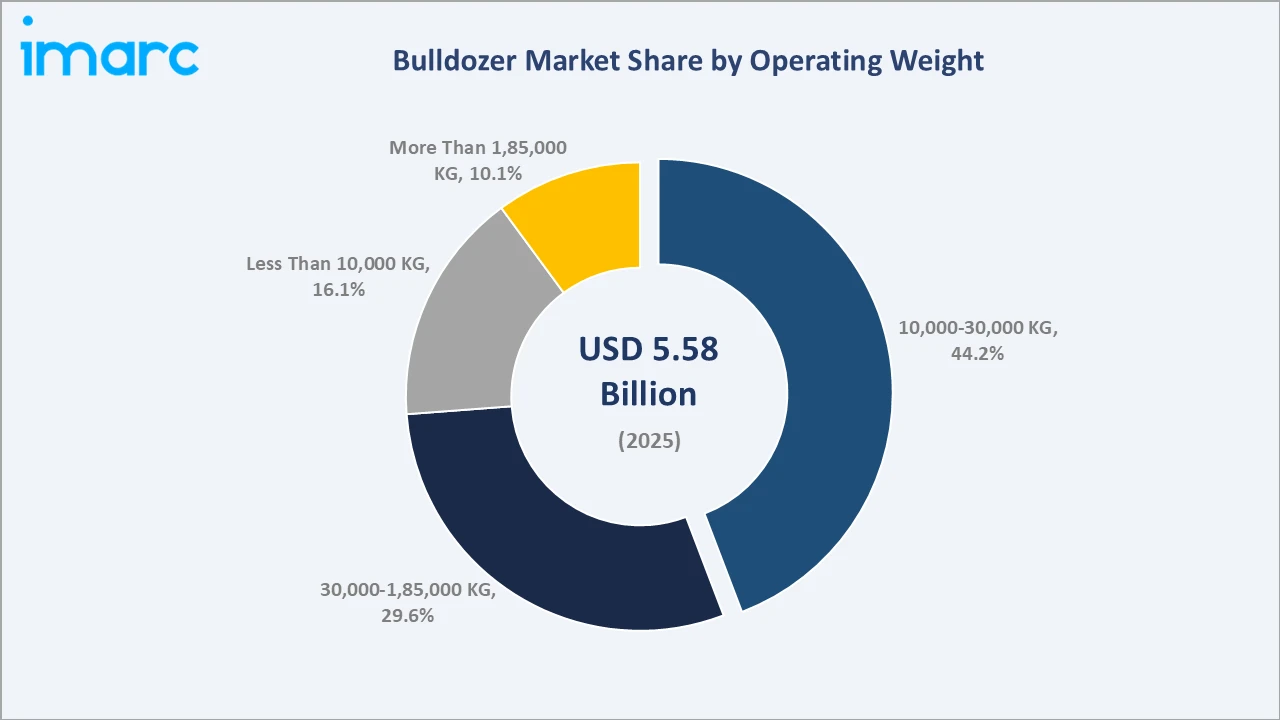
The 30,000-1,85,000 KG class at 29.6% serves large infrastructure and mining projects, while machines under 10,000 KG (16.1%) suit compact and agricultural applications, and units above 1,85,000 KG (10.1%) serve heavy mining operations. Demand across these heavier classes is closely linked to capital cycles in the global mining and large-scale infrastructure sectors.
Regional Market Insights
|
Region |
Share (2025) |
Key Bulldozer Market Drivers & Characteristics |
|
Asia Pacific |
39.6% |
Driven by strong construction and infrastructure activity across major economies in the region |
|
North America |
25.1% |
Supported by infrastructure reinvestment and steady replacement demand across construction and mining sectors |
|
Europe |
20.4% |
Driven by regulatory compliance requirements and ongoing investment in construction equipment upgrades |
|
Latin America |
8.2% |
Growing through mining sector mechanization and gradual infrastructure modernization |
|
Middle East and Africa |
6.7% |
Emerging through diversification of construction activity and infrastructure development initiatives |
Asia Pacific, at 39.6%, leads through sustained construction and infrastructure investment across the region's major economies. North America, at 25.1%, and Europe, at 20.4%, reflect mature replacement demand and steady investment in equipment upgrades, supported by well-established dealer and financing networks.
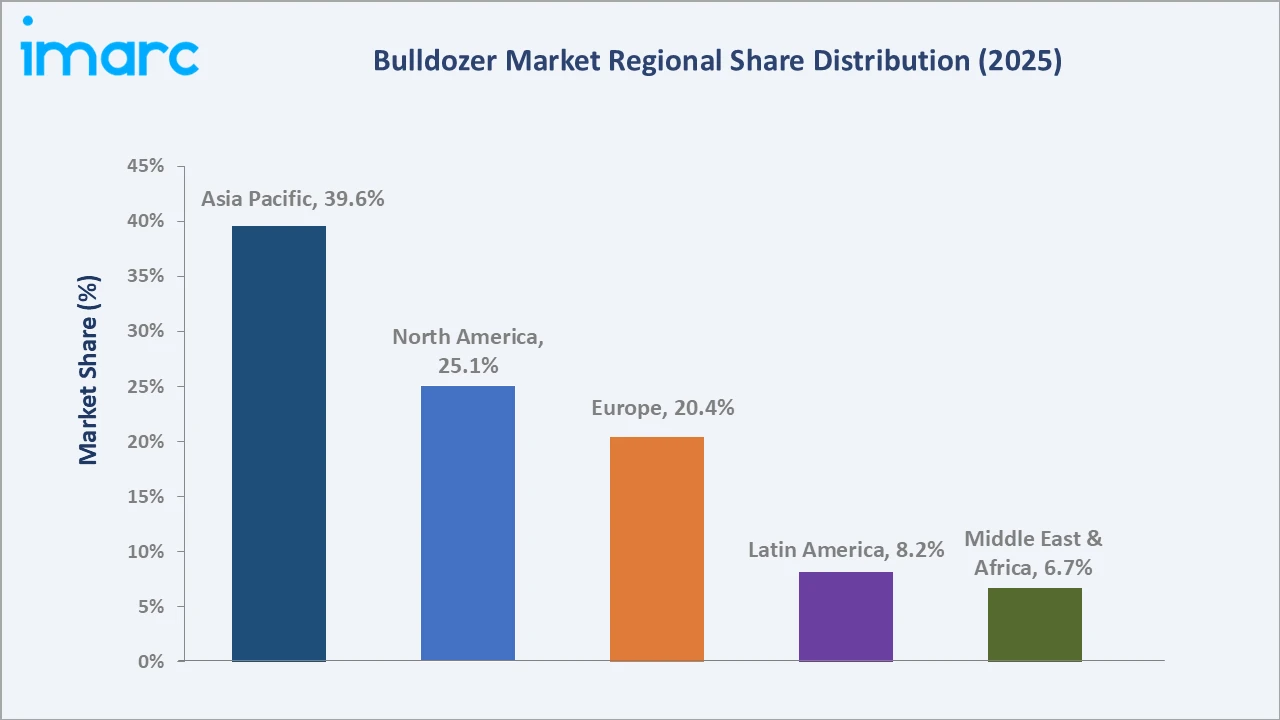
Latin America, at 8.2%, and Middle East and Africa, at 6.7%, represent earlier-stage but steadily growing markets, driven primarily by mining mechanization and infrastructure diversification programs respectively. Both regions are expected to see accelerating equipment adoption as capital investment in resource extraction and public works continues to expand.
Competitive Landscape
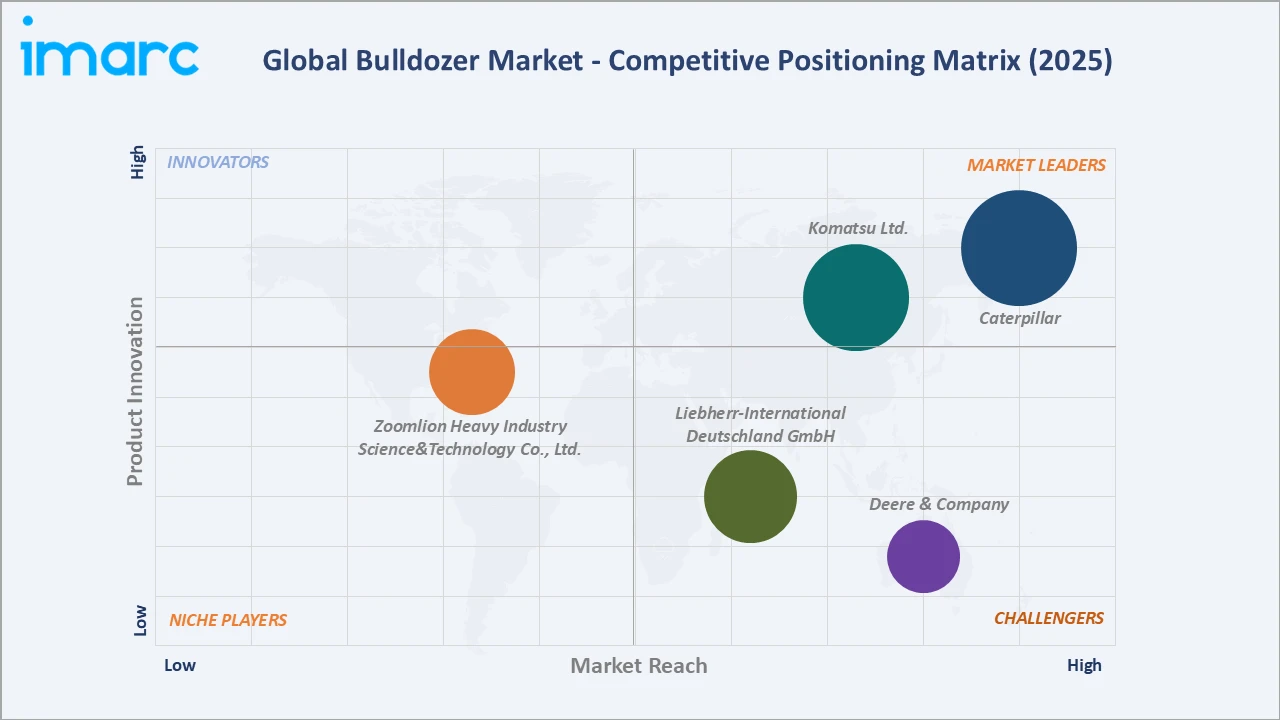
The global bulldozer market competitive landscape is moderately concentrated, led by diversified heavy-equipment manufacturers with global dealer networks, alongside specialized regional and Chinese domestic manufacturers competing on cost.
|
Company Name |
Key Products |
Market Position |
Core Strength |
|
Caterpillar |
D8, D9, D10, D1, D2, D3, D6R2, D9 GC, 814, 824, D11, D8T |
Market Leader |
Caterpillar holds the industry's largest dealer network and broadest bulldozer product range spanning compact to heavy-mining classes. |
|
Komatsu Ltd. |
D37PX-24, D37EX-24, D39EXi-24, D39PX-24 D51EX-24, D475A-5E0 |
Market Leader |
Komatsu is a pioneer in intelligent Machine Control (iMC) technology, integrating GPS grading and autonomous blade control across its dozer range. |
|
Deere & Company |
1050 P-Tier, 450 P-Tier, 550 P-Tier, 650 P-Tier, 700 P-Tier, 950 P-Tier, 850 X-Tier E-Drive, 850 P-Tier |
Strong Challenger |
Deere leverages precision grade-control technology and its dealer service network to serve North American construction contractors. |
|
Liebherr-International Deutschland GmbH |
PR 766, PR 776, PR 756, PR 746, PR 726, PR 716, PR 736 Litronic, PR 766 Litronic |
Strong Challenger |
Liebherr focuses on high-performance crawler dozers with teleoperation-ready technology for mining applications. |
| Zoomlion Heavy Industry Science&Technology Co., Ltd. | ZD170G, ZD340G, ZD170GH, ZD160-3, ZD160S-3, ZD220-3, ZD220S-3, ZD320-3 |
Emerging Player |
Zoomlion is expanding cost-competitive crawler dozer exports from its China manufacturing base into emerging markets. |
Key players include Caterpillar, Komatsu Ltd., Deere & Company, Liebherr-International Deutschland GmbH, Zoomlion Heavy Industry Science&Technology Co., Ltd., and others.
Key Company Profiles
Caterpillar
Caterpillar is a US-based global leader in construction and mining equipment, with the industry's broadest bulldozer range spanning compact to heavy-class track-type tractors. The company's extensive global dealer network underpins its long-standing leadership position across most regional markets.
- Key Products: D8 XE Electric Drive Dozer, D9 and D10 Track-Type Tractors, Next Generation D4-D7 medium dozers.
- Recent Developments: In March 2026, Caterpillar launched the D8 XE at ConExpo-Con/Agg, its second electric-drive medium dozer, delivering up to 10% better fuel efficiency and 6% higher productivity than the standard D8. The launch builds on the earlier D6 XE platform and reinforces Caterpillar's electric-drive product roadmap.
- Strategic Focus: Expanding its Next Generation dozer platform with electric-drive technology, remote-control readiness, and Cat Grade with 3D machine control across its medium and large dozer lineup.
Komatsu Ltd.
Komatsu Ltd. is a Japan-based manufacturer of construction and mining equipment, recognized for pioneering intelligent Machine Control technology across its bulldozer range. The company maintains a strong manufacturing and distribution presence across Asia Pacific, North America, and Europe.
- Key Products: D51i-24, D61i-24 Intelligent Machine Control Dozers, D175AX-10 Next-Generation Bulldozer.
- Recent Developments: In March 2026, Komatsu unveiled its next-generation bulldozer lineup led by the D175AX-10 at ConExpo, featuring redesigned intelligent Machine Control 3.0 and improved fuel efficiency. The launch extends Komatsu's proactive full-site automation capability to a wider range of dozer classes.
- Strategic Focus: Advancing proactive, full-site autonomous blade control and low-emission dozer technology to address operator shortages and sustainability requirements in construction and mining.
Market Concentration Analysis
The bulldozer market is moderately concentrated, with the top five key players collectively accounting for a substantial share of global crawler and wheeled bulldozer revenue. Chinese domestic manufacturers are steadily gaining share in cost-sensitive emerging markets, gradually reducing overall concentration through the forecast period. Continued investment in automation, electrification, and regional service infrastructure by established OEMs is expected to help sustain their competitive position over the coming years.
Investment & Growth Opportunities
Highest Growth Segments
Wheeled bulldozers (~5.4% CAGR), the 10,000-30,000 KG operating weight class (~5.3% CAGR), Asia Pacific regional demand (~5.6% CAGR), electric-drive dozer platforms, and autonomous grade-control systems represent the highest-growth investment vectors through 2034. These segments benefit from a combination of favorable demand fundamentals and accelerating technology adoption.
Emerging Investment Opportunities
Mining-class heavy bulldozers represent the market's highest per-unit-value opportunity, with large crawler units commanding premium pricing driven by expanding mineral extraction investment across Latin America and Asia Pacific through 2034. Rental fleet expansion in emerging markets also presents a growing opportunity for financing providers and equipment lessors.
Investment Themes
- Autonomous and Telematics-Enabled Bulldozer Technology: Investment in autonomous blade control and remote-teleoperation platforms offers manufacturers a sustainable technology-driven differentiation advantage as mining and hazardous-site operators prioritize operator safety.
- Electrification and Hybrid Powertrain Development: Electrification of compact and mid-size dozer platforms creates a growing investment opportunity as fuel-cost savings and emission compliance requirements accelerate adoption across developed markets.
Future Market Outlook (2026-2034)
The global bulldozer market is projected to grow from USD 5.58 Billion in 2025 to USD 8.73 Billion by 2034, delivering a 4.94% CAGR. By 2030, the market is expected to reach approximately USD 7.11 Billion, supported by expanding electric-drive dozer adoption and wider deployment of autonomous grade-control systems. Continued infrastructure spending in emerging economies is expected to remain the primary driver of unit volume growth over this period.
Three structural forces will define growth through 2034: sustained global infrastructure investment creating consistent baseline demand, automation and electrification technology adoption improving productivity and lowering total ownership costs and mining sector mechanization in emerging markets generating incremental high-value equipment demand. Together, these forces support a stable, multi-year growth outlook across both established and emerging bulldozer markets.
Research Methodology
Primary Research
Primary research comprised structured interviews with industry stakeholders, including OEM product managers, construction equipment dealers, and infrastructure contractors across major regional markets. These interviews provided qualitative insight into procurement decision drivers, technology adoption timelines, and regional demand variations.
Secondary Research
Secondary research encompassed company annual reports, industry association data, government infrastructure spending records, and construction machinery trade publications reviewed across multiple regional sources. This desk-based research was used to validate market sizing assumptions and cross-check company-level competitive positioning.
Forecasting Models
Market revenue forecasts were developed using an infrastructure-spend-based bottom-up model incorporating regional construction and mining capital expenditure trends, equipment replacement cycles, and product-type adoption rates. Forecast outputs were further triangulated against historical shipment data and macroeconomic construction-sector indicators to improve reliability.
Report Coverage:
| Report Features | Details |
|---|---|
| Base Year of the Analysis | 2025 |
| Historical Period | 2020-2025 |
| Forecast Period | 2026-2034 |
| Units | Billion USD |
| Scope of the Report |
Exploration of Historical Trends and Hot Melts Adhesive Market Outlook, Industry Catalysts and Challenges, Segment-Wise Historical and Future Market Assessment:
|
| Types Covered | Small Bulldozers, Mid-Size Bulldozers, Large Bulldozers |
| Product Types Covered | Crawler Bulldozers, Wheeled Bulldozers, Others |
| Operating Weights Covered | Less Than 10,000 KG, 10,000-30,000 KG, 30,000 KG-1,85,000 KG, More Than 1,85,000 KG |
| Horsepowers Covered | Less Than 150 HP, 151-260 HP, 261-500 HP, More Than 500 HP |
| Flywheel Powers Covered | Less Than 85 KW, 85-200 KW, More Than 200 KW |
| Blade Types Covered | U-Blade, Semi-U, Sigma-4, Others |
| Engine Capacities Covered | Less Than 5L, 5L-10L, More Than 10L |
| End-Use Industries Covered | Military, Construction, Infrastructure, Mining, Agriculture, Others |
| Region Covered | Asia Pacific, Europe, North America, Latin America, Middle East and Africa |
| Countries Covered | United States, Canada, Germany, France, United Kingdom, Italy, Spain, Russia, China, Japan, India, South Korea, Australia, Indonesia, Brazil, Mexico |
| Companies Covered | Caterpillar, Komatsu Ltd., Deere & Company, Liebherr-International Deutschland GmbH, Zoomlion Heavy Industry Science&Technology Co.Ltd., etc. |
| Customization Scope | 10% Free Customization |
| Post-Sale Analyst Support | 10-12 Weeks |
| Delivery Format | PDF and Excel through Email (We can also provide the editable version of the report in PPT/Word format on special request) |
Frequently Asked Questions About the Bulldozer Market Report
The global bulldozer market reached USD 5.58 Billion in 2025, driven by wheeled bulldozers dominant at 48.5%, the 10,000-30,000 KG operating weight class leading at 44.2%, and Asia Pacific commanding 39.6% market share. Sustained infrastructure and mining investment continues to support steady global demand.
The bulldozer market grows at 4.94% CAGR during 2026-2034, reaching USD 8.73 Billion by 2034, driven by infrastructure investment, automation adoption, and mining sector mechanization. Automation and electrification technologies are expected to be key incremental growth contributors.
Wheeled bulldozers lead at 48.5%, valued for road mobility and cost efficiency, growing at ~5.4% CAGR through rising urban infrastructure demand. Crawler bulldozers remain the preferred choice for rough-terrain and mining applications.
The 10,000-30,000 KG class leads at 44.2%, serving the largest base of mid-scale construction and infrastructure projects. This class offers the broadest balance of power, cost, and versatility across applications.
Asia Pacific leads at 39.6% through China's construction scale, Japan's manufacturing base, and India's infrastructure expansion. North America and Europe remain significant contributors through steady replacement demand.
Leading companies include Caterpillar, Komatsu Ltd., Deere & Company, Liebherr-International Deutschland GmbH, Zoomlion Heavy Industry Science&Technology Co., Ltd., and others.
The bulldozer market is projected to reach approximately USD 7.11 Billion by 2030, with electric-drive dozers and autonomous grade-control systems achieving wider commercial adoption across major regional markets.
Priority investment opportunities include autonomous and telematics-enabled bulldozer technology, electrification of compact and mid-size dozer platforms, and mining-class heavy bulldozer manufacturing capacity. Rental fleet expansion in emerging markets also offers meaningful growth potential.
Need more help?
- Speak to our experienced analysts for insights on the current market scenarios.
- Include additional segments and countries to customize the report as per your requirement.
- Gain an unparalleled competitive advantage in your domain by understanding how to utilize the report and positively impacting your operations and revenue.
- For further assistance, please connect with our analysts.
 Request Customization
 Speak to an Analyst
 Request Brochure
 Inquire Before Buying
Benefits of Customization
- Personalize this research
- Triangulate with your data
- Get data as per your format and definition
- Gain a deeper dive into a specific application, geography, customer, or competitor
- Any level of personalization
Get in Touch With Us
UNITED STATES
Phone: +1-201-971-6302
INDIA
Phone: +91-120-433-0800
UNITED KINGDOM
Phone: +44-753-714-6104
Email: [email protected]
Client Testimonials




.webp)




.webp)













Related Reports

Choose your plan
*Please note that the prices mentioned below are starting prices for each bundle type. Kindly contact our team for further details.*
Single User License
- 1 User License, Access on 2 Devices
- PDF Report + Excel Dataset (Password Protected)
- Lifetime Access
- No Printing Rights
- 10% Free Report Customization
- 10–12 Weeks of Analyst Support
Five User License
- Access for 5 Users, 2 Devices per User
- PDF Report + Excel Dataset (Password Protected)
- Lifetime Access
- Dedicated Account Manager
- 12–14 Weeks of Analyst Support
- No Printing Rights
- 15% Free Report Customization
- 25% Discount on Your Next Purchase
Corporate User License
- Unlimited User Access (Within Your Organization)
- PDF Report + Excel Dataset
- Lifetime Access
- Dedicated Account Manager
- 14–20 Weeks of Analyst Support
- No Printing Rights
- 20% Free Report Customization
- 30% Discount on Your Next Purchase
Essential Insights
What's included:
3 reports
- Lifetime Access
- PDF Reports
- Excel Datasets
- 2 Weeks of Free Analyst Support
- 2 User Licenses
- Access on 2 Devices
- Printing Rights
- Complimentary PowerPoint (PPT) Version
- Complimentary License Upgrade
Professional Access
What's included:
5 reports
- Lifetime Access
- PDF Reports
- Excel Datasets
- 8 Weeks of Free Analyst Support
- 2 User Licenses
- Access on 2 Devices
- Printing Rights
- Complimentary PowerPoint (PPT) Version
- Complimentary License Upgrade
Business Advantage
What's included:
8 reports
- Lifetime Access
- PDF Reports
- Excel Datasets
- 14 Weeks of Free Analyst Support
- 2 User Licenses
- Access on 2 Devices
- Printing Rights
- Complimentary PowerPoint (PPT) Version
- Complimentary License Upgrade
Enterprise Intelligence
What's included:
10 reports
- Lifetime Access
- PDF Reports
- Excel Datasets
- 20 Weeks of Free Analyst Support
- 2 User Licenses
- Access on 2 Devices
- Printing Rights
- Complimentary PowerPoint (PPT) Version
- Complimentary License Upgrade