
Butyraldehyde Prices, Trend, Chart, Demand, Market Analysis, News, Historical and Forecast Data Report 2026 Edition
Butyraldehyde Price Trend, Index and Forecast
Track real-time and historical butyraldehyde prices across global regions. Updated monthly with market insights, drivers, and forecasts.
Butyraldehyde Prices September 2026
| Region | Price (USD/KG) | Latest Movement |
|---|---|---|
| Northeast Asia | 1.57 | 12.1% ↑ Up |
| Europe | 3.4 | 17.2% ↑ Up |
| Middle East | 0.94 | 20.5% ↑ Up |
| Southeast Asia | 1.44 | 8.3% ↑ Up |
| North America | 2.22 | 6.7% ↑ Up |
Butyraldehyde Price Index (USD/KG):
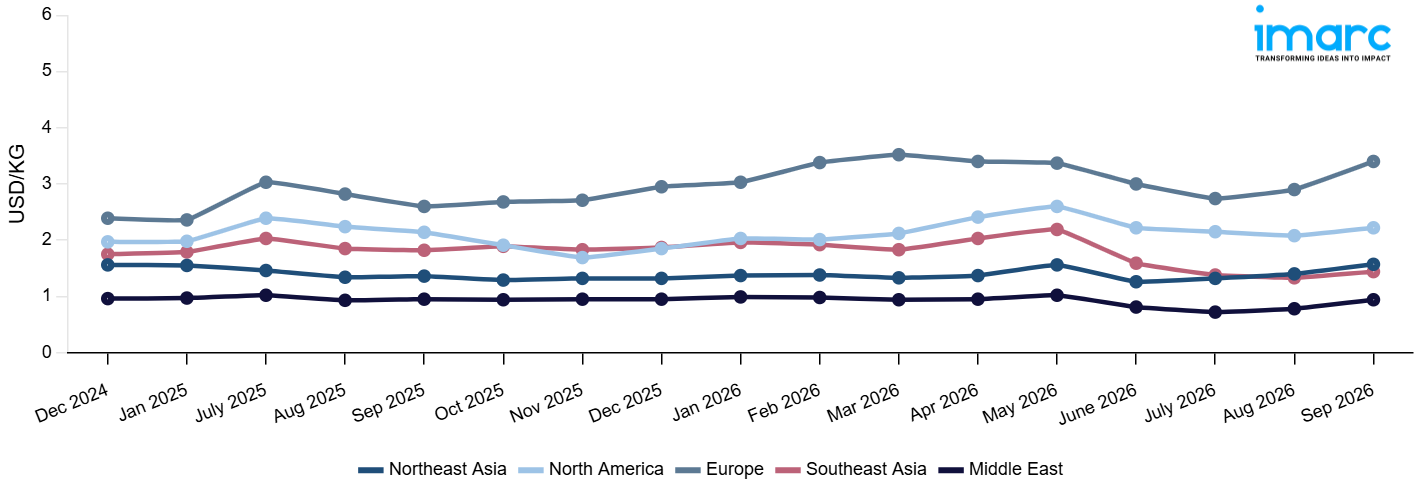
The chart below highlights monthly butyraldehyde prices across different regions.
Get Access to Monthly/Quarterly/Yearly Prices, Request Sample
Market Overview Q1 Ending March 2026
Northeast Asia: The butyraldehyde prices in Northeast Asia reached 1.33 USD/KG in March 2026. The upward pricing movement registered between December and March 2026 was 0.8%. Marginally firming demand from the plasticizer, resin, and specialty chemical manufacturing sectors provided modest procurement support and contributed to mildly bullish conditions across Northeast Asian markets during the review period. Slightly elevated upstream propylene and synthesis gas feedstock costs at regional production facilities placed incremental upward pressure on butyraldehyde manufacturing expenses and supported the prevailing marginal price increase throughout the quarter. Steady import cargo availability from key supplying regions maintained adequate supply conditions and limited the extent of upward price movement during the period.
Europe: The butyraldehyde prices in Europe reached 3.52 USD/KG in March 2026. The upward pricing movement registered between December and March 2026 was 19.3%. Strong demand from the 2-ethylhexanol, plasticizer, and specialty solvent manufacturing sectors drove robust butyraldehyde procurement activity and reinforced sharply bullish pricing conditions across European markets throughout the review period. Significantly rising upstream propylene and synthesis gas feedstock costs at regional oxo synthesis production facilities elevated manufacturing expenses considerably and provided sustained upward support to prevailing European market rates during the quarter. Constrained domestic production availability amid unplanned operational outages at key manufacturing facilities tightened regional supply conditions and intensified competition among downstream plasticizers and solvent buyers for available volumes.
Middle East: The butyraldehyde prices in the Middle East reached 0.94 USD/KG in March 2026. The downward pricing movement registered between December and March 2026 was 1.1%. Marginally softening export demand from Asian and European importing regions reduced butyraldehyde offtake volumes and contributed to mild bearish pricing conditions across Middle Eastern markets throughout the review period. Adequate regional production output from Oxo synthesis manufacturing facilities maintained sufficient supply conditions and placed modest downward pressure on prevailing market rates during the quarter. Slightly declining upstream propylene feedstock costs at regional production facilities lowered manufacturing expenses and reduced the cost floor supporting existing butyraldehyde price levels.
Southeast Asia: The butyraldehyde prices in Southeast Asia reached 1.83 USD/KG in March 2026. The downward pricing movement registered between December and March 2026 was 2.1%. Softening demand from the plasticizer, specialty solvent, and resin manufacturing sectors reduced procurement activity and contributed to mild bearish conditions for butyraldehyde across Southeast Asian markets during the review period. Competitive import cargo availability from Northeast Asian and Middle Eastern supplying nations exerted consistent downward pressure on prevailing regional market rates, limiting suppliers' ability to sustain existing price levels during the quarter. Slightly declining upstream propylene and synthesis gas feedstock costs at key producing facilities reduced manufacturing expenses and weakened the cost support for existing butyraldehyde price levels.
North America: The butyraldehyde prices in North America reached 2.12 USD/KG in March 2026. The upward pricing movement registered between December and March 2026 was 14.6%. Firm demand from the 2-ethylhexanol, plasticizer, and specialty chemical manufacturing sectors drove active butyraldehyde procurement and reinforced bullish pricing conditions across North American markets throughout the review period. Rising upstream propylene and synthesis gas feedstock costs at domestic Oxo synthesis production facilities significantly increased manufacturing expenses and sustained upward pressure on prevailing regional market rates during the quarter. Tightening domestic butyraldehyde production availability amid planned maintenance outages at key Gulf Coast manufacturing facilities constrained supply volumes and intensified competition among downstream plasticizers and solvent buyers across the region.
Market Overview Q4 Ending December 2025
Northeast Asia: The butyraldehyde prices in Northeast Asia reached 1.32 USD/KG in December 2025. The downward pricing movement registered between September and December 2025 was 3.2%. The moderate price decline was primarily driven by softened demand from the n-butanol, 2-ethylhexanol, and plasticizer intermediate manufacturing sectors, which moderated procurement volumes amid subdued downstream consumption across the region. Declining upstream propylene and synthesis gas feedstock costs further eroded production cost support for regional manufacturers operating oxo-synthesis processes. Elevated inventory levels among major producers prompted competitive pricing strategies to facilitate stock rotation, while surplus production capacity amplified supply side pressure.
Europe: The butyraldehyde prices in Europe reached 2.95 USD/KG in December 2025. The upward pricing movement registered between September and December 2025 was 13.4%. Tightened supply conditions stemming from planned maintenance turnarounds at key oxo-synthesis production facilities, which significantly limited regional availability throughout the quarter, were the main driver of the notable price increase. Despite low spot market volumes, procurement competitiveness increased due to strong demand from the n-butanol, 2-ethylhexanol, and trimethylolpropane industrial sectors. Production costs for local firms were further increased by rising upstream propylene and synthesis gas feedstock costs.
Middle East: The butyraldehyde prices in the Middle East reached 0.95 USD/KG in December 2025. The upward pricing movement registered between September and December 2025 was 0.2%. The negligible price increase reflected a predominantly stable market environment characterized by equilibrium between supply and demand fundamentals across the region. Moderate consumption from the plasticizer intermediate and specialty chemical sectors maintained consistent procurement activity, while adequate production output from established oxo-synthesis facilities ensured comfortable supply availability. Firm upstream propylene feedstock costs provided marginal pricing support for regional producers, while balanced inventory positions among key distributors limited significant pricing fluctuation.
Southeast Asia: The butyraldehyde prices in Southeast Asia reached 1.87 USD/KG in December 2025. The upward pricing movement registered between September and December 2025 was 2.7%. Firm demand from the n-butanol, plasticizer intermediate, and specialty chemical manufacturing sectors, which sustained strong procurement activity amid stable downstream consumption patterns throughout the area, drove the mild price appreciation. Regional manufacturers' production costs increased due to rising upstream propylene and synthesis gas feedstock costs, which reinforced upward pricing dynamics. Spot market volumes were further constrained by limited import availability amid high international benchmark valuations, intensifying procurement rivalry among downstream consumers.
North America: The butyraldehyde prices in North America reached 1.85 USD/KG in December 2025. The downward pricing movement registered between September and December 2025 was 13.7%. Weakened demand from the n-butanol, 2-ethylhexanol, and plasticizer intermediate manufacturing sectors in the face of deteriorating end market conditions and limited industrial activity throughout the region was the primary cause of the notable price fall. Aggressive downward price revisions were made possible by declining upstream propylene and synthesis gas feedstock costs, which significantly reduced production cost support for domestic manufacturers. Growing import competition from competitively priced cargoes further lowered current market rates, while surplus production from expanding domestic oxo synthesis capacity exerted strong supply side pressure.
Market Overview Q3 Ending September 2025
Northeast Asia: The upward movement was driven primarily by stable domestic demand from chemical intermediates and solvent production sectors in countries like China, South Korea, and Japan. Supply-side factors, including steady production from key regional manufacturers maintained balance in the market. Cost components such as international shipping and port handling charges remained largely stable, while domestic logistics and compliance costs, including environmental regulations, contributed minimally to the price adjustment. Currency fluctuations, particularly the slight strengthening of the Chinese yuan against the US dollar, also marginally impacted import valuations. Overall, the market in Northeast Asia reflected a combination of stable supply chains, moderate demand growth in the adhesives and coatings sectors, and cost pressures from transportation and currency adjustments, resulting in a slight upward trend for butyraldehyde pricing.
Europe: In Europe, prices declined sharply. The downward trend was influenced by reduced demand from downstream applications in solvents, coatings, and resins across Germany, France, and Italy. Supply-side dynamics included consistent output from regional chemical manufacturers, coupled with a temporary oversupply from imports from North America and the Middle East. Cost determinants such as port handling, customs, and intra-European logistics remained stable, while currency volatility, particularly fluctuations of the Euro against the US dollar, further pressured pricing. Additionally, compliance with EU chemical regulations and sustainability standards introduced marginal cost adjustments but did not offset the overall reduction in prices. The market trend reflected a combination of subdued demand, stable supply, and macroeconomic currency factors contributing to the significant quarter-on-quarter decline.
Middle East: Butyraldehyde pricing in the Middle East recorded a modest increase. Countries such as Saudi Arabia, the UAE, and Kuwait observed steady demand from solvent production, adhesives, and chemical intermediates industries. Supply remained stable, supported by local production capacities and limited export of excess volumes to Asia and Europe. Shipping and port handling costs were slightly higher due to seasonal logistic constraints, while customs duties and domestic distribution charges had minimal influence. Currency fluctuations were limited, as most trade is invoiced in USD. Regulatory compliance costs were negligible during this period, allowing prices to reflect mostly supply-demand dynamics and minor transport costs.
Southeast Asia: In Southeast Asia, prices declined slightly. The decrease was largely due to moderate reductions in industrial demand from chemical manufacturing and solvent production sectors in countries including Indonesia, Thailand, and Vietnam. Supply-side conditions remained robust, with regional producers maintaining steady outputs and imports from Northeast Asia balancing the market. Cost components such as port handling, customs, and domestic logistics had a neutral effect on pricing. Minor currency fluctuations and transport cost variations slightly contributed to downward pressure. The market trend indicates a stable supply-demand balance, with the slight decline reflecting moderate seasonal demand softness in downstream applications.
North America: Reduced demand from the adhesives, coatings, and plastics intermediates sectors across the United States, Canada, and Mexico contributed to the decline. Supply remained consistent, with production at key chemical plants running at normal capacity and imports from Europe supplementing availability. Cost factors, including international shipping, port handling, and domestic transportation, remained largely stable, while currency fluctuations between the US dollar and Canadian dollar exerted minor pressure on trade valuations. Environmental compliance and safety regulations contributed marginally to production costs. The price movement in North America reflected an interplay of moderate demand softening, steady supply, and minor cost adjustments impacting the regional market.
Butyraldehyde Price Trend, Market Analysis, and News
IMARC's latest publication, “Butyraldehyde Prices, Trend, Chart, Demand, Market Analysis, News, Historical and Forecast Data Report 2026 Edition,” presents a detailed examination of the butyraldehyde market, providing insights into both global and regional trends that are shaping prices. This report delves into the spot price of butyraldehyde at major ports and analyzes the composition of prices, including FOB and CIF terms. It also presents detailed butyraldehyde prices trend analysis by region, covering North America, Europe, Asia Pacific, Latin America, and Middle East and Africa. The factors affecting butyraldehyde pricing, such as the dynamics of supply and demand, geopolitical influences, and sector-specific developments, are thoroughly explored. This comprehensive report helps stakeholders stay informed with the latest market news, regulatory updates, and technological progress, facilitating informed strategic decision-making and forecasting.
Butyraldehyde Industry Analysis
The global butyraldehyde industry size reached USD 5,010.32 Million in 2025. By 2034, IMARC Group expects the market to reach USD 7,275.86 Million, at a projected CAGR of 4.23% during 2026-2034. The market is driven by the increasing demand from adhesives and coatings industries, expansion of solvent production applications, rising consumption in chemical intermediates, and growth in downstream polymers and plastics manufacturing.
Latest developments in the Butyraldehyde Industry:
- August 2025: Researchers developed a bi-phase electrolysis technique for the selective oxidation of n-butanol into butyraldehyde. This method employs carbon and stainless steel electrodes within an undivided electrochemical cell. The reaction medium consists of an aqueous NaNO₃ solution, with a small amount of sulfuric acid (H₂SO₄) acting as the supporting electrolyte.
- July 2025: In a study, two cubic-phase barium titanate (BaTiO₃) samples (BTO-1, BTO-2) and one tetragonal-phase sample (BTO-3) were synthesized. BTO-1 underwent nitrogen calcination to enhance VO concentration, while BTO-2 was prepared without this step. Structural and morphological analyses indicated that BTO-1 exhibited the highest VO content and surface-adsorbed oxygen. Gas sensing tests revealed that all samples demonstrated high cataluminescence specificity toward iso-butyraldehyde (IBD), with sensitivity closely correlated to VO concentration.
- December 2022: In a study, researchers from ICAR-Indian Agricultural Statistics Research Institute identified a total of 16 volatile organic compounds (VOCs) that showed statistically significant differences between the groups analyzed. Among these, butyraldehyde and butyric acid emerged as the most prominent markers, ranking first and second in their ability to differentiate patients with cancer from healthy individuals.
Product Description
Butyraldehyde, also known as butanal, is a colorless flammable liquid with an unpleasant smell. It is miscible with many organic solvents and has a 20 0F flash point and a 75.7 oF boiling point. Butyraldehyde serves as an intermediate to manufacture alcohols, plasticizers, solvents, and polymers, such as n-butanol, trimethylolpropane, n-butyric acid, methyl amyl ketone, and polyvinyl butyral. It also acts as a suitable biofuel due to its lower vapor pressure and hydrophilicity and higher energy density as compared to ethanol. It can replace fuel oil and is used in current engines without any previous modifications. In addition, butyraldehyde is used as a synthetic flavoring agent in the food and beverage (F&B) industry in alcoholic and non-alcoholic beverages, ice cream, candy, and baked items.
Report Coverage
| Key Attributes | Details |
|---|---|
| Product Name | Butyraldehyde |
| Report Features | Exploration of Historical Trends and Market Outlook, Industry Demand, Industry Supply, Gap Analysis, Challenges, Butyraldehyde Price Analysis, and Segment-Wise Assessment. |
| Currency/Units | US$ (Data can also be provided in local currency) or Metric Tons |
| Region/Countries Covered | The current coverage includes analysis at the global and regional levels only. Based on your requirements, we can also customize the report and provide specific information for the following countries: Asia Pacific: China, India, Indonesia, Pakistan, Bangladesh, Japan, Philippines, Vietnam, Thailand, South Korea, Malaysia, Nepal, Taiwan, Sri Lanka, Hongkong, Singapore, Australia, and New Zealand Europe: Germany, France, United Kingdom, Italy, Spain, Russia, Turkey, Netherlands, Poland, Sweden, Belgium, Austria, Ireland, Switzerland, Norway, Denmark, Romania, Finland, Czech Republic, Portugal and Greece North America: United States and Canada Latin America: Brazil, Mexico, Argentina, Columbia, Chile, Ecuador, and Peru Middle East & Africa: Saudi Arabia, UAE, Israel, Iran, South Africa, Nigeria, Oman, Kuwait, Qatar, Iraq, Egypt, Algeria, and Morocco The list of countries presented is not exhaustive. Information on additional countries can be provided if required by the client. |
| Information Covered for Key Suppliers |
|
| Customization Scope | The report can be customized as per the requirements of the customer |
| Report Price and Purchase Option |
Plan A: Monthly Updates - Annual Subscription
Plan B: Quarterly Updates - Annual Subscription
Plan C: Biannually Updates - Annual Subscription
|
| Post-Sale Analyst Support | 360-degree analyst support after report delivery |
| Delivery Format | PDF and Excel through email (We can also provide the editable version of the report in PPT/Word format on special request) |
Key Benefits for Stakeholders:
- IMARC’s report presents a detailed analysis of butyraldehyde pricing, covering global and regional trends, spot prices at key ports, and a breakdown of Ex Works, FOB, and CIF prices.
- The study examines factors affecting butyraldehyde price trend, including raw material costs, supply-demand shifts, geopolitical impacts, and industry developments, offering insights for informed decision-making.
- The competitive landscape review equips stakeholders with crucial insights into the latest market news, regulatory changes, and technological advancements, ensuring a well-rounded, strategic overview for forecasting and planning.
- IMARC offers various subscription options, including monthly, quarterly, and biannual updates, allowing clients to stay informed with the latest market trends, ongoing developments, and comprehensive market insights. The butyraldehyde price charts ensure our clients remain at the forefront of the industry.
Frequently Asked Questions About the Butyraldehyde Price Trend Report
The butyraldehyde prices in September 2026 were 1.57 USD/Kg in Northeast Asia, 3.4 USD/Kg in Europe, 0.94 USD/Kg in the Middle East, 1.44 USD/Kg in Southeast Asia, and 2.22 USD/Kg in North America.
The butyraldehyde pricing data is updated on a monthly basis.
We provide the pricing data primarily in the form of an Excel sheet and a PDF.
Yes, our report includes a forecast for butyraldehyde prices.
The regions covered include North America, Europe, Asia Pacific, Middle East, and Latin America. Countries can be customized based on the request (additional charges may be applicable).
Yes, we provide both FOB and CIF prices in our report.
Need more help?
- Speak to our experienced analysts for insights on the current market scenarios.
- Include additional segments and countries to customize the report as per your requirement.
- Gain an unparalleled competitive advantage in your domain by understanding how to utilize the report and positively impacting your operations and revenue.
- For further assistance, please connect with our analysts.
 Request Customization
 Inquire Before Buying
 Speak to an Analyst
 Request Brochure
Benefits of Customization
- Personalize this research
- Triangulate with your data
- Get data as per your format and definition
- Gain a deeper dive into a specific application, geography, customer, or competitor
- Any level of personalization
Get in Touch With Us
UNITED STATES
Phone: +1-201-971-6302
INDIA
Phone: +91-120-433-0800
UNITED KINGDOM
Phone: +44-753-714-6104
Email: [email protected]
Client Testimonials




.webp)




.webp)













Related Reports

Why Choose Us
IMARC offers trustworthy, data-centric insights into commodity pricing and evolving market trends, enabling businesses to make well-informed decisions in areas such as procurement, strategic planning, and investments. With in-depth knowledge spanning more than 1000 commodities and a vast global presence in over 150 countries, we provide tailored, actionable intelligence designed to meet the specific needs of diverse industries and markets.
1000
+Commodities
150
+Countries Covered
3000
+Clients
20
+Industry

Robust Methodologies & Extensive Resources
IMARC delivers precise commodity pricing insights using proven methodologies and a wealth of data to support strategic decision-making.

Subscription-Based Databases
Our extensive databases provide detailed commodity pricing, import-export trade statistics, and shipment-level tracking for comprehensive market analysis.

Primary Research-Driven Insights
Through direct supplier surveys and expert interviews, we gather real-time market data to enhance pricing accuracy and trend forecasting.

Extensive Secondary Research
We analyze industry reports, trade publications, and market studies to offer tailored intelligence and actionable commodity market insights.
Trusted by 3000+ industry leaders worldwide to drive data-backed decisions. From global manufacturers to government agencies, our clients rely on us for accurate pricing, deep market intelligence, and forward-looking insights.