
Canada Helicopter Services Market Size, Share, Trends and Forecast by Type, Application, End User, and Region, 2026-2034
Canada Helicopter Services Market Size, Share, Trends & Forecast (2026-2034)
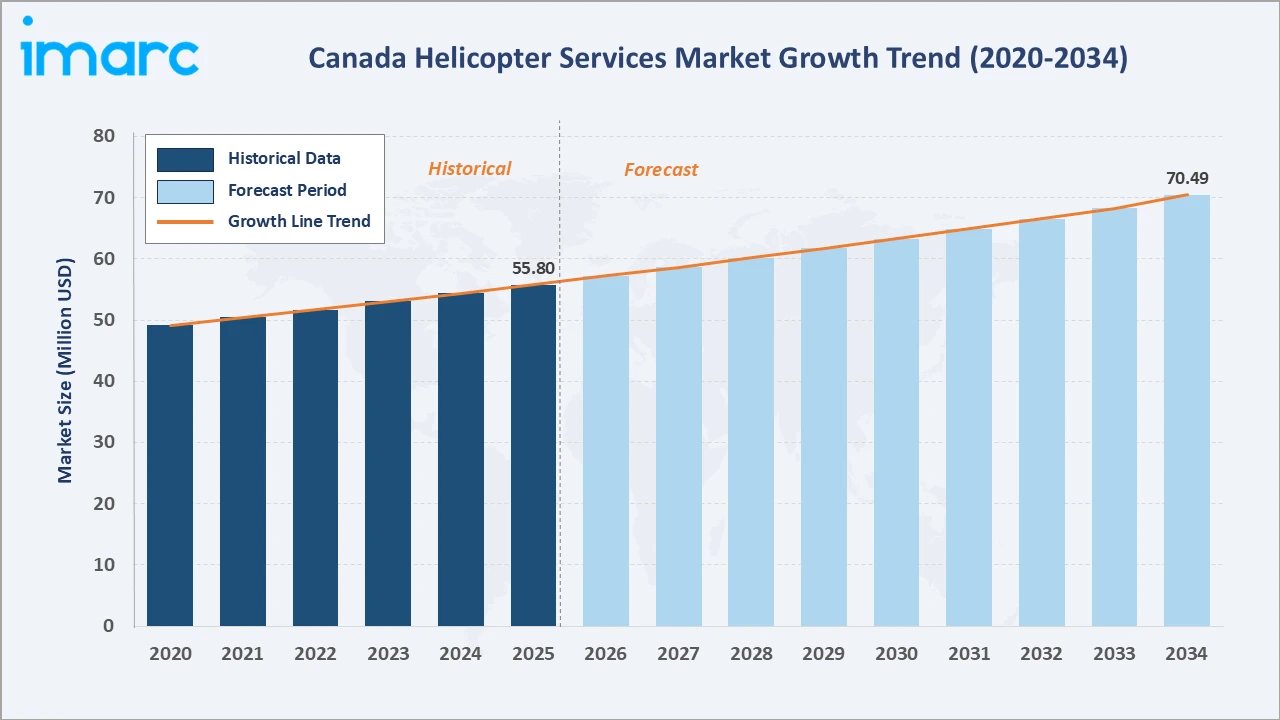
The Canada helicopter services market grew from USD 55.80 Million in 2025 to USD 57.22 Million in 2026 and is projected to reach USD 70.49 Million by 2034, exhibiting a CAGR of 2.55% during 2026-2034. Rising demand for offshore oil and gas support, expanding air ambulance operations, and increasing utilization across remote industrial transport are the primary forces shaping market growth.
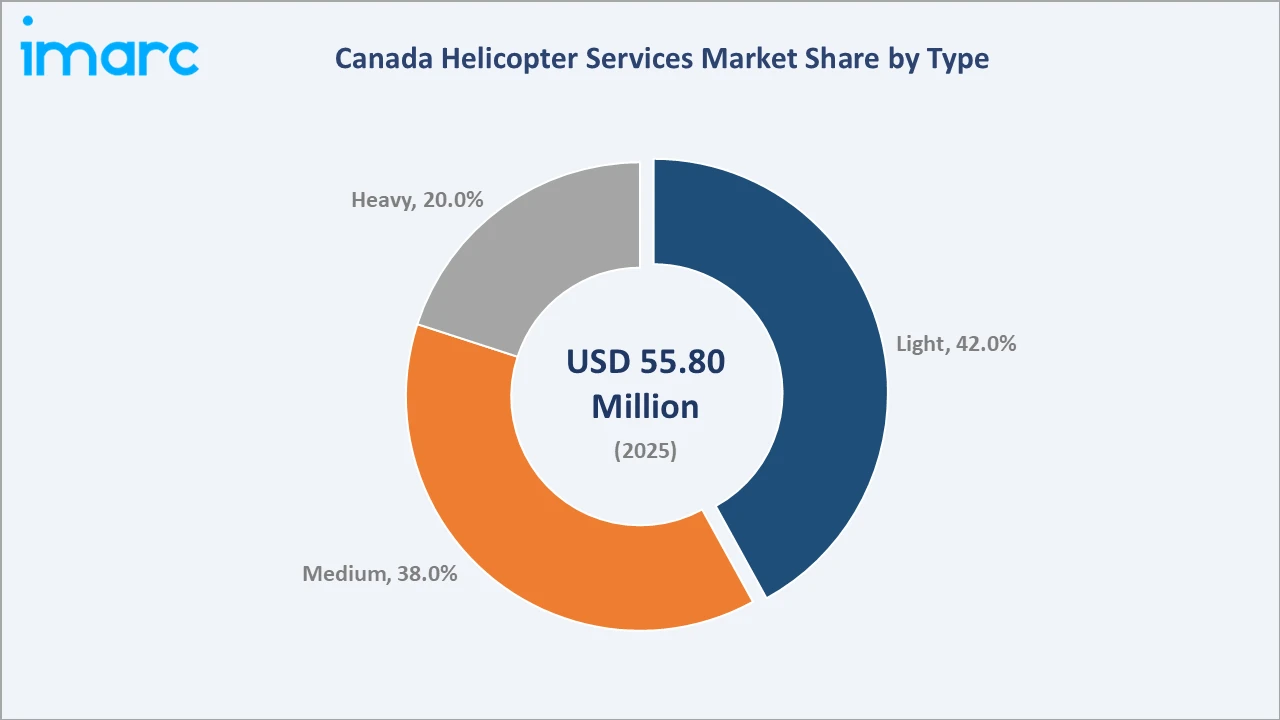
Light leads the type segment at 42.0%, air ambulance dominates the application segment at 22.0%, and Ontario commands 35.0% of regional share.
Market Snapshot
|
Metric |
Value |
|
Base Year Market Size (2025) |
USD 55.80 Million |
|
Market Size (2026) |
USD 57.22 Million |
|
Forecast Market Size (2034) |
USD 70.49 Million |
|
CAGR (2026-2034) |
2.55% |
|
Base Year |
2025 |
|
Historical Period |
2020-2025 |
|
Forecast Period |
2026-2034 |
|
Largest Region |
Ontario (35.0%, 2025) |
|
Second Largest Region |
Quebec (23.0%, 2025) |
|
Leading Type |
Light (42.0%, 2025) |
|
Leading Application |
Air Ambulance (22.0%, 2025) |
The Canada helicopter services market size increased from USD 49.19 Million in 2020 to USD 55.80 Million in 2025 and is estimated to reach USD 57.22 Million in 2026. The market is further expected to grow to USD 63.29 Million by 2030 and USD 70.49 Million by 2034. The market's steady growth trajectory is underpinned by Canada's vast and challenging geography, a robust offshore energy sector concentrated in Atlantic Canada, expanding medical air transport infrastructure, and sustained demand for helicopter-based industrial support services across the forestry, mining, and construction sectors.
To get more information on this market, Request Sample
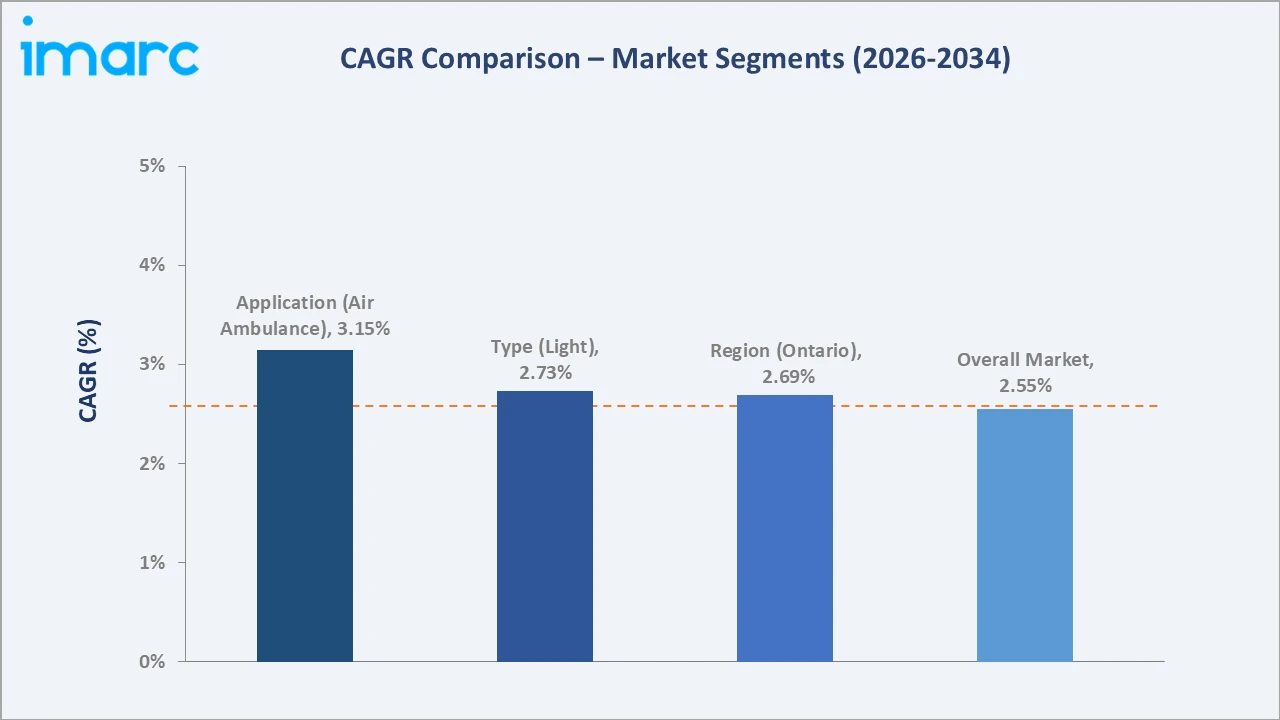
CAGR trajectories across type, application, and regional sub-segments show air ambulance and leisure charter expanding faster than the overall 2.55% market CAGR, driven by provincial healthcare investment, growing tourism demand, and increasing corporate helicopter utilization in major urban corridors.
Executive Summary
The Canada helicopter services market expanded from USD 55.80 Million in 2025 to an estimated USD 57.22 Million in 2026, positioning it as a key component of Canada's national aviation infrastructure. The market growth is driven by Canada's expansive remote geography, strong offshore energy sector demand, and rising emergency medical service utilization across provincial air ambulance programs.
Light commands 42.0% type share, reflecting its wide application across forestry surveys, light transport, and leisure charter operations. Air ambulance leads the application segment at 22.0%, supported by provincial government contracts, expanding trauma center networks, and rising demand for time-critical patient transfer services. Ontario leads regional share at 35.0%, anchored by its dense population, well-funded air ambulance network, and high business aviation activity.
Key Market Insights
|
Insight |
Data |
|
Leading Type |
Light - 42.0% share (2025) |
|
Second Largest Type |
Medium - 38.0% share (2025) |
|
Leading Application |
Air Ambulance - 22.0% share (2025) |
|
Second Largest Application |
Transport - 20.0% share (2025) |
|
Leading Region |
Ontario - 35.0% share (2025) |
|
Second Largest Region |
Quebec - 23.0% share (2025) |
|
Top Companies |
VIH Aviation Group Ltd., Ornge, STARS Air Ambulance |
Key Analytical Observations Expanding On the Data Above:
- Light dominance at 42.0% reflects broad versatility across low-load, short-range operations, making it the first-choice asset for forestry, survey, leisure, and light logistics missions across Canada's vast terrain.
- Medium at 38.0% is supported by its balance of payload capacity and operating economics, making it the preferred platform for offshore crew transfers, medium-range transport, and industrial support contracts.
- Air ambulance leadership at 22.0% is driven by provincial government contracts, expanding intensive care transport capabilities, and Canada's reliance on rotary-wing aircraft for rapid patient evacuation from remote communities without fixed-wing airport access.
- Transport at 20.0% is the second-largest application, underpinned by resource sector demand for crew and equipment movement to remote construction, mining, and energy sites across British Columbia, Alberta, and northern territories.
- Ontario regional dominance at 35.0% reflects its large population base, substantial air ambulance network investment, high corporate travel demand, and established helicopter maintenance and operations infrastructure.
Canada Helicopter Services Market Overview
Helicopter services encompass the commercial operation of rotary-wing aircraft for passenger transport, cargo movement, emergency medical services, offshore energy support, and specialized industrial applications. In Canada, the sector serves critical logistical and humanitarian functions across geographies that are largely inaccessible by road or fixed-wing aircraft, particularly in northern territories, remote resource sites, and offshore maritime zones.
The Canadian helicopter services ecosystem integrates aircraft manufacturers, MRO providers, fuel and logistics suppliers, provincial emergency services operators, offshore energy companies, and regulatory authorities under Transport Canada and the Canadian Aviation Regulations. Together, these participants sustain a network of flight operations spanning from densely populated southern provinces to remote Arctic environments, underscoring the market's critical role in Canada's national infrastructure.
Market Dynamics
To evaluate market opportunities, Request Sample
Market Drivers
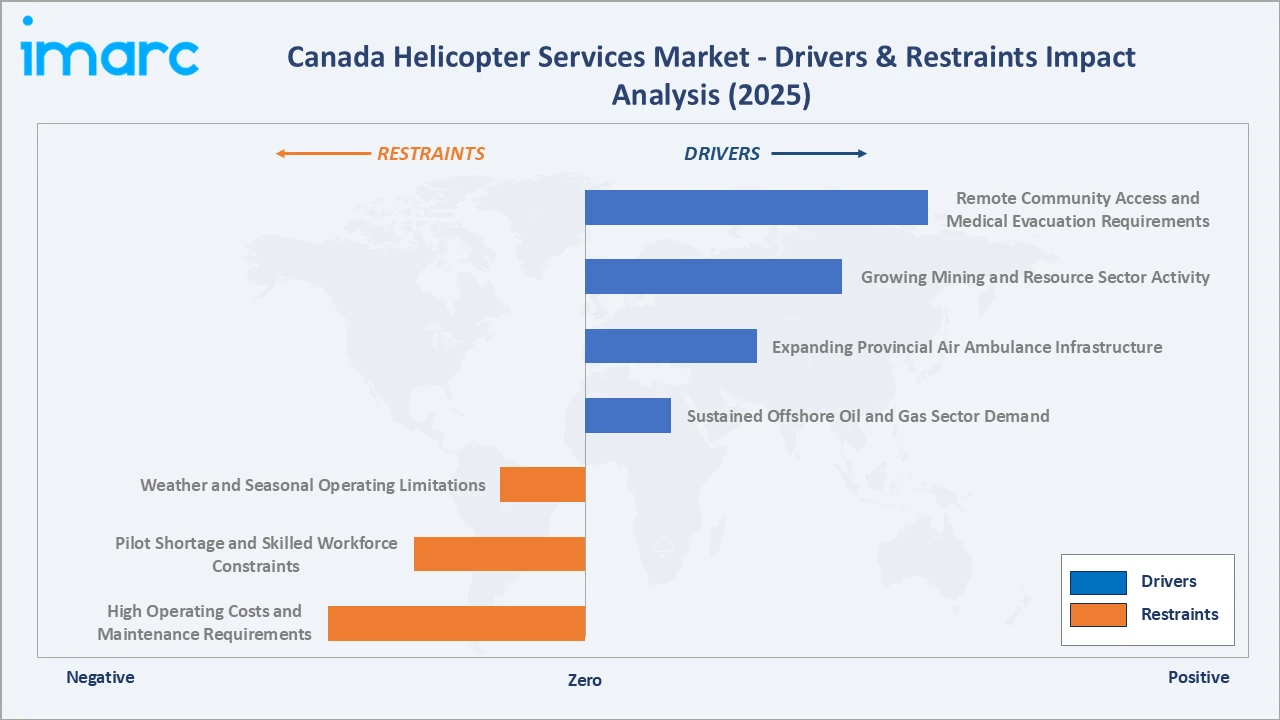
- Sustained Offshore Oil and Gas Sector Demand: Atlantic Canada's offshore energy sector generates consistent demand for offshore crew transport services. Canada's offshore sector supports thousands of platform workers requiring regular helicopter rotations, primarily served by medium and heavy helicopter operators under long-term service agreements with major energy companies.
- Expanding Provincial Air Ambulance Infrastructure: Rising healthcare budgets across Ontario, Alberta, British Columbia, and the Prairie provinces are driving investment in dedicated air ambulance fleets, increasing the serviceable aircraft base and flight hour volumes across the country.
- Growing Mining and Resource Sector Activity: Helicopter services play an indispensable role in Canada's mining, forestry, and oil sands industries, with continued resource extraction investment across British Columbia, Alberta, and northern Quebec sustaining strong industrial helicopter demand. In 2024, Canada's mining industry added USD 111 Billion to the nation's gross domestic product, representing 3.6% of the overall economy.
- Remote Community Access and Medical Evacuation Requirements: Many northern and Indigenous communities lack road access, making helicopter services the primary mode of transport for medical emergencies and essential supply movement, ensuring baseline demand across all operating conditions.
Market Restraints
- High Operating Costs and Maintenance Requirements: Helicopter operations carry substantially higher per-seat and per-kilometer costs than fixed-wing alternatives. MRO, crew training, and insurance requirements create significant ongoing expenditure for operators, limiting margin and constraining fleet expansion for smaller regional businesses.
- Pilot Shortage and Skilled Workforce Constraints: Canada's aviation industry faces structural shortages of certified helicopter pilots and licensed maintenance engineers, limiting capacity expansion and constraining operational growth for established operators.
- Weather and Seasonal Operating Limitations: Canada's extreme seasonal weather, including prolonged winters with heavy snowfall, ice fog, and low visibility, restricts flying hours in northern and prairie regions and introduces operational volatility into service provider revenue models.
Market Opportunities
- Urban Air Mobility and Business Aviation Growth: Increasing corporate demand for time-efficient inter-city travel in corridors such as Toronto-Ottawa and Vancouver-Victoria is creating incremental demand for business and corporate helicopter charter services.
- Search and Rescue and Defense Contracts: Federal government investment in search and rescue capability modernization and Indigenous community support programs is generating new long-term service contracts for qualified helicopter operators.
Market Challenges
- Regulatory Compliance and Safety Management Requirements: Canada's regulatory framework under Transport Canada imposes stringent maintenance schedules, safety management system requirements, and pilot certification standards, increasing compliance costs for smaller regional operators.
- Competition from Fixed-Wing Alternatives for Mid-Range Routes: For routes where runway infrastructure exists, fixed-wing turboprop aircraft offer lower operating costs and greater payload capacity, limiting helicopter market share on certain industrial and commercial routes.
Emerging Market Trends
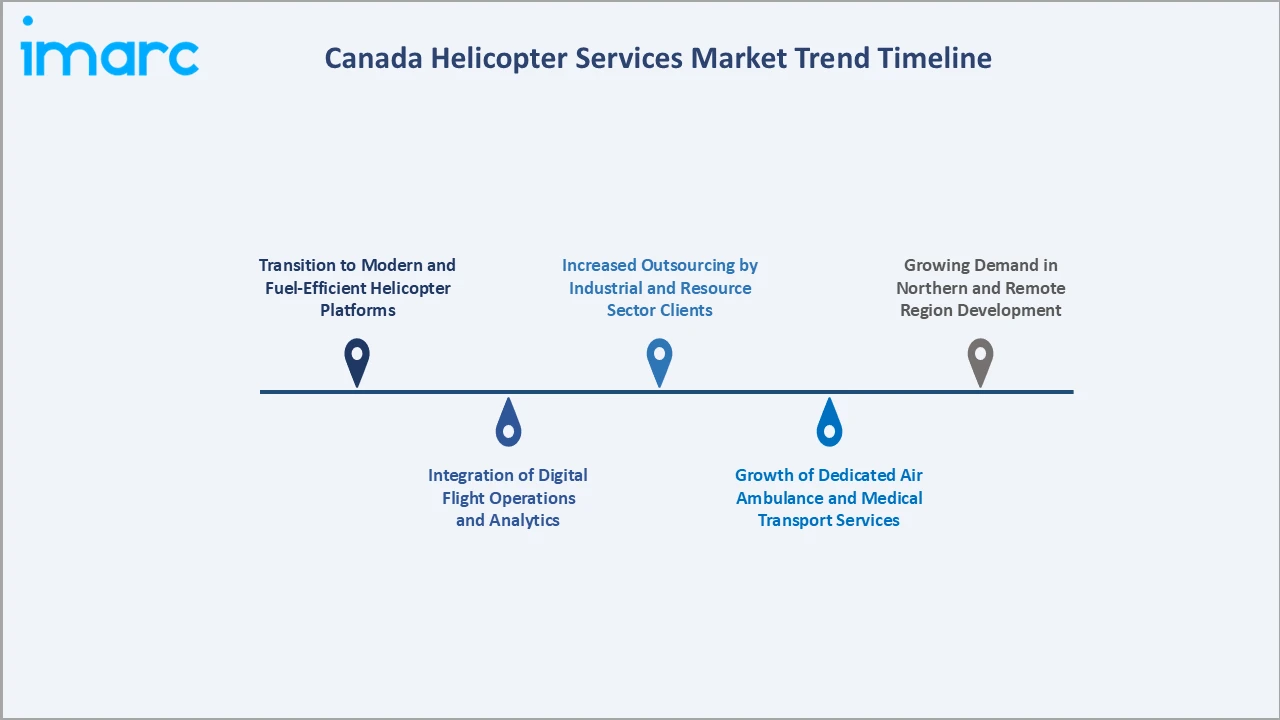
1. Transition to Modern and More Fuel-Efficient Helicopter Platforms
Canadian operators are progressively replacing aging helicopter fleets with newer-generation aircraft offering improved fuel efficiency, lower maintenance costs, and enhanced avionics. This fleet modernization trend is improving operating economics and competitive positioning. The shift toward advanced helicopter platforms is becoming a defining differentiator for operators competing on medium- and long-term service contracts.
2. Integration of Digital Flight Operations and Analytics
Advanced avionics suites, predictive maintenance platforms, and digital flight data monitoring systems are being adopted by leading Canadian operators. These technologies reduce unplanned maintenance downtime, improve flight safety compliance, and generate data-driven insights for route optimization and fleet management.
3. Growth of Dedicated Air Ambulance and Medical Transport Services
Provincial air ambulance programs are expanding their geographic coverage and medical intervention capabilities. Investment in intensive care-configured helicopters and crew training is enabling increasingly complex pre-hospital interventions during transport, raising service value and driving incremental fleet investment.
4. Increased Outsourcing by Industrial and Resource Sector Clients
Mining, forestry, and oil sands operators are increasingly outsourcing helicopter services rather than maintaining proprietary fleets, favoring variable cost structures over capital ownership. This trend is concentrating helicopter service demand with established commercial operators and improving their capacity utilization rates.
5. Growing Demand in Northern and Remote Region Development
Infrastructure development projects in Canada's northern territories, including road construction, hydro projects, and Indigenous community expansion programs, are generating multi-year helicopter service contracts that diversify operator revenue beyond traditional resource and medical sectors.
Industry Value Chain Analysis
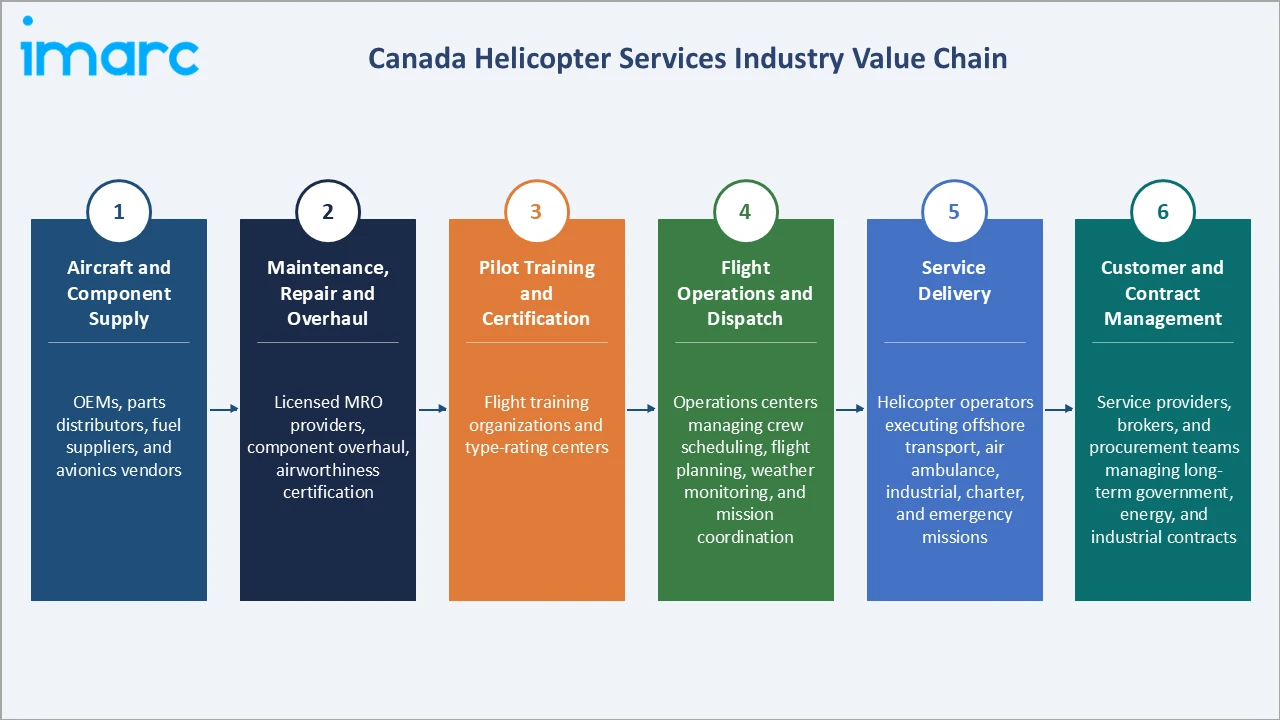
The Canada helicopter services value chain spans six stages, from aircraft and component supply through mission execution and customer-facing service delivery. MRO, pilot training, and regulatory compliance stages capture significant value-add, while long-term service contracts with provincial governments and energy companies determine competitive positioning at the customer interface.
| Stage | Key Players / Examples |
|---|---|
| Aircraft and Component Supply | OEMs, parts distributors, fuel suppliers, and avionics vendors providing aircraft and consumables for fleet operation |
| Maintenance, Repair and Overhaul | Licensed MRO providers executing scheduled maintenance, component overhaul, and airworthiness certification |
| Pilot Training and Certification | Flight training organizations and type-rating centers qualifying pilots and engineers to Transport Canada standards |
| Flight Operations and Dispatch | Operations centers managing crew scheduling, flight planning, weather monitoring, and mission coordination |
| Service Delivery | Helicopter operators executing offshore transport, air ambulance, industrial, charter, and emergency missions |
| Customer and Contract Management | Service providers, brokers, and procurement teams managing long-term government, energy, and industrial contracts |
Vertically integrated operators controlling aircraft sourcing, flight operations, and MRO are positioned to capture greater margin than single-stage service providers dependent on external maintenance and spot charter rates.
Technology Landscape in the Canada Helicopter Services Industry
Modern Rotary-Wing Platforms
The Canadian helicopter services industry is undergoing a generational transition from legacy helicopter platforms to modern twin-turbine aircraft. These next-generation platforms offer improved fuel efficiency, lower maintenance requirements, and enhanced avionics systems, helping reduce operator costs per flight hour. This transition is encouraging fleet modernization and improving operational efficiency across commercial and specialized helicopter services.
Avionics and Digital Flight Management
Advanced flight management systems, enhanced ground proximity warning, digital autopilot, and synthetic vision systems are now standard on new deliveries entering the Canadian fleet. These technologies improve situational awareness in Canada's demanding low-visibility and mountainous operating environments.
Predictive Maintenance and Health Monitoring
Leading operators are deploying vibration health monitoring systems (HUMS) and digital maintenance management platforms that enable condition-based maintenance, reducing scheduled downtime and extending component service life. Predictive maintenance adoption is improving fleet availability rates for operators with large multi-aircraft contracts.
Medical Technology Integration in Air Ambulance
Intensive care-configured helicopters are equipped with advanced life support systems, power management units, and medical monitoring platforms, enabling in-flight clinical intervention for critically ill patients. Technology investment in this segment is accelerating as provincial governments increase air ambulance performance standards.
Market Segmentation Analysis
The report covers the following segments:
| Segment Category | Leading Segment | Market Share | Year |
|---|---|---|---|
| Type | Light | 42.0% | 2025 |
| Application | Air Ambulance | 22.0% | 2025 |
| End User | 🔒 | 🔒 | 2025 |
| Region | Ontario | 35.0% | 2025 |

By Type
Light commands a 42.0% majority share in 2025, driven by its versatility across a broad range of low-load applications including forestry surveys, leisure charter, power line inspection, and short-range personnel transport.
To access detailed market analysis, Request Sample
Medium represents 38.0% of the type segment in 2025, supported by its role as the preferred platform for offshore crew transfers, medium-range industrial transport, and emergency medical services requiring greater payload capacity.
By Application
Air ambulance leads the application segment at 22.0% in 2025, driven by provincial government contracts, expanding healthcare infrastructure, and Canada's reliance on rotary-wing emergency medical transport for communities without road access.
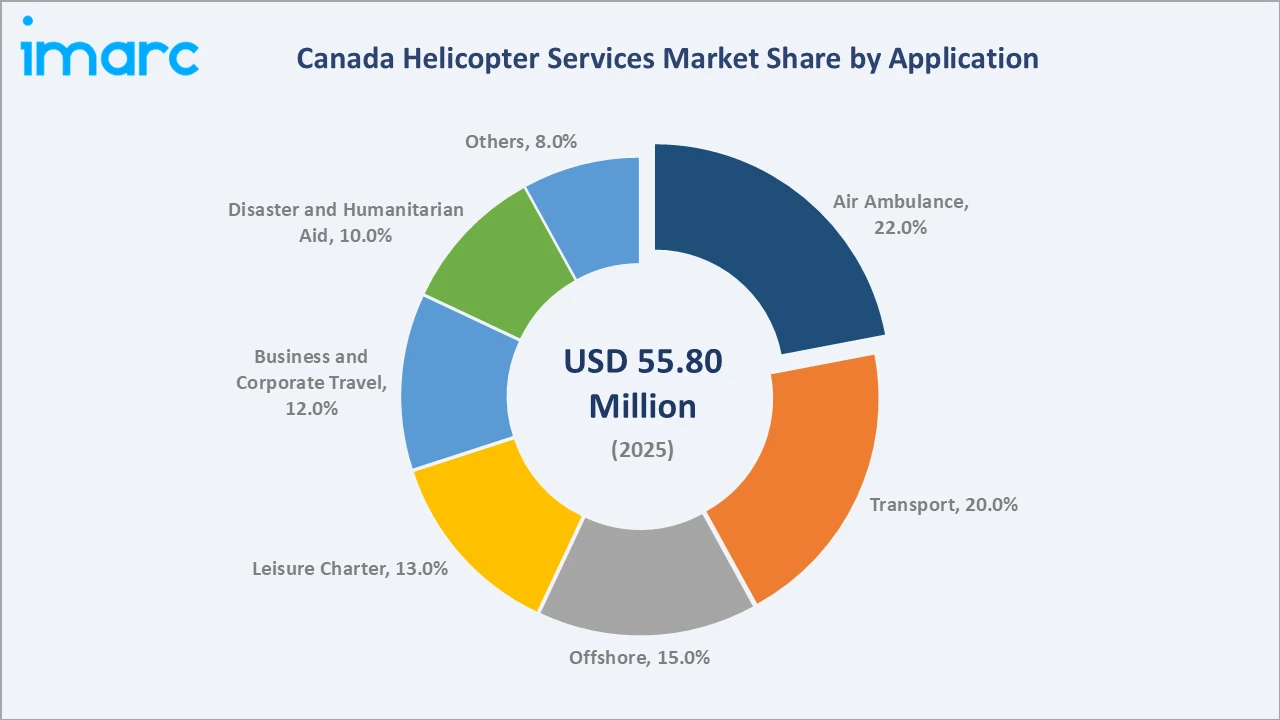
Transport at 20.0% is the second-largest application, underpinned by sustained resource sector activity across British Columbia, Alberta, and northern Quebec generating demand for crew and equipment movement to remote sites.
Regional Market Insights
| Region | Share (2025) | Key Growth Drivers |
|---|---|---|
| Ontario | 35.0% | Well-funded provincial air ambulance network, high corporate aviation demand, large population base, and significant helicopter maintenance and operations infrastructure |
| Quebec | 23.0% | Extensive forestry and hydroelectric sector helicopter utilization, growing remote community support services, and strong industrial aviation demand in northern Quebec |
| Alberta | 18.0% | Strong oil sands and energy sector helicopter demand and active search and rescue operations |
| British Columbia | 15.0% | Rugged mountain terrain driving helicopter utilization for forestry, construction, and leisure charter, with strong offshore support demand from Pacific-based energy and marine operations |
| Others | 9.0% | Expanding helicopter use across Saskatchewan, Manitoba, and northern territories for Indigenous community support, resource extraction, and federal government contracts |
Ontario at 35.0% in 2025 leads the regional landscape, anchored by Ornge's extensive air ambulance network, high corporate travel demand, and the concentration of aviation infrastructure in the Greater Toronto Area and surrounding regions.
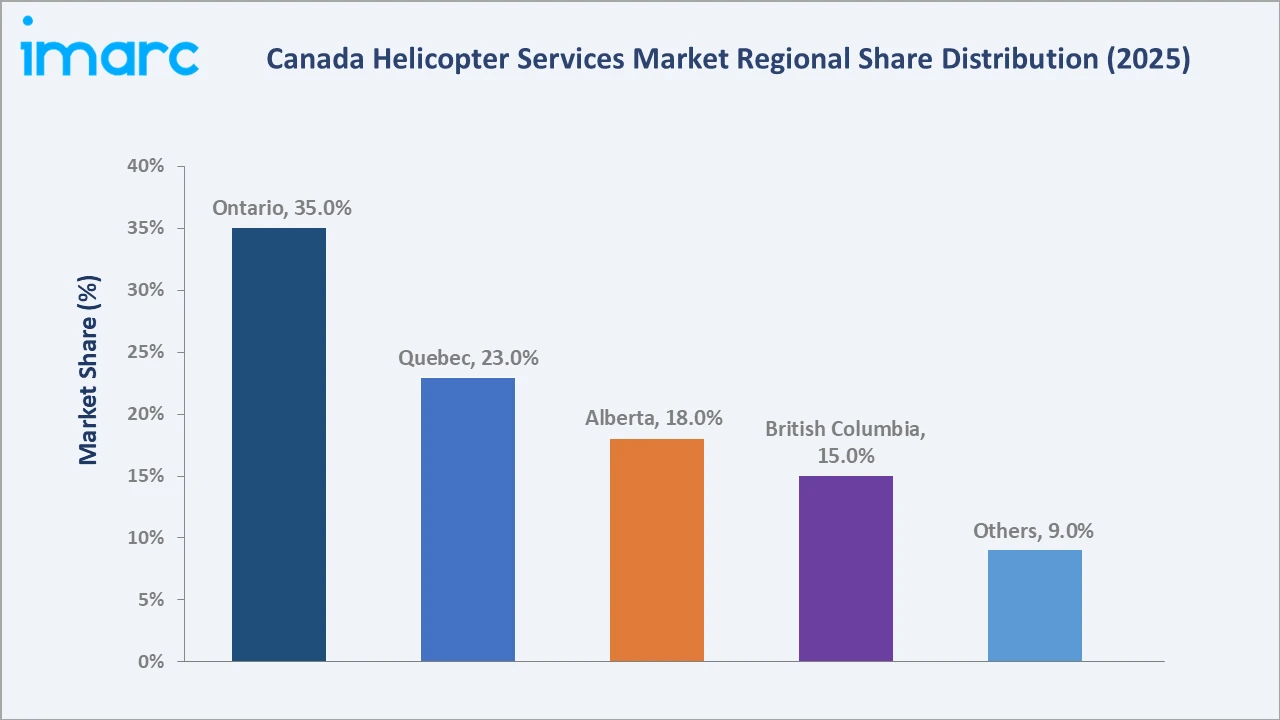
British Columbia, while ranked fourth at 15.0%, is a strategically important market given the province's mountainous geography, active forestry industry, and growing luxury leisure charter segment targeting scenic mountain and coastal tours.
Competitive Landscape
The Canada helicopter services market is moderately fragmented, with a mix of large multi-service operators, provincial government-funded air ambulance organizations, and specialized regional operators competing on service reliability, aircraft capabilities, and long-term contract relationships.
| Company Name | Brand / Key Product | Position | Strategic Focus |
|---|---|---|---|
| VIH Aviation Group Ltd. | VIH Helicopters | Leader | Expanding service capabilities across commercial, industrial, and specialized helicopter operations while improving geographic reach |
| Ornge | Ornge | Challenger | Enhancing air ambulance capabilities through fleet upgrades, expanded service coverage, and improvements in emergency medical transportation |
| STARS Air Ambulance | STARS | Challenger | Strengthening critical care transport services through fleet development, operational improvements, and expanded emergency response capabilities |
Key players include VIH Aviation Group Ltd., Ornge, and STARS Air Ambulance, among others.
Key Company Profiles
VIH Aviation Group Ltd.
VIH Aviation Group Ltd. is a Canadian aviation group headquartered in North Saanich, British Columbia. The group provides a range of aviation services, including helicopter operations, maintenance, repair, and specialized aerial support solutions.
- Product Portfolio: Offshore crew transport services, industrial helicopter services, power line inspection, wildfire suppression, search and rescue, air ambulance, and helicopter maintenance and overhaul services.
- Recent Developments: The company continues to strengthen its aviation service capabilities through operational improvements, fleet enhancements, and the expansion of specialized helicopter services to address evolving industry requirements.
- Strategic Focus: Expanding offshore and wildfire suppression capabilities through fleet technology upgrades while growing diversified aviation revenue across industrial, government, MRO, and corporate charter segments in Canada and international markets.
Ornge
Ornge is Ontario's air ambulance and critical care transport organization, headquartered in Mississauga, Ontario. The organization operates a dedicated fleet of helicopters and fixed-wing aircraft providing emergency medical transport services across the province of Ontario.
- Product Portfolio: Air ambulance and critical care transport services.
- Recent Developments: Ornge continues to expand its critical care capabilities, invest in crew training, and broaden service coverage to underserved northern Ontario communities.
- Strategic Focus: Expanding critical care transport capabilities, extending service coverage to remote northern Ontario communities, and improving response time performance across the provincial network.
STARS Air Ambulance
STARS Air Ambulance is a non-profit air medical transport organization providing helicopter emergency services across Alberta, Saskatchewan, and Manitoba. The organization focuses on delivering specialized emergency medical transportation and critical care services to patients in remote and underserved communities.
- Product Portfolio: Air medical transport services configured for intensive care intervention, covering urban, rural, and remote communities across the Prairie provinces.
- Recent Developments: STARS Air Ambulance has expanded service coverage and continues to invest in advanced helicopters with enhanced life support capabilities to improve patient outcomes.
- Strategic Focus: Extending air ambulance geographic coverage, investing in modern medical helicopter platforms, and deepening clinical care capabilities during transport to improve survival rates.
Market Concentration Analysis
The Canada helicopter services market exhibits moderate fragmentation, with the leading tier of operators collectively accounting for a significant but minority share of total market revenues. The market's geographic fragmentation across provincial operating zones limits the ability of any single operator to achieve dominant national market share.
Barriers to entry are significant, including Transport Canada Air Operator Certificate requirements, capital-intensive aircraft acquisition, and the relationship-dependent nature of long-term government and industrial service contracts. These factors favor established operators with certified fleets, trained crews, and proven safety management systems over greenfield entrants with limited track records.
Consolidation activity in the sector remains moderate, driven by competitive pressure on smaller regional operators facing higher fuel costs and rising maintenance complexity. Provincial government air ambulance programs remain structurally separate from commercial market consolidation given their public funding models.
Investment & Growth Opportunities
Fastest-Growing Segments
Air ambulance is the fastest-growing application sub-segment, driven by provincial government investment, expanding Indigenous community healthcare access programs, and increasing demand for intensive care-configured helicopter transport.
Emerging Markets
British Columbia is the fastest-growing regional market, fueled by expanding offshore and remote-area operations, rising demand for emergency medical transportation, growing tourism activities, and investments in infrastructure supporting commercial and specialized helicopter services.
Venture & Investment Trends
Investment activity is concentrated in fleet modernization, medical helicopter configuration upgrades, and digital operations management platforms. Capital is also flowing into expanded MRO infrastructure and pilot training facilities, addressing the structural supply constraint in certified helicopter aircrew that limits capacity expansion across the industry.
Future Market Outlook (2026-2034)
The Canada helicopter services market is projected to grow from USD 55.80 Million in 2025 to USD 57.22 Million in 2026, reaching USD 70.49 Million by 2034, registering a CAGR of 2.55% during 2026-2034.
Four forces will shape the market through 2034 continued offshore energy sector activity in Atlantic Canada; expansion of provincial air ambulance infrastructure into underserved regions; growth in resource sector helicopter utilization driven by mining and forestry activity in northern provinces; and increasing adoption of modern, fuel-efficient helicopter platforms that improve operator economics and service reliability.
By 2034, the Canada helicopter services market is expected to be characterized by a smaller number of well-capitalized operators with modern fleets, deeper government and industrial contract relationships, and improved digital operations capabilities. Structural pilot supply constraints will likely sustain service pricing and operator margins through the forecast period.
Research Methodology
Primary Research
Primary research included structured discussions with helicopter fleet operators, provincial emergency services administrators, offshore energy procurement managers, and aviation industry analysts, validating market sizing, segment mix, and regional demand patterns across the Canada helicopter services ecosystem.
Secondary Research
Secondary sources included Transport Canada aviation statistics, Canadian Aviation Regulations, provincial air ambulance program reports, Natural Resources Canada energy sector publications, and public disclosures from listed and private helicopter operators and OEMs serving the Canadian market.
Forecasting Models
Market forecasts used top-down and bottom-up models combining helicopter fleet inventory data, flight hour utilization rates, segment revenue composition estimates, and regional demand drivers. Scenario analysis addressed energy sector activity levels, provincial healthcare budget trends, and pilot supply constraints.
Canada Helicopter Services Market Report Coverage:
| Report Features | Details |
|---|---|
| Base Year of the Analysis | 2025 |
| Historical Period | 2020-2025 |
| Forecast Period | 2026-2034 |
| Units | Million USD |
| Scope of the Report |
Exploration of Historical Trends and Market Outlook, Industry Catalysts and Challenges, Segment-Wise Historical and Future Market Assessment:
|
| Types Covered | Light, Medium, Heavy |
| Applications Covered | Offshore, Air Ambulance, Business and Corporate Travel, Disaster and Humanitarian Aid, Transport, Leisure Charter, Others |
| End Users Covered | Civil, Commercial, Military |
| Regions Covered | Ontario, Quebec, Alberta, British Columbia, Others |
| Companies Covered | VIH Aviation Group Ltd., Ornge, STARS Air Ambulance, etc. |
| Customization Scope | 10% Free Customization |
| Post-Sale Analyst Support | 10-12 Weeks |
| Delivery Format | PDF and Excel through Email (We can also provide the editable version of the report in PPT/Word format on special request) |
Key Benefits for Stakeholders:
- IMARC’s industry report offers a comprehensive quantitative analysis of various market segments, historical and current market trends, market forecasts, and dynamics of the Canada helicopter services market from 2020-2034.
- The research report provides the latest information on the market drivers, challenges, and opportunities in the Canada helicopter services market.
- Porter's five forces analysis assist stakeholders in assessing the impact of new entrants, competitive rivalry, supplier power, buyer power, and the threat of substitution. It helps stakeholders to analyze the level of competition within the Canada helicopter services industry and its attractiveness.
- Competitive landscape allows stakeholders to understand their competitive environment and provides an insight into the current positions of key players in the market.
Frequently Asked Questions About the Canada Helicopter Services Market Report
The Canada helicopter services market size is estimated at USD 57.22 Million in 2026, driven by offshore energy demand, air ambulance expansion, and industrial transport needs across Canada's remote geography.
The market is projected to grow at a CAGR of 2.55% from 2026-2034, reaching USD 70.49 Million by 2034, supported by air ambulance growth and sustained offshore energy sector demand.
Light dominates the type segment at 42.0% share in 2025, driven by its versatility and cost-effectiveness across forestry, survey, leisure, and light transport applications.
Air ambulance leads the application segment at 22.0% in 2025, driven by provincial government contracts and Canada's reliance on helicopter medical transport for remote community access.
Ontario commands 35.0% regional share in 2025, led by Ornge's air ambulance network, high corporate travel demand, and concentrated aviation infrastructure.
Key players include VIH Aviation Group Ltd., Ornge, and STARS Air Ambulance, among others.
Key drivers include sustained offshore energy demand, provincial air ambulance infrastructure expansion, growing resource sector activity, and increasing remote community access requirements.
Key challenges include high operating costs, structural pilot shortages, weather-related operational limitations, and regulatory compliance requirements under Transport Canada.
Need more help?
- Speak to our experienced analysts for insights on the current market scenarios.
- Include additional segments and countries to customize the report as per your requirement.
- Gain an unparalleled competitive advantage in your domain by understanding how to utilize the report and positively impacting your operations and revenue.
- For further assistance, please connect with our analysts.
 Request Customization
 Speak to an Analyst
 Request Brochure
 Inquire Before Buying
Benefits of Customization
- Personalize this research
- Triangulate with your data
- Get data as per your format and definition
- Gain a deeper dive into a specific application, geography, customer, or competitor
- Any level of personalization
Get in Touch With Us
UNITED STATES
Phone: +1-201-971-6302
INDIA
Phone: +91-120-433-0800
UNITED KINGDOM
Phone: +44-753-714-6104
Email: [email protected]
Client Testimonials























Related Reports

Choose your plan
*Please note that the prices mentioned below are starting prices for each bundle type. Kindly contact our team for further details.*
Single User License
- 1 User License, Access on 2 Devices
- PDF Report + Excel Dataset (Password Protected)
- Lifetime Access
- No Printing Rights
- 10% Free Report Customization
- 10–12 Weeks of Analyst Support
Five User License
- Access for 5 Users, 2 Devices per User
- PDF Report + Excel Dataset (Password Protected)
- Lifetime Access
- Dedicated Account Manager
- 12–14 Weeks of Analyst Support
- No Printing Rights
- 15% Free Report Customization
- 25% Discount on Your Next Purchase
Corporate User License
- Unlimited User Access (Within Your Organization)
- PDF Report + Excel Dataset
- Lifetime Access
- Dedicated Account Manager
- 14–20 Weeks of Analyst Support
- No Printing Rights
- 20% Free Report Customization
- 30% Discount on Your Next Purchase
Essential Insights
What's included:
3 reports
- Lifetime Access
- PDF Reports
- Excel Datasets
- 2 Weeks of Free Analyst Support
- 2 User Licenses
- Access on 2 Devices
- Printing Rights
- Complimentary PowerPoint (PPT) Version
- Complimentary License Upgrade
Professional Access
What's included:
5 reports
- Lifetime Access
- PDF Reports
- Excel Datasets
- 8 Weeks of Free Analyst Support
- 2 User Licenses
- Access on 2 Devices
- Printing Rights
- Complimentary PowerPoint (PPT) Version
- Complimentary License Upgrade
Business Advantage
What's included:
8 reports
- Lifetime Access
- PDF Reports
- Excel Datasets
- 14 Weeks of Free Analyst Support
- 2 User Licenses
- Access on 2 Devices
- Printing Rights
- Complimentary PowerPoint (PPT) Version
- Complimentary License Upgrade
Enterprise Intelligence
What's included:
10 reports
- Lifetime Access
- PDF Reports
- Excel Datasets
- 20 Weeks of Free Analyst Support
- 2 User Licenses
- Access on 2 Devices
- Printing Rights
- Complimentary PowerPoint (PPT) Version
- Complimentary License Upgrade