
Continuously Variable Transmission Systems Market Size, Share, Trends and Forecast by Vehicle Type, Type, Fuel, Capacity, End-User, and Region, 2026-2034
Continuously Variable Transmission Systems Market Size, Share, Trends & Forecast (2026-2034)
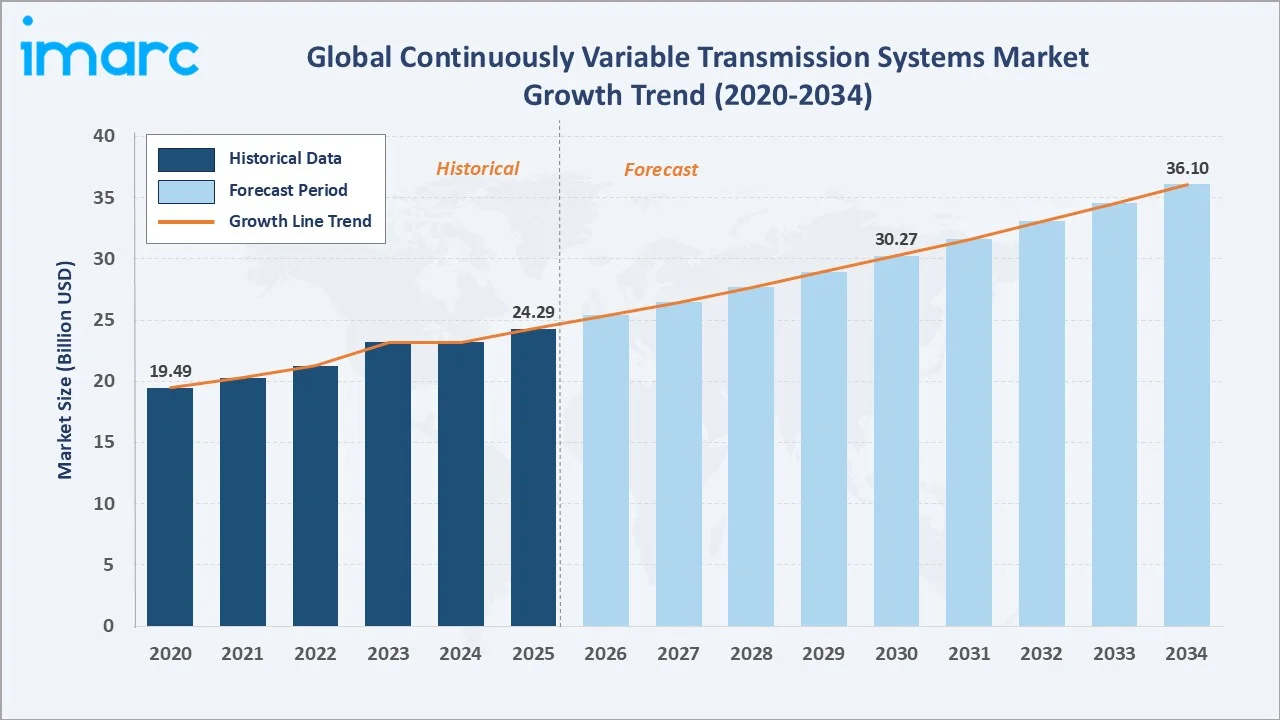
The continuously variable transmission systems market grew from USD 24.29 Billion in 2025 to USD 25.38 Billion in 2026 and is projected to reach USD 36.10 Billion by 2034, exhibiting a CAGR of 4.50% during 2026-2034. Tightening global fuel economy and emissions regulations are the primary regulatory forces accelerating continuously variable transmission adoption across passenger and light commercial vehicle segments.
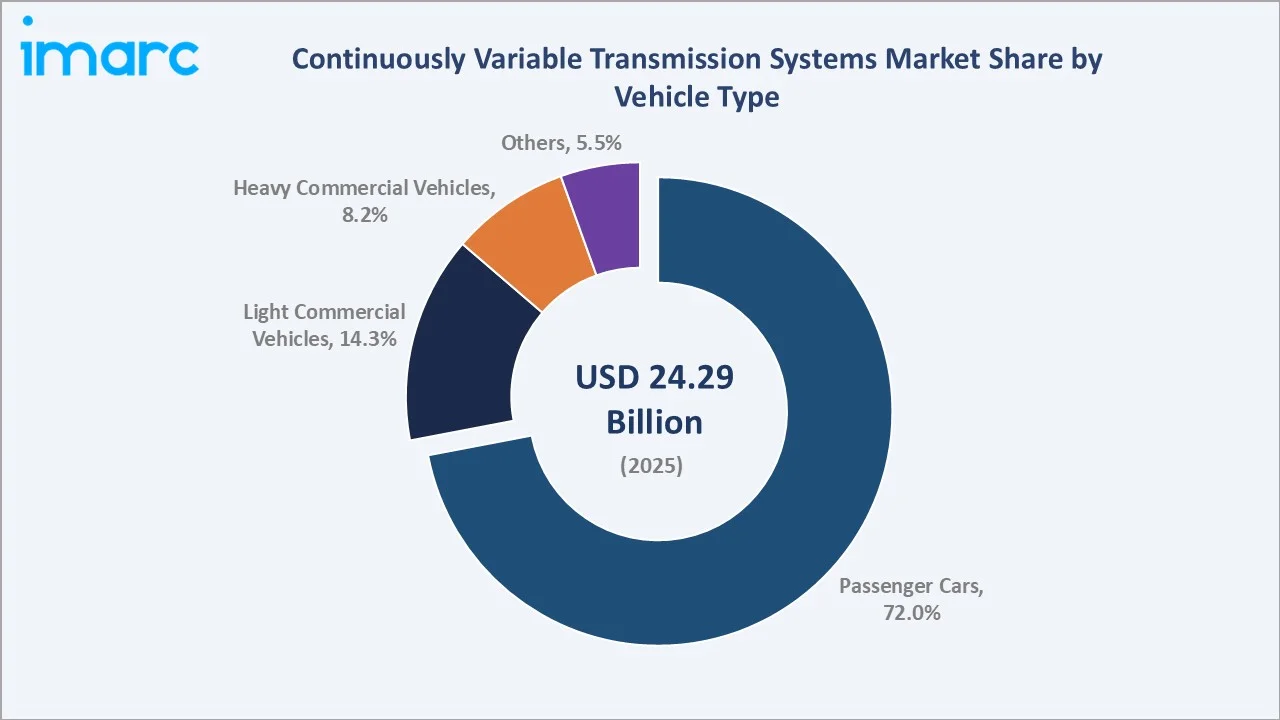
Passenger cars account for the largest vehicle-type share at 72.0%, gasoline prevails over the fuel segment with 60.0% share, and Asia-Pacific dominates at 58.0%.
Market Snapshot
|
Metric |
Value |
|
Base Year Market Size (2025) |
USD 24.29 Billion |
|
Market Size (2026) |
USD 25.38 Billion |
|
Forecast Market Size (2034) |
USD 36.10 Billion |
|
CAGR (2026-2034) |
4.50% |
|
Base Year |
2025 |
|
Historical Period |
2020-2025 |
|
Forecast Period |
2026-2034 |
|
Largest Region |
Asia-Pacific (58.0%, 2025) |
|
Second Largest Region |
North America (18.7%, 2025) |
|
Leading Vehicle Type |
Passenger Cars (72.0%, 2025) |
|
Leading Fuel Type |
Gasoline (60.0%, 2025) |
The continuously variable transmission systems market expanded from USD 19.49 Billion in 2020 to USD 24.29 Billion in 2025 and is estimated to reach USD 25.38 Billion in 2026. The market is further expected to grow to USD 30.27 Billion by 2030 and USD 36.10 Billion by 2034, underpinned by rising passenger car production volumes, OEM integration of continuously variable transmission systems in fuel-efficient platforms, and the growing adoption of hybrid drivetrains.
To get more information on this market, Request Sample
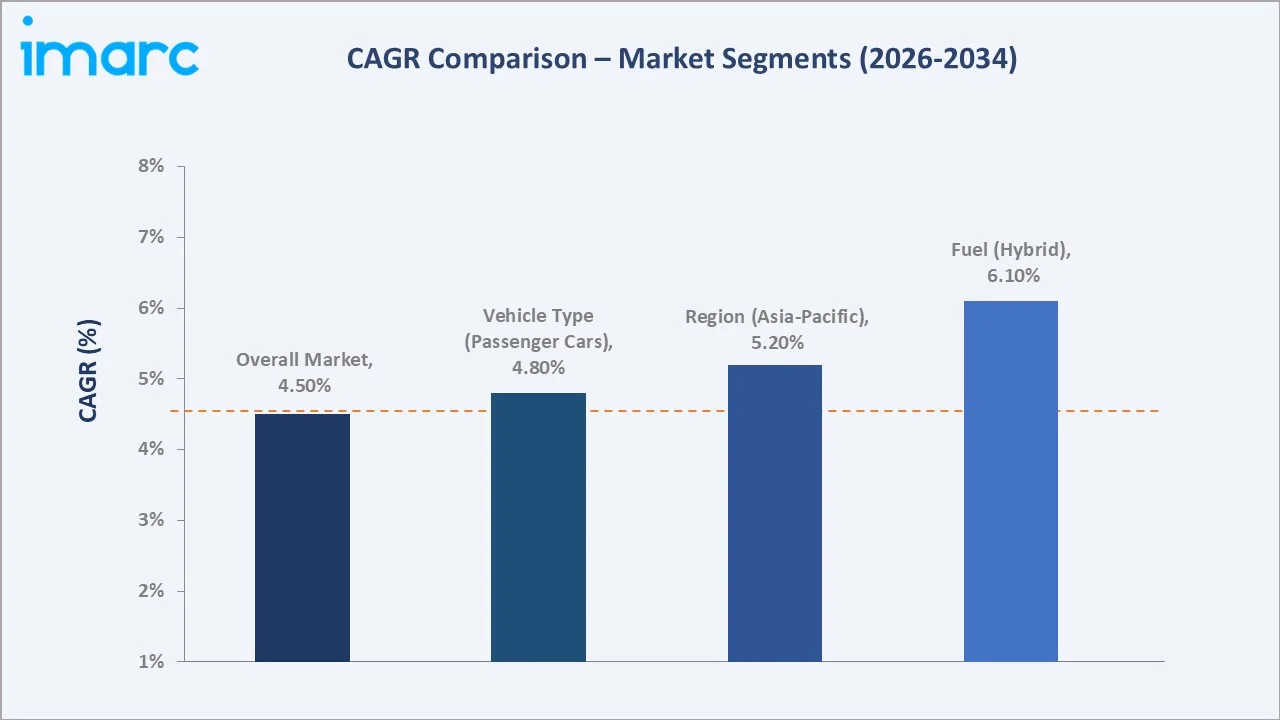
CAGR trajectories across vehicle type and fuel sub-segments, together with regional patterns, show hybrid and Asia-Pacific expanding faster than the overall 4.50% market CAGR, driven by rising hybrid platform integrations, OEM localization, and government incentive programs for low-emission vehicles.
Executive Summary
The continuously variable transmission systems market expanded from USD 24.29 Billion in 2025 to an estimated USD 25.38 Billion in 2026, reflecting consistent demand for fuel-efficient powertrain solutions across passenger and light commercial vehicle platforms. The industry has evolved from conventional stepped automatic platforms to advanced belt-and-pulley and chain-type continuously variable transmission architectures that deliver measurable improvements in fuel efficiency, torque delivery, and driving comfort.
Passenger cars represent 72.0% of vehicle type share in 2025, reflecting the deep integration of continuously variable transmission systems in small and mid-size sedans and crossovers. Gasoline commands 60.0% fuel share, supported by the strong presence of gasoline-powered vehicles across major passenger car segments. Asia-Pacific commands 58.0% of regional share, led by Japan, China, and India, where leading OEMs operate large-scale continuously variable transmission manufacturing and assembly operations.
Key Market Insights
|
Insight |
Data |
|
Leading Vehicle Type |
Passenger Cars – 72.0% share (2025) |
|
Second Largest Vehicle Type |
Light Commercial Vehicles – 14.3% share (2025) |
|
Leading Fuel |
Gasoline – 60.0% share (2025) |
|
Second Largest Fuel |
Hybrid – 25.7% share (2025) |
|
Leading Region |
Asia-Pacific – 58.0% share (2025) |
|
Second Largest Region |
North America – 18.7% share (2025) |
|
Top Companies |
JATCO Ltd., Aisin Corporation, Honda Motor Co., Ltd., Robert Bosch GmbH |
Key Analytical Observations Expanding On the Data Above:
- Passenger cars dominance at 72.0% is driven by deep OEM integration of continuously variable transmission systems in compact sedans, crossover utility vehicles, and subcompact platforms, where continuous ratio variation delivers measurable improvements in fuel efficiency and driving smoothness over conventional automatic transmissions.
- Light commercial vehicles share at 14.3% reflects growing adoption of continuously variable transmission systems in urban delivery vans and small utility vehicles, where stop-and-go operating cycles benefit from continuously variable ratio optimization.
- Gasoline leadership at 60.0% highlights the established base of internal combustion engine vehicles equipped with continuously variable transmission systems across passenger and commercial platforms globally.
- Hybrid at 25.7% represents the fastest-growing fuel category, as automakers integrate continuously variable transmission systems into hybrid electric platforms to optimize the interaction between electric motor and internal combustion engine power delivery.
- Asia-Pacific leadership at 58.0% is anchored by Japan and China, where major continuously variable transmission manufacturers operate large-scale production facilities serving both domestic OEM demand and global export markets.
Continuously Variable Transmission Systems Market Overview
Continuously variable transmission systems are a class of automotive transmission that provides a seamless range of effective gear ratios between a defined minimum and maximum, replacing discrete gear steps with a continuously adjustable ratio. They are deployed across passenger cars, light commercial vehicles, heavy commercial vehicles, and specialty equipment, delivering superior fuel economy, smoother acceleration, and reduced powertrain complexity relative to conventional stepped automatic transmissions.
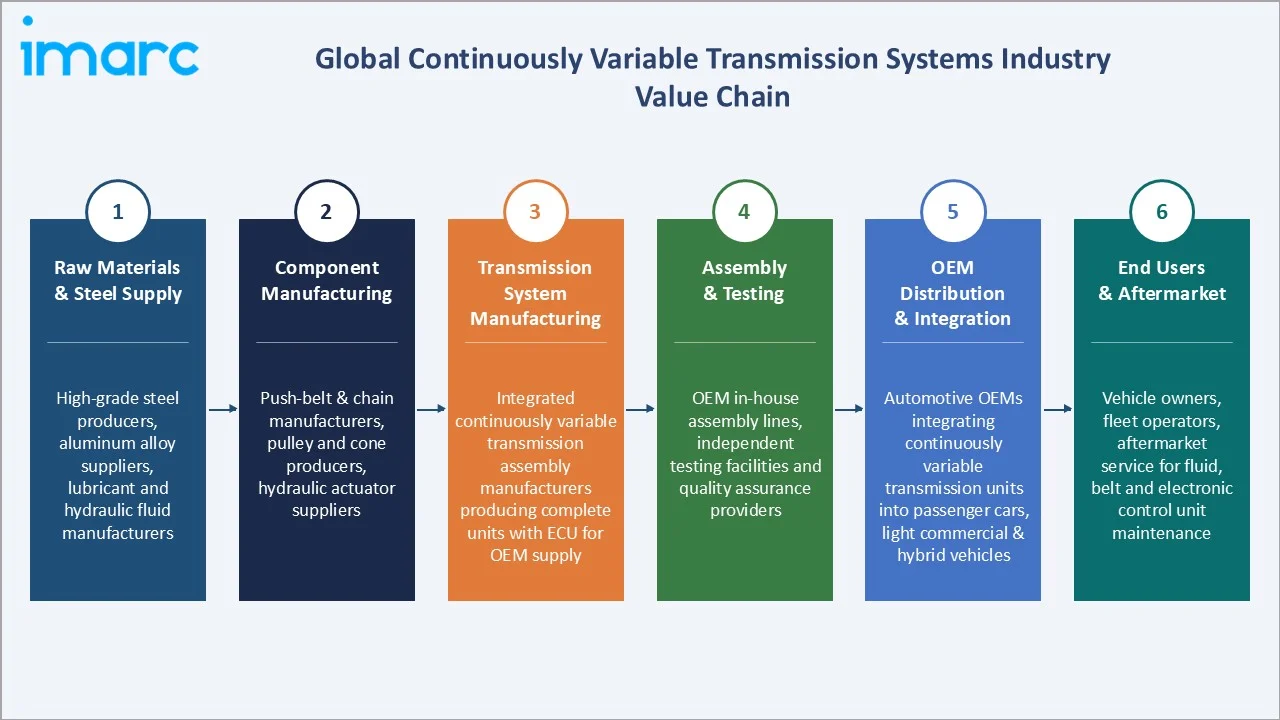
The continuously variable transmission systems industry ecosystem integrates raw material and component suppliers, transmission system manufacturers, tier-1 suppliers, OEM vehicle builders, distribution and aftermarket networks, and end users across individual, fleet, and commercial segments. Regulatory bodies, R&D institutions, and technology firms contribute to innovation across materials, electronic control systems, and electrified powertrain integration.
Market Dynamics
To evaluate market opportunities, Request Sample
Market Drivers
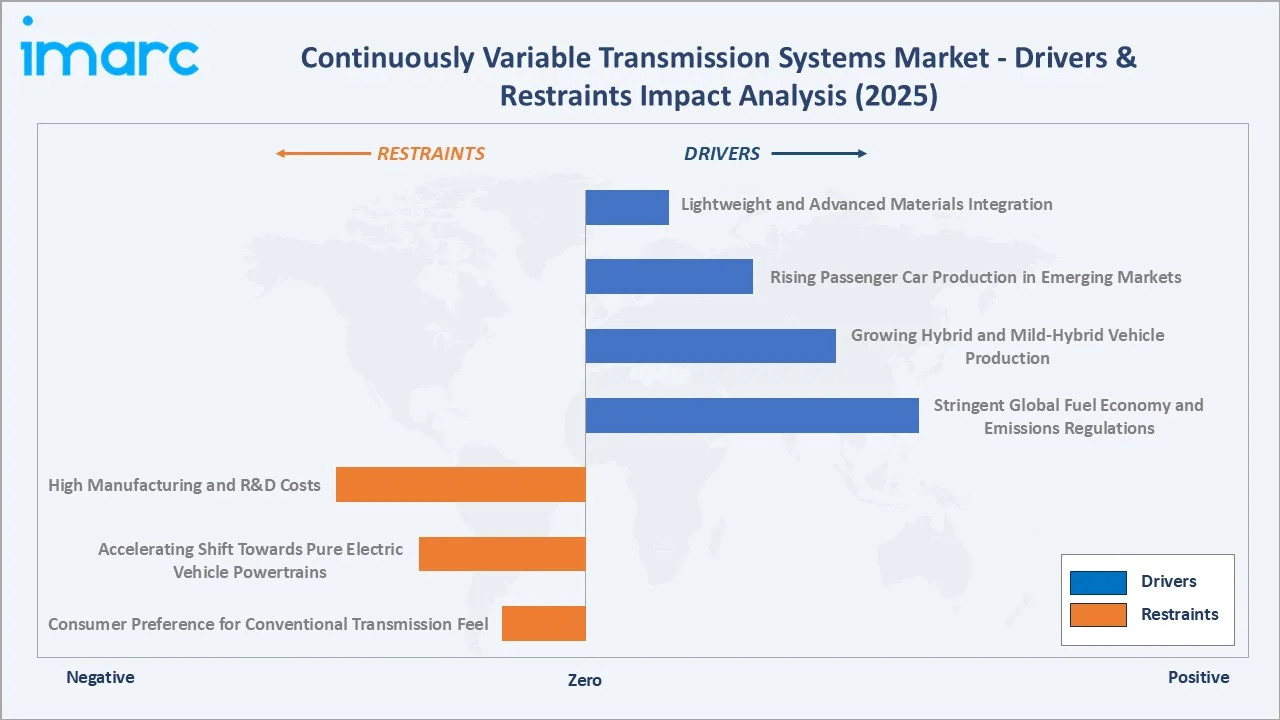
- Stringent Global Fuel Economy and Emissions Regulations: Government-mandated targets for vehicle fuel consumption and CO2 emissions across key markets including the United States, European Union, Japan, and China are incentivizing OEMs to adopt continuously variable transmission systems in passenger and light commercial vehicle platforms. Continuously variable transmissions enable higher engine efficiency and lower tailpipe emissions compared to conventional stepped transmissions.
- Growing Hybrid and Mild-Hybrid Vehicle Production: The global shift towards hybrid electric vehicle architectures is directly increasing continuously variable transmission demand, as automakers integrate continuously variable transmission systems with electric motors to optimize combined powertrain efficiency. As per IMARC Group, the global hybrid electric vehicle market size reached 16.27 Million Units in 2025.
- Rising Passenger Car Production in Emerging Markets: Accelerating vehicle ownership growth in India, Southeast Asia, and China is expanding the addressable market for continuously variable transmission-equipped entry-level and mid-segment passenger cars, where the technology's smooth ride quality and fuel efficiency represent key commercial advantages. India’s passenger vehicle sector saw robust performance in September 2026, with Vahan registrations totaling 4,20,359 units, a 31.8% increase from 3,18,907 units in September 2025.
- Lightweight and Advanced Materials Integration: Ongoing innovation in belt materials, pulley coatings, and electronic control systems is enabling continuously variable transmission manufacturers to reduce transmission weight, improve torque handling capacity, and extend service intervals, supporting OEM preferences for compact, high-efficiency powertrain architectures across the broader automotive transmission market.
Market Restraints
- High Manufacturing and R&D Costs: Continuously variable transmission system production involves precision-engineered components including steel push-belts, chain assemblies, and hydraulically controlled pulley systems that require significant capital investment. Rising raw material costs and engineering complexity limit adoption among cost-sensitive OEM segments.
- Accelerating Shift Towards Pure Electric Vehicle Powertrains: Growing OEM commitment to battery electric vehicles, which do not require multi-ratio transmissions, is reducing long-term demand growth potential for continuously variable transmission systems in markets with aggressive electrification timelines. The transition is most pronounced in Western Europe and China.
- Consumer Preference for Conventional Transmission Feel: A segment of consumers, particularly in North America and Europe, associates continuously variable transmission driving dynamics with an unfamiliar acceleration response compared to stepped automatic transmissions, creating adoption barriers in premium and performance vehicle categories.
Market Opportunities
- Hybrid and Mild-Hybrid Continuously Variable Transmission Integration: The rapid growth of hybrid electric vehicle production globally presents a structural opportunity for continuously variable transmission manufacturers to develop hybrid-optimized transmission systems that reduce fuel consumption while supporting electric motor torque integration.
- Expansion in Light Commercial Vehicles: Growing demand for urban delivery and last-mile logistics vehicles in densely populated emerging markets is creating new adoption pathways for continuously variable transmission systems in light commercial platforms, where continuous ratio adjustment improves fuel efficiency in stop-and-go operating conditions.
- Aftermarket and Service Market Growth: Expanding the installed base of continuously variable transmission-equipped vehicles globally is generating consistent aftermarket demand for transmission fluid, belt replacement, and control unit servicing, providing manufacturers with recurring revenue opportunities beyond initial OEM supply.
Market Challenges
- Electrification Disruption of Conventional Powertrain Demand: Accelerating battery electric vehicle adoption in major markets is compressing long-term demand projections for continuously variable transmission systems in markets with strong EV policy support, requiring manufacturers to diversify into hybrid-optimized and electrified continuously variable transmission architectures.
- Supply Chain Complexity and Component Sourcing: Continuously variable transmission systems depend on specialized components including precision-engineered push-belts, high-strength pulleys, and advanced electronic control units. Supply disruptions for raw materials such as high-grade steel and rare materials used in hydraulic fluid systems create production vulnerability.
Emerging Market Trends
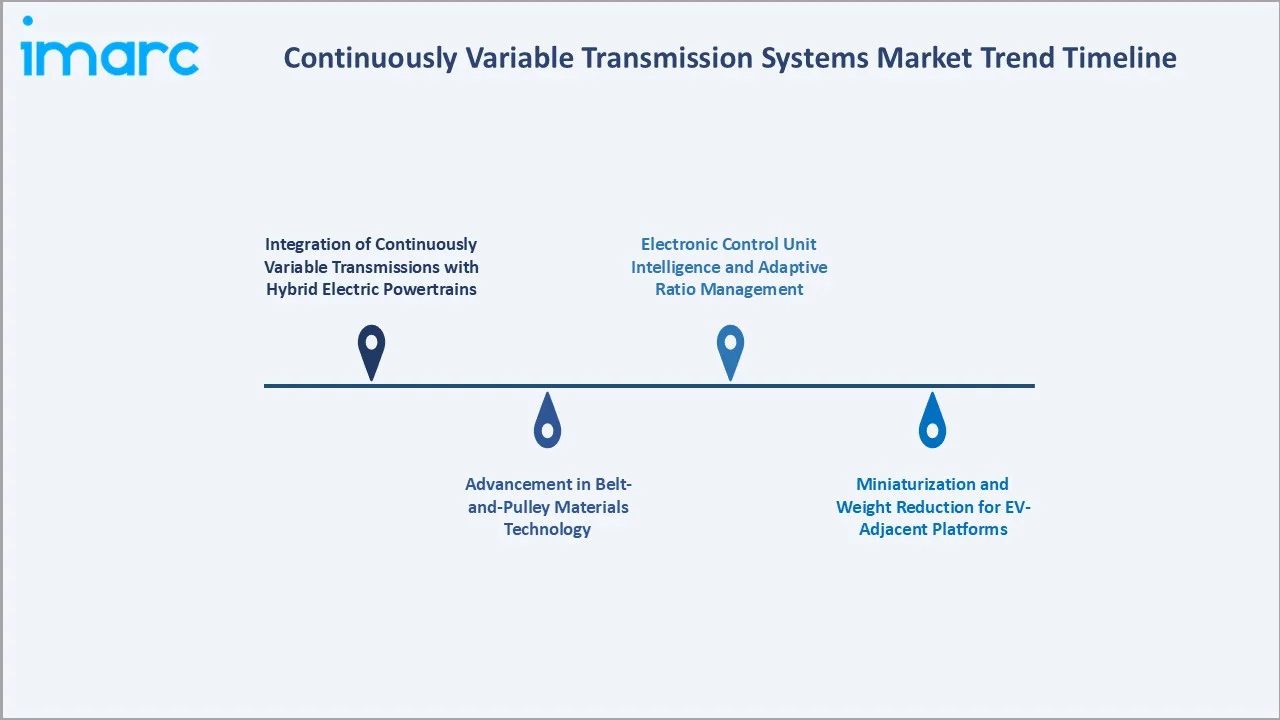
1. Integration of Continuously Variable Transmissions with Hybrid Electric Powertrains
OEMs are increasingly incorporating continuously variable transmission systems into parallel and series-parallel hybrid architectures, enabling continuous optimization of the engine and electric motor operating points. This integration reduces fuel consumption and improves acceleration response in stop-and-go urban driving cycles, making hybrid continuously variable transmission platforms a preferred powertrain solution for fuel economy compliance.
2. Advancement in Belt-and-Pulley Materials Technology
Manufacturers are investing in high-strength steel push-belts and advanced pulley coatings to increase continuously variable transmission torque capacity and reduce friction losses. Improved belt durability extends service intervals, reduces total cost of ownership, and expands continuously variable transmission applicability to higher-displacement engines across the commercial vehicle transmission market.
3. Electronic Control Unit Intelligence and Adaptive Ratio Management
Smart electronic control units with AI-assisted ratio management algorithms are being developed to dynamically optimize continuously variable transmission gear ratio based on real-time driving conditions, road gradient, and driver preference inputs. These intelligent control systems improve fuel economy, drivability, and transmission longevity across diverse operating environments.
4. Miniaturization and Weight Reduction for EV-Adjacent Platforms
Continuously variable transmission manufacturers are designing lighter, more compact transmission units using advanced alloys and optimized hydraulic architectures to meet the weight and packaging constraints of hybrid and mild-hybrid vehicle platforms. Reduced transmission weight contributes directly to overall vehicle fuel efficiency and supports OEM targets for lower fleet average emissions.
Industry Value Chain Analysis
The continuously variable transmission systems value chain spans six core stages, from raw material procurement through end-user operation and aftermarket servicing. Transmission manufacturing and OEM integration capture the highest value-add, while electronic control systems and advanced materials increasingly determine sustainable competitive positioning across the supply chain.
|
Stage |
Key Players / Examples |
|
Raw Materials & Steel Supply |
High-grade steel producers, aluminum alloy suppliers, specialty lubricant and hydraulic fluid manufacturers supplying transmission system inputs |
|
Component Manufacturing |
Push-belt and chain assembly manufacturers, pulley and cone component producers, hydraulic actuator and seal suppliers |
|
Transmission System Manufacturing |
Integrated continuously variable transmission assembly manufacturers producing complete transmission units for OEM supply, including electronic control unit integration |
|
Assembly & Testing |
OEM in-house assembly lines, independent transmission testing facilities, and quality assurance service providers |
|
OEM Distribution & Integration |
Automotive OEMs integrating continuously variable transmission units into passenger cars, light commercial vehicles, and hybrid platforms |
|
End Users & Aftermarket |
Individual vehicle owners, fleet operators, aftermarket service providers supplying transmission fluid, belt replacement, and electronic control unit maintenance |
Vertically integrated transmission manufacturers, particularly those owning proprietary belt-and-pulley technology, in-house electronic control unit development, and direct OEM supply relationships, are positioned to capture greater value than tier-1 suppliers reliant on third-party component sourcing. The aftermarket stage represents a growing value-capture opportunity as the installed base of continuously variable transmission-equipped vehicles expands globally.
Technology Landscape in the Continuously Variable Transmission Systems Industry
Belt-and-Pulley Technology Innovation
The belt-and-pulley architecture remains the most widely deployed continuously variable transmission configuration globally. Advances in steel push-belt manufacturing precision, belt element geometry, and pulley surface treatment are enabling higher torque transfer efficiency and extended service life. OEMs and transmission manufacturers are adopting belts with tighter element tolerances to reduce energy loss and expand continuously variable transmission applicability to larger-displacement engines.
Electrified and Hybrid-Compatible Transmission Platforms
Hybrid-optimized continuously variable transmission systems integrate dedicated electric motor interfaces and dual-input power management modules that allow seamless switching between combustion engine and electric motor driving modes. These electrified transmission platforms support OEM strategies for delivering strong fuel economy performance without transitioning to full battery electric architectures.
Electronic Control and Adaptive Ratio Management
Advanced electronic control unit platforms with real-time sensor integration enable adaptive continuously variable transmission ratio management that responds dynamically to vehicle speed, engine load, road conditions, and driver demand signals. Predictive control algorithms that incorporate navigation and terrain data are emerging as a differentiating capability among premium continuously variable transmission system suppliers.
Lightweight Materials and Compact Design
Integration of high-strength aluminum alloys, carbon-fiber reinforced components, and optimized hydraulic circuit architectures is reducing continuously variable transmission unit weight and packaging dimensions. Compact, lightweight transmission designs are critical enablers for hybrid vehicle OEM packaging requirements, particularly in small and mid-size passenger car platforms.
Market Segmentation Analysis
The report covers the following segments:
|
Segment Category |
Leading Segment |
Market Share |
Year |
|
Vehicle Type |
Passenger Cars |
72.0% |
2025 |
|
Type |
Variable Diameter |
65.0% |
2025 |
|
Fuel |
Gasoline |
60.0% |
2025 |
|
Capacity |
1.5 L to 3.0 L |
55.0% |
2025 |
|
End-User |
OEM |
88.0% |
2025 |
|
Region |
Asia-Pacific |
58.0% |
2025 |

By Vehicle Type
Passenger cars dominate vehicle type segmentation at 72.0% share in 2025, reflecting the deep integration of continuously variable transmission systems in compact, subcompact, and crossover platforms where continuous ratio adjustment provides fuel consumption and driving comfort advantages. The segment benefits from high global production volumes, strong OEM adoption in Japan, the United States, and China, and the alignment of continuously variable transmission efficiency advantages with the fuel economy profiles of small to mid-size passenger vehicles.
To access detailed market analysis, Request Sample
Light commercial vehicles hold 14.3% share in 2025, driven by growing deployment of continuously variable transmission systems in urban delivery vans and small utility vehicles.
By Fuel
Gasoline leads the fuel segmentation at 60.0% share in 2025, supported by the large installed base of internal combustion engine vehicles equipped with continuously variable transmission systems, particularly in Japan, China, and the United States. The gasoline segment benefits from long-standing OEM integration programs across compact and mid-size passenger car categories.
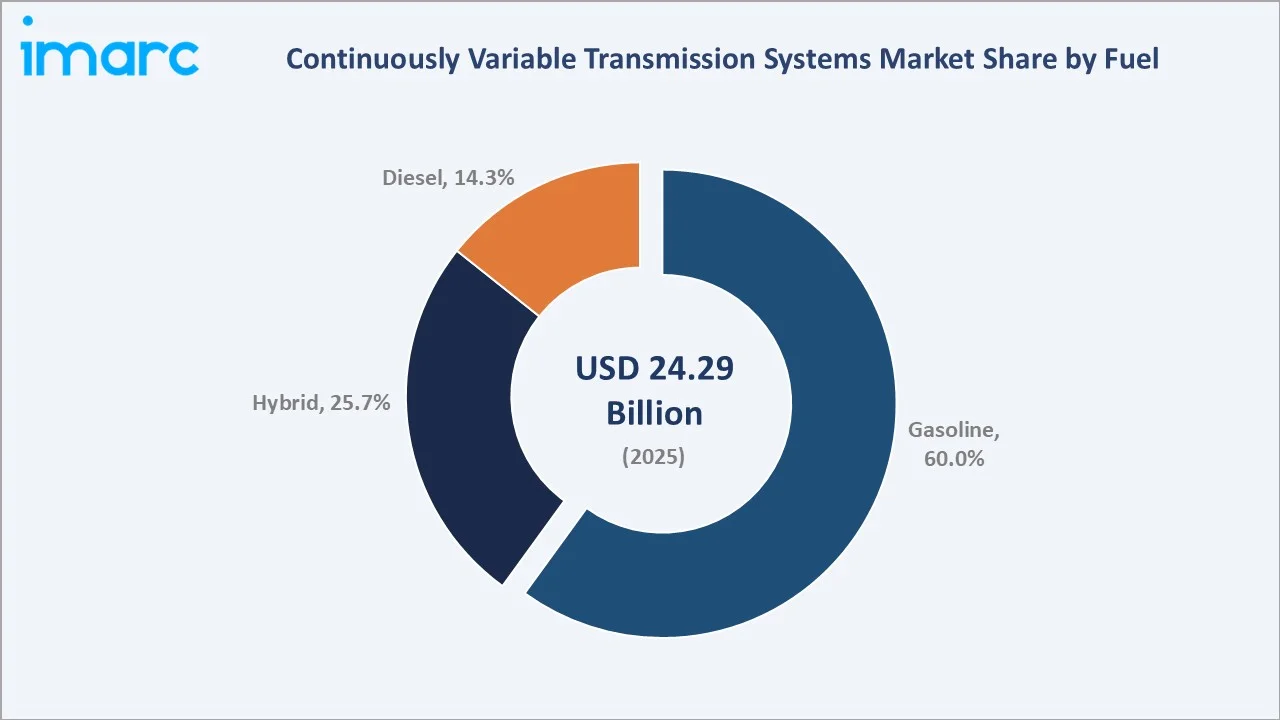
Hybrid commands 25.7% fuel segment share and represents the highest-growth sub-segment, as hybrid electric vehicle production scales across Asia-Pacific and North America.
Regional Market Insights
|
Region |
Share (2025) |
Key Growth Drivers |
|
Asia-Pacific |
58.0% |
Large-scale continuously variable transmission manufacturing in Japan and China, high passenger car production volumes, strong hybrid vehicle adoption, and rising vehicle ownership in India and Southeast Asia |
|
North America |
18.7% |
CAFE standards driving continuously variable transmission adoption, strong demand in compact and mid-size passenger car segments, and growing hybrid vehicle production among major automakers |
|
Europe |
14.2% |
Stringent CO2 emission targets, growing hybrid vehicle penetration, and continuously variable transmission adoption in fuel-efficient compact vehicle platforms |
|
Latin America |
5.4% |
Rising passenger car demand, growing domestic vehicle assembly operations, and increasing OEM introduction of continuously variable transmission-equipped models in key markets |
|
Middle East and Africa |
3.7% |
Expanding vehicle imports, growing preference for automatic transmissions, and rising urbanization supporting passenger vehicle demand |
Asia-Pacific at 58.0% in 2025 leads regional distribution, anchored by Japan's position as the global center for continuously variable transmission technology development and production. China's large domestic automobile market and growing hybrid vehicle production further support regional dominance.
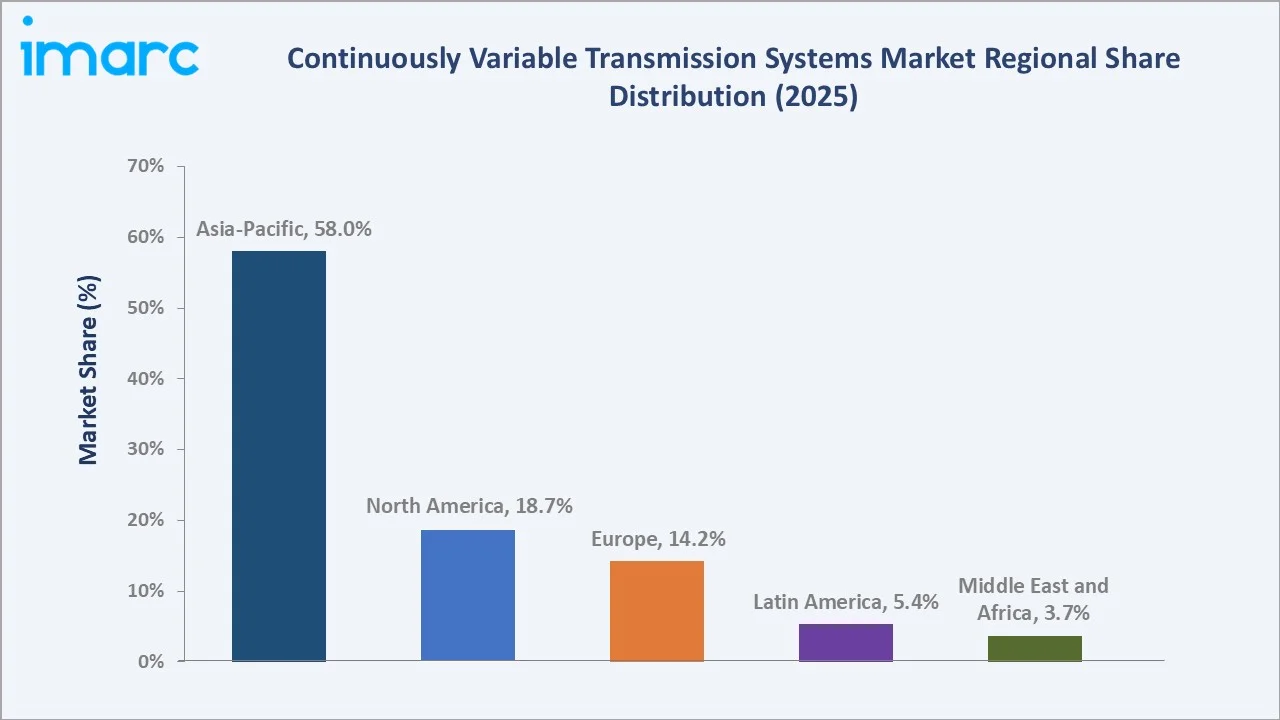
North America at 18.7% is driven by regulatory pressure from CAFE fuel economy standards and OEM adoption of continuously variable transmission systems in compact and subcompact vehicle platforms marketed across the United States.
Competitive Landscape
The continuously variable transmission systems market is moderately concentrated, with a small number of global transmission manufacturers and automotive technology companies holding leading positions in OEM supply contracts. Key competitive differentiators include transmission torque capacity, manufacturing scale, electronic control system capability, and hybrid-platform integration expertise.
|
Company Name |
Brand / Key Product |
Position |
Strategic Focus |
|
JATCO Ltd. |
JATCO CVT-X / CVT-XS |
Leader |
Expanding continuously variable transmission production capacity and strengthening hybrid transmission platform offerings for global OEM partners |
|
Aisin Corporation |
Aisin CVT / Hybrid Transmission |
Leader |
Advancing continuously variable transmission technology integration with Toyota hybrid platforms and expanding electrified transmission capabilities globally |
|
Honda Motor Co., Ltd. |
Honda CVT (Earth Dreams) |
Challenger |
Strengthening in-house continuously variable transmission manufacturing and advancing belt technology for improved fuel efficiency across vehicle platforms |
|
Robert Bosch GmbH |
Transmission Control Units |
Challenger |
Advancing electrified transmission control systems and expanding electronic transmission management solutions for hybrid platforms |
Key players include JATCO Ltd., Aisin Corporation, Honda Motor Co., Ltd., and Robert Bosch GmbH, among others.
Key Company Profiles
JATCO Ltd.
JATCO Ltd. is a Japanese automotive transmission manufacturer headquartered in Fuji City, Shizuoka, Japan, and is the world's leading dedicated continuously variable transmission manufacturer. The company supplies continuously variable transmission systems to major OEMs across passenger car and light commercial vehicle platforms.
- Product Portfolio: Comprehensive continuously variable transmission system range covering the CVT-X and CVT-XS series for front-wheel drive passenger cars and light commercial vehicles across multiple engine displacement classes, including hybrid-compatible configurations.
- Recent Developments: JATCO Ltd. continues to expand its continuously variable transmission product range and invest in next-generation transmission technologies, including electrified powertrain systems, to serve the evolving requirements of global OEM partners across key production markets.
- Strategic Focus: Scaling continuously variable transmission manufacturing capacity globally and deepening hybrid-compatible transmission development programs in collaboration with OEM partners to address growing demand for fuel-efficient powertrain platforms.
Aisin Corporation
Aisin Corporation is a Japanese automotive components manufacturer headquartered in Kariya, Aichi, Japan. It is a leading developer and producer of continuously variable transmission systems and hybrid transaxle units for global OEM partners, supplying transmission technologies across a wide range of passenger car and hybrid vehicle platforms.
- Product Portfolio: Continuously variable transmission systems and hybrid transmission solutions for vehicle platforms, including hybrid-compatible continuously variable transmission configurations and electrified drivetrain modules for partner OEMs across domestic and international markets.
- Recent Developments: Aisin Corporation continues to advance its electrified transmission and hybrid transaxle product lines, supporting OEM partners with next-generation powertrain solutions. The company is actively investing in expanding its global manufacturing capabilities and electrification-related transmission technologies.
- Strategic Focus: Integrating continuously variable transmission technology across hybrid vehicle platforms and growing electrified transaxle capabilities to serve expanding OEM demand for low-emission powertrain architectures worldwide.
Honda Motor Co., Ltd.
Honda Motor Co., Ltd. is a Japanese multinational automotive manufacturer headquartered in Tokyo, Japan. Honda is among the pioneering OEMs in in-house continuously variable transmission manufacturing, operating dedicated transmission production facilities and deploying its continuously variable transmission systems across multiple passenger car platforms globally.
- Product Portfolio: Honda CVT series including Earth Dreams CVT configurations deployed across compact, mid-size, and hybrid-compatible passenger car platforms, providing smooth and fuel-efficient power delivery for the firm's global vehicle line-up.
- Recent Developments: Honda Motor Co., Ltd. continues to advance its continuously variable transmission technology through ongoing investment in belt design, pulley efficiency, and electronic control integration, supporting the deployment of continuously variable transmission systems across an expanding range of domestic and international vehicle models.
- Strategic Focus: Developing advanced continuously variable transmission belt and pulley technologies to improve fuel economy performance and refining in-house manufacturing processes to strengthen transmission efficiency across Honda's global vehicle platforms.
Market Concentration Analysis
The continuously variable transmission systems market is moderately concentrated, with a limited number of established global manufacturers holding significant OEM supply relationships across the primary production geographies of Japan, the United States, Europe, and China. JATCO Ltd. and Aisin Corporation command leading positions in continuously variable transmission volume and technology breadth, with mid-tier players such as Honda Motor Co., Ltd. and Robert Bosch GmbH holding challenger positions in specific regional or application segments.
Barriers to entry are high, driven by the capital intensity of continuously variable transmission component manufacturing, the need for OEM qualification processes, and the engineering depth required to develop hybrid-compatible transmission systems. These structural factors favor established suppliers with proven track records in transmission performance, reliability, and global service infrastructure.
Consolidation activity is gradually increasing, with leading players acquiring niche transmission technology and electronic control system capabilities to strengthen product portfolios. Strategic partnerships between continuously variable transmission manufacturers, OEMs, and hybrid system integrators are further reshaping competitive dynamics, particularly as electrification-compatible transmission development becomes a key investment priority.
Investment & Growth Opportunities
Fastest-Growing Segments
Hybrid is expanding at the fastest rate within the fuel segment, driven by OEM acceleration of hybrid electric vehicle programs targeting regulatory compliance in the United States, Europe, and Japan. Continuously variable transmission manufacturers with hybrid-compatible transmission platforms are positioned to capture disproportionate growth as hybrid production volumes scale.
Emerging Markets
Asia-Pacific represents the most significant growth opportunity. Rising vehicle ownership rates, government incentives for fuel-efficient vehicles, and expanding domestic OEM assembly operations are supporting new continuously variable transmission demand.
Venture & Investment Trends
Investment activity is concentrated in hybrid continuously variable transmission development programs, electronic control system intelligence, and compact transmission design for hybrid platforms. Capital is also flowing into supply chain localization as OEMs and tier-1 suppliers seek to reduce transmission component sourcing dependency across single geographies. Battery electric vehicle adjacent technologies, including electrified continuously variable transmission platforms for hybrid applications, are attracting growing venture and corporate R&D investment.
Future Market Outlook (2026-2034)
The continuously variable transmission systems market is projected to grow from USD 24.29 Billion in 2025 to USD 25.38 Billion in 2026, reaching USD 36.10 Billion by 2034, registering a CAGR of 4.50% during 2026–2034. The market's anchor value of USD 30.27 Billion in 2030 reflects a structural mid-point as hybrid continuously variable transmission integration deepens across major OEM platforms and transmission adoption expands in light commercial vehicle segments globally.
Four forces will shape the market through 2034: accelerating hybrid continuously variable transmission integration as OEMs pursue fuel economy compliance; advancement in belt-and-pulley and chain-type transmission technology; expanding continuously variable transmission adoption in emerging Asian and Latin American markets; and growing investment in smart, electronically managed transmission ratio control systems.
By 2034, the continuously variable transmission market is expected to be defined by hybrid-optimized transmission platforms, with pure electric vehicle growth partially offsetting demand from conventional internal combustion engine vehicles. Manufacturers with diversified product portfolios spanning both hybrid continuously variable transmission and conventional continuously variable transmission applications are best positioned to sustain competitive advantage through the forecast period.
Research Methodology
Primary Research
Primary research included structured interviews with automotive transmission engineers, continuously variable transmission system procurement specialists at major OEMs, tier-1 automotive component suppliers, and industry trade association representatives. Primary findings validated market sizing, segment share distribution, competitive positioning, and regional demand patterns presented in this report.
Secondary Research
Secondary sources included publications from the Japan Automobile Manufacturers Association, International Energy Agency vehicle electrification reports, regulatory filings from the United States Environmental Protection Agency and the European Commission on vehicle emissions standards, and annual reports, investor presentations, and press releases from leading continuously variable transmission manufacturers and OEMs.
Forecasting Models
Market forecasts were developed using a combination of top-down and bottom-up modelling approaches incorporating vehicle production volume projections by region, continuously variable transmission penetration rate estimates by vehicle type and fuel category, raw material cost trend analysis, and scenario modelling for regulatory and electrification impacts.
Report Coverage:
| Report Features | Details |
|---|---|
| Base Year of the Analysis | 2025 |
| Historical Period | 2020-2025 |
| Forecast Period | 2026-2034 |
| Units | Billion USD |
| Scope of the Report | Exploration of Historical Trends and Market Outlook, Industry Catalysts and Challenges, Segment-Wise Historical and Future Market Assessment:
|
| Vehicle Types Covered | Passenger Cars, Light Commercial Vehicles, Heavy Commercial Vehicles, Others |
| Types Covered | Hydrostatic, Toroidal, Cone, Variable Geometry, Variable Diameter, Others |
| Fuels Covered | Gasoline, Diesel, Hybrid |
| Capacities Covered | Upto 1.5 L, 1.5 L to 3.0 L, Above 3.0 L |
| End-Users Covered | OEM, Aftermarket |
| Regions Covered | Asia Pacific, Europe, North America, Latin America, Middle East and Africa |
| Companies Covered | JATCO Ltd., Aisin Corporation, Honda Motor Co., Ltd., Robert Bosch GmbH, etc. |
| Customization Scope | 10% Free Customization |
| Post-Sale Analyst Support | 10-12 Weeks |
| Delivery Format | PDF and Excel through Email (We can also provide the editable version of the report in PPT/Word format on special request) |
Frequently Asked Questions About the Continuously Variable Transmission Systems Market Report
The continuously variable transmission systems market size is estimated at USD 25.38 Billion in 2026, driven by rising passenger car production, hybrid vehicle adoption, and tightening global fuel economy regulations.
The market is projected to grow at a CAGR of 4.50% from 2026-2034, reaching USD 36.10 Billion, supported by hybrid continuously variable transmission integration, light commercial vehicle adoption, and technology advancement in belt-and-pulley systems.
Passenger cars lead the vehicle type segment with the largest share at 72.0% in 2025, driven by widespread OEM integration of continuously variable transmission systems in compact, subcompact, and crossover vehicles across major production markets globally.
Gasoline holds the largest fuel-type share at 60.0% in 2025, supported by the large installed base of internal combustion engine vehicles equipped with continuously variable transmission systems across passenger and light commercial platforms globally.
Asia-Pacific commands 58.0% share in 2025, led by Japan and China, where the world's leading continuously variable transmission manufacturers operate large-scale production facilities and serve major domestic and export OEM demand.
Leading players include JATCO Ltd., Aisin Corporation, Honda Motor Co., Ltd., and Robert Bosch GmbH, among others.
Growing hybrid vehicle production is expanding demand for hybrid-compatible continuously variable transmission systems, as automakers integrate transmission technology with electric motor powertrains to optimize fuel efficiency and regulatory compliance.
Key drivers include stringent fuel economy regulations, rising passenger car production in emerging markets, increasing hybrid vehicle adoption, and advancement in belt-and-pulley materials and electronic control technologies.
High manufacturing costs, the accelerating shift to battery electric vehicles, and consumer perception challenges related to continuously variable transmission driving dynamics represent the primary restraints on market growth through 2034.
Need more help?
- Speak to our experienced analysts for insights on the current market scenarios.
- Include additional segments and countries to customize the report as per your requirement.
- Gain an unparalleled competitive advantage in your domain by understanding how to utilize the report and positively impacting your operations and revenue.
- For further assistance, please connect with our analysts.
 Request Customization
 Speak to an Analyst
 Request Brochure
 Inquire Before Buying
Benefits of Customization
- Personalize this research
- Triangulate with your data
- Get data as per your format and definition
- Gain a deeper dive into a specific application, geography, customer, or competitor
- Any level of personalization
Get in Touch With Us
UNITED STATES
Phone: +1-201-971-6302
INDIA
Phone: +91-120-433-0800
UNITED KINGDOM
Phone: +44-753-714-6104
Email: [email protected]
Client Testimonials























Related Reports

Choose your plan
*Please note that the prices mentioned below are starting prices for each bundle type. Kindly contact our team for further details.*
Single User License
- 1 User License, Access on 2 Devices
- PDF Report + Excel Dataset (Password Protected)
- Lifetime Access
- No Printing Rights
- 10% Free Report Customization
- 10–12 Weeks of Analyst Support
Five User License
- Access for 5 Users, 2 Devices per User
- PDF Report + Excel Dataset (Password Protected)
- Lifetime Access
- Dedicated Account Manager
- 12–14 Weeks of Analyst Support
- No Printing Rights
- 15% Free Report Customization
- 25% Discount on Your Next Purchase
Corporate User License
- Unlimited User Access (Within Your Organization)
- PDF Report + Excel Dataset
- Lifetime Access
- Dedicated Account Manager
- 14–20 Weeks of Analyst Support
- No Printing Rights
- 20% Free Report Customization
- 30% Discount on Your Next Purchase
Essential Insights
What's included:
3 reports
- Lifetime Access
- PDF Reports
- Excel Datasets
- 2 Weeks of Free Analyst Support
- 2 User Licenses
- Access on 2 Devices
- Printing Rights
- Complimentary PowerPoint (PPT) Version
- Complimentary License Upgrade
Professional Access
What's included:
5 reports
- Lifetime Access
- PDF Reports
- Excel Datasets
- 8 Weeks of Free Analyst Support
- 2 User Licenses
- Access on 2 Devices
- Printing Rights
- Complimentary PowerPoint (PPT) Version
- Complimentary License Upgrade
Business Advantage
What's included:
8 reports
- Lifetime Access
- PDF Reports
- Excel Datasets
- 14 Weeks of Free Analyst Support
- 2 User Licenses
- Access on 2 Devices
- Printing Rights
- Complimentary PowerPoint (PPT) Version
- Complimentary License Upgrade
Enterprise Intelligence
What's included:
10 reports
- Lifetime Access
- PDF Reports
- Excel Datasets
- 20 Weeks of Free Analyst Support
- 2 User Licenses
- Access on 2 Devices
- Printing Rights
- Complimentary PowerPoint (PPT) Version
- Complimentary License Upgrade