
Crowdfunding Market Size, Share, Trends and Forecast by Type, End Use, and Region, 2026-2034
Crowdfunding Market Size, Share, Trends & Forecast (2026-2034)
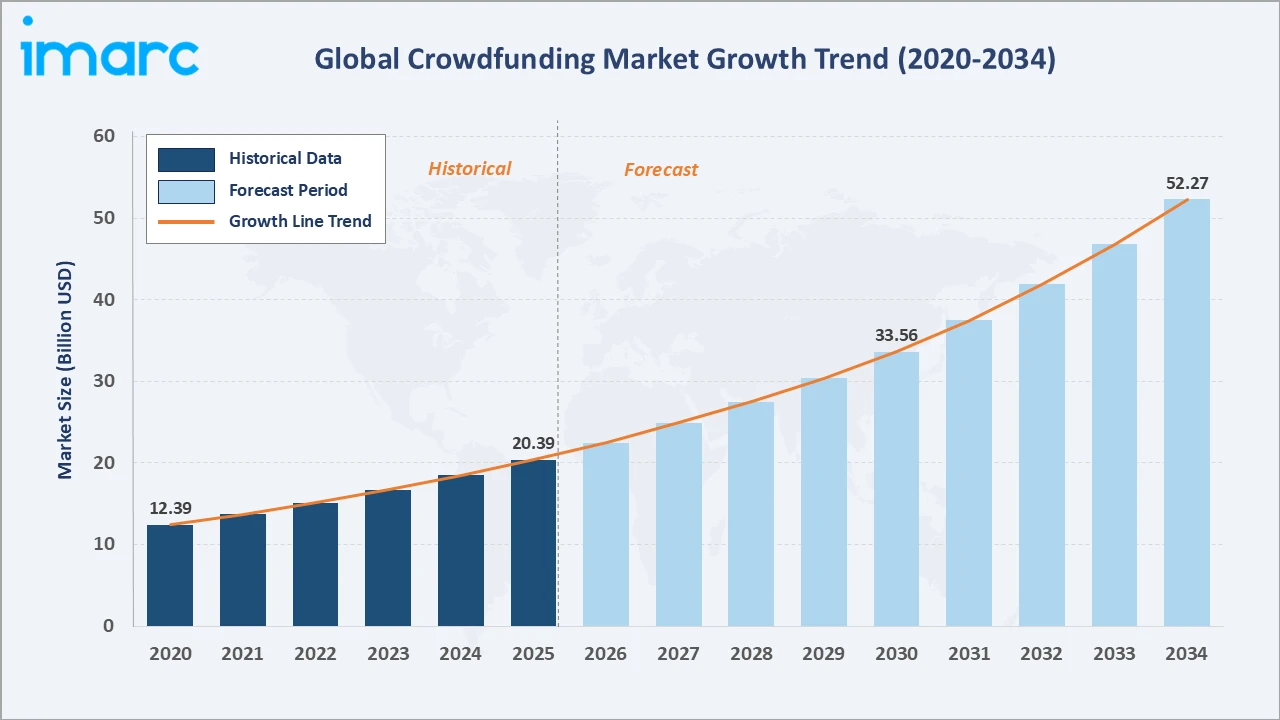
The global crowdfunding market reached USD 20.39 Billion in 2025 and is projected to reach USD 52.27 Billion by 2034, exhibiting a CAGR of 10.47% during 2026-2034. Growing availability of regulated crowdfunding platforms, rising SME financing needs, increasing retail investor participation, supportive government regulations, and the digitalization of investment services are key factors driving the market. Across the EU, 181 authorized crowdfunding service providers collectively raised more than EUR 4 Billion in 2024 across 21 Member States. Loan-based campaigns accounted for the largest share of funding (58%), followed by debt-based (23%) and equity-based (12%) financing. This expanding network of regulated platforms is improving investor confidence, broadening access to capital for startups and SMEs, and increasing participation from both retail and institutional investors. P2P lending leads the type at 37.6%, entrepreneurship dominates end use at 28.5%, and Europe accounts for the largest regional share at 31.4%.
Market Snapshot
|
Metric |
Value |
|
Market Size (2025) |
USD 20.39 Billion |
|
Forecast Market Size (2034) |
USD 52.27 Billion |
|
CAGR (2026-2034) |
10.47% |
|
Base Year |
2025 |
|
Historical Period |
2020-2025 |
|
Forecast Period |
2026-2034 |
|
Dominant Type |
P2P Lending (37.6%, 2025) |
|
Dominant End Use |
Entrepreneurship (28.5%, 2025) |
|
Leading Region |
Europe (31.4%, 2025) |
The global crowdfunding market grew from USD 12.39 Billion in 2020 to USD 20.39 Billion in 2025, driven by COVID-19 accelerating digital financial adoption, regulatory frameworks expanding retail investor access, and platform technology improvements reducing transaction friction. The market is projected to reach USD 33.56 Billion by 2030 and USD 52.27 Billion by 2034.
To get more information on this market, Request Sample
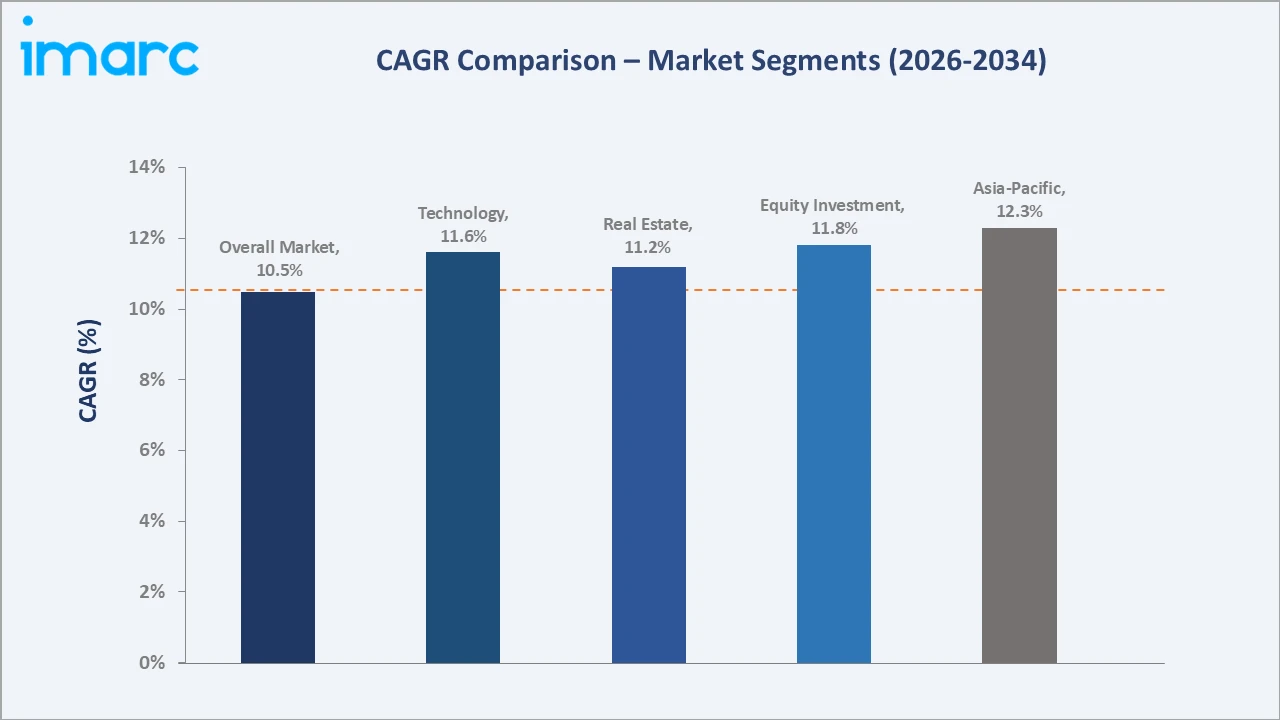
Equity investment type grows at ~11.8% CAGR. Technology end use grows at ~11.6% CAGR as AI, climate-tech, and deep-tech startups increasingly use equity crowdfunding for early validation alongside venture capital. Asia-Pacific leads at ~12.3% CAGR as India and Southeast Asian fintech markets rapidly develop regulated crowdfunding infrastructure.
Executive Summary
The global crowdfunding market has evolved from a niche web-based fundraising curiosity into a mainstream alternative finance ecosystem that collectively directs toward startups, creative projects, real estate, and social causes that the traditional financial system underserves. The market's structural growth narrative is underpinned by both demand-side and supply-side forces that reinforce each other: on the demand side, small businesses globally face persistent financing gaps that traditional banks cannot fill due to risk aversion, collateral requirements, and compliance costs; on the supply side, millions of retail investors seek yield and impact opportunities beyond conventional equities and bonds, and the digital-native generation of consumers extends financial participation to a wide range of affinity-driven investments. Market value stood at USD 20.39 Billion in 2025 and is forecast to reach USD 52.27 Billion by 2034.
P2P lending leads at 37.6% (2025), representing the market's largest and most financially substantial type, where individuals lend to borrowers (individuals or businesses) through online platforms that match lenders and borrowers algorithmically, collect interest payments, and manage default risk through credit scoring and portfolio diversification. Entrepreneurship dominates end use at 28.5% (2025), reflecting crowdfunding's original and most culturally resonant application, enabling founders and startups to raise initial capital, validate market demand, and build customer communities simultaneously through reward-based, equity, or debt campaigns. Europe commands 31.4% (2025) as the market's largest region by volume, reflecting the combined depth of the UK, Germany, France, and the progressive harmonization of the European crowdfunding regulatory framework.
Key Market Insights
|
Insight |
Data |
|
Dominant Type |
P2P Lending - 37.6% share (2025) |
|
Dominant End Use |
Entrepreneurship - 28.5% share (2025) |
|
Leading Region |
Europe - 31.4% share (2025) |
|
Market Opportunity |
Real estate tokenization; climate-tech equity CF; P2P lending in emerging markets; creator economy subscription models |
Key Analytical Observations Supporting the Above Data:
- P2P Lending at 37.6% (2025): Peer-to-peer lending platforms represent the crowdfunding market's largest segment by transaction volume because each loan facility involves periodic principal and interest payments that generate recurring transaction activity well beyond the initial funding event.
- Entrepreneurship at 28.5% (2025): The entrepreneurship category encompasses startup and early-stage business fundraising across all crowdfunding types, from reward-based product launches to equity raises, to SME P2P loans. Entrepreneurship crowdfunding serves the financing gap between friends-and-family seed capital and formal venture capital, enabling non-profit structured business fundraising alongside personal campaigns.
- Europe at 31.4% share (2025): Europe leads regionally due to its well-established regulatory framework, large network of authorized platforms, strong investor participation, and growing use of crowdfunding by startups and SMEs.
Crowdfunding Market Overview
The global crowdfunding market encompasses online platforms that facilitate the pooling of financial contributions from large numbers of individuals or organizations to fund specific campaigns, projects, businesses, or causes. Crowdfunding differs from traditional financing by democratizing capital access, enabling anyone with internet access to either seek funding or provide funding, removing the institutional gatekeepers that have historically controlled access to financial capital. The market operates across four primary models: reward-based (non-financial returns to backers), equity-based (ownership stakes in funded companies), debt/P2P lending (interest-bearing loans between individuals or SMEs and investors), and donation-based (philanthropic contributions without financial return). Hybrid models combining elements across these types are increasingly common as platforms seek to offer comprehensive financial service suites rather than single-model specialization. Macroeconomic factors include rising entrepreneurial activity, increasing demand for alternative financing amid tighter bank lending, and ongoing digital transformation in financial services.
Market Dynamics
To evaluate market opportunities, Request Sample
Market Drivers
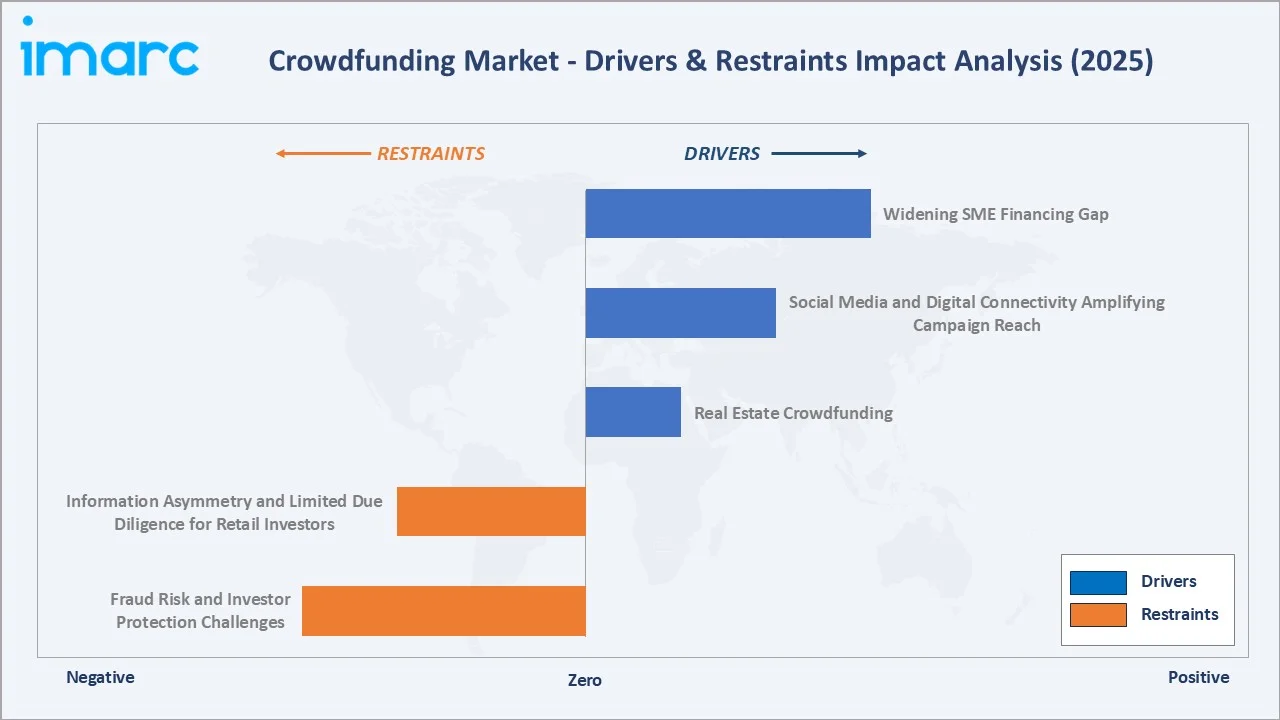
- Widening SME Financing Gap: Without significant reforms to the global financial system, the financing gap is projected to reach US$6.4 trillion by 2030, representing the fundamental structural demand for crowdfunding as a financing mechanism. Traditional banks' post-financial-crisis risk models, capital adequacy requirements, and credit scoring systems systematically underserve early-stage companies and individuals lacking collateral or credit history. Crowdfunding platforms address this gap by using community validation, social proof, and project-specific merit assessment to allocate capital where institutional risk models would deny it, creating financing access that enables economic activity otherwise foregone.
- Social Media and Digital Connectivity Amplifying Campaign Reach: Crowdfunding campaigns are intrinsically social phenomena with social media and digital platforms providing crowdfunding campaign creators with unprecedented organic marketing channels that were simply unavailable to fundraisers a decade ago. In June 2026, Farm to Pet initiated its first Regulation Crowdfunding campaign through StartEngine.com. After achieving profitability in 2026, Farm to Pet intends to use the proceeds to increase production capacity, broaden distribution, reach more consumers, and strengthen its operational capabilities. AI-powered campaign promotion tools optimize campaign messaging, donor targeting, and promotion timing to maximize the probability of social amplification.
- Real Estate Crowdfunding: Real estate crowdfunding has become the market's fastest growing subsegment within equity and debt types, driven by strong returns relative to public market alternatives, portfolio diversification benefits, and technology platforms making fractional real estate investment accessible with minimum investments versus traditional private real estate investment thresholds. In June 2026, Blue Mahoe Capital Caribbean Inc. launched an equity crowdfunding campaign aimed at providing retail investors and members of the Caribbean diaspora with regulated access to regional housing investments. The offering is hosted on the regulated Silicon Prairie platform, where shares are available at USD 10 each with a minimum investment of USD 100.
Market Restraints
- Fraud Risk and Investor Protection Challenges: Crowdfunding markets face persistent fraud challenges from campaign creators misrepresenting products or financial projections to P2P lending platforms that collapse with investor losses. These fraud events damage market trust broadly, reducing investor participation and forcing platform compliance costs to maintain investor confidence.
- Information Asymmetry and Limited Due Diligence for Retail Investors: Crowdfunding's democratization of investing creates an information asymmetry challenge: campaign creators know far more about their business prospects than retail investors who may invest in equity crowdfunding campaigns without access to the due diligence resources that venture capital investors deploy when evaluating comparable opportunities. This asymmetry is partly mitigated by regulatory disclosure requirements and platform review processes but fundamentally persists in reward-based campaigns and P2P lending.
Market Opportunities
- Blockchain Tokenization Enabling Secondary Market Liquidity: The tokenization of crowdfunding investments on blockchain networks has the potential to address crowdfunding's most persistent limitation: illiquidity. Current equity crowdfunding investments are typically locked without secondary market access, limiting their appeal to investors requiring capital access flexibility.
- AI-Powered Consumer Electronics Crowdfunding: In July 2026, TOZO launched a Kickstarter crowdfunding campaign for its new AIVU AI Glasses, an AI-enabled smart eyewear product designed to combine advanced technology with everyday usability. The glasses emphasize comfort, safety, style, privacy, and a user-focused approach to wearable computing. As demand for innovative AI devices increases, crowdfunding enables companies to validate products, build early adopter communities, and secure pre-launch funding while accelerating commercialization.
Market Challenges
- Platform Sustainability and Revenue Model Pressure: Many crowdfunding platforms face sustainable revenue model challenges, particularly reward-based platforms that typically charge successfully raised funds, generating revenue only on successful campaigns while bearing operating costs across all campaigns. Platform consolidation reflects the industry recognition that scale is necessary for profitability in a market where technology costs, compliance expenses, and marketing investment are substantial fixed costs.
- Regulatory Complexity Across Jurisdictions: Crowdfunding platforms operating globally face a fragmented patchwork of national regulatory requirements that adds compliance complexity and limits cross-border campaign accessibility. This regulatory fragmentation constrains the network effects that would otherwise make global crowdfunding platforms dramatically more valuable to both campaign creators and investors.
Emerging Market Trends
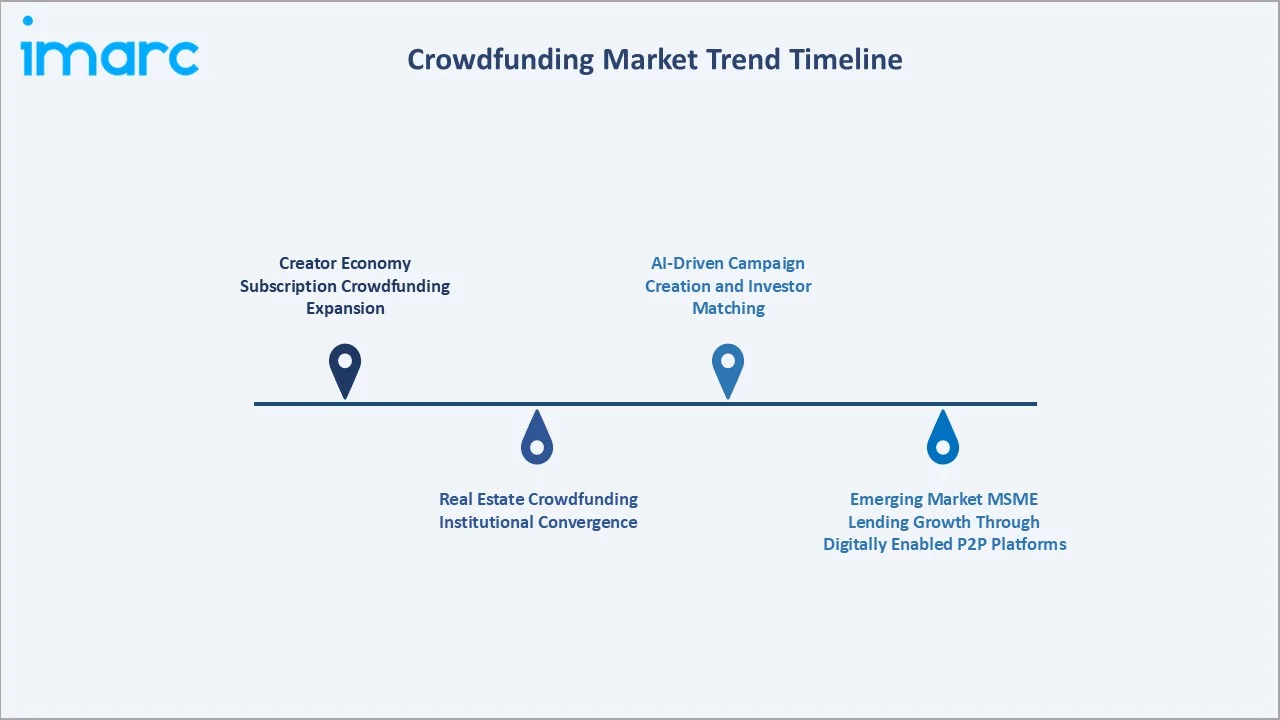
1. Creator Economy Subscription Crowdfunding Expansion
In December 2025, BackerKit introduced a new Patreon integration that enables creators to convert their existing subscriber communities into crowdfunding backers. The integration simplifies campaign launches by allowing Patreon creators to offer exclusive rewards and customized pledge levels, helping them unlock an additional revenue stream. This subscription-based model differs fundamentally from campaign-based crowdfunding by generating recurring, predictable revenue streams rather than one-time campaign proceeds, making it the crowdfunding mechanism most analogous to traditional media subscription businesses.
2. Real Estate Crowdfunding Institutional Convergence
Real estate crowdfunding platforms are converging toward institutional-grade alternative investment structures that happen to accept retail investors rather than purpose-built retail investment platforms that happen to invest in real estate. This institutionalization enables larger asset acquisitions, more sophisticated risk management, and improved investor transparency, but raises questions about whether the community and democratization ethos of crowdfunding is preserved when platforms begin resembling asset managers.
3. AI-Driven Campaign Creation and Investor Matching
Platform AI capabilities are transforming both the campaign creation experience and the investor matching experience. In December 2024, SOUP, an AI-powered social collaboration platform, launched a crowdfunding campaign on Wefunder. The platform aims to reduce information overload, toxic interactions, and inefficient communication by creating focused spaces for meaningful discussions, faster consensus building, and actionable insights. Its iOS beta has already shown potential in improving brainstorming, feedback collection, and sentiment analysis.
4. Emerging Market MSME Lending Growth Through Digitally Enabled P2P Platforms
P2P lending platforms serving micro, small, and medium enterprises in emerging markets are growing rapidly as digital banking infrastructure and mobile money penetration create the payment rails needed for efficient P2P loan origination, disbursement, and collection. These emerging market platforms serve borrowers who are formally employed or operating established businesses but lack the credit history documentation required by formal banking systems, using alternative data to underwrite creditworthy borrowers systematically excluded from formal credit markets. The combination of high borrower demand, strong credit performance, and attractive returns for lenders makes emerging market P2P lending the highest-growth component of the global crowdfunding market.
Industry Value Chain Analysis
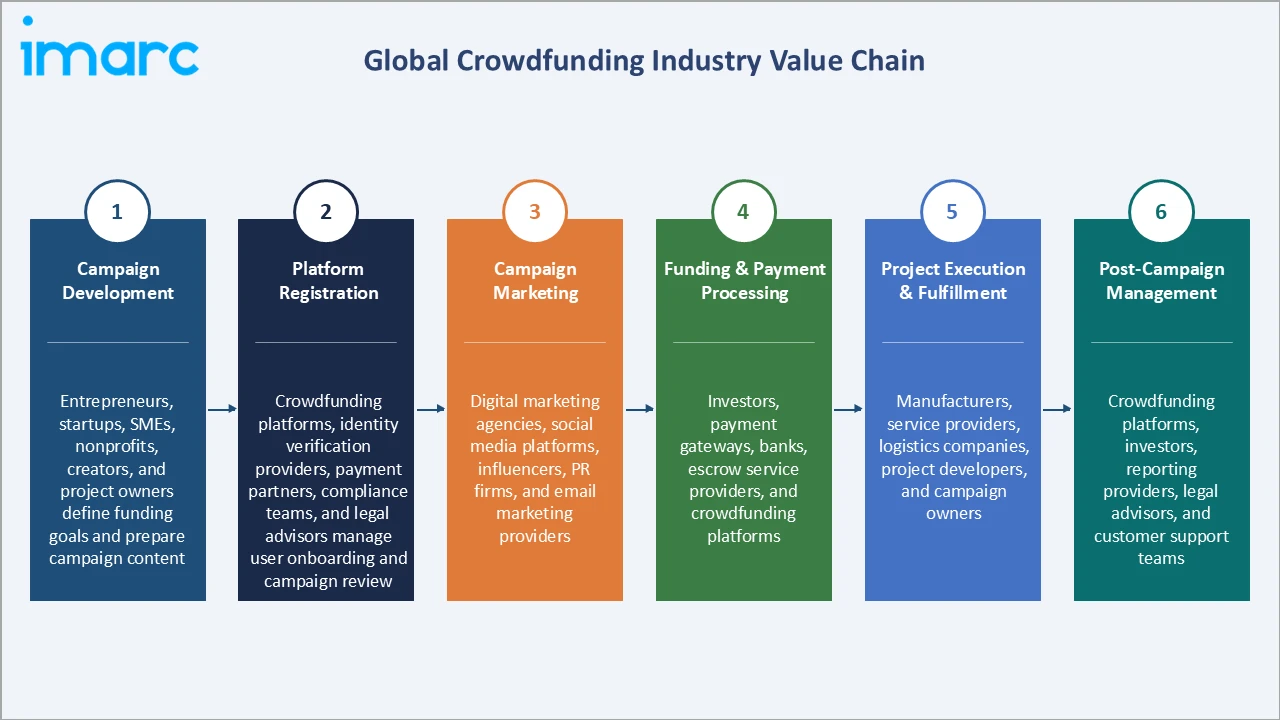
The crowdfunding market value chain integrates campaign development, platform registration, campaign marketing, funding and payment processing, project execution and fulfillment, and post-campaign management.
|
Stage |
Key Participants |
|
Campaign Development |
Entrepreneurs, startups, SMEs, nonprofits, creators, and project owners define funding goals and prepare campaign content. |
|
Platform Registration |
Crowdfunding platforms, identity verification providers, payment partners, compliance teams, and legal advisors manage user onboarding and campaign review. |
|
Campaign Marketing |
Digital marketing agencies, social media platforms, influencers, PR firms, and email marketing providers. |
|
Funding and Payment Processing |
Investors, payment gateways, banks, escrow service providers, and crowdfunding platforms. |
|
Project Execution and Fulfillment |
Manufacturers, service providers, logistics companies, project developers, and campaign owners. |
|
Post-Campaign Management |
Crowdfunding platforms, investors, reporting providers, legal advisors, and customer support teams. |
Campaign marketing is the most value-added stage in the crowdfunding value chain, as campaign visibility, investor engagement, and conversion rates largely determine fundraising success. Effective digital marketing, social media promotion, and community building significantly increase funding outcomes and long-term platform growth.
Technology Landscape in the Crowdfunding Industry
AI and Machine Learning for Campaign Optimization
Artificial intelligence is transforming crowdfunding platform capabilities across the campaign lifecycle. Pre-launch AI tools analyze comparable historical campaigns to predict success probability, recommend optimal funding goals, and generate compelling campaign narrative structures. During campaigns, ML-based promotion algorithms optimize outreach timing, targeting, and messaging to maximize conversion rates from platform user bases. Post-campaign, AI fraud detection systems identify potential misrepresentation patterns in funded campaigns before delivery commitments are violated. For P2P lending platforms, alternative data AI credit models incorporating utility payment history, mobile money patterns, and business digital footprint enable more accurate creditworthiness assessment for borrowers outside traditional credit scoring systems, expanding addressable borrower populations while managing default risk.
Blockchain and Tokenization Technology
The tokenization of crowdfunding investment claims has the potential to address crowdfunding's most significant structural limitation: investment illiquidity. Current equity crowdfunding investments typically require 5-10 year holding periods before liquidity events, limiting their appeal to investors who need capital flexibility. Blockchain-based tokenized securities platforms are creating regulated secondary trading markets where crowdfunding investment tokens can be transferred between investors, creating exit optionality that current structures do not provide. In July 2025, INDIECOIN, in partnership with The Underground Theater of Seattle, introduced a blockchain-based crowdfunding solution for the creative economy. The decentralized platform enables theater audiences to directly support and invest in specific productions and seasons, expanding access to arts funding and community participation.
Embedded Finance and Platform Integration
Crowdfunding capabilities are increasingly being embedded within broader digital platforms rather than requiring users to visit dedicated crowdfunding sites. Social commerce platforms enable product pre-order campaigns that function analogously to reward-based crowdfunding within social media interfaces. Business banking platforms are integrating P2P lending marketplace capabilities, enabling customers to access alternative lending alongside traditional banking services. E-commerce platforms are enabling supplier pre-financing through buyer pre-order crowdfunding mechanisms. This embedding trend will progressively expand the crowdfunding market's effective reach without requiring users to explicitly visit crowdfunding platforms.
Market Segmentation Analysis
The report covers the following segments:
|
Segment Category |
Leading Segment |
Market Share |
Year |
|
Type |
P2P Lending |
37.6% |
2025 |
|
End Use |
Entrepreneurship |
28.5% |
2025 |
|
Region |
Europe |
31.4% |
2025 |

By Type
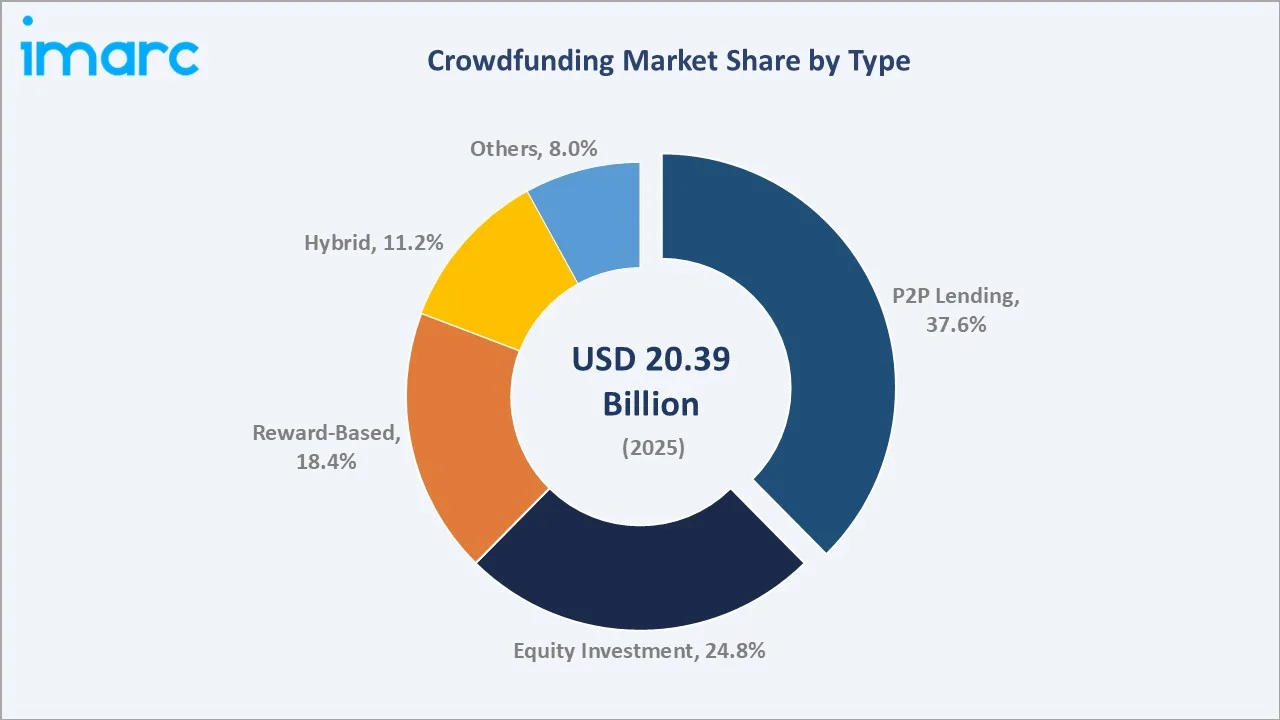
P2P lending leads at 37.6% (2025), representing the largest crowdfunding type by transaction volume through its recurring loan payment structure and institutional adoption. P2P lending platforms match borrower credit needs with lender yield-seeking capital, generating transaction volumes that reflect both initial loan disbursements and ongoing loan book management.
To access detailed market analysis, Request Sample
Equity investment at 24.8%, growing at ~11.8% CAGR, represents the fastest-growing type, driven by regulatory expansions enabling retail equity crowdfunding at meaningful scales. Reward-based at 18.4% represents the market's most culturally prominent model through global brand recognition in technology hardware, creative projects, and social innovation. Hybrid at 11.2% encompasses platforms combining elements that address specific campaign creator and investor preference combinations. Others at 8.0% include donation-based crowdfunding and emerging model variants.
By End Use
Entrepreneurship dominates at 28.5% (2025), encompassing startup and SME capital raising across reward, equity, and lending crowdfunding types. Technology at 18.7% reflects the strong affinity between the digitally native technology sector and crowdfunding's digital infrastructure, social community validation mechanisms, and alignment with tech audiences. Real estate at 14.2% has emerged as a major crowdfunding category as platforms make fractional real estate investment accessible to retail investors.
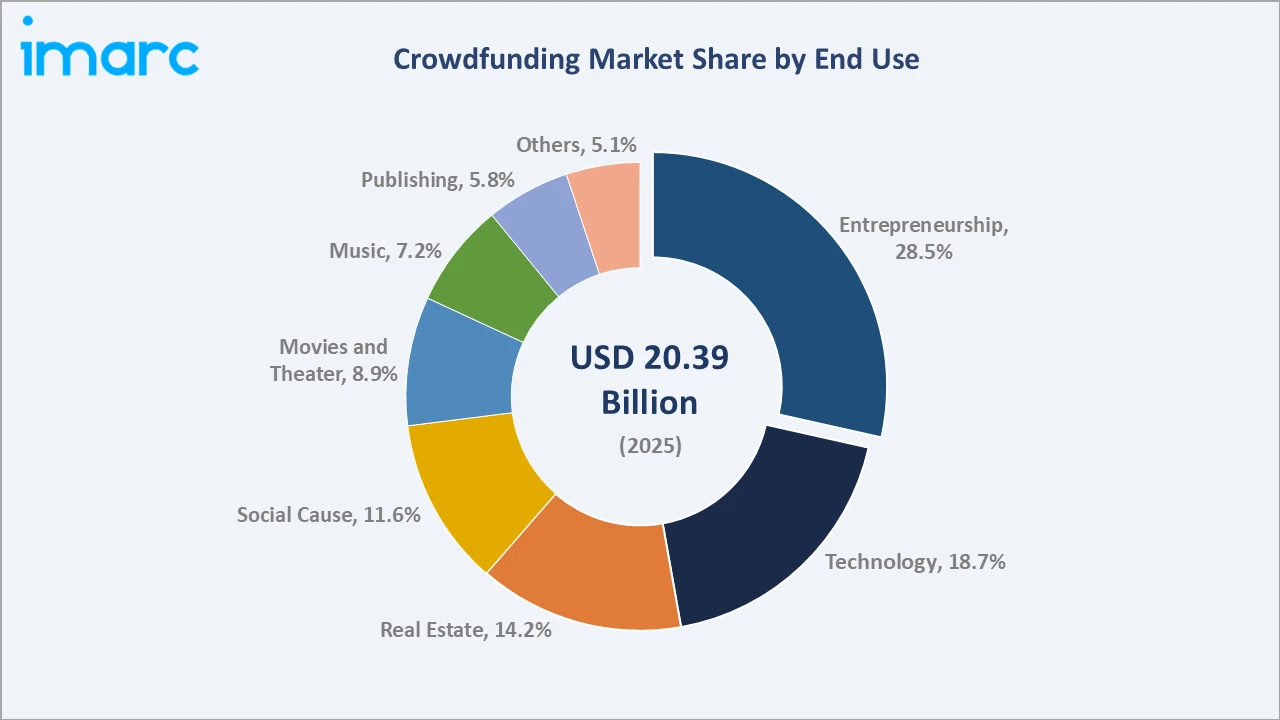
Social cause at 11.6% encompasses personal campaigns for medical expenses, disaster relief, and community needs. Movies and theater at 8.9% include film campaigns and theatrical production funding, representing the creative industry's use of crowdfunding as both capital and audience validation. Music at 7.2%, publishing at 5.8%, and others at 5.1% round out the end-use distribution.
Regional Market Insights
|
Region |
Share (2025) |
Key Crowdfunding Market Drivers & Characteristics |
|
Europe |
31.4% |
Strong regulatory framework, widespread adoption of crowdfunding platforms, high SME financing demand, and growing retail investor participation support market leadership. |
|
North America |
29.6% |
Mature crowdfunding ecosystem, favorable fundraising regulations, strong startup culture, and high digital payment adoption drive market growth. |
|
Asia-Pacific |
25.8% |
Rapid digitalization, expanding fintech ecosystem, increasing entrepreneurial activity, and rising internet penetration accelerate crowdfunding adoption. |
|
Latin America |
7.1% |
Growing financial inclusion, increasing demand for alternative financing, and expanding fintech platforms support steady market expansion. |
|
Middle East and Africa |
6.1% |
Emerging startup ecosystems, improving digital infrastructure, supportive government initiatives, and increasing investment in fintech contribute to market growth. |
Europe's 31.4% is supported by a harmonized regulatory framework, widespread platform adoption, and strong demand for alternative SME financing. North America at 29.6% follows closely, benefiting from a mature startup ecosystem, favorable fundraising regulations, and high participation from retail and accredited investors.
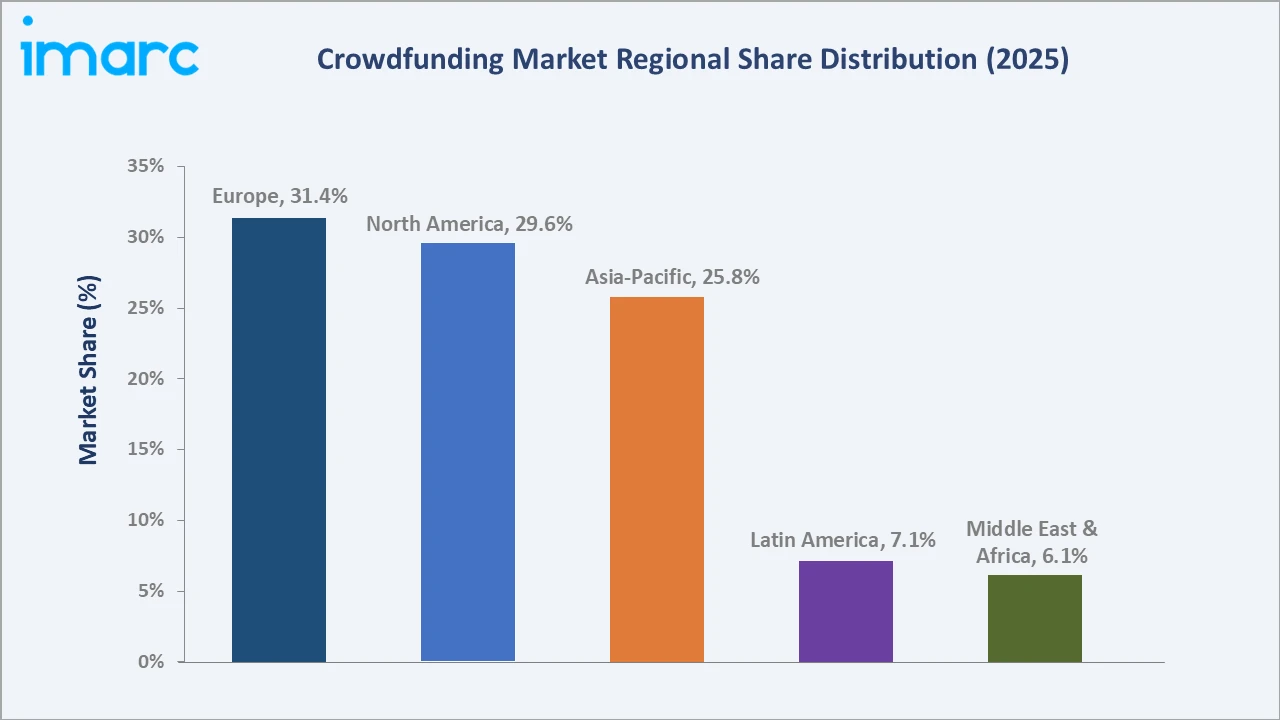
Asia-Pacific at 25.8%, growing at ~12.3% CAGR, is the market's most dynamic region, expanding rapidly due to rising internet penetration, fintech innovation, and growing entrepreneurial activity. China, India, Japan, South Korea, and Southeast Asian countries are contributing to regional platform development. Latin America, at 7.1%, is witnessing steady growth as crowdfunding improves financial inclusion and access to capital for small businesses. The Middle East and Africa, at 6.1%, remain emerging markets but offer significant long-term potential.
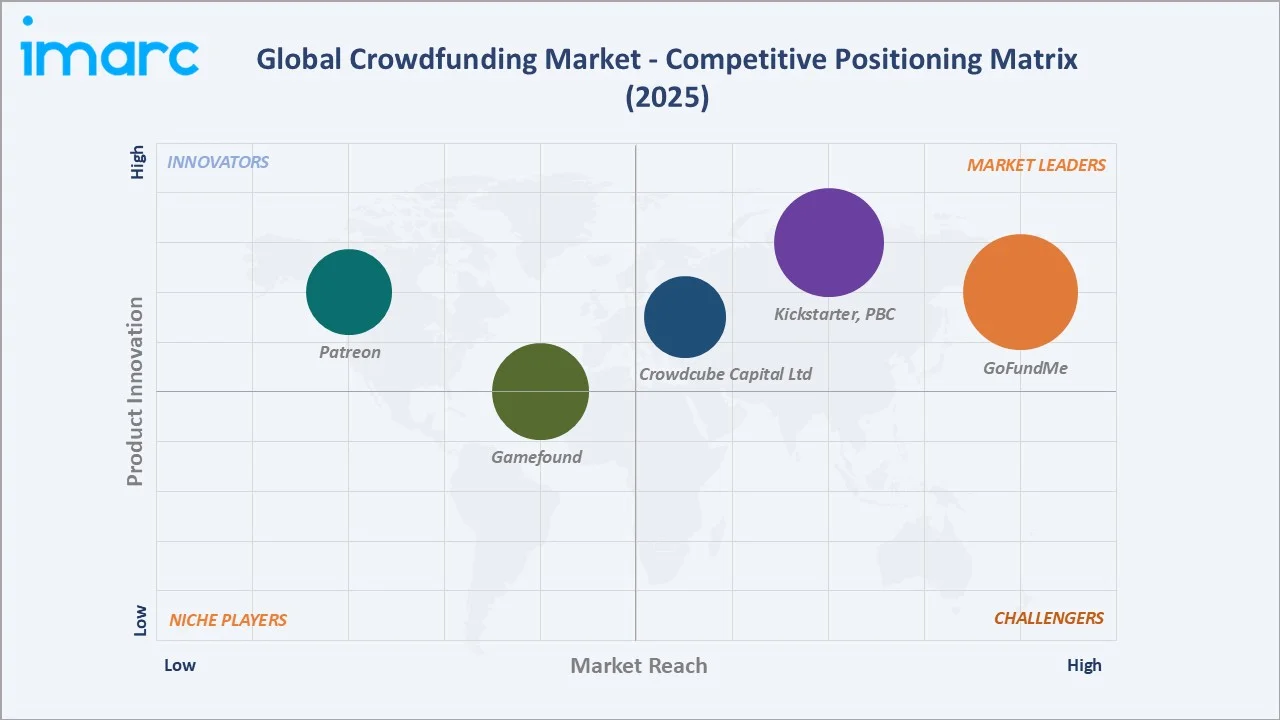
Competitive Landscape
The global crowdfunding market is fragmented at the platform level but increasingly concentrated by type-specific vertical leaders. The competitive landscape is evolving through platform consolidation, vertical specialization, and technology differentiation. International expansion is constrained by regulatory jurisdiction-specific requirements, creating geographic niches where regional platforms maintain competitive advantages over global entrants.
|
Company |
Key Platforms |
Market Position |
Core Strength |
|
GoFundMe |
GoFundMe |
Market Leader |
GoFundMe plays a defining role in the crowdfunding industry as the leading platform for social and charitable fundraising. |
|
Kickstarter, PBC |
Kickstarter |
Market Leader |
Kickstarter, PBC operates as a global rewards-based crowdfunding platform with a legally binding charter to support creative projects. |
|
Gamefound |
Gamefound |
Established Player |
Gamefound is a specialized crowdfunding platform and pledge management tool primarily focused on board games and tabletop projects. |
|
Patreon |
Patreon |
Innovator |
Patreon pioneered subscription-based crowdfunding, replacing the traditional one-off campaign model with an ongoing patronage system. |
|
Crowdcube Capital Ltd |
Crowdcube |
Market Leader |
Crowdcube Capital Ltd operates a leading equity crowdfunding platform that connects startups and growth-stage companies with everyday investors. |
Competition dynamics are shifting from brand and network effects toward technology differentiation as AI-powered campaign optimization, investor matching algorithms, and fraud detection capabilities become significant competitive factors. Platforms investing in AI tooling are demonstrating measurably superior campaign success rates and investor outcomes, creating data-driven competitive moats that complement scale-based advantages.
Key Company Profiles
GoFundMe
GoFundMe is one of the leading crowdfunding companies, specializing in personal, charitable, medical, emergency relief, education, and nonprofit fundraising campaigns. The platform enables individuals and organizations to raise funds through online donations from a global community of supporters. With millions of campaigns hosted across various countries, the company leverages a user-friendly digital platform, secure payment processing, and extensive social sharing features to strengthen its position in the global crowdfunding market.
- Key Platforms: GoFundMe.
- Key Developments: In March 2026, GoFundMe launched an AI-powered smart fundraising coach to help users create, promote, and manage campaigns more effectively. Drawing insights from millions of fundraisers on the platform, the tool provides personalized guidance to improve campaign confidence, engagement, and fundraising outcomes.
- Strategic Focus: Expanding its leadership in donation-based crowdfunding by enhancing user experience, strengthening trust and security, and integrating AI-driven tools to improve campaign discovery and fraud prevention.
Kickstarter, PBC
Kickstarter, PBC is one of the leading reward-based crowdfunding companies, connecting creators with backers to fund creative and innovative projects. The company supports projects across categories such as technology, design, games, film, music, publishing, and art. As a Public Benefit Corporation (PBC), Kickstarter operates with a mission to promote creativity while generating positive social impact. The platform follows an all-or-nothing funding model, helping creators validate ideas, build communities, and secure funding before production.
- Key Platforms: Kickstarter.
- Key Developments: In July 2026, TOZO launched a Kickstarter crowdfunding campaign for its AIVU AI Glasses, a smart eyewear product combining advanced artificial intelligence with practical everyday use. The glasses are designed to emphasize comfort, safety, style, privacy, and user-centered wearable computing.
- Strategic Focus: Strengthening its position in reward-based crowdfunding by enhancing creator tools, improving campaign discovery, and expanding global access to creative fundraising. The company is investing in platform innovation, community engagement, and AI-enabled features while supporting creative entrepreneurs through secure, transparent, and creator-centric funding solutions.
Market Concentration Analysis
The global crowdfunding market is moderately fragmented at the platform level, with no single company commanding dominant global market share across all crowdfunding types. Vertical-specific concentration is higher: GoFundMe holds overwhelming market share in personal/social cause fundraising; Kickstarter dominates reward-based crowdfunding; Patreon leads creator subscriptions. The largest crowdfunding type, P2P lending, is served by a diverse set of regional players rather than any single global dominant platform, reflecting the jurisdiction-specific regulatory requirements and credit underwriting knowledge that sustain regional competitive advantages. Market concentration is expected to increase modestly through 2034 as technology investment requirements, regulatory compliance costs, and scale advantages in AI-powered matching and credit scoring create economic moats that disadvantage smaller platforms.
Investment & Growth Opportunities
Highest Growth Segments
Equity investment type (~11.8% CAGR), technology end use (~11.6% CAGR), Asia-Pacific region (~12.3% CAGR), real estate crowdfunding sub-segment, and emerging market MSME P2P lending represent the crowdfunding market's highest-growth investment vectors through 2034.
Investment Themes
- Emerging market P2P MSME lending platform investment: Investors are increasingly funding P2P lending platforms that provide faster and more accessible financing to micro, small, and medium-sized enterprises (MSMEs) in underserved markets. This trend supports financial inclusion while expanding alternative lending opportunities through digital platforms.
- Blockchain-enabled crowdfunding secondary market infrastructure: Investment is growing in blockchain-based infrastructure that enables secure, transparent, and efficient trading of crowdfunding-backed securities in secondary markets. This improves liquidity for investors, enhances transaction transparency, and broadens long-term participation in crowdfunding ecosystems.
Future Market Outlook (2026-2034)
The global crowdfunding market is projected to grow from USD 20.39 Billion in 2025 to USD 52.27 Billion by 2034, delivering a 10.47% CAGR, reflecting the structural demand for alternative financing that grows as traditional financial institution underserved populations continue to grow in absolute number despite overall financial inclusion improvements, supplemented by the growing cultural acceptance of crowdfunding as a legitimate financing and investment mechanism across all economic cohorts globally. The anchor value is USD 33.56 Billion in 2030, reflecting the compounding effect of regulatory framework maturation, platform technology improvement, and geographic market expansion across Asia-Pacific and Latin America.
Three structural forces will define the crowdfunding market trajectory through 2034. First, regulatory maturation across additional global jurisdictions will progressively expand the addressable market for equity and P2P lending crowdfunding types by enabling retail investor participation in markets currently restricted to accredited investors or informal fundraising. Second, the intersection of crowdfunding and the creator economy will generate a structural demand wave that extends crowdfunding's cultural relevance beyond its traditional financing and investment context into an ongoing relationship economy where fans finance the creative output they want to exist. Third, Asia-Pacific's growing digital economy infrastructure makes Asia-Pacific the market's most important growth driver through 2034. China's controlled P2P lending recovery under new regulatory frameworks, India's equity crowdfunding regulation development, and Southeast Asia's fintech hub deepening will collectively make Asia-Pacific the largest crowdfunding region.
Research Methodology
Primary Research
Primary research comprised in-depth interviews with crowdfunding platform executives, campaign creators from reward-based and equity crowdfunding platforms, retail and accredited investor participants, regulatory affairs specialists, and independent alternative finance and fintech market analysts. These discussions validated market size estimates, assessed platform volume trends, evaluated regulatory framework developments, and provided insights into platform technology evolution, investor behavior trends, and geographic market development across Europe, North America, Asia-Pacific, and emerging markets.
Secondary Research
Secondary research encompassed annual summary reports, investment-based crowdfunding market report publications, implementation documentation, global alternative finance benchmarking reports, platform press releases and investor relations disclosures, financial inclusion reports, and credible market intelligence sources.
Forecasting Models
Forecasting models were developed using historical crowdfunding market data, regulatory expansion scenario modeling, platform user base and transaction volume growth trajectories, creator economy growth projections, real estate crowdfunding product adoption curves, and emerging market digital finance penetration rates. Both top-down and bottom-up approaches were validated through primary research. Market projections incorporated technology-driven platform efficiency improvement, consolidation effects, and geographic expansion scenarios to generate reliable forecasts through 2034.
Crowdfunding Market Report Scope:
| Report Features | Details |
|---|---|
| Base Year of the Analysis | 2025 |
| Historical Period | 2020-2025 |
| Forecast Period | 2026-2034 |
| Units | Billion USD |
| Scope of the Report | Exploration of Historical Trends and Market Outlook, Industry Catalysts and Challenges, Segment-Wise Historical and Future Market Assessment:
|
| Types Covered | P2P Lending, Equity Investment, Hybrid, Reward-based, Others |
| End Uses Covered | Entrepreneurship, Social Cause, Movies and Theater, Real Estate, Music, Technology, Publishing, Others |
| Regions Covered | Asia Pacific, Europe, North America, Latin America, Middle East and Africa |
| Countries Covered | United States, Canada, Germany, France, United Kingdom, Italy, Spain, Russia, China, Japan, India, South Korea, Australia, Indonesia, Brazil, Mexico |
| Companies Covered | GoFundMe, Kickstarter, PBC, Gamefound, Patreon, Crowdcube Capital Ltd, etc. |
| Customization Scope | 10% Free Customization |
| Post-Sale Analyst Support | 10-12 Weeks |
| Delivery Format | PDF and Excel through Email (We can also provide the editable version of the report in PPT/Word format on special request) |
Key Benefits for Stakeholders:
- IMARC’s industry report offers a comprehensive quantitative analysis of various market segments, historical and current market trends, market forecasts, and dynamics of the crowdfunding market from 2020-2034.
- The research report provides the latest information on the market drivers, challenges, and opportunities in the global crowdfunding market.
- The study maps the leading, as well as the fastest-growing, regional markets. It further enables stakeholders to identify the key country-level markets within each region.
- Porter's five forces analysis assists stakeholders in assessing the impact of new entrants, competitive rivalry, supplier power, buyer power, and the threat of substitution. It helps stakeholders to analyze the level of competition within the crowdfunding industry and its attractiveness.
- The competitive landscape allows stakeholders to understand their competitive environment and provides insight into the current positions of key players in the market.
Frequently Asked Questions About the Crowdfunding Market Report
The global crowdfunding market reached USD 20.39 Billion in 2025, driven by real estate crowdfunding, mergers creating the largest equity CF marketplace, and creator subscriptions.
The market grows at 10.47% CAGR during 2026-2034, reaching USD 52.27 Billion by 2034. The CAGR reflects regulatory expansion enabling new market participation, Asia-Pacific growing at ~12.3% CAGR, equity investment growing at ~11.8% CAGR, creator economy subscription growth, and emerging market MSME P2P lending scaling.
P2P lending leads at 37.6% (2025) through recurring loan transaction volume and institutional adoption on emerging market MSME platforms.
Entrepreneurship dominates at 28.5% (2025), encompassing startup and SME capital raising across reward, equity, and lending crowdfunding types, addressing the global MSME financing gap.
Europe leads at 31.4% (2025) through regulatory harmonization enabling pan-European campaigns, UK P2P lending depth, and German and French equity CF growth.
Leading companies include GoFundMe, Kickstarter, PBC, Gamefound, Patreon, and Crowdcube Capital Ltd, among others.
The market is projected to reach approximately USD 33.56 Billion by 2030, driven by EU deployment enabling pan-European equity CF scale, Asia-Pacific P2P lending and equity CF market regulatory development, real estate AUM expansion, creator economy scaling, and AI-powered campaign optimization improving success rates globally.
Top opportunities include emerging market MSME P2P lending with high demand and growing digital infrastructure, blockchain-enabled crowdfunding secondary market infrastructure solving equity investment illiquidity, climate-tech equity CF enabling impact investor community building alongside capital raising, real estate crowdfunding product innovation for Asia-Pacific, and AI-powered crowdfunding platform tools enabling higher campaign success rates and improved investor-campaign matching.
Need more help?
- Speak to our experienced analysts for insights on the current market scenarios.
- Include additional segments and countries to customize the report as per your requirement.
- Gain an unparalleled competitive advantage in your domain by understanding how to utilize the report and positively impacting your operations and revenue.
- For further assistance, please connect with our analysts.
 Request Customization
 Speak to an Analyst
 Request Brochure
 Inquire Before Buying
Benefits of Customization
- Personalize this research
- Triangulate with your data
- Get data as per your format and definition
- Gain a deeper dive into a specific application, geography, customer, or competitor
- Any level of personalization
Get in Touch With Us
UNITED STATES
Phone: +1-201-971-6302
INDIA
Phone: +91-120-433-0800
UNITED KINGDOM
Phone: +44-753-714-6104
Email: [email protected]
Client Testimonials




.webp)




.webp)













Related Reports

Choose your plan
*Please note that the prices mentioned below are starting prices for each bundle type. Kindly contact our team for further details.*
Single User License
- 1 User License, Access on 2 Devices
- PDF Report + Excel Dataset (Password Protected)
- Lifetime Access
- No Printing Rights
- 10% Free Report Customization
- 10–12 Weeks of Analyst Support
Five User License
- Access for 5 Users, 2 Devices per User
- PDF Report + Excel Dataset (Password Protected)
- Lifetime Access
- Dedicated Account Manager
- 12–14 Weeks of Analyst Support
- No Printing Rights
- 15% Free Report Customization
- 25% Discount on Your Next Purchase
Corporate User License
- Unlimited User Access (Within Your Organization)
- PDF Report + Excel Dataset
- Lifetime Access
- Dedicated Account Manager
- 14–20 Weeks of Analyst Support
- No Printing Rights
- 20% Free Report Customization
- 30% Discount on Your Next Purchase
Essential Insights
What's included:
3 reports
- Lifetime Access
- PDF Reports
- Excel Datasets
- 2 Weeks of Free Analyst Support
- 2 User Licenses
- Access on 2 Devices
- Printing Rights
- Complimentary PowerPoint (PPT) Version
- Complimentary License Upgrade
Professional Access
What's included:
5 reports
- Lifetime Access
- PDF Reports
- Excel Datasets
- 8 Weeks of Free Analyst Support
- 2 User Licenses
- Access on 2 Devices
- Printing Rights
- Complimentary PowerPoint (PPT) Version
- Complimentary License Upgrade
Business Advantage
What's included:
8 reports
- Lifetime Access
- PDF Reports
- Excel Datasets
- 14 Weeks of Free Analyst Support
- 2 User Licenses
- Access on 2 Devices
- Printing Rights
- Complimentary PowerPoint (PPT) Version
- Complimentary License Upgrade
Enterprise Intelligence
What's included:
10 reports
- Lifetime Access
- PDF Reports
- Excel Datasets
- 20 Weeks of Free Analyst Support
- 2 User Licenses
- Access on 2 Devices
- Printing Rights
- Complimentary PowerPoint (PPT) Version
- Complimentary License Upgrade