
Customized Premixes Market Size, Share, Trends and Forecast by Nutrient Type, Form, Function, Application, and Region, 2026-2034
Customized Premixes Market Size and Share:
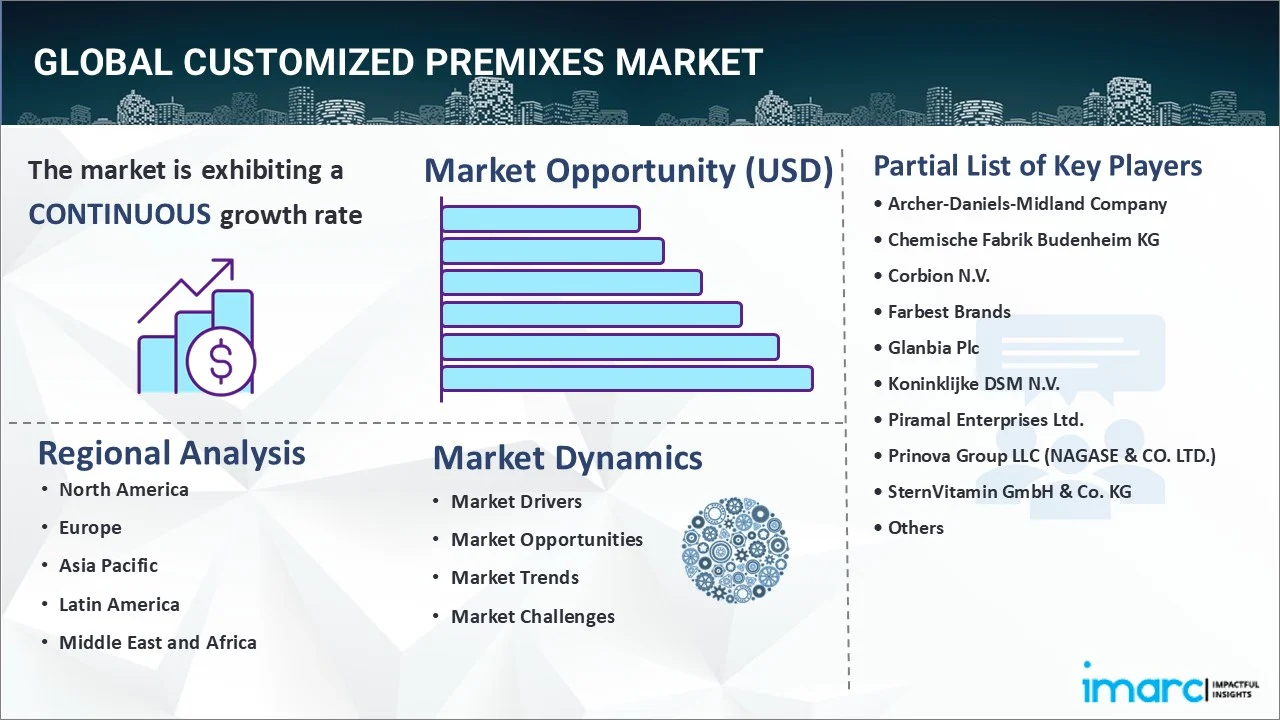
The global customized premixes market size was valued at USD 1.96 Billion in 2025. Looking forward, IMARC Group estimates the market to reach USD 2.93 Billion by 2034, exhibiting a CAGR of 4.32% from 2026-2034. North America currently dominates the market, holding a market share of 38.7% in 2025. The region benefits from advanced food processing infrastructure, stringent regulatory frameworks mandating nutritional fortification, and high per-capita dietary supplement consumption driven by rising health awareness among the aging population, contributing to the customized premixes market share.
Rising global awareness about preventive healthcare and nutritional deficiency has significantly accelerated the market growth across food and beverage (F&B), dietary supplement, and pharmaceutical manufacturing sectors. Regulatory bodies in multiple countries have strengthened mandatory fortification standards, compelling producers to integrate precise blends of vitamins, minerals, and bioactive compounds into staple food products. The increasing prevalence of micronutrient deficiency among vulnerable populations worldwide has amplified the need for scalable, cost-effective premix formulations. Rising disposable incomes in emerging economies are expanding consumer access to functional food and supplement products, broadening the addressable market for premix suppliers. The global aging demographic continues to drive demand for preventive nutrition solutions enriched with bone health, immunity, and energy-supporting micronutrients, fueling the customized premixes market growth.
The United States has emerged as a major region in the customized premixes market owing to many factors. The country benefits from a highly developed regulatory environment for dietary supplements and fortified foods governed by the Food and Drug Administration, which establishes rigorous standards for nutrient inclusion and product labeling. High per-capita disposable income sustains robust consumer spending on premium functional food and supplement products. In the United States, the per-capita disposable income reached USD 67494.00000 in October 2025, according to the United States Federal Reserve. Growing health-consciousness among American adults, particularly millennials and the aging baby boomer population, continues to reinforce demand for fortified F&B products, incorporating customized premix solutions. A robust domestic food manufacturing sector and well-established distribution networks further enable large-scale integration of premix formulations across food categories.
To get more information on this market Request Sample
Customized Premixes Market Trends:
Rising Demand for Functional and Fortified Foods
The increasing consumer inclination towards health-supporting food products has emerged as a prominent driver shaping the customized premixes industry. As vitamin and mineral deficiencies affect a substantial proportion of the global population, food manufacturers face growing pressure to fortify products with targeted nutrient profiles. Customized premixes enable producers to deliver precise combinations of vitamins, minerals, and bioactive compounds within staple food categories, including cereals, dairy alternatives, and infant nutrition products. The global shift in consumer behavior from disease treatment towards preventive wellness has amplified demand for nutrient-enriched daily food options across both emerging and developed markets, particularly as per-capita disposable incomes continue to rise. Fortification initiatives supported by international health organizations have provided clear frameworks that make premix adoption commercially viable and publicly beneficial.
Growing Adoption of Personalized Nutrition
The shift towards individualized dietary solutions has introduced significant momentum into the customized premixes market trends. As per IMARC Group, the global personalized nutrition and supplements market size was valued at USD 14.14 Billion in 2024. Consumers globally are increasingly seeking products tailored to their specific health requirements, spanning age group, lifestyle, and targeted outcomes, including weight management, cognitive function, and sports performance optimization. This personalization trend has encouraged premix manufacturers to develop highly specific formulations meeting distinct consumer health profiles. Digital health platforms and wearable technologies tracking nutritional intake and biometric data enable consumers and healthcare practitioners to identify individual deficiency patterns, generating more precise and evidence-based premix demand. The direct-to-consumer (D2C) nutrition segment has expanded rapidly, with personalized supplement services integrating customized premix inputs to deliver targeted health outcomes for individual consumers.
Technological Advancements in Premix Formulation
Ongoing innovations in food processing technologies are reshaping the development and application of customized premix solutions, with advancements in microencapsulation, spray-drying, and controlled-release delivery systems significantly improving nutrient stability and bioavailability. These technological developments address longstanding formulation challenges related to ingredient interaction, heat sensitivity, and organoleptic impact, enabling manufacturers to incorporate a broader range of bioactive compounds without compromising product quality. The integration of artificial intelligence (AI) and digital formulation tools into research and development (R&D) is accelerating the creation of precision premix solutions tailored to specific consumer needs. Blockchain-based supply chain traceability technologies are further enhancing quality assurance and ingredient source verification, strengthening confidence among both manufacturers and consumers. Positive customized premixes market forecast indicators continue to reflect the commercial appeal of technologically advanced premix solutions across functional food, pharmaceutical, and clinical nutrition segments.
Customized Premixes Industry Segmentation:
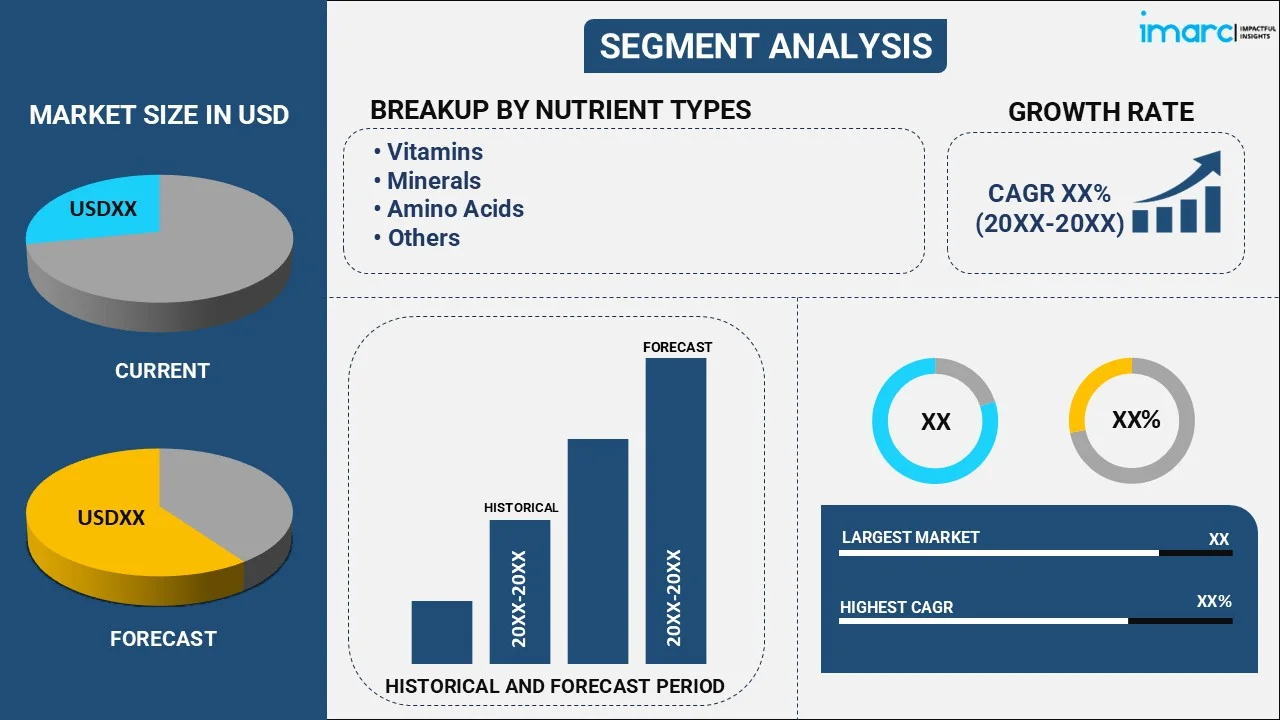
IMARC Group provides an analysis of the key trends in each segment of the global customized premixes market, along with forecast at the global, regional, and country levels from 2026-2034. The market has been categorized based on nutrient type, form, function, and application.
Analysis by Nutrient Type:
To get detailed segment analysis of this market Request Sample
- Vitamins
- Minerals
- Amino Acids
- Nucleotides
- Nutraceuticals
- Others
Vitamins hold 29.8% of the market share, owing to their fundamental role in supporting metabolic functions, immune health, energy production, and cellular maintenance across all population groups. The extensive range of applicable vitamin types, spanning fat-soluble forms including A, D, E, and K and water-soluble B-complex vitamins and vitamin C, enables premix manufacturers to design precise, targeted formulations across diverse food application categories. Institutional demand for vitamin-enriched premixes is particularly robust in infant formula, fortified flour, breakfast cereals, and dairy product segments, where regulatory standards and consumer expectations necessitate exact dosing. The centrality of vitamins in addressing widespread deficiency conditions reinforces their foundational role in both commercial and humanitarian food fortification programs globally. Additionally, the growing emphasis on preventive healthcare and nutritional fortification is further driving the incorporation of vitamin premixes across a wide range of processed F&B products.
Analysis by Form:
- Powder
- Liquid
Powder leads the market with a share of 58.3% because of its exceptional stability, long shelf life, ease of precise dosing, and suitability for a variety of food production methods. Powder premixes are easily incorporated into dry blending, spray-drying, and extrusion-based production lines that are frequently utilized in the production of infant formula, dairy powder, cereal, and baked goods. They are the preferred option for large-scale food manufacturers and contract producers worldwide due to their stability under ambient storage conditions and simplicity of handling and transportation when compared to liquid options. Because powder premixes are so versatile, they can be used to a wide range of nutrient categories, such as vitamins, minerals, amino acids, and nutraceuticals. This allows producers to satisfy complex multi-nutrient fortification requirements in a single production step.
Analysis by Function:
- Bone Health
- Skin Health
- Energy
- Immunity
- Digestion
- Others
Energy dominates the market, with a share of 27.9%, driven by robust global demand for energy-supporting nutritional solutions across sports nutrition, functional food, and daily wellness supplement categories. Energy premixes typically incorporate B-vitamins, iron, coenzyme Q10, magnesium, and adaptogenic compounds that support cellular energy metabolism, reduce fatigue, and enhance physical and cognitive performance. Consumer interest in sustained energy management without stimulant-dependent products has expanded demand for science-backed micronutrient-based energy formulations. Positive customized premixes market outlook metrics across the energy function segment reflect growing integration into mainstream functional food formats, including energy bars, fortified cereals, and performance beverages. The broadening consumer demographic seeking energy support, spanning working adults, athletes, and the aging population, continues to reinforce this segment's leadership position. As per the United Nations Organization, by the mid-2030s, there will be 265 Million people aged 80 and above, surpassing the number of infants.
Analysis by Application:
- Food and Beverages
- Dietary Supplements
- Nutrition Products
- Others
Food and beverages represent the leading segment, with a market share of 36.4%, reflecting the extensive reliance of food and beverage manufacturers on premix-based fortification to meet both regulatory requirements and consumer health expectations. Premix solutions are integral to the production of fortified staple foods, including wheat flour, rice, breakfast cereals, dairy beverages, plant-based milk alternatives, and infant formula. Growing consumer awareness about the importance of micronutrient adequacy in daily diet has encouraged food manufacturers to proactively fortify mainstream products with targeted vitamin and mineral premixes. International regulatory frameworks, including mandatory fortification programs implemented across Asia-Pacific, Africa, and Latin America, continue to generate institutional demand for food-grade premix formulations. In August 2025, the Government of India's Union Cabinet formally approved the continuation of the Fortified Rice initiative through December 2028, reinforcing large-scale governmental demand for vitamin and mineral premix solutions within major food staple programs.
Regional Analysis:
To get more information on the regional analysis of this market Request Sample
- North America
- United States
- Canada
- Asia-Pacific
- China
- Japan
- India
- South Korea
- Australia
- Indonesia
- Others
- Europe
- Germany
- France
- United Kingdom
- Italy
- Spain
- Russia
- Others
- Latin America
- Brazil
- Mexico
- Others
- Middle East and Africa
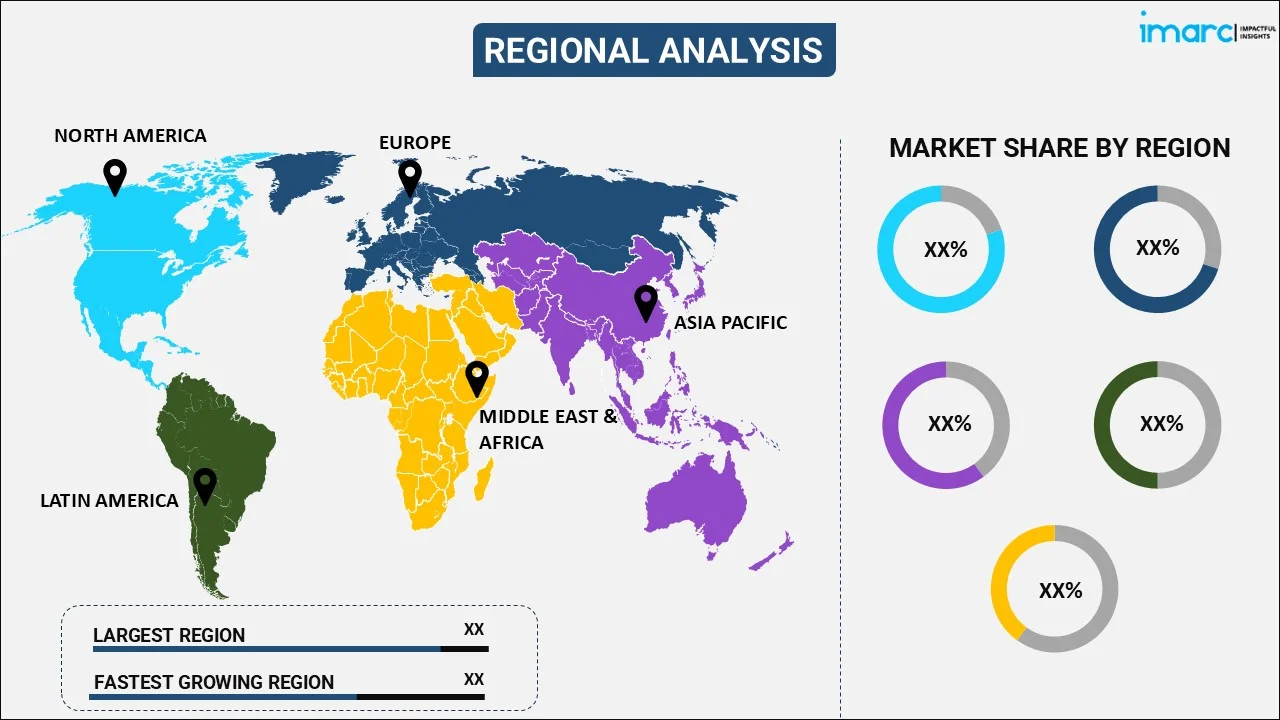
North America, accounting for 38.7% of the share, enjoys the leading position in the market. North America's dominance in the market is underpinned by a highly advanced food manufacturing ecosystem, strong per-capita nutritional supplement expenditure, and a well-established regulatory infrastructure administered by the United States Food and Drug Administration and Health Canada. The region's F&B industry has extensively integrated premix-based fortification solutions into product development, supported by favorable consumer acceptance of functional and nutrient-enriched products. The growing prevalence of lifestyle diseases, including obesity, type 2 diabetes, and cardiovascular disorders, has intensified demand for preventive nutrition solutions incorporating targeted micronutrient premixes. The region also benefits from an extensive network of premix suppliers, contract manufacturers, and ingredient distributors enabling rapid scale-up of formulations. In June 2024, the Government of Canada announced an investment of more than USD 11 Million to support healthy eating initiatives and food security programs, underscoring the regional governmental commitment to nutritional enhancement.
Key Regional Takeaways:
United States Customized Premixes Market Analysis
The United States represents a significant market within the customized premixes landscape, driven by a combination of advanced food processing capabilities, strong regulatory standards, and high per-capita functional food consumption. The Food and Drug Administration oversees rigorous labeling and safety compliance requirements for fortified food and dietary supplement products, providing a stable regulatory framework that encourages product innovation and premix integration. American consumers exhibit strong awareness of and willingness to spend on health-optimizing nutritional products, spanning functional beverages, protein bars, and daily vitamin supplements. The rapid growth of D2C health and wellness brands has created additional demand for customized premix inputs meeting individualized nutritional targets. Food manufacturers across the country increasingly rely on premix suppliers to streamline production processes and maintain dosing consistency across large-scale manufacturing runs. According to World Bank data published in 2024, 18% of the United States population was aged 65 years or older, driving robust demand for bone health, immunity, and energy-supporting premix formulations among the aging demographic. This aging trend is expected to sustain premium segment demand throughout the forecast horizon.
Europe Customized Premixes Market Analysis
The Europe customized premixes market is shaped by rigorous regulatory oversight from the European Food Safety Authority, which establishes maximum permissible levels and approved compound lists for vitamins and minerals in food products. European consumers demonstrate strong demand for clean-label, sustainably sourced, and minimally processed food products, influencing premix manufacturers to develop formulations aligned with these preferences. The region's well-developed food processing industry, particularly in Germany, France, the United Kingdom, Italy, and Spain, provides a large addressable market for premix-based fortification solutions. Growing awareness about micronutrient deficiency in aging European populations, combined with expanding plant-based food product categories, is broadening demand for tailored premix applications. Rising interest in sports nutrition and premium functional food formats is further stimulating innovation in European premix formulations across diverse product categories.
Asia-Pacific Customized Premixes Market Analysis
The Asia-Pacific region constitutes a significant and rapidly growing segment of the global customized premixes market, supported by large-scale government-driven food fortification mandates across India, China, Japan, and South Korea. The region's vast population base, increasing urbanization, and rising middle-class incomes contribute to expanding demand for functional foods, infant formula, and dietary supplement products incorporating premix solutions. By 2036, 600 million people, or 40% of India’s population, will reside in towns and cities, an increase from 31% in 2011, with urban regions delivering nearly 70% of GDP. Government nutrition programs targeting micronutrient deficiency among rural and vulnerable populations generate sustained institutional demand for cost-effective premix formulations. Japan's developed functional food sector and China's rapidly broadening dietary supplement industry further reinforce regional market expansion.
Latin America Customized Premixes Market Analysis
Latin America represents a growing market for customized premixes, driven by expanding food processing industries in Brazil and Mexico, rising consumer awareness about nutritional supplementation, and increasing government food fortification programs. The mandatory fortification of wheat and corn flour with iron and folic acid across several Latin American countries has created consistent institutional demand for premix formulations. Additionally, the rising demand for fortified beverages, dairy products, and bakery items is encouraging food manufacturers to incorporate customized premixes to enhance the nutritional profile of their product offerings.
Middle East and Africa Customized Premixes Market Analysis
The Middle East and Africa region presents emerging opportunities for customized premix suppliers, driven by growing food fortification initiatives, expanding food manufacturing investments, and rising government attention to nutritional security across the region. International development organizations continue to support premix-enabled fortification programs targeting vitamin and mineral deficiency in vulnerable population groups. In March 2025, Egypt launched a National Flour Fortification Program, mandating the fortification of wheat flour with essential vitamins and minerals, creating a direct government-driven demand channel for customized premix formulations and establishing a precedent for broader regional adoption.
Competitive Landscape:
The global customized premixes market exhibits a moderately consolidated competitive structure, with established multinational ingredient companies competing alongside specialized regional premix manufacturers. Participants differentiate on formulation expertise, ingredient quality, regulatory compliance, and the ability to offer tailored technical advisory services to food and supplement manufacturers. Leading companies are actively investing in R&D activities to create premix solutions aligned with evolving consumer trends, including personalized nutrition, clean-label formulation, and plant-based product development. Strategic mergers, acquisitions, and cross-sector partnerships have emerged as prominent competitive strategies, enabling players to expand their geographic footprints, diversify ingredient portfolios, and strengthen manufacturing capabilities across key markets. The capacity to provide consistent product quality alongside regulatory and technical support has become a key differentiator, as food manufacturers increasingly prefer premix suppliers capable of delivering end-to-end formulation and compliance solutions.
The report provides a comprehensive analysis of the competitive landscape in the customized premixes market with detailed profiles of all major companies, including:
- Archer-Daniels-Midland Company
- Chemische Fabrik Budenheim KG
- Corbion N.V.
- Farbest Brands
- Glanbia Plc
- Koninklijke DSM N.V.
- Piramal Enterprises Ltd.
- Prinova Group LLC (NAGASE & CO. LTD.)
- SternVitamin GmbH & Co. KG
- Utrix S.A.L
- Vitablend Netherlands B.V.
- Wright Enrichment Inc.
Customized Premixes Market Report Scope:
| Report Features | Details |
|---|---|
| Base Year of the Analysis | 2025 |
| Historical Period | 2020-2025 |
| Forecast Period | 2026-2034 |
| Units | Billion USD |
| Scope of the Report |
Exploration of Historical Trends and Market Outlook, Industry Catalysts and Challenges, Segment-Wise Historical and Future Market Assessment:
|
| Nutrient Types Covered | Vitamins, Minerals, Amino Acids, Nucleotides, Nutraceuticals, Others |
| Forms Covered | Powder, Liquid |
| Functions Covered | Bone Health, Skin Health, Energy, Immunity, Digestion, Others |
| Applications Covered | Food and Beverages, Dietary Supplements, Nutrition Products, Others |
| Region Covered | North America, Asia-Pacific, Europe, Latin America, Middle East and Africa |
| Countries Covered | United States, Canada, China, Japan, India, South Korea, Australia, Indonesia, Germany, France, United Kingdom, Italy, Spain, Russia, Brazil, Mexico |
| Companies Covered | Archer-Daniels-Midland Company, Chemische Fabrik Budenheim KG, Corbion N.V., Farbest Brands, Glanbia Plc, Koninklijke DSM N.V., Piramal Enterprises Ltd., Prinova Group LLC (NAGASE & CO. LTD.), SternVitamin GmbH & Co. KG, Utrix S.A.L, Vitablend Netherlands B.V., Wright Enrichment Inc., etc. |
| Customization Scope | 10% Free Customization |
| Post-Sale Analyst Support | 10-12 Weeks |
| Delivery Format | PDF and Excel through Email (We can also provide the editable version of the report in PPT/Word format on special request) |
Key Benefits for Stakeholders:
- IMARC’s report offers a comprehensive quantitative analysis of various market segments, historical and current market trends, market forecasts, and dynamics of the customized premixes market from 2020-2034.
- The research study provides the latest information on the market drivers, challenges, and opportunities in the global customized premixes market.
- The study maps the leading, as well as the fastest-growing, regional markets. It further enables stakeholders to identify the key country-level markets within each region.
- Porter’s Five Forces analysis assists stakeholders in assessing the impact of new entrants, competitive rivalry, supplier power, buyer power, and the threat of substitution. It helps stakeholders to analyze the level of competition within the customized premixes industry and its attractiveness.
- Competitive landscape allows stakeholders to understand their competitive environment and provides an insight into the current positions of key players in the market.
Frequently Asked Questions About the Customized Premixes Market Report
The customized premixes market was valued at USD 1.96 Billion in 2025.
The customized premixes market is projected to exhibit a CAGR of 4.32% during 2026-2034, reaching a value of USD 2.93 Billion by 2034.
The customized premixes market is driven by growing global micronutrient deficiency concerns, government-mandated food fortification programs, and rising consumer demand for functional and health-supporting food products. Technological advancements in encapsulation and bioavailability, the expanding aging population, and growing adoption of personalized nutrition solutions further drive sustained market expansion across food, supplement, and pharmaceutical applications.
North America currently dominates the customized premixes market, accounting for a share of 38.7%. The region benefits from advanced food processing infrastructure, stringent regulatory frameworks for nutritional fortification, and high per-capita dietary supplement consumption among health-conscious aging and adult populations.
Some of the major players in the customized premixes market include Archer-Daniels-Midland Company, Chemische Fabrik Budenheim KG, Corbion N.V., Farbest Brands, Glanbia Plc, Koninklijke DSM N.V., Piramal Enterprises Ltd., Prinova Group LLC (NAGASE & CO. LTD.), SternVitamin GmbH & Co. KG, Utrix S.A.L, Vitablend Netherlands B.V., Wright Enrichment Inc., etc.
Need more help?
- Speak to our experienced analysts for insights on the current market scenarios.
- Include additional segments and countries to customize the report as per your requirement.
- Gain an unparalleled competitive advantage in your domain by understanding how to utilize the report and positively impacting your operations and revenue.
- For further assistance, please connect with our analysts.
 Request Customization
 Speak to an Analyst
 Request Brochure
 Inquire Before Buying
Benefits of Customization
- Personalize this research
- Triangulate with your data
- Get data as per your format and definition
- Gain a deeper dive into a specific application, geography, customer, or competitor
- Any level of personalization
Get in Touch With Us
UNITED STATES
Phone: +1-201-971-6302
INDIA
Phone: +91-120-433-0800
UNITED KINGDOM
Phone: +44-753-714-6104
Email: [email protected]
Client Testimonials




.webp)




.webp)













Related Reports

Choose your plan
*Please note that the prices mentioned below are starting prices for each bundle type. Kindly contact our team for further details.*
Single User License
- 1 User License, Access on 2 Devices
- PDF Report + Excel Dataset (Password Protected)
- Lifetime Access
- No Printing Rights
- 10% Free Report Customization
- 10–12 Weeks of Analyst Support
Five User License
- Access for 5 Users, 2 Devices per User
- PDF Report + Excel Dataset (Password Protected)
- Lifetime Access
- Dedicated Account Manager
- 12–14 Weeks of Analyst Support
- No Printing Rights
- 15% Free Report Customization
- 25% Discount on Your Next Purchase
Corporate User License
- Unlimited User Access (Within Your Organization)
- PDF Report + Excel Dataset
- Lifetime Access
- Dedicated Account Manager
- 14–20 Weeks of Analyst Support
- No Printing Rights
- 20% Free Report Customization
- 30% Discount on Your Next Purchase
Essential Insights
What's included:
3 reports
- Lifetime Access
- PDF Reports
- Excel Datasets
- 2 Weeks of Free Analyst Support
- 2 User Licenses
- Access on 2 Devices
- Printing Rights
- Complimentary PowerPoint (PPT) Version
- Complimentary License Upgrade
Professional Access
What's included:
5 reports
- Lifetime Access
- PDF Reports
- Excel Datasets
- 8 Weeks of Free Analyst Support
- 2 User Licenses
- Access on 2 Devices
- Printing Rights
- Complimentary PowerPoint (PPT) Version
- Complimentary License Upgrade
Business Advantage
What's included:
8 reports
- Lifetime Access
- PDF Reports
- Excel Datasets
- 14 Weeks of Free Analyst Support
- 2 User Licenses
- Access on 2 Devices
- Printing Rights
- Complimentary PowerPoint (PPT) Version
- Complimentary License Upgrade
Enterprise Intelligence
What's included:
10 reports
- Lifetime Access
- PDF Reports
- Excel Datasets
- 20 Weeks of Free Analyst Support
- 2 User Licenses
- Access on 2 Devices
- Printing Rights
- Complimentary PowerPoint (PPT) Version
- Complimentary License Upgrade